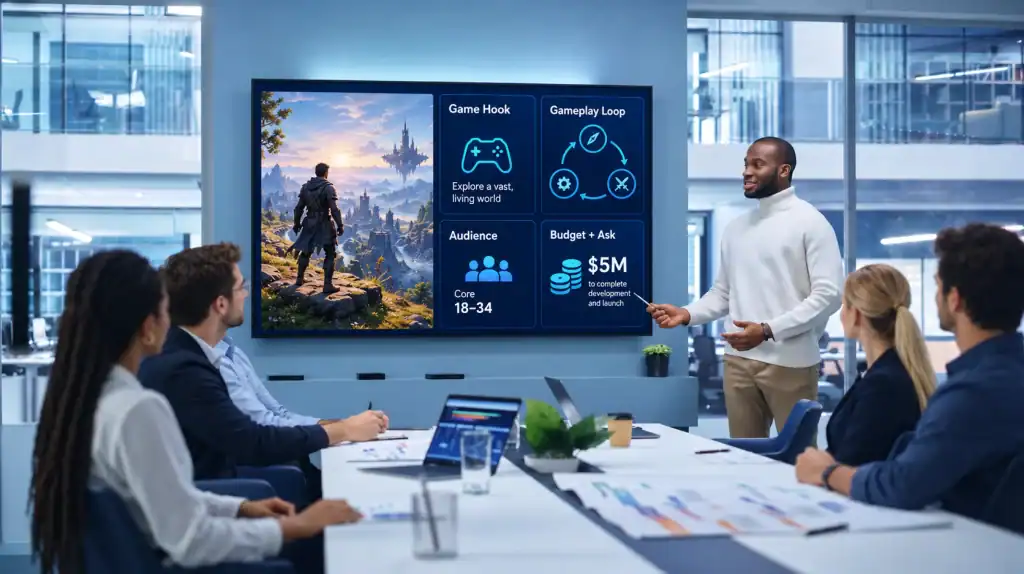
A great game idea can fit into a sentence. Convincing a publisher or investor that it can become a viable product takes much more. The Entertainment Software Association reports that 190.6 million Americans play video games, representing a large potential audience. But reaching that audience requires a clear concept, differentiated gameplay, a defined market, and a credible production plan.
That is what a game pitch deck is designed to communicate. It gives publishers and investors a concise view of the game, its audience, development status, budget, market opportunity, and the funding or publishing support required.
A pitch deck is not a compressed Game Design Document. A GDD explains how the game works in detail; the pitch deck explains why the game is worth backing and what it will take to build and launch it. This guide covers the key elements, from the opening hook and gameplay loop to market research, vertical slices, financial projections, and the final ask.
Key Takeaways
- A game pitch deck should make the game, audience, differentiation, production plan, and commercial opportunity easy to understand.
- Publisher and investor decks share core information but emphasize different risks and evidence.
- The strongest structure moves from hook → gameplay → audience → market → proof → production → financials → team → ask.
- A prototype or vertical slice can provide concrete evidence that the team can execute the core game concept.
- Budgets and financial projections should connect directly to production scope, milestones, and funding requirements.
- A pitch deck should create enough confidence and curiosity for the next conversation rather than attempting to document the entire game.
What Is a Game Pitch Deck?
A game pitch deck is a short, visual presentation used to communicate a game’s concept, gameplay, audience, market position, development status, team, budget, roadmap, and funding or publishing requirements.
A typical video game pitch deck may contain around 10 to 15 slides, although there is no universal slide count. Some game projects need fewer slides, while more complex games may require additional supporting material.
The important question is not “How many slides should a game pitch deck have?”
It is:
Can someone understand the opportunity without you explaining every slide?
A publisher or investor should quickly understand:
- What is the game?
- What does the player actually do?
- Who is it for?
- Why would players choose it?
- What evidence supports the opportunity?
- What has already been built?
- What remains to be built?
- How much will it cost?
- Who is building it?
- What exactly are you asking for?
That makes the deck a decision document rather than a collection of promotional slides.
What a Game Pitch Deck Is Designed to Prove
A useful deck should connect five pieces of evidence:
| Question | Evidence to include |
| What is the game? | High concept, genre, platform, player fantasy |
| Why this game? | USP, gameplay differentiation, visual identity |
| Who will play it? | Target audience, player profile, comparable titles |
| Can the team execute it? | Prototype, vertical slice, shipped work, team credentials |
| What does the project need? | Budget, milestones, funding request, publisher requirements |
If the reader has to guess the answers, the deck is doing unnecessary work.
Game Pitch Deck vs Game Design Document
A game design document (GDD) and a game pitch deck serve different purposes.
| Document | Primary purpose | Typical audience | Typical content |
| Game pitch deck | Present the opportunity | Publishers, investors, partners | Concept, gameplay, audience, market, budget, roadmap |
| GDD | Define the game | Designers and development team | Mechanics, systems, rules, content, progression |
| Technical design document | Define implementation | Engineers and technical teams | Architecture, systems, technical requirements |
Your pitch deck should summarize the systems that matter to the funding or publishing decision. It should not reproduce dozens of pages covering every mechanic, quest, dialogue tree, enemy behavior, or technical specification.
Publisher vs Investor Game Pitch Deck: What Changes?
One of the biggest mistakes in pitching game publishers is assuming every funding audience evaluates a game in exactly the same way.
The same project can require two versions of the deck.
A publisher is evaluating the game as a product it may help bring to market. An investor is more likely to examine the broader business opportunity, monetization model, financial assumptions, scalability, and use of capital.
Unity’s guidance on pitching an indie game makes this distinction particularly clear: publishers are generally familiar with game categories, while investors may need more context around audience potential, comparable games, and the ability to scale.
| Publisher pitch | Investor pitch |
| Game concept and hook | Market opportunity |
| Core gameplay loop | Business model |
| Genre and comparable games | Monetization strategy |
| Prototype or vertical slice | Traction and validation |
| Production scope | Revenue assumptions |
| Development milestones | Financial projections |
| Platform strategy | Distribution and growth |
| Publishing requirements | Use of funds |
| Funding request | Investment case |
The simplest way to think about it is:
Publisher deck: Can this team build a compelling game, and what support is required to bring it to market?
Investor deck: Is there a credible business opportunity here, and does the team have a defensible plan for using capital to pursue it?
What Publishers Want to Understand?
A publisher-facing game pitch deck should make these points easy to find:
- Game concept
- Core gameplay loop
- Genre
- Target platforms
- Target audience
- Unique selling proposition
- Comparable titles
- Development stage
- Prototype or vertical slice
- Team credentials
- Development roadmap
- Budget
- Funding requirement
- Publishing support required
Production risk matters here.
A small premium indie game, a multiplayer mobile title, and a large open-world RPG have very different requirements for engineering, content production, backend infrastructure, QA, localization, certification, and post-launch support.
What Investors Want to Understand
A video game pitch deck to investors needs stronger commercial context.
Depending on the business model, include:
- Market opportunity
- Target audience
- Comparable products
- Monetization model
- Pricing
- Platform strategy
- Player acquisition assumptions
- Retention or engagement signals
- Development budget
- Revenue scenarios
- Funding requirement
- Use of funds
- Team execution capability
That does not mean investors ignore the game or publishers ignore the numbers. The emphasis changes according to the decision being made.
How to Write a Game Pitch Deck: The Slide-by-Slide Structure

A strong game pitch deck outline should feel like a narrative rather than a checklist.
- Start with the game.
- Then explain the experience.
- Then establish the audience and market.
- Then provide evidence.
- Then show how the game will be built.
- Then explain the economics.
- Finally, make the ask.
A practical sequence is:
Hook → Game → Gameplay → Differentiation → Audience → Market → Proof → Roadmap → Budget → Team → Ask
1. Start With the Game’s Hook and High-Concept Pitch
The opening slide has one job: make the reader understand what they are looking at.
Include:
- Game title
- One-line tagline
- Genre
- Primary platform
- Key visual
- Studio name
Then use the next slide to deliver the high-concept pitch.
A strong logline should communicate the player fantasy and core experience without requiring a paragraph of explanation.
For example:
A cooperative survival game where two players rebuild a stranded research station while defending it from creatures attracted by its power systems.
That is more useful than:
An immersive next-generation survival experience featuring innovative mechanics, dynamic environments, and engaging multiplayer gameplay.
The first tells the reader what happens.
The second uses adjectives without establishing a product.
For publisher-facing decks, the opening should also establish enough context for someone to understand the project’s genre, intended audience, and market position quickly. GameDeveloper’s publisher guidance similarly recommends a concise introduction built around the game’s strongest selling points, features, and vision.
2. Explain the Core Gameplay Loop
Once the reader understands the concept, show what the player actually does.
The core gameplay loop can often be represented as:
Player action → feedback → reward/progression → new decision → repeat
Depending on the genre, that could mean:
- Explore → discover resources → upgrade equipment → access new areas
- Fight → earn rewards → improve abilities → face stronger enemies
- Build → optimize production → expand → unlock new systems
- Compete → win matches → earn progression → improve strategy
- Solve → receive information → make a choice → change the narrative
Do not attempt to describe every mechanic.
Focus on the activity that occupies most of the player’s time and creates the repeatable experience.
If your deck says the game revolves around tactical resource management but the demo spends most of its time on real-time combat, the pitch and product are already telling different stories.
3. Define the Unique Selling Proposition
A unique selling proposition (USP) is not simply a feature list.
“50 weapons” is a feature.
“Procedurally generated weapons that change how each class plays” begins to explain differentiation.
Use this framework:
Feature → Player benefit → Differentiation → Evidence
Ask:
- What does the game do differently?
- Why does that difference matter to players?
- Can the difference be demonstrated?
- Does the current build support the claim?
- Would a competing game reasonably make the same claim?
Unity’s publisher guidance makes a similar point: a memorable pitch needs a clear reason to exist and a specific edge that connects to the team behind it.
Your USP should also connect to what your team can actually build. A distinctive mechanic that already exists in a prototype carries more weight than one that exists only in a design document.
Build Evidence Into the Game Pitch Deck
A concept becomes easier to evaluate when the deck contains proof.
That proof does not have to mean millions of views or a finished game.
Depending on the project’s stage, it could be:
- Functional prototype
- Vertical slice
- Gameplay footage
- Playtest findings
- Steam wishlists
- Community growth
- Press coverage
- Previous shipped titles
- Publisher interest
- Relevant production milestones
4. Show the Target Audience and Player Profile
“Everyone who likes games” is not a target audience.
Define the audience through behavior and preferences.
Depending on the project, consider:
- Genre preferences
- Platform
- Age range
- Player motivations
- Session length
- Multiplayer behavior
- Comparable games
- Price sensitivity
- Community interests
For example, instead of:
Our target audience is gamers aged 18–45.
A stronger profile might be:
The primary audience is PC players who regularly play cooperative survival games, value base-building and resource management, and prefer small-group multiplayer sessions.
That statement gives you something to validate against market evidence.
5. Use Market Analysis and Comparable Games Properly
Comparable titles, or comps, help establish where the game sits in the market.
But choosing comps is more than finding three successful games in the same genre.
Compare relevant factors:
| Factor | What it helps establish |
| Genre | Category and player expectations |
| Platform | Distribution environment |
| Price | Commercial positioning |
| Core mechanic | Gameplay overlap and differentiation |
| Visual style | Creative positioning |
| Audience | Potential player overlap |
| Release model | Premium, F2P, Early Access, subscription, etc. |
| Commercial evidence | Context for projections |
Use comparable titles that resemble the proposed game in meaningful ways.
A small premium indie game should not build its entire financial case around the revenue of a massive AAA franchise. The scale, marketing budget, brand awareness, distribution reach, team size, and production investment are too different.
Also distinguish reported figures from third-party estimates. If a sales number comes from an estimate rather than a publisher, platform, or developer disclosure, label it accordingly.
For PC projects, Steam wishlists can provide a useful signal of player interest. Steam’s own documentation explains that wishlists let players track games before release and that developers can review wishlist activity by region and other dimensions. It also cautions that there is no formula that converts wishlist totals directly into sales.
6. Show Gameplay Through Screenshots, Video, and a Vertical Slice
Visual material is particularly important for games because the product itself is experiential.
A pitch can include:
- Key art
- In-engine screenshots
- Character designs
- Environment art
- UI
- Gameplay footage
- Prototype footage
- Playable demo
- Vertical slice
The evidence should match the development stage.
A rough prototype can prove that a mechanic works.
A vertical slice can demonstrate a more representative combination of gameplay, art direction, UI, animation, audio, and technical implementation.
| Prototype | Vertical Slice |
| Tests whether an idea works | Demonstrates the intended player experience |
| Often rough | More polished |
| Focuses on mechanics or feasibility | Combines systems, art, UX, audio, and production quality |
| Useful early in development | Useful when demonstrating production direction |
You do not need to pretend every game requires a fully polished vertical slice before anyone can see it. The point is to provide the strongest available evidence for the project’s current stage.
For teams that need to validate mechanics before committing to full production, game prototyping services can help turn a concept into a functional, playable build that exposes gameplay and technical issues earlier.
7. Show Development Status and Production Roadmap
The reader should know what exists today and what still needs to be built.
A simple roadmap might look like:
Prototype → Vertical Slice → Full Production → Content Complete → QA/Certification → Launch
Each milestone should mean something concrete.
| Milestone | Deliverable |
| Prototype | Core movement and gameplay loop |
| Vertical Slice | Representative level with final-direction art and gameplay |
| Full Production | Content and systems production |
| Content Complete | Planned content implemented |
| QA/Certification | Bug fixing, platform testing, certification requirements |
| Launch | Release build and launch operations |
Connect the roadmap to funding.
If the studio is requesting $2 million, the reader should understand what that capital enables and which milestones it is expected to fund.
A roadmap should also account for dependencies. Multiplayer games, for example, may require networking, backend services, matchmaking, authentication, analytics, and server infrastructure before the project can be treated as production-complete.
Build the Financial Case Behind the Game Pitch

A game pitch deck can have beautiful art and a strong concept, but an unrealistic production model can undermine the entire proposal.
8. Create a Realistic Game Budget
A game budget should reflect actual production requirements rather than an attractive round number.
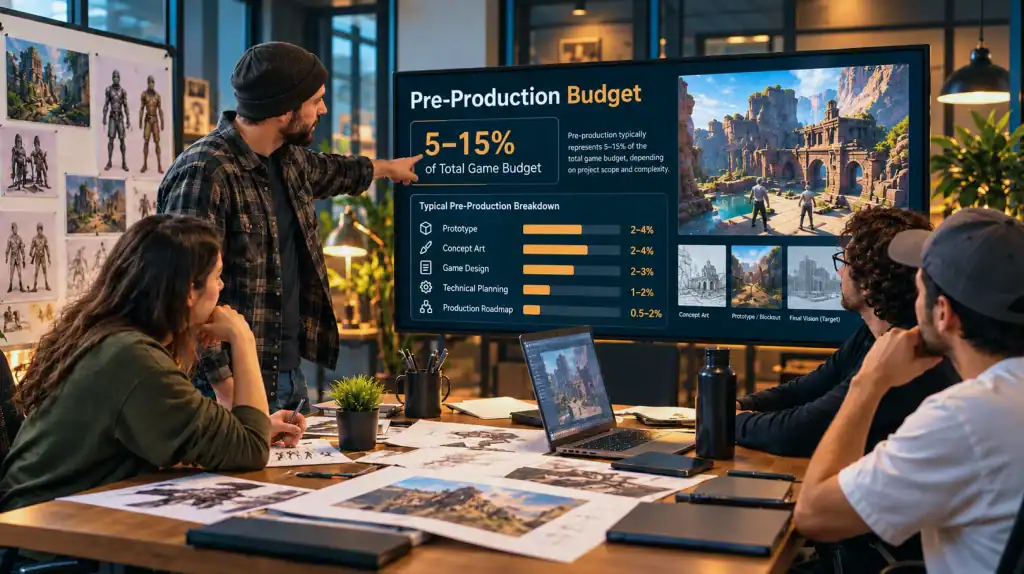
Depending on the project, major cost categories may include:
- Game design
- Engineering
- 2D and 3D art
- Character and environment production
- Animation
- UI/UX
- Audio and music
- QA
- Localization
- Backend infrastructure
- Multiplayer services
- Platform certification
- Marketing
- External contractors
- Contingency
Separate the development budget from the broader go-to-market budget when appropriate.
For example, a studio may need one amount to finish production and another for launch marketing, localization, platform support, community management, and post-launch operations.
The budget should also match the scope.
If the pitch promises multiple platforms, online multiplayer, dozens of environments, cinematic storytelling, extensive character customization, and live-service updates, those features should appear somewhere in the production model.
That is where a technically informed development plan matters.
9. Add Financial Projections Without Making Them Look Invented
Financial projections are estimates, not facts.
A defensible model should explain its assumptions.
Depending on the business model, that may include:
- Units sold
- Average selling price
- Platform mix
- Platform fees or revenue shares
- In-app purchase assumptions
- Advertising revenue
- Subscription revenue
- Player acquisition
- Retention
- Development cost
- Marketing spend
- Support and live operations
- Revenue timing
Instead of presenting one dramatic revenue number, build scenarios.
| Scenario | Assumption | Purpose |
| Downside | Conservative sales and pricing | Tests project resilience |
| Base | Most defensible assumptions | Main planning case |
| Upside | Stronger market response | Shows potential without treating it as guaranteed |
For an investor-oriented game budget and financial projection pitch, show how the assumptions connect.
If you expect 500,000 units at a $30 price, explain how that volume was estimated and distinguish gross consumer spending from the revenue the studio ultimately receives.
The objective is not to make the forecast look impressive.
It is to make the model understandable.
Make the Team Part of the Pitch
10. Show Why This Team Can Build the Game
The team slide should answer one question:
Why is this team equipped to execute this particular project?
Include relevant:
- Founders
- Game designers
- Creative leadership
- Engineering leadership
- Art leadership
- Producers
- Shipped titles
- Genre experience
- Platform experience
- Multiplayer experience
- Technical specialization
Do not turn the slide into a list of unrelated résumés.
If the game is a multiplayer RPG, highlight experience with multiplayer systems, backend infrastructure, progression systems, live operations, or shipped titles in the relevant category.
If the studio has a capability gap, explain how it will be filled.
That is more credible than pretending the team already has every capability required.
For example, a studio that needs additional engineering, art, QA, or platform expertise can explain how an external game development studio fits into the production plan.
End the Game Pitch Deck With a Specific Ask
11. State Exactly What You Want
A pitch should never make the reader guess what happens next.
Your final slide should clearly state the ask.
That might be:
- Development funding
- Funding for a vertical slice
- Publishing agreement
- Marketing and distribution support
- Platform introductions
- QA and certification
- Localization
- Community support
- Co-development resources
Also explain what the studio is bringing to the table.
For example:
Seeking $1.5 million in development funding to take the project from vertical slice to content complete, with the studio retaining development leadership and seeking publishing support across distribution, marketing, QA, and platform relationships.
The exact commercial structure will depend on the project and negotiation.
The important thing is that the reader understands what you need.
Publisher submission requirements also vary. Devolver Digital’s public submission process, for example, asks developers for information such as a quick pitch, gameplay video, pitch deck, estimated release date, requested funds, and additional documentation.
Game Pitch Deck Examples: What Strong Decks Have in Common
Looking at game pitch deck examples is useful when you study the reasoning behind their structure rather than copying their visual style.
Published pitch-deck collections feature examples from games such as Backbone, Bear & Breakfast, Diablo, Button City, The Flame in the Flood, and One Lonely Outpost.
These presentations vary considerably in style, but recurring elements include gameplay explanation, visual identity, market positioning, development plans, team information, budgets, and a clear next step.
That gives you a useful checklist:
| Pattern | What it demonstrates |
| Strong visual identity | The game is easy to recognize |
| Clear gameplay | The product is understandable |
| Target audience | The commercial audience is defined |
| Market positioning | The game has context |
| Development roadmap | Scope is being considered |
| Budget | Production requirements are understood |
| Team | Execution capability is visible |
| Clear ask | Partnership requirements are explicit |
The lesson is not to make your deck look like a famous game’s deck.
The lesson is to understand how strong pitch materials reduce uncertainty.
Common Game Pitch Deck Mistakes That Weaken a Pitch
A strong game pitch deck can lose its impact when important information is poorly prioritized. These common mistakes can make the project harder to understand, weaken its credibility, or leave publishers and investors with unanswered questions.
1. Leading With Lore Instead of Gameplay
A compelling story can support a game pitch, but it should not overshadow the actual player experience. Lead with the game concept, core gameplay loop, and player fantasy before introducing deeper narrative details.
2. Mistaking Features for a USP
A feature is not automatically a differentiator. Explain what makes the feature meaningful to players, how it differs from comparable games, and why that difference matters commercially.
3. Using Unrealistic Market Comparisons
Comparable games should help establish positioning, audience, and commercial context. Avoid selecting only blockbuster titles or using revenue figures without explaining their source and relevance to your project.
4. Showing Concept Art Without Playable Evidence
Concept art can communicate the game’s direction, but artwork alone does not demonstrate whether the core experience works. Where development allows, support the pitch with a prototype, gameplay footage, or vertical slice.
5. Hiding the Budget and Funding Ask
Publishers and investors need to understand how much capital the project requires and what it will fund. State the development budget, funding requirement, major cost areas, and intended use of funds clearly.
6. Turning the Pitch Deck Into a GDD
A pitch deck should communicate the information needed to evaluate the project, not document every mechanic, system, feature, or production detail. Keep deeper specifications in the GDD and supporting documentation.
7. Sending the Same Deck to Every Publisher
Different publishers have different portfolios, platforms, genres, audiences, and submission requirements. Tailor the pitch to show why the project fits the specific publisher rather than sending a generic deck to everyone.
8. Overloading Slides With Text
A pitch deck should make important information easy to understand at a glance. Use concise copy, clear visuals, charts, screenshots, and structured layouts to communicate the key point of each slide.
Game Design Document, Pitch Deck, and Vertical Slice: How They Work Together
A game pitch deck is only one part of the development documentation. Each asset has a different role, and understanding that distinction helps you present the right information to the right audience.
| Asset | Primary Purpose |
| Game Concept | Defines the core idea, genre, player experience, and creative direction. |
| Prototype | Tests whether key mechanics or technical ideas work as intended. |
| Pitch Deck | Presents the game’s concept, market opportunity, production plan, and funding or publishing needs. |
| Vertical Slice | Demonstrates a representative portion of the intended gameplay and production quality. |
| GDD | Documents the game’s mechanics, systems, content, and design requirements in detail. |
| Technical Documentation | Defines the architecture, integrations, and implementation requirements for complex systems. |
These assets also evolve throughout development. Prototype results can change the pitch, while playtesting, market feedback, or production constraints can affect the game’s scope, audience, monetization, or platform strategy.
The key is to keep the pitch deck aligned with the current state of the project, supported by what has been validated rather than what the team plans to build.
Game Pitch Deck Checklist Before You Send It
Before you send your game pitch deck, review it for clarity, credibility, and completeness. Use this checklist to make sure the game, market opportunity, production plan, financial case, and funding ask are all clearly presented.
1. Game
- Game concept is immediately understandable
- Genre is clear
- Platform is identified
- Player fantasy is defined
- Core gameplay loop is explained
- USP is specific
- Visual identity is consistent
2. Market
- Target audience is defined
- Comparable games are relevant
- Market positioning is clear
- Commercial evidence is sourced
- Reported data is separated from estimates
- Available traction is included
3. Production
- Current development stage is clear
- Prototype, demo, or vertical slice is shown where available
- Development roadmap is realistic
- Major milestones are defined
- Production scope matches team size
- Technical requirements are understood
4. Financials
- Development budget is calculated
- Major cost categories are explained
- Marketing and go-to-market costs are considered
- Financial assumptions are documented
- Downside, base, and upside scenarios are separated where appropriate
- Funding requirement is explicit
- Use of funds is clear
5. Pitch
- Publisher or investor version is tailored
- Ask is specific
- Demo or trailer is accessible
- Supporting documents are ready
- Contact information is easy to find
- PDF has been tested on desktop and mobile
- Every slide has a clear purpose
Game Design Document, Pitch Deck, and Vertical Slice: How They Work Together
A game concept, prototype, pitch deck, vertical slice, and GDD serve different purposes throughout development. They should work together rather than duplicate one another.
- Game concept: Defines the core idea, genre, player experience, and creative direction.
- Prototype: Tests whether key mechanics, interactions, or technical ideas are viable.
- Pitch deck: Communicates the game’s concept, market opportunity, production plan, and funding or publishing requirements to external decision-makers.
- Vertical slice: Demonstrates a representative section of the intended gameplay experience, including the level of quality and integration expected in the final game.
- Game Design Document (GDD): Provides detailed design information that guides production across gameplay, systems, content, and player experience.
- Technical documentation: Defines the architecture, systems, integrations, and implementation requirements behind complex game features.
These assets evolve as the project develops. Prototype results, market feedback, vertical-slice testing, and financial modeling can all lead to changes in the game’s scope, audience, monetization, or platform strategy.
The pitch deck should therefore reflect the current state of the project, backed by what has been validated rather than what the team hopes to build.
Final Thoughts on Creating a Winning Game Pitch Deck
A strong game pitch deck does not try to make the project sound bigger than it is.
It makes the project easier to understand.
The reader should finish the deck knowing:
What the game is → why players might want it → who it is for → how it differs → what has been proven → what remains to build → what it will cost → who is building it → what you are asking for.
That is the real purpose of a game pitch deck.
If the concept needs a prototype before the pitch is credible, build the prototype. If the gameplay is difficult to explain, improve the playable experience rather than adding another page of text. If the budget does not match the scope, fix the production plan before sending the deck.
For teams that need support turning a game concept into a production-ready project, a custom game development team can cover the engineering, gameplay systems, platform requirements, and other production needs behind the pitch.
If the project is already moving toward mobile, PC, or console production, the development partner should also be able to support the technical requirements that come after the pitch, rather than treating the deck as the end of the process.
Secure publisher funding. Get your custom pitch deck now
Contact UsFrequently Asked Questions
1. What are the essential slides in a game pitch deck?
Cover the game concept, gameplay, USP, audience, market, development status, visuals, roadmap, team, budget, and funding or publishing ask. Adapt the structure to your audience.
2. How do you pitch a game to a publisher?
Explain the game, gameplay, differentiation, audience, development progress, roadmap, budget, and team, then make a specific publishing request. Always check the publisher’s submission requirements first.
3. What is the difference between a publisher and investor game pitch deck?
A publisher deck emphasizes the game, production scope, development stage, and publishing needs. An investor deck typically places more emphasis on market opportunity, monetization, financials, traction, and use of funds.
4. How much does a game pitch deck cost to create?
There is no fixed cost. Pricing depends on the amount of original artwork, gameplay footage, financial modeling, and supporting materials required.
5. Do I need a playable demo or vertical slice for a game pitch deck?
Not always. Early concepts can use concept art or prototypes, while a vertical slice provides stronger evidence of the intended gameplay experience and production quality.
6. What should the budget and financial projection slide include?
Include development costs, major expenses, funding requirements, use of funds, timeline assumptions, and the basis for revenue projections. Clearly separate estimates from verified data.
7. What is the difference between a game design document and a pitch deck?
A pitch deck communicates the game’s opportunity to external stakeholders, while a GDD provides detailed design information for development. The pitch deck should summarize relevant mechanics and systems rather than reproduce the GDD.
8. Where can I find game pitch deck examples?
Study published examples to understand how successful decks present the game, market, production plan, team, financials, and ask. Use them as references for structure and information hierarchy, not as templates to copy.