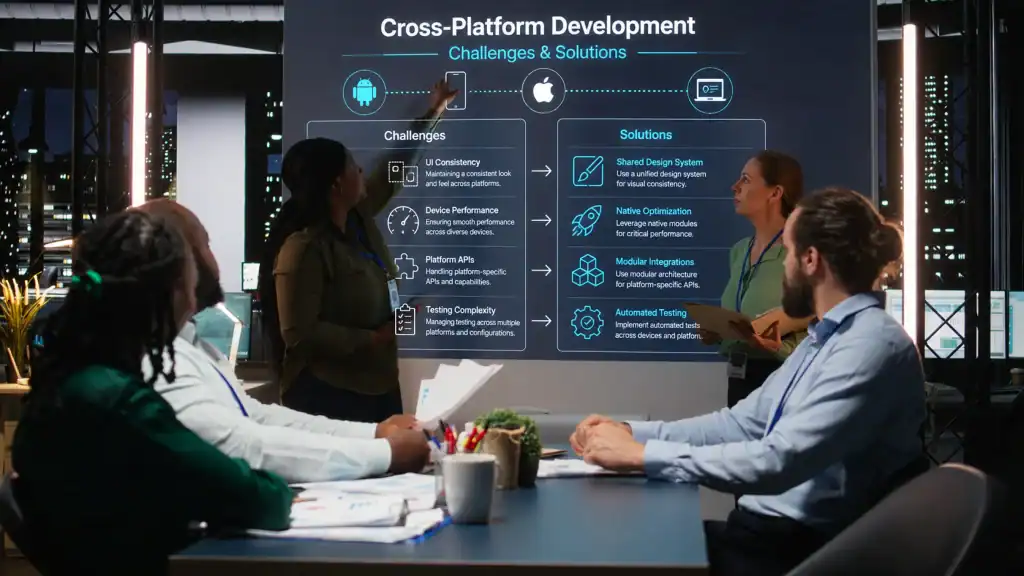
Key Takeaways
- Choose a framework based on your business goals, not just its popularity or market share.
- Cross-platform development reduces costs and accelerates time to market by using a shared codebase across multiple operating systems.
- Each framework serves different use cases, whether you’re building an MVP, enterprise application, eCommerce platform, or gaming experience.
- Scalability, security, maintenance, and ecosystem support are essential factors to consider before selecting a framework.
- The right development partner is just as important as the framework, helping you build a secure, scalable, and high-performing application that supports long-term business growth.
Mobile users expect fast, intuitive, and reliable applications regardless of the device they use. For businesses, meeting those expectations while keeping development costs under control has made cross-platform app development frameworks a strategic investment. Instead of maintaining separate codebases for Android and iOS, organizations can accelerate development, reduce maintenance efforts, and deliver consistent user experiences across multiple devices.
According to Persistence Market Research, the global cross-platform app development framework market is projected to grow from US$124.5 million in 2025 to US$369.2 million by 2032. Among the leading technologies, React Native is expected to remain a dominant choice, with its segment forecast to expand at a 16.8% CAGR during the same period.
Unlike traditional native development, which requires separate codebases for different operating systems, cross-platform frameworks enable developers to build applications from a shared codebase. This approach reduces development costs, shortens time to market, simplifies maintenance, and delivers a consistent user experience across devices.
However, not every framework is suited to every project. Some prioritize performance, while others focus on development speed, scalability, or native integrations. Understanding these differences is essential for selecting the right technology stack.
In this guide, we’ll explore the top 10 best cross-platform app development frameworks, compare their strengths and limitations, and help you determine which framework best aligns with your business goals.
Read More: Is Cross-Platform the Future of Mobile App Development
Why Businesses Choose Cross-Platform Development in 2026
Not long ago, building separate applications for different operating systems was considered the standard approach. Today, businesses are increasingly prioritizing faster releases, efficient resource allocation, and simplified maintenance. Modern development frameworks have matured to the point where a shared codebase can deliver excellent performance while significantly reducing development overhead.
According to the Stack Overflow Developer Survey, multi-platform development technologies continue to rank among the most widely adopted tools, reflecting growing confidence within the developer community.
Lower Development Costs
Building two independent applications often means hiring separate development teams, duplicating testing efforts, and managing parallel release cycles. Cross-platform development minimizes these challenges by allowing developers to reuse much of the application logic.
This approach helps businesses:
- Reduce overall development costs
- Simplify project management
- Minimize duplicated engineering effort
- Accelerate product delivery
For startups operating under limited budgets, these efficiencies can make the difference between launching this quarter or delaying the product for several months.
Faster Time to Market
Speed is often a competitive advantage.
Launching earlier enables companies to:
- Validate product-market fit
- Collect user feedback sooner
- Release new features more frequently
- Respond to customer demands faster
Instead of managing multiple development roadmaps, businesses maintain one primary codebase while delivering applications across different mobile operating systems.
Easier Maintenance
- Every software product evolves after launch.
- Bug fixes, security improvements, feature updates, and UI enhancements become much easier when developers maintain a unified architecture.
- Rather than updating two independent applications, engineering teams can implement improvements once and distribute them across supported platforms.
Consistent User Experience
Customers expect similar experiences regardless of the device they use. Modern frameworks provide sophisticated rendering engines, responsive layouts, and reusable interface components that help maintain visual consistency while respecting each platform’s design guidelines.
Better Return on Investment
Technology investments should generate measurable business value. Cross-platform development often improves ROI by reducing engineering costs without sacrificing application quality. Organizations can allocate more resources toward innovation, customer acquisition, analytics, and ongoing product improvements instead of maintaining duplicate codebases.
How We Evaluated These Frameworks
Every framework discussed in this guide was assessed using criteria that matter to businesses planning real-world mobile applications rather than experimental projects.
Performance
Performance remains one of the most important evaluation factors. We considered rendering speed, startup time, memory usage, responsiveness, and support for complex interfaces.
Development Productivity
Experienced Cross-Platform developers increase productivity that directly impacts project timelines.
Frameworks that offer mature tooling, hot reload capabilities, reusable components, and efficient debugging environments help teams deliver products more quickly.
Community and Ecosystem
A strong developer ecosystem reduces implementation risks.
We evaluated:
- Documentation quality
- Community size
- Plugin availability
- Third-party libraries
- Long-term maintenance
Scalability
Business applications rarely remain static.
We assessed how well each framework supports:
- Enterprise architecture
- Growing codebases
- Large development teams
- Continuous feature expansion
Native Integration
Many applications require access to device capabilities such as:
- Camera
- GPS
- Bluetooth
- Biometrics
- Push notifications
- Offline storage
Frameworks with mature native integration generally provide greater development flexibility.
Long-Term Viability
Technology choices should support future business growth.
Rather than focusing solely on current popularity, we considered:
- Vendor support
- Release frequency
- Enterprise adoption
- Future roadmap
- Community momentum
These factors help determine whether a framework will remain a practical investment over the coming years.
Top 10 Best Cross-Platform App Development Frameworks
Over the years, cross-platform has taken the bench and become one of the most popular ways to build mobile applications. The list is not exhaustive, but the main thing to realize is that there is no particular tool that is ideal for development. The cross-platform app development frameworks depend on your project requirements as well as your goals. Nevertheless, in this blog, we have tried to pick the best frameworks for cross-platform mobile app development to give you a starting point for your project.

1: Flutter
Since its release, Flutter has become one of the most widely adopted choices for businesses seeking visually polished, high-performance mobile applications. Developed and maintained by Google, the framework uses the Dart programming language and its own rendering engine to deliver a consistent experience across multiple operating systems.
Unlike many frameworks that rely heavily on native UI components, Flutter renders its interface independently, allowing developers to create highly customized designs while maintaining predictable performance.
Why Businesses Choose Flutter
Flutter is particularly well suited for organizations that prioritize design consistency, rapid iteration, and long-term maintainability.
Key advantages include:
- Excellent UI flexibility
- Fast development with Hot Reload
- Extensive widget library
- Strong documentation
- Active developer community
- Consistent visual rendering
These capabilities make Flutter an excellent option for startups launching customer-facing products as well as enterprises modernizing existing applications.
Potential Considerations
Flutter’s custom rendering engine contributes to its performance but can increase application size compared to some alternatives. Teams without prior Dart experience may also face a brief learning curve during adoption.
Best For
- Startup MVPs
- Retail applications
- Healthcare solutions
- FinTech products
- Enterprise mobile platforms
- Customer-facing business applications
Read More: What is Flutter? Overview, Features and Working Process
2: React Native
Developed by Meta, React Native remains one of the most trusted frameworks for businesses that want native-like performance while leveraging JavaScript expertise. Its mature ecosystem, extensive third-party library support, and large developer community have helped it maintain widespread adoption across industries.
One of React Native’s biggest strengths is its ability to reuse business logic across mobile applications while still allowing developers to integrate native components whenever deeper platform-specific functionality is required.
For organizations that already have experience with React for web development, adopting React Native can significantly reduce onboarding time and improve development efficiency.
Why Businesses Choose React Native
React Native offers an excellent balance between development speed and performance, making it a preferred choice for companies seeking cost-effective mobile solutions.
Key advantages include:
- Large developer ecosystem
- Faster development cycles
- Extensive third-party integrations
- Strong community support
- Reusable code architecture
- Easy maintenance and updates
Potential Considerations
Applications with highly complex animations, graphics-intensive workloads, or advanced platform-specific functionality may require additional native development.
Best For
- Startup applications
- Social networking apps
- E-commerce platforms
- On-demand service apps
- Enterprise mobility solutions
- Content-driven applications
3: Ionic Framework
Ionic Framework is a popular open-source solution that enables developers to build mobile applications using familiar web technologies such as HTML, CSS, and JavaScript. Its flexibility and low learning curve make it particularly attractive for organizations with existing web development teams.
The framework leverages web technologies while providing access to native device capabilities through plugins and integrations.
Why Businesses Choose Ionic
Companies often choose Ionic when they want to maximize code reuse across web and mobile projects.
Key advantages include:
- Rapid development process
- Lower development costs
- Strong web technology support
- Reusable UI components
- Large plugin ecosystem
- Easy learning curve
Potential Considerations
Applications requiring extensive graphics processing or highly demanding performance may benefit from alternative frameworks.
Best For
- Business applications
- Customer portals
- Internal enterprise tools
- SaaS platforms
- MVP development
- Content-focused applications
4: .NET MAUI
.NET MAUI represents Microsoft’s evolution of cross-platform application development. Built on the .NET ecosystem, it allows developers to create applications for mobile and desktop environments from a unified codebase.
Organizations already invested in Microsoft technologies often find .NET MAUI particularly appealing due to its seamless integration with enterprise systems.
Why Businesses Choose .NET MAUI
The framework offers strong enterprise capabilities while simplifying application management.
Key advantages include:
- Native performance
- Microsoft ecosystem integration
- Shared business logic
- Enterprise-grade security
- Modern development tools
- Long-term Microsoft support
Potential Considerations
Smaller developer communities compared to Flutter and React Native can impact hiring flexibility.
Best For
- Enterprise applications
- Financial services platforms
- Internal business software
- Healthcare systems
- Government applications
- Corporate productivity tools
5: Kotlin Multiplatform
Kotlin Multiplatform takes a different approach to cross-platform development by allowing teams to share business logic while maintaining native user interfaces for each platform.
This hybrid model enables organizations to preserve native experiences without duplicating backend logic.
Why Businesses Choose Kotlin Multiplatform
Businesses seeking maximum performance with partial code sharing often prefer this approach.
Key advantages include:
- Native user experience
- Shared business logic
- Excellent performance
- Flexible architecture
- Growing ecosystem
- Reduced maintenance effort
Potential Considerations
Development complexity can be higher than fully shared UI frameworks.
Best For
- FinTech applications
- Healthcare solutions
- Enterprise software
- Performance-focused products
- Banking applications
- Large-scale platforms
6: Xamarin
Although Microsoft has transitioned its focus toward .NET MAUI, Xamarin remains relevant for organizations maintaining existing applications. Many enterprises continue to support Xamarin-based solutions while planning migration strategies.
Why Businesses Choose Xamarin
For organizations already using Xamarin, maintaining existing applications can remain cost-effective.
Key advantages include:
- Mature framework
- Native API access
- Shared codebase
- Strong enterprise adoption
- Microsoft ecosystem support
- Proven reliability
Potential Considerations
New projects are generally better served by .NET MAUI due to Microsoft’s future roadmap.
Best For
- Legacy enterprise applications
- Existing Xamarin projects
- Corporate software maintenance
- Migration planning initiatives
7: NativeScript
NativeScript enables developers to build truly native mobile applications using JavaScript or TypeScript while maintaining direct access to native APIs. Its architecture provides flexibility for businesses requiring deeper platform integrations.
Why Businesses Choose NativeScript
Organizations seeking native functionality without abandoning JavaScript often find NativeScript appealing.
Key advantages include:
- Direct native API access
- Flexible architecture
- Strong TypeScript support
- Native user experiences
- Open-source ecosystem
- Cross-platform deployment
Potential Considerations
Community size is smaller than leading alternatives such as Flutter and React Native.
Best For
- Custom enterprise apps
- Utility applications
- Internal business tools
- Specialized mobile solutions
8: Apache Cordova
Apache Cordova is one of the earliest cross-platform development solutions and continues to support businesses building lightweight applications using web technologies. While newer frameworks have gained popularity, Cordova still serves specific use cases effectively.
Why Businesses Choose Apache Cordova
Its simplicity and familiarity make it attractive for web-focused development teams.
Key advantages include:
- Low development cost
- Easy implementation
- Web technology foundation
- Extensive plugin support
- Quick prototyping
- Large knowledge base
Potential Considerations
Performance limitations may arise in complex applications requiring extensive native functionality.
Best For
- Internal company apps
- Simple business applications
- MVP projects
- Lightweight mobile products
9: Unity
While primarily recognized as a game engine, Unity has evolved into a powerful framework for creating immersive mobile experiences, interactive applications, and real-time 3D solutions. Its versatility extends beyond gaming into education, healthcare, retail, and training applications.
Why Businesses Choose Unity
Organizations building highly interactive experiences often rely on Unity’s robust rendering capabilities.
Key advantages include:
- Advanced graphics capabilities
- AR and VR support
- Real-time rendering
- Cross-platform deployment
- Extensive asset ecosystem
- Large developer community
Potential Considerations
Unity may be excessive for traditional business applications that do not require advanced visual experiences.
Best For
- Mobile games
- AR applications
- VR solutions
- Training simulations
- Interactive product experiences
- Metaverse projects
10: Qt Framework
Qt Framework is widely used for developing cross-platform applications across mobile, desktop, and embedded systems. Its performance and flexibility make it particularly valuable for enterprise and industrial applications. Qt’s comprehensive toolkit enables developers to create sophisticated user interfaces while maintaining high performance.
Why Businesses Choose Qt Framework
Qt is often selected for projects requiring reliability, scalability, and support across multiple device categories.
Key advantages include:
- Excellent performance
- Cross-device compatibility
- Advanced UI capabilities
- Enterprise-grade stability
- Embedded systems support
- Long-term maintainability
Potential Considerations
Licensing costs may be a consideration for some commercial projects.
Best For
- Automotive software
- Medical devices
- Industrial systems
- Enterprise applications
- IoT solutions
- Embedded software
How to Choose the Right Cross-Platform App Development Framework
Selecting the right cross-platform framework involves more than comparing features or following industry trends. The best choice depends on your business goals, project requirements, budget, timeline, and long-term growth plans. A framework that works well for a startup MVP may not be the ideal fit for a large enterprise application.

Before making a decision, evaluate the following factors:
Define Your Business Goals
Start by identifying what you want your application to achieve. Are you building an MVP to validate an idea, a customer-facing application, or an enterprise solution? Your objectives will influence the framework that best supports your product roadmap.
Consider Performance Requirements
Applications with complex animations, real-time processing, or graphics-intensive features require frameworks that deliver near-native performance. Simpler business applications, customer portals, or eCommerce apps may prioritize faster development over maximum performance.
Evaluate Development Time and Budget
Every project has budget and timeline constraints. Frameworks with reusable components, mature tooling, and large developer communities can shorten development cycles and reduce overall costs.
Check Scalability
Your application should support future growth without requiring a complete rebuild. Choose a framework that can handle increasing users, new features, third-party integrations, and changing business requirements.
Assess Community Support
A strong developer community ensures access to regular updates, comprehensive documentation, third-party libraries, and faster issue resolution. Frameworks backed by active communities are generally easier to maintain over the long term.
Review Native Feature Support
Many applications rely on device capabilities such as cameras, GPS, biometric authentication, push notifications, and offline storage. Ensure the framework provides reliable access to the native features your app requires.
Think Beyond the Initial Launch
Launching your app is only the beginning. Consider long-term maintenance, security updates, testing, feature enhancements, and compatibility with future operating system releases. Choosing a framework with a clear development roadmap can help reduce technical debt over time.
Work with an Experienced Development Partner
Even the most capable framework cannot compensate for poor architecture or implementation. An experienced development team can evaluate your requirements, recommend the right technology stack, and build an application that balances performance, scalability, security, and user experience.
Quick Decision Guide
| If Your Priority Is… | Consider |
|---|---|
| Fast MVP development | Flutter or React Native |
| Enterprise business applications | .NET MAUI or Kotlin Multiplatform |
| High-performance mobile apps | Flutter or Kotlin Multiplatform |
| Web-first development | Ionic Framework |
| Gaming or AR/VR experiences | Unity |
| Embedded or industrial software | Qt Framework |
The right framework is the one that aligns with your technical requirements, business objectives, and future growth strategy. Evaluating these factors early in the planning process can help you avoid costly redesigns and ensure your application remains reliable and scalable as your business evolves.
Selecting the right framework isn’t just about writing code, it’s about aligning your application with business objectives, leveraging your team’s strengths, and meeting user expectations. – Shoaib Abdul Ghaffar, Vice President at Cubix
Common Mistakes to Avoid When Choosing Cross-Platform Development Frameworks
Selecting the right Cross-Platform Development Frameworks is about more than comparing features or following industry trends. While many frameworks offer similar capabilities, choosing one without evaluating your project’s technical and business requirements can lead to higher development costs, performance issues, and maintenance challenges. Avoiding these common mistakes will help you build an application that remains scalable, secure, and easier to maintain as your business grows.
Choosing a Framework Based on Popularity Alone
A widely adopted framework isn’t automatically the right fit for your project. Every application has unique requirements, and the most popular option may not provide the performance, integrations, or flexibility your business needs. Instead of following trends, evaluate each framework based on your goals, budget, and long-term product roadmap.
Ignoring Scalability
Your application may start with a limited feature set, but user expectations and business requirements will evolve. Selecting a framework that cannot efficiently support increased traffic, new features, or third-party services may result in costly redevelopment later. Consider how well the framework can accommodate future growth before making a decision.
Overlooking Long-Term Maintenance
Application development doesn’t end after launch. Regular updates, security patches, operating system compatibility, and feature enhancements require ongoing maintenance. Choosing a framework with active community support and consistent updates can reduce maintenance challenges and extend your application’s lifespan.
Not Considering Developer Availability
The availability of experienced developers directly impacts project timelines and future support. Frameworks backed by large developer communities are generally easier to staff, making it simpler to scale your development team or maintain the application over time.
Ignoring Third-Party Integrations
Most modern applications rely on integrations such as payment gateways, analytics tools, cloud services, CRM platforms, and authentication providers. Before selecting a framework, verify that it supports the third-party services your application depends on without requiring extensive custom development.
Skipping Architecture Planning
Even the best framework cannot compensate for poor software architecture. Failing to define your application’s architecture, scalability strategy, and development roadmap early can lead to technical debt, slower performance, and expensive refactoring. Investing time in proper planning helps ensure your application remains efficient, maintainable, and ready for future enhancements.
Why Cubix Is the Right Development Partner Beyond the Framework

The right framework provides the foundation, but the right development partner determines how successfully your application is planned, built, and scaled. An experienced team focuses on your business goals first and then recommends the technology that best fits your project rather than following industry trends.
At Cubix, we help businesses build scalable mobile applications by combining technical expertise with strategic planning. As a trusted mobile app development agency, our team of Cross-Platform Developers supports every stage of the development lifecycle, from product strategy to post-launch optimization. We have worked with global clients like Politico, Walmart, TISSOT, and Canon.
Why the Right Development Partner Makes a Difference
- Scalable Architecture: Build a strong technical foundation that supports future growth.
- User-Centered UI/UX: Create intuitive experiences that improve engagement and retention.
- Comprehensive QA: Ensure reliable performance through continuous testing and quality assurance.
- CI/CD Pipelines: Accelerate development with automated testing and seamless deployments.
- Built-In Security: Protect user data with secure coding practices and industry standards.
- Ongoing Maintenance: Keep applications updated, secure, and optimized after launch.
- Future-Ready Solutions: Design applications that can evolve with changing business needs.
The best apps are built by teams that align technology with business strategy, not by technology alone. – Salman Lakhani, CEO of Cubix
Conclusion
Choosing the right cross-platform app development framework is a strategic decision that influences your application’s performance, development timeline, maintenance, and future growth. While frameworks like Flutter, React Native, and .NET MAUI each offer unique advantages, the best choice ultimately depends on your business goals, budget, technical requirements, and long-term vision.
There isn’t a one-size-fits-all solution. A startup building an MVP may have different priorities than an enterprise developing a complex business application. Evaluating your project’s specific needs before selecting a framework can help you avoid unnecessary costs and technical challenges down the road.
Equally important is choosing the right development partner. An experienced team can recommend the most suitable technology, build a scalable architecture, and ensure your application delivers a seamless user experience from launch to future updates.
If you’re planning your next mobile application, consider partnering with an experienced team that can help you select the right framework and build a solution tailored to your business objectives.
Frequently Asked Questions
1: Which is the best cross-platform framework in 2026?
There isn’t a single best framework for every project. Flutter is an excellent choice for creating visually rich applications, while React Native is ideal for businesses with JavaScript expertise. .NET MAUI, Kotlin Multiplatform, and other frameworks may be better suited for enterprise or specialized use cases depending on your requirements.
2: Flutter vs React Native: Which is better?
Flutter provides a highly customizable UI and consistent performance across platforms using its own rendering engine. React Native uses native components and has a large JavaScript ecosystem, making it a great option for faster development and teams already familiar with React. The right choice depends on your project’s complexity, performance needs, and development expertise.
3: Is cross-platform development suitable for enterprise applications?
Yes. Modern cross-platform frameworks support enterprise-grade applications by offering scalability, robust security, native integrations, and efficient maintenance. Many organizations use them to reduce development costs while delivering consistent user experiences across multiple platforms.
4: How much does cross-platform app development cost?
The cost depends on factors such as application complexity, design requirements, feature set, third-party integrations, development timeline, and the experience of your development team. Building a cross-platform app is generally more cost-effective than developing separate native applications because much of the codebase can be shared.
5: How do I choose the right cross-platform framework?
Start by evaluating your business objectives, target audience, performance requirements, budget, and scalability needs. Compare frameworks based on their ecosystem, native capabilities, community support, and long-term maintenance. Consulting experienced cross-platform developers can also help you select the framework that best aligns with your project goals.