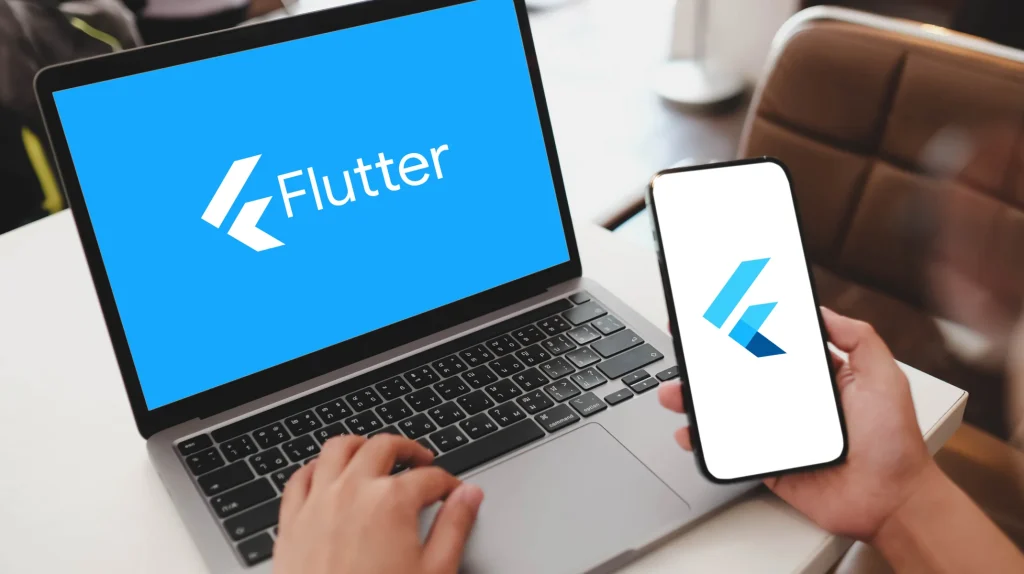
Flutter is an open-source UI software development kit (SDK) by Google. It helps developers to build cross-platform apps for IOS and Android, web, and desktop using a single code base.
According to Lean Code, by the end of 2025, 13% of Flutter applications will have an audience exceeding 1 million users, showcasing the framework’s capability to support large-scale, high-traffic apps.
What is Flutter?

Flutter is a global Google UI toolkit that is used to make beautiful, user-friendly, and compiled applications for mobile, web, and desktop from a single code base. This development framework is particularly renowned for its rapid performance, expressive UI elements, and hot reload feature, by which developers get to see real-time changes as they develop. For any mobile app development company, Flutter offers an efficient way to build high-performance apps with a unified workflow.
Flutter has been extensively used to develop an array of applications, from mobile applications to customized applications and hybrid applications. Flutter makes use of the Dart programming language and provides a wide collection of pre-designed widgets in order to allow developers to develop outstanding user interfaces with ease.
Reports and trends highlight that:
- According to Dev TO, by 2026, the integration of AI is expected to deepen, with Flutter providing built-in tools to enhance app functionalities, such as chatbots, predictive analytics, and automation.
- According to Wired, by 2028, the evolution of AI-assisted coding tools could result in more efficient development processes, with AI generating Flutter UI components and logic.
Read More: AI Revolutionizing Game Development – 5 Key Ways
Overview Of Flutter
Flutter was first released by Google back in 2017 and has since become incredibly popular amongst developers and companies seeking a trusted cross-platform app development framework. Flutter provides a fluid and high-performance experience through the utilization of a rendering engine that directly speaks to native components instead of using platform-specific widgets.
This platform is a perfect fit for creating a mobile app, be it for startups or big companies. The increasing community and huge support from Google make it a solution of choice for companies that want to build iOS apps, Android apps, and even web applications with a single codebase. especially when working with an iphone app development company that leverages Flutter’s full potential.
Read More: Flutter Vs React Native – Which One is the Best for Your Project?
Features of Flutter

Flutter is full of mobile app features that make it a game-changer in mobile app development. Some of Flutter’s features are listed below:
1. Single Codebase
One of the greatest features of Flutter is that it enables developers to code a single codebase that can run on several platforms. This indicates that you can develop both iOS apps and Android apps without writing different codes for each platform.
2. Fast Performance
Flutter uses Skia, its rendering engine, which ensures smooth animation and high-performance applications. This is an important factor in custom app development, where adaptability and smoothness matter.
3. Hot Reload
The hot reload features help to make changes in the app without restarting it. This speeds up the development process and enhances productivity, making hybrid app development faster and more efficient.
4. Rich Set of Widgets
Flutter supports a rich collection of widgets that help in designing beautiful user interfaces. The widgets ensure consistency across different platforms, and therefore, it is easy to develop a cross-platform application with a native-like feel.
5. Dart Programming Language
Flutter is built using Dart, a programming language developed by Google. Dart provides excellent performance and supports ahead-of-time (AOT) compilation, thus ensuring that the mobile app performs optimally on all platforms.
6. Native Performance
Flutter is very much in sync with APIs of the various platforms in making it easy for developers to build personalized applications that mimic the behavior of native applications. That way, the users would have a better user experience while enabling smooth functioning across different devices.
7. Open Source and Company Support
Flutter is open source, so it has a huge community of developers who are continuously contributing to its development. Enterprises and developers use solid community support to develop great hybrid apps.
Read More: Flutter vs. Ionic – The Right Framework for Your Mobile App
How Flutter Works?

Now we understand how Flutter works to make the most out of the framework.. Below is the step-by-step breakdown.
Development with Dart
Flutter has Dart as its programming language. The code is written in Dart by the developers, and then it is compiled into native ARM code so that the mobile app runs efficiently.
Rendering Engines
Flutter has its high-performance rendering engine, Skia. It makes sure that the UI of the cross-platform app is rendered uniformly across all platforms.
Use of Widgets
All in Flutter is a widget. From buttons to full screens, the UI elements are constructed with widgets, making it easy and flexible to develop custom apps.
State Management
Flutter offers different state management methods, such as Provider, Riverpod, and Bloc, to handle the state of the hybrid app effectively.
Native Performance
After development is done, the Flutter framework translates the Dart code to native machine code. The resultant mobile app can then be distributed on iOS app store and Android app store smoothly.
Read More: Flutter App Development Pros and Cons For Android
Why Choose Flutter Mobile App?

Fluuter has been chosen for its numerous benefits. Here’s why you should choose Flutter for your next cross-platform app project:
1. Cost-effective Solution
Why invest in two separate apps when one does it all? Flutter’s single codebase approach reduces development by half while delivering high-performance cross-platform apps with no compromise.
2. Faster Development Process
Flutter’s Hot Reload allows developers to test and refine the app in real time, cutting debug time and iteration. The payoff? A tailor-made app built faster than ever, with no compromise on quality.
3. Next-Level User Experience
With a smooth interface, silky animations, and pixel-perfect layouts, Flutter delivers UI perfection to your mobile app, ensuring it flows smoothly and is interactive on both the iOS and Android platforms.
4. Used by Global Innovators
Google and BMW, Alibaba and eBay, leading companies rely on Flutter for their hybrid apps. Its strong and expanding community and Google-backed support make it a future-proof solution.
Read More: Mobile App Development Cost (A Breakdown)
Build Your Next Flutter Application with Cubix!

Flutter app development is grabbing the future; it’s not just a mobile application development framework. One-click uploading means writing a single code for both iOS and Android applications, which is potent, effective, and below the mark affording cost. A flutter app development company can maximize these advantages by delivering high-performance, scalable digital products. Flutter brings freedom, innovation, and modernity to its users, whether building native, hybrid, or cross-platform applications. Be a part of the Flutter Revolution and take your application development to the next level!
You have an app idea, and you need a Flutter developer to bring it to life. Cubix is here to create high-performance mobile apps made according to your business requirements. Contact us now!