
Game porting typically costs $15,000 to $150,000 or more, depending on the game’s complexity, source and target platforms, and the engineering work required. A straightforward port with minimal changes may cost less, while projects involving major code refactoring, performance optimization, platform integration, and certification-related fixes can exceed $300,000.
The investment in multiplatform development is substantial. According to the Australian Bureau of Statistics, multiplatform games accounted for A$72.6 million in production costs in Australia during 2021–22. Although this figure covers game production rather than porting alone, it highlights the resources involved in developing games across platforms.
Your actual budget depends on the porting direction, the condition of your existing codebase, and the work needed to meet each platform’s requirements. Understanding these factors, along with testing, certification, and ongoing maintenance, helps you evaluate quotes and plan a realistic budget.
Key Takeaways
- Game porting costs vary by scope: Budget depends on the source platform, target platform, game complexity, and condition of the existing codebase.
- Platform changes affect cost: Porting a PC game to consoles often involves different requirements than adapting a game for mobile devices.
- Technical complexity drives effort: Rendering changes, control adaptation, performance optimization, and platform-specific integrations can increase development costs.
- QA and certification matter: Testing, platform compliance, bug fixing, and certification preparation should be included in the budget.
- Plan for post-launch expenses: Updates, patches, compatibility fixes, and ongoing support can add to the total cost.
- Get a detailed estimate first: A technical audit of the codebase, assets, dependencies, and target platforms helps identify risks before development begins.
- Choose the right development approach: Compare in-house and outsourced porting based on your team’s expertise, available resources, timeline, and support needs.
Ready to Port Your Game? Get a Custom Cost Estimate Today
Contact UsHow Much Does Game Porting Cost for Different Platforms?
Game porting costs depend on the source platform, target platform, and amount of engineering work required. As an initial planning guide, a port may cost around $15,000 for a relatively straightforward project, while complex ports can exceed $300,000. The estimates below provide broad budgeting ranges, not fixed prices or guaranteed industry averages.
1. Console-to-PC Porting Cost
Estimated cost: 150,000
Porting a console game to PC involves adapting it to a wider range of hardware configurations, graphics settings, input methods, and operating environments. A game with a compatible engine and limited console-specific dependencies may require relatively little structural work. A title with custom integrations or tightly coupled systems can require substantially more engineering.
Common cost drivers include:
- Hardware compatibility: Supporting different processors, graphics cards, memory configurations, and display resolutions.
- Graphics and performance settings: Adding configurable options and optimizing performance across a wider range of PCs.
- Input support: Adapting controls for keyboard and mouse alongside gamepads, where appropriate.
- Platform-specific systems: Reworking achievements, save data, multiplayer integrations, or other console-dependent features.
- Quality assurance: Testing different hardware configurations, resolutions, and input setups.
A port with reusable code and limited changes may fall toward the lower end of the range. Extensive compatibility work and custom dependencies can push the cost higher.
2. PC-to-Console Porting Cost
Estimated cost: 150,000+, depending on the console and scope.
Porting a PC game to console requires adapting its build, controls, performance, and platform integrations to the target system. Even when the game runs well on PC, it may need significant changes to meet console-specific requirements.
Key cost drivers include:
- Platform integration: Implementing required SDKs, achievements, account systems, save functionality, and other platform services.
- Controller and interface adaptation: Making menus, navigation, and gameplay comfortable to use with a controller and on a television screen.
- Performance optimization: Meeting CPU, GPU, memory, and loading requirements.
- Compliance and submission: Testing against platform requirements and addressing issues identified during review.
- Regression testing: Confirming that fixes do not introduce problems elsewhere.
The target console matters. A game moving to hardware with tighter memory or performance constraints may require more optimization than one moving to a platform with specifications closer to the original development environment. The estimate should account for the expected integration, optimization, and submission work.
3. PC or Console-to-Mobile Porting Cost
Estimated cost: 300,000+
Moving a PC or console game to mobile can require substantial changes because mobile devices have different input methods, performance limits, screen sizes, and power constraints.
Typical cost drivers include:
- Touch controls and UI: Reworking gameplay controls, menus, text, and interface layouts for smaller touchscreens. Significant interface redesign may also require Game UI/UX Design to adapt navigation, layouts, and interactions for mobile use.
- Graphics optimization: Adjusting rendering quality, effects, textures, and other resource-intensive features.
- Memory and thermal limits: Reducing resource usage and managing performance during longer play sessions.
- Device compatibility: Testing across a representative range of screen sizes, hardware capabilities, and operating system versions.
- Mobile-specific features: Adapting account systems, connectivity, monetization, or progression where required.
A focused port with a compatible engine may cost less than a project requiring extensive redesign and optimization. Supporting both iOS and Android can also increase the budget, depending on how much code and testing can be shared.
4. Mobile-to-PC or Console Porting Cost
Estimated cost: 200,000 per target platform.
Porting a mobile game to PC or console may require changes to make its controls, interface, graphics, and platform features work well on the new system.
The main cost drivers include:
- Input redesign: Supporting keyboard and mouse or console controllers instead of relying on touch gestures.
- Interface adaptation: Reworking menus, HUD elements, text, and navigation for larger displays.
- Graphics and performance: Adjusting visual quality and performance for the target hardware.
- Platform services: Integrating relevant achievements, account systems, and cloud saves.
- Feature and monetization changes: Reviewing mobile-specific ads, in-app purchases, and progression systems to determine what needs to change.
A port with reusable systems and limited interface changes may require less work than one that needs extensive feature redevelopment or changes to its monetization model.
| Porting Direction | Illustrative Budget Range (USD) | Main Cost Drivers |
|---|---|---|
| Console to PC | 150,000 | Hardware variability, graphics settings, input support, and compatibility testing |
| PC to console | 150,000+ | Platform integration, controller and UI changes, optimization, and compliance |
| PC or console to mobile | 300,000+ | Touch controls, device coverage, memory limits, and thermal optimization |
| Mobile to PC or console | 200,000 | Input redesign, interface adaptation, platform services, and feature changes |
These figures are illustrative planning estimates, not verified industry averages. They may not include development kits, platform fees, third-party licensing, extensive submission rework, or ongoing maintenance. Costs can fall outside the ranges depending on the game’s technical condition and required scope.
The porting direction provides an initial budgeting reference, but the amount of engineering work ultimately determines the final cost.
How Does Game Porting Scope Affect the Cost?
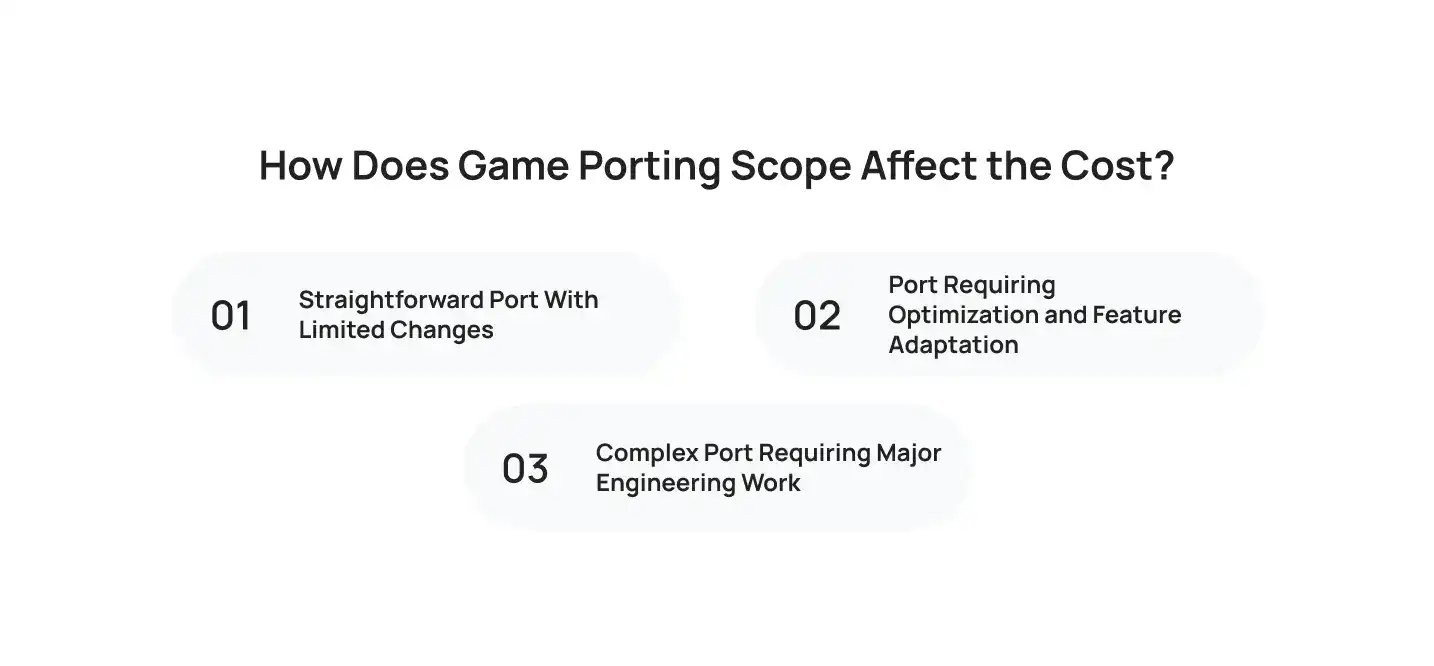
Game porting projects generally fall into three categories based on how much of the existing game can be reused and how much engineering work is required.
1. Straightforward Port With Limited Changes
This type of port uses an existing engine and a codebase largely compatible with the target platform. Most gameplay systems and assets can remain unchanged, with work limited to build configuration, minor interface or control adjustments, and essential platform integration.
2. Port Requiring Optimization and Feature Adaptation
This port requires changes to make the game work effectively on its target platform. Developers may need to adjust graphics settings, redesign parts of the UI, adapt input systems, or modify existing features. The additional engineering effort depends on the number and complexity of these changes.
3. Complex Port Requiring Major Engineering Work
A complex port involves substantial changes to the game’s underlying technology. This may include upgrading the engine, replacing incompatible plugins, refactoring legacy code, rebuilding features, or restructuring core systems. These projects require more engineering hours and carry greater uncertainty than ports that preserve most of the original implementation.
When engine upgrades, legacy-code refactoring, or core feature redevelopment go beyond a conventional port, broader game development services may be needed to rebuild or replace incompatible systems.
What Factors Drive Game Porting Costs Up?
Game porting costs rise when technical issues require more engineering hours, specialist expertise, or additional testing. The financial impact depends on the work involved, so studios should identify these risks before finalizing a quote.
1. Source Code Quality, Engine Version, and Plugins
A well-structured codebase is easier to adapt than one with undocumented systems or tightly coupled platform-specific code. Poor code quality can require extra time to trace dependencies, fix compatibility issues, and refactor existing systems. Engine upgrades can add further work if gameplay code, assets, or plugins need updating.
Third-party middleware can also increase the budget when licenses must be renewed, plugins are incompatible, or replacements require custom integration. For example, replacing an unsupported plugin may involve both implementation and regression testing, rather than simply purchasing an alternative.
If a Unity project needs additional engineering expertise to resolve compatibility issues or adapt platform-specific features, Hire Unity Developers may be worth considering.
Cost implication: Additional engineering hours accumulate quickly. At an illustrative blended rate of $100 per hour, 80 unexpected hours of refactoring or integration would add $8,000 to the project. This is a calculation example, not a standard industry rate.
2. Performance Optimization and Platform Services
A game that runs well on its original platform may need significant optimization to meet the target platform’s performance requirements. Developers may need to reduce memory usage, improve asset loading, optimize rendering, or address frame-rate issues.
Platform services can add separate integration work. Achievements, cloud saves, multiplayer functionality, and account systems may require new implementations or modifications, depending on what the original game supports.
Cost implication: If optimization and platform integration require an additional 120 hours at an illustrative blended rate of $100 per hour, that represents another $12,000. The actual effort depends on the game’s architecture, performance problems, and required integrations.
3. QA, Compliance, and the Device Matrix
Testing effort grows with the number of supported configurations and scenarios. PC ports may need validation across different hardware setups, while mobile releases can require coverage across devices and operating system versions. Regression testing adds work whenever code changes risk affecting existing functionality.
Console releases also have platform-specific compliance requirements. If a submission fails technical checks, developers must investigate the issue, implement a fix, and validate the revised build. Repeated submission cycles can increase both QA and engineering costs.
Cost implication: Suppose expanded compatibility testing and compliance fixes require 60 additional hours at an illustrative blended rate of $75 per hour. That adds $4,500, excluding any separately charged platform fees or external testing expenses.
Dedicated game testing services can help identify defects and compatibility issues before release. However, functional QA and platform compliance are distinct activities, so the quote should specify which testing, submission fixes, and retesting cycles are included.
What Hidden Costs Should You Include in a Game Porting Budget?

A game porting quote may exclude expenses beyond core engineering. Budget for these separately and confirm what your studio’s proposal actually covers.
| Potential Extra Cost | Illustrative Budget Allowance (USD) | What to Clarify |
|---|---|---|
| Development hardware and platform access | 2,000+ per kit, where applicable | Are development kits, test devices, accounts, or access arrangements required? |
| Middleware, plugins, and licensing | 5,000+ | Are new licenses, subscriptions, or replacement tools needed? |
| Certification-related fixes | 15,000+ | How many rounds of fixes and resubmissions are included? |
| QA and regression testing | 10,000+ | Which devices, configurations, and test scenarios are covered? |
| Store assets and localization | 10,000+ | Are translations, store graphics, and other release assets included? |
| Launch support | 5,000+ | Does the quote cover release coordination and post-launch troubleshooting? |
| Patch maintenance | 10,000+ per support period | Who handles bug fixes, compatibility updates, and regression testing after launch? |
These expenses vary by project. For example, a port that uses existing licensed middleware may not need replacement tools, while a game targeting several platforms may require additional test hardware and broader QA coverage.
The main budgeting risk is unclear scope. Ask the studio to identify exclusions, specify how extra work is approved and billed, and distinguish one-time porting costs from recurring licensing and maintenance expenses. This makes proposals easier to compare and reduces the risk of unexpected charges after development begins.
How Long Does Game Porting Take, and How Does the Timeline Affect Cost?
Game porting can take a few weeks for a limited-scope project or several months for a complex release. The timeline depends on the source and target platforms, codebase condition, integration work, and testing requirements.
What Determines the Porting Timeline?
Four factors have a direct impact on how long a port takes:
- Project scope and source-code condition: Reusing existing systems usually takes less time than substantial refactoring or feature redevelopment.
- Engine, middleware, and platform compatibility: Engine upgrades, unsupported plugins, and platform-specific integrations can add engineering work.
- Access to builds, assets, and development hardware: Missing files, incomplete documentation, or delayed access can hold up development.
- Optimization, testing, and submission feedback: Performance issues, defects, and compliance fixes can require additional development and review cycles.
The source and target platforms also influence the schedule. The following ranges are illustrative planning estimates, not guaranteed delivery times.
| Porting Direction | Estimated Timeline | Main Schedule Drivers |
|---|---|---|
| Console to PC | 2–6 months | PC compatibility, graphics settings, input support, and hardware testing |
| PC to console | 3–9 months | Platform integration, optimization, compliance, and submission fixes |
| PC or console to mobile | 4–12 months | Touch controls, performance optimization, device coverage, and UI adaptation |
| Mobile to PC or console | 2–6 months | Input redesign, interface changes, platform services, and feature adaptation |
These ranges assume an existing, playable game and do not cover a complete redevelopment. Projects involving major engine changes, extensive technical debt, multiplayer redevelopment, or multiple target platforms may take longer. The schedule also depends on the availability of platform access and review timelines.
How Do Delays Affect the Budget?
Delays increase costs when they require additional paid work. For example, if compatibility issues add 80 engineering hours at an illustrative blended rate of $100 per hour, the additional labor would cost $8,000. Extra QA, retesting, or submission fixes could increase the total further.
However, longer calendar duration does not automatically mean higher costs. Waiting for platform access, approvals, or external dependencies may extend the schedule without adding equivalent billable hours. The key distinction is between elapsed project time and the actual engineering and QA effort billed.
To control costs, establish milestones, identify dependencies early, and agree on how unexpected rework and scope changes will be approved and charged.
Outsourcing vs. In-House Game Porting Cost
Choosing between in-house and outsourced game porting affects both the upfront budget and the resources tied up in the project. The following example compares the two approaches for a port requiring 800 hours of engineering and QA work.
| Cost Component | In-House Porting | Outsourced Porting |
|---|---|---|
| Engineering and QA labor | 800 hours × $60 = $48,000 | 800 hours × $85 = $68,000 |
| Tools, hardware, and project overhead | $5,000 | Included in the quoted fee |
| Additional coordination | Included in internal overhead | $2,000 |
| Illustrative total | $53,000 | $70,000 |
These figures are hypothetical budgeting assumptions, not verified market rates or vendor quotes. The comparison assumes equivalent work and scope.
Non-labor costs can change the final total. Development kits, test devices, platform access, middleware licenses, localization, store assets, and third-party services may be charged separately. Some projects may not need all these items, and existing licenses or hardware may reduce additional spending. Confirm which expenses are included before comparing estimates.
When Does In-House Porting Make Sense?
In-house porting may cost less when your studio already has experienced engineers and available capacity. In this example, its estimated cost is $17,000 lower than outsourcing. However, assigning existing staff to porting can delay other development work, while hiring or training a team adds expenses beyond the assumed labor rate.
When Is Outsourcing Worth the Cost?
Outsourcing may justify a higher project fee when your team lacks platform-specific expertise, faces a tight deadline, or needs additional capacity without permanent hires. An experienced provider can also reduce the learning curve associated with unfamiliar platform requirements, although results depend on the provider’s actual experience.
Before signing a contract, confirm what’s included in the fee, especially testing, submission fixes, scope changes, and post-launch support. Cubix’s Game Porting Services may be relevant if you need external engineering support.
Compare the total cost alongside delivery risks and internal resource demands, rather than choosing solely on the initial price.
How Do Game Porting Studios Estimate a Project?
A reliable game porting estimate starts with a technical review and a clear breakdown of the work required. Studios use this information to calculate labor, account for additional expenses, and identify uncertainties before agreeing on a budget.
1. Start With a Technical Audit
The studio reviews the existing build, source code, engine, plugins, and middleware to determine what can be reused. It also confirms the target platform, required features, and known performance issues.
This review can reveal risks such as incompatible plugins, outdated engine components, or undocumented code. If a key technical assumption needs validation before budgeting the full project, Game Prototyping Services may help assess feasibility before the full port proceeds.
If the studio cannot verify important parts of the project, it may need a paid discovery phase before providing a firm quote.
2. Build a Work Breakdown Structure
The studio estimates each task separately, applies the relevant labor rate, and adds applicable expenses and a risk-based contingency.
For example, consider a hypothetical PC-to-console port with a defined scope:
| Estimate component | Assumption | Cost |
|---|---|---|
| Technical audit and planning | 40 hours × $90 | $3,600 |
| Platform integration | 160 hours × $90 | $14,400 |
| Refactoring and optimization | 200 hours × $90 | $18,000 |
| UI and controller adaptation | 100 hours × $90 | $9,000 |
| QA and regression testing | 120 hours × $70 | $8,400 |
| Compliance-related fixes | 40 hours × $90 | $3,600 |
| Estimated labor | 660 hours | $57,000 |
| Development hardware and access | Planning allowance | $2,000 |
| Additional tools and licensing | Planning allowance | $1,000 |
| Contingency | 10% of labor | $5,700 |
| Illustrative project budget | $65,700 |
This is a hypothetical estimate, not a Cubix quote or an industry benchmark. It assumes the listed work is required; actual expenses, rates, and contingency depend on the project. Platform fees, taxes, localization, and post-launch maintenance are excluded unless separately agreed.
3. Compare Fixed-Price and Time-and-Materials Proposals
A fixed-price proposal sets a price for a defined scope, while a time-and-materials proposal charges for actual work at agreed rates. Compare milestones, acceptance criteria, exclusions, and change-control terms alongside the price.
If the project needs substantial feature redevelopment or architectural changes, it may require a broader video game development service rather than a straightforward port. Before signing, confirm how additional work will be approved and billed.
What Does a Studio Need to Provide an Accurate Game Porting Estimate?
A game porting studio needs technical files, platform details, and a clear scope of work to estimate the project accurately. Prepare the following before requesting a quote.
- Playable build and source code: Share a working build and source repository, where available. Include project files and build instructions.
- Engine and dependencies: Specify the engine and version, plugins, middleware, SDKs, and licensing restrictions.
- Required file formats: Provide files in their original, editable formats where possible. Common examples include Unity project files and assets, Unreal Engine .uproject files and associated content, 3D models in formats such as FBX, textures such as PNG or TGA, and audio files such as WAV. Include configuration files and platform-specific build settings. The exact requirements depend on the engine and project.
- Source and target platforms: Identify the current platform and every intended destination, including required platform integrations.
- Features and technical issues: List essential gameplay systems, multiplayer requirements, known bugs, crash reports, and performance problems.
- Required work and deadlines: Define optimization, UI and control changes, QA, compliance support, milestones, and acceptance criteria.
What Is a Rough Game Porting Budget?
For initial planning, a straightforward port may cost 50,000, a port requiring moderate optimization and integration may cost 150,000, and a complex port involving major refactoring or redevelopment may exceed 300,000.
These are illustrative budgeting ranges, not verified industry averages. Actual costs depend on the game’s condition, target platform, scope, and testing requirements.
Missing source files, assets, or technical documentation can prevent a firm estimate. A studio may provide a provisional quote until it can inspect the project and confirm the work required.
Game Porting Cost Example: A Hypothetical Project Estimate
Consider an indie studio planning to port an existing PC game to console. The game is playable, its core gameplay systems can be reused, and the project does not require a complete rebuild.
For this example, assume the port requires platform integration, controller and UI adaptation, performance optimization, compliance-related fixes, and regression testing.
| Work Item | Estimated Hours | Cost at Assumed Rate |
|---|---|---|
| Technical audit and planning | 40 | $3,600 |
| Platform integration | 160 | $14,400 |
| Optimization and code changes | 200 | $18,000 |
| UI and controller adaptation | 100 | $9,000 |
| QA and regression testing | 120 | $8,400 |
| Compliance-related fixes | 40 | $3,600 |
| Estimated labor total | 660 | $57,000 |
| Hardware, access, and tools | Allowance | $3,000 |
| Risk contingency | 10% of labor | $5,700 |
| Illustrative total budget | $65,700 |
The example shows why a porting estimate should separate engineering tasks, non-labor expenses, and contingency. If the audit reveals incompatible middleware or substantial architectural problems, the scope and budget may need to increase. A reliable estimate depends on inspecting the existing game and defining the work required for the target platform.
Final Thoughts
Game porting cost depends on the work needed to adapt an existing game to its target platform. Code quality, platform compatibility, optimization, testing, and additional engineering requirements all affect the final budget. A technical audit and a detailed estimate help you identify potential costs early, compare proposals fairly, and avoid unexpected expenses during development.
If you’re planning a port, start by defining your target platforms, required changes, and release priorities. Reviewing the approach taken by experienced teams can also help you understand the technical work involved. Explore Cubix Games to learn more about game development expertise and services that may support your project.
Planning a New Platform Launch? Start With a Clear Budget.
Contact UsFrequently Asked Questions
1. How much does it cost to port a PC game to a console?
A PC-to-console port may cost around 150,000 or more, depending on platform integration, optimization, controller support, testing, and the game’s existing codebase. These are illustrative planning estimates, not fixed industry rates.
2. What information does a studio need for an accurate game porting quote?
Provide a playable build, available source code, engine and dependency details, target platform, feature requirements, known technical issues, and expected deliverables.
3. Why can two game porting estimates differ so much?
Studios may make different assumptions about reusable code, engineering hours, testing coverage, technical risks, and what’s included in the quote. Compare deliverables and exclusions, not just the final price.
4. Does a game porting budget include certification and patches?
Not necessarily. Confirm whether platform compliance fixes, resubmissions, post-launch patches, and ongoing maintenance are included or billed separately.
5. Is it cheaper to port a game to multiple platforms at once?
It can be. Shared engineering work may reduce duplicated effort, but each additional platform can require separate integration, optimization, testing, and compliance work. The savings depend on how much technology and code can be reused. This is also a key consideration in cross-platform game development, where shared systems can reduce duplicated work across supported platforms.