Key Takeaways
- A governance framework defines who owns each AI system, which data it can access, how it is tested, and how it is monitored after launch.
- Policy templates shorten drafting time and give auditors a consistent structure. Adapt each one to your risk profile, regions, and industry.
- Risk classification comes first. It decides how much testing, documentation, and approval each system needs.
- Generative AI and autonomous agents add prompt, output, identity, and permission risks that standard IT policies do not cover.
- Review policies every quarter, because models, vendors, and regulations change on short cycles.
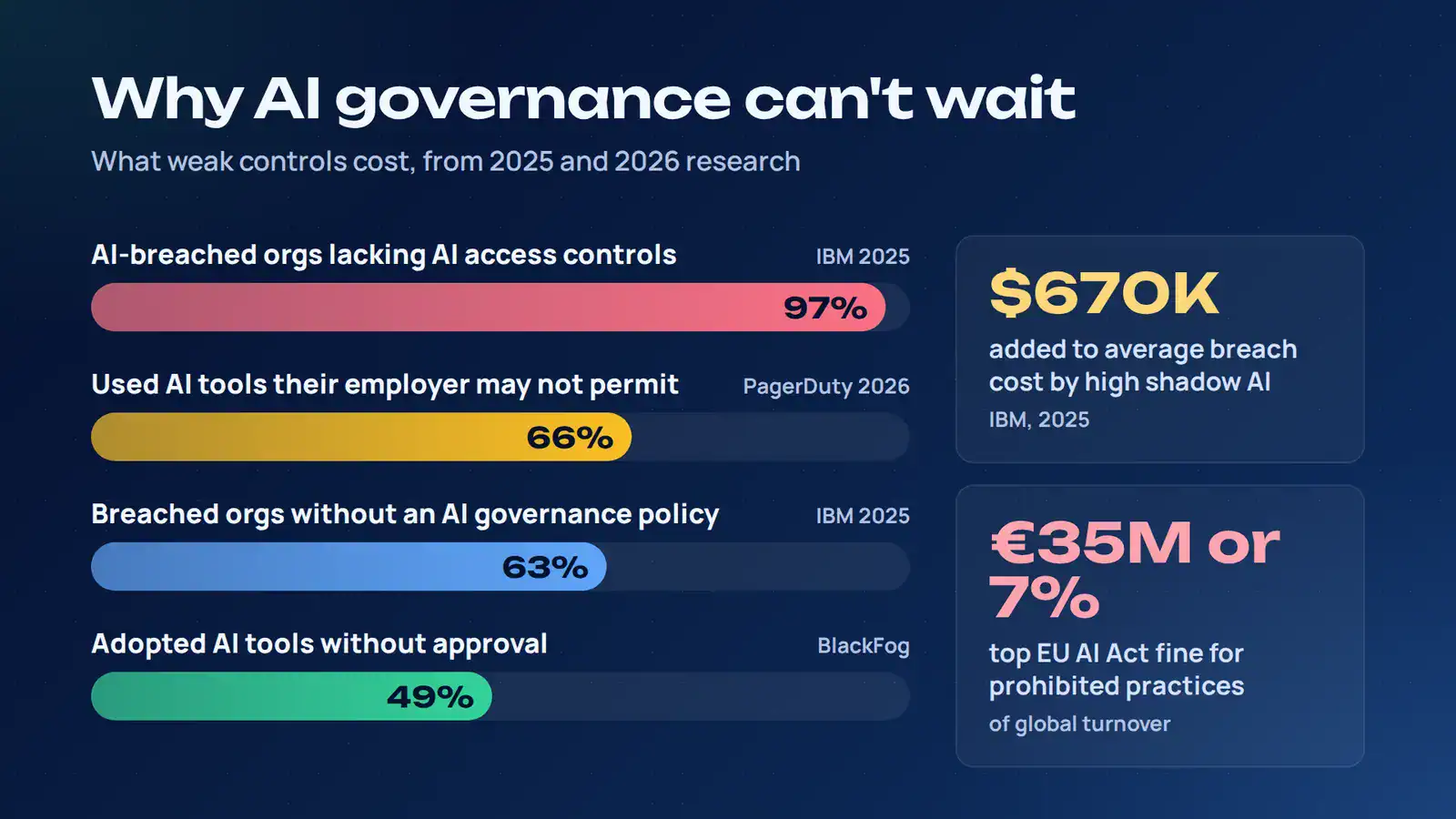
An enterprise AI governance framework is the set of policies, roles, controls, and review processes that governs how your organization builds, buys, deploys, and monitors AI. It replaces department level decisions with one standard. The gap is large today. A 2026 PagerDuty survey found that 66% of office professionals used AI tools they believed their employer did not permit.
This guide explains the principles, components, and implementation steps behind effective governance. It also provides six policy templates. Each template lists its purpose, required sections, and customization guidance, so your legal, security, and data teams can adapt them directly.
Organizations that build their own AI products should apply these controls during design. A partner that offers custom generative ai development services can build logging, access limits, evaluation steps, and human review into the product architecture from the first release.
What Is an Enterprise AI Governance Framework?
It is the formal structure that connects your AI principles to daily operations. Principles state what you value, such as fairness and accountability. The framework turns them into approval gates, technical controls, documentation standards, and audit evidence. As a result, every AI system follows the same path from proposal to retirement.
What Is Enterprise AI Governance?
Enterprise AI governance is the discipline of directing and controlling AI use across an entire organization. It covers internal models, vendor tools, and AI features embedded in existing software. A complete program answers six questions:
- Who approves a new AI system, and on what criteria?
- Which data can each system collect, process, and store?
- How do teams test accuracy, bias, and security before launch?
- Who monitors performance and policy compliance after launch?
- How does the organization respond when a system fails or causes harm?
- How does it prove all of this to regulators and customers?
AI Governance Framework vs. AI Policy
An AI governance framework is the full management system. An AI policy is one controlled document inside it. Confusing the two leaves organizations with rules but no owners, no evidence, and no enforcement.
| Aspect | Governance Framework | AI Policy |
|---|---|---|
| Scope | Entire AI lifecycle | One topic, such as acceptable use |
| Purpose | Sets structure, ownership, and oversight | Sets required and prohibited behavior |
| Contents | Principles, policies, roles, risk tiers, monitoring, audit | Rules, exceptions, consequences |
| Owner | AI governance committee | Policy owner in legal or security |
| Evidence | Registers, assessments, logs, metrics | Signed acknowledgments |
| Review cycle | Annual redesign, quarterly checks | Quarterly or on tool change |
How an AI Governance Program Works
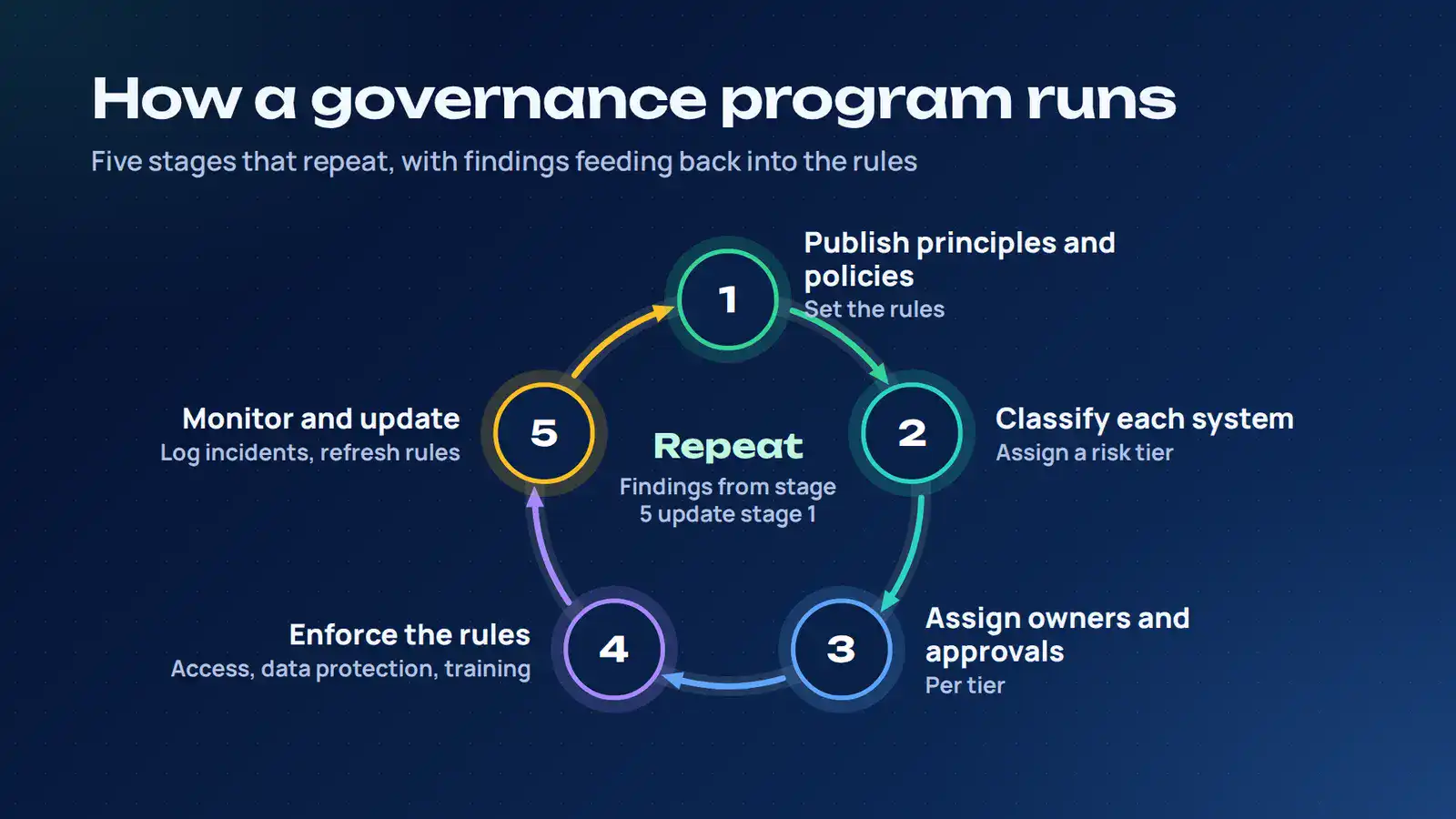
The program runs as a repeating cycle with five stages:
- Publish principles and policies that set the rules.
- Classify each AI system by risk tier.
- Assign owners and approval paths for every tier.
- Enforce rules through access controls, data protection, and training.
- Monitor outcomes, log incidents, and update the rules.
Findings from stage five feed back into stage one. That feedback loop keeps the program current as models and regulations change.
Why AI Governance Matters in 2026
AI adoption now moves faster than the controls around it. Consequently, security exposure, legal liability, and untracked tools grow together.
Managing AI Security and Data Privacy Risks
Weak governance has a measurable cost. IBM’s 2025 Cost of a Data Breach report found that 63% of breached organizations had no AI governance policy or were still developing one. High levels of shadow AI added $670,000 to the average breach cost. In addition, 97% of organizations that reported a breach of an AI model or application lacked proper AI access controls.
The attack surface also differs from traditional software. Prompt injection, training data leakage, insecure plugins, and excessive agent permissions all require controls that standard application security reviews miss.
Meeting Regulatory and Compliance Requirements
The EU AI Act sets the global reference point. Penalties reach up to €35 million or 7% of global turnover for prohibited practices. The Digital Omnibus moved stand-alone high-risk obligations to 2 December 2027 and embedded systems to 2 August 2028.
However, a later date does not shorten the preparation time. Risk management files, technical documentation, data governance records, and oversight procedures take months to build. A single internal standard also reduces rework when additional regions add their own rules.
Reducing Shadow AI Across the Enterprise
Shadow AI is any AI tool used without IT or security approval. A BlackFog survey found that 49% of workers adopted AI tools without employer approval, and many used free versions that retain input data.
Prohibition alone fails because employees use these tools to save time. Effective governance pairs clear restrictions with approved alternatives, network visibility, and a fast request process.
Building Trust Without Slowing AI Adoption
Customers, auditors, and partners increasingly ask how AI decisions are controlled. Documented governance answers those questions quickly. Speed also improves when you apply tiered review:
- Publish a catalog of pre-approved tools and use cases.
- Route low risk requests through a short form with automatic approval.
- Reserve committee review for high impact systems.
Core Principles of an Effective AI Governance Framework
A strong enterprise AI governance framework rests on six principles. Each one converts into specific policies and controls described later in this guide.
1. Accountability and Clear Ownership
Every AI system needs a named business owner and a technical owner. The business owner answers for purpose and outcomes. The technical owner answers for security, performance, and change control. Without both, issues pass between teams without resolution.
2. Transparency and Explainability
Teams must be able to describe what a system does, what data it uses, and why it produced a given output. Maintain model cards, data lineage records, and decision logic summaries. In addition, disclose AI interaction to users where law or ethics require it.
3. Risk-Based Governance
A spell checker and a loan approval model do not carry equal risk. Score each system on impact, data sensitivity, autonomy, and reversibility, then scale controls to the score. This approach concentrates effort where harm is greatest.
4. Privacy and Data Protection
AI systems must follow existing data rules. Apply data minimization, purpose limits, retention schedules, and deletion rights to prompts, outputs, embeddings, and training sets. Run a data protection impact assessment for systems that process personal data at scale.
5. Human Oversight and Fairness
People remain responsible for decisions that affect other people. Test models for disparate outcomes across relevant groups before launch and after every material change. Reviewers need the authority and the information to override an AI output.
6. Continuous Monitoring and Improvement
Model behavior shifts as data and usage change. Track accuracy, drift, error rates, and incidents on a fixed schedule. Then feed the results back into policy updates and retraining decisions.
Key Components of an Enterprise AI Governance Framework
An enterprise AI governance framework includes policies, risk assessments, defined responsibilities, data security controls, compliance documentation, and continuous monitoring.
AI Policies and Acceptable Use Rules
Your AI governance policy sets binding rules for AI use. It lists approved tools, restricted data types, required reviews, and consequences for violations. Supporting standards then translate the policy into technical settings, such as logging requirements and retention periods. Keep the policy itself short so employees read it.
AI Risk Assessment and Classification
Maintain a central register of AI systems. Score each entry for impact, data sensitivity, autonomy, and regulatory exposure. Then assign a tier. The tier determines testing depth, documentation, approvers, and monitoring frequency.
Governance Roles and Responsibilities
Document AI governance roles and responsibilities before launching tools. A workable structure includes:
- An executive sponsor who owns the program and its budget
- A governance committee that approves high-risk systems and resolves disputes
- System owners who manage performance and risk day to day
- Legal, privacy, and security reviewers who sign off on assessments
- An incident lead who runs response and reporting
Data Governance and Security Controls
AI safety depends on the data and access around the model. Apply data classification, role-based access, encryption in transit and at rest, and prompt and output logging. Segment training data from production data. For deeper guidance, read this resource on protecting enterprise data in AI systems.
Regulatory Compliance and Documentation
Keep a file for each system with its purpose, data sources, test results, approvals, known limitations, and change history. Map each control to the regulation or standard it satisfies, such as the EU AI Act, NIST AI RMF, or ISO/IEC 42001. Auditors request this evidence first.
AI Monitoring, Auditing, and Incident Response
Track model performance, drift, usage, and policy violations through dashboards with alert thresholds. Audit high risk systems at least twice a year. Your incident plan should cover containment, stakeholder notification, regulatory reporting, root cause analysis, and policy updates.
Enterprise AI Governance Policy Templates for 2026
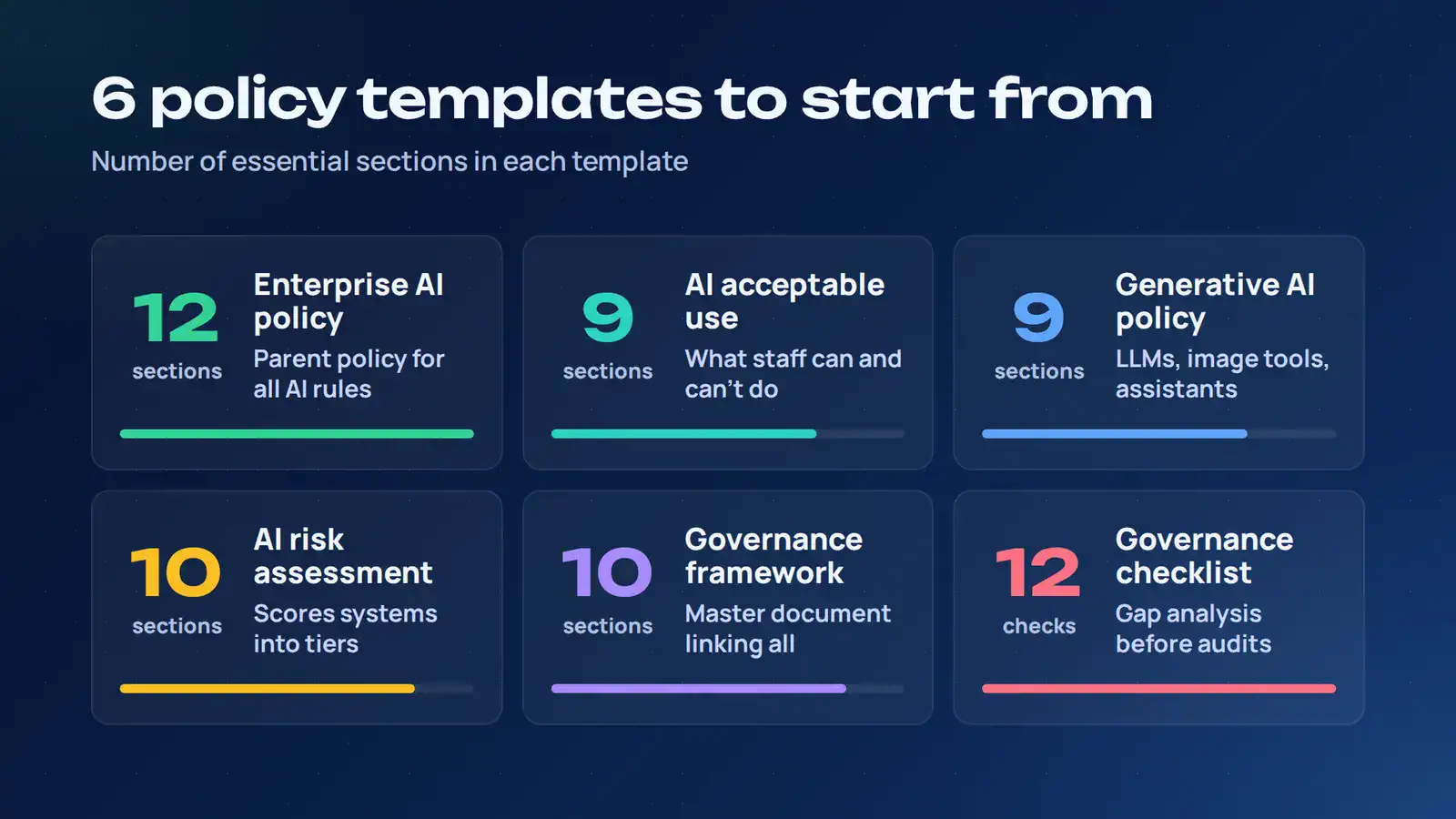
A well built AI policy template reduces drafting time and keeps documents consistent. Use the six templates below as starting points. Each lists its purpose, essential sections, and customization steps.
1. Enterprise AI Policy Template
Purpose:
Sets organization wide rules for AI development, procurement, and use. It is the parent document for all other AI policies.
Essential sections:
1. Purpose and scope
2. Definitions (AI system, model, agent, shadow AI, high risk system)
3. Governing principles
4. Roles and responsibilities
5. Risk classification requirements
6. Data handling and privacy rules
7. Approval process for new AI systems
8. Vendor and third party requirements
9. Training requirements
10. Incident reporting
11. Enforcement and consequences
12. Review schedule and version history
How to customize:
- Add the regional laws that apply to your operations.
- Replace generic roles with real committee names and approval forms.
- Link each section to the technical standard that enforces it.
- Set a review date no later than 12 months out.
2. AI Acceptable Use Policy Template
Purpose:
Tells employees exactly which AI tools and behaviors are allowed. It is the most visible policy, so clarity matters more than detail.
Essential sections:
1. Approved tools and access method
2. Permitted use cases
3. Prohibited use cases
4. Data that must never enter AI tools
5. Output verification requirements
6. Disclosure rules for AI assisted work
7. Process for requesting a new tool
8. Violation reporting and consequences
9. Employee acknowledgment
How to customize:
- Update the approved tools list whenever the catalog changes.
- Define restricted data in your own terms, such as client contracts, source code, or health records.
- Keep the final document to two pages.
3. Generative AI Policy Template
Purpose:
Controls large language models, image generators, and AI assistants, which create outputs that need verification.
Essential sections:
1. Approved generative AI platforms
2. Prompt and data restrictions
3. Rules for customer facing content
4. Intellectual property and licensing guidance
5. Output verification and fact checking
6. Labeling of AI generated content
7. Vendor retention and training terms
8. Logging and monitoring
9. Prompt injection and security requirements
How to customize:
- Align restrictions with your data classification levels.
- Add mandatory expert review for legal, medical, and financial content.
- Prohibit personal accounts for company work.
4. AI Risk Assessment Template
Purpose:
Produces a repeatable score that assigns each system to a risk tier.
Essential sections:
1. System name, owner, and business purpose
2. Data types and sensitivity
3. Users and affected individuals
4. Level of autonomy
5. Impact of failure or error
6. Bias and fairness evaluation
7. Security and privacy risks
8. Legal and regulatory flags
9. Risk score and tier
10. Required controls and approver sign off
How to customize:
- Rate each factor from 1 to 5 and define score ranges for each tier.
- Add questions specific to your industry.
- Require reassessment after any change to the model, data, or use case.
5. AI Governance Framework Template
Purpose:
Works as the master document of your enterprise AI governance framework and links every policy, standard, and procedure.
Essential sections:
1. Vision and objectives
2. Guiding principles
3. Governance structure and committee charter
4. Risk tiers and review requirements
5. Policy and standards library index
6. Technical control standards
7. Compliance mapping (EU AI Act, NIST AI RMF, ISO/IEC 42001)
8. Monitoring metrics and reporting
9. Incident response process
10. Review and improvement cycle
How to customize:
- Map each section to the standards your regulators expect.
- Begin with a one page version, then expand as the program matures.
- Assign an owner and review date to every section.
6. AI Governance Checklist for Enterprises
Purpose:
Verifies that each core control exists and works. Use this AI governance checklist for gap analysis before an audit or program launch.
✔ Complete inventory of AI systems, models, and agents
✔ Risk tier assigned to every system
✔ Business and technical owner named for every system
✔ Governance committee with a written charter
✔ Published acceptable use policy
✔ Data classification applied to AI inputs
✔ Access controls and logging in place
✔ Vendor risk reviews completed
✔ Employee training delivered and tracked
✔ Monitoring dashboards live with alert thresholds
✔ Incident response plan tested within 12 months
✔ Policy review dates scheduled
How to customize:
Add lines for industry rules. Score each line as complete, partial, or missing. Then assign an owner and deadline to every gap.
How to Implement an Enterprise AI Governance Framework
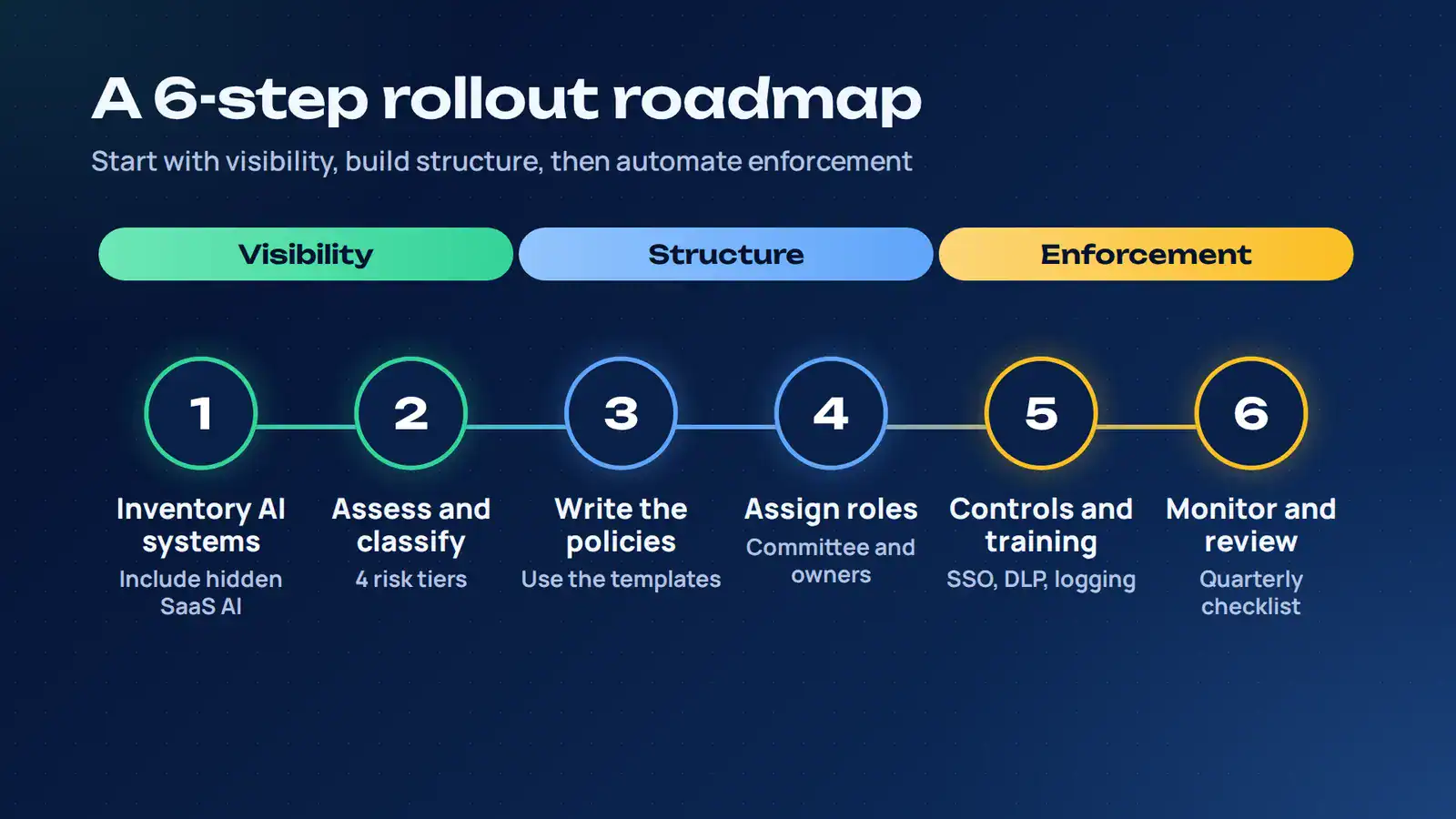
This section shows how to implement AI governance in six steps. Start with visibility, build structure, and then automate enforcement. Six step roadmap for AI governance are given below.
Step 1: Inventory Existing AI Systems
Visibility comes first. List every AI tool, model, and agent in use, including AI features inside software you already own. Survey each department, then compare the results against SaaS logs, browser telemetry, and network traffic to find tools nobody reported.
Record the owner, purpose, data used, vendor, and deployment date for each entry.
Step 2: Assess and Classify AI Risks
Run each system through your AI risk assessment template and assign one of four tiers. Prohibited systems are not built or bought. High risk systems receive full review. Limited risk systems need disclosure and output checks. Minimal risk systems follow standard use rules.
Review the high risk tier first. Systems that influence hiring, credit, health, or safety carry the greatest exposure.
Step 3: Develop AI Governance Policies
Write the acceptable use, generative AI, data handling, and vendor policies. Use the AI governance framework template as the master document. Define terms precisely and include concrete examples of allowed and prohibited actions.
Circulate drafts to legal, security, HR, and business leaders. Publish only after all reviewers sign off.
Step 4: Assign Governance Roles and Responsibilities
Form a governance committee with members from legal, security, privacy, data science, engineering, and business units. Give it written authority to approve, pause, or retire AI systems. Then name owners for every system and record their duties in the register.
Step 5: Implement Technical Controls and Training
Policies fail without enforcement. Implement these controls:
- Single sign on and role based access for all AI tools
- Data loss prevention that blocks sensitive data in prompts
- Logging for prompts, outputs, and model changes
- An approved tool catalog with a simple request form
For customer-facing assistants, work with a chatbot development company that builds guardrails, escalation paths, and audit logs into the bot. Training matters equally. Short, role-specific sessions keep rules relevant to daily work.
Step 6: Monitor Compliance and Review Policies
Track usage, violations, and system performance continuously. Run the AI governance checklist each quarter and report results to the committee. After any incident, update the failed control, retest it, and share the lesson across teams.
AI Governance Best Practices for Enterprise Teams
AI governance best practices help enterprise teams manage risks without unnecessarily restricting AI adoption. These practices include risk-based controls, clear ownership, employee training, governance throughout AI development, and regular performance reviews.
1. Align Governance With Business Goals
Tie your enterprise AI governance framework to measurable outcomes, such as faster approvals, fewer incidents, and safer data use. When leaders see business value, funding and cooperation follow.
2. Apply Controls Based on Risk Levels
Give low risk tools a light review and high risk systems a deep one. This protects speed where risk is small. Learn more about AI risk management strategies for scaling controls.
3. Integrate Governance Into AI Development
Embed checks in the delivery pipeline. Require a risk assessment before development, bias and security tests before release, and sign off before production. Governance then becomes part of normal engineering work.
4. Train Employees on Responsible AI Use
Teach employees which data to protect, how to verify outputs, and how to report problems. Repeat training when tools or rules change.
5. Review Policies and Track Governance Metrics
Report these metrics to the committee each quarter:
- Percentage of AI systems inventoried and classified
- Average time to approve a new tool
- Number of policy violations and incidents
- Percentage of employees trained
- Audit findings closed on schedule
AI Governance for Generative AI and Autonomous Agents
AI governance for generative AI and autonomous agents establishes rules for data access, model behavior, tool permissions, and human oversight.
1. Generative AI Governance and Data Protection
Generative AI adds risks of data leakage, inaccurate outputs, and intellectual property disputes. Apply the generative AI policy template to every tool. Block confidential data from public models, require human review of customer facing content, and test for prompt injection.
2. AI Model Governance Across the Lifecycle
Extend your enterprise AI governance framework across every lifecycle stage: data sourcing, training, evaluation, deployment, monitoring, and retirement. Register each model, version it, and keep a change log. Re-evaluate after every retraining or prompt change.
3. AI Agent Governance Framework and Access Controls
Agents call tools, change records, and trigger workflows without a person in each step. An AI agent governance framework must therefore limit what each agent can do.
- Assign every agent a unique identity.
- Grant the least access needed for the task.
- Log every action and tool call.
- Set spending, rate, and scope limits.
- Add a kill switch that stops the agent immediately.
Review how AI agents operate inside enterprise workflows before setting permissions.
4. Human Approval for High-Impact AI Actions
Require a person to approve actions that move money, change customer records, send external messages, or affect safety. Show the reviewer the agent’s reasoning and proposed action. Record who approved it and when.
AI Governance Challenges and How to Address Them
Common AI governance challenges include shadow AI, regulatory complexity, third-party risks, and rapidly changing technology. Businesses can address these issues through clear policies, risk-based reviews, employee training, vendor assessments, and continuous monitoring.
Managing Shadow AI and Unapproved Tools
Publish a tailored AI acceptable use policy template version and pair it with approved alternatives. Monitor network traffic for unknown AI services, and offer an easy request path so employees do not build workarounds.
Balancing AI Innovation With Risk Controls
Create a sandbox where teams test ideas with synthetic or low risk data. Move to production only after a risk review. Experiments stay fast and production stays controlled.
Maintaining Compliance Across Multiple Regions
Build your enterprise AI governance framework around the strictest rule that applies to you, then add local requirements. Maintain a regulation map that links each law to your internal controls, and assign legal owners to track updates.
Governing Third-Party AI Tools and Vendors
Review every vendor before purchase. Ask where data is stored, whether it trains their models, how long they retain it, and which security certifications they hold. Write these terms into contracts and reassess annually.
Keeping Policies Current as AI Evolves
Treat AI governance implementation as an ongoing program. Review policies each quarter. Add triggers for out of cycle updates, such as a new regulation, a new model class, or a major incident.
AI Governance in Regulated Industries
Regulated sectors need a stricter version of your enterprise AI governance framework. Add sector rules on top of your core controls.
AI Governance in Healthcare
Protect patient data under HIPAA and local privacy laws. Validate clinical tools for accuracy across patient groups. Keep clinicians in the decision loop and document every AI assisted recommendation.
AI Governance in Financial Services
Treat AI models as model risk. Validate, document, and independently review them under your model risk management program. Test credit and fraud models for bias, and keep explanations available for adverse decisions.
AI Governance in Government and the Public Sector
Public agencies owe citizens transparency. Publish where AI informs decisions, run impact assessments, and keep appeal paths open. Align with the NIST AI Risk Management Framework and procurement rules.
AI Governance in Education
Protect student data under laws such as FERPA and COPPA. Set clear rules for academic integrity. Review tools for age appropriateness and bias before classroom use.
How Cubix Helps Businesses Build Enterprise AI Solutions
Cubix helps businesses develop enterprise AI solutions tailored to their workflows, technical requirements, and business goals. Its team works with organizations to identify suitable AI applications that address operational challenges and support informed decision-making.
Through its large language model development services, Cubix helps organizations build AI systems designed for specific business use cases. These solutions can support knowledge retrieval, document processing, customer interactions, and internal workflows.
Enterprise AI solutions also require careful attention to data security, access permissions, and human oversight. Cubix helps businesses develop AI applications around their requirements, supporting responsible AI adoption while aligning system functionality with organizational policies and governance needs.
Conclusion
A working enterprise AI governance framework gives your teams clear rules, named owners, and controls that match risk. Start by inventorying your systems and classifying their risk. Then adopt the templates above, assign roles, and enforce them with technical controls.
Review everything on a fixed schedule. AI tools and regulations keep changing, and your governance program must change with them.
Ready to put governance into practice? Book a free consultation
Contact UsFrequently Asked Questions
1. What should an enterprise AI governance policy include?
It should include scope, definitions, principles, roles, risk tiers, approved tools, data rules, approval steps, training, incident reporting, enforcement, and a review schedule.
2. What is the difference between an AI governance framework and an AI policy?
A framework is the complete system of principles, roles, controls, and monitoring. A policy is a single document that sets rules for one area, such as acceptable use.
3. Who should be responsible for AI governance in an enterprise?
An executive sponsor owns the program. A cross functional committee approves high risk systems. System owners handle daily performance, and legal, security, and privacy teams review compliance.
4. How can businesses adapt an AI policy template to their needs?
Replace generic terms with your tools, data classes, and approval forms. Add laws that apply to your regions and industry. Then have legal and security review it. Start with the enterprise policy and add specialized versions later.
5. How should enterprises govern generative AI tools and AI agents?
Approve specific tools, block sensitive data in prompts, and require human review of external content. For agents, apply an AI agent governance framework with unique identities, least access, action logs, and human approval for high impact actions.
6. How often should an AI governance policy be reviewed?
Review every quarter and after any major change in regulation, technology, or incident. Run a full redesign once a year.
7. How can businesses prevent employees from sharing sensitive data with AI tools?
Combine four measures: an approved tool catalog, data loss prevention in browsers and endpoints, clear rules on restricted data, and short recurring training.
8. What is the difference between NIST AI RMF and ISO/IEC 42001?
NIST AI RMF is a voluntary US framework organized around four functions: Govern, Map, Measure, and Manage. ISO/IEC 42001 is an international management system standard that you can certify against. Many enterprises use NIST to guide risk work and ISO to prove it.