Key Takeaways
- A strong video game script combines story, dialogue, player choices, quests, and gameplay to create an engaging interactive experience.
- Start with the game concept, world, characters, and story structure before writing dialogue to keep the narrative focused and consistent.
- Meaningful player choices should have real consequences, with branching paths, story flags, relationships, and multiple outcomes mapped clearly.
- Connect narrative beats with gameplay mechanics so the story supports what players are doing instead of interrupting the gameplay experience.
- Use consistent script formatting, flowcharts, and narrative tools such as Twine or Articy: Draft to manage dialogue, quests, branching stories, and production workflows.
A weak script can sink a great game idea. Strong dialogue, on the other hand, keeps players hooked long after the credits roll. If you want to know how to write a video game script that actually holds a game together, you need more than good writing skills. You need to understand pacing, player choice, and how story connects to gameplay.
The opportunity for story-driven games is also growing. The global narrative game platforms market was valued at $12.4 billion in 2025 and reached $13.6 billion in 2026, projecting to reach $28.9 billion by 2034, growing at a 9.8% CAGR from 2026 to 2034.
This guide breaks the process into clear, actionable steps you can follow, whether you’re a solo developer or part of a full studio team. Once your script is ready, the next step is turning your narrative into an engaging mobile experience. You can hire mobile game development company to help bring the story, characters, mechanics, and interactive elements together.
Want to discuss your project? Our experts are just a click away.
Contact Us
What Is a Video Game Script?
A video game script is the written blueprint for everything a player hears, reads, and experiences through the story. It covers dialogue, narration, cutscenes, and the branching paths a player might take.
Unlike a novel, a game script has to account for interaction. The player isn’t just watching a story unfold. They’re shaping it.
This matters in a market with billions of players worldwide. Industry estimates put the global player base at approximately 3.6 billion people, including around 1.6 billion paying users in 2026. With such a large and diverse audience, a game’s narrative needs to give players a reason to stay engaged rather than simply move them from one level to another.
What Does a Video Game Script Include?
A complete script usually contains:
- Character dialogue and voice-over lines
- Scene descriptions and cutscene directions
- Branching choice points and their outcomes
- Quest and mission text
- In-game notes, item descriptions, and environmental storytelling
- Stage directions for animation and camera work
Think of it as a hybrid between a screenplay and a technical document. It needs to read well and function well inside a game engine.
How Is a Game Script Different From a Movie Script?
A movie script follows one fixed path from beginning to end. A video game script, however, often needs to account for multiple outcomes. As a result, the video game script format looks different on the page.
| Element | Movie Script | Video Game Script |
| Structure | Mostly linear | Linear, branching, or modular |
| Player input | None | Central to the experience |
| Pacing | Fixed runtime | Often player-controlled |
| Dialogue delivery | Actor performance | Voice lines, text, subtitles, and UI |
| Endings | Usually one | Can have multiple outcomes |
Because of this, game writers work closely with designers from day one. A script that ignores gameplay mechanics rarely survives production.
Why Is a Script Important in Game Development?
The script gives every department something to build around. Artists need it for tone and setting. Designers need it for pacing and mission structure. Programmers need it for dialogue systems and branching logic.
Without a solid script, teams end up guessing at intent. That leads to wasted hours and inconsistent storytelling. A custom game development company will typically bring writers into pre-production early for exactly this reason.
The scale of the broader games industry reinforces why narrative planning matters. The global games market is projected to reach roughly $205 billion in 2026, representing a 4.6% increase over 2025.
What Makes a Good Video Game Script?
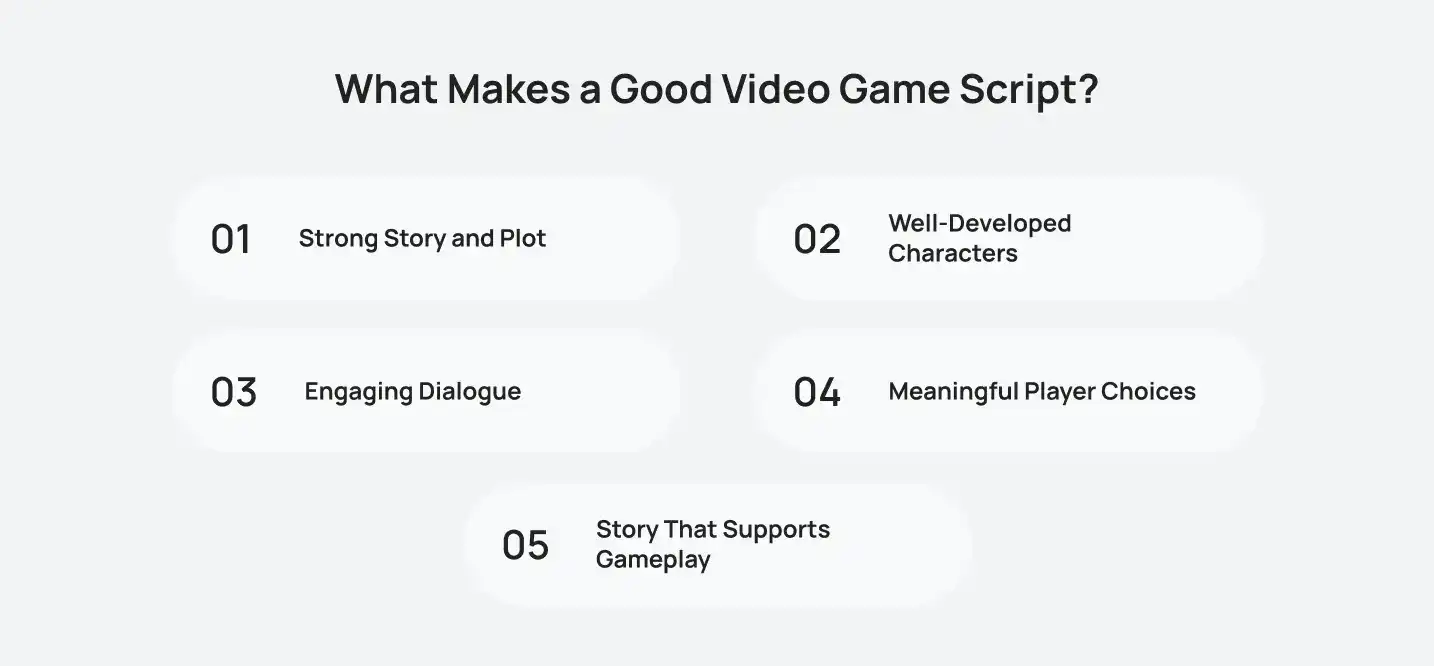
Not every well-written script makes a good game. Video game story writing has its own rules, and they differ from traditional fiction in a few key ways.
1. Strong Story and Plot
Your plot needs a clear goal, real stakes, and a reason for the player to keep going. However, it also needs room to breathe.
Players explore, backtrack, and take detours, so your plot should tolerate a flexible pace without losing its shape.
That flexibility is particularly important for narrative-focused games. The narrative game platforms market is expanding as developers invest in immersive storytelling, player agency, branching dialogue, and interactive experiences. DataIntelo narrative game platforms market report
2. Well-Developed Characters
Players spend dozens of hours with game characters, often far longer than they’d spend with a movie cast. Because of this, character development has to go deeper.
Give your cast clear motivations, flaws, and growth arcs that respond to what the player does.
A strong character should not simply exist to deliver exposition. Their goals should influence quests, dialogue, conflicts, and sometimes the player’s available choices.
3. Engaging Dialogue
Good video game dialogue writing sounds natural when spoken aloud. Cut anything that feels like exposition dumped on the player.
Instead, let characters reveal information through conflict, humor, tension, and interaction.
Keep lines relatively short, especially when players are moving through an active gameplay sequence. Dialogue should enhance the experience rather than interrupt it.
4. Meaningful Player Choices
Choices should carry real weight. If every option leads to the same outcome, players notice quickly and stop caring.
Branching dialogue in video games works best when consequences show up later, sometimes hours after the original decision.
This is one reason narrative design has become an increasingly important part of modern game production. Story-driven experiences are no longer limited to traditional adventure games; narrative elements now appear across RPGs, mobile games, horror titles, action games, and interactive fiction.
5. Story That Supports Gameplay
Your narrative and your mechanics should point in the same direction.
A stealth game with a story about loud, aggressive combat feels disjointed. Align the two, and the whole experience feels intentional rather than bolted together.
The best game scripts understand what the player is doing at every stage and use the story to make those actions feel meaningful.
How to Write a Video Game Script: Step by Step
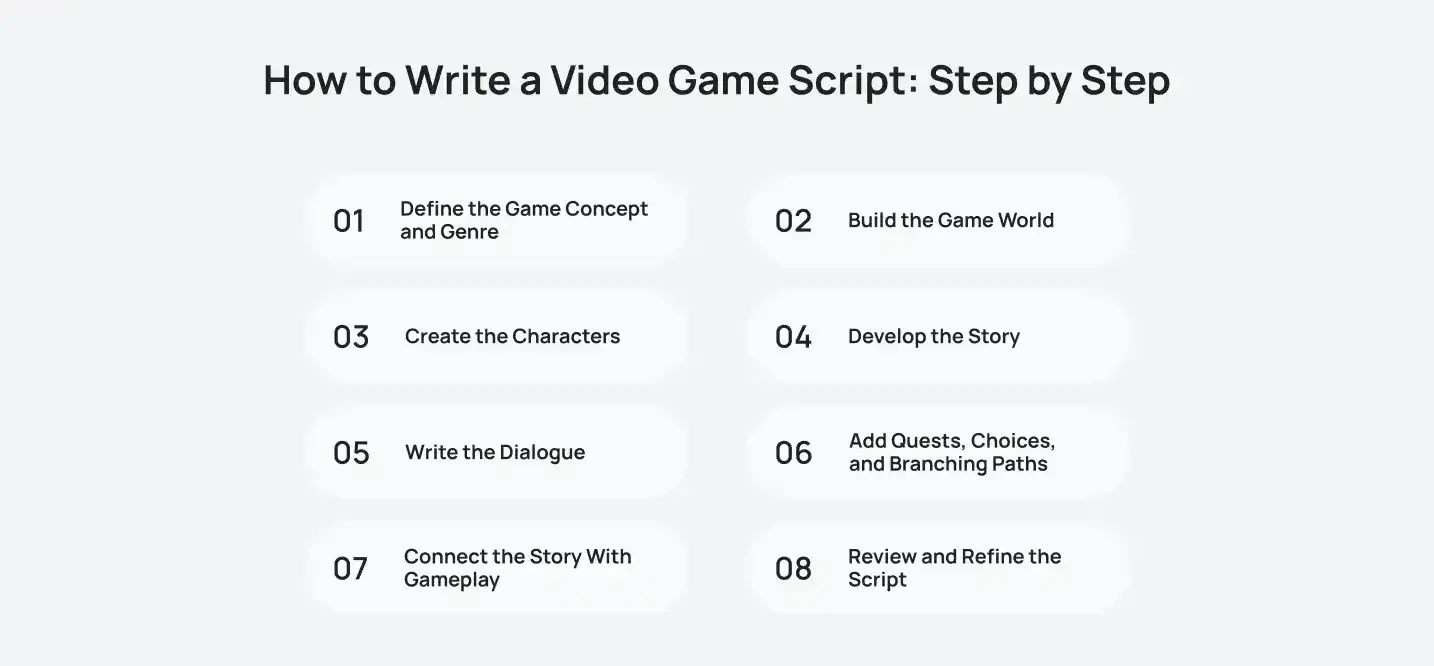
Writing a video game script takes planning, clear formatting, and teamwork with game makers. You must define your core story, build your characters, outline the plot, write dialogue, and format the script properly for production.
1. Define the Game Concept and Genre
Start with the basics. What genre are you writing for?
A horror game needs different pacing than a puzzle platformer. An RPG may require hundreds of characters, quests, dialogue branches, and lore entries, while a short narrative adventure may rely heavily on scripted scenes.
Nail down the tone, target audience, and core gameplay loop before you write a single line of dialogue.
2. Build the Game World
Your setting shapes everything else.
Game worldbuilding includes history, culture, politics, geography, and the rules that govern your world, whether that’s magic systems or futuristic technology.
Consistency matters here more than volume. A smaller, coherent world beats a sprawling one full of contradictions.
3. Create the Characters
Sketch out your main cast, including their backstories, goals, motivations, and relationships to one another.
Give side characters a clear purpose too. If a character doesn’t affect the plot, reveal something about the world, support gameplay, or create a meaningful interaction, consider cutting them.
4. Develop the Story
Outline your main arc, then map key turning points.
Your story outline should answer basic questions:
- What does the player need to accomplish?
- What stands in the player’s way?
- What changes after each major event?
- Where can the player make meaningful decisions?
- What happens when the player succeeds or fails?
The growing market for narrative-focused games shows why these decisions matter. The global narrative adventure games market is projected to grow at an 8.0% CAGR between 2026 and 2034, reflecting continued interest in story-driven interactive experiences.
5. Write the Dialogue
This is where video game script writing gets granular.
Write dialogue in short exchanges. Give each character a distinct voice through word choice, rhythm, and tone.
Read every line out loud before locking it in. If something sounds unnatural when spoken, rewrite it.
6. Add Quests, Choices, and Branching Paths
Quest design connects your story to actual player tasks.
Each quest should tie back to a character motivation or plot thread. When you add choices, map out every branch so you don’t lose track of consequences later in production.
For larger projects, create a clear system for tracking:
- Dialogue branches
- Story flags
- Character relationships
- Quest states
- Player decisions
- Multiple endings
7. Connect the Story With Gameplay
Check that your narrative beats line up with gameplay moments.
A big story reveal shouldn’t land in the middle of an unrelated side quest. Pacing your story around gameplay, rather than around chapters alone, keeps players immersed.
This becomes particularly important in mobile games. Mobile gaming is projected to generate roughly $107 billion in 2026, representing about 52% of total gaming revenue. Mobile audiences often experience games in shorter sessions, so narrative pacing needs to account for how and when players engage with the game.
8. Review and Refine the Script
Read through the entire script for consistency.
Check character voice, timeline logic, worldbuilding, quest dependencies, and whether choices actually matter. This is also the stage where you test dialogue in theGame Design Document (GDD) engine to see how it lands with voice acting and animation.
If you’re mapping this process against a broader production timeline, this guide to game development walks through how narrative work fits alongside art, design, and engineering milestones.
How to Structure and Format a Video Game Script
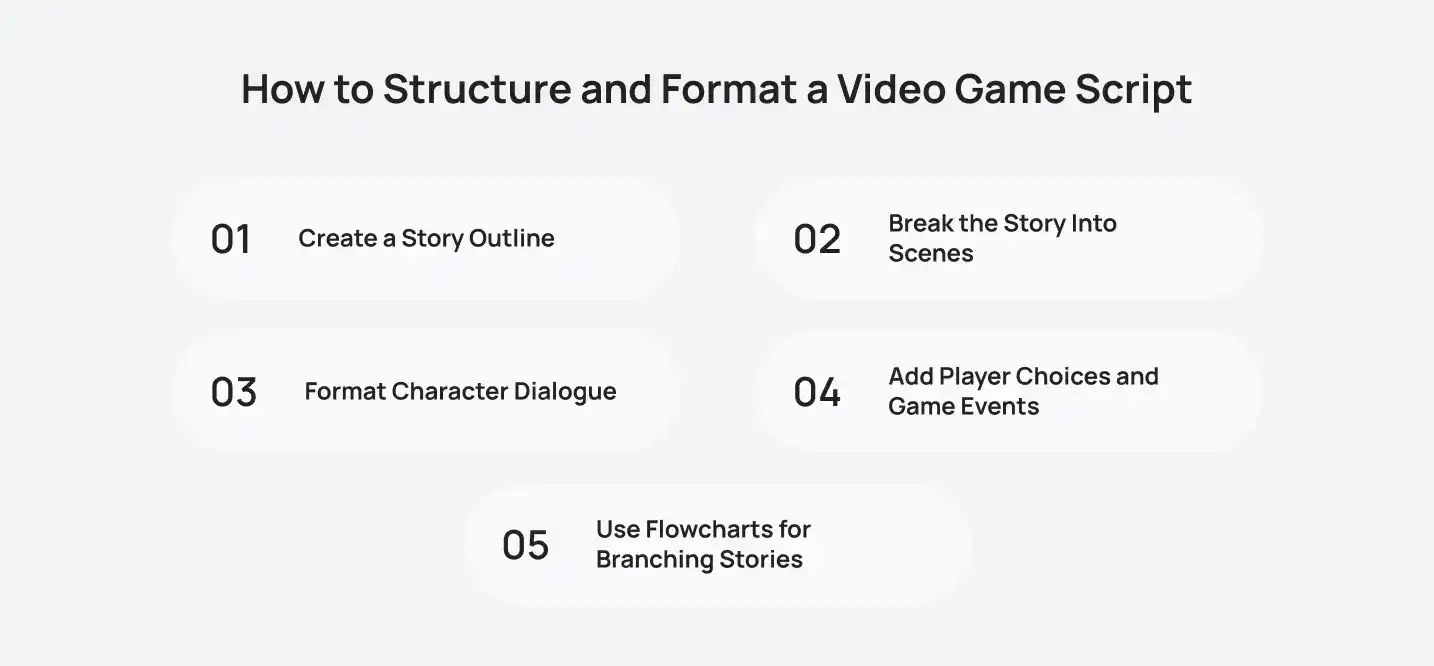
Structuring and formatting a video game script requires mixing standard cinematic screenplay formats with interactive logic, spreadsheets, and node-based flowcharts. Because games are non-linear, writers use specialized tools and modular formats rather than one single linear document.
1. Create a Story Outline
Start with a high-level outline.
List your acts, major beats, and where branching paths split and reconnect. This becomes your map for the entire writing process.
2. Break the Story Into Scenes
Break your outline into individual scenes.
Each scene should have a clear purpose, whether that’s revealing character, advancing the plot, introducing a quest, or delivering gameplay instructions.
3. Format Character Dialogue
A clean video game script template usually lists the character name, the dialogue line, and any relevant tags for tone, animation cues, or branching conditions.
For example:
CHARACTER: [Name]
LINE: [Dialogue text]
TAG: [Emotion / Trigger / Branch condition]
Keeping a consistent format saves time when your script gets loaded into a game engine or dialogue system.
4. Add Player Choices and Game Events
Mark choice points clearly, along with the conditions that trigger them.
Note any variables the choice affects, such as reputation, relationships, inventory, quest states, or story flags.
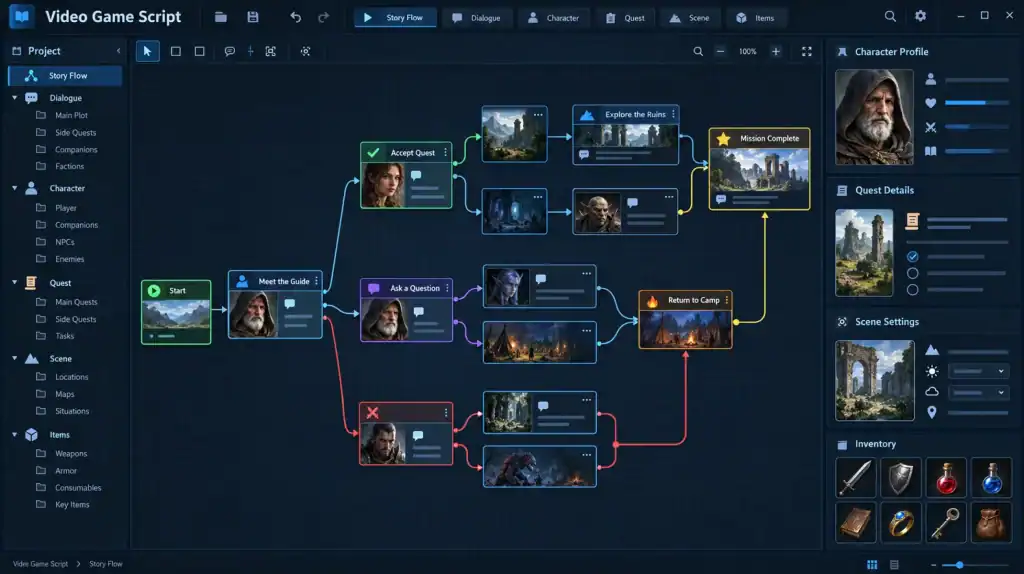
5. Use Flowcharts for Branching Stories
Text alone struggles to show branching structure clearly.
Flowcharts let writers and designers see the full shape of a story at a glance, including dead ends, loops, and points where paths converge again.
For a large branching game, this can prevent narrative problems from becoming expensive technical problems later in development.
What Tools Can You Use to Write a Video Game Script?
You can use dedicated screenwriting software and narrative design tools to write a video game script. Popular choices include Twine, Final Draft, Fade In, Arcweave, and Inklewriter.
Twine
Twine is a free, open-source tool built for interactive fiction and branching narratives. It’s useful for prototyping dialogue trees before committing them to a full production pipeline.
Articy: Draft
Articy: Draft is designed for game narrative design. It can help organize characters, dialogue, story structures, and quest logic in one workspace.
Final Draft
Final Draft works well for cutscene-heavy games that lean on cinematic storytelling. It’s also familiar to writers coming from film and television backgrounds.
Flowchart and Collaboration Tools
Tools such as Miro and Lucidchart can help teams visualize branching paths together.
These are particularly useful when writers, designers, and programmers need to review story logic in the same session.
The need for collaboration is increasingly important as narrative teams become part of larger production workflows. At the same time, AI is becoming a major discussion point within game development. According to the GDC 2026 State of the Game Industry Report, 63% of game design and narrative professionals surveyed held unfavorable views of generative AI’s impact on the industry.
For writers, the takeaway is simple: tools can support the workflow, but narrative quality still depends on human decisions around character, pacing, player agency, and story purpose.
Common Video Game Script Writing Mistakes to Avoid
Writing a video game script is different from writing a movie. You must blend a good plot with player choices. Avoiding common traps helps keep players interested in your story.
1. Writing Too Much Dialogue
Players skip long blocks of text. Trim dialogue down to what’s necessary, and let gameplay and visuals carry some of the storytelling weight instead.
2. Ignoring Gameplay
A script written in isolation from mechanics often creates friction once it hits the engine. Loop designers in early so story and gameplay develop together.
3. Creating Meaningless Player Choices
If every choice leads to the same result, players will notice. Give choices real consequences, even small ones, so they feel earned rather than decorative.
4. Weak Character Development
Flat characters break immersion fast. Give your cast internal conflict and growth, not just a role to fill in the plot.
5. Making the Story Too Complicated
Overloaded lore and convoluted plots frustrate players. Keep your core story clear, then layer in optional depth through side content for players who want more.
Final Video Game Script Writing Checklist
Use this checklist before you consider your script production-ready.
Story and Character Checklist
- Clear central conflict and goal
- Defined arcs for all major characters
- Consistent worldbuilding and lore
- No unresolved plot holes
Dialogue and Quest Checklist
- Dialogue reads naturally when spoken aloud
- Distinct voice for each character
- Every quest ties to a character or plot thread
- Dialogue formatted consistently throughout
Gameplay and Branching Checklist
- Story beats align with gameplay moments
- Branching paths mapped and tested
- Player choices carry real consequences
- Flowcharts match the final script
Editing and Testing Checklist
- Full script read-through for consistency
- Voice-over lines tested for length and tone
- Feedback gathered from designers and program=ers
- Final pass for grammar, pacing, and formatting
How Can Cubix Help You Develop a Story-Driven Video Game?
Building a story-driven game takes more than a talented writer. It takes a team that can turn a script into working systems, from dialogue engines to branching quest logic.
Cubix works with studios and independent developers to bring narrative-heavy projects from concept to launch, handling everything from game design documents to full production.
The team’s approach centers on keeping story and gameplay tightly connected from the earliest planning stages, rather than treating narrative as something to bolt on after mechanics are locked. That alignment is often what separates a script that reads well from one that actually plays well.
If you’re scoping out a project, this breakdown of video game development timeline expectations and this guide to game development cost can help you plan your budget and schedule around your narrative goals.
Want to discuss your project? Our experts are just a click away.
Contact Us
Frequently Asked Questions About Video Game Scripts
1. How to write a compelling video game script using popular game development tools?
Start with the game concept, characters, story arc, and gameplay mechanics. Use tools like Twine or Articy Draft to map dialogue, quests, and branching choices.
2. Best software for creating detailed video game scripts and storyboards?
Twine is ideal for branching narratives, while Articy: Draft helps manage complex game stories and dialogue. Final Draft works well for cinematic, cutscene-heavy games.
3. How to structure a compelling story for an interactive game experience?
Build the story around a clear goal, conflict, character arcs, and meaningful player choices. Divide it into scenes, quests, key events, and branching paths.4.
4. Step-by-step guide to crafting a video game narrative with industry-standard platforms?
Define the concept, build the world, create characters, outline the story, write dialogue, and map player choices. Then connect the narrative to gameplay and test the script.
5. Tips for creating believable characters in a game narrative?
Give each character clear goals, motivations, flaws, relationships, and a distinct voice. Make their decisions and development respond naturally to the player’s actions.
6. Where to find templates for professional video game scriptwriting software?
You can create templates based on your game’s production needs using tools like Twine, Articy: Draft, or Final Draft. Include character names, dialogue, scene directions, and branching conditions.
7. Software tools for organizing complex game plotlines and character arcs?
Articy: Draft is useful for organizing characters, dialogue, quests, and branching storylines. Twine and flowchart tools can also help visualize complex narrative structures.
8. How to integrate dialogue and gameplay in a video game script for immersive storytelling?
Write dialogue around what the player is doing rather than treating story and gameplay separately. Align dialogue, quests, mechanics, and story events to keep the experience cohesive.
9. Best practices for writing engaging dialogue in video games?
Keep dialogue concise, natural, and character-specific. Read lines aloud and remove unnecessary exposition so conversations support gameplay instead of slowing it down.
10. What are the key components of a professional video game script?
A professional game script typically includes dialogue, scene descriptions, quests, character actions, player choices, branching conditions, and gameplay events. Consistent formatting makes it easier for the development team to implement.