Key Takeaways
- The right game category depends on your business goals, not your ambition. Hyper-casual games are ideal for rapid validation, mid-core games balance retention and monetization, while AAA games require significant investment but offer the highest production value.
- Development costs, timelines, and team sizes increase dramatically across categories. Hyper-casual games can be built in a few months by small teams, whereas AAA titles often take several years and hundreds of developers.
- Player retention has become just as important as downloads. Rising user acquisition costs mean studios must focus on long-term engagement through progression systems, LiveOps, and fair monetization strategies.
- Outsourcing the right expertise can reduce costs and accelerate development. Partnering with an experienced game development company helps studios high-quality games while managing production risks effectively.
The game you decide to build shapes everything that follows. It affects your budget, development timeline, team size, marketing strategy, and how you earn revenue after launch. A simple hypercasual game can reach the market in a few months with a small team, while mid core games often require months of balancing, LiveOps planning, and long-term content updates. At the other end of the spectrum, AAA games can take hundreds of developers and budgets that exceed blockbuster Hollywood films.
If you’ve ever wondered what is a hypercasual game, what is a mid core game, or what is a AAA game, the answer comes down to player commitment. Hyper-casual titles focus on instant fun, mid-core games add progression and strategy, and AAA experiences aim to deliver premium production values across PC and consoles. None is “better” than the others. The right choice depends on your business goals.
The numbers support that decision. The global gaming industry is expected to generate more than $200 billion in revenue in 2026, with mobile gaming remaining the largest platform by revenue. At the same time, player acquisition costs continue to rise, making retention and lifetime value just as important as downloads.
So before writing a single line of code, you need to answer one question:
What kind of business are you actually trying to build?
Understanding Hyper-Casual, Mid-Core, and AAA Games
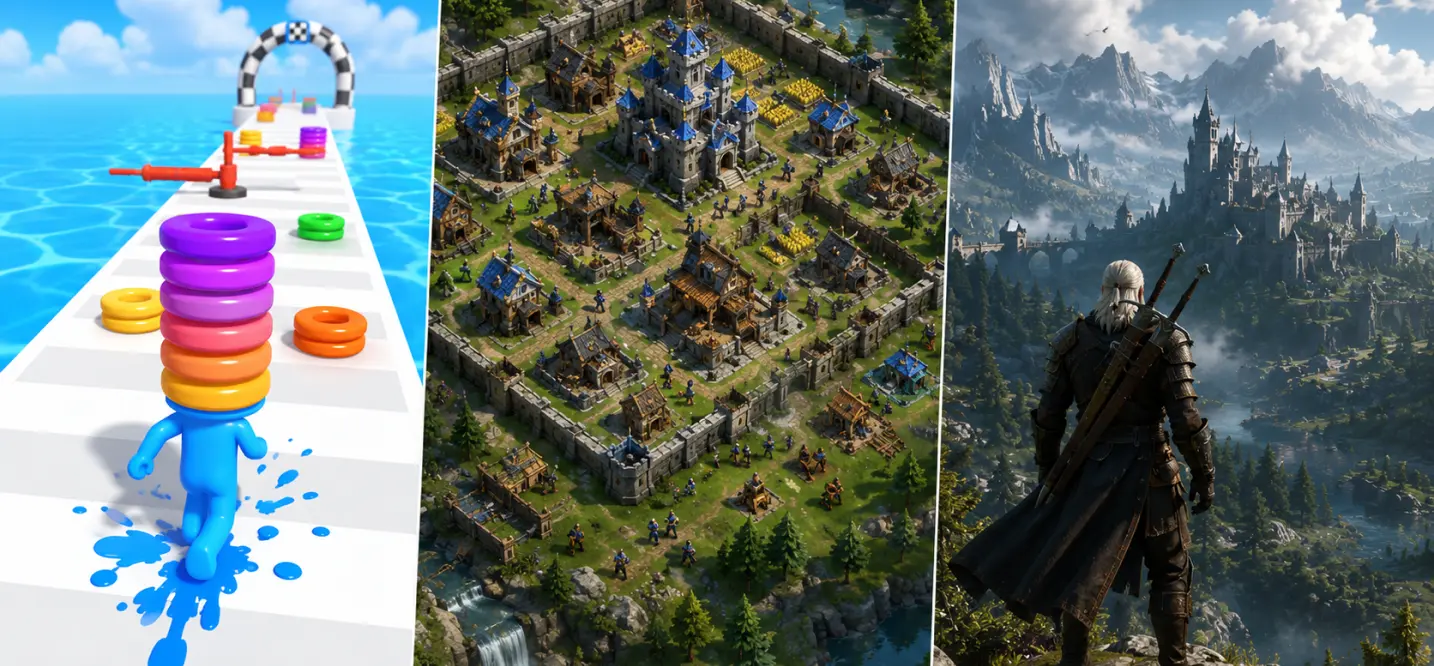
Every game category serves a different audience. The mechanics, production process, monetization model, and even the technology stack vary significantly.
Hyper-Casual Games: Fast, Simple, and Built for Scale
If someone asks what classifies hypercasual games, the answer is simple: easy-to-learn gameplay that anyone can understand within seconds.
Most hypercasual mobile games have:
- One-touch controls
- Very short game sessions
- Minimal tutorials
- Simple art styles
- Advertising as the primary revenue model
Popular hypercasual video games include:
- Helix Jump
- Stack Ball
- Paper.io 2
- Crossy Road
- Color Switch
Instead of keeping players engaged for months, these games focus on attracting millions of downloads quickly. That’s why many publishers use a hypercasual game as a low-risk way to test gameplay ideas before investing in larger projects.
Current hypercasual game trends 2026 show the genre evolving beyond simple ad-driven experiences. Many successful studios now add battle passes, cosmetic rewards, and light progression systems, creating what is often called hybrid casual gaming.
If your goal is rapid validation and fast market entry, partnering with a hyper casual game development service can significantly reduce production time while helping you optimize monetization from the start.
Mid-Core Games: Where Engagement Meets Revenue
If you’re asking what is mid core game, think of it as the middle ground between casual accessibility and hardcore depth.
Unlike hyper-casual games, mid core games encourage players to return every day through progression systems, upgrades, achievements, competitive events, and social features.
Popular examples include:
- Clash Royale
- Brawl Stars
- AFK Journey
- Whiteout Survival
- Survivor.io
The typical mid core gamer enjoys strategy without committing hundreds of hours like a traditional gamer hardcore audience. Sessions usually last between 10 and 30 minutes, making these games highly suitable for mobile devices.
Revenue also becomes more diversified.
Instead of relying mainly on advertisements, developers combine:
- In-app purchases
- Battle passes
- Cosmetic items
- Seasonal events
- Limited-time offers
This creates much higher lifetime value than traditional hyper-casual titles.
AAA Games: Premium Experiences at Massive Scale
People often ask what is a AAA video game or what does AAA mean in games.
The term doesn’t refer to genre. It refers to production scale.
An AAA video game is developed with large budgets, experienced multidisciplinary teams, advanced technology, cinematic storytelling, and extensive marketing campaigns.
Some of the best AAA games released in recent years include:
- Grand Theft Auto VI
- Elden Ring
- Call of Duty
- Assassin’s Creed Shadows
- Baldur’s Gate 3
Leading AAA game studios such as Rockstar Games, Ubisoft, Naughty Dog, and Santa Monica Studio often spend hundreds of millions of dollars developing a single title.
That investment allows them to create:
- Photorealistic graphics
- Motion capture animation
- Open-world environments
- Advanced AI systems
- Multiplayer infrastructure
- Continuous post-launch content
For companies targeting consoles and PC, experienced AAA game art studio services often play a critical role in producing environments, characters, props, and cinematic assets without expanding internal teams.
Comparing the Three Development Models
| Feature | Hyper-Casual | Mid-Core | AAA |
| Development Time | 2–6 months | 8–18 months | 3–7 years |
| Team Size | 5–20 | 20–100 | 200–1000+ |
| Budget | <$500K | $500K–$15M | $50M–$300M+ |
| Main Revenue | Ads | IAP + Ads | Premium sales, DLC, Live Service |
| Player Retention | Low | Medium to High | High |
Market Trends, Budgets, and the Numbers Behind Each Category
Choosing between these models becomes easier when you look at industry data instead of assumptions.
According to Newzoo, the global gaming market is expected to surpass 3.5 billion players by 2026, with mobile accounting for nearly half of worldwide gaming revenue.
Meanwhile, GameAnalytics reports that the median Day-1 retention across mobile games remains around 22%, highlighting how difficult it has become to keep players engaged after installation.
Here’s how each category compares.
| Metric | Hyper-Casual | Mid-Core | AAA |
| Average CPI | Low | Medium | High |
| D1 Retention Target | 35–40% | 30–40% | N/A |
| Primary Monetization | Ads | Ads + IAP | Sales + DLC + Live Service |
| LiveOps Importance | Low | High | Very High |
| Average Session | 2–5 min | 15–30 min | 1–3 hours |
Another major trend is player expectations.
Five years ago, players accepted repetitive gameplay if it was free.
Today they expect:
- Frequent updates
- Fair monetization
- Personalized progression
- Social interaction
- Seasonal content
This explains why many publishers now evolve successful hypercasual mobile games into deeper experiences instead of continuously releasing new titles.
How Development Changes Across Hyper-Casual, Mid-Core, and AAA Games

Development isn’t just about writing code. Every category requires different planning, technology, and production workflows.
Hyper-Casual Development Prioritizes Speed
Hyper-casual teams validate ideas quickly. Many prototypes are completed in just a few weeks before moving into user testing.
This is one reason Unity remains the preferred engine for many studios. A common question from aspiring developers is:
Why might Unity and C# be a better choice than Unreal Engine and C++?
For web and mobile game development, Unity offers faster iteration, lighter hardware requirements, an extensive asset ecosystem, and a shorter learning curve. C# is also easier for beginners than C++, allowing smaller teams to build and test ideas rapidly.
That speed is essential when success depends on releasing multiple prototypes each year.
Mid-Core Development Requires Long-Term Planning
Building mid core games isn’t simply adding more levels.
Developers must design:
- Balanced economies
- Progression systems
- Matchmaking
- Analytics dashboards
- LiveOps events
- Seasonal updates
This is why successful studios spend months refining gameplay before launch.
Think about Angry Birds.
Many people ask:
How do developers decide on the right balance of levels and challenges?
The answer isn’t guesswork.
Teams rely on player analytics, A/B testing, completion rates, session length, and retention data to continuously adjust difficulty. Every level teaches players something new while gradually increasing complexity.
That process continues even after launch.
AAA Development Is Built Around Scale
Large AAA games involve hundreds of specialists working simultaneously.
Artists, gameplay programmers, AI engineers, technical animators, writers, QA teams, audio designers, producers, and marketing departments all contribute to the final product.
This also explains another common question:
Why might Unreal Engine require more powerful hardware than Unity?
Unreal Engine is designed to render highly detailed environments, advanced lighting systems, Nanite virtualized geometry, and Lumen global illumination. Those features demand significantly more processing power than typical Unity mobile projects.
People also wonder:
Can you become a successful game developer using only Blueprints instead of C++?
Absolutely. Many Unreal designers specialize in Blueprint scripting. While C++ becomes essential for advanced engine programming, gameplay designers can build successful careers focusing on visual scripting, level design, and gameplay systems.
Another interesting example is Like a Dragon Gaiden, which reached players in roughly six months because it reused existing technology, assets, animation systems, and production pipelines from previous games.
New intellectual properties rarely have that advantage. Every mechanic, environment, and workflow must be built from scratch, which explains why fresh franchises typically require much longer development cycles.
Which Development Model Makes the Most Business Sense?

Choosing between these three approaches isn’t about ambition. It’s about aligning your investment with realistic business goals.
| Business Goal | Best Choice |
| Test a new gameplay idea | Hyper-Casual |
| Launch quickly | Hyper-Casual |
| Build recurring revenue | Mid-Core |
| Create a long-term franchise | AAA |
| Mobile-first strategy | Hyper-Casual or Mid-Core |
| Console-first strategy | AAA |
Budget also influences this decision. Many studios ask:
How do budgeting and costs impact outsourcing?
The answer is simple.
Hiring a full in-house team isn’t always practical. Outsourcing art, QA, backend engineering, or LiveOps support allows companies to control costs while accessing specialized expertise.
Working with a custom game development company also reduces hiring time and gives studios flexibility as projects scale.
Another common production mistake involves constant changes.
How can game development teams avoid making and unmaking decisions that delay projects?
Successful teams lock core mechanics early, document design decisions, build vertical slices before full production, and use milestone reviews instead of continuously changing direction.
Too many revisions often cost more than technical challenges.
Team composition matters as well.
Many casual game studios intentionally include designers who aren’t traditional hardcore game players. Fresh perspectives help create mechanics that appeal to broader audiences instead of only experienced gamers.
Choosing the Right Development Partner
No matter which category you choose, execution determines success. A reliable development partner should understand more than programming.
Look for experience in:
- Game design
- Art production
- Backend architecture
- Analytics
- Monetization
- LiveOps
- Quality assurance
- Cross-platform deployment
Many studios combine internal leadership with external specialists for specific disciplines.
For example:
- AAA game art studio services can accelerate environment and character production.
- Casual game art services help maintain consistent visual quality for mobile titles.
- A dedicated hypercasual game development company can rapidly prototype concepts before larger investments are made.
- A trusted custom game development company provides end-to-end development support across multiple genres.
Why Studios Choose Cubix for Game Development
Choosing the right game category is only half the decision. The other half is finding a development partner that understands how to turn your idea into a successful product.
As a leading custom game development company, we provide end-to-end services that cover strategy, game design, engineering, backend development, QA, LiveOps, and post-launch support. For businesses looking to enter the mobile gaming market quickly, our hyper casual game development service helps transform ideas into market-ready games with shorter development cycles and data-driven monetization strategies.
Visual quality is equally important. Our dedicated artists deliver high-quality environments, characters, UI, and animations through our AAA game art studio services, helping studios produce premium visuals while reducing production costs and accelerating development.
Frequently Asked Questions
1. What is the biggest difference between hyper-casual, mid-core, and AAA games?
The biggest difference is the level of complexity and player engagement. Hyper-casual games focus on simple mechanics and short play sessions, making them ideal for quick entertainment. Mid-core games introduce progression systems, strategy, and social features to improve long-term retention. AAA games offer premium graphics, cinematic storytelling, and large-scale gameplay experiences, but they also require significantly larger budgets and development teams.
2. Which game type is the most profitable to develop?
There isn’t a single answer because profitability depends on your business model. Hyper-casual games can generate substantial revenue through millions of downloads and in-app advertising. Mid-core games often achieve higher lifetime value (LTV) by combining in-app purchases with LiveOps events and battle passes. AAA games have the highest revenue potential but also carry the greatest financial risk due to their massive production and marketing costs.
3. Is Unity or Unreal Engine better for game development?
It depends on the type of game you’re building. Unity is generally a better choice for hyper-casual and many mobile games because it offers faster development, lower hardware requirements, and a simpler learning curve using C#. Unreal Engine is better suited for AAA-quality PC and console games that require advanced graphics, realistic lighting, and large open-world environments.
4. Should startups begin with a hyper-casual game or a mid-core game?
For most startups, beginning with a hyper-casual game is a practical choice because it requires less investment, shorter development cycles, and allows teams to validate gameplay ideas quickly. If the concept performs well, developers can expand it into a mid-core game by introducing progression systems, LiveOps features, and additional monetization options.