Quick Game Development Industry Statistics
- The global video game market is valued at more than $200 billion.
- More than 3.4 billion people play video games worldwide.
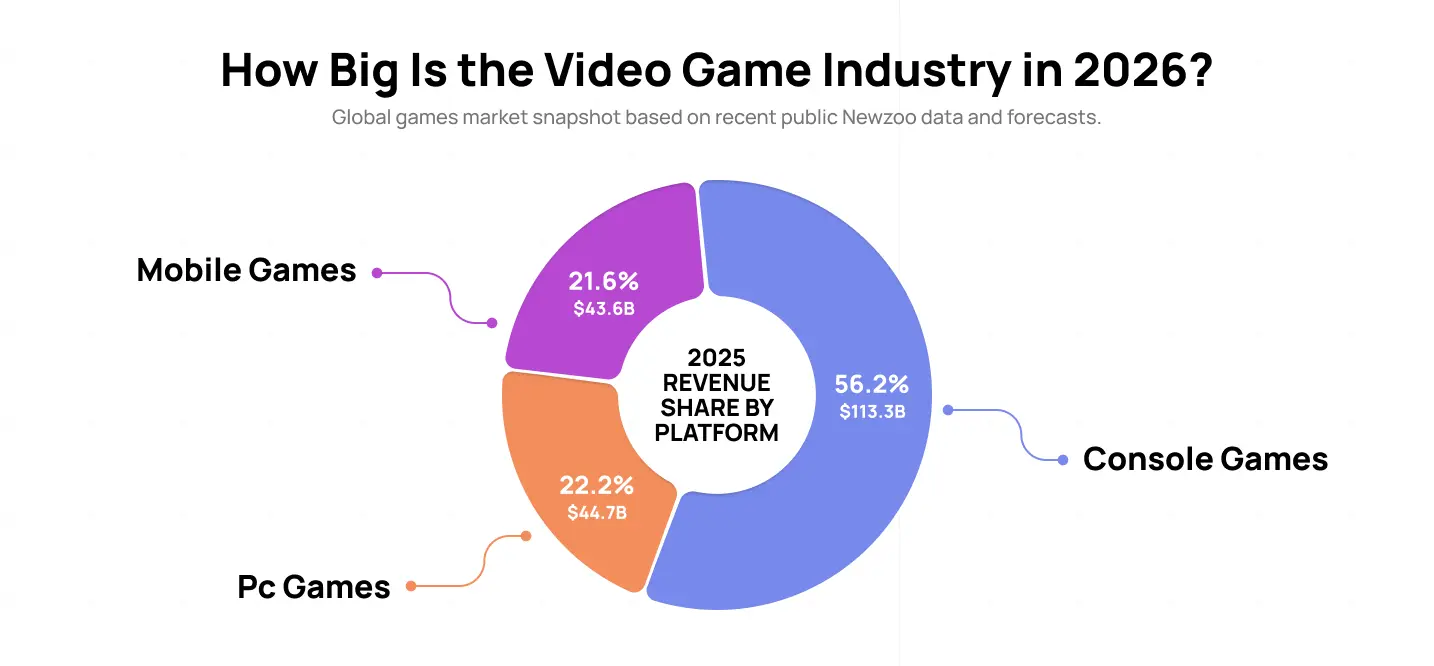
- Mobile gaming accounts for over 50% of total gaming revenue.
- PC gaming generates more than $40 billion annually.
- Console gaming contributes over $45 billion in global revenue.
- Cloud gaming users are expected to surpass 200 million globally.
- Free-to-play games continue to dominate mobile and multiplayer markets.
- Live-service games generate billions through ongoing content updates.
- The Asia-Pacific region remains the largest gaming market worldwide.
- Mobile game downloads exceed 80 billion annually.
The gaming industry has come a long way from its arcade roots. Today, it is one of the largest and fastest-growing entertainment industries in the world. Millions of players log in every day, new titles launch across multiple platforms, and studios continue to find innovative ways to engage audiences.
The latest game development industry statistics show just how much the market has evolved. Global gaming revenue has surpassed $200 billion, mobile games account for more than half of all industry earnings, and over 3 billion people now play video games worldwide. At the same time, emerging technologies like cloud gaming, artificial intelligence, and cross-platform development are changing how games are built and played.
For developers, publishers, investors, and entrepreneurs, these numbers tell an important story. They reveal where players are spending money, which genres are growing, and where future opportunities are likely to emerge.
“The biggest change we’ve seen isn’t just where players are gaming, it’s how they engage. Players expect connected experiences, regular updates, and social interaction regardless of platform. Studios that focus on long-term engagement rather than just downloads are seeing the strongest results.”
– Cubix Game Development Team
How Big Is the Video Game Industry in 2026?
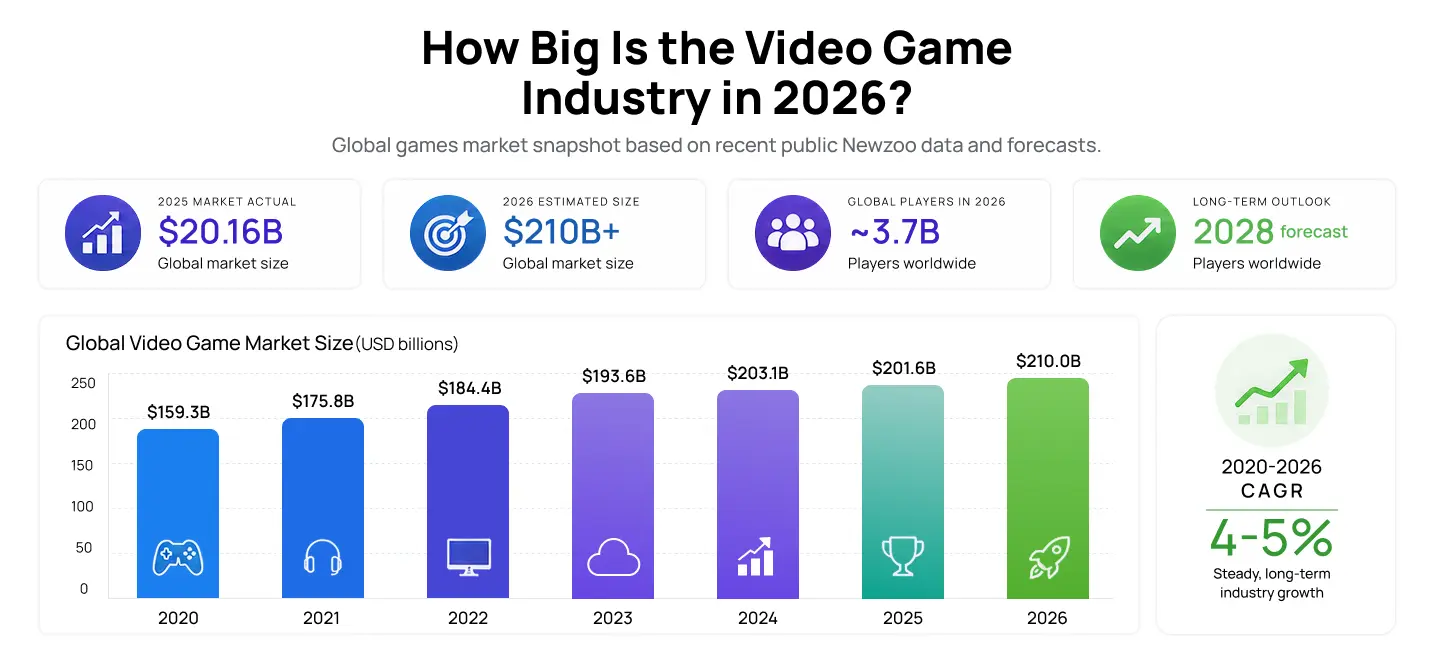
The question “how big is the video game industry” is one of the most searched gaming-related topics online.
The answer depends on how the market is measured, but most industry reports estimate global gaming revenue at more than $200 billion in 2026.
This places gaming ahead of many traditional entertainment sectors, including music and box office revenues.
Global Gaming Market Size
| Segment | Estimated Revenue |
| Mobile Gaming | $110B+ |
| Console Gaming | $45B+ |
| PC Gaming | $40B+ |
| Other Gaming Segments | $5B+ |
| Total Market | $200B+ |
The market continues to expand due to:
- Increased smartphone adoption
- Better internet infrastructure
- Growth of cloud gaming
- Cross-platform experiences
- Expansion of emerging gaming markets
As more consumers play gaming experiences across multiple devices, developers are creating products that reach wider audiences than ever before.
25 Game Development Industry Statistics You Need to Know
The following game development industry statistics provide a snapshot of where the market stands today.
Market Statistics
- The gaming industry serves more than 3 billion active players worldwide.
- Mobile gaming remains the largest segment by revenue.
- Global gaming revenue exceeds $200 billion.
- Asia-Pacific contributes the largest share of worldwide gaming revenue.
- Cloud gaming continues to experience double-digit growth.
- Cross-platform gaming adoption is increasing every year.
- Digital game sales significantly outperform physical game sales.
Player Statistics
- Mobile devices are the most common platform used to play video games.
- The average player uses more than one gaming platform.
- Multiplayer experiences continue to attract the highest engagement levels.
- Social gaming remains a major growth category.
- Younger audiences spend more time gaming than consuming traditional media.
- Mobile users represent the largest global gaming audience.
- Online communities play a major role in player retention.
Revenue Statistics
- Mobile gaming generates more than half of total gaming revenue.
- Free-to-play games dominate revenue rankings.
- In-game purchases generate billions every year.
- Subscription services continue gaining popularity.
- Live-service games generate recurring revenue streams.
- Digital storefronts remain the primary distribution channel.
Development Statistics
- AI tools are becoming increasingly common in game development.
- Unity and Unreal Engine remain industry-leading platforms.
- Cross-platform development is a priority for many studios.
- Multiplayer development continues to grow across genres.
- Cloud infrastructure is becoming an important part of modern game development pipelines.
As a result, many publishers are investing heavily in mobile-first experiences and seeking professional mobile game development services to bring their ideas to market.
Why Mobile Gaming Continues to Dominate

Mobile games are available instantly. Players can enjoy gaming experiences while commuting, traveling, or relaxing at home.
This accessibility helps mobile games reach audiences that traditional platforms often cannot. Industry reports suggest mobile gaming now represents approximately 55% of total global gaming revenue.
Real-World Example: Domino Earning World
The Domino Earning World project demonstrates how mobile-first design can attract and retain users in highly competitive markets.
Features such as social interaction, competitive gameplay, and accessible mechanics align with broader industry trends driving mobile growth.
Real-World Example: Dragon Zoom
Dragon Zoom showcases another important mobile trend: simple, engaging gameplay designed for broad audiences.
Casual and hyper-casual games continue attracting millions of players globally.
Real-World Example: Bright Farm
Bright Farm reflects growing demand for family-friendly and casual gaming experiences.
Simulation and farming games remain popular due to their accessibility and long-term player engagement.
What Genres Are Generating the Most Revenue?
Not all games generate the same level of revenue.
Some genres consistently outperform others because they attract larger audiences, encourage longer play sessions, or support stronger monetization strategies.
Understanding these trends can help studios identify opportunities in a highly competitive market.
Action Games Continue to Lead
Action titles remain among the most popular games worldwide.
Their broad appeal, competitive elements, and replayability make them attractive to both players and publishers.
Many of the industry’s biggest franchises belong to this category.
Puzzle Games Remain a Mobile Favorite
Puzzle games continue to perform exceptionally well, particularly on mobile devices.
Their accessibility makes them appealing to casual audiences, while progression systems encourage long-term engagement.
The Unity-Based Merge 3 Puzzle Adventure Game project reflects the ongoing popularity of puzzle mechanics and mobile-first experiences.
Multiplayer Experiences Drive Retention
Multiplayer games consistently outperform single-player experiences when it comes to long-term engagement.
Players are more likely to return when friends, teams, and communities are involved.
Projects like Relentless demonstrate how social interaction can become a key driver of player retention and growth.
Card and Casino Games Maintain Strong Audiences
Card-based experiences continue to generate significant player activity across mobile platforms.
The Lady Luck Multiplayer Card Game project reflects the ongoing demand for competitive, social card experiences that combine skill, progression, and multiplayer engagement.
How Studios Make Money in 2026

Building a successful game is only part of the equation. Studios also need a sustainable way to generate revenue and fund future development.
Over the years, monetization strategies have evolved significantly. While premium game sales still generate billions in revenue, many studios now rely on multiple income streams.
This shift has made understanding game company profit sharing models 2026 more important than ever.
The Most Common Revenue Models Today
Free-to-Play
Free-to-play remains the dominant business model, particularly in mobile gaming.
Players can download and play for free, while developers earn revenue through:
- In-app purchases
- Cosmetic items
- Battle passes
- Advertisements
- Premium content
Many of the highest-grossing games in the world use this model because it lowers the barrier to entry and attracts larger audiences.
Premium Games
Premium titles charge players upfront for access.
This model remains common in PC gaming and console gaming, where players are often willing to pay for high-quality experiences.
Subscription Services
Gaming subscriptions continue to gain traction.
Players pay a monthly fee to access a library of games, creating recurring revenue for publishers and platform owners.
Revenue Sharing Agreements
Modern game company profit sharing models 2026 often involve revenue-sharing arrangements between developers, publishers, investors, and distribution platforms.
A typical structure may include:
- Platform fees
- Publisher shares
- Marketing recoupment
- Developer royalties
While the exact percentages vary, these partnerships allow studios to reduce risk and secure funding for larger projects.
The rise of live-service games has also changed how revenue is distributed. Instead of relying on a single launch event, studios can generate income for years through updates, expansions, and seasonal content.
Top-Grossing Games and Franchises Continue to Dominate Revenue
One of the most interesting game development industry statistics is how concentrated gaming revenue has become. While thousands of new games launch every year, a relatively small group of titles generates a significant share of industry earnings.
What’s even more remarkable is how long these games remain at the top. Unlike many entertainment products that enjoy a short period of popularity, leading games often sustain their positions for years through regular updates, live-service content, strong communities, and ongoing monetization strategies.
This trend highlights a major shift in the video game industry. Success is no longer determined solely by launch-day sales. Long-term engagement, recurring content, and player retention have become equally important.
Many of today’s highest-grossing games operate as evolving platforms rather than standalone products. They continuously introduce new features, events, cosmetics, and experiences that keep players coming back.
Top-Grossing Games by Annual Revenue
| Game | Publisher | Release Year | Business Model |
| Fortnite | Epic Games | 2017 | Free-to-Play |
| Call of Duty: Modern Warfare II / Warzone | Activision Blizzard | 2022 / 2020 | Premium + Free-to-Play |
| Grand Theft Auto V | Take-Two Interactive | 2013 | Premium + Online Services |
| Roblox | Roblox Corporation | 2006 | Platform-Based Free-to-Play |
| Genshin Impact | miHoYo | 2020 | Free-to-Play with Gacha Monetization |
What These Statistics Mean for Game Developers
Statistics are useful, but only when they lead to action.
The latest game development industry statistics reveal several clear lessons for studios entering the market.
Mobile Should Not Be Ignored
With mobile gaming generating more than half of global revenue, studios should carefully evaluate whether their concepts can succeed on smartphones and tablets.
This does not mean every game should be mobile-first.
However, ignoring mobile entirely could mean missing access to the industry’s largest audience.
Retention Matters More Than Downloads
Downloads are important, but retention is often a stronger indicator of long-term success.
Games that keep players engaged for months or years tend to generate significantly more revenue than games focused solely on user acquisition.
Features that support retention include:
- Progression systems
- Social mechanics
- Competitive gameplay
- Regular updates
- Community engagement
Multiplayer Opportunities Continue to Expand
The success of multiplayer experiences shows that players increasingly value connection and competition.
Projects like Taunt Battle and Lady Luck Multiplayer Card Game reflect the growing demand for interactive experiences that bring players together.
Simplicity Can Be Powerful
Not every successful game requires a massive budget. Many highly successful titles rely on simple mechanics executed exceptionally well.
This is one reason why working with an experienced 2d game development company can still be a smart investment. Well designed 2D games continue to attract large audiences across mobile and PC platforms.
Real World Projects Reflecting Industry Trends
The latest game development industry statistics reveal a clear pattern: players are spending more time in games that offer progression systems, social interaction, immersive worlds, and long-term engagement loops.
Several Cubix projects reflect the same market shifts currently shaping the industry.
Time Forge: Retention Is Becoming More Valuable Than Acquisition
One of the biggest changes in modern game development is the growing focus on retention. According to industry studies, acquiring a new player can cost significantly more than retaining an existing one, making long-term engagement a top priority for studios.
Time Forge was built around mechanics that encourage repeat gameplay through progression systems, unlockable content, and long-term objectives. This approach aligns with a broader industry trend where developers are prioritizing lifetime player value rather than short-term downloads.
As competition in the game market increases, progression-driven experiences are becoming essential for maintaining active player communities and sustainable gaming revenue.
Cloud of Venus: Narrative-Driven Experiences Continue to Attract Players
While multiplayer games often dominate revenue charts, narrative-focused games continue to command strong engagement across PC gaming and console gaming audiences.
Cloud of Venus reflects this demand through its focus on world-building, exploration, and immersive storytelling. Industry data shows that RPG, adventure, and science-fiction genres consistently rank among the most popular categories for players seeking deeper experiences.
As the global video game audience grows, studios are increasingly investing in narrative design to differentiate their games in an increasingly crowded marketplace.
Space Pirates: Multiplayer and Social Gameplay Drive Engagement
Social gaming remains one of the strongest growth drivers in the industry. Research consistently shows that multiplayer experiences generate longer session times and higher retention rates than purely single-player games.
Space Pirates was developed around cooperative and competitive gameplay mechanics that encourage player interaction. This reflects a wider market trend where community engagement has become a critical factor in player retention.
With more than 3 billion people now playing games worldwide, multiplayer functionality is no longer considered a premium feature. For many genres, it has become an expectation.
Wagmi: Community-Led Experiences Are Shaping Modern Gaming
The relationship between players and games has changed dramatically over the past decade. Modern gamers increasingly want to participate in communities rather than simply consume content.
Wagmi aligns with this shift by emphasizing player engagement, collaboration, and community participation. This trend is becoming particularly important as live-service games continue to grow and studios focus on building long-term ecosystems around their products.
Industry analysts have repeatedly highlighted community engagement as one of the most important factors influencing player retention and long-term growth.
Boss of the World: Progression Systems Remain a Core Growth Strategy
Achievement systems, rankings, rewards, and progression loops remain some of the most effective tools for increasing engagement.
Boss of the World reflects this strategy through gameplay systems designed around progression and player advancement. These mechanics are particularly valuable in today’s market, where players have thousands of competing entertainment options available at any given time.
Industry reports continue to show that games offering meaningful progression often achieve stronger retention metrics, longer session durations, and greater monetization opportunities than games lacking long-term engagement systems.
The Future of the Video Game Industry

The future looks incredibly promising for the gaming industry. Several trends are expected to shape the market over the next few years.
More Players Worldwide
As internet access improves and smartphone adoption increases, the global gaming audience will continue expanding.
Emerging markets are expected to contribute significantly to future growth.
Cloud Gaming Will Mature
While cloud gaming remains in its early stages, infrastructure improvements will likely accelerate adoption.
This could reduce hardware barriers and make gaming accessible to entirely new audiences.
AI Will Influence Development Workflows
Artificial intelligence will continue helping studios streamline production and improve efficiency.
Developers who successfully integrate AI tools into their workflows may gain a competitive advantage.
Cross-Platform Gaming Will Become Standard
The distinction between mobile, PC, and console ecosystems is becoming less important.
Future games will increasingly be designed to support multiple devices and player preferences.
Live-Service Games Will Continue Growing
Studios are recognizing the value of ongoing player relationships.
As a result, live-service models are expected to remain a major source of gaming revenue across the industry.
Today, more than 3 billion people play video games across mobile, PC, and console platforms. As the global video game market continues to grow, studios that understand changing player behaviors and invest in quality game development services will be better positioned for long-term success. Partnering with experienced mobile game development services providers can help accelerate development and reduce risk.
Why Studios Choose Cubix for Game Development

Building a successful game requires more than a great idea. It takes the right strategy, technology, design expertise, and development partner to turn that idea into a product players genuinely enjoy.
For more than a decade, Cubix Games has helped startups, enterprises, and gaming brands bring their concepts to life through custom game development solutions.
Our services include:
- Mobile game development
- Multiplayer game development
- Cross-platform game development
- Unity and Unreal Engine development
- Live-service game solutions
- 2D and 3D game development
- Game design and art production
- Ongoing support and optimization
The latest game development industry statistics show that player engagement, retention, and accessibility are more important than ever. That’s why every project we build is designed with performance, scalability, and user experience in mind.
[blog_cta]
FAQs
1. How big is the video game industry in 2026?
The global video game industry is estimated to generate more than $200 billion in annual revenue, making it one of the largest entertainment sectors in the world.
2. What platform generates the most gaming revenue?
Mobile gaming generates the most revenue and accounts for more than half of global gaming revenue.
3. Is PC gaming still growing?
Yes. PC gaming continues to generate more than $40 billion annually and remains a major segment of the industry.
4. What is the fastest-growing gaming segment?
Cloud gaming is among the fastest-growing segments due to advances in internet infrastructure and game streaming technology.
5. What are the most profitable game genres?
Action games, multiplayer games, puzzle games, strategy games, and card games continue to perform strongly across various platforms.
6. Why are game development industry statistics important?
These statistics help studios, publishers, and investors understand market trends, player behavior, growth opportunities, and revenue potential.