Key Takeaways
- Adoption is near-universal, but depth is not. In Vivrato’s VAIA report (101 studio leaders), 97% had used AI, yet 52% rated how deeply it was built into production at 3/10 or lower.
- Strategic fit comes first. Core, player-facing AI (NPC intelligence, systemic behavior) leans in-house. Commodity integration leans partners.
- A minimal in-house AI team is a multi-year commitment. One estimate puts three to four people at roughly $420,000 to $590,000 a year fully loaded, before compute.
- Compare equal scope. Studio fees look high next to a salary, but only until you add recruiting, ramp-up, overhead and idle time to the in-house side.
- Contracts decide ownership. Code, models, training data and tooling must be written down, not assumed.
- Hybrid reduces risk. Co-development with a clear exit path lets you start in weeks and build internal capability gradually.
Quick answer: Keep AI in-house when it is core gameplay IP, such as the NPC behavior players remember your game for. Partner with a studio when you need speed, scarce machine learning skills, or a capability you will not run for three or more years. Most studios land on a hybrid: own the vision, data and architecture, and rent the engineering capacity.
Need a second opinion on your delivery model? Talk to Cubix about AI game development. Their team can scope a pilot with you before you commit to a hire or a contract.
Why This Decision Matters More in 2026
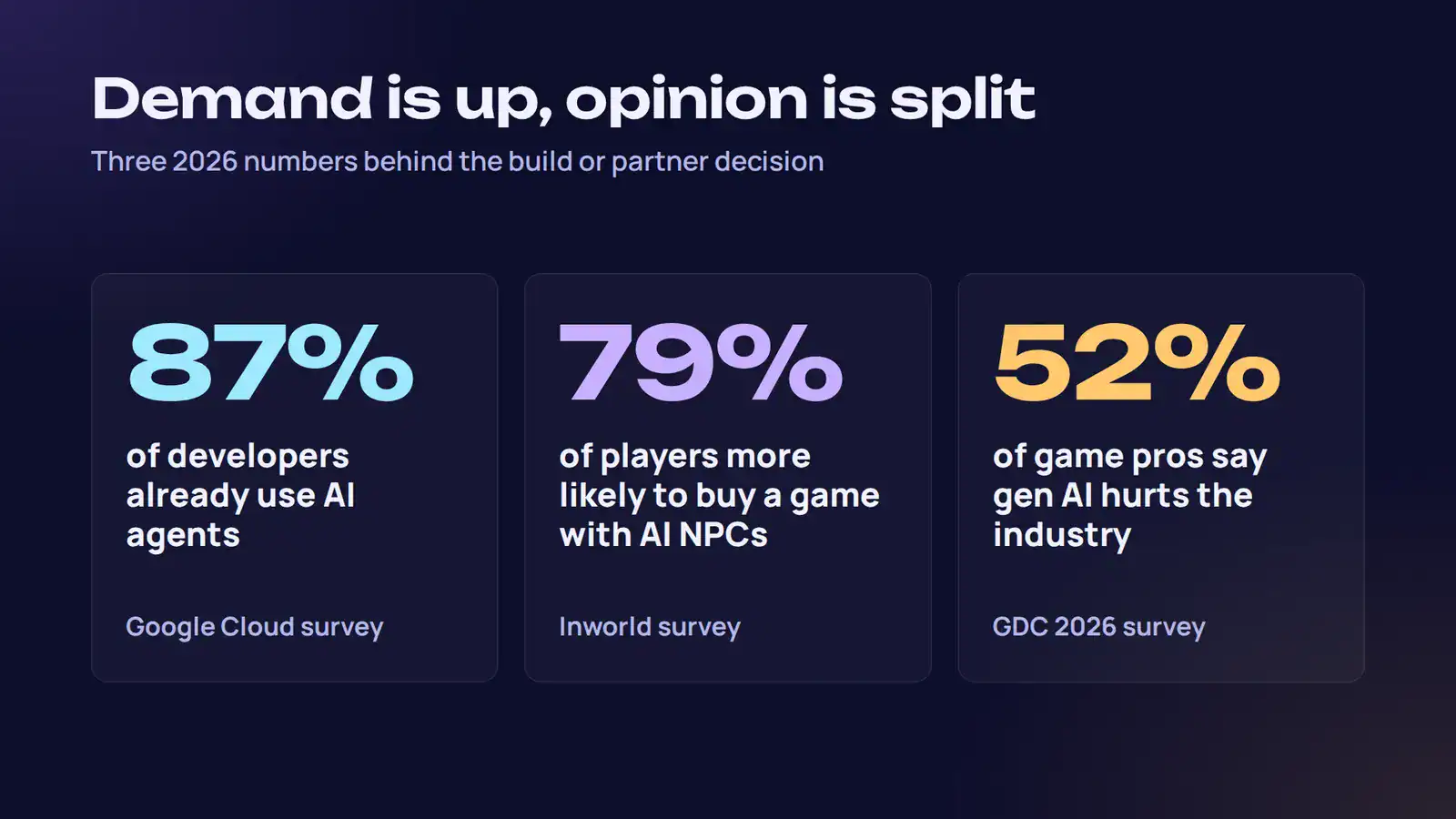
A few years ago, “AI in games” meant behavior trees and pathfinding. Now it spans learned NPC behavior, automated QA, dynamic balancing and agentic production tools. The numbers show how fast that moved:
- Google Cloud’s survey of 615 game developers found 87% already use AI agents in their work.
- 44% use agents for content optimization, 38% for dynamic balancing, 35% for automated testing and bug reporting, and 34% for advanced NPC behavior.
- Inworld’s survey of 1,000 US players found 79% would be more likely to buy a game with AI NPCs and 81% would pay more for one.
- The GDC 2026 State of the Industry survey (2,300+ professionals) found 36% use generative AI tools, but 52% think it is having a negative impact.
Read those together and you get the real problem. Demand is rising, adoption is broad, and sentiment is split. The question is no longer whether to use AI. It is who builds and runs it, and that choice carries real cost, speed and risk consequences.
Quick pulse check: Before reading on, answer honestly. Is your AI work (a) a feature players will notice, (b) a pipeline tool your team will use, or (c) not scoped yet? Your answer shapes everything below.
The Adoption Gap: Why “We Use AI” Isn’t a Strategy
The VAIA report is a useful reality check. Researchers ran 101 confidential interviews between April and September, each following the same 44-question guide across nine production stages. The headline: 94% of studios use AI in at least one stage, but more than half say it is barely embedded in their pipeline.
Regional differences are notable too. Studios in Europe reported deeper adoption than those in North America. For example, 70% of European studios used AI in art, assets and animation, against 53% in North America.
What does this mean for your model choice? Shallow adoption usually signals one of three problems: no one owns the AI roadmap, the skills are missing, or experiments never get production-grade engineering. Each problem points to a different fix, which is why the decision starts with diagnosis rather than a preference for hiring or outsourcing.
Three Delivery Models at a Glance
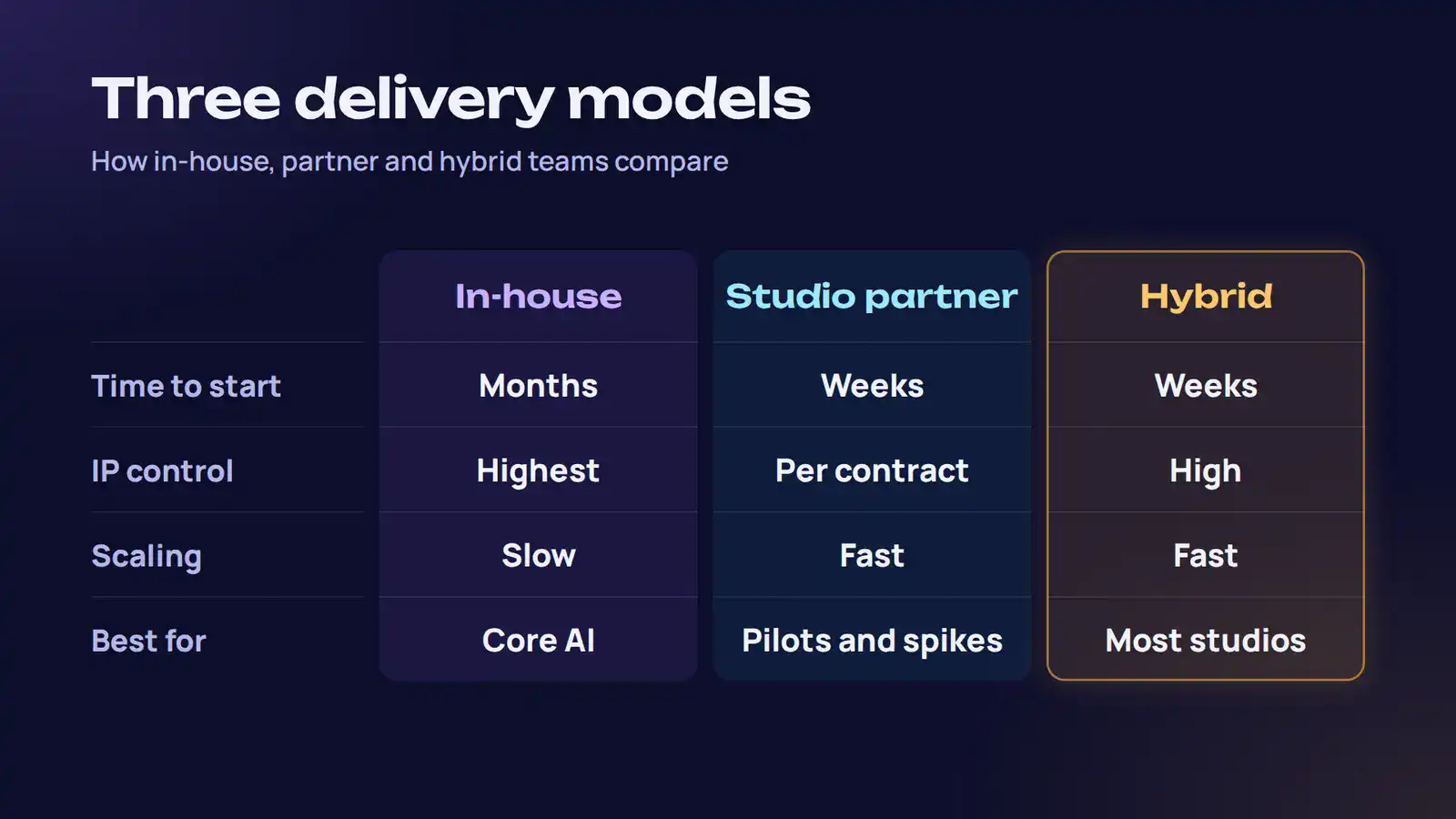
| Dimension | In-house team | Studio partnership | Hybrid / co-development |
|---|---|---|---|
| Cost shape | Fixed payroll plus compute | Project or retainer fees | Core team plus flexible capacity |
| Time to start | Months (recruiting, onboarding) | Weeks | Weeks |
| Control of IP and design | Highest | Depends on contract | High if governance is clear |
| Scaling up or down | Slow, painful | Fast | Fast |
| Knowledge retention | Strong | Risk of leaving with vendor | Strong with a transfer plan |
| Best for | Core AI as differentiator | Pilots, spikes, specialist skills | Most studios with an AI roadmap |
When Game AI Should Stay In-House
Let’s answer one of the most common questions directly: when should game AI stay in-house?
Keep it in-house when:
- It is your core gameplay IP. If the NPC behavior is the game, you want that expertise on payroll and under your roof.
- You own proprietary data. Years of telemetry or a distinctive asset library can make a custom model meaningfully better than a generic one.
- You can fund it for 3+ years. A team cut after twelve months produces cost rather than capability.
- You can hire and retain the talent. ML engineers compare your offer with AI labs, not just other studios.
For scale, consider Krafton. Its reported GPU cluster is valued at roughly KRW 100 billion (about $70 million), and its goal is player-facing AI, specifically Co-Playable Characters. That is a bet at a size most studios cannot match, but the logic is useful: build when AI is the product, not a back-office helper.
Mini-exercise: Write down the three AI features in your roadmap. Next to each, mark “ships to players” or “internal only.” If most are internal-only, building an expensive in-house team is probably premature.
When a Studio Partner Is the Smarter Move
Partnering usually wins in these situations:
- You need results before a hiring cycle can finish. Recruiting specialized engineers takes months, while a partner can begin in weeks.
- The skill is needed for a phase, not forever. Hiring a full-time expert for a three-month integration rarely makes sense.
- The work is commodity integration. Wiring an LLM-driven dialogue system, building a QA bot or tuning a recommendation model is well-trodden ground.
- Your team is stretched. Game production swings between pre-production, crunch and live ops, and fixed headcount does not flex.
Vendors will tell you outsourcing saves money, and some quote big figures. One studio-side source claims outsourcing cut costs by 40% for 65% of surveyed studios, and that in-house overheads (licences, rent, taxes) add 30 to 40% on top of base salary. Treat numbers like these as directional, since they come from a vendor with a stake in the answer. The more reliable lesson is structural: outsourcing converts fixed costs into variable ones, and that helps most when your workload is uneven.
The same source projects the game outsourcing services market growing from USD 1.5 billion to USD 3.8 billion by 2033, a sign that studios increasingly treat external capacity as normal rather than a last resort.
If your project also needs engine talent, you can hire Unity developers to extend your team alongside your AI work, and a full-service partner can cover wider game development services when AI is one piece of a larger build.
The Capability Check: Five Skills You Need Either Way
Whichever model you pick, the project needs these five capabilities. Score your studio from 0 (none) to 2 (strong) on each.
- Engine integration. Can your engineers run inference inside Unity or Unreal within frame budgets?
- Machine learning. Who selects models, fine-tunes them and evaluates quality? If the answer is “nobody,” look at specialist machine learning services.
- Backend and MLOps. Who handles deployment, monitoring, retraining and cost control for live inference?
- Design. Who defines what “good” NPC behavior looks like, and writes acceptance criteria for it?
- Safety and compliance. Who covers content filtering, player-data privacy and AI disclosure requirements?
Scoring: 8 to 10 means you can lead an in-house build. 4 to 7 means a hybrid model fits. 0 to 3 means a partner should drive delivery while you hire your first technical lead.
Notice that design and safety are often the weakest scores. Both are expensive to get wrong and impossible to fully outsource, because they define your game’s identity and your legal exposure.
What In-House AI Really Costs
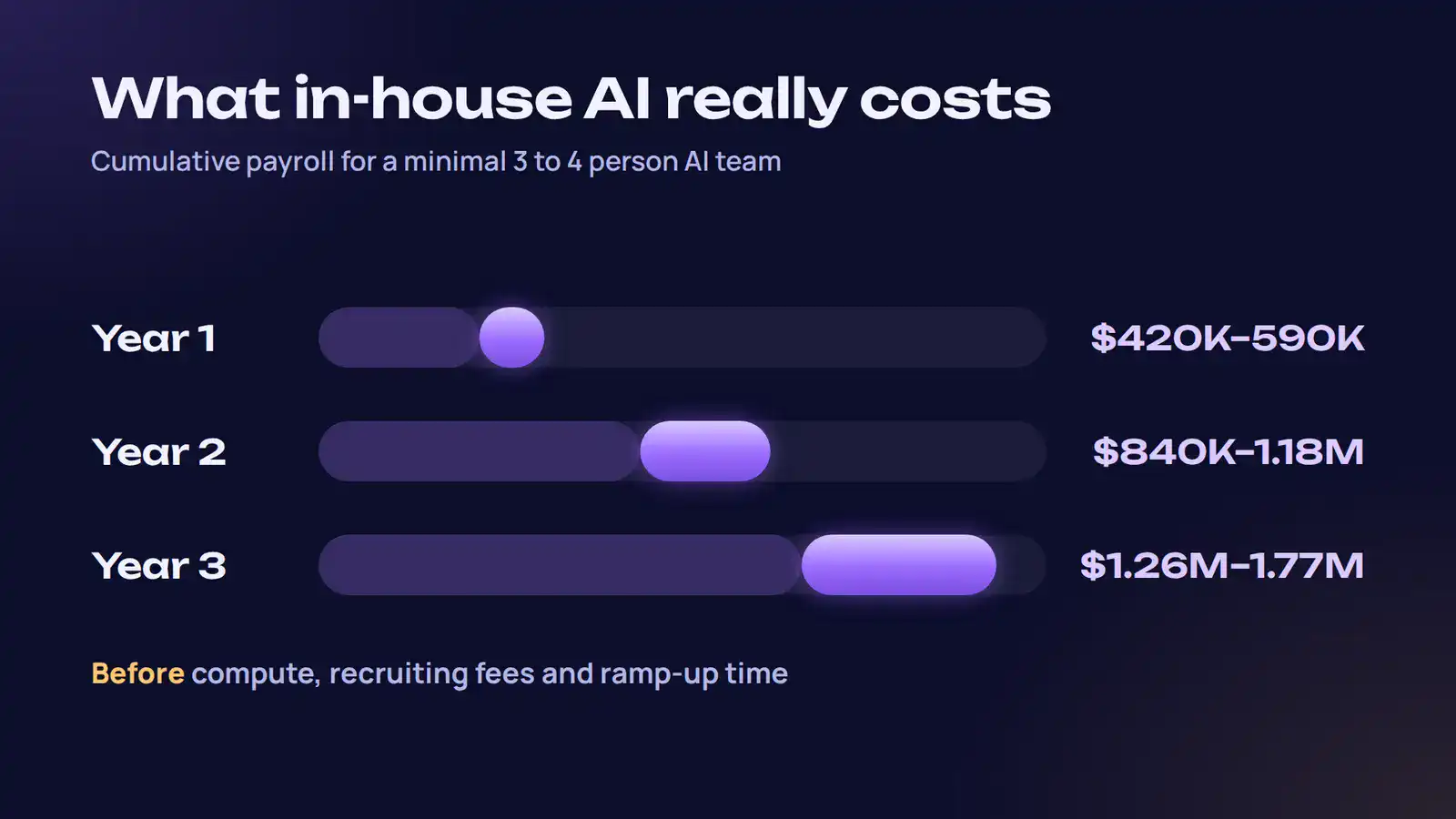
There is no published benchmark for an in-house AI team at a game studio, so be wary of anyone quoting a precise figure. One industry advisor offers a planning range: a minimal team of three to four people (ML engineer, pipeline engineer, data engineer, part of a technical lead) at about $420,000 to $590,000 a year fully loaded in Western Europe or North America, before compute. By the same source’s estimate, commercial AI subscriptions often run roughly $50 to $500 a month per tool or team tier.
Run the simple math over a three-year horizon, using that range:
- Annual payroll: $420,000 to $590,000
- Three-year payroll: roughly $1.26 million to $1.77 million, before GPU or cloud spend, recruiting fees and ramp-up time
Then add the hidden item: time to value. In-house teams commonly need several quarters before production staff rely on their output daily. If your launch window is shorter than that, the cheapest team on paper may be the most expensive in practice.
How to Compare Studio Fees with In-House Costs Fairly
This is where most comparisons go wrong. Studio invoices are visible and lumpy. In-house costs are spread across payroll, tools and management time. To compare fairly, build both sides on equivalent scope, equivalent duration and equivalent risk.
Total cost of ownership checklist
In-house side (add all of these):
- Salaries, benefits and payroll taxes
- Recruiting fees and months of vacancy
- Onboarding and ramp-up time
- Compute, tooling and licences
- Management overhead
- Cost of idle time between projects
- Attrition and replacement cost
Studio side (add all of these):
- Fees for the full statement of work
- Your internal management and review time
- Change requests and rework
- Ongoing support under a service level agreement
- Knowledge transfer and documentation
- Exit or transition costs
Rule of thumb: If one side of your spreadsheet has fewer than seven lines, it is incomplete. Total cost of ownership over 24 to 36 months is the number to compare, not the monthly sticker price.
Hybrid Models: Can They Reduce Delivery Risk?
Yes, and for most studios this is the answer. A hybrid AI game development model splits responsibilities by strategic value:
- You keep: creative vision, core gameplay design, data strategy, architecture decisions and final acceptance of quality.
- The partner supplies: specialist engineers, ML experimentation capacity, MLOps setup and surge staffing.
- Both share: a roadmap, a release cadence and a documentation standard.
There are three common hybrid patterns:
- Staff augmentation. Partner engineers join your team under your management. Good when you have leadership but lack hands.
- Co-development. A shared team with joint planning and shared milestones. Good when you need both capacity and expertise.
- Build-operate-transfer. The partner builds and runs the capability, then hands it over. Good when you intend to go in-house eventually but cannot start there.
Hybrid reduces risk for a simple reason: you are never fully dependent on one hiring pipeline or one vendor. If a hire falls through, the partner covers the gap. If a partner underperforms, your internal lead can redirect the work.
The warning is governance. Hybrid models fail when nobody knows who decides what. Write down decision rights before day one.
Governance: Who Decides What?
Use this simple table as a starting point for your agreement:
| Decision | Owner | Partner role |
|---|---|---|
| NPC design goals and tone | Studio | Advises |
| Model selection and evaluation method | Joint | Proposes, studio approves |
| Architecture and engine integration | Joint | Implements |
| Data collection and privacy rules | Studio | Follows |
| Release scheduling | Studio | Commits to milestones |
| Quality sign-off | Studio | Provides evidence |
Review it monthly. If a row keeps causing arguments, the ownership is unclear and needs fixing.
Who Owns the Models, Code and Training Data?
This is the question that surprises studios most often, so ask it before signing anything. A good agreement spells out each of these separately:
- Source code access. Do you receive full repositories, build scripts and documentation, or only compiled output?
- Model ownership. Who owns trained weights, fine-tuned models and evaluation sets? What about the partner’s pre-existing tools?
- Data licensing. Whose data trained the model, under what licence, and can it be used for other clients?
- Third-party components. Are open-source and commercial model licences compatible with commercial release?
- Player data. Where is it stored, who can access it and how is it deleted?
- Exit rights. Can you move code, data, models and operations to another team without penalty?
The risk is vendor lock-in: a system only the original partner can run or update. Avoid it by demanding portability from the start, with code in your repositories, documented pipelines and reproducible training runs.
How to Evaluate an AI Game Development Partner
What should an AI development partner deliver? More than code. A mature partner delivers:
- A written statement of work with measurable acceptance criteria
- Working builds on a regular release cadence
- Evaluation reports that show NPC quality, latency and cost per interaction
- Documentation and knowledge transfer sessions
- Clean handover of source code, model artifacts and deployment scripts
- A service level agreement covering support after launch
What to ask an AI game development studio
Use these questions in your next vendor call:
- Which shipped games or prototypes used the same kind of AI you need?
- Who exactly will work on our project, and how long have they been with you?
- How do you measure NPC quality, not just whether it runs?
- What happens to our data and fine-tuned models after the project?
- How do you manage model drift and inference cost after launch?
- How much overlap will your team have with our working hours? (Aim for at least two to three shared hours a day.)
- What does your exit process look like?
Red flags: vague scope, no acceptance criteria, refusal to name team members, reluctance to give repository access, and pricing that is suspiciously low compared with competing quotes. A low rate often means junior talent and weak management.
Run a Pilot Before You Commit
What should an AI game development pilot include? Think of it as a small, time-boxed production test, usually six to ten weeks:
- One narrow use case. For example, one NPC archetype or one QA automation flow.
- Defined success metrics. Response quality, latency, cost per interaction, player test results.
- A vertical slice. A fully working, playable piece rather than a slide deck.
- Documentation and handover. Even the pilot should prove that knowledge can transfer.
- A go or no-go review. Decide whether to scale, change course or stop.
A pilot gives you real evidence on speed, communication and quality before you sign a larger contract or open a headcount requisition.
Your Decision Scorecard
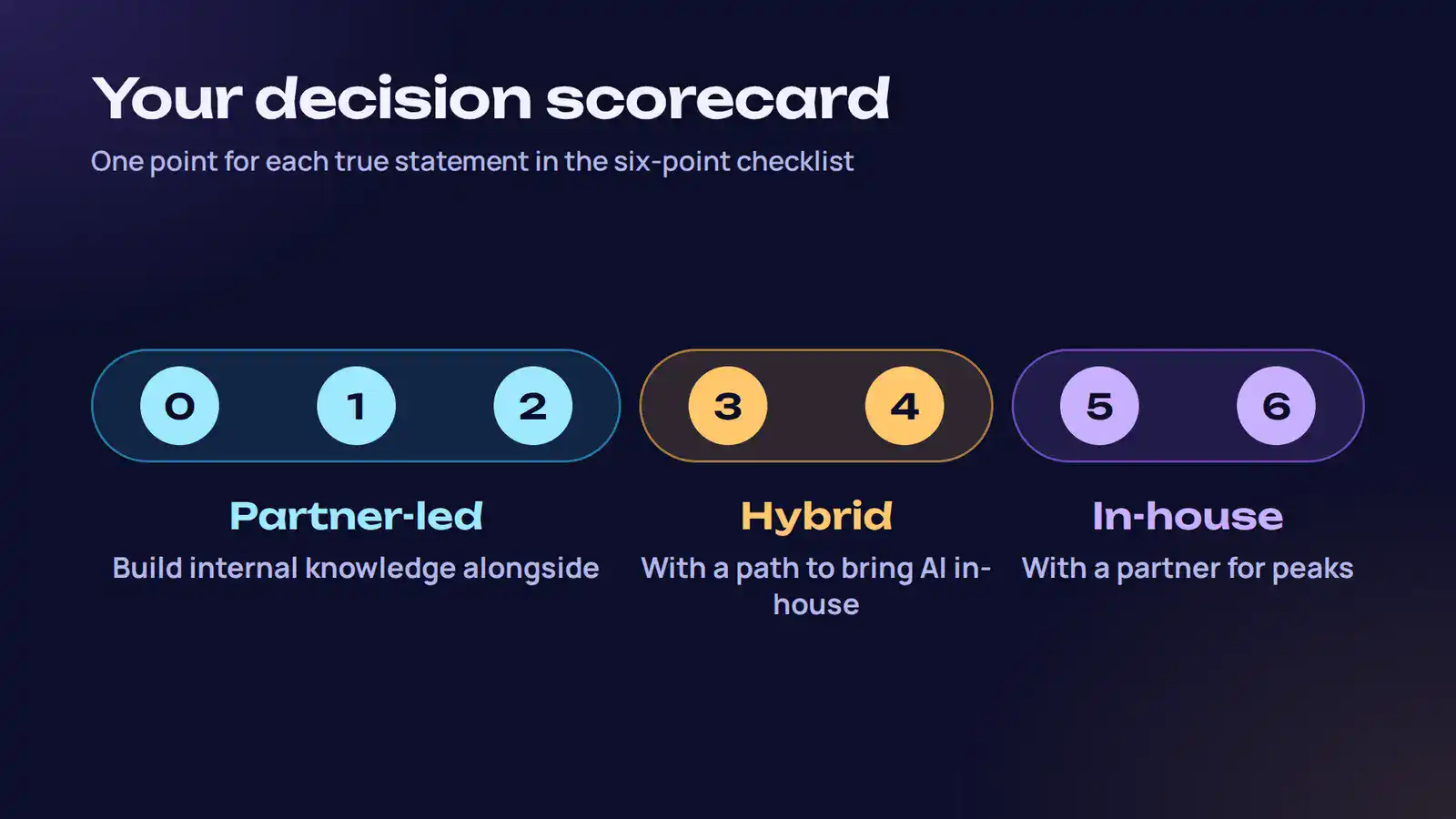
Time to interact. Give your studio one point for each statement that is true:
- The AI feature ships to players and is central to the game’s identity.
- We own proprietary data that would improve a custom model.
- We can fund a dedicated AI team for 36 months.
- We have, or can hire, a senior ML lead within three months.
- Our launch date is more than 9 months away.
- We have clear internal owners for design, safety and data.
Your result:
- 5 to 6 points: Lean in-house, with a partner for peaks.
- 3 to 4 points: Hybrid model with a path to bring capability in-house.
- 0 to 2 points: Partner-led delivery, plus a plan to build internal knowledge.
If your answers feel split, that is normal. Most studios sit in the middle, which is why hybrid is the most common outcome.
Exit Readiness: Plan the Ending at the Start
Every healthy partnership has a clean exit. Before the first sprint, confirm that:
- All code lives in repositories you control
- Training data, prompts, configuration and evaluation sets are documented and stored with you
- Models can be retrained from scratch using your assets
- Deployment and monitoring runbooks exist
- At least two internal people have been trained on the system
- Technical debt is tracked and visible, not hidden
Portability protects you whether the relationship ends in success or disappointment.
Final Thoughts
In-house versus outsourced AI game development isn’t a battle with a winner. It is a sequencing decision. Keep what makes your game unique close to home, rent what you need only temporarily, and make sure the contract protects your code, models and data either way.
If you are weighing the options, start with a pilot and a scorecard rather than a headcount plan. The evidence will make the next decision much easier.
Ready to disrupt the gaming industry?
Contact UsFrequently Asked Questions
1. When should a game studio build its AI team in-house?
When AI is part of the player-facing product, you hold proprietary data, you can fund the team for several years and you can hire and keep the talent. If any of those four are missing, a hybrid or partner-led model is usually safer.
2. What is a hybrid AI game development model?
A setup where your studio owns the vision, data and final decisions while an external partner provides specialist engineers and flexible capacity. Common versions include staff augmentation, co-development and build-operate-transfer.
3. How do I compare studio fees with in-house costs?
Compare equal scope over 24 to 36 months. Include recruiting, ramp-up, overhead, compute and idle time on the in-house side, and management time, change requests, support and exit costs on the studio side.
4. Who owns the AI models, game code and training data?
Whoever your contract says. Specify ownership of source code, trained models, training data and the partner’s pre-existing tools separately, and secure rights to move everything if you change vendors.
5. What should an AI game development pilot include?
One narrow use case, clear success metrics, a playable vertical slice, documentation, a knowledge transfer session and a go or no-go review at the end, typically over six to ten weeks.