Key Takeaways
- Predictive analytics forecasts user behavior using signals such as session frequency, feature usage, and purchase history to predict churn, purchases, and content preferences.
- Mobile churn happens quickly. Only about 25% of iOS app users remain after day one, while Android retention is roughly 20%
- AI-driven personalization can improve retention. Mixpanel’s 2026 Annual Benchmark Report, which analyzed roughly 8,000 mobile products.
- Seven predictive model types power common mobile use cases: classification, regression, time-series, clustering, recommendation, forecasting, and deep learning/AI.
- Predictive analytics can be implemented in weeks. A focused churn-prediction rollout typically takes 8–16 weeks, depending on the existing analytics stack and level of customization.
Ready for smarter mobile experiences? Let’s bring your vision to life
Contact UsMobile apps compete for attention every single day, and most lose that fight fast. Business of Apps reports that iOS apps see a 75% churn rate after day one, climbing to 95% by day 30, while Android apps churn even faster, at 80% and 96%. As a result, product teams are turning to predictive analytics in mobile apps to spot at-risk users before they leave and act on that signal in real time.
This guide explains what predictive analytics means for mobile products, how the technology works end to end, and where it delivers measurable retention and revenue gains. You will also find real use cases, model types, and an implementation roadmap you can apply directly.
What Is Predictive Analytics?
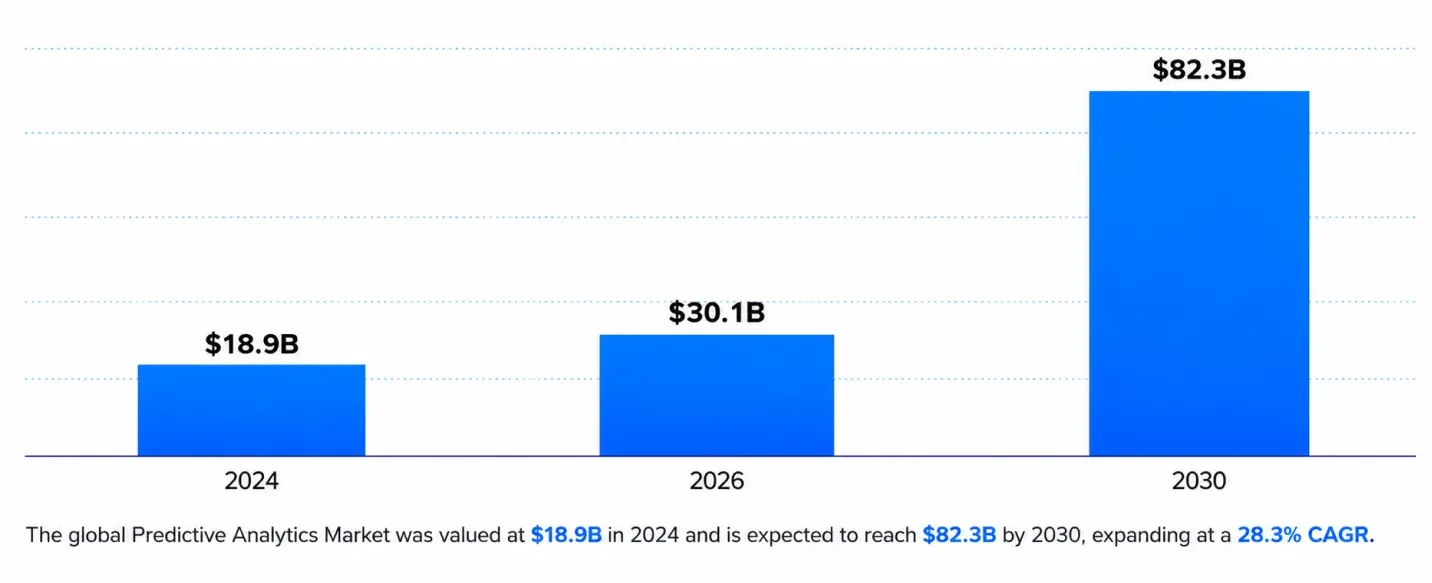
Predictive analytics uses historical data, statistics, and machine learning to forecast what a user, system, or market will do next. Instead of reporting on what already happened, it estimates the probability of a future outcome. Therefore, teams can act before an event occurs rather than reacting after it.
The global predictive analytics market is projected to grow from $18.9 billion in 2024 to $30.1 billion in 2026, reflecting the growing use of data-driven models to anticipate behavior, identify risks, and support faster decision-making.
In enterprise software, predictive analytics already powers fraud detection, demand forecasting, and supply chain planning. The same modeling approach now applies directly to mobile products, where user behavior generates constant, granular data.
What Does Predictive Analytics Mean for Mobile Apps?
For a mobile product, predictive analytics for mobile apps means using in-app signals, such as session frequency, feature usage, and purchase history, to forecast what a specific user will do next. Common predictions include churn risk, next purchase likelihood, and the content or feature a user is most likely to engage with.
Because these predictions run on individual user data, the app can respond in real time. A generic app shows the same home screen to everyone. A predictive app adjusts that screen based on what each user is likely to want.
How Is Predictive Analytics Different From Traditional App Analytics?
Traditional app analytics, such as Google Analytics dashboards, describes past behavior: sessions last week, downloads last month, and revenue last quarter. It answers “what happened.” Predictive analytics answers “what happens next,” and it does so automatically, without a human pulling a report.
Most mobile app analytics solutions started as descriptive tools. Vendors have since layered machine learning on top of that same event data, turning static dashboards into forward-looking prediction engines. This shift is why product and growth teams increasingly ask for predictive capability rather than another chart. This same shift toward AI-driven product decisions is reshaping how mobile products get built from day one; our guide on AI in mobile app development breaks down where that shift is heading next.
Why Predictive Analytics is Important for Mobile Apps?

Mobile teams operate on thin margins for attention. Users decide whether an app earns a second session within seconds of the first one. Consequently, predicting behavior early, rather than reviewing it after the fact, has become a competitive requirement rather than a nice-to-have feature.
Predictive Analytics Improves User Engagement
Predictive models flag which users are becoming less active, so teams can intervene with relevant content or offers before engagement drops further. As a result, apps stop treating every user the same way and instead respond to individual behavior patterns.
Predictive Analytics Helps Increase App Retention
Retention improves when the app anticipates needs instead of waiting for a user to search or churn. Mixpanel’s 2026 Annual Benchmark Report, which analyzed roughly 8,000 mobile products, found that apps using in-app AI assistants retained users at nearly double the rate of those without them, 9.1% versus 5.8% at day 30.
Predictive models work best alongside strong interface design, since a well-timed prompt still needs an intuitive screen to convert; see our roundup of UI/UX design practices that increase user engagement and retention for the design side of this equation.
Predictive Analytics Helps Reduce User Churn
Churn prediction models score every user on the likelihood they will stop using the app within a set window. Teams then combine this score with mobile app user behavior analytics to understand why a specific segment is at risk, whether it is a broken onboarding step, missing content, or pricing friction. This targeted view is far more actionable than a single aggregate churn number.
Predictive Analytics Supports App Revenue Growth
Forrester Research’s Enterprise Mobility Survey, covering 2,800 organizations, found that productivity apps using native AI task automation reached a day-30 retention rate of 7.6%, nearly 85% above the category average of 4.1%. Higher retention directly compounds into higher lifetime value and lower acquisition spend per active user.
Core Components of Predictive Analytics in Mobile Apps
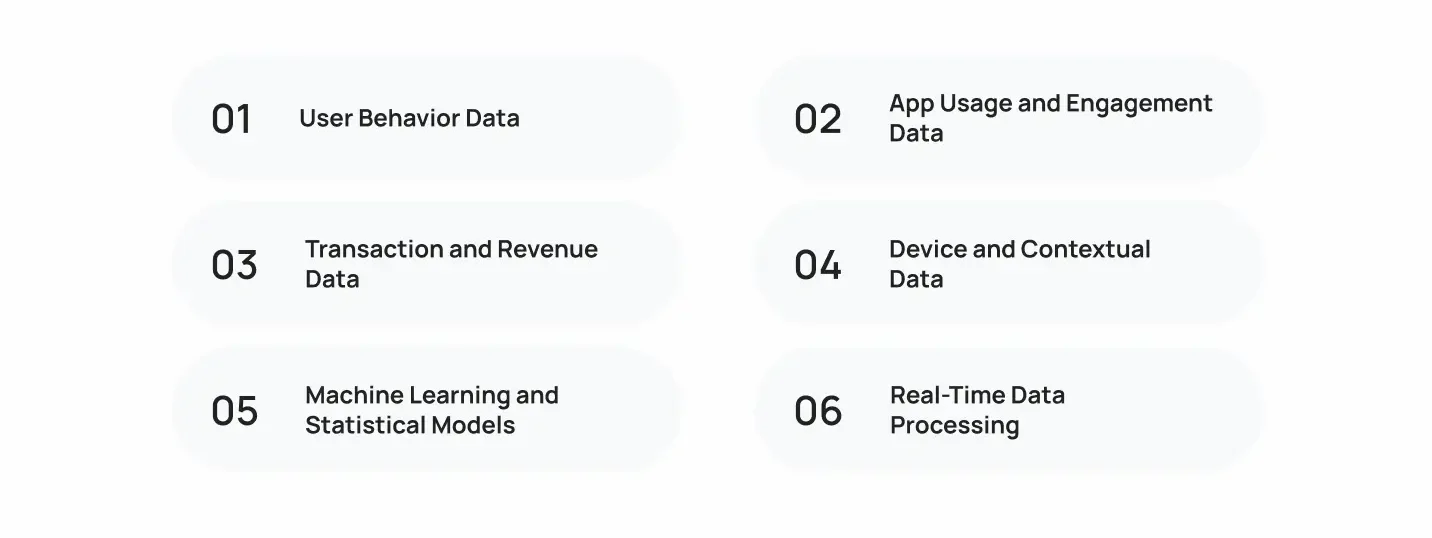
Every predictive system in a mobile app rests on the same underlying building blocks. Understanding each one helps teams scope a realistic implementation instead of treating predictive analytics as a single plug-in feature.
1. User Behavior Data
This includes taps, screen views, session length, feature adoption, and in-app search terms. Mobile app user behavior analytics forms the foundation for nearly every prediction the app makes, since behavior is the strongest early signal of intent.
2. App Usage and Engagement Data
Session frequency, time between sessions, and feature stickiness tell the model how a user’s engagement is trending over time. A sudden drop in session frequency is one of the earliest and most reliable churn indicators.
3. Transaction and Revenue Data
Purchase history, subscription status, and average order value feed models that predict lifetime value and next purchase likelihood. Fintech and e-commerce apps rely heavily on this layer for fraud detection and upsell timing.
4. Device and Contextual Data
Device type, operating system, location, time zone, and network conditions add context to raw behavior. For example, a user on a slow connection during commute hours behaves differently than the same user on Wi-Fi at home, and the model should account for that.
Feeding accurate device and network context into a model only pays off if the app itself performs well under those conditions, which is why teams pair this data layer with dedicated work like our Android app optimization best practices.
5. Machine Learning and Statistical Models
This is the analytical engine that turns raw data into a prediction. Simpler use cases rely on logistic regression or decision trees, while more complex personalization tasks use deep learning. AI predictive analytics for mobile apps increasingly relies on models that retrain automatically as new behavior data arrives, rather than static models refreshed manually.
6. Real-Time Data Processing
Predictions lose value if they arrive too late. Streaming data pipelines process events as they happen, so the app can act within the same session rather than a day later through a batch report.
Predictive Analytics vs. Descriptive and Prescriptive Analytics
Descriptive, predictive, and prescriptive analytics form a progression of data analysis that answers what happened, what is likely to happen, and what actions you should take.
| Aspect | Descriptive Analytics | Predictive Analytics | Prescriptive Analytics |
|---|---|---|---|
| Core question | What happened? | What will happen? | What should we do about it? |
| Method | Reports and dashboards | Statistical models, machine learning | Optimization and simulation |
| Mobile app example | Daily active users last month | Probability a user churns in the next 7 days | The exact offer or notification to send that user |
| Output | Metrics and charts | Scores and probabilities | Recommended actions |
How Predictive Analytics in Mobile Apps Works
Predictive analytics in mobile apps uses historical user data and machine learning to forecast future actions and personalize experiences in real time.
Collect mobile app data
Instrument the app with an SDK or analytics platform to capture events, transactions, and device context continuously.
Prepare and analyze user data
Clean, deduplicate, and structure the raw event data so it is usable for modeling. This step often takes longer than building the model itself.
Identify behavioral patterns
Analysts and data scientists look for correlations; for instance, users who skip onboarding step three churn at a much higher rate.
Build and train predictive models
Teams select an algorithm, train it on historical data, and validate it against a holdout set to check accuracy.
Generate user behavior predictions
The trained model scores each user, producing outputs such as a churn probability or a recommended product.
Turn predictions into real-time actions
The app triggers a notification, changes a screen, or adjusts pricing based on the prediction, ideally within the same session.
Monitor and update predictive models
User behavior shifts over time, so models need regular retraining and performance monitoring to stay accurate.
This ongoing maintenance is one of several hurdles teams run into once a model moves from prototype to production; our overview of common mobile app development challenges covers the rest.
Types of Predictive Models Used in Mobile Apps
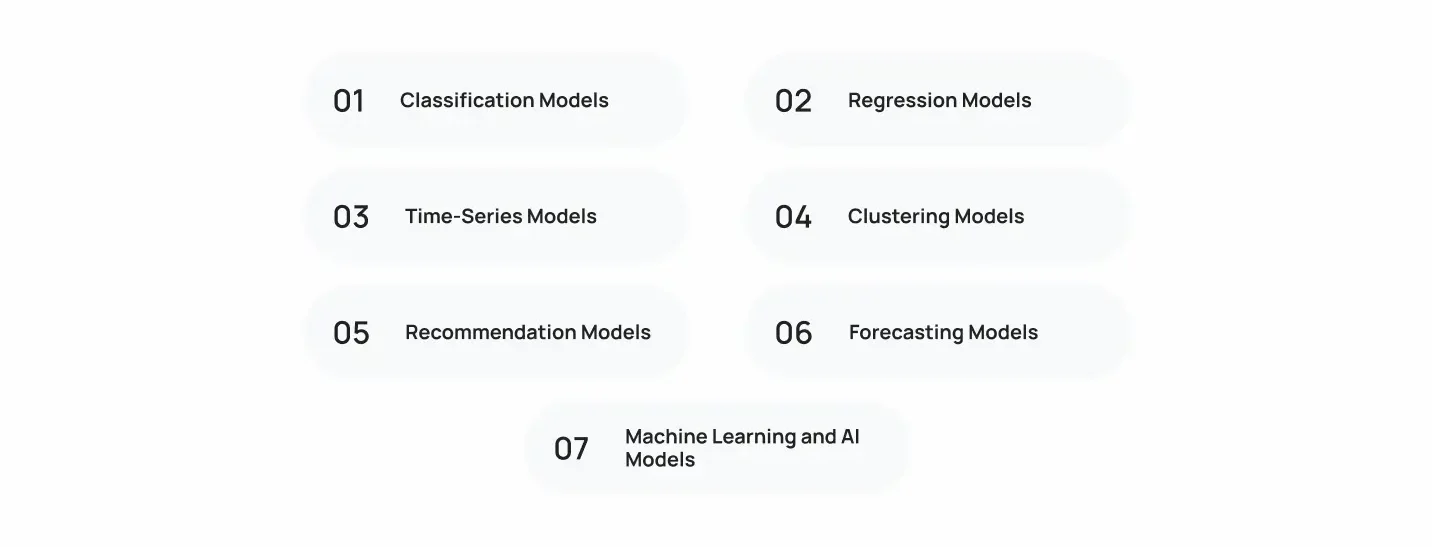
Different business questions call for different model types. The table below maps common model families to mobile use cases.
1. Classification Models
Classification models sort users into categories, such as “likely to churn” or “likely to convert.” They are the backbone of most churn prediction systems because the output is simple to act on.
2. Regression Models
Regression models predict a number rather than a category, for example, predicted revenue per user over the next 90 days. Product teams use these scores to prioritize which segments deserve a retention budget.
3. Time-Series Models
Time-series models analyze data points collected over time to forecast trends, such as expected app downloads or in-app purchases next quarter. Seasonal apps, such as travel or shopping platforms, depend heavily on this model type.
4. Clustering Models
Clustering groups users by shared behavior without predefined labels. This supports behavioral segmentation, allowing teams to build campaigns for “power users,” “at-risk users,” and “casual browsers” instead of treating the whole user base as one group.
5. Recommendation Models
Recommendation models generate predictive recommendations in mobile apps by analyzing what similar users engaged with previously. Streaming, retail, and news apps use this model type to personalize feeds the moment a user opens the app.
6. Forecasting Models
Forecasting models estimate future volume, such as expected traffic during a flash sale or peak streaming hours. Engineering teams use these forecasts to scale infrastructure ahead of demand rather than after an outage.
7. Machine Learning and AI Models
Deep learning models handle high-dimensional data, such as combining device signals, location, and transaction patterns to detect fraud in milliseconds. These models require more data and computing power but deliver the highest accuracy for complex, multi-signal predictions. For a broader look at where this technology is showing up across the app experience, see our roundup of AI features for mobile apps.
Key Benefits of Predictive Analytics for Mobile Apps
The benefits below explain why predictive capability has moved from a nice-to-have to a standard product requirement.
- Personalized user experiences: Content, offers, and layouts adjust automatically based on predicted preferences.
- Higher user engagement: Timely, relevant prompts keep users active instead of letting sessions taper off.
- Improved user retention: Early intervention on at-risk segments reduces overall churn.
- Early churn prediction: Teams get a warning window measured in days, not a surprise after the user has already left.
- Better customer lifetime value prediction: Marketing and finance teams can forecast revenue per cohort with more confidence.
- More effective in-app recommendations: Suggestions match actual behavior instead of generic popularity rankings.
- Data-driven product decisions: Roadmap priorities shift from opinion-based debates to evidence backed by predicted impact.
These benefits compound when they’re built on a solid product foundation; our list of tips for a successful mobile application covers the fundamentals worth getting right first.
How Predictive Analytics Improves Mobile App Retention
Retention is where predictive analytics in mobile apps proves its value most directly, since a small improvement in day-30 retention compounds into significant lifetime value gains. This is also where predictive user retention strategies move from theory into daily product decisions.
Identifying Users at Risk of Churn
Models score every active user on churn probability daily or weekly. Teams then route the highest-risk segment into a retention workflow before the user disengages completely.
Predicting the Best Time to Re-Engage Users
Timing determines whether a message helps or annoys. As discussed earlier, Iterable’s 2026 analysis of 2.3 billion push notification sends found that AI-optimized, individual send-time personalization improved open rates by 34% compared to fixed send windows. This is the core logic behind smart notifications for mobile apps, which send messages based on each user’s active hours rather than a single blast time for everyone.
Personalizing Retention Campaigns
Instead of one generic win-back email, predictive segmentation lets teams tailor the offer, channel, and message to why a specific group is disengaging, whether that is price sensitivity, missing features, or poor onboarding.
Predicting Next Best Actions
Next-best-action models suggest the single most impactful thing to show a user right now, whether that is a tutorial, a discount, or a feature they have not tried yet. This keeps intervention focused instead of overwhelming users with generic prompts.
Using Behavioral Signals to Improve Retention
Session frequency drops, feature abandonment, and support ticket spikes all serve as early behavioral signals. Feeding these signals into a model, rather than reviewing them manually, shortens the time between a warning sign and a response.
Real-World Use Cases: How Predictive Analytics Powers Mobile Apps
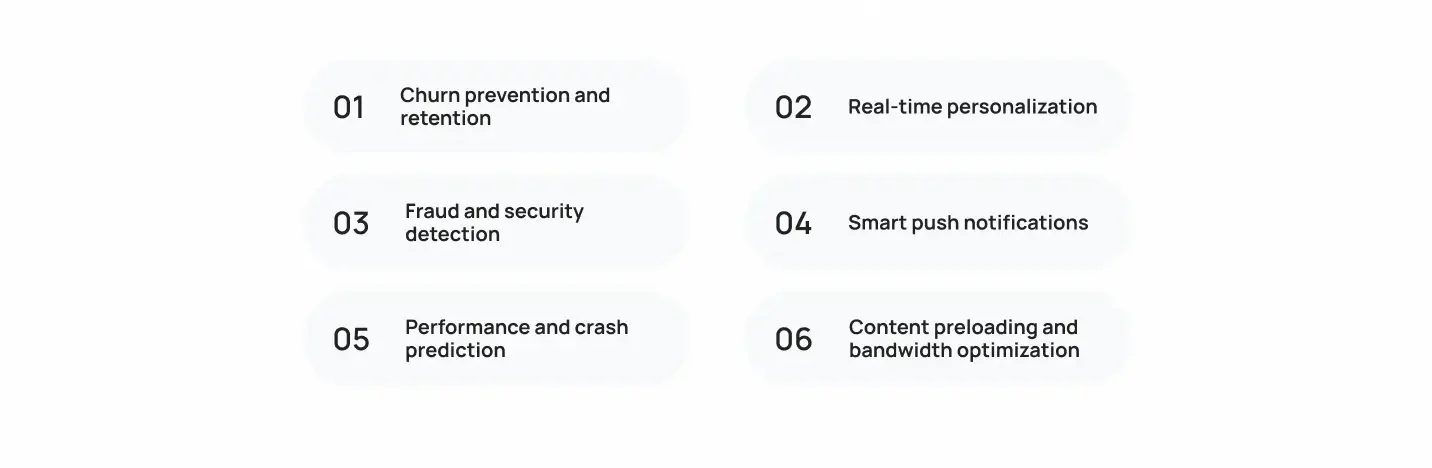
Churn prevention and retention:
E-commerce and subscription apps analyze drop-off patterns to identify when a customer is about to leave, then automatically trigger a targeted discount or re-engagement notification.
Real-time personalization:
Media and shopping apps forecast individual preferences to generate predictive recommendations in mobile apps, dynamically adjusting product feeds, layouts, or video suggestions the moment a user opens the app.
Fraud and security detection:
Fintech and banking apps flag unusual transaction patterns or abnormal device behavior instantly, blocking fraudulent access before it completes.
Smart push notifications:
Context-aware apps track when a user is most active, or moving along a familiar route, to deliver smart notifications for mobile apps at the exact moment a response is likely.
Performance and crash prediction:
Development and DevOps teams monitor usage and failure trends to predict memory bottlenecks or crash-prone features, patching issues before they reach most active users.
Content preloading and bandwidth optimization:
Streaming apps forecast peak viewing hours or individual habits to preload content during off-peak windows, keeping playback smooth and latency low.
How to Implement Predictive Analytics Mobile App Development
Turning predictive analytics from a concept into a shipped feature follows a consistent path, regardless of app category.
Define Your Predictive Analytics Goals
Start with one clear business question, such as “which users are likely to churn in the next 14 days,” instead of trying to predict everything at once. A narrow, well-defined goal is easier to validate and ship.
Collect and Prepare Mobile App Data
Audit existing event tracking to confirm the app already captures the signals a model would need. Many teams discover gaps here before they even reach the modeling stage.
Choose the Right Predictive Model
Match the model type to the business question. A churn flag needs classification, a lifetime value estimate needs regression, and a personalized feed needs a recommendation engine. Overbuilding with deep learning for a simple binary prediction adds cost without adding accuracy.
Integrate Predictions Into the User Experience
A prediction only creates value once it changes what a user sees or receives. Connect model output to a specific in-app action, such as a notification trigger, a screen variant, or a support flow, and measure the resulting change in behavior.
Teams should budget for ongoing model monitoring after launch. IDC and Microsoft’s 2026 research puts the average return at $3.70 per dollar spent on generative AI initiatives, with a median time to positive ROI of 14 months, underscoring that predictive systems need sustained investment rather than a one-time build.
Build Smarter Mobile Apps With Predictive Analytics
Turning predictive analytics into a shipped feature takes more than a model; it takes clean data pipelines, the right in-app triggers, and a team that can maintain the system as user behavior shifts.
Cubix works as a custom mobile app development agency that helps product and growth teams build predictive capabilities directly into their apps, from churn scoring and personalized recommendation engines to fraud detection and performance monitoring, so every prediction turns into an action a user actually sees.
If your team is ready to move from historical dashboards to real-time, predictive product decisions, our mobile app development team can help you scope the right model, build it, and ship it.
Build predictive mobile app solutions. Contact Cubix to get started
Contact UsFrequently Asked Questions
1. What is mobile app predictive analytics, and why does it matter?
It uses historical and real-time user data to forecast future behavior, such as churn risk or next purchase likelihood. It matters because it lets teams act before a user disengages rather than analyzing the loss afterward.
2. What are some real-life examples of how predictive analytics can be used in the real world?
Common examples include Netflix forecasting what a viewer will watch next, banks flagging fraudulent transactions in real time, and e-commerce apps predicting which shoppers are about to abandon their cart.
3. How is AI used in predictive analytics?
AI, specifically machine learning, identifies patterns in large datasets that would be too complex for manual analysis. In mobile products, AI predictive analytics for mobile apps continuously retrains on new behavior data, so predictions improve as the app collects more usage history.
4. What are the limitations of predictive analytics?
Predictions depend on data quality, so incomplete or biased data produces unreliable scores. Models also struggle with sudden behavior shifts they have never seen before, such as a new competitor entering the market, and they require ongoing retraining to stay accurate.
5. What is an example of the use of predictive analytics?
A subscription app predicting which users are likely to cancel next month, then automatically offering a discount to the highest-risk segment, is a typical example.
6. What are the three main types of predictive analytics?
The three broad categories are classification models, which predict a category or outcome, regression models, which predict a numeric value, and time-series models, which forecast trends over time.
7. Which tool is best for predictive analytics?
The right tool depends on team size and technical depth. Options range from built-in platform analytics with predictive add-ons to custom machine learning pipelines built on frameworks such as TensorFlow or cloud services from AWS, Google Cloud, or Azure. Most mid-size teams start with a vendor platform before building custom models in-house.
8. How long does it take to implement predictive analytics in a mobile app?
A focused, single-use-case implementation, such as churn scoring, typically takes 8 to 16 weeks for predictive analytics mobile app development, covering data preparation, model training, and in-app integration. Broader, multi-model systems can take several months.
9. How can predictive analytics improve mobile app retention and reduce churn?
By scoring users on churn risk early, apps can trigger targeted retention actions, such as personalized offers or re-engagement notifications, before the user leaves. This shift from reactive to proactive outreach is the core mechanism behind stronger predictive user retention.
10. How much does it cost to add predictive analytics to a mobile app?
Costs vary widely based on scope. A basic implementation using an existing analytics platform’s built-in predictive features can start in the low five figures, while a custom machine learning system built from scratch, including data infrastructure, commonly runs into six figures.