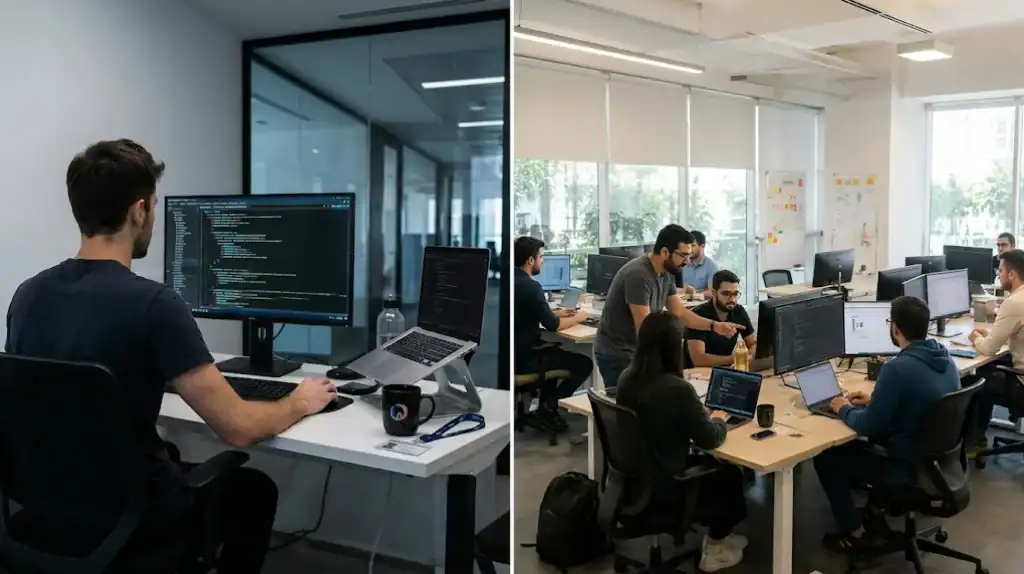
Key Takeaways
- In-house software development gives businesses more control over product decisions, team collaboration, and long-term knowledge.
- Outsourced software development can lower hiring costs, shorten development timelines, and provide access to experienced specialists.
- The cheapest hourly rate does not always lead to the lowest overall project cost.
- The best software development model depends on business goals, available budget, product complexity, and growth plans.
- Many companies combine internal leadership with external development teams to balance cost, speed, and expertise.
Building software is rarely just a technology decision. It is a business decision that affects hiring, budgets, product quality, and how quickly a company can bring new ideas to market.
Over the years, both strategies have delivered immensely successful software products. Basecamp remains a prime example of an in-house success, while at times, both Slack and GitHub outsourced development to an external agency. These companies illustrate that there’s no universal “right” way.
The best solution ultimately depends on budget, deadlines, available talent pool, and long-term business strategy. This has never been truer than today, as the hiring market has become more challenging for tech businesses than ever before.
The U.S. Bureau of Labor Statistics (BLS) projects that employment of software developers will increase by 17.9% between 2023 and 2033, which is much faster than the average for all occupations (about 4%).
As a result, hiring experienced developers has become harder. It has also become more expensive. This is where businesses need to think beyond the simple comparison of hourly wages when comparing in-house vs outsourced software development; recruitment fees, onboarding, product familiarity, communication, maintenance, and future scaling are all factors that will influence the true cost.
Read on for the ultimate comparison that breaks down in-house software development vs outsource across various criteria, illustrating exactly where each model excels, and informing the most pragmatic decision for your company.
What Is In-House Software Development?

In-house software development means building software with employees who work directly for the company. The business hires developers, designers, testers, product managers, and other specialists, then manages the entire project internally.
This approach gives companies direct control over priorities, product decisions, and day-to-day development. Because the team works closely with the business, they develop a deeper understanding of customer needs, company goals, and the product itself. That knowledge often leads to better decisions as the product grows.
Internal teams also work more closely with departments like marketing, sales, and customer support. Feedback can move quickly between teams, making it easier to improve features based on real customer experiences.
How an In-House Team Works
An internal development team usually includes professionals with different responsibilities, such as:
- Product managers who define features and priorities
- Software developers who build the application
- UI/UX designers who improve the user experience
- QA engineers who test new releases
- DevOps engineers who handle deployments and infrastructure
Together, these roles support the entire software lifecycle, from planning and development to ongoing updates and maintenance.
Advantages of In-House Software Development
An in-house team gives businesses direct control over product development and day-to-day decision-making. Because employees work closely with other departments, they gain a deeper understanding of business goals, customer needs, and the product itself. This approach is often a good fit for companies building software that plays a central role in their long-term strategy.
Deep Product Knowledge
Internal teams spend years working on the same products. Over time, they build a strong understanding of the business, customers, and technical architecture. That experience becomes valuable when adding new features or solving complex issues.
Faster Collaboration
Developers can speak directly with product managers, designers, or business leaders without coordinating through another company. Faster conversations often lead to quicker decisions and fewer misunderstandings.
More Control
Companies decide how projects are managed, which features receive priority, and when new releases happen. This level of control is often valuable when software plays a central role in the business.
Better Cross-Team Communication
Because developers work alongside other departments, customer feedback and business priorities can move through the development workflow with fewer delays.
Challenges of In-House Development
Building an internal team also requires a significant investment.
Hiring experienced developers in the United States can take several months. Beyond salaries, companies must budget for recruitment, benefits, equipment, training, and employee retention.
Growth can also become difficult when project needs change. If additional specialists are needed, hiring takes time. While recruitment is underway, product development may slow down.
Read More: How Much Does it Cost to Outsource Software Development
What Is Outsourced Software Development?

Outsourced software development means hiring an external company to build part or all of a software product. Depending on the project, the outside team may handle design, development, testing, deployment, maintenance, or all of these responsibilities.
Instead of building a large internal engineering department, businesses gain access to experienced professionals who are ready to start work. This approach is especially useful for startups, companies launching new products, or organizations that need specialized technical skills for a limited time.
Common Outsourcing Models: Companies generally choose one of three approaches based on their goals.
Project-Based Development: The development partner manages the entire project according to agreed requirements, budget, and deadlines.
Dedicated Development Team: A remote development team works exclusively on one company’s product while remaining employed by the outsourcing provider.
Staff Augmentation: External developers join an existing internal team to fill skill gaps or increase development capacity during busy periods.
Benefits of Outsourced Software Development
Outsourcing gives businesses access to experienced development teams without the time and expense of building an internal department. It can shorten development timelines, reduce hiring costs, and provide specialized expertise when projects require skills that are not available in-house. When managed effectively, outsourcing also gives companies the flexibility to adjust team size as project needs change.
Faster Access to Skilled Developers
Finding experienced engineers can take months. An outsourcing partner already has established teams, allowing projects to begin much sooner.
Lower Operating Costs
Businesses avoid many expenses that come with full-time hiring, including recruitment, employee benefits, office space, and ongoing training.
Easier Team Expansion
Development needs often change as projects grow. Outsourcing allows companies to increase or reduce team size without lengthy hiring cycles, making project scalability much easier to manage.
Specialized Experience
Many outsourcing companies have built products across healthcare, finance, retail, logistics, and other industries. That experience often helps teams solve technical challenges more efficiently and avoid common development mistakes.
For businesses looking for experienced partners, choosing a company that offers end-to-end software development services can simplify the development process while providing access to proven technical expertise.
| Factor | In-House Software Development | Outsourced Software Development |
| Cost | Higher upfront investment due to salaries, recruitment, benefits, equipment, and training. | Lower initial costs since businesses pay for the required services without building a full-time team. |
| Hiring Speed | Recruiting experienced developers can take several months, especially in competitive markets. | Established teams can often begin work within weeks, reducing project delays. |
| Time to Market | Product timelines may be affected by hiring and onboarding. | Faster project kickoff helps businesses launch products sooner. |
| Access to Talent | Limited to candidates the company can recruit and retain. | Access to specialists with experience across industries and technologies. |
| Communication | Direct collaboration with internal stakeholders enables faster day-to-day discussions. | Communication depends on structured meetings, documentation, and project management practices. |
| Control | Full control over priorities, development processes, hiring decisions, and product direction. | Less day-to-day oversight, although experienced partners provide regular reporting and collaboration. |
| Flexibility | Expanding the team often requires lengthy recruitment and onboarding. | Teams can be scaled up or down more quickly based on project needs. |
| Product Knowledge | Employees build deep familiarity with the product and business over time. | Product knowledge is documented, and knowledge transfer becomes important when projects change hands. |
| Best For | Businesses building long-term products that require continuous internal collaboration and strategic control. | Startups, growing companies, and organizations that need faster delivery, specialized expertise, or temporary development support. |
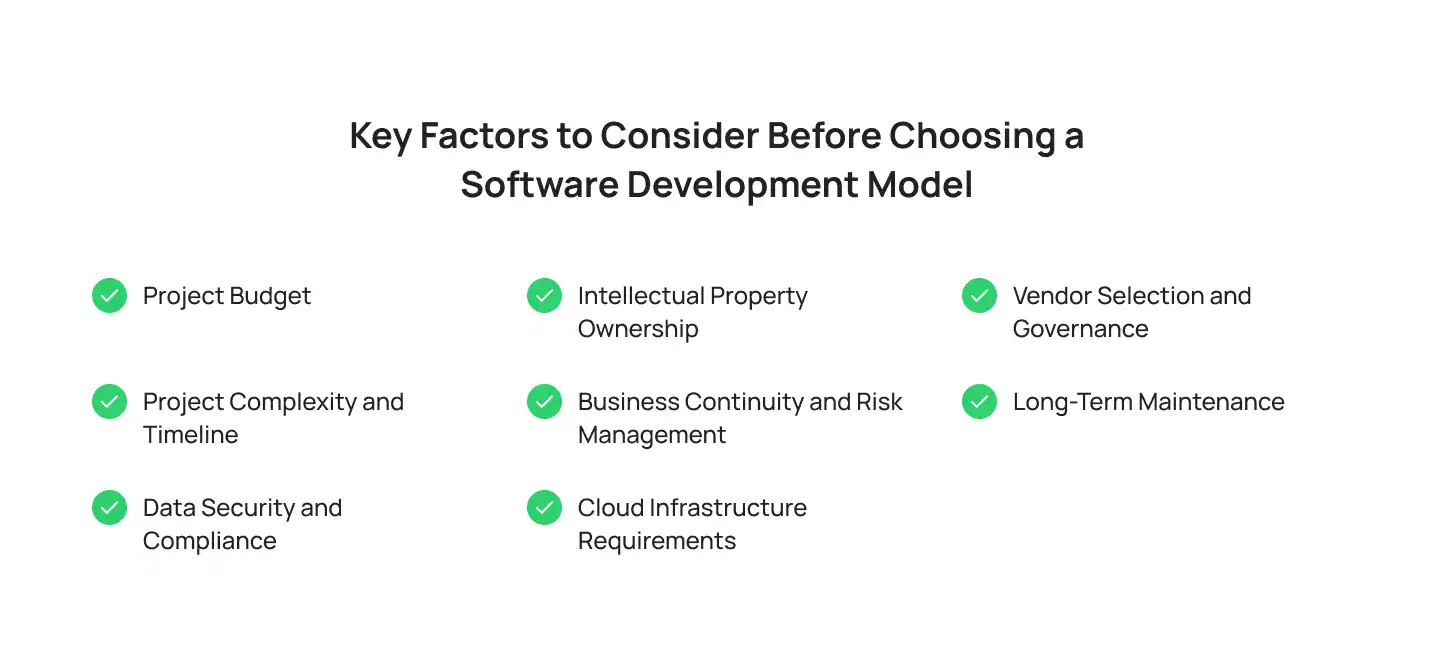
Key Factors to Consider Before Choosing a Software Development Model
The right development approach depends on more than cost alone. Businesses should consider how the project will evolve, what skills are required, and how the software will be maintained after launch. Evaluating these factors early can prevent delays, reduce unnecessary spending, and help teams choose a model that supports both immediate goals and future growth.
Project Budget
Evaluating software development cost requires looking beyond hourly rates. Recruitment, onboarding, software licenses, infrastructure, maintenance, and future enhancements all contribute to the total cost of ownership.
An in-house team often requires a larger upfront investment, while outsourcing can reduce many of these operational expenses. Regardless of the approach, businesses should also plan for unexpected costs such as scope changes, feature revisions, or extended testing before release.
Project Complexity and Timeline
The complexity of a project often influences which development model works best.
Products that require continuous updates, close collaboration with internal teams, and long-term product planning are often better suited to an in-house team. In contrast, projects with clearly defined requirements and aggressive launch schedules can benefit from outsourcing, where experienced teams are already in place and ready to begin development.
Data Security and Compliance
Organizations handling sensitive customer information need to evaluate how each development model protects data security and meets industry compliance requirements.
This is especially important in healthcare, financial services, and insurance. These industries have strict rules for collecting, storing, and processing sensitive customer data. Before development begins, businesses should verify that internal teams or outsourcing partners follow recognized security practices and understand the regulations that apply to the project.
Intellectual Property Ownership
Software often represents a company’s most valuable asset, making intellectual property ownership a key consideration.
With an internal team, ownership is generally straightforward because employees create the software for the company. When outsourcing, contracts should clearly define ownership of source code, documentation, custom features, and any third-party components. Addressing these terms early helps prevent disputes after the project is completed.
Business Continuity and Risk Management
Unexpected events such as employee turnover, operational disruptions, or infrastructure failures can affect software projects. A strong development strategy should support business continuity through reliable documentation, code repositories, backup procedures, and clear handover processes.
Reducing reliance on a single developer or team also lowers the risk of delays if key personnel become unavailable.
Cloud Infrastructure Requirements
Many modern applications rely on scalable cloud infrastructure built on platforms such as Amazon Web Services (AWS), Microsoft Azure, or Google Cloud.
Some outsourcing partners bring extensive experience with these platforms, allowing businesses to implement cloud-based architectures without hiring additional specialists. For organizations with existing cloud environments, internal teams may already possess the knowledge needed to maintain and expand those systems.
Vendor Selection and Governance
Choosing the right outsourcing partner requires more than comparing prices. Effective vendor management depends on evaluating technical expertise, communication practices, project history, and delivery processes.
A well-defined service level agreement (SLA) should outline responsibilities, performance expectations, response times, reporting frequency, and issue resolution procedures. Clear agreements help both parties stay aligned throughout the project.
Long-Term Maintenance
Software continues to evolve long after its initial release. Poor planning, rushed development, or weak documentation can create technical debt, making future updates slower and more expensive.
Whether development is handled internally or by an external partner, maintaining clean code, thorough documentation, and regular code reviews helps reduce maintenance costs and keeps the application easier to improve over time.
When In-House Software Development Makes the Most Sense

An internal development team is often the better choice when software plays a central role in a company’s long-term strategy. While the upfront investment is higher, businesses gain greater control over product direction, technical decisions, and ongoing innovation.
SaaS Companies
Software-as-a-Service products require frequent updates, customer-driven improvements, and continuous feature development. An in-house team develops a deep understanding of user behavior and product architecture, making it easier to respond to changing customer needs.
Banking Platforms
Banks and financial institutions handle highly sensitive customer information and operate under strict regulatory requirements. Internal teams often provide greater oversight of development processes, security controls, and system integrations for mission-critical applications.
Healthcare Software
Healthcare applications must comply with industry regulations while protecting patient information. Organizations developing electronic health records, telemedicine platforms, or medical software often prefer a trusted healthcare software development company with internal teams that understand both regulatory requirements and long-term product goals.
Products with Continuous Research and Development
Product innovation depends on close collaboration. Engineers, designers, and product managers can work together more effectively as one internal team. Frequent experimentation, rapid prototyping, and long-term planning are often easier to manage with an internal team.
When Outsourced Software Development Is the Better Choice

Outsourcing is often the more practical option when businesses need specialized expertise, faster delivery, or additional development capacity without expanding their permanent workforce.
Startups Building an MVP
Startups often need to validate an idea before investing in a large engineering team. Outsourcing allows them to launch a minimum viable product (MVP) more quickly while keeping initial costs under control.
Companies Filling Skill Gaps
An internal team may have strong product knowledge but lack experience with a specific technology or platform. Outsourcing gives businesses access to specialists without requiring permanent hires.
Short-Term Projects
Not every project justifies building a full-time development team. For fixed-scope initiatives such as internal business applications, customer portals, or proof-of-concept projects, outsourcing can be a more cost-effective approach.
Legacy System Modernization
Modernizing older software often requires expertise in cloud migration, application refactoring, or platform upgrades. Development partners with experience in modernization projects can help businesses update legacy systems while minimizing operational disruption.
Rapid Business Growth
When demand increases unexpectedly, hiring dozens of developers internally may not be practical. Outsourcing enables companies to expand development capacity quickly without lengthy recruitment cycles.
Can a Hybrid Model Offer the Best of Both?

For many organizations, the choice is no longer limited to in-house or outsourced development. A hybrid model combines both approaches, allowing businesses to keep strategic responsibilities internally while relying on external specialists for additional expertise or faster delivery.
In a typical hybrid setup, the internal team manages product strategy, business requirements, architecture, and customer priorities. External developers handle specialized development tasks, quality assurance, or temporary workload increases.
This model offers several advantages:
- Internal teams maintain control over product direction and business decisions.
- External specialists provide expertise that may not exist within the organization.
- Development capacity can expand during busy periods without permanent hiring.
- Businesses can optimize costs while maintaining product quality.
A hybrid approach works particularly well for companies with mature products that require ongoing development but occasionally need additional engineering support for major releases or new initiatives.
Which Software Development Model Should You Choose?
The best choice depends on your business goals, budget, and the type of product you’re building. While every project has unique requirements, these general guidelines can help narrow your decision.
- Choose in-house software development if your product is central to your business, requires continuous innovation, and benefits from full control over development and long-term planning.
- Choose outsourced software development if you need to reduce upfront costs, accelerate development, or access specialized expertise without expanding your internal team.
- Choose a hybrid model if you want to keep product strategy and core decision-making in-house while using external developers to add skills, increase capacity, or speed up delivery.
Why Choose Cubix for Software Development?

Selecting the right software development partner is just as important as choosing the right delivery model. With more than 18 years of experience, Cubix has helped startups, mid-sized businesses, and global enterprises build web, mobile, AI, gaming, and enterprise software solutions across a wide range of industries.
Whether a business needs a dedicated development team, project-based delivery, or additional engineering support, we adapt our approach to match project goals, timelines, and technical requirements. From product discovery and UI/UX design to development, testing, deployment, and ongoing support, every stage is handled with a focus on quality, transparency, and measurable business outcomes.
If you’re evaluating the best way to build your next software product, we can help identify the development model that aligns with your budget, timeline, and growth strategy.
Conclusion
The best development model depends on what the business needs today and how the product is expected to grow. Some organizations benefit from an internal team. Others gain more value from outsourcing. Many combine both approaches to balance cost, expertise, and flexibility.
In-house development is all about better control, more profound product understanding, and interdepartmental cooperation. Outsourcing allows for quicker access to talent, reduced expenses, and scaling depending on changing business conditions. At the same time, companies frequently manage to make use of both approaches.
Before making a final decision, you need to consider not the rates of development, but rather the total cost of ownership of the product. Recruitment, maintenance, infrastructure, and continuous support all influence the true investment. For a better understanding of the expenses that can affect your budget, explore our guide on Hidden Costs in Software Development.
Choosing the right development model starts with understanding your business priorities. When your strategy, budget, and technical requirements are aligned, you’re more likely to build software that delivers lasting value.
Frequently Asked Questions
1: Is in-house software development more expensive than outsourcing?
In most cases, yes. In-house development includes salaries, recruitment, employee benefits, equipment, and ongoing operational costs. Outsourcing can reduce many of these expenses, especially for short-term or specialized projects.
2: When should a startup choose outsourced software development?
Outsourcing is often a good choice when a startup is building an MVP, working with limited funding, or needs to launch quickly without hiring a full engineering team.
3: Which industries benefit most from in-house software development?
Industries such as banking, healthcare, and SaaS often prefer in-house development because their products require continuous improvement, close collaboration, and greater control over sensitive systems.
4: Can businesses combine in-house and outsourced development teams?
Yes. Many companies use a hybrid model where internal teams manage product strategy and core development while external specialists provide additional expertise or help scale development capacity.
5: What is the biggest factor when choosing a software development model?
The decision should be based on business goals, project complexity, budget, timeline, and the level of control required throughout the software development process.