Key Takeaways:
- LEGO Batman succeeded by combining family-friendly gameplay, iconic characters, and engaging co-op experiences.
- Character switching, puzzle-solving, and open-world exploration created a fun and highly replayable gameplay loop.
- The franchise showcases important game development practices, including accessibility, scalability, and performance optimization.
- Superhero games remain popular due to strong IP recognition, immersive storytelling, and rewarding progression systems.
- Cubix leverages 17+ years of expertise and 200+ game projects to build scalable, player-focused gaming experiences.
Superhero games continue to dominate the gaming industry as some of the most commercially successful entertainment properties worldwide, driven by strong IP recognition, cinematic storytelling, and global fan engagement. The LEGO Batman franchise stands out as one of the genre’s biggest successes, selling over 14 million copies globally according to Warner Bros. and Guinness World Records. Its performance demonstrates how recognizable characters, approachable gameplay, and cooperative design can transform licensed games into long-lasting global franchises.
LEGO Batman: Legacy of the Dark Knight goes beyond a standard superhero release, reflecting how licensed games have evolved through improved storytelling, expanded open-world design, and more refined cooperative systems. It builds on the legacy of LEGO-based titles while deepening Batman’s digital universe with humor, exploration, and interactive gameplay that appeals to both younger players and long-time fans.
As a leading game development company, Cubix understands how franchises like LEGO Batman succeed by combining strong IPs with scalable game architecture and engaging mechanics. Modern superhero titles demonstrate how thoughtful design decisions, from multiplayer systems to immersive environments, drive long-term player retention and commercial success.
[blog_cta]
How LEGO Batman Became One of the Most Successful Superhero Game Franchises
LEGO Batman transformed a licensed superhero game into a global success through accessible gameplay, strong brand appeal, and innovative design. Its ability to attract players of all ages helped establish a lasting franchise.
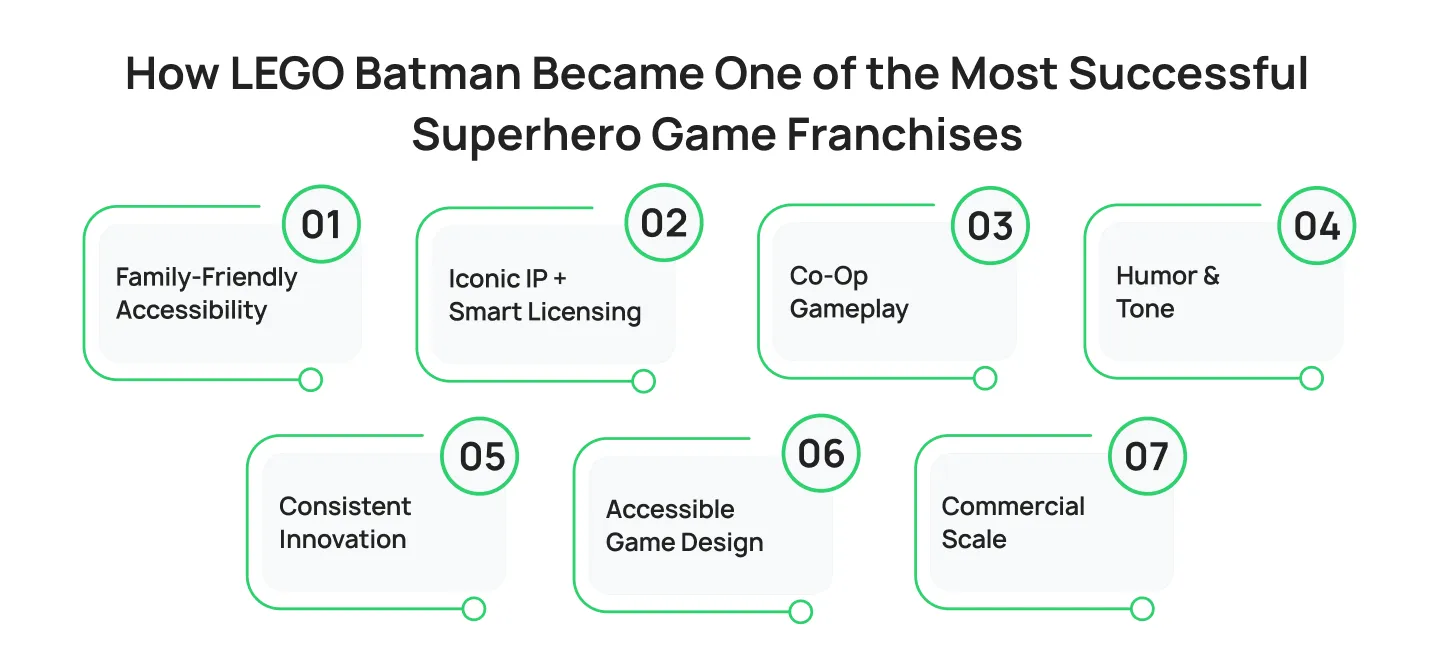
1. Family-Friendly Accessibility
LEGO Batman appealed to a wide audience beyond traditional superhero game fans. Unlike darker superhero titles, it delivered a family-friendly experience where children and parents could play together. The LEGO style softened Batman’s darker tone, making the game more approachable for younger players. This combination of accessible design and iconic characters helped the franchise grow through strong word-of-mouth and broad audience appeal.
2. Iconic IP + Smart Licensing
The combination of LEGO and Batman brought together two globally recognized brands with strong cultural value. Batman contributes a rich storytelling legacy and iconic characters, while LEGO adds charm, humor, and universal appeal. Warner Bros. effectively leveraged Batman’s rogues’ gallery in a playful LEGO format, creating strong brand synergy that attracted fans from both franchises and amplified global reach.
3. Co-op Gameplay
Cooperative gameplay became the core of LEGO Batman’s experience, transforming solo play into shared adventures. Each level and puzzle was designed around two-player mechanics, encouraging teamwork and character-based problem-solving. This approach made the game feel more social and engaging, allowing families and friends to progress together. Co-op gameplay also strengthened replay value by making collaboration a central part of progression.
4. Humor & Tone
LEGO Batman blends Batman’s serious identity with LEGO’s lighthearted world, creating a unique tonal balance. The series uses self-aware humor and playful character interactions to reinterpret iconic moments in a comedic style. This contrast between dark source material and playful execution makes the game appealing to both younger audiences and long-time fans.
5. Consistent Innovation
LEGO Batman maintained long-term relevance by continuously evolving its gameplay systems across releases. Developers introduced new mechanics, expanded environments, and improved visual fidelity while keeping core gameplay familiar. These iterative improvements helped sustain player engagement and kept the franchise fresh without losing its identity.
6. Accessible Game Design
LEGO Batman emphasizes intuitive gameplay systems that are easy to learn but still rewarding to master. Combat, puzzles, and navigation are designed with simplicity in mind, supported by clear visual cues and structured progression. This ensures that players of all skill levels can enjoy the experience without barriers to entry.
7. Commercial Scale
LEGO Batman achieved over 14 million copies sold globally, establishing it as one of the best-selling superhero game franchises. This commercial success validated its design philosophy and reinforced Warner Bros.’ investment in LEGO based titles. It also demonstrated how accessible gameplay combined with strong IP integration can create globally scalable entertainment franchises.
The Core Gameplay Systems That Defined Legacy of the Dark Knight
LEGO Batman’s success is built on gameplay systems that seamlessly combine action, exploration, puzzle-solving, and progression. These mechanics create an engaging experience that keeps players invested throughout the adventure.
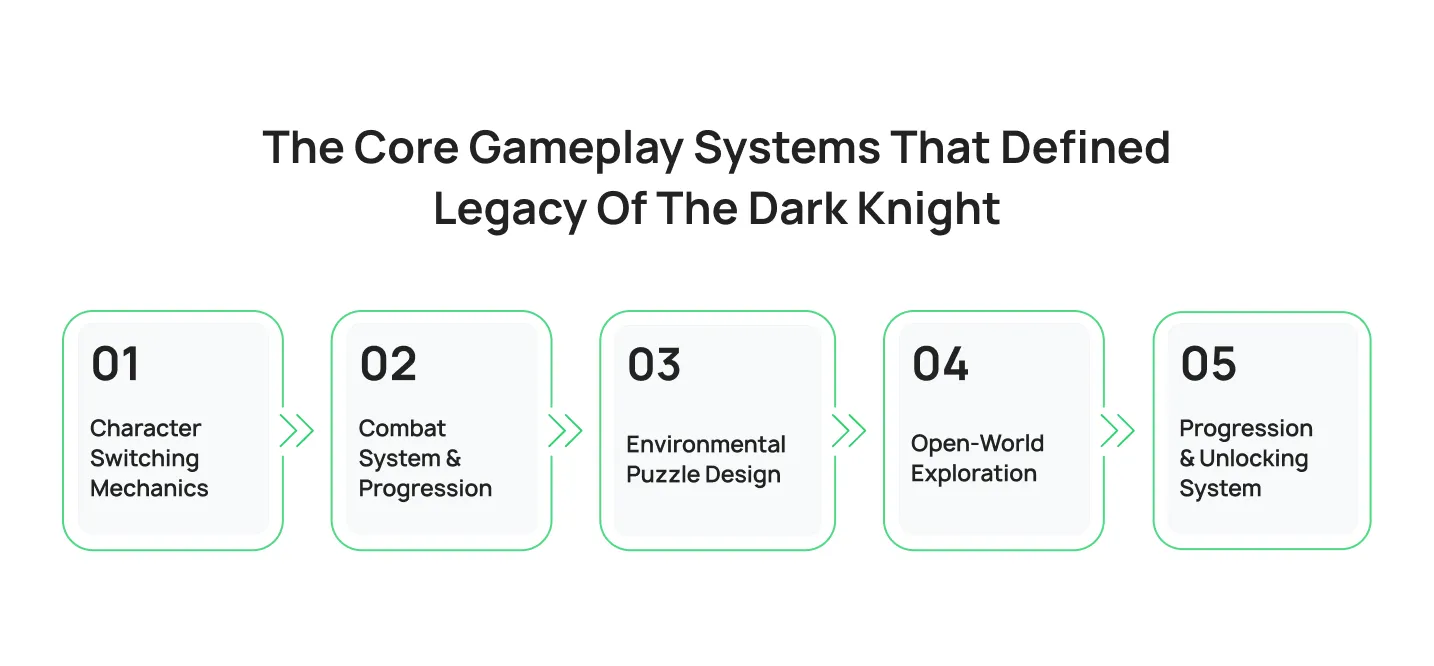
1. Character Switching Mechanics
LEGO Batman’s character-switching system allowed players to instantly swap between heroes with unique abilities, enabling dynamic problem-solving throughout gameplay. Different characters could interact with specific objects and environments, making strategic selection essential for progression. This system ensured that each character contributed meaningfully to both puzzles and exploration.
2. Combat System & Progression
Combat in LEGO Batman was accessible yet layered with light tactical depth, combining basic combos, special abilities, and team coordination. Each character featured unique moves aligned with their role, while boss encounters introduced timing and pattern based challenges. Progression rewarded both skill and exploration through unlockable characters and abilities, balancing simplicity for newcomers with long-term depth.
3. Environmental Puzzle Design
The core gameplay loop focused on interacting with LEGO environments by breaking, rebuilding, and assembling structures to progress. Players solved multi-layered puzzles using character abilities and creative building mechanics. Visual feedback and evolving level design helped maintain engagement while keeping the experience intuitive and varied.
4. Open-World Exploration
Gotham City was designed as an open-world hub filled with collectibles, side missions, and hidden secrets. Different areas require specific abilities to access, encouraging experimentation with characters and traversal tools like flight and grappling hooks. This structure balanced mission-based gameplay with free exploration at the player’s own pace.
5. Progression & Unlocking System
Players earned studs through combat, exploration, and puzzle-solving, which served as in-game currency for unlocking characters, vehicles, and extras. Collectibles and bonus objectives encouraged replayability and deeper engagement. This system created a steady progression loop that rewarded completion without feeling repetitive.
Technical Game Design Lessons Developers Can Learn from LEGO Batman
Beyond entertainment, LEGO Batman showcases development strategies that support scalability, performance, and long-term growth. Its technical foundation offers valuable lessons for modern game developers and studios.
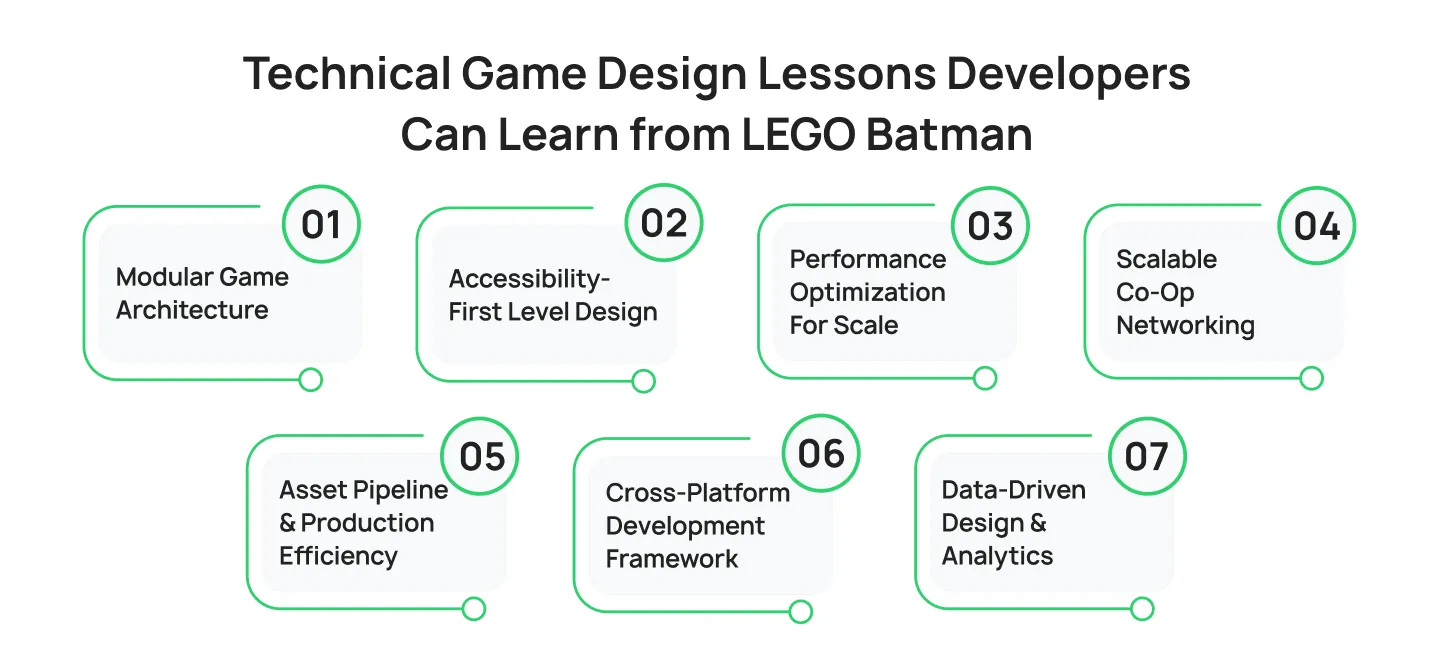
1. Modular Game Architecture
LEGO Batman used a modular system where each level worked independently while sharing core mechanics. This allowed developers to build new content without rewriting foundational code. Character abilities plugged into the same framework smoothly, reducing bugs and development time. It also enabled faster iteration, easier testing, and long-term franchise scalability across multiple platforms without major system overhauls.
2. Accessibility-First Level Design
Levels were built to be accessible for all players, not just experienced gamers. Clear visuals, simple controls, and forgiving mechanics made onboarding easy. Tutorials introduced mechanics gradually, while way point systems reduced confusion. Progressive difficulty prevented frustration. This approach showed that accessibility improves overall design quality and expands audience reach, becoming a standard best practice in modern game development.
3. Performance Optimization for Scale
LEGO Batman was optimized to run across consoles, PC, and mobile through techniques like level streaming, dynamic resolution scaling, and efficient memory management. Loading times were reduced, and visual quality was preserved across devices. These optimizations ensured smooth gameplay on different hardware, helping the franchise reach a wider audience and proving that performance directly impacts commercial success.
4. Scalable Co-op Networking
The game’s co-op system relied on a strong networking architecture to ensure smooth multiplayer experiences. Local and online co-op were synchronized to prevent gameplay disruption from lag or desync issues. Redundant systems ensured stability even under poor network conditions. This scalable approach made multiplayer a core strength of the franchise and influenced modern co-op game design standards.
5. Asset Pipeline & Production Efficiency
Efficient asset pipelines enabled LEGO Batman to manage large character rosters and diverse environments. Developers reused animation systems and standardized environmental building blocks to reduce workload. Procedural tools and automated testing improved production speed and reduced bugs. These streamlined workflows allowed faster content creation and helped the franchise scale efficiently across multiple sequels.
6. Cross-Platform Development Framework
A unified development framework allowed LEGO Batman to run across multiple platforms with minimal duplication. Platform-specific features were abstracted so developers could write once and deploy everywhere. This reduced development costs, improved release speed, and ensured consistency across consoles, PC, and mobile. It also demonstrated the long-term value of cross-platform architecture in modern game development.
7. Data-Driven Design & Analytics
LEGO Batman used player data and telemetry to improve game design decisions. Analytics tracked progression, difficulty spikes, and engagement patterns to identify areas needing adjustment. Developers used this data to balance gameplay, refine levels, and improve retention. This data-driven approach reduced guesswork and became a standard practice in modern game development for improving long-term player engagement.
Why Superhero Games Continue to Dominate the Gaming Industry.
Superhero games like LEGO Batman maintain their industry dominance by blending deep-rooted nostalgia with a unique “pick-up-and-play” accessibility. These titles leverage the massive cultural footprint of characters like the Dark Knight, allowing players of all ages to step into a familiar world without the steep learning curve often found in modern gaming. By combining the legendary lore of DC Comics with the lighthearted, low-stakes environment of the LEGO universe, developers create a cross-generational appeal that attracts both seasoned gamers looking for a fun diversion and parents eager to introduce their children to gaming through a safe, recognizable brand.
Beyond simple brand recognition, these games excel by prioritizing a satisfying power fantasy alongside rewarding progression. Whether it’s the thrill of unlocking dozens of unique suits or the clever use of character-specific gadgets to solve puzzles, the gameplay loop keeps players engaged through constant discovery. The LEGO formula, in particular, removes the frustration of “game over” screens, focusing instead on collaborative play and humor, making it an enduring staple in a market often dominated by more stressful, competitive experiences. This consistent quality has transformed superhero games from mere movie tie-ins into a stand-alone pillar of the gaming world.
How Cubix Builds Modern Gaming Experiences Inspired by Industry Leaders

At Cubix, we apply many of the same game design principles that helped franchises like LEGO Batman achieve long-term success in the gaming industry. We focus on building engaging, scalable, and player-centric gaming experiences across mobile, console, PC, blockchain, and AR/VR platforms. By combining creative storytelling with modern engineering, we create games that balance immersive gameplay, technical performance, and long-term player engagement.
We emphasize accessibility-first design, multiplayer functionality, progression systems, and cross-platform optimization to deliver experiences that appeal to both casual and experienced players. From concept design and development to live operations and post-launch support, our end-to-end game development approach helps businesses transform innovative gaming ideas into commercially successful digital products.
[blog_cta_2]
Final Thoughts
Franchises like LEGO Batman prove that successful games are built on more than popular characters. Long-term success comes from engaging gameplay, intuitive design, multiplayer functionality, scalable technology, and immersive player experiences. At Cubix, we help businesses bring gaming ideas to life by combining creative game design with advanced development practices. With 17+ years of industry experience, a team of 350+ designers, developers, artists, and engineers, and more than 200 successfully designed game projects, we have the expertise to build high-quality gaming experiences across multiple platforms.
Our end-to-end game development services cover everything from concept creation and game design to development, testing, deployment, and post-launch support. We specialize in mobile, PC, AR/VR, blockchain, and console game development, focusing on scalable architectures, engaging progression systems, multiplayer functionality, and cross-platform performance. By leveraging emerging technologies and player-centric design strategies, Cubix helps startups, enterprises, and gaming brands create innovative games that drive engagement, retention, and long-term commercial success.
FAQs
1. What is LEGO Batman: Legacy of the Dark Knight?
LEGO Batman: Legacy of the Dark Knight is a superhero action-adventure game experience that expands on the LEGO Batman franchise through cooperative gameplay, exploration, puzzle-solving, and character-driven mechanics inspired by the Batman universe.
2. Why is LEGO Batman considered one of the most successful superhero game franchises?
The franchise became successful because it combines globally recognized IP, family-friendly gameplay, humor, cooperative mechanics, and an accessible design that appeals to both younger audiences and long-time Batman fans.
3. What gameplay features make LEGO Batman unique?
Key gameplay features include character switching, co-op gameplay, environmental puzzle-solving, open-world Gotham City exploration, progression systems, and unlockable characters and abilities.
4. How do superhero games remain popular in the gaming industry?
Superhero games remain popular because they combine familiar characters, immersive storytelling, rewarding progression systems, multiplayer experiences, and accessible gameplay that attracts players across different age groups.
5. How does Cubix help businesses develop modern games?
Cubix provides end-to-end game development including game design, multiplayer systems, console and mobile game development services, AR/VR experiences, blockchain gaming, UI/UX, testing, and post-launch support to help businesses create scalable and engaging gaming products.