Key Takeaways
- Calculate ROI of custom software development using Total Cost of Ownership (TCO) and measurable business returns.
- Share financial data relevant to your board’s business goals.
- Consider the longer-term expenses such as maintenance, training, and infrastructure.
- Boost ROI by automation, efficiency and scalability.
- Provide factual business information and quantifiable results for all investment decisions.
The first question your board will ask before approving a major software investment isn’t, “What does it do?” It will be “What’s the ROI of custom software development?” According to McKinsey & Company, organizations that successfully adopt digital technologies can improve operational efficiency by 20-30%, making custom software a strategic investment rather than just another business expense.
As a leading provider of custom software development services, Cubix delivers results, from reducing operational costs and increasing productivity to growth.
In this guide, you’ll learn how to calculate the ROI of custom software development and present a data-backed business case that earns your board’s approval.
What Is ROI in Software Development?
Return on investment measures what a project gives back compared to what it costs. In software, that return shows up as saved labor hours, new revenue, or fewer costly mistakes.
Custom software ROI works differently than a typical software purchase. A subscription tool charges you a flat monthly fee. Custom software front loads your costs during development, then pays you back gradually as your team adopts it.
Don’t confuse ROI with price. Price tells you what you spend. ROI tells you what you get back for every dollar. Your board cares about the second number.
How to Calculate the ROI of Custom Software Development

Start with a formula. Then fill it with accurate numbers. Get the cost side wrong, and your projection falls apart under questioning. Get the benefit side wrong, and you either underpromise or overpromise.
Deloitte’s research on digital transformation found that most organizations struggle to define reliable metrics for their technology investments. That’s why you need a structured framework before you walk into the boardroom. (Deloitte)
Basic Formula To Calculate ROI
Here’s the standard formula:
ROI = (Net Benefit – Total Cost) / Total Cost * 100.
Net benefit includes everything the software returns to your business: savings, new revenue, minus ongoing costs. Total cost includes the full investment, not just the initial build.
This basic formula gives you a starting percentage. It doesn’t tell you how long it takes to get there. That’s why your board also wants a payback period.
Total Cost of Ownership (TCO)
Total Cost of Ownership includes every dollar a project consumes, not just the invoice from your development partner. Boards that only see the sticker price get blindsided by year two expenses.
Break TCO into these categories:
1. Development Costs
Development covers discovery, design, engineering, and quality assurance, the core phases of the software development life cycle. This is usually your largest line item, and it scales with complexity.
- A simple internal tool: tens of thousands of dollars
- An enterprise platform with multiple integrations: high six figures
2. Implementation Costs
Implementation covers data migration, system integration, and rollout planning. Teams underestimate this because it doesn’t surface until the build is nearly finished.
Budget 10 to 20 percent of your development cost for implementation.
3. Maintenance and Support
When you get your software out there, it still needs constant care and maintenance: bug fixes, security patches, performance monitoring. Allocate 15 to 25 percent of your original development cost each year.
Miss this line item and you’ll lose board credibility fast when the “finished” project keeps generating invoices
4. Employee Training
New software changes how people work. Training costs include:
- Lost productivity during onboarding
- Documentation
- Formal training sessions
Even well designed software needs a ramp up period before your team reaches full efficiency.
5. Infrastructure and Cloud Costs
Hosting, storage, and cloud compute costs scale with usage. A customer facing application with unpredictable traffic needs a bigger infrastructure budget than an internal reporting tool.
Measuring Financial Returns
Once you map your costs, apply the same discipline to your benefits. Financial returns from custom software fall into five categories.
1. Increased Revenue
You can build new revenue streams with new digital capabilities like a customer portal, a faster quoting system, a mobile app that accesses new markets.” You’ll see this effect if you watch your sales figures before and after launch.
2. Operational Cost Savings
Automation reduces labor spend without cutting headcount. A process that took ten hours a week can shrink to two, freeing your staff for higher value work.
3. Productivity Improvements
Custom software fits your actual workflows. Your employees stop working around software limitations and start spending that time on work that matters.
4. Reduced Human Errors
Manual data entry and duplicate processes create costly mistakes. Automate those steps, and you lower both the error rate and the cost of fixing them.
5. Lower Software Licensing Costs
Replace multiple SaaS subscriptions with one custom platform, and you eliminate recurring per seat fees. Over several years, this offsets a real share of your original investment. See our full breakdown of SaaS development costs for a direct comparison.
Business Benefits That Deliver High ROI from Custom Software Development
Financial metrics tell part of the story. Custom software also strengthens your business in ways that compound over time. Tie these benefits back to strategy, and your board will listen.
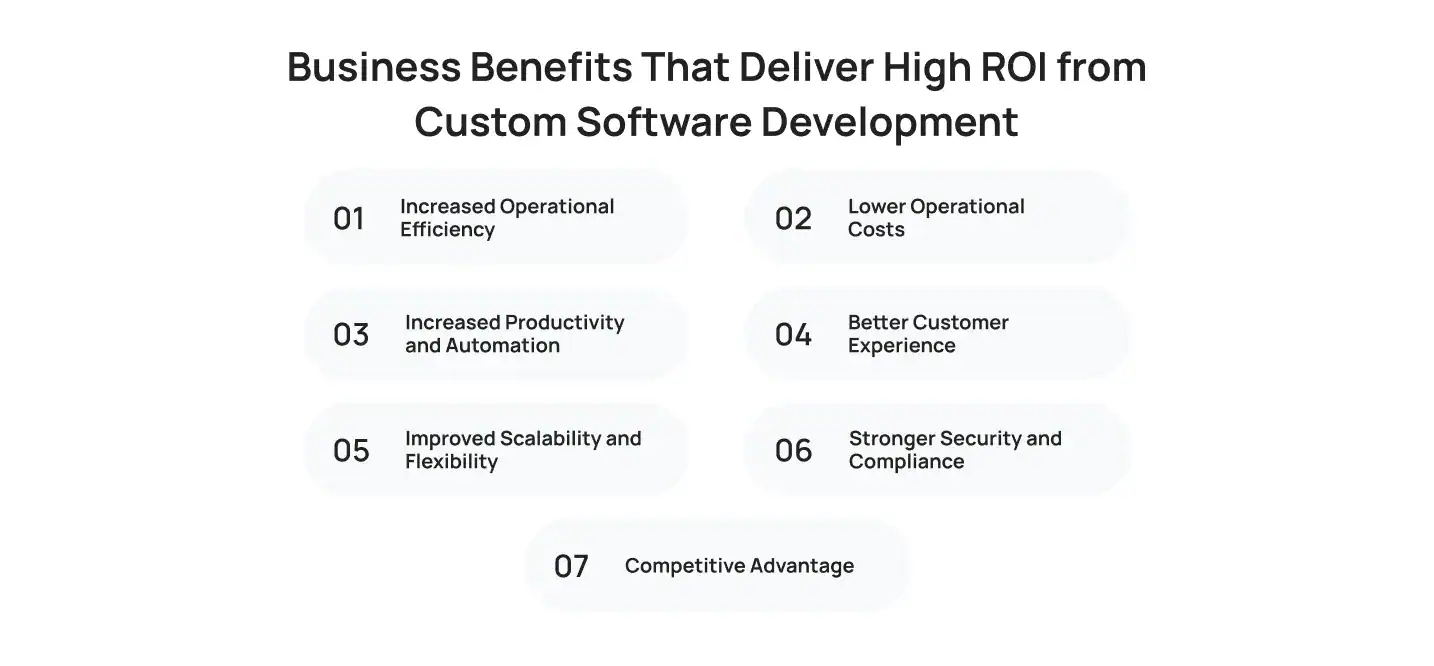
1. Increased Operational Efficiency
Custom software automates the repetitive work that eats into your team’s day. This is where business process automation drives operational efficiency, turning hours of manual effort into minutes of automated processing.
McKinsey’s research on maintenance technology found that well run digitization programs cut unplanned downtime by roughly 20 percent. That gain compounds across every department that relies on the same system. (McKinsey)
2. Lower Operational Costs
Custom software reduces the overhead of running multiple disconnected tools. One platform cuts down on:
- Licensing fees
- IT support tickets
- Time your employees lose switching between systems
3. Increased Productivity and Automation
Automation saves time. It also removes the mental load of repetitive tasks, so your employees can focus on judgment based work. You’ll see this in your throughput numbers and project turnaround times.
4. Better Customer Experience
Faster response times, personalized service, fewer errors. All of it traces back to better internal tools. When your staff isn’t fighting outdated systems, customers notice the difference.
5. Improved Scalability and Flexibility
Off the shelf tools hit a ceiling as your company grows. Custom software scales with your headcount, transaction volume, and geographic footprint, so you avoid costly platform migrations later.
6. Stronger Security and Compliance
Regulated industries need software built around their specific compliance needs. This matters most during legacy system modernization projects, when outdated platforms can’t meet current security standards.
7. Competitive Advantage
Proprietary software reflects how your business actually operates. Competitors can’t easily replicate it. That differentiation becomes a long term asset, not just a productivity tool. It strengthens your position during due diligence, fundraising, or acquisition talks.
How to Justify a Custom Software Investment to Your Board
A solid financial model is half the job. Boards approve investments when they see how the numbers connect to strategy, risk, and accountability. Use this approach to turn your calculations into a business case.
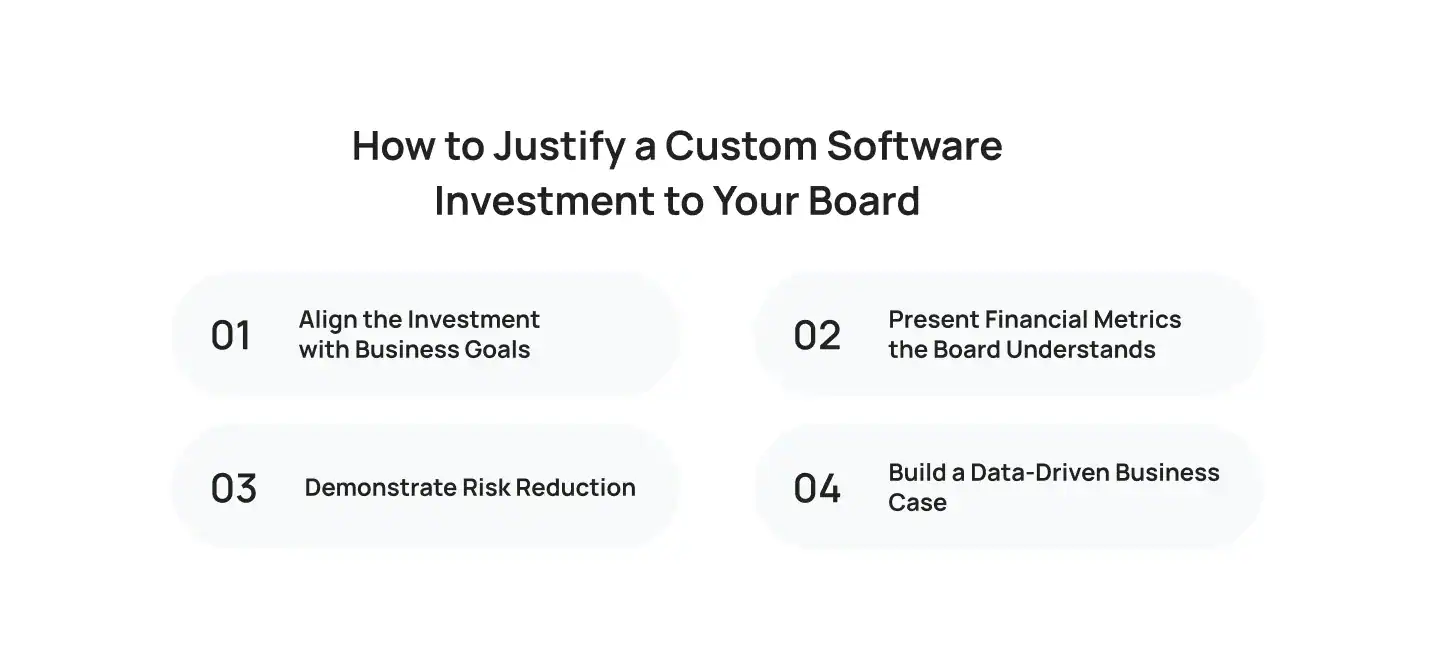
1. Align the Investment with Business Goals
Connect the project to a goal your board already cares about: revenue growth, margin improvement, market expansion. “We need new software” doesn’t land. “This closes our 15 percent margin gap” does.
2. Present Financial Metrics the Board Understands
Skip the technical architecture discussion. Lead with the numbers:
- Total cost
- Projected savings
- Payback period
- ROI percentage
A single summary table communicates more in ten seconds than a twenty slide deck. Your board reviews dozens of proposals a year. Clarity wins.
3. Demonstrate Risk Reduction
Every investment carries risk. Address it directly.
- What happens if a legacy system fails during peak season?
- What does it cost you if a competitor launches a better digital experience first?
Quantify the risk of inaction. It often persuades more than the upside case alone.
4. Build a Data-Driven Business Case
Support your projections with numbers from your own operations, not industry averages. Track your current process times, error rates, and staffing costs before you build your pitch.
Add a business intelligence layer to your reporting. Give your board dashboards instead of static spreadsheets, and you’ll build credibility for your next budget request too.
Is Custom Software Worth the Investment?

Not every business needs a fully custom build. The right answer depends on how specific your workflows are and how much your off the shelf tools already cost you in workarounds.
When Custom Software Delivers the Highest ROI
Custom software outperforms generic tools when your processes are complex, your data needs are unique, or your growth plans will outpace a subscription platform. Companies running a broader digital transformation, where multiple systems need to work together, see the strongest returns from a purpose built platform.
This holds especially true for enterprise software environments, where dozens of workflows and departments depend on the same data.
Common Mistakes That Reduce ROI
Check your project against this list before you launch:
- Treating launch as the finish line instead of the starting point
- Skipping ongoing measurement after go live
- Skipping user training
- Ignoring change management
- Choosing the wrong development partner
Before you sign a contract, read our guide on how to choose the best software development company to avoid the mistakes that quietly erode your returns.
Choose Cubix to Build Your Next Custom Software
A strong ROI projection depends on execution, not just a spreadsheet. Cubix designs, builds, and scales custom applications for enterprise software teams. We build platforms that hold up against the financial case you present to your board.
Our team focuses on the metrics that matter to your stakeholders:
- Cost control
- Measurable efficiency gains
- A platform built to scale with your business
Whether you’re modernizing a legacy system or building a new digital product, our custom software development services are built to deliver a return you can defend in the boardroom.
Ready to turn your ROI projection into a funded, delivered project? Our team can help you scope it accurately from day one.
Final Takeaways
Justifying the ROI of custom software development to your board comes down to translation. Turn technical value into financial language.
- Time savings become dollar figures.
- Error reduction becomes fewer costly fixes.
- New capabilities become new revenue.
None of this requires a finance degree. It requires discipline in how you gather and present your numbers.
Start with an honest Total Cost of Ownership estimate. Build your financial case around real operational data. Talk about risk instead of avoiding it. Get the math right, present it clearly, and the investment case makes itself.
FAQs
1. What’s a good ROI for a custom software project?
Most custom software projects target 100 to 300 percent ROI within two to three years. Compare your projected return against the cost of continuing to operate without the software, not against an arbitrary industry number.
2. How do you calculate the ROI of custom software development?
Subtract your total cost of ownership from your total financial benefit. Divide that number by your total cost, then multiply by 100. Include tangible savings, like reduced labor hours, and revenue gains from new capabilities the software unlocks.
3. What factors affect software development ROI?
Development complexity, team adoption rates, maintenance budgets, and integration speed with your existing systems all shape your ROI. Projects with clear objectives and strong internal buy in outperform projects launched without a defined success metric.
4. What is a good ROI for an IT project?
Payback should be less than 2 years and the ROI should be more than 100% within 5 years. Larger projects, infrastructure heavy, take a longer time to break-even, but provide a higher cumulative return once your team is fully operational with the projects.