Key Takeaways
- Technical debt is not inherently bad, but unmanaged debt slows product velocity over time.
- Technical debt in software development affects engineering speed, software quality, and business outcomes.
- Technical debt in product development delays roadmaps and reduces innovation capacity.
- Measuring technical debt helps organizations prioritize improvements and justify investment.
- Sustainable technical debt management focuses on continuous improvement instead of major rewrites.
- Preventing future debt requires stronger engineering standards, automation, and quality practices.
What if the biggest obstacle to delivering your next feature is not budget limitations, hiring constraints, or market conditions, but the shortcuts hidden inside your existing codebase?
For many organizations, that obstacle is technical debt.
According to the Consortium for Information & Software Quality (CISQ), accumulated software technical debt reached nearly $1.52 trillion in 2022, contributing to a broader $2.41 trillion cost of poor software quality across the United States.
These numbers reveal a challenge that extends far beyond engineering.
Modern businesses operate under constant pressure to release features faster, respond to customer expectations, and bring ideas to market quickly. In many cases, teams intentionally choose short-term development shortcuts to maintain momentum.
In software development, moving fast often creates the appearance of progress. Features reach production quickly, roadmaps stay on track, and customers continue receiving updates. But every shortcut taken today creates future work.
Like financial debt, technical debt accumulates interest over time. The longer organizations postpone addressing underlying issues, the more expensive future development becomes. Engineering teams gradually spend more time maintaining legacy systems and resolving recurring issues than delivering new value, causing product velocity to decline.
This article explores technical debt in software development, its impact on product development, and practical strategies to restore delivery speed without sacrificing quality.
What Is Technical Debt in Software Development?
Technical debt refers to the future cost of choosing a faster or temporary implementation instead of building the most maintainable solution during software development.
The term was introduced in 1992 by programmer and Agile Manifesto co-author Ward Cunningham to describe software shortcuts that eventually require additional effort to maintain and improve.
Technical debt can exist in:
- Application code
- Architecture
- Infrastructure
- Documentation
- Development processes
When managed strategically, technical debt can accelerate delivery and support business goals.
When ignored, it gradually reduces engineering efficiency and slows growth.
Technical Debt vs Poor Code
| Technical Debt | Poor Code |
| Intentional trade-off to deliver faster | Usually caused by weak practices or execution |
| Created to achieve short-term business goals | Rarely delivers meaningful business value |
| Can be managed and reduced over time | Becomes harder to maintain if ignored |
| Example: Delaying refactoring to meet a deadline | Example: Duplicate code with limited testing |
Types of Technical Debt
Technical debt can appear in several forms:
1.Code Debt
Poorly structured code, duplication, insufficient testing, and inconsistent coding standards make future development more difficult.
Time to fix: A few days to 3–6 weeks for small areas, longer if spread across the system.
2.Architecture Debt
Outdated architectural decisions can limit scalability, flexibility, and system performance as products grow.
Time to fix: 1–6 months depending on system size and complexity.
3.Infrastructure Debt
Legacy infrastructure, manual deployment processes, and unsupported technologies increase operational complexity.
Time to fix: 2–8 weeks for improvements, up to 3–6 months for major upgrades.
4.Documentation Debt
Missing or outdated documentation slows onboarding, troubleshooting, and collaboration.
Time to fix: 3–14 days for updates in key areas, ongoing maintenance afterward.
5.Process Debt
Inefficient workflows, weak governance, and inconsistent development practices reduce team effectiveness.
Time to fix: 2–6 weeks for process changes, longer for full adoption.
Common Causes of Technical Debt
Technical debt rarely results from poor engineering decisions alone. More often, it accumulates when teams must balance delivery speed, changing requirements, and limited resources. While these trade-offs can help achieve short-term business goals, they often create challenges that affect future development.

Several factors commonly contribute to technical debt accumulation:
- Tight project deadlines often force developers to implement quick fixes instead of well-designed, maintainable solutions.
- Rapid product growth can strain an application’s original architecture, making it harder to scale and support new features.
- Frequent changes in business requirements may lead to repeated modifications, increasing code complexity over time.
- Limited engineering resources can leave teams with little capacity for refactoring, optimization, and technical improvements.
- Poor testing practices increase the risk of defects and make developers hesitant to improve existing code.
- Lack of architectural planning often results in systems that become difficult to maintain as the product evolves.
- Pressure to release features quickly can push technical improvements and code cleanup to the bottom of the priority list.
- Inadequate documentation and knowledge sharing make maintenance more difficult and increase dependency on specific team members.
- Legacy systems and outdated technologies require additional effort to support and can slow development progress.
Understanding these root causes is the first step toward managing technical debt effectively and preventing it from impacting product velocity.
Warning Signs Your Team Has a Technical Debt Problem
Technical debt does not usually announce itself through a major failure. More often, it appears through gradual changes in delivery speed, software reliability, and team behavior. These signs indicate that technical debt has moved from a hidden issue to an active constraint on product velocity.
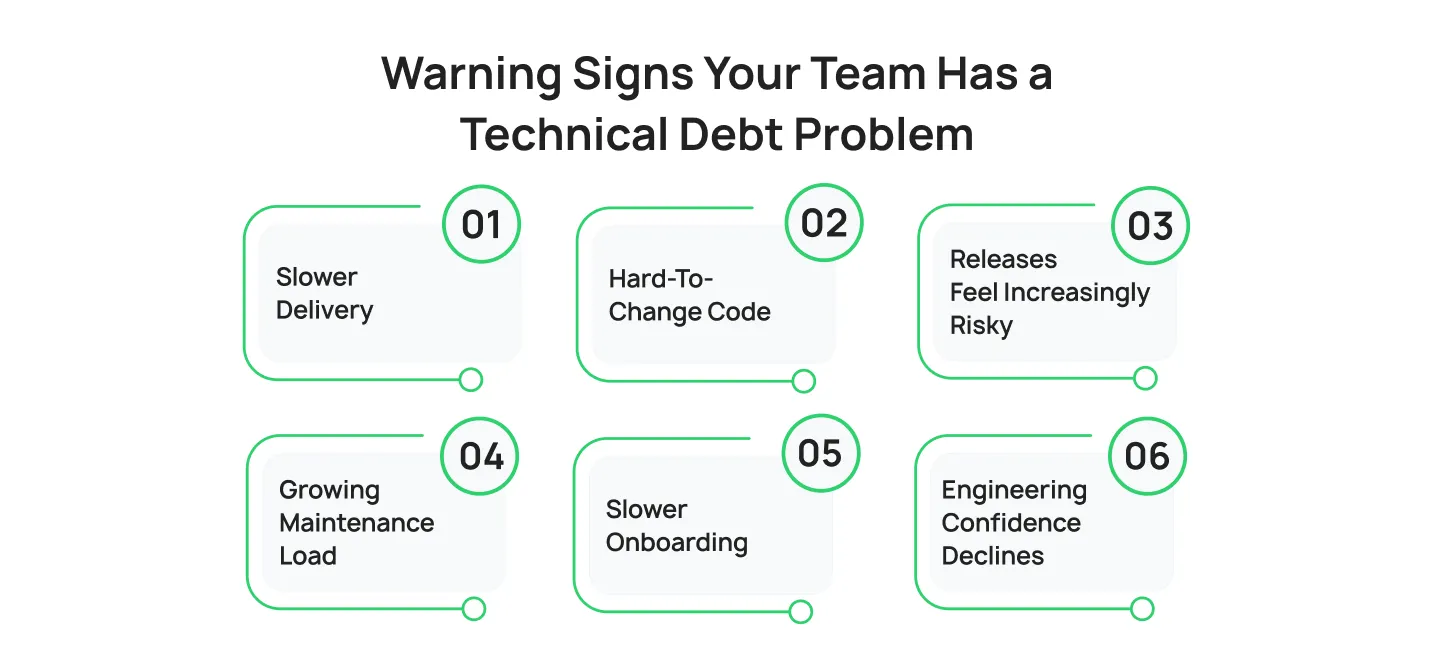
Slower Delivery
Projects that once followed expected timelines now experience frequent delays. Engineering estimates become harder to trust because unexpected technical obstacles continue appearing during development.
Hard-to-Change Code
Simple updates begin consuming disproportionate amounts of time. Developers must review multiple systems, perform additional testing, and validate dependencies before releasing even minor improvements.
Releases Feel Increasingly Risky
Teams become hesitant to deploy changes because production incidents, rollbacks, or emergency fixes happen more often than expected.
Growing Maintenance Load
Sprint capacity gradually shifts away from new features and toward bug fixes, technical support, and operational tasks.
Slower Onboarding
Onboarding slows because systems become difficult to understand, documentation is incomplete, and institutional knowledge becomes concentrated among a few individuals.
Engineering Confidence Declines
Teams become less willing to experiment, optimize, or modernize because the cost and uncertainty of making changes continue increasing.
Real-World Examples of Technical Debt
The company deployed a software update that accidentally included outdated legacy code. That code had not been properly tested across all production systems.

Within minutes of the market opening, the system began executing unintended trades at scale. What started as a routine deployment quickly turned into a major operational failure.
In less than an hour, the firm lost around $440 million.
The impact was immediate and irreversible. Knight Capital was forced into a crisis and was later acquired by a competitor.
What makes this case important is not just the financial loss, but what caused it:
- Legacy code that should have been removed was still active
- Testing coverage was incomplete across systems
- Deployment safeguards were not strong enough to catch inconsistencies
- Technical debt had quietly increased system risk over time
This incident shows how technical debt is not only a code issue. When it is left unmanaged, it can turn a small software oversight into a large-scale business failure.
The Impact of Technical Debt on Product Velocity
Product velocity is not just about how quickly teams ship features. It reflects how consistently an organization can turn ideas into customer value.

When velocity is strong, teams respond quickly to market needs, deliver against roadmaps with confidence, and maintain steady innovation. When it declines, technical debt is often a key driver.
The impact is rarely sudden. Technical debt builds gradually, slowing engineering work through added complexity, hidden dependencies, and repeated workarounds. Over time, these small inefficiencies compound and significantly reduce delivery speed.
Slower Feature Releases
As systems grow, developers spend more time understanding legacy code and navigating dependencies. Even small features may take significantly longer to release because of added validation and risk.
Increased Bugs and System Instability
Complex codebases make systems more fragile. Minor changes can trigger unexpected issues, increasing defects and forcing teams to focus on fixes instead of new development.
Reduced Engineering Productivity
A growing share of engineering effort shifts toward maintaining existing systems. Teams stay busy, but output slows because less time is spent on building new capabilities.
Higher Maintenance Costs
Technical debt increases the ongoing cost of supporting software. More resources are required for bug fixes, infrastructure upkeep, and operational support, leaving less room for innovation.
Impact on Developer Experience
Working with fragile systems reduces developer satisfaction. Over time, this can lead to frustration, slower onboarding, and higher turnover, especially when engineers spend more time working around limitations than solving meaningful problems.
How to Measure Technical Debt
Technical debt becomes manageable only when it is measurable. Instead of treating it as a vague engineering concern, high-performing teams track indicators that reflect delivery efficiency, system stability, and maintenance effort.
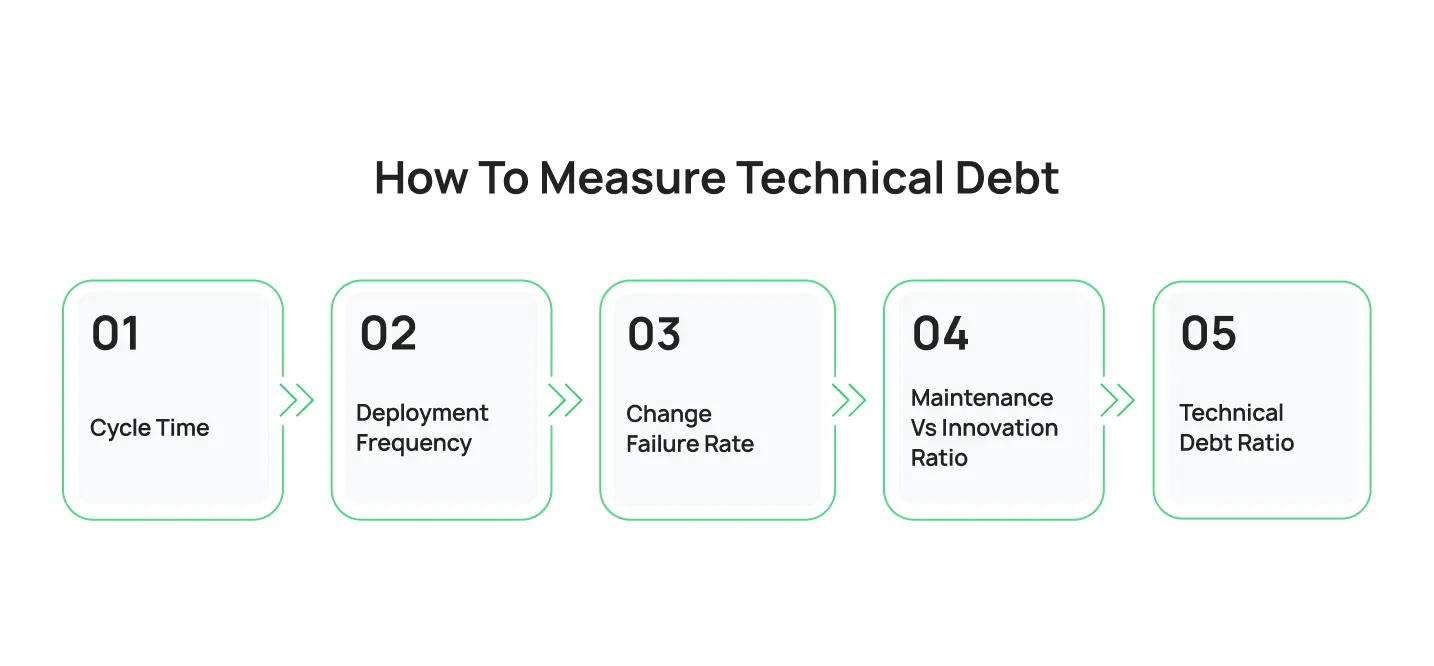
Cycle Time
Cycle time measures how long it takes for work to move from development to production. Increasing cycle time often signals growing system complexity and hidden dependencies slowing down delivery.
Deployment Frequency
This metric reflects how often teams are able to release changes. A decline in deployment frequency usually indicates rising release risk or increased validation overhead caused by technical debt.
Change Failure Rate
Change failure rate tracks how often releases result in incidents, rollbacks, or production issues. Higher rates typically suggest fragile systems and insufficient test coverage.
Maintenance vs Innovation Ratio
This ratio compares the effort spent maintaining existing systems against building new features. When maintenance begins dominating capacity, technical debt is limiting product growth.
Technical Debt Ratio
Technical debt ratio estimates the cost required to fix known debt compared to total development effort. It provides leadership with a high-level view of long-term system health.
Technical Debt Audit Framework
A structured audit framework helps organizations move from identification to action. The goal is not to eliminate all debt at once, but to prioritize improvements based on impact.

- Debt Registry
A centralized registry documents known technical debt across systems, including architecture issues, code smells, infrastructure gaps, and process inefficiencies.
- Severity Classification
Each item should be categorized based on impact:
-
- Critical: Blocks delivery or creates operational risk
- Moderate: Reduces engineering efficiency
- Low: Minimal impact, can be deferred
- Mapping to Business Outcomes
Technical debt becomes easier to prioritize when linked to business results such as delivery speed, reliability, or customer experience.
- ROI-Based Prioritization
Teams should prioritize debt reduction based on effort versus impact, focusing first on issues that unlock measurable improvements in velocity or stability.
Fixing Technical Debt Without Stopping Development
Addressing technical debt does not require halting product delivery or freezing feature work. In practice, the most effective organizations treat technical debt as an ongoing part of engineering execution rather than a separate initiative. The goal is to improve system quality continuously while maintaining steady delivery of business value.
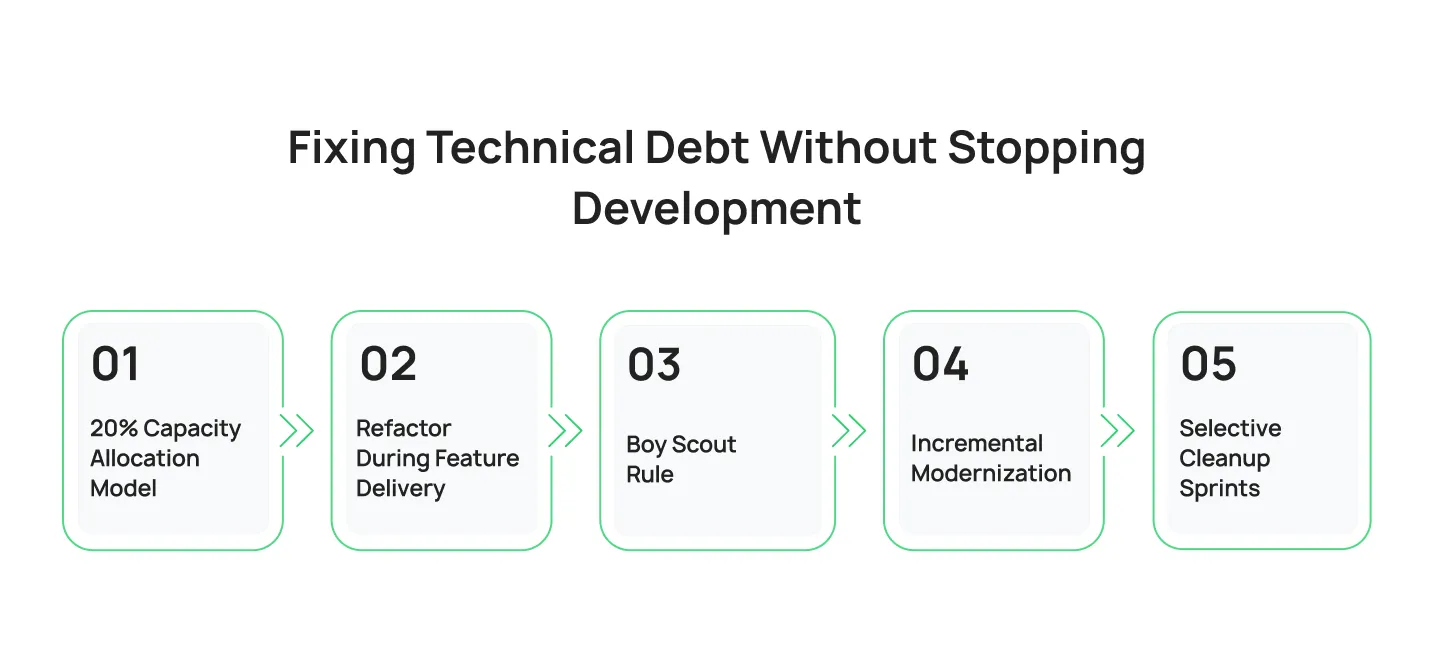
20% Capacity Allocation Model
Many engineering teams reserve a fixed portion of each sprint specifically for technical improvements. This ensures that debt reduction is not constantly deprioritized in favor of new feature work. Over time, this steady investment prevents small issues from accumulating into larger structural constraints that slow down delivery.
Refactor During Feature Delivery
Instead of postponing improvements, teams can address technical debt in the exact areas they are already modifying. When new features touch legacy code or complex modules, engineers can simplify logic, remove duplication, and improve structure as part of the same work. This approach reduces friction without requiring separate refactoring cycles.
Boy Scout Rule
A simple but powerful principle is to leave code in a better state than it was found. Small actions such as improving naming, removing unused logic, and adding missing tests gradually strengthen system quality. When applied consistently across teams, these incremental changes compound into meaningful long-term improvements.
Incremental Modernization
Large-scale rewrites introduce significant risk and disruption. A more stable approach is to modernize systems step by step, replacing or improving components gradually. This allows teams to maintain continuity while steadily reducing complexity and improving maintainability.
Selective Cleanup Sprints
In cases where technical debt significantly impacts delivery speed or system stability, organizations may schedule focused cleanup efforts. These short, targeted sprints address the most critical issues, restore engineering efficiency, and help teams regain predictable delivery without long-term disruption.
Refactor vs Rewrite Decision Framework
Choosing between refactoring and rewriting is a strategic decision that affects delivery risk, cost, and long-term system stability. The table below provides a clear comparison to support engineering and product leadership decisions.
| Dimension | Refactoring | Rewrite |
| When to Use | When the existing system still supports core business needs and issues are contained within specific areas | When the current architecture limits scalability, reliability, or future product direction |
| Scope of Change | Incremental improvements to existing codebase | Complete rebuild of system or major components |
| Risk Level | Lower risk due to continuity of existing system | Higher risk due to uncertainty and system replacement |
| Delivery Impact | Minimal disruption to ongoing development | Potential delays in feature delivery during rebuild |
| Knowledge Retention | Preserves existing system knowledge within the team | Risk of losing embedded domain knowledge |
| Time to Value | Faster realization of improvements | Longer timeline before benefits are realized |
| Common Triggers | Code complexity, minor performance issues, localized technical debt | Architectural limitations, system instability, inability to scale |
| Leadership Decision Focus | Efficiency and maintainability improvements | Strategic platform or product direction shifts |
Preventing Future Technical Debt
The most effective way to manage technical debt is to prevent it from accumulating in the first place. Mature engineering organizations focus not only on remediation but also on establishing systems, processes, and cultural practices that reduce the likelihood of avoidable debt entering the codebase.
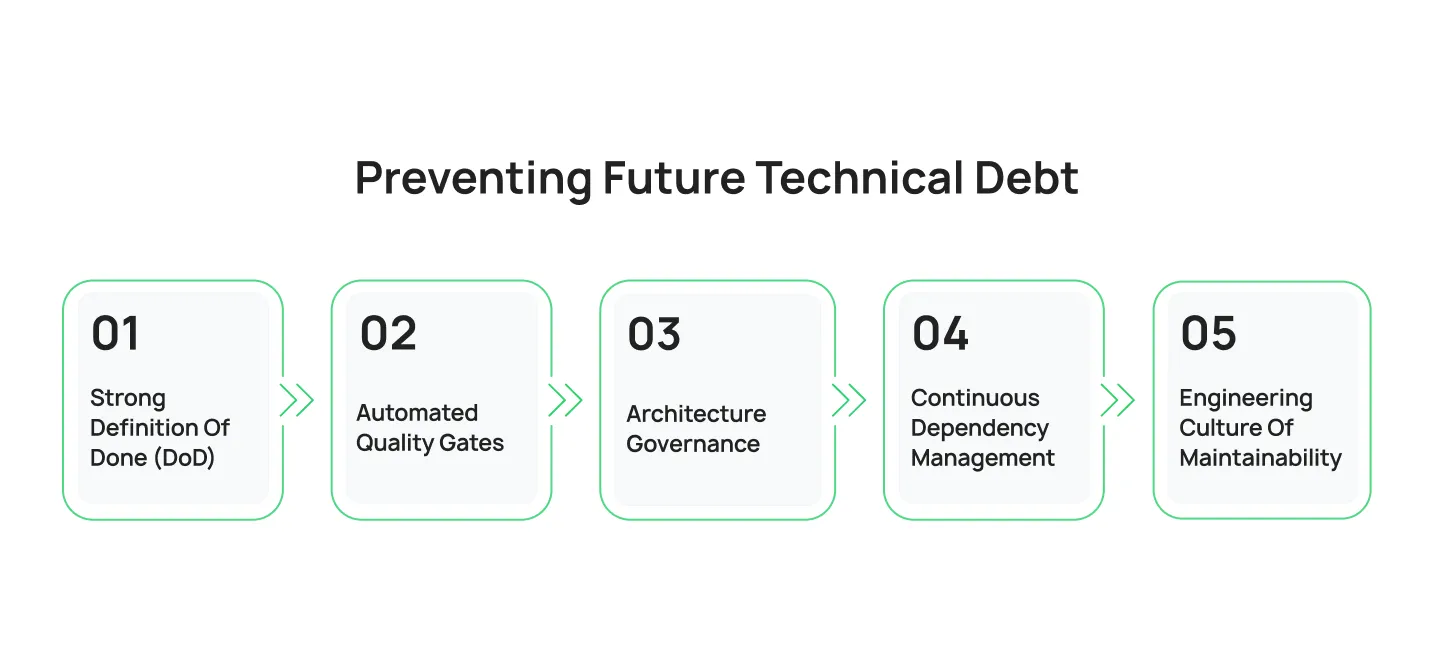
Strong Definition of Done (DoD)
Work should not be considered complete unless it meets clearly defined standards for testing, documentation, and maintainability. A strong Definition of Done ensures that quality is built into the delivery process rather than addressed after release.
Automated Quality Gates
CI/CD pipelines can enforce consistent quality checks before code is merged or deployed. These automated gates help ensure adherence to coding standards, testing requirements, and basic security practices, reducing the introduction of preventable issues.
Architecture Governance
Regular architectural reviews help ensure that system design decisions remain aligned with long-term product direction. This reduces the risk of fragmented systems and inconsistent design patterns that contribute to technical debt over time.
Continuous Dependency Management
Outdated libraries and frameworks are a common source of hidden risk. Continuous monitoring and regular updates prevent dependency gaps from accumulating into larger modernization challenges later.
Engineering Culture of Maintainability
Beyond tools and processes, sustainable systems depend on culture. Teams that value clarity, simplicity, and maintainability alongside delivery speed are more likely to produce systems that remain adaptable and easier to evolve.
How Cubix Helps Reduce Technical Debt

Addressing technical debt at scale often requires a structured approach that combines engineering expertise with product and architecture alignment.
As a software development company, Cubix supports organizations with over 15 years of experience by focusing on targeted improvements across systems, processes, and delivery practices:
- Conducting architecture assessments to identify structural constraints and inefficiencies
- Modernizing legacy systems without disrupting ongoing product delivery, helping reduce production issues by up to 30%
- Optimizing codebases for maintainability, performance, and scalability
- Improving engineering processes to support consistent and predictable delivery
- Executing incremental transformation strategies that reduce risk while improving system quality
In many engagements, organizations also see up to 25–35% faster feature delivery cycles once key architectural and process bottlenecks are addressed.
The focus is not just on fixing existing issues, but on improving how systems are built and evolved.
This approach helps organizations improve product velocity while maintaining system stability and continuity.
At Cubix, we focus on refining systems continuously to support sustainable product growth without disrupting delivery. – Salman Lakhani, CEO at Cubix
Conclusion
Technical debt is not inherently harmful, but when unmanaged, it becomes a persistent constraint on product velocity, system stability, and engineering efficiency. Organizations that succeed are those that treat it as an ongoing discipline rather than a one-time fix. By measuring impact, prioritizing remediation, and embedding prevention into engineering practices, teams can maintain consistent delivery without sacrificing quality. The objective is not to eliminate technical debt, but to control its influence so systems remain adaptable, scalable, and aligned with long-term product goals.