Artificial intelligence is no longer just a technology-industry story. It is now a national-policy issue touching economic competitiveness, cybersecurity, consumer protection, jobs, public services, and the global race to build more capable AI systems.
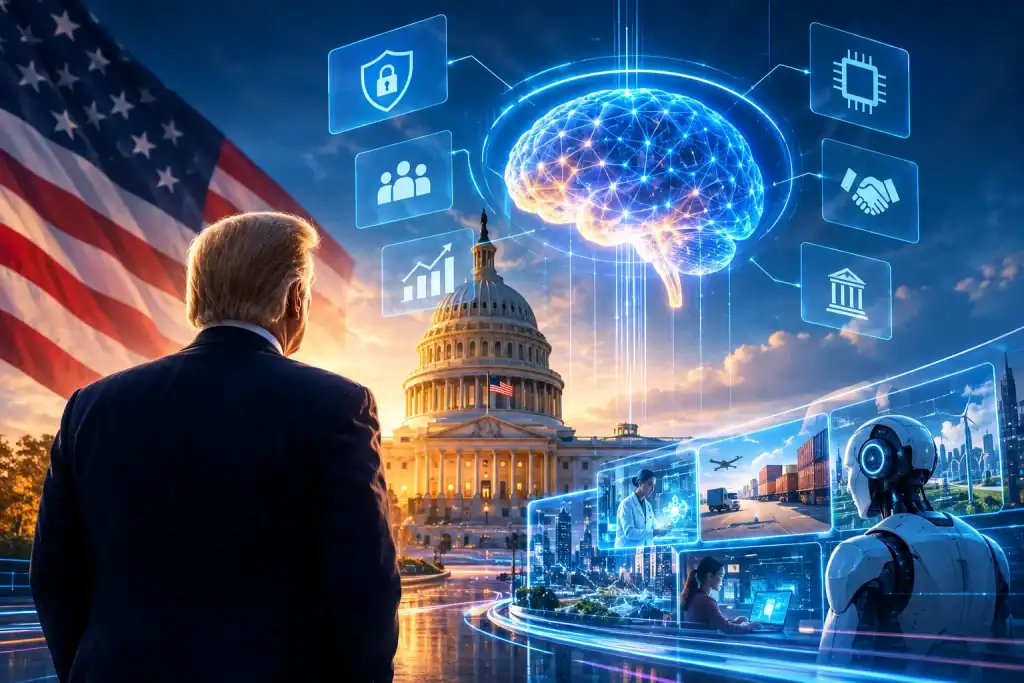
President Donald Trump has announced a new federal AI task force called the “Super Intelligence Force.” The group is intended to coordinate the U.S. government’s approach to advanced AI, with the administration presenting it as part of a wider effort to keep America ahead in what it sees as the next major technological revolution.
What is the Super Intelligence Force?
Despite its dramatic name, the Super Intelligence Force is not a new AI product, a military unit, or a government-built chatbot. It is a White House-backed task force that will bring together senior officials to shape how the federal government engages with AI development and its consequences.
Trump said the group will coordinate the federal government’s engagement with consumers, public-interest organizations, religious groups, critical-infrastructure providers, and AI companies. In simple terms, it is meant to become a central point for discussing how advanced AI should be developed, used, and managed across the country.
The administration has been using the phrase “super intelligence” as its preferred label for the next stage of AI. While the term does not have one universally accepted technical definition, it generally points to AI systems that may eventually perform at, or beyond, the level of human experts across a broad range of tasks.
That framing matters. The White House is not discussing AI only as a tool for writing emails, generating images, or answering customer-service questions. It is placing AI in the same category as major economic and societal shifts such as the Industrial Revolution and the rise of the internet. Trump said the initiative is intended to help the United States remain a world leader in “Super Intelligence” while protecting American interests and improving lives.
Who will lead the task force?
The force will be led by Director of National Intelligence Jay Clayton, who is expected to take on a central role in the administration’s AI policy effort. His appointment highlights how closely the White House connects AI with national security, geopolitical competition, and strategic technology.
Clayton will work alongside several senior officials with different areas of responsibility:
- Andrew Ferguson, chair of the Federal Trade Commission, brings a consumer-protection and competition perspective.
- Emil Michael, Undersecretary of Defense for Research and Engineering, represents the defense and research side of the AI discussion.
- Scott Kupor, Director of the Office of Personnel Management, adds a government-workforce perspective as AI begins to reshape how organizations operate.
- The group will report to Trump and White House Chief of Staff Susie Wiles.nbcnews+1
This combination is telling. AI policy is no longer limited to questions such as “Which tools are safe?” or “Can a company use a chatbot?” It now includes issues such as how AI affects national defense, whether consumers are treated fairly, how government agencies modernize, and whether U.S. businesses can compete with rivals abroad.
Why the White House is focusing on AI now
The timing is not accidental. AI capabilities have accelerated rapidly, moving from research labs into everyday business operations. Companies are using AI for software development, fraud detection, customer support, forecasting, supply-chain management, medical research, content creation, and internal automation.
At the same time, technology has created difficult questions. How should businesses protect data used by AI systems? Who is accountable when an AI tool makes an inaccurate or biased decision? Could advanced AI systems be used for cyberattacks, misinformation, or other harmful activity? And how can the United States remain competitive as other countries invest heavily in AI research and infrastructure?
Clayton has argued that the risk of the United States not leading the AI race is itself significant. He said that being first could put the country in a stronger position to address known and unknown risks, particularly those involving adversaries.
The task force was announced shortly after Trump met with major technology leaders at the White House, including Anthropic CEO Dario Amodei, Tesla CEO Elon Musk, and Meta CEO Mark Zuckerberg. Following that meeting, Trump described an industry commitment around self-regulation, though reporting characterized the arrangement as nonbinding.nbcnews+1
Want to discuss your project? Our experts are just a click away.
Contact UsInnovation versus guardrails
The biggest debate around the Super Intelligence Force will likely be how it balances innovation with oversight.
On one side, supporters of a lighter regulatory approach argue that America needs room to innovate. They believe excessive rules could slow down startups, make AI development more expensive, and allow other countries to gain an advantage. AI has the potential to make businesses more efficient, support scientific discovery, improve accessibility, and help organizations make faster, better-informed decisions.
For example, a healthcare organization might use AI to help clinicians review large volumes of medical information. A logistics company could use it to anticipate delays and reroute shipments. A financial-services provider might deploy AI to identify unusual transactions and reduce fraud. In each case, AI can create value, but only when it is trained, tested, monitored, and used responsibly.
On the other side, critics worry that voluntary commitments may not be enough for technology with broad social impact. They point to risks involving privacy, discrimination, inaccurate outputs, job displacement, deepfakes, cybercrime, and the potential misuse of powerful systems.
The task force’s reported charter reflects this tension. It is expected to develop plans for AI-enabled threats while also preventing what the administration describes as overregulation and regulatory capture that could stifle innovation and competition.
For now, however, many of the practical details remain unclear. Trump’s announcement did not outline specific enforcement powers, binding safety requirements, or a defined timeline for new regulations. ABC News reported that the announcement offered limited detail on what concrete oversight the group would have over AI development.
What it could mean for businesses
For everyday people, this policy discussion may soon show up in familiar places: the apps they use, the services they receive, the information they see online, and the systems that influence decisions at work, in finance, healthcare, education, and government.
For businesses, the message is equally clear: AI is becoming a core strategic capability, not a side experiment. But adopting it successfully will require more than adding a chatbot to a website or using a generic tool.
Organizations will need to identify practical use cases, set clear data and security policies, involve human oversight where decisions matter, and build systems that customers and employees can trust. They will also need to stay alert as federal AI policy evolves and as expectations around safety, transparency, and accountability become clearer.
The businesses most likely to benefit from AI will be those that focus on real problems: reducing manual work, improving customer experiences, delivering faster insights, and helping people make better decisions.
Turning AI ambition into real products
The White House’s new task force shows just how seriously the U.S. government now views advanced AI. But policy is only one part of the equation. For companies, the more immediate challenge is turning AI potential into useful, scalable products that solve real customer and operational problems.
That is where an experienced technology partner can make a difference. Cubix helps businesses explore practical AI opportunities and transform them into custom web, mobile, and enterprise solutions. From AI-powered automation and intelligent workflows to product development and user-focused digital experiences, the goal should be to build technology that creates measurable value, not simply follow the latest trend.
As the national conversation around AI becomes more ambitious, successful organizations will be the ones that pair innovation with thoughtful execution. The future of AI may be debated in Washington, but its real impact will be decided by how responsibly and effectively businesses put it to work.
Frequently Asked Questions
1. What is Trump’s “Super Intelligence Force”?
Trump’s “Super Intelligence Force” is a new federal artificial-intelligence task force. Its purpose is to coordinate the U.S. government’s approach to advanced AI, including engagement with technology companies, consumers, critical-infrastructure providers, and public-interest groups. It is not an AI product or a new military unit; it is a policy and coordination body.
2. Who is leading the Super Intelligence Force?
The task force is being spearheaded by Director of National Intelligence Jay Clayton. Other announced members include Federal Trade Commission Chair Andrew Ferguson, Undersecretary of Defense for Research and Engineering Emil Michael, and Office of Personnel Management Director Scott Kupor. The group reports to President Trump and White House Chief of Staff Susie
3. Why has the U.S. created an AI task force now?
The administration says advanced AI is becoming central to economic growth, innovation, national security, and global competitiveness. The task force is intended to help the U.S. maintain leadership in AI while preparing for risks such as AI-enabled cyber threats, misuse by foreign adversaries, and disruption to critical systems.
4. Will the Super Intelligence Force regulate AI companies?
Its exact powers and future rules have not yet been fully defined. Reporting indicates that the group will consider AI-related threats while seeking to avoid policies the administration believes could overregulate the sector or limit innovation and competition. Any future regulations, enforcement mechanisms, or mandatory safety standards remain unclear.
5. What does this mean for businesses that want to use AI?
Businesses should expect AI to become a more important part of technology, security, data, and customer-experience planning. Rather than adopting AI simply because it is popular, organizations should focus on clear use cases, strong data practices, human oversight, cybersecurity, and measurable business outcomes. Partners such as Cubix can help companies design and develop AI-enabled products, automate workflows, and implement technology around real user and operational needs.