
Key Takeaways
- Gamers are not one group. They fall into distinct types.
- The Bartle Taxonomy sorts players into four core categories.
- Quantic Foundry’s model maps six deeper gaming motivations.
- Casual, core, and hardcore gamers play very differently.
- Platform choice often reveals a player’s gaming style.
- Genre loyalty says a lot about a gamer’s personality.
- Game studios like Cubix design experiences around these player types.
- Understanding your gamer type helps you pick better games and gear.
Here’s a number that might surprise you. Over 3.3 billion people play video games worldwide today. That’s nearly 40% of the entire planet. Yet not one of these billions plays the same way.
Some people chase high scores for hours. Others just want to relax after work. A few live for competition and bragging rights. This mix of habits, goals, and personalities is what creates “gamer types.” Knowing your type helps you pick better games. It also helps developers build smarter experiences.
At Cubix, we understand what different gamer types want and what it takes to turn those insights into engaging games. If you’re ready to bring your idea to life, you can hire a mobile game development company like Cubix to build an experience your target players will want to keep coming back to.
This blog breaks down every major gamer classification out there. We’ll cover Bartle’s taxonomy, Quantic Foundry’s model, and more. You’ll also see real stats, charts, and comparison tables. By the end, you’ll know exactly where you fit in.
Want to discuss your project? Our experts are just a click away.
Contact UsWhat Are the Different Types of Gamers?
Gamers get grouped in many ways. Some models focus on personality. Others focus on platform or time spent. There’s no single “correct” system either.
Researchers have studied player behavior for decades now. Two frameworks stand out above the rest. The first is the Bartle Taxonomy, created in 1996. The second is Quantic Foundry’s Gamer Motivation Model, built in 2015. Both remain widely used by game designers today.
Nearly 71% of professional game designers reference some player-type model during development. That’s a huge number for an “informal” field. It shows how seriously the industry takes player psychology.
Why does any of this matter to you? Because knowing your type saves time. You stop wasting money on games you won’t enjoy. You also start noticing patterns in your own habits. Maybe you always quit shooters but finish every RPG. That’s not random. That’s your gamer type talking.
Developers use these same patterns too. They study drop-off points and session lengths closely. They test which rewards keep players coming back. This data shapes everything from tutorials to endgame content.
Here’s a quick snapshot before we go deeper.
Gamer Types at a Glance
| Gamer Type | Core Trait | Typical Platform | Best Genre Fit |
| Achiever | Loves goals and rewards | Console, PC | RPG, Strategy |
| Explorer | Loves discovery and lore | PC, VR | Open-world, Adventure |
| Socializer | Loves community and chat | Mobile, PC | MMO, Party games |
| Killer | Loves competition | PC, Console | Shooter, Battle Royale |
| Casual Gamer | Plays for fun, low commitment | Mobile | Puzzle, Hyper-casual |
| Hardcore Gamer | Plays for mastery | PC, Console | Esports titles, RPG |
The Bartle Taxonomy: A Classic Framework
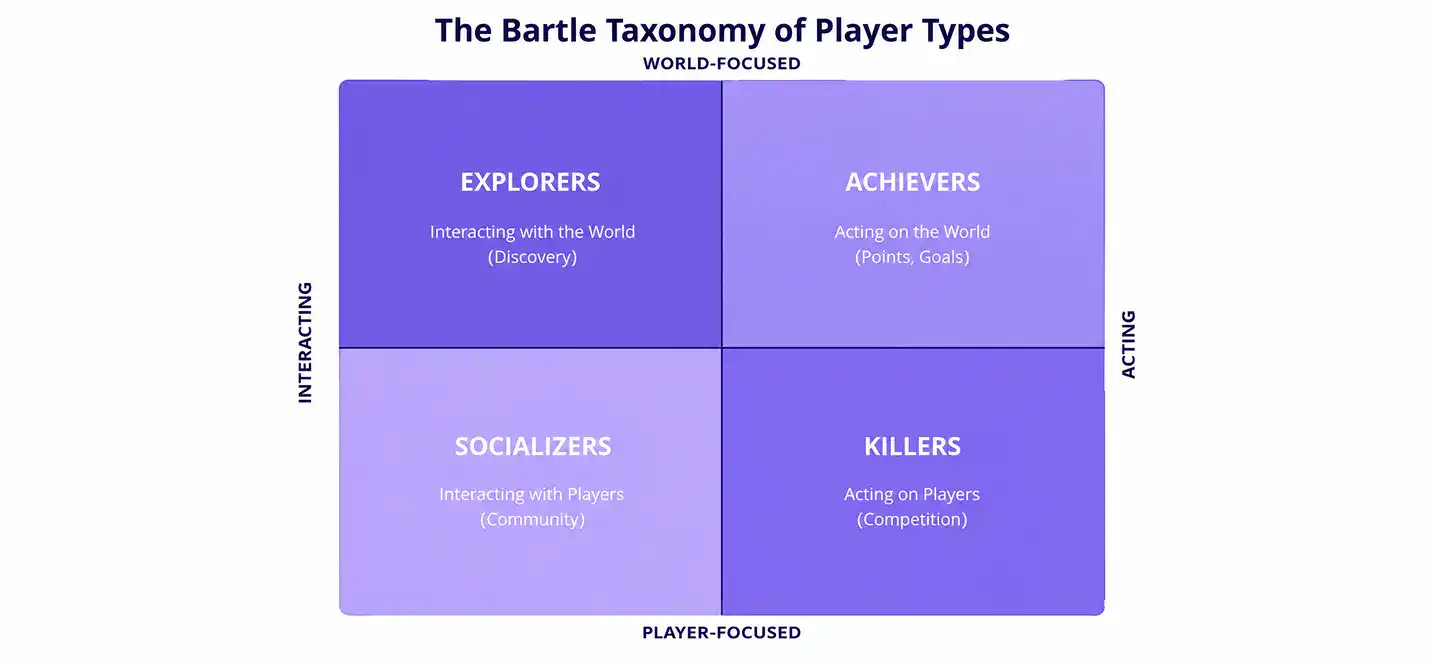
Richard Bartle created this model back in 1996. He studied players of early text-based games. From that research, he found four clear player types. This taxonomy still shapes game design decisions today.
Achievers love points, badges, and levels. They want visible progress at every step. Trophy hunters and completionists usually fall here.
Explorers love uncovering hidden content. They read lore, find secrets, and map worlds. A rich open world keeps them hooked for hours.
Socializers play games to connect with people. Chatting, teaming up, and building friendships matter most. Multiplayer worlds are their natural home.
Killers thrive on direct competition. They want to win, dominate, and climb ranks. PvP modes were basically built for them.
Roughly 40% of players identify strongly as Achievers, based on multiple gamer surveys. That makes it the single most common Bartle type. If you’re building a role-playing world with quests and leveling systems, understanding these traits is essential. This is exactly where experienced RPG game development services come in, blending achievement loops with exploration and story depth.
Most players don’t fit just one box neatly. Someone can be an Achiever and a Socializer together. That overlap is actually the norm, not the exception. Bartle’s model works best as a spectrum, not strict boxes. Think of it as four dials, not four doors. Every player sets those dials a little differently.
The Quantic Foundry Model: A Modern Approach
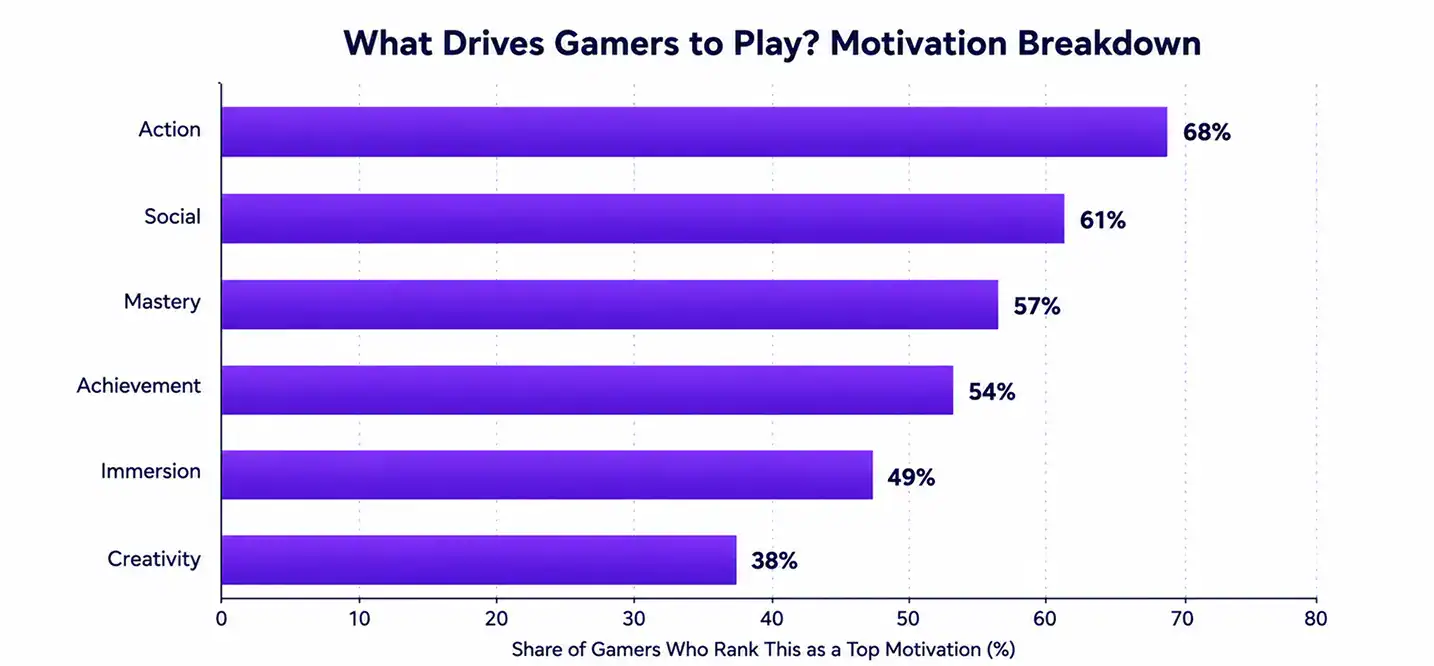
Bartle’s model is simple but a bit dated. Quantic Foundry built something more detailed in 2015. Their model studied over 400,000 gamers worldwide. It identifies six core motivations instead of four.
The six motivations are Action, Social, Mastery, Achievement, Immersion, and Creativity. Each motivation connects to specific genres and features. A player can score high in more than one.
Action tops the list at 68%, based on aggregated player motivation data. Social motivation follows closely at 61%. This shows most gamers want fast excitement or real connection. Mastery and Achievement sit in the middle, appealing to skill-focused players.
Motivation vs Preferred Genre
| Motivation | What They Want | Preferred Genre |
| Action | Fast pace, excitement | Shooter, Battle Royale |
| Social | Teamwork, connection | MMO, Co-op games |
| Mastery | Skill improvement | Fighting, Strategy |
| Achievement | Progress, completion | RPG, Sandbox |
| Immersion | Story, atmosphere | Narrative, Open-world |
| Creativity | Building, customizing | Simulation, Sandbox |
Social gamers are growing fast right now. Multiplayer titles now make up a huge chunk of new releases. Studios building team-based experiences often turn to specialized Multiplayer Game Development Services to handle real-time syncing, matchmaking, and server stability at scale.
The Big 3 Gamer Categories: Casual, Core, and Hardcore
Beyond psychology, gamers also split by commitment level. This is often called the “Big 3” in gaming circles. It’s a simpler, time-based way to classify players.
Casual gamers play in short bursts. They enjoy easy-to-learn, hard-to-master games. Mobile puzzle games are their go-to choice.
Core gamers play more regularly. They enjoy moderate challenges and longer sessions. Console and PC games fit them well.
Hardcore gamers play for hours daily. They chase mastery, rankings, and deep mechanics. Esports titles are built with them in mind.
Casual vs Core vs Hardcore Comparison
| Factor | Casual Gamer | Core Gamer | Hardcore Gamer |
| Hours per week | 1-4 hours | 5-15 hours | 20+ hours |
| Spending habits | Low, occasional | Moderate, regular | High, frequent |
| Game complexity | Simple | Medium | High |
| Common platform | Mobile | Console/PC | PC/Console |
| Motivation | Relaxation | Fun challenge | Mastery, ranking |
Casual mobile gaming now accounts for over 50% of total global gaming revenue. This shift has pushed studios to invest heavily in mobile. A skilled mobile game development company understands how to hook casual players fast. For simple, addictive loops, many brands also rely on a specialized hyper casual game development company to nail that instant fun factor.
Types of Gamers by Platform Preference
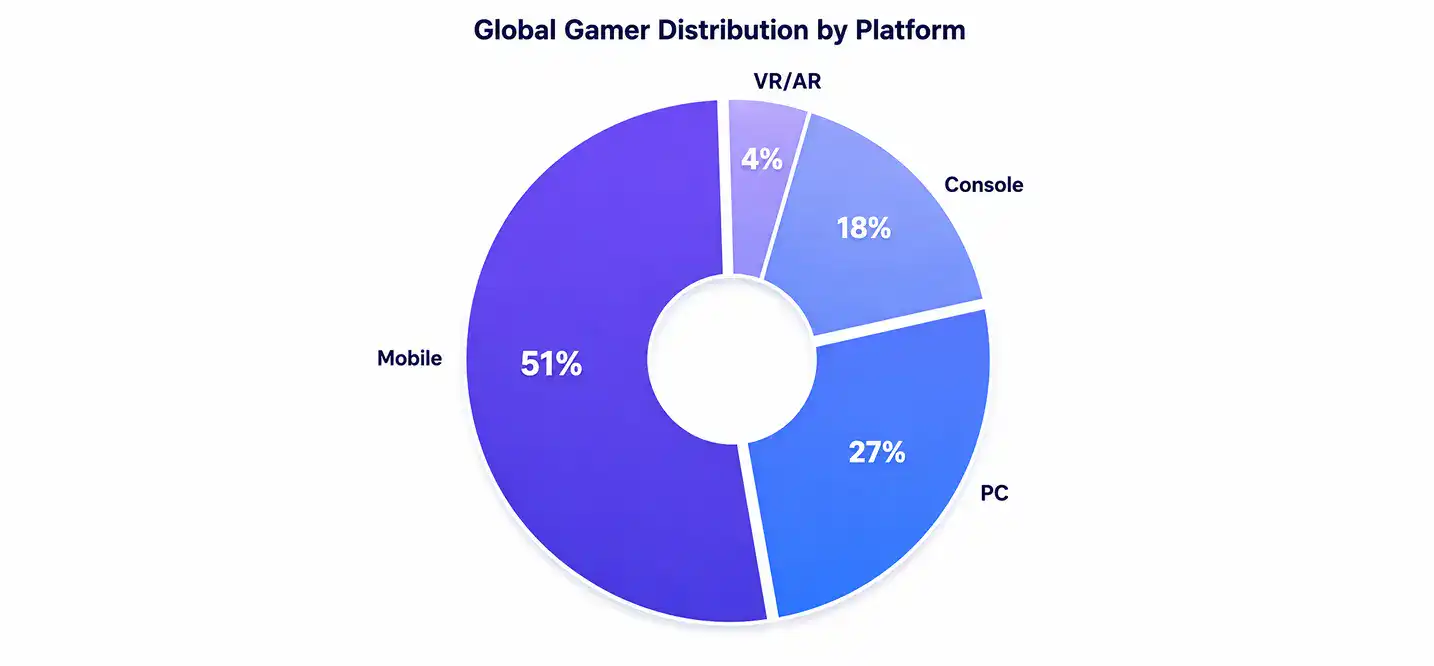
Platform choice tells you a lot about a gamer. It reflects budget, lifestyle, and personal taste. Let’s break down the four main groups.
Mobile gamers dominate the market today. They value convenience and short play sessions. This group skews toward casual and social players.
PC gamers value power and customization. They often chase high graphics and deep gameplay. Strategy, RPG, and competitive shooters thrive here.
Console gamers want a plug-and-play experience. They enjoy exclusive titles and couch co-op. This group blends casual and core habits.
VR/AR gamers are the newest, smallest group. They crave full immersion and physical interaction. This segment is growing fast, though still niche.
Mobile gamers make up 51% of all global gamers, based on current platform data. That’s more than PC and console combined. VR still sits at just 4%, but interest is rising quickly. Studios entering this space often need dedicated VR Game Development Services to build comfortable, motion-safe, truly immersive worlds.
Types of Gamers by Genre Loyalty
Genre preference is another strong signal of gamer type. Most players stick to two or three favorite genres. Let’s map the most common ones.
Genre vs Typical Gamer Type
| Genre | Typical Gamer Type | Key Appeal |
| RPG | Achiever, Explorer | Progression and story |
| Strategy | Mastery-driven, Achiever | Planning and skill |
| Shooter | Killer, Action-driven | Speed and competition |
| Simulation | Creative, Casual | Building and control |
| Puzzle | Casual | Quick, relaxing challenge |
Genre-loyal players often stick with a favorite franchise for years. This loyalty makes solid game engines critical for developers. Many top-rated genre titles rely on flexible Unity game development services for cross-platform reach and smooth performance across devices.
Genre habits also shift with age and free time. Younger players often gravitate toward fast-paced shooters. Players with less free time often prefer puzzle or simulation titles. Life stage really does shape gaming taste over time. A ten-minute commute favors puzzles over sprawling RPGs. A free weekend opens the door to deeper genres entirely.
Levels of Gamers: Beginner to Pro
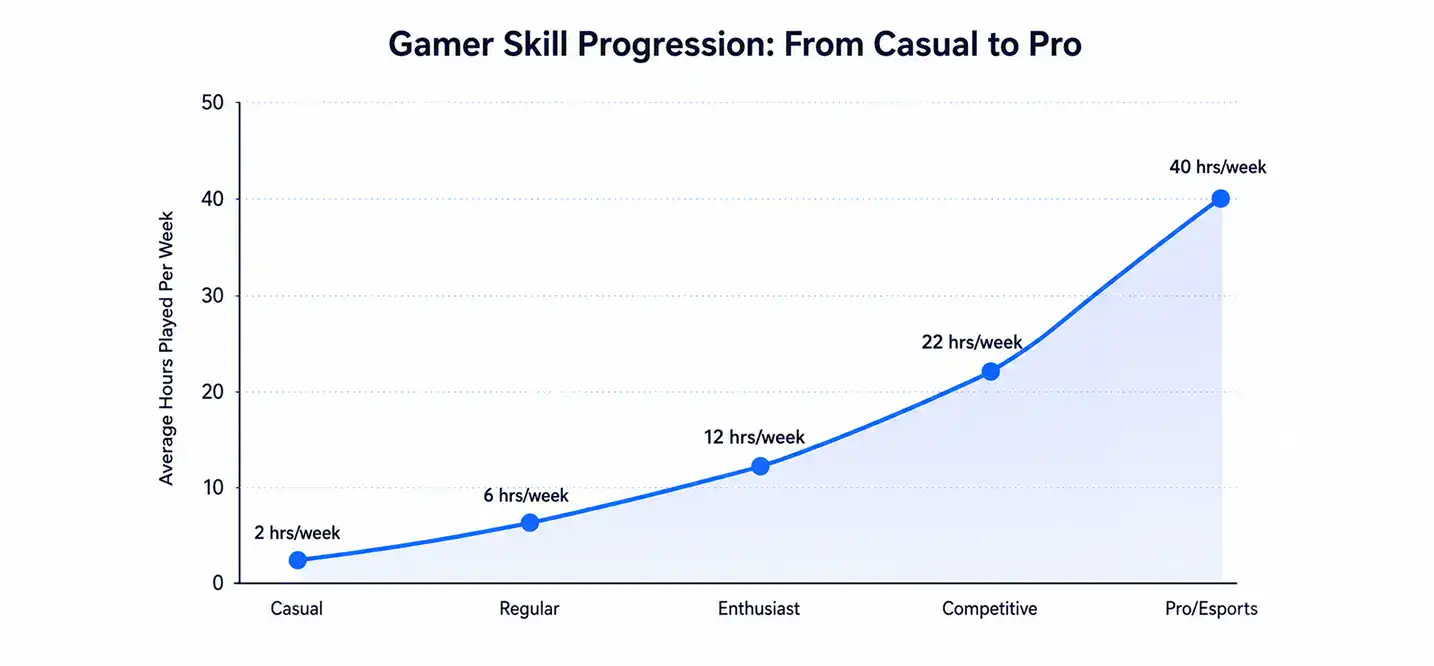
Gamer type isn’t only about personality or platform. Skill level also plays a huge role. Most gamers move through five general stages.
Casual players start around two hours weekly. Regular players bump that up to roughly six hours. Enthusiasts push into double digits, often twelve hours weekly. Competitive players train much harder, closer to twenty-two hours weekly. Pro and esports players can hit forty hours weekly, treating gaming like a full-time job.
The global esports audience is projected to top 640 million people soon. That’s a massive jump from just a decade ago. This growth proves gaming is no longer a small hobby. It’s a legitimate, structured career path for many.
Brands building for this competitive tier need more than templates. They need tailored systems built for scale and precision. This is exactly the kind of work a custom game development company specializes in, from ranked matchmaking to anti-cheat systems.
Not every player wants to climb this ladder, though. Plenty of gamers stay happily at the casual or regular stage forever. That’s not a lesser way to play at all. Gaming should fit your life, not take it over. The best games actually support every stage on this curve at once.
How Game Studios Design for Different Gamer Types
Understanding gamer types isn’t just a fun exercise. It directly shapes how games get built. Smart studios design with player psychology in mind from day one.
This is where Cubix stands out in the industry. As a full-service Game Development Studio, Cubix builds games around real player behavior. The team studies motivation data before writing a single line of code. That means fewer guesses and stronger player retention later.
Cubix has worked across nearly every gamer segment out there. For Achievers, the studio builds layered progression systems with clear rewards. For Explorers, it crafts rich, detailed worlds worth wandering through. For Socializers, it builds smooth multiplayer systems that keep friend groups connected. For Killers and competitive players, it builds fair, responsive ranking systems that reward real skill.
Games designed around real player psychology see up to 30% higher retention, according to industry benchmarking data. That’s a massive difference for any studio’s bottom line. It proves that understanding gamer types isn’t optional anymore. It’s a core part of building anything that lasts.
Why Partner with Cubix for Your Next Game
Choosing the right development partner changes everything. Cubix has spent years mastering player psychology and technical execution together. That combination is rare in the game development space.
The studio’s portfolio spans casual mobile hits to deep, competitive RPGs. This range shows real versatility, not just surface-level experience. Clients get a partner who understands both fun and function.
Cubix also emphasizes long-term player engagement over quick launches. Retention, monetization, and community building all get built in early. This approach helps games survive well past their first month.
If you’re planning your next game, don’t guess at your audience. Work with a team that studies gamer types as closely as gameplay itself. As a trusted Game Development Studio, Cubix turns player psychology into real, measurable results.
Want to discuss your project? Our experts are just a click away.
Contact UsFrequently Asked Questions
1. What are the different levels of gamers?
Most gamers move through five levels. These are casual, regular, enthusiast, competitive, and pro. Each level reflects more time and skill invested.
2. What are the big 3 in gaming?
The Big 3 usually refers to casual, core, and hardcore gamers. This system groups players by time and commitment level.
3. What are different game styles?
Common styles include action, strategy, simulation, RPG, and puzzle. Each style appeals to different player motivations and skills.
4. What are the levels in gaming?
Skill levels typically range from beginner to professional. Time invested and mechanical skill both increase along the way.
5. Which companies specialize in gaming gear for different types of gamers?
Many hardware brands build gear for specific player types now. Competitive players often buy high-refresh monitors and precision mice. Casual mobile gamers usually stick with their existing smartphones instead. On the development side, studios like Cubix build the software experiences these players actually use, tailored to how each group plays.
6. What gaming consoles are best suited for casual gamers?
Casual gamers usually prefer consoles with simple, quick-load libraries. Handheld hybrid consoles work especially well for short sessions. Mobile phones remain the top choice for true casual convenience.