

Healthcare software compliance requirements affect much more than how an application stores patient records. They influence who can access information, how systems exchange data, which vendors can process it, how clinical features are validated, and what happens when a security incident occurs.
The first challenge is identifying which requirements actually apply. A hospital EHR, a telehealth platform, and a consumer wellness app do not necessarily fall under the same regulations, even if all three handle health-related information. Their obligations depend on the organization operating the software, the data involved, the product’s intended purpose, and the services it performs.
The scale of the problem is clear. According to the U.S. Department of Health and Human Services (HHS), the Office for Civil Rights received 663 reports of large breaches involving unsecured protected health information in 2024, affecting approximately 242.9 million individuals. Hacking and IT incidents accounted for 81% of those reported breaches. These figures show why healthcare organizations need to treat data protection and compliance as ongoing responsibilities, not a final check before launch.
A reliable approach connects regulatory requirements to software architecture, development practices, vendor management, and post-launch operations. This guide explains how to identify the rules that apply to a healthcare product, translate them into engineering decisions, and maintain compliance as the system changes.
Key Takeaways
- Healthcare software compliance requirements depend on the software’s purpose, the data it handles, and the organization’s role.
- HIPAA, HITECH, state privacy laws, FDA regulations, and FTC rules may apply to different healthcare products.
- Compliance starts with identifying applicable regulations and translating them into clear technical and operational requirements.
- Security controls, risk assessments, vendor agreements, and compliance documentation must be part of the development process.
- Compliance does not end at launch. Regular reviews, security updates, access audits, and risk assessments help maintain it as software evolves.
What Are Healthcare Software Compliance Requirements?
Healthcare software compliance requirements are the legal, regulatory, contractual, and operational obligations an organization must meet when developing, operating, or maintaining software that handles healthcare information or performs regulated medical functions.
These obligations vary by product and organization. A software platform that stores electronic protected health information (ePHI) for a hospital may fall under HIPAA through the hospital’s covered-entity relationship. A consumer health app that operates outside HIPAA may still have obligations under state privacy laws or the Federal Trade Commission’s Health Breach Notification Rule. Software with a medical purpose may also require an FDA regulatory assessment.
Healthcare compliance and software security are closely connected, but they are not interchangeable.
Healthcare Software Compliance vs. Healthcare Software Security
Compliance determines which obligations apply and whether an organization meets them. Security focuses on protecting systems, data, and operations against unauthorized access, alteration, disclosure, or disruption.
| Area | What it addresses | Example |
| Regulatory compliance | Applicable legal and regulatory obligations | Meeting HIPAA requirements when handling regulated PHI |
| Data privacy | How personal and health information is collected, used, disclosed, and retained | Applying appropriate consent and data-sharing rules |
| Software security | Protection of systems and information | Authentication, access restrictions, encryption, and monitoring |
| Operational compliance | Policies, responsibilities, and processes | Reviewing access, managing incidents, and retaining compliance evidence |
Security controls support regulatory compliance, but they do not establish it on their own. An application might encrypt patient records and still violate applicable requirements if it shares information improperly, lacks required documentation, or fails to follow the organization’s privacy procedures.
Which Healthcare Software Products Need a Compliance Assessment?
Any healthcare technology project should begin with an assessment of its intended use, data, users, and operating relationships. Common examples include:
- Electronic health record (EHR) and electronic medical record (EMR) systems: Store patient histories, diagnoses, medications, clinical notes, and treatment information.
- Hospital management software: Supports admissions, scheduling, billing, resource allocation, and other administrative workflows.
- Practice management systems: Handle appointments, patient registration, insurance information, and billing.
- Telehealth platforms: Support remote consultations, patient-provider communication, and sometimes the exchange of clinical records.
- Patient portals and mobile health applications: Give patients access to records, appointments, test results, and care-related services.
- Laboratory information systems (LIS): Manage laboratory orders, specimens, results, and reporting.
- Remote patient monitoring platforms: Collect health measurements from connected devices and transmit them to care teams.
- Clinical decision support software: Analyzes patient information to assist clinical decisions and may require an FDA assessment depending on its function.
The product category alone does not determine its regulatory status. A hospital scheduling tool and an application that analyzes medical images may serve the same organization but have very different compliance considerations.
For a closer look at the systems used across healthcare operations, see our guide to types of software used in the healthcare industry.
Which Healthcare Software Regulations Apply in the United States?
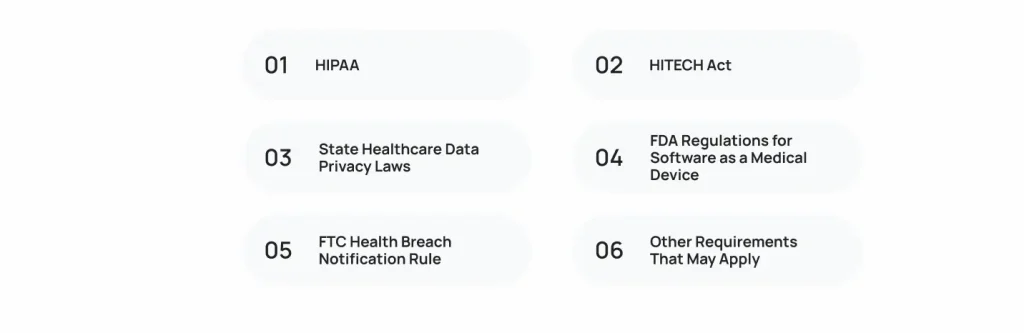 Healthcare software regulatory requirements in the United States come from several federal and state laws. HIPAA is central to many healthcare organizations, but it is not the only regulation to assess.
The applicable requirements depend on the entity’s legal role, the information it processes, its users, its geographic reach, and the software’s intended purpose.
1. HIPAA: Health Insurance Portability and Accountability Act
HIPAA establishes federal privacy and security requirements for covered entities and business associates that handle protected health information (PHI).
Covered entities include:
- Health plans.
- Healthcare clearinghouses.
- Healthcare providers that conduct certain electronic transactions covered by HIPAA.
A business associate is generally a person or organization that performs certain functions or services for a covered entity involving PHI. A healthcare software vendor may qualify when its services involve creating, receiving, maintaining, or transmitting PHI on behalf of a covered entity.
HIPAA includes three major rules relevant to healthcare software:
- Privacy Rule: Governs permitted uses and disclosures of PHI and establishes individual privacy rights.
- Security Rule: Requires administrative, physical, and technical safeguards to protect electronic PHI.
- Breach Notification Rule: Establishes notification obligations following breaches of unsecured PHI.
The Security Rule focuses on protecting the confidentiality, integrity, and availability of ePHI. Its requirements affect access management, risk analysis, system activity monitoring, authentication, and data transmission.
HIPAA does not apply automatically to every company that develops healthcare technology. The organization’s role and activities determine whether it is a covered entity or business associate and which HIPAA obligations apply.
For a detailed explanation of the rules and their obligations, see our guide to building custom software for US healthcare and HIPAA compliance.
2. HITECH Act
The Health Information Technology for Economic and Clinical Health (HITECH) Act strengthened the privacy and security protections established under HIPAA. It expanded the responsibilities of business associates, strengthened enforcement, and established breach notification requirements.
For healthcare software teams, HITECH matters because compliance responsibilities can extend beyond the healthcare provider to vendors and other organizations handling regulated information.
The practical effect is that a software provider cannot assume the healthcare organization alone is responsible for protecting ePHI. Its contractual role and actual data-handling activities matter.
3. State Healthcare Data Privacy Laws
Federal healthcare regulations do not cover every health-related data activity. State privacy laws can impose additional obligations, particularly on consumer-facing applications and organizations handling health data outside HIPAA.
Two examples illustrate why a state-level assessment matters:
- Washington My Health My Data Act: Establishes requirements for certain consumer health data that may fall outside HIPAA. Depending on applicability, regulated entities may need to address consent, privacy policies, consumer rights, data-sharing practices, and security.
- California Consumer Privacy Act (CCPA), as amended by the California Privacy Rights Act (CPRA): Covers qualifying businesses and personal information, subject to statutory exemptions. Certain medical information governed by California’s Confidentiality of Medical Information Act and certain PHI handled by HIPAA-regulated entities are exempt, but the exemption is not a blanket exclusion for every health-related data activity.
A healthcare platform serving users in multiple states should assess where its users are located, which entities collect the data, and whether the relevant state law covers the information and processing activity.
4. FDA Regulations for Software as a Medical Device
Not all healthcare software is a medical device. The FDA’s regulatory assessment depends heavily on the software function and its intended medical purpose.
Software may fall within medical-device regulation when it is intended to diagnose, treat, mitigate, cure, or prevent a disease or condition. Examples can include certain software functions that analyze medical images, interpret physiological signals, or provide clinical recommendations.
By contrast, general administrative tools such as appointment scheduling and billing software do not become medical devices simply because healthcare organizations use them.
The distinction matters during product planning. A team developing clinical decision support or diagnostic functionality should assess FDA requirements before finalizing product features, claims, validation plans, and release processes.
5. FTC Health Breach Notification Rule
Some consumer health applications and personal health record services operate outside HIPAA but still handle sensitive health information.
The FTC Health Breach Notification Rule applies to certain vendors of personal health records, related entities, and their service providers. It requires notification when a qualifying breach involves unsecured personal health record information.
This is particularly relevant to direct-to-consumer health apps, connected health products, and services that combine information from multiple sources.
A product team should not assume that operating outside HIPAA means it has no health-data breach obligations.
6. Other Requirements That May Apply
A healthcare product’s users and business model may bring additional requirements into scope.
| Regulation or standard | Main area covered | When to assess it |
| 42 CFR Part 2 | Confidentiality of certain substance use disorder patient records | When software handles records maintained by qualifying Part 2 programs |
| FERPA | Student education records, which can include certain student health records | When software supports educational institutions or school health services |
| COPPA | Personal information collected online from children under 13 | When an app or online service is directed to children or has actual knowledge it collects their information |
| GDPR | Personal data protection | When an organization or its processing activities fall within the regulation’s territorial scope |
| PCI DSS | Payment card data security | When the system stores, processes, or transmits payment card data, or otherwise falls within the applicable card-data environment |
These requirements do not apply to every healthcare product. For example, FERPA may govern student health records maintained by an educational institution, while HIPAA may govern records held by a separate healthcare provider. The relationship between the institution, provider, and records must be assessed.
How Do You Determine Which Healthcare Software Compliance Requirements Apply?
Start with a documented applicability assessment before finalizing the product architecture or development scope. This helps the team identify legal obligations early, avoid unnecessary controls, and prevent important requirements from being discovered during testing or after deployment.
1. Define the Software’s Intended Purpose and Users
Document what the product does and who will use it.
Ask:
- Does it support clinical care, healthcare administration, billing, or general wellness?
- Will healthcare providers, patients, insurers, administrators, or caregivers use it?
- Does it store or exchange medical records?
- Does it analyze patient information or produce clinical recommendations?
- Does it perform a function that may qualify as a medical device?
Intended use is especially important for software that makes diagnostic recommendations, analyzes medical data, or supports treatment decisions. Product descriptions, marketing claims, and actual functionality can all matter when assessing regulatory scope.
2. Identify the Data the Software Collects and Processes
Create an inventory of information the application collects, receives, stores, modifies, or transmits.
Common data categories include:
- Protected health information (PHI).
- Electronic protected health information (ePHI).
- Personally identifiable information (PII).
- Medical histories and clinical notes.
- Diagnoses, prescriptions, and laboratory results.
- Insurance and billing information.
- Biometric and device-generated measurements.
- Consumer health data.
Do not treat all health-related information as the same legal category. PHI under HIPAA has a specific meaning, and information outside HIPAA can still be protected by state privacy laws or other requirements.
The inventory should also identify where each data type originates, where it is stored, which services process it, and who can access it.
3. Establish the Organization’s Regulatory Role
Determine which role the organization performs in relation to the data and services.
| Organization or role | Compliance consideration |
| Covered entity | Must meet applicable HIPAA requirements for its regulated activities |
| Business associate | Has direct HIPAA obligations when performing qualifying services involving PHI |
| Healthcare software vendor | May be a business associate depending on its actual services and access to PHI |
| Subcontractor | May have business associate obligations when handling PHI on behalf of another business associate |
| Consumer health app operator | May fall under FTC and state privacy requirements even when HIPAA does not apply |
A software development company does not automatically become a business associate simply because it builds a healthcare application. Its role depends on whether it creates, receives, maintains, or transmits PHI on behalf of a covered entity or business associate as part of a qualifying service.
4. Review Integrations and Third-Party Data Sharing
A healthcare application rarely operates in isolation. Its integrations can introduce additional data access, privacy, security, and contractual responsibilities.
Review every service that receives or processes information, including:
- EHR and EMR platforms.
- Cloud hosting and storage providers.
- Payment gateways.
- Analytics and monitoring services.
- Telehealth and communication platforms.
- AI, transcription, and document-processing services.
- External APIs and data exchange partners.
- Software development and support vendors.
For each integration, document the data exchanged, the purpose of the transfer, the systems involved, the parties with access, and the contractual arrangements required.
5. Build a Healthcare Software Compliance Applicability Matrix
Bring the findings together in a matrix that connects product characteristics to potential obligations.
| Assessment area | Questions to answer | Compliance outcome |
| Intended use | Does the software support diagnosis, treatment, administration, or general wellness? | Identify potential FDA and other regulatory considerations |
| Data handled | Does it process PHI, consumer health data, or other sensitive information? | Identify applicable privacy and security obligations |
| Business relationship | Is the organization a covered entity, business associate, or another type of operator? | Establish legal responsibilities |
| User location | Which states or countries will the product serve? | Identify jurisdiction-specific requirements |
| Integrations | Which external systems and vendors access information? | Determine supplier and data-sharing obligations |
| Product functionality | Does the software make or support clinical decisions? | Assess potential medical-device considerations |
The result should be a documented compliance scope that the product owner, technical team, compliance officer, and legal advisor can review. It should also identify unresolved questions and assign responsibility for resolving them.
How Do You Translate Compliance Requirements Into Software Engineering Decisions?

Once the applicable requirements are clear, translate them into functional requirements, technical specifications, architecture decisions, and testable acceptance criteria.
Regulatory language is often broad. A requirement to restrict access, for example, needs to become a clear rule about which users can access which records, under what conditions, and how the application verifies that access.
1. Convert Regulatory Obligations Into Functional and Technical Requirements
Build a traceability process that connects each applicable obligation to the part of the system responsible for meeting it.
Requirements may cover:
- User roles and permission boundaries.
- Patient consent and authorization workflows.
- Data access, sharing, and disclosure rules.
- Data retention and disposal.
- Audit history and reporting.
- Integration and information exchange.
- Incident reporting and response.
- Patient requests and administrative workflows.
For example, if a healthcare organization needs to limit access to patient information, the development team must define the relevant roles, record-level permissions, access conditions, and exception workflows. The requirement should be testable rather than left as a general instruction to “secure patient data.”
2. Incorporate Compliance Into the Software Architecture
Compliance decisions affect several parts of the application architecture.
| Architecture layer | Compliance-related considerations |
| User interface | Consent notices, user permissions, session handling, and safe display of patient information |
| Application layer | Business rules, authorization decisions, validation, and workflow restrictions |
| API and integration layer | Authentication, authorization, data exchange, and third-party access |
| Data layer | Data classification, retention, integrity, and encryption |
| Infrastructure | Hosting responsibilities, monitoring, backups, and recovery |
Consider a patient portal connected to an EHR. The portal must not simply retrieve every available patient record. Its integration layer needs to authenticate the requesting user, enforce the appropriate access rules, and exchange only the information permitted for that workflow.
The same principle applies to analytics and AI services. Before sending patient information to an external service, the team must establish whether the transfer is permitted, what data is necessary, and which contractual and security requirements apply.
For a broader look at architecture, development stages, and technology decisions, see the healthcare software development guide.
3. Define Compliance Acceptance Criteria Before Development
Each requirement should have a clear way to verify that the implementation works.
| General requirement | Engineering acceptance criteria |
| Restrict patient record access | Users can access only the records permitted by their assigned role and relationship |
| Maintain audit history | Relevant access and modification events are recorded and available for review |
| Protect data exchange | APIs enforce the approved authentication and authorization requirements |
| Apply retention rules | Records follow the organization’s approved retention and disposal process |
| Support patient requests | The application records and routes requests according to approved procedures |
| Control third-party access | External services receive only the data and permissions authorized for their function |
Maintain traceability between the original obligation, the software requirement, the implementation, and the test result. This makes it easier to investigate gaps and demonstrate how the system addresses its compliance scope.
4. Validate Compliance During Testing
Compliance-related testing should take place throughout development, not only during final quality assurance.
Relevant testing activities include:
- Access-control testing: Verify that users cannot access records or functions outside their permissions.
- API and integration testing: Check authentication, authorization, data validation, and error handling across system boundaries.
- Privacy testing: Verify that data collection, use, disclosure, and retention follow approved requirements.
- Security testing: Identify vulnerabilities through code analysis, dependency checks, and penetration testing.
- Audit-log testing: Confirm that relevant events are recorded accurately and can be reviewed.
- Backup and recovery testing: Validate that critical data and services can be restored according to documented recovery objectives.
- User acceptance testing: Confirm that clinical and administrative workflows behave as intended.
Testing evidence should be retained alongside the requirements and implementation records. A passing test does not prove universal regulatory compliance, but it helps demonstrate that the system meets its documented technical requirements.
How Do You Establish a Healthcare Software Security and Compliance Program?
Software controls need organizational processes behind them. A healthcare security and compliance program defines who owns each responsibility, how risks are assessed, how vendors are reviewed, and how evidence is maintained.
1. Assign Compliance Ownership and Responsibilities
Define responsibilities across the organization instead of assigning every compliance task to the development team.
| Role | Typical responsibility |
| Compliance and privacy officers | Interpret applicable obligations, oversee policies, and coordinate compliance reviews |
| Security team | Assess technical risks, monitor security events, and coordinate incident response |
| Product owner | Ensure requirements and compliance considerations are included in the product roadmap |
| Software architects and developers | Translate approved requirements into system design and implementation |
| Healthcare operations teams | Validate clinical and administrative workflows |
| Vendors and service providers | Meet contractual and applicable legal obligations for the services they perform |
A development partner can implement agreed technical safeguards and provide documentation, but outsourcing software development does not automatically transfer the healthcare organization’s legal responsibilities.
2. Conduct Regular Security Risk Assessments
A security risk assessment identifies threats, vulnerabilities, and potential impacts on the confidentiality, integrity, and availability of healthcare information.
For systems handling ePHI, HIPAA’s Security Rule requires regulated entities to conduct an accurate and thorough risk analysis. Risk management then involves implementing measures to reduce identified risks to an appropriate level.
A useful assessment covers:
- Asset identification: Locate systems, applications, databases, devices, and services that create, receive, maintain, or transmit ePHI.
- Data-flow mapping: Identify where information enters, moves through, and leaves the environment.
- Threat identification: Consider unauthorized access, ransomware, compromised credentials, misconfigured cloud services, and third-party failures.
- Vulnerability assessment: Identify weaknesses in applications, infrastructure, integrations, and operational procedures.
- Risk evaluation: Assess the likelihood and potential impact of each risk.
- Risk treatment: Assign remediation actions, owners, priorities, and deadlines.
- Documentation: Retain the assessment and evidence of decisions and remediation.
A risk assessment is not a one-time project document. It should be revisited when the product, environment, vendors, or threat landscape changes.
3. Maintain Policies, Procedures, and Compliance Evidence
A compliance program needs documented procedures that employees and service providers can follow.
Maintain records covering:
- Risk assessments and remediation plans.
- Data classification and handling procedures.
- Access management and authorization policies.
- Vendor assessments and contractual agreements.
- Security testing and vulnerability remediation.
- Incident response and breach notification procedures.
- Employee training and policy acknowledgments.
- Backup, recovery, and business continuity tests.
- Compliance reviews and management approvals.
The objective is not to create documentation for its own sake. Each record should show what the organization decided, who approved it, how the requirement was implemented, and whether it was reviewed.
4. Manage Third-Party and Vendor Compliance
Healthcare software often depends on external services for infrastructure, data exchange, communication, analytics, and support. Each vendor should be assessed according to the data it accesses and the function it performs.
Review:
- Whether the vendor receives, maintains, or transmits PHI.
- What information the vendor needs to perform its service.
- How the vendor controls employee and subcontractor access.
- Whether its security practices meet the organization’s requirements.
- How it reports incidents and vulnerabilities.
- How data is returned or deleted when the service ends.
- Whether a Business Associate Agreement (BAA) is required.
A BAA is generally required when a covered entity engages a business associate to perform qualifying services involving PHI. Similar requirements can apply between a business associate and its subcontractor. A vendor’s marketing claim or security certificate does not replace the required legal agreement.
The vendor review should also account for changes. A service that initially receives only non-sensitive operational data may later be configured to process patient information. That change can alter the compliance assessment.
For projects that require an external engineering partner, work with a custom software development company that can document its development practices, integration responsibilities, security processes, and support arrangements.
How Do You Maintain Healthcare Software Compliance After Launch?

Healthcare software compliance continues after deployment. New users, features, integrations, vulnerabilities, vendors, and regulatory changes can all affect the original compliance assessment.
A post-launch compliance process should include the following activities.
1. Review Access Permissions and User Accounts
Access should reflect each user’s current responsibilities.
Conduct periodic reviews of:
- Active and inactive accounts.
- Employee role changes.
- Departed employees and contractors.
- Privileged and administrative access.
- Third-party and service accounts.
- Unusual access patterns.
Remove permissions that are no longer required and ensure that access changes are reflected across connected systems. This is especially important when staff work across multiple clinical locations or applications.
2. Maintain Software and Third-Party Dependencies
Healthcare applications rely on frameworks, libraries, cloud services, APIs, and external software components. Vulnerabilities in any of these dependencies can affect the security of the wider application.
A vulnerability management process should include:
- Monitoring security advisories.
- Identifying affected software components.
- Prioritizing vulnerabilities based on risk and exposure.
- Applying and validating patches.
- Reviewing changes to third-party services.
- Testing integrations after updates.
- Maintaining an inventory of software dependencies.
A Software Bill of Materials (SBOM) can help document the components included in a software product. It supports dependency visibility and vulnerability response, but it is not, by itself, a universal HIPAA requirement.
3. Monitor Security Events and Investigate Incidents
Monitoring helps identify suspicious activity before it develops into a larger incident.
Depending on the system and its risk profile, monitor:
- Repeated failed login attempts.
- Unusual access to patient records.
- Unexpected privilege changes.
- Abnormal API requests.
- Unauthorized data exports.
- Changes to sensitive records.
- Suspicious activity involving third-party accounts.
The organization should also maintain an incident response process that defines escalation paths, investigation responsibilities, evidence preservation, containment, recovery, and required notifications.
If a qualifying breach of unsecured PHI occurs, HIPAA’s Breach Notification Rule may require notifications to affected individuals, HHS, and, in certain circumstances, the media. The applicable timing and responsibilities depend on the breach and the parties involved.
4. Test Backup, Disaster Recovery, and Business Continuity
Healthcare systems need recovery plans that account for clinical and administrative operations, not just infrastructure restoration.
A business continuity plan should identify essential services, responsible personnel, communication procedures, and alternatives for maintaining critical workflows during an outage.
Two useful recovery measures are:
- Recovery Time Objective (RTO): The target time within which a system or service should be restored after disruption.
- Recovery Point Objective (RPO): The maximum acceptable amount of data loss measured in time.
For example, a hospital may set different recovery objectives for an EHR, appointment scheduling platform, and internal reporting system. The impact of downtime is not the same across all three.
Test backups regularly, verify that restored data is usable, and confirm that recovery procedures work under realistic conditions. A backup that has never been tested is not sufficient evidence of recovery readiness.
5. Reassess Compliance When the Product Changes
A software update can change the data the application collects, the people who can access it, or the regulations that apply.
Trigger a compliance review when the organization:
- Adds an AI feature that processes patient information.
- Introduces a new EHR or external data integration.
- Expands into another state or country.
- Changes cloud hosting or infrastructure providers.
- Adds new user roles or access permissions.
- Changes data retention or sharing practices.
- Introduces a clinical function that may qualify as a medical device.
- Replaces a vendor or adds a new subcontractor.
This review should update the data-flow inventory, applicability assessment, risk register, technical requirements, and vendor documentation where necessary.
Software maintenance also needs a planned budget for patches, infrastructure changes, security reviews, and operational support. Our guide to hospital software maintenance cost explains the factors that affect ongoing maintenance investment.
Healthcare Software Compliance Checklist
Use this checklist as a starting point for reviewing a healthcare software project. The required actions will vary according to the product, organization, and applicable regulations.
| Project stage | Compliance checks |
| Before development | Identify applicable regulations, define intended use, classify data, and establish organizational responsibilities |
| During planning | Map data flows, review integrations, document privacy requirements, and assess third-party services |
| During development | Implement approved access rules, data-handling requirements, audit capabilities, and security measures |
| Before launch | Complete relevant testing, review vendor agreements, document risks, and validate recovery procedures |
| After launch | Review access, maintain dependencies, monitor incidents, test recovery, and reassess significant changes |
Before release, confirm that each applicable requirement has an owner, an implementation plan, and a way to verify its effectiveness. Retain the assessment and testing evidence so the organization can review its decisions later.
This checklist is not a substitute for legal advice, a product-specific regulatory assessment, or a formal security risk analysis.
Common Healthcare Software Compliance Mistakes
Even well-funded healthcare technology projects can create compliance gaps when teams make assumptions about regulations, integrations, or post-launch responsibilities.
1. Assuming Every Healthcare Application Is Automatically HIPAA-Regulated
HIPAA applies to covered entities and business associates in their regulated activities. A consumer health application may operate outside HIPAA while still being subject to state privacy laws or the FTC Health Breach Notification Rule.
Better approach: Determine the organization’s legal role, the data involved, and the services performed before deciding which regulations apply.
2. Treating Compliance as a Pre-Launch Audit
Waiting until testing or deployment to review compliance can expose expensive design problems. For example, an application may have an integration architecture that sends more patient information to an external service than the workflow requires.
Better approach: Include compliance requirements in discovery, architecture, development, and testing. Review them again before release.
3. Overlooking Third-Party Integrations
An application may have strong internal security controls but still expose information through analytics platforms, AI services, cloud tools, or poorly configured APIs.
Better approach: Maintain an inventory of integrations, data exchanged, vendor access, contractual responsibilities, and security review status.
4. Confusing Encryption With Complete Compliance
Encryption protects information in certain storage and transmission scenarios, but it does not establish appropriate access, permitted disclosures, auditability, documentation, or organizational accountability.
Better approach: Treat encryption as one part of a wider security and compliance program.
5. Ignoring Compliance After Software Updates
New features, user roles, integrations, and geographic expansion can change the application’s data flows and regulatory scope.
Better approach: Make compliance impact assessments part of the change management process.
6. Failing to Document Compliance Decisions
A team may implement appropriate controls but struggle to demonstrate why they were selected, which requirements they address, or whether they were tested.
Better approach: Maintain traceability between regulations, internal requirements, implementation decisions, test results, risk treatment, and approvals.
Conclusion
Healthcare software compliance starts with knowing which regulations apply to the product, organization, and data. From there, teams need to translate those obligations into architecture decisions, development requirements, vendor agreements, testing procedures, and post-launch controls. A documented, risk-based process makes compliance easier to manage as the product evolves.
If you are planning a new healthcare platform or modernizing an existing system, Cubix’s custom healthcare software services can help you plan the architecture, integrations, and engineering requirements around your product’s operational and compliance needs.
Building Healthcare Software? Get the Compliance Details Right From Day One.
Contact Us
Frequently Asked Questions
1. What Are the Main Healthcare Software Compliance Requirements in the US?
Key requirements include HIPAA, HITECH, applicable state privacy laws, FDA regulations, and the FTC Health Breach Notification Rule. Other laws may apply depending on the software and organization.
2. Is All Healthcare Software Required to Be HIPAA Compliant?
No. HIPAA applies to covered entities and business associates handling PHI in regulated activities. Other health apps may fall under state privacy laws or FTC requirements.
3. What Is the Difference Between Healthcare Software Compliance and Security?
Compliance means meeting applicable legal and regulatory obligations. Security protects software, systems, and data from unauthorized access, disclosure, or disruption.
4. How Do You Make Healthcare Software Compliant?
Identify applicable regulations, assess data and organizational responsibilities, implement the required controls, test them, and maintain compliance documentation.
5. How Often Should Healthcare Software Compliance Be Reviewed?
Review compliance regularly and whenever significant changes affect software functionality, data flows, vendors, integrations, or regulatory scope.
6. Who Is Responsible for Healthcare Software Compliance?
Responsibility depends on each organization’s role. Covered entities, business associates, vendors, and subcontractors may have separate obligations.
7. Does Healthcare Software Need FDA Approval?
No. FDA oversight applies to software functions that meet the medical-device definition and fall within the agency’s regulatory scope.