Key Takeaways
- PCG automates content creation using algorithms, rules, parameters, and constraints, reducing the need to handcraft every game element.
- AI can enhance traditional PCG by adding learned patterns and content variation, but it works best when combined with clear rules and design constraints.
- Procedural generation can create levels, worlds, environments, assets, items, and encounters at a much larger scale.
- Hybrid PCG is often the most practical approach, combining procedural systems for structure and control with AI for variation and complex generation.
- PCG is especially valuable for replay-focused and large-scale games, including roguelikes, survival games, RPGs, open-world games, strategy titles, and live-service games.
- The right PCG partner needs more than technical generation skills. Game design, engine integration, technical art, QA, optimization, scalability, and post-launch support all matter.
Building a larger game world does not necessarily mean building every part of it by hand.
As games demand greater scale and variation, development teams need ways to create content efficiently without giving up control over gameplay or design. Procedural Content Generation (PCG) addresses this by using algorithms, rules, parameters, and constraints to generate game content automatically or with limited human input.
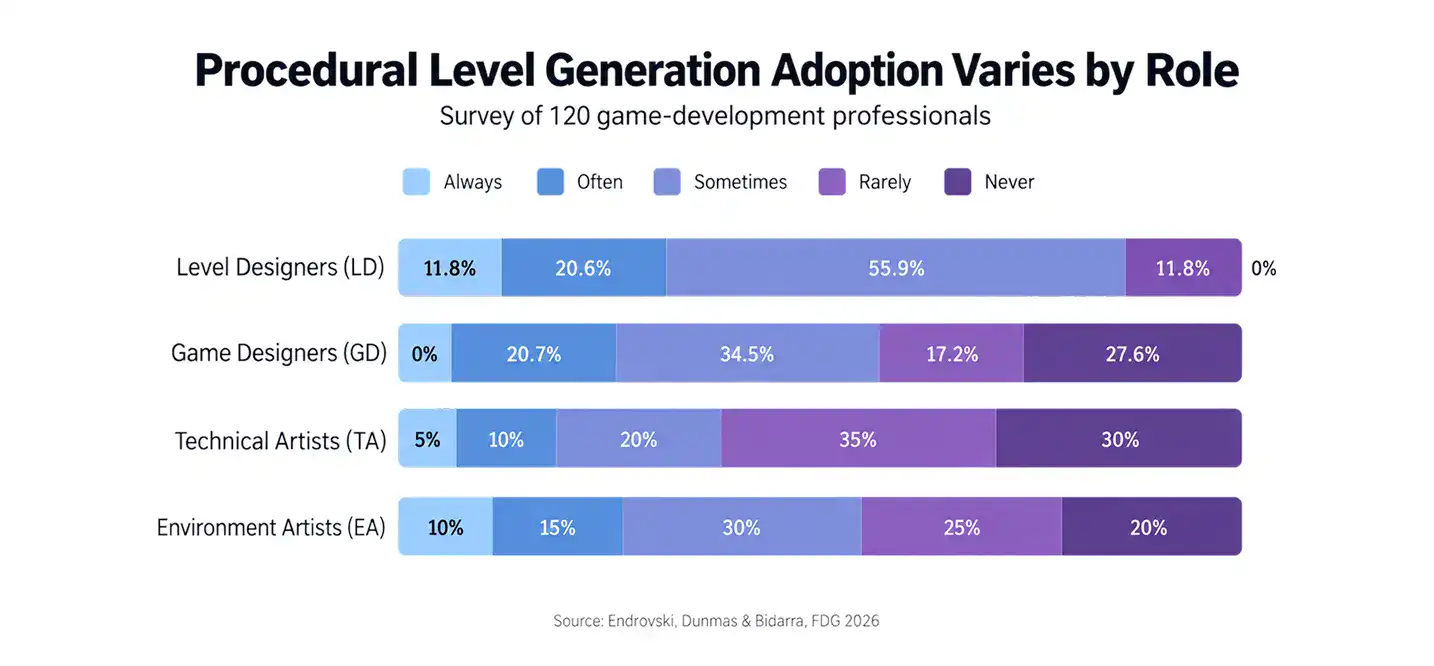
A 2026 survey of 120 game development professionals found that procedural generation adoption varies across roles, with artists using procedural tools more frequently than designers. The research also found that developers value creative control and process transparency more than automation alone.
That distinction becomes important as AI procedural content generation enters the pipeline. AI can add learned patterns and generative variation to procedural systems, but still works best alongside clear design rules and technical constraints.
For studios looking to scale their content pipeline, procedural content generation services can help create playable levels, expansive worlds, dynamic environments, and scalable asset variations while keeping them aligned with the game’s requirements.
What Is Procedural Content Generation in Game Development?
Procedural Content Generation (PCG) is the automated or semi-automated creation of game content using algorithms, rules, parameters, and constraints instead of manually authoring every element.
In procedural game design, developers build a generation system that determines how content is created and how much variation it can have. The system can use rules, templates, modular components, noise functions, grammars, and data-driven parameters to produce different outputs while staying within defined design boundaries.
A key concept is deterministic generation. By using a specific random seed, developers can reproduce the same output whenever needed. This is particularly useful for testing, debugging, multiplayer synchronization, and recreating generated game states.
How Traditional PCG Works
Traditional PCG is primarily rule- and algorithm-driven. Developers define what the system can generate, establish constraints to prevent invalid results, and use parameters to control variables such as scale, density, difficulty, or variation.
For example, a procedural level generator might use modular room templates, connection rules, and a random seed to create hundreds of different layouts while ensuring that every generated level remains playable.
This gives developers a balance between variation and control, which is central to procedural generation in game design.
How AI Procedural Content Generation Differs
AI procedural content generation introduces Machine Learning, Generative AI, or neural networks into the generation process, forming part of the broader shift toward AI-driven game development. Instead of relying only on explicitly programmed rules, AI can learn patterns from existing content and use them to generate, modify, or adapt new content.
| Traditional PCG | AI-Assisted PCG |
| Rule and algorithm-driven | Combines procedural logic with AI/ML |
| Predictable and reproducible | Can learn patterns and generate variations |
| Strong designer control | Expands the range of possible outputs |
| Best suited to structured systems | Useful for complex or learned relationships |
The most practical approach is often hybrid PCG, where procedural systems handle structure and constraints while AI supports areas such as variation and AI-assisted game design. Deterministic procedural systems can enforce gameplay rules, technical constraints, and designer intent, while AI handles areas where learned patterns or generative variation can add value. This allows studios to use AI without giving up the control that makes procedural systems reliable in production.
What Can Procedural Content Generation Create?
Procedural Content Generation can operate at different scales, from individual assets and items to complete game worlds. The value comes from giving developers a system that can produce controlled variation without requiring every output to be authored manually.
1. Procedural Level Generation for More Dynamic Gameplay
Procedural level generation can create layouts, rooms, pathways, encounters, and other gameplay spaces from predefined rules and modular components. This is particularly useful for games where replayability depends on players encountering different configurations.
Spelunky is a well-known example of this approach, using procedural generation to create new level layouts while maintaining the rules that make its platforming and exploration systems work. For a development team, the same principle can be adapted to generate dungeon layouts, mission spaces, combat arenas, or puzzle configurations.
2. Procedural World Generation for Large, Dynamic Environments
Procedural world generation takes the concept beyond individual levels and applies it to larger environments. Terrain, biomes, structures, vegetation, and other world features can be generated according to parameters and placement rules.
Minecraft provides a clear example. Its world-generation system starts with a seed and uses noise generators and multiple generation passes to create terrain, biomes, structures, and environmental features.
For studios, this approach can make large explorable environments more practical to build while allowing designers to control factors such as terrain shape, biome distribution, resource placement, and world density.
3. Procedural Asset Generation for Scalable Content Libraries
PCG can also generate variations of game assets, including objects, environments, items, and other reusable content. Instead of manually creating every variation, developers can define parameters that control how components are combined or modified.
No Man’s Sky demonstrates the concept at an enormous scale. Its universe is procedurally generated, with planetary terrain, environmental variation, creatures, and other elements contributing to distinct worlds.
The production advantage is scalability. A well-designed procedural content pipeline can turn a relatively small library of rules and components into a much larger range of usable game content, while still keeping generation within the project’s technical and design constraints.
How Does a Procedural Content Pipeline Work?
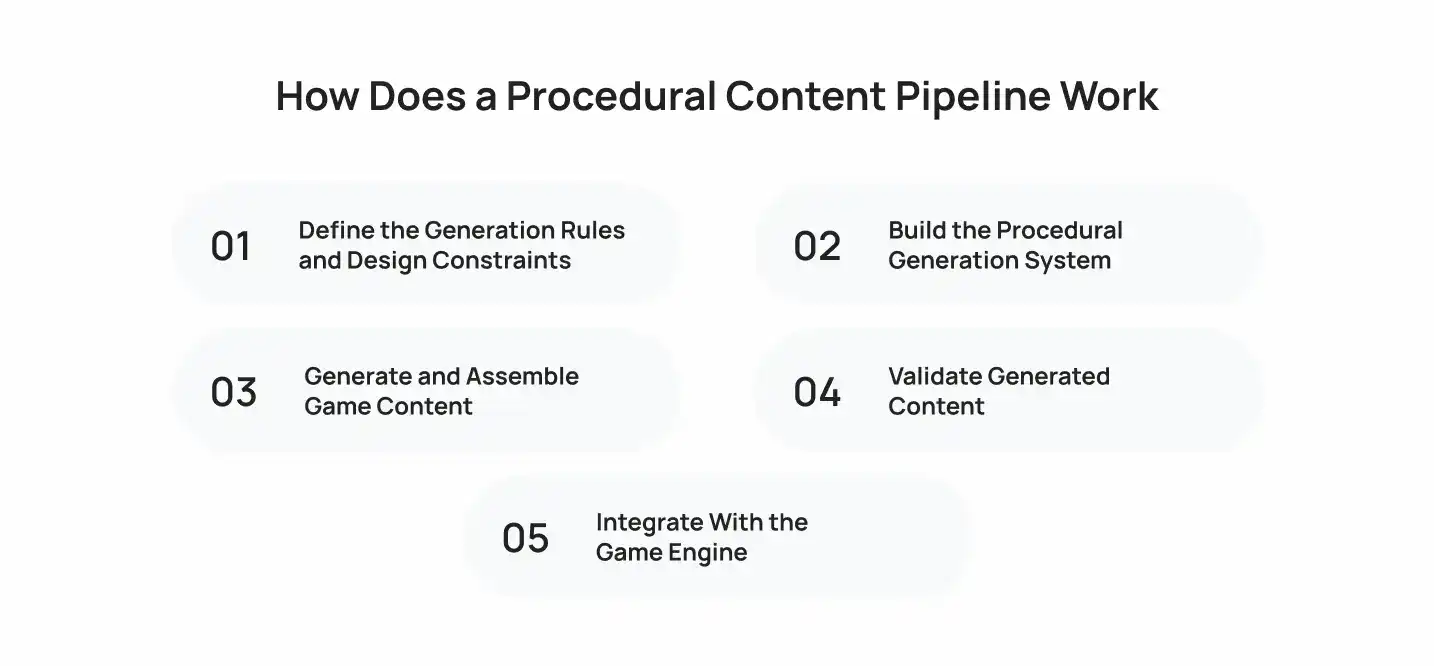
A procedural content pipeline turns game design requirements into generated content that can be tested and integrated into the final game. A typical workflow looks like:
Game Design Requirements → Generation Rules → Procedural Generation System → Content Generation → Validation → Artist/Designer Review → Engine Integration → Optimization
Each stage controls a different part of the process.
1. Define the Generation Rules and Design Constraints
The process starts with the game’s requirements. The development team defines the art direction, gameplay goals, difficulty range, content boundaries, platform limitations, and technical constraints the generator must respect.
For example, a dungeon generator may need to maintain minimum room sizes, guaranteed paths between key areas, enemy-density limits, and a target difficulty curve. These constraints prevent the system from producing technically valid but poorly designed content.
2. Build the Procedural Generation System
Developers then translate those requirements into generation algorithms, rules, parameters, and constraint systems. Seed management provides reproducibility, while modular components and data-driven generation make the system easier to expand.
The result may be a procedural graph, custom tool, or code-based generation system that designers can adjust without rewriting the underlying logic. Modern engines increasingly support this workflow directly. Unreal Engine’s PCG Framework, for example, uses procedural graphs to process spatial data and generate assets in both editor and runtime contexts.
3. Generate and Assemble Game Content
Once the system is ready, it can generate and combine different types of content, including levels, environments, worlds, assets, items, loot, and encounters.
Generation does not necessarily mean creating everything from scratch. A system might assemble approved modular assets according to procedural rules, vary their properties, and place them within a generated environment.
4. Validate Generated Content
Generation is only useful when its outputs meet production requirements. Procedural content generation testing and validation checks for issues such as:
- Playability and level connectivity
- Collision and navigation problems
- Asset integrity
- Performance bottlenecks
- Difficulty and progression issues
- Visual inconsistencies
- Unusual or invalid edge cases
Validation can happen automatically through rules and automated tests, followed by artist and designer review for qualities that are harder to measure programmatically.
5. Integrate With the Game Engine
Finally, the procedural system is connected to the target game engine, such as Unity, Unreal Engine, or Godot, using engine APIs, C#, custom tools, or existing asset pipelines. For teams building specifically with Unity, Unity procedural generation can be integrated into the broader content workflow.
There is an important distinction between offline generation and runtime procedural generation. Offline generation creates content during development, allowing teams to review and optimize it before shipping. Runtime generation creates or assembles content while the game is running, which can support dynamic environments and large or continuously changing worlds.
Modern engine tooling supports both approaches. Unreal’s PCG Framework, for instance, provides editor and runtime generation modes, along with partitioning and hierarchical generation for larger environments.
What Are the Benefits of Procedural Content Generation for Game Studios?
PCG gives game studios more than automated content creation. Its real value comes from making variation, scale, and iteration easier to manage.
| Benefit | What It Means for Studios |
| More content, less repetition | Generate large numbers of level, environment, item, or asset variations without manually creating each one. |
| Greater replayability | Change layouts, encounters, loot, and environments between playthroughs to keep gameplay fresh. |
| Larger game worlds | Generate terrain, biomes, structures, and environmental details at a scale that would be difficult to build entirely by hand. |
| Faster iteration | Adjust rules and parameters to explore new content variations without rebuilding the entire system. |
| Reusable production systems | Extend the same generation framework with new assets, rules, and parameters as the game grows. |
The result is a production model where developers author the system, not every possible output.
Why Studios Use Procedural Content Generation
Studios typically adopt PCG when manual content production becomes a bottleneck or when a game requires more variation than designers can reasonably create by hand. AI-driven procedural generation can further expand these systems by introducing learned patterns and additional content variation.
- Large content scope: Build levels, environments, and assets from reusable rules and components.
- Replay-focused gameplay: Generate different layouts, encounters, and item combinations between playthroughs.
- Dynamic systems: Adapt environments, encounters, or world elements based on gameplay conditions.
- Ongoing content demands: Expand content by updating generation rules and content pools instead of rebuilding everything manually.
Real-World Example: No Man’s Sky
No Man’s Sky shows how PCG can support enormous content requirements. Its technology generates planets, environments, creatures, and other elements across a procedurally generated universe. During its five-year development, Hello Games had an average team of six people, with 15 at launch.
The example demonstrates how procedural systems can help studios create large amounts of varied content without manually authoring every element.
Which Types of Games Benefit From Procedural Generation?
Procedural generation can support many game genres, but its value is highest where variation, scale, replayability, or continuously changing content are central to the experience.
| Game Type | How PCG Can Help |
| Roguelikes / Roguelites | Generate levels, rooms, encounters, items, and enemy layouts |
| Survival Games | Generate terrain, resources, biomes, and environmental conditions |
| Open-World Games | Scale terrain, landscapes, structures, and environmental details |
| RPGs | Generate quests, dungeons, loot, encounters, and world events |
| Strategy Games | Create maps, scenarios, factions, and gameplay conditions |
| Multiplayer Games | Generate map variations, encounters, and dynamic content |
| Live-Service Games | Create repeatable content variations for ongoing updates |
What Are the Challenges of Procedural Content Generation?
Procedural generation makes it easier to create content at scale, but generating more possibilities does not guarantee better content. Studios still need systems that control quality, gameplay, and performance.
The main challenges include:
- Quality Control: Generated content can be repetitive, inconsistent, or simply fail to create an enjoyable experience.
- Gameplay Balance: Random combinations may produce overpowered items, unfair encounters, or uneven progression.
- Design Oversight: Artists and designers still need to define constraints, review outputs, and maintain the game’s creative direction.
- Testing at Scale: Thousands of possible combinations require automated validation, seed-based testing, simulations, and edge-case checks.
- Performance: Runtime generation can increase CPU/GPU load, memory usage, asset-streaming demands, and multiplayer synchronization requirements.
Real-World Example: Dead Cells
Dead Cells offers a practical example of why these controls matter. Motion Twin initially experimented with fully procedural level generation, but found that the resulting levels could become chaotic and lack consistency. The team ultimately adopted a hybrid approach, combining handcrafted rooms and fixed structural elements with procedural generation to create variation while preserving level quality and flow.
What Do Procedural Content Generation Services Include?
Procedural content generation services can range from building a single generation tool to developing a complete procedural content pipeline integrated with the game’s engine, asset workflow, and QA process.
1. Procedural Level Generation
Systems can generate:
- Dungeons and maps
- Mission spaces
- Encounter layouts
- Procedurally assembled rooms
- Difficulty-aware level variations
2. Procedural World and Environment Generation
For larger game spaces, PCG can generate and populate:
- Terrain and landscapes
- Biomes and vegetation
- Cities and structures
- Dynamic environments
- Large-scale explorable worlds
3. Procedural Asset and Item Generation
Parameterized and modular systems can produce variations of:
- Environmental props
- Modular game assets
- Items and equipment
- Loot and rewards
- Other reusable content
4. AI-Enhanced Content Generation
AI development services can extend traditional procedural systems with capabilities such as:
- AI-generated game environments
- AI-generated game assets
- AI-assisted content variation
- Learned content patterns
- Semantic generation based on design requirements
A hybrid approach can combine AI-generated variation with procedural rules and constraints to keep outputs production-ready.
5. PCG Tooling and Engine Integration
A procedural generation vendor can build systems around the studio’s existing technology stack, including:
- Unity, Unreal Engine, and Godot
- C# development
- Custom editor tools
- Runtime generation systems
- APIs and asset pipelines
6. Testing, Optimization, and Post-Launch Support
Production support can cover the full lifecycle of a procedural system:
- QA and generation validation
- Performance optimization
- Gameplay balancing
- Bug fixes and system maintenance
- LiveOps updates and ongoing improvements
This allows a procedural content development company to support anything from a focused PCG feature to a scalable, production-ready generation pipeline.
How to Choose a Procedural Content Generation Company?
Choosing a PCG partner is less about finding a vendor that can generate content and more about finding a team that can engineer a reliable content-generation system around your game’s design and technical requirements. Good game development planning also helps define the game’s scope, technical requirements, and content needs before development begins.
What to Look For
Use this checklist when evaluating a procedural content generation company:
- PCG Development Experience: Proven experience building algorithmic and procedural generation systems.
- Game Engine Expertise: Strong Unity and Unreal Engine capabilities, with experience integrating custom generation tools.
- AI and Machine Learning: Ability to apply AI where it adds value without forcing AI into problems better solved with traditional PCG.
- Game Design Knowledge: Understanding of gameplay rules, progression, difficulty, pacing, and player experience.
- Level and World Generation: Experience with procedural levels, environments, terrain, biomes, and dynamic worlds.
- Technical Art Expertise: Knowledge of modular assets, procedural asset generation, and existing art pipelines.
- Testing and Validation: Automated testing and validation methods for detecting invalid or undesirable outputs.
- Performance and Scalability: Ability to optimize generation for large content volumes, runtime systems, and multiplayer environments.
- LiveOps Support: Ongoing maintenance, balancing, updates, and improvements after launch.
- Custom Development: Willingness to build a system around your game’s requirements rather than offering a one-size-fits-all solution.
Questions to Ask a PCG Development Partner
Before selecting a procedural generation vendor, ask:
- Can you build a custom system around our gameplay rules?
- Can generated content be reproduced using seeds?
- How will you validate generated content?
- How will the system integrate with Unity or Unreal?
- Where would you recommend traditional PCG versus AI?
- How will the system scale as content volume grows?
- What post-launch support is included?
The right partner should be able to explain how the system will work, how its outputs will be controlled, and how it will fit into your existing development pipeline, not just demonstrate that it can generate content.
Conclusion
Procedural Content Generation gives game studios a practical way to scale levels, environments, assets, and gameplay variation while keeping control over the experience. Its success, however, depends on more than generation algorithms. Strong design rules, validation, optimization, and the right balance between procedural systems and AI are what turn generated content into production-ready game content.
If you’re exploring procedural generation for a new game or looking to extend an existing content pipeline, the right approach starts with understanding your game’s requirements and where PCG can create the most value. Cubix combines procedural generation expertise with AI game development services to help studios build custom systems around their game’s design and technical needs.
Want to discuss your project? Our experts are just a click away.
Contact Us
FAQs About Procedural Content Generation Services
1. How much do procedural content generation services cost?
The cost depends on the system’s complexity, content scope, engine integration, AI requirements, testing, and whether generation happens offline or at runtime.
2. Which procedural content generation company is best for AI-built game worlds?
Look for a partner with experience in PCG, AI, game design, technical art, and game-engine integration. Custom development experience is particularly important for complex game worlds.
3. How long does it take to develop a procedural content generation system?
Timelines vary based on the generation system’s complexity, target platforms, engine integration, AI requirements, and testing scope. A simple generator will generally require less development than a complete production pipeline.
4. Should a studio use traditional PCG, generative AI, or a hybrid approach?
Traditional PCG offers greater predictability and control, while AI can introduce learned patterns and additional variation. A hybrid approach can combine both where they provide the most value.
5. Can procedural content generation create production-ready game assets and environments?
Yes, but generated content still requires validation, optimization, technical checks, and often artist or designer review before it can be considered production-ready.
6. How can studios maintain quality and gameplay balance in AI-generated content?
Studios can combine AI generation with procedural rules, constraints, automated validation, seed-based testing, simulations, and human review to keep outputs within defined gameplay and technical boundaries.