Key Takeaways
- Build a website to establish your online presence, improve SEO, and generate leads.
- Choose a web app when users need secure, interactive features and personalized experiences.
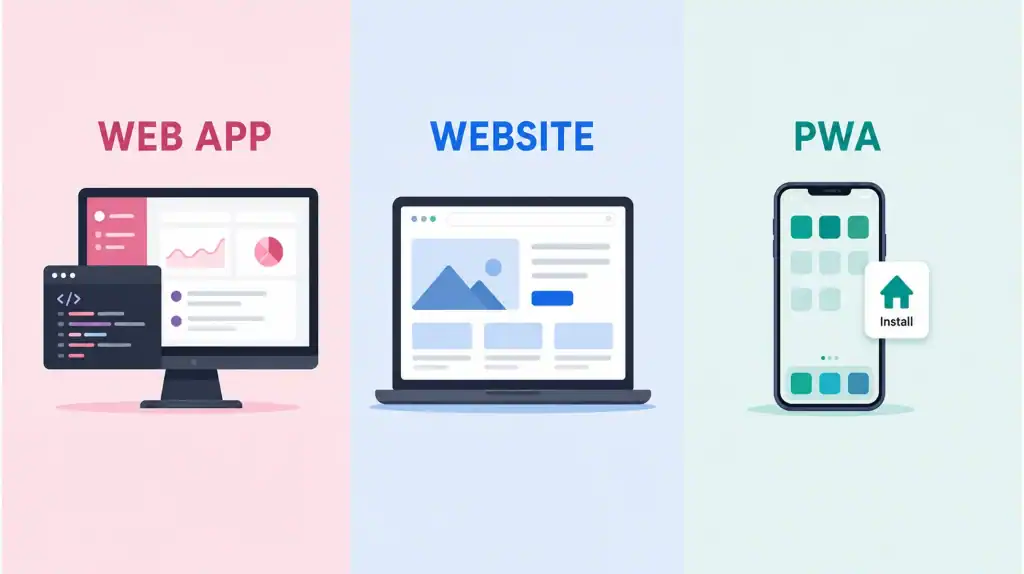
- A Progressive Web App (PWA) combines web accessibility with app-like features such as offline access and push notifications.
- Your business goals, user behavior, budget, and long-term plans should guide your decision.
- Choosing the right platform from the start helps reduce redevelopment costs and creates a better experience for your users.
Your digital product is often the first interaction customers have with your business. If it loads slowly, feels outdated, or fails to meet user expectations, they’ll move on quickly. That’s why choosing the right platform matters before development even begins.
Businesses today have more options than ever. You can launch a traditional website, build a feature-rich web application, or invest in a Progressive Web App (PWA) that combines the accessibility of the web with many capabilities of native mobile apps. Each option serves a different purpose, supports different user experiences, and requires a different level of investment.
According to Statista, global spending on digital transformation continues to grow across every industry, while Google’s Chrome team reports that fast-loading web experiences significantly improve engagement and conversions. At the same time, users expect seamless mobile optimization, instant performance, and consistent browser compatibility across every device they use.
Planning a digital product in 2026 starts with choosing the right platform. Understanding the differences between websites, web apps, and Progressive Web Apps (PWAs) helps you make a smarter investment, avoid unnecessary redevelopment, and build a solution that supports your long-term business goals.
For a deeper look at whether a Progressive Web App (PWA) is the right choice for your business, read our guide on PWA Worth for Your Business, where we cover its benefits, practical use cases, and the value it delivers across industries.
Quick Answer
The choice depends entirely on your business goals.
- Build a website if your priority is sharing information, improving search visibility, and generating leads.
- Choose a web application when users need to log in, manage data, collaborate, or perform tasks online.
- Invest in a Progressive Web App (PWA) when you want app-like performance, offline access, push notifications, fast loading, and a mobile-first experience without depending entirely on traditional app stores.
The sections below explain each option in detail so you can confidently choose the right one for your business.
What Is the Difference Between a Website, Web App, and PWA?
| Feature | Website | Web App | Progressive Web App (PWA) |
| Primary Purpose | Share information, promote services, generate leads, and publish content. | Help users complete tasks, manage data, and interact with business systems. | Deliver an app-like experience through the web with improved speed and engagement. |
| User Interaction | Low to moderate. Users mainly browse pages and submit simple forms. | High. Users log in, create content, manage accounts, collaborate, and perform workflows. | High. Users interact much like they would with a native mobile app. |
| Core Features | Informational pages, blogs, galleries, contact forms, and landing pages. | Authentication, dashboards, databases, APIs, real-time updates, and personalized experiences. | Home screen installation, offline access, push notifications, background sync, and fast loading. |
| Technology Focus | Website development emphasizes content management, responsive web design, and SEO. | Web app development focuses on business logic, APIs, databases, authentication, and scalability. | Progressive web app development combines modern web technologies with app-like capabilities. |
| Internet Requirement | Requires an internet connection for most functionality. | Requires an internet connection for real-time features and data synchronization. | Continues working even with limited connectivity through offline access. |
| Installation | No installation required. Opens directly in a browser. | No installation required unless packaged as an app. | Users can install it directly from the browser without relying entirely on app stores. |
| Performance | Depends on page size, hosting, and optimization. | Optimized for interactive workflows and dynamic content. | Designed for fast loading, smooth navigation, and responsive performance. |
| Best Use Cases | Corporate websites, blogs, portfolios, news portals, educational websites, and marketing sites. | CRM systems, SaaS products, banking platforms, booking systems, and project management tools. | Ecommerce, healthcare, travel, education, food delivery, media platforms, and customer portals. |
| Mobile Experience | Built using responsive web design and mobile optimization techniques. | Responsive interfaces that adapt across devices. | Mobile-first experience that closely resembles a native application. |
| Browser Compatibility | Supports all major browsers with proper optimization. | Works across modern browsers while supporting complex functionality. | Built to maintain strong browser compatibility while providing advanced web capabilities. |
How Do User Experience and Functionality Compare?
The right choice isn’t about selecting the latest technology. It’s about understanding how your users interact with your business every day.
Think about what you want visitors to do. Are they simply looking for information, or do they need to log in, manage accounts, complete purchases, or collaborate with others? The answer helps determine whether a website, web app, or Progressive Web App is the better fit.
Here’s how each option differs from a user experience perspective.
Website Experience
A website is designed to deliver information in a simple and accessible way. Visitors arrive with a specific goal, such as learning about your company, exploring your services, reading an article, or contacting your team.
Typical website interactions include:
- Reading blogs and articles
- Browsing products or services
- Watching videos
- Viewing company information
- Filling out contact or inquiry forms
Most users don’t need to sign in or perform complex actions. Instead, the focus is on helping them find information quickly and move smoothly through the site.
To support a seamless experience, modern websites prioritize browser compatibility, ensuring pages work consistently across Chrome, Safari, Edge, Firefox, and other major browsers. Combined with responsive layouts and fast loading times, this creates a reliable experience on any device.
For businesses focused on brand awareness, content marketing, or lead generation, a website often delivers everything they need.
Web App Experience
A web app is built for interaction rather than information.
Instead of browsing pages, users actively engage with the platform to complete tasks, manage data, or access personalized services. The experience is dynamic, with content and features changing based on each user’s actions.
Common web app features include:
- Secure user authentication
- Personalized dashboards
- Real-time collaboration
- Data storage and management
- File uploads and sharing
- Online payments
- Workflow automation
Because users depend on these platforms daily, web apps require a stronger technical foundation, including APIs, databases, authentication systems, and scalable infrastructure.
Businesses developing customer portals, SaaS products, internal management systems, or enterprise platforms often rely on Custom Web Application Development Services to build solutions that align with their operational needs.
Progressive Web App (PWA) Experience
A Progressive Web App (PWA) combines the convenience of a website with many of the features users expect from a mobile app.
It opens in a browser but feels much like a native application. Pages load quickly, navigation is smooth, and users can install the app directly on their home screen without visiting traditional app stores.
Key benefits include:
- Fast loading speeds
- Smooth navigation and animations
- Home screen installation
- Reliable performance on slow or unstable networks
- Offline access
- Push notifications
- Automatic updates without requiring manual downloads
These features help reduce friction throughout the user journey. Instead of waiting for pages to load or downloading updates from an app store, users can access the latest version instantly.
This makes PWAs an excellent choice for ecommerce, healthcare, education, travel, retail, and other businesses where speed, convenience, and user engagement directly influence conversions and customer retention.
The best digital products don’t force users to adapt. They remove friction at every interaction. Choosing the right platform is the first step toward creating that experience. – Salman Lakhani, CEO at Cubix
Which Performs Better: Website vs PWA?
Performance has a direct impact on user experience. A slow-loading page, delayed interactions, or an inconsistent mobile experience can increase bounce rates and reduce conversions. Google’s Core Web Vitals continue to make performance an important ranking factor in 2026, making speed and usability essential for every digital product.
When comparing website vs PWA, the better option depends on how users interact with your business.
Website Performance
A modern website performs well when developers follow best practices such as image optimization, caching, content delivery networks (CDNs), and clean code. Informational websites, blogs, corporate sites, and portfolios often deliver an excellent experience without requiring advanced app-like functionality.
A website is the right choice when your primary goals are:
- Publishing content
- Improving search visibility
- Generating leads
- Showcasing products or services
- Building brand credibility
With proper responsive web design and mobile optimization, websites provide a consistent experience across desktops, tablets, and smartphones.
PWA Performance
A Progressive Web App (PWA) goes beyond traditional website performance by using technologies such as service workers and local caching.
Instead of downloading every resource whenever users revisit your platform, a PWA stores frequently used assets on the device. As a result, pages load significantly faster, even on slower networks.
Additional performance benefits include:
- Near-instant page loading
- Reliable offline access
- Faster repeat visits
- Background synchronization
- Reduced data usage
- Better engagement through push notifications
Google has highlighted that businesses adopting Progressive Web Apps often see higher user engagement and improved conversion rates because visitors experience fewer interruptions during their journey.
Read More: How to Start Building Web Apps from Scratch?
Website vs PWA at a Glance
| Feature | Website | PWA |
| Loading Speed | Fast with proper optimization | Faster through caching and service workers |
| Offline Access | No | Yes |
| Push Notifications | No | Yes |
| Installation | Browser only | Install directly from the browser |
| Mobile Experience | Responsive | App-like experience |
| Updates | Server-side | Automatic background updates |
| Best For | Content, marketing, SEO | Ecommerce, customer engagement, recurring users |
For businesses that rely on repeat customer interactions, a PWA often delivers a smoother experience. However, organizations focused primarily on content marketing and lead generation rarely need the additional functionality.
Web App vs PWA: Which One Should You Choose?
A common misconception is that a web app and a PWA serve the same purpose. While both deliver interactive experiences through a browser, they solve different business problems.
Understanding the difference between a web app vs PWA helps you avoid investing in features your users don’t actually need.
Choose a Web App When Your Business Requires Complex Functionality
A web app is designed for users who perform tasks rather than simply consume content.
It’s the right option when your platform includes:
- User authentication
- Customer dashboards
- Business workflows
- Data management
- Reporting and analytics
- Team collaboration
- Third-party integrations
- Secure payment systems
Examples include banking portals, ERP platforms, CRM software, project management tools, healthcare systems, and SaaS applications.
These platforms prioritize functionality, security, and business processes over mobile-first engagement.
Choose a PWA When Mobile Engagement Matters Most
A PWA focuses on accessibility, speed, and convenience.
Instead of asking users to download an application from app stores, a PWA allows them to install your platform directly from the browser and access it with a single tap.
PWAs work particularly well for:
- Ecommerce stores
- Food delivery services
- Travel booking platforms
- Online education
- Media publishers
- Retail businesses
- Event platforms
Features like offline access, push notifications, and fast loading help businesses keep users engaged without requiring a native mobile application.
Can a Web App Also Be a PWA?
The answer is yes.
A Progressive Web App isn’t a separate type of software. It’s a set of technologies that can enhance an existing web application.
For example, a customer portal or SaaS platform can be developed as a web app while also supporting PWA features such as:
- Home screen installation
- Offline functionality
- Push notifications
- Background synchronization
- Improved mobile performance
This approach allows businesses to combine advanced functionality with a better mobile experience, giving users the best of both worlds.
How Do Development Cost, Time, and Maintenance Compare?
Budget plays an important role when deciding what to build. The initial development cost is only one part of the investment. You also need to consider maintenance, future updates, scalability, and long-term operational expenses.
Here’s how the three options compare.
| Factor | Website | Web App | PWA |
| Development Complexity | Low | High | Medium to High |
| Development Time | Short | Long | Medium |
| Initial Cost | Lowest | Highest | Medium |
| Maintenance | Simple | Ongoing feature updates | Moderate |
| User Authentication | Optional | Essential | Optional |
| Offline Support | No | Limited | Yes |
| Push Notifications | No | Optional | Yes |
| Installation | Browser | Browser | Browser + Home Screen |
| Scalability | Moderate | High | High |
While a traditional website remains the most affordable option, businesses with interactive platforms often benefit from investing in a web app. A PWA sits between the two, offering many mobile app capabilities without the additional cost of maintaining separate iOS and Android applications.
Choosing the right web developer early helps you avoid unnecessary costs and technical limitations as your business grows. A solution built around your users, business processes, and future goals is easier to scale and maintain over time.
Businesses with customer portals, enterprise systems, or workflow-driven platforms often need software built specifically for the way they operate. A tailored solution fits existing processes more effectively, connects with the tools already in use, and gives teams the flexibility to expand features as business needs change.
How Do You Choose the Right Option for Your Business in 2026?

By now, you’ve seen that websites, web apps, and PWAs each serve a different purpose. The right choice depends on what you want users to do after they land on your platform.
Before starting your project, ask yourself these questions:
- Do users only need to read information or browse your services?
- Will they create accounts, manage data, or complete transactions?
- Is mobile engagement a priority?
- Do you want users to access your platform without downloading an app?
- How important are features like offline access and push notifications?
- What is your budget and timeline?
Your answers will point you toward the right solution.
Build a Website When…
A traditional website is the best option if your primary goal is to inform, educate, or generate leads.
Choose a website when you want to:
- Build an online presence
- Publish blogs and resources
- Showcase products or services
- Improve search engine visibility
- Collect inquiries through contact forms
A well-designed website is easier to launch, simpler to maintain, and remains one of the most effective tools for digital marketing.
Build a Web App When…
A web app makes sense when users need to interact with your platform regularly.
It’s the right choice for businesses offering:
- SaaS products
- Customer portals
- Booking systems
- Banking platforms
- Healthcare portals
- Internal business tools
- Enterprise software
These platforms focus on functionality, security, and productivity rather than simply displaying information.
Want to discuss your project? Our experts are just a click away.
Contact UsBuild a Progressive Web App (PWA) When…
A Progressive Web App (PWA) is a strong choice when your users primarily access your platform from mobile devices and expect a fast, app-like experience.
PWAs work especially well for:
- Ecommerce stores
- Retail businesses
- Food delivery platforms
- Travel and hospitality
- Education platforms
- Media and publishing websites
- Membership communities
Instead of asking users to install an application through app stores, a PWA lets them access your platform instantly while still benefiting from offline access, push notifications, and a responsive interface.
If you’re considering this approach, explore our Progressive Web App solutions to see how businesses use PWAs to improve engagement and deliver a better mobile experience.
Why Businesses Choose Cubix for Modern Web Solutions

Building a successful digital product starts with selecting the right technology, but execution matters just as much.
With more than 18 years of experience, Cubix has helped startups, growing businesses, and enterprise organizations build websites, web applications, and Progressive Web Apps that solve real business challenges.
Whether the goal is launching a marketing website, developing a customer portal, or creating a feature-rich PWA, the focus remains the same: delivering a reliable, user-friendly experience that supports long-term business growth.
Cubix works across modern frameworks and technologies to build secure, scalable web solutions that perform consistently across devices and browsers. Every project begins with understanding your business objectives before recommending the most suitable development approach.
Conclusion
Choosing between a website, web app, and Progressive Web App isn’t about selecting the most advanced technology. It’s about selecting the one that aligns with your business goals and your users’ expectations.
A website is ideal for sharing information, building credibility, and attracting new customers through search engines.
A web app is the right choice when users need personalized experiences, account management, or business functionality.
A Progressive Web App (PWA) bridges the gap by combining the accessibility of the web with many features users expect from a mobile application, including offline access, push notifications, and fast performance.
As user expectations continue to rise in 2026, investing in the right platform from the beginning saves time, reduces future development costs, and creates a better experience for every visitor.
Whether you’re planning a new digital product or upgrading an existing one, understanding these differences helps you make a decision that supports your business today and as it grows.
Frequently Asked Questions
1. Is a Progressive Web App better than a website?
A Progressive Web App offers features such as offline access, push notifications, and home screen installation, making it ideal for businesses that rely on repeat user engagement. A traditional website remains the better choice for content-focused businesses, lead generation, and brand visibility.
2. What’s the difference between a web app and a website?
A website primarily shares information, while a web app allows users to complete tasks such as managing accounts, collaborating with teams, making payments, or accessing personalized dashboards.
3. Can a website become a Progressive Web App?
Yes. Developers can enhance an existing website with PWA technologies, including service workers, offline functionality, and push notifications, provided the website meets the necessary technical requirements.
4. Do Progressive Web Apps need to be published on app stores?
No. Users can install a PWA directly from their browser without downloading it from an app store. Businesses can also choose to publish PWAs on supported app stores if they want additional visibility.
5. Which option is more cost-effective for small businesses?
For most small businesses, a website is the most affordable starting point. Businesses that require interactive features or frequent customer engagement often see greater long-term value from a web app or Progressive Web App.
6. Are Progressive Web Apps good for SEO?
Yes. Because PWAs are web-based, they can be indexed by search engines when implemented correctly. Combined with fast loading speeds, responsive design, and a strong content strategy, they can support both user experience and organic search visibility.