Key Takeaways
- How to hire a game developer the right way starts with a two-way interview, not a one-way pitch, you’re vetting the studio as much as they’re vetting your project.
- The global games market hit $205B in 2026, with mobile holding 52% share, know the market before you negotiate scope or price.
- How much does it cost to hire a game developer depends heavily on region: $20–$45/hr in Southeast Asia vs. $80–$150+/hr in North America and Western Europe.
- Outsourcing can cut total development costs by 40–60% compared to building an equivalent in-house team.
- The 10 questions to ask, skipping any one of these is how projects go over budget or miss deadlines.
- A studio that doesn’t ask you questions back hasn’t fully understood your project, treat that as a red flag, not a green light.
You’ve got the idea. You’ve got the budget. What you don’t have yet is the one thing that decides whether this project ships on time, on budget, and actually fun, the right studio.
Here’s the uncomfortable truth: most founders don’t lose money on game development because their idea was bad. They lose it because they picked the wrong partner and found out three months in, when the “in-house Unreal team” turned out to be two freelancers and a Slack channel. Learning how to hire a game developer isn’t a nice-to-have, it’s the single highest-leverage decision you’ll make before a single line of code gets written.
This guide breaks down exactly what to ask, why it matters, and what the numbers say about hiring game developers in 2026, whether you’re evaluating a game development outsourcing company for the first time or comparing your fifth shortlist. Think of it less like a vendor checklist and more like a game interview, except this time, you’re the one asking the questions.
By the end, you’ll have 10 concrete questions to ask for a game project, the red flags that should end a conversation immediately, and the stats to back up every one of your decisions.
Want to discuss your project? Our experts are just a click away.
Contact UsWhy This Is a Two-Way Interview
Most people treat hiring a studio like ordering off a menu: browse the portfolio, pick what looks good, sign the contract. That’s backwards. A custom game development company is about to become your technical co-founder for the next 6–18 months. You wouldn’t hire a business partner without a serious conversation, so don’t hire a dev studio without one either.
Flip the dynamic. Instead of just being evaluated, treat the call like your game questions to ask session. The best gaming questions aren’t about flattering the studio’s portfolio, they’re about stress-testing whether this team can actually deliver your game, on your timeline, at your budget.
The State of Game Development in 2026
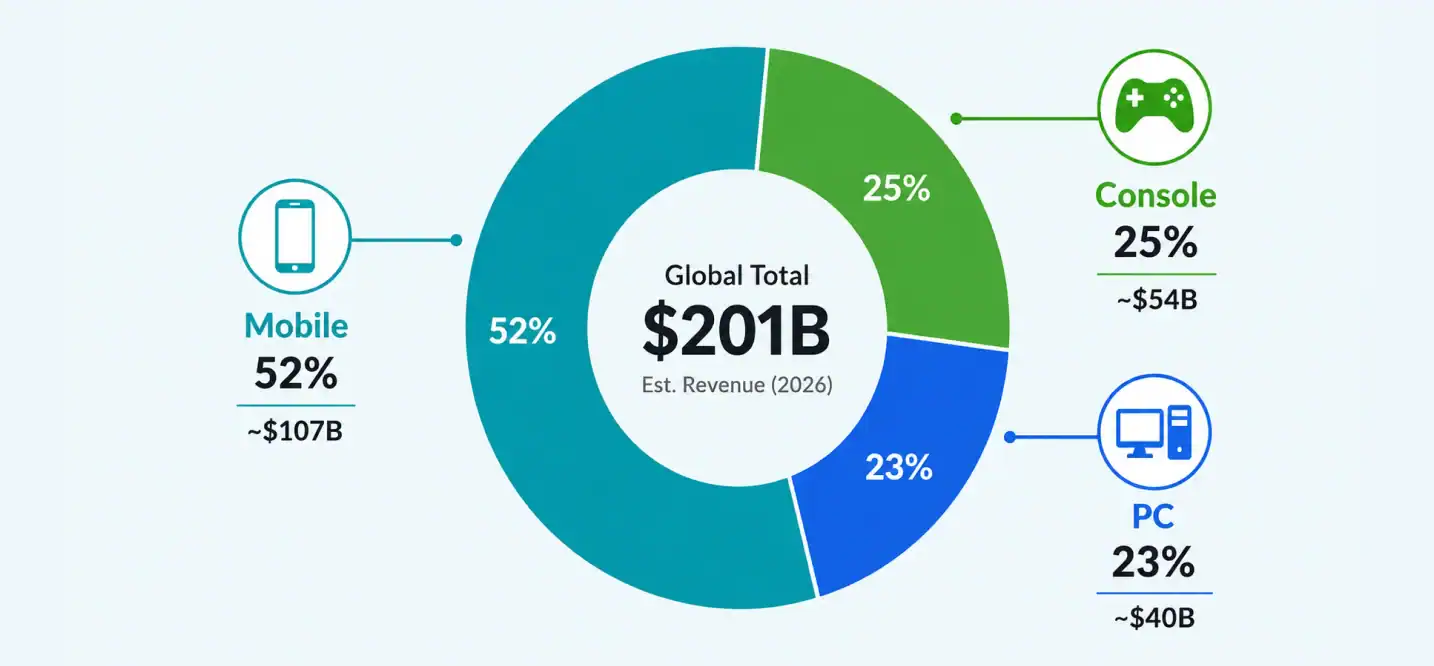
Before you start interviewing studios, it helps to know the market you’re stepping into. Here’s what’s actually happening in gaming right now.
The global games market is valued at roughly $205 billion in 2026, and mobile continues to dominate the revenue split, but the gap is closer than most founders assume.
| Platform | 2026 Market Share | Est. Revenue | Notable Trend |
| Mobile | 52% | ~$107B | Largest segment; free-to-play drives 85%+ of mobile revenue |
| Console | 25% | ~$54B | Fastest-growing platform (~5.5% YoY), fueled by Switch 2 and GTA VI momentum |
| PC | 23% | ~$40B | Steam holds ~74% of digital PC distribution |
Source: Newzoo Global Games Market Report, 2026; STG Research, 2026
A few numbers worth sitting with before you write your first RFP:
- 3.6 billion people play video games worldwide in 2026, about 44% of the planet.
- Asia-Pacific generates 46% of global game revenue, followed by North America (28%) and Europe (17%).
- Outsourced game development can cut total project costs by 40–60% compared to building an equivalent team in-house.
- A 20-person in-house studio costs $2.4M–$4.8M a year once salaries, benefits, and overhead are factored in, which is exactly why so many founders and even established publishers now build through a dedicated Game Development Outsourcing Company instead.
Those numbers explain why outsourcing has become the default model. They don’t tell you who to trust with it. That’s what the next section is for.
How Much Does It Cost to Hire a Game Developer?
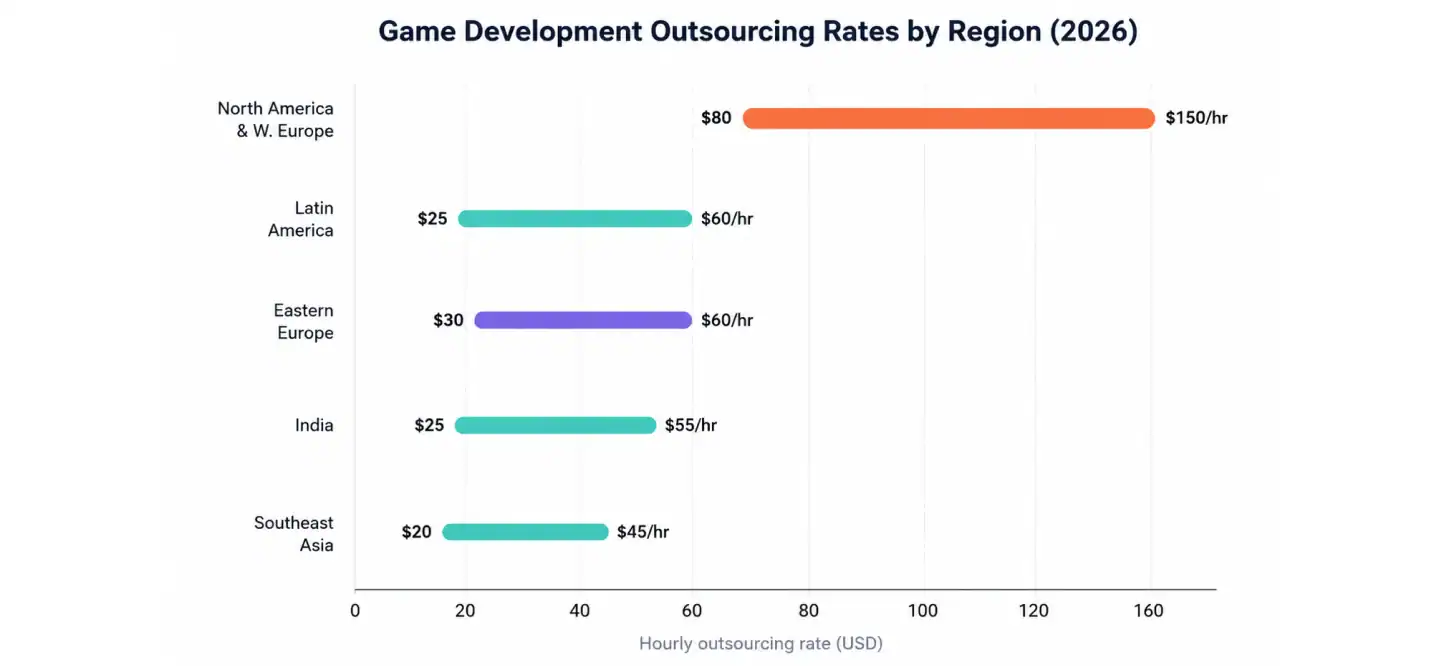
This is usually the first question on everyone’s mind, and it’s a fair one, but the honest answer is “it depends on where they’re based and what you’re building.” Here’s the regional breakdown so you’re not caught off guard mid-negotiation.
| Region | Hourly Rate (USD) | Best For |
| Southeast Asia | $20 – $45 | Budget-conscious projects, high-volume art production |
| India | $25 – $55 | Full-stack teams, QA, backend infrastructure |
| Eastern Europe | $30 – $60 | Strong technical + art balance, mid-size studios |
| Latin America | $25 – $60 | Timezone-friendly for US clients, growing talent pool |
| North America & Western Europe | $80 – $150+ | Premium creative direction, AAA-level polish |
And because “how much does it cost to hire a game developer” really means “what will my project cost”, here’s the same question, but by scope instead of by hour:
| Project Type | Typical Budget | Typical Team |
| Hyper-casual 2D mobile | $20K – $80K | 3–5 specialists |
| Mid-core 3D mobile | $80K – $250K | 6–12 specialists |
| PvP / live-service multiplayer | $300K – $2M | 15–30 specialists |
| AAA-style console / PC | $1M – $5M+ | 30+ specialists |
If a studio can’t explain where you’d land on this chart within your first call, that’s already an answer to one of your questions to ask for a game, just not the one you wanted.
The 10 Questions to Ask Before Hiring a Game Dev Studio
Here’s the core list. Ask all 10, or at minimum, don’t sign anything until you’ve gotten a straight answer to the first five.
1. What’s actually in their portfolio, and does it match your genre?
A flashy showreel means nothing if none of it resembles what you’re building. If you’re making a stylized 3D mobile RPG, a portfolio full of 2D hyper-casual puzzlers doesn’t prove capability in your genre, it proves capability in a different one. Ask for genre-specific case studies, not just the highlight reel.
2. Do they have dedicated game design and character talent, or is everyone a generalist?
Character work is often the difference between a forgettable game and one players remember. Ask specifically whether you’d be working with people who can Hire Character Designers status internally, or true specialists in 3D Character Design Services. Generalist studios can build a functional game. Specialist teams build a memorable one.
3. How much does it cost to hire a game developer for this specific project, and how is that number built?
Push past the hourly rate. Ask for a scope-based estimate broken into pre-production, production, and post-launch, so you can see exactly what’s driving the number.
4. What does the team structure actually look like?
Get names and roles, not job titles pulled from a website. How many programmers, artists, designers, and QA testers will touch your project, and how much of their time is genuinely dedicated versus shared across other clients?
5. Which engines and tech stack do they actually ship with?
Unity, Unreal, Godot, proprietary engines, the right answer depends on your platform and performance targets, not on what’s trendy. A studio that pushes one engine for every project regardless of fit is optimizing for their comfort, not your game.
6. What does their project management process look like?
This is where a lot of “hiring game developers” horror stories start. Ask about sprint cadence, reporting frequency, and who owns decisions when priorities conflict. A studio that can’t describe their process clearly in the interview won’t magically develop one once you’ve signed.
7. What do past clients actually say, on independent platforms, not just their own site?
Check Clutch, GoodFirms, and Trustpilot rather than testimonials curated for a landing page. Independent reviews are far harder to fake and tend to surface the details a sales call won’t.
8. How do they handle IP protection and NDAs?
Every asset, every line of code, every character design should be contractually yours. Confirm work-for-hire terms explicitly and have a lawyer review the NDA before any concept art gets shared.
9. What happens after launch?
Launch day is the beginning, not the finish line. Ask what post-launch support looks like, bug fixes, LiveOps, content updates, and whether that’s baked into the original contract or billed separately.
10. Can they actually scale for your platform of choice?
If you’re building mobile-first, confirm the studio has shipped mobile titles at scale, not just ported PC builds down to a smaller screen. Platform-specific expertise in performance, monetization, and store compliance is not interchangeable across mobile, console, and PC.
For full-service teams that check every box above, from Hire Game Designers to complete production, Cubix studio has spent 15+ years building across mobile, console, PC, and blockchain titles for brands ranging from Nintendo to DreamWorks.
Quick-Reference Checklist
Bookmark this table. It’s the fastest way to sanity-check a studio mid-call.
| # | Question | What a Strong Answer Sounds Like | Red Flag |
| 1 | Portfolio fit | Specific genre case studies, live metrics | Only generic reel, no genre match |
| 2 | Design & character talent | Named specialists, dedicated art leads | “Everyone does a bit of everything” |
| 3 | Cost breakdown | Scoped estimate by phase | Vague hourly quote, no breakdown |
| 4 | Team structure | Named roles, allocation % | Won’t disclose team composition |
| 5 | Tech stack | Engine choice justified by your platform | One-size-fits-all engine pitch |
| 6 | PM process | Clear sprint cadence, reporting cycle | “We’ll figure it out as we go” |
| 7 | Client reviews | Verifiable third-party reviews | Only on-site testimonials |
| 8 | IP & NDA | Explicit work-for-hire clause | Reluctance to put IP terms in writing |
| 9 | Post-launch support | Defined SLA and update cadence | No mention of what happens after ship |
| 10 | Platform expertise | Shipped titles on your target platform | Ported experience, not native |
Bonus: Questions a Studio Might Ask You Back
A good Video Game Development Services partner isn’t just answering your questions, they’re running their own version of a game interview to see if the fit is real on both sides. Expect to be asked:
- What’s your target platform and launch window?
- What’s your budget range, realistically?
- Do you have existing concept art, a GDD, or is this a greenfield?
- Who signs off on creative decisions on your side?
- What does success look like six months post-launch?
If a studio doesn’t ask you anything back, treat that as its own red flag. Studios that don’t probe your project usually haven’t fully understood it, and that gap tends to show up in the final product.
How Long Does It Actually Take?
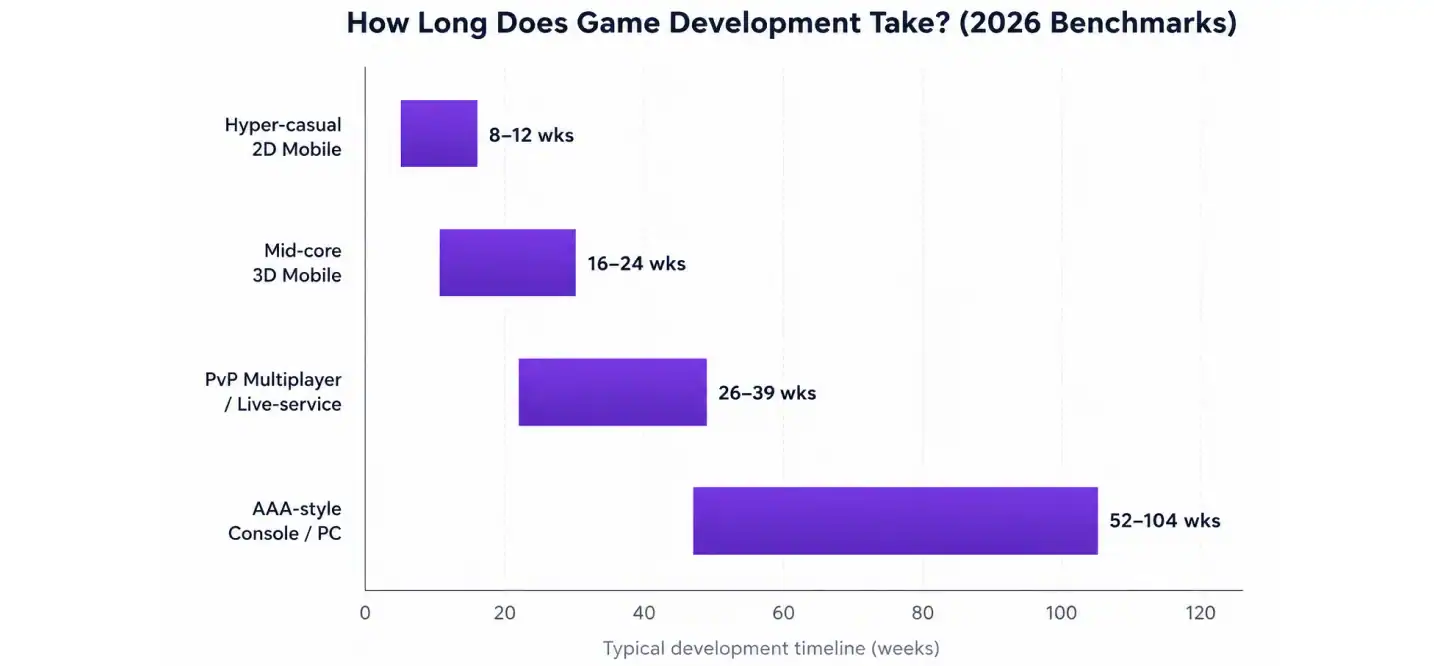
Timeline expectations derail more projects than the budget does. Here’s a realistic benchmark by project type, so you can sanity-check any quote you’re given.
| Project Type | Typical Timeline |
| Hyper-casual 2D mobile | 8 – 12 weeks |
| Mid-core 3D mobile | 16 – 24 weeks |
| PvP / live-service multiplayer | 26 – 39 weeks |
| AAA-style console / PC | 52 – 104+ weeks |
Any studio quoting significantly faster than these ranges for a comparable scope is either underestimating the work, or planning to cut corners you’ll pay for later.
Why Founders Choose Cubix
Cubix has delivered 150+ games across 15+ years, working with brands like DreamWorks, Nintendo, Sony, and Walmart. Our teams cover the full pipeline, from Hire Game Designers and Hire Character Designers to full Video Game Development Services across 2D, 3D, mobile, console, multiplayer, and blockchain titles.
If you’re comparing studios right now, run this exact list of questions against us. We’d rather earn the project by answering them clearly than win it on a polished pitch deck.
Looking for a partner who welcomes every question on this list? Cubix has been building custom games for global brands since day one, and we’re happy to be interviewed.
Want to discuss your project? Our experts are just a click away.
Contact UsFrequently Asked Questions
1. What are the top 10 questions to ask an interviewer?
Whether you’re interviewing a studio or being interviewed for a game dev role, the strongest questions probe process over polish: portfolio fit, team structure, cost transparency, tech stack rationale, project management style, client references, IP handling, post-launch support, platform expertise, and timeline realism, the same 10 covered in this guide.
2. What are the top 10 questions to ask before hiring a game development studio?
See the full breakdown above, portfolio relevance, design/character specialization, true project cost, team composition, engine choice, PM process, independent reviews, IP protection, post-launch support, and platform-specific experience.
3. Which game development studios specialize in mobile games, and what questions should I ask them?
Look for studios with shipped, native mobile titles (not ported builds) and ask specifically about monetization design, store compliance, and device performance optimization, mobile has different constraints than console or PC and requires dedicated expertise.
4. How do I evaluate the portfolio of a game dev studio before hiring?
Match genre and platform first, then check for post-launch metrics (retention, ratings, downloads) rather than just visual polish. A beautiful trailer doesn’t confirm a studio can hit performance targets or ship on schedule.
5. What are the key technical questions to ask a game development company?
Ask which engine they’ll use and why, how they handle cross-platform optimization, their approach to version control and code review, and how they test for performance across target devices.
6. Can you provide a checklist of questions to assess a game dev studio’s project management skills?
Yes, ask about sprint cadence, reporting frequency, escalation paths for blockers, how scope changes are priced, and who your single point of contact will be. The Quick-Reference Checklist table above covers all of this in one view.
7. What is the 80/20 rule in game development?
It’s the idea that roughly 80% of a game’s player-facing polish comes from 20% of the total development effort, usually the final tuning, feel, and juice, which is why studios budget dedicated time for post-alpha refinement rather than treating it as a rounding error.
8. What are 10 common interview questions?
For a game dev role specifically: your favorite project and why, how you handle crunch, your process for debugging or design iteration, tools you’re proficient in, how you take feedback, and what game you’d want to work on next, alongside standard background and motivation questions.
9. Is it hard to get hired as a game developer?
It’s competitive, the applicant-to-opening ratio in games is higher than in general software, but specialists with a focused portfolio (not generalists) and demonstrable shipped work consistently stand out fastest.
10. What is the 30-60-90 question in an interview?
It asks candidates (or new hires) to lay out what they’ll accomplish in their first 30, 60, and 90 days on the job, a useful framework to request from a dev studio too, since it forces a concrete early-milestone plan instead of a vague roadmap.