The way people search for property has changed. Buyers don’t call the agents first anymore. They open the app, browse listings, filter by school district, compare neighbourhoods, and simply shortlist properties based on prime locations, amenities, and investment before speaking to anyone. That shift is one of the biggest reasons real estate app development has become a priority for agencies, brokerages, property managers, and Proptech startups in 2026.
The global Proptech market is on track to hit USD 4154.46 million in 2026 and climb towards USD 5358.28 million by 2035, growing at a projected 2.9% during 2026-2035. This growth reflects the industry’s continuous investment in digital property experiences. As more buyers and renters rely on mobile-first platforms, businesses are investing in smarter search, AI-powered property recommendations, virtual tours, and seamless user experiences to stay competitive.
This guide explains what it costs to build a real estate app in 2026, the features that users expect, the technologies agencies use, and the development process behind successful products. Whether you’re a founder, broker, property manager, or investor planning your next digital product, you’ll gain practical insights to make informed development decisions.
Want to discuss your project? Our experts are just a click away.
Contact Us
What Is Real Estate App Development?
Real estate app development is the process of building a mobile or web platform that lets people search, list, manage, or invest in property. That covers a wide range of products: a simple property search app for a local brokerage, a full listings marketplace pulling in MLS data, or a property management system built for landlords running hundreds of units.
Agencies rarely build these from a generic template. Custom real estate software gets shaped around a specific business model, commission-based marketplaces, subscription tools for agents, SaaS platforms for property managers, or lead-generation apps that sell buyer intent to brokerages. The starting point always comes down to who uses the app and what decision it helps them make faster: buy, rent, list, or manage.
Some companies build in-house. Most hire an experienced mobile app development company that already understands MLS compliance, geolocation search, and the data volume real estate platforms handle. That experience shortens the timeline and avoids rebuilding features that already have proven patterns.
Why Businesses Are Investing in Real Estate Apps in 2026
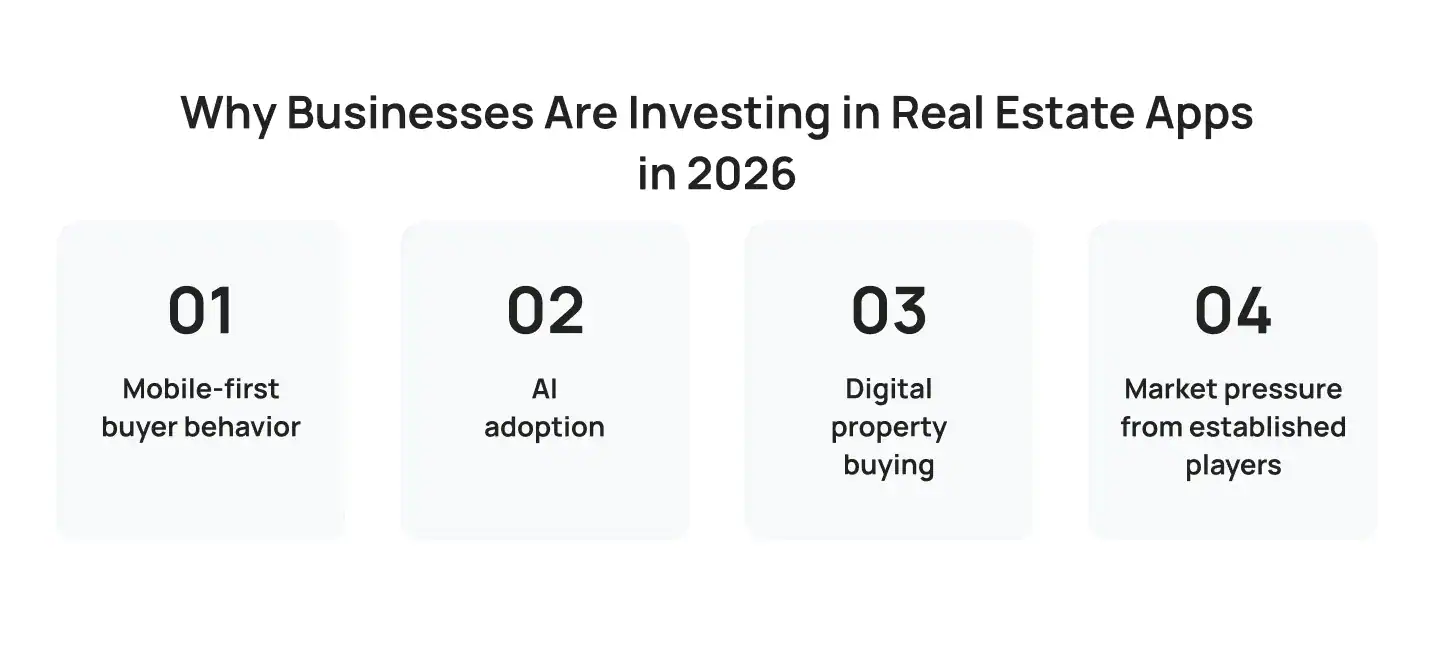
A few forces are pushing this spending, and none of them are slowing down.
Mobile-first buyer behavior: Most home searches now start on a phone, not a desktop. Buyers browse listings during a commute, save favorites, and message agents before ever visiting a website.
AI adoption: Property recommendation engines, automated valuations, and predictive investment scoring have moved from novelty to expectation. Buyers want an app that learns what they like instead of making them scroll through hundreds of irrelevant listings.
Digital property buying: Virtual tours, digital document signing, and remote closing tools cut the friction out of transactions that used to require multiple in-person visits. That matters even more for out-of-state investors and relocation buyers.
Market pressure from established players: Zillow, Redfin, and Realtor.com set user expectations high. A brokerage running a bare-bones app now looks outdated next to platforms offering instant search, interactive filtering, and real-time alerts.
Put together, these trends mean a slow, clunky property search app costs a business more in lost leads than a proper build would have cost upfront.
Types of Real Estate Apps

Not every real estate app solves the same problem. Here’s how the main categories break down.
Property Marketplace Apps
These connect buyers and sellers directly, functioning as a digital real estate marketplace. Zillow and Realtor.com fall into this category. They center on search, filtering, and listing detail pages, and they typically pull in MLS data to stay current.
Rental Apps
Built for tenants and landlords, rental apps handle listings, applications, background checks, and often rent payments. Speed matters here — a rental application app that takes five minutes to browse loses users to one that takes thirty seconds.
Commercial Real Estate Apps
Commercial real estate deals move differently than residential ones. These apps focus on square footage, zoning, lease terms, and investment metrics like cap rate and net operating income, aimed at brokers and institutional buyers rather than individual home shoppers.
Property Management Apps
Landlords and property managers use these to track maintenance requests, collect rent, screen tenants, and manage multiple properties from one dashboard. This category overlaps heavily with property management software built for operational efficiency rather than public listings.
Brokerage Apps
Built for internal use by real estate agents and brokers, these apps manage leads, client communication, transaction pipelines, and commission tracking. They function less like a consumer product and more like a client management system with a mobile front end.
Investment Apps
Aimed at property investors, these apps surface deal analysis tools, ROI calculators, and portfolio tracking. Some platforms in this space now build in AI-driven market forecasting to flag undervalued properties before they hit general search.
Essential Features Every Real Estate App Needs
The success of a real estate app depends on more than an attractive interface. It needs features that simplify property searches, improve communication, and help businesses manage listings efficiently. While every platform serves different users, the following features have become essential for delivering a seamless experience.
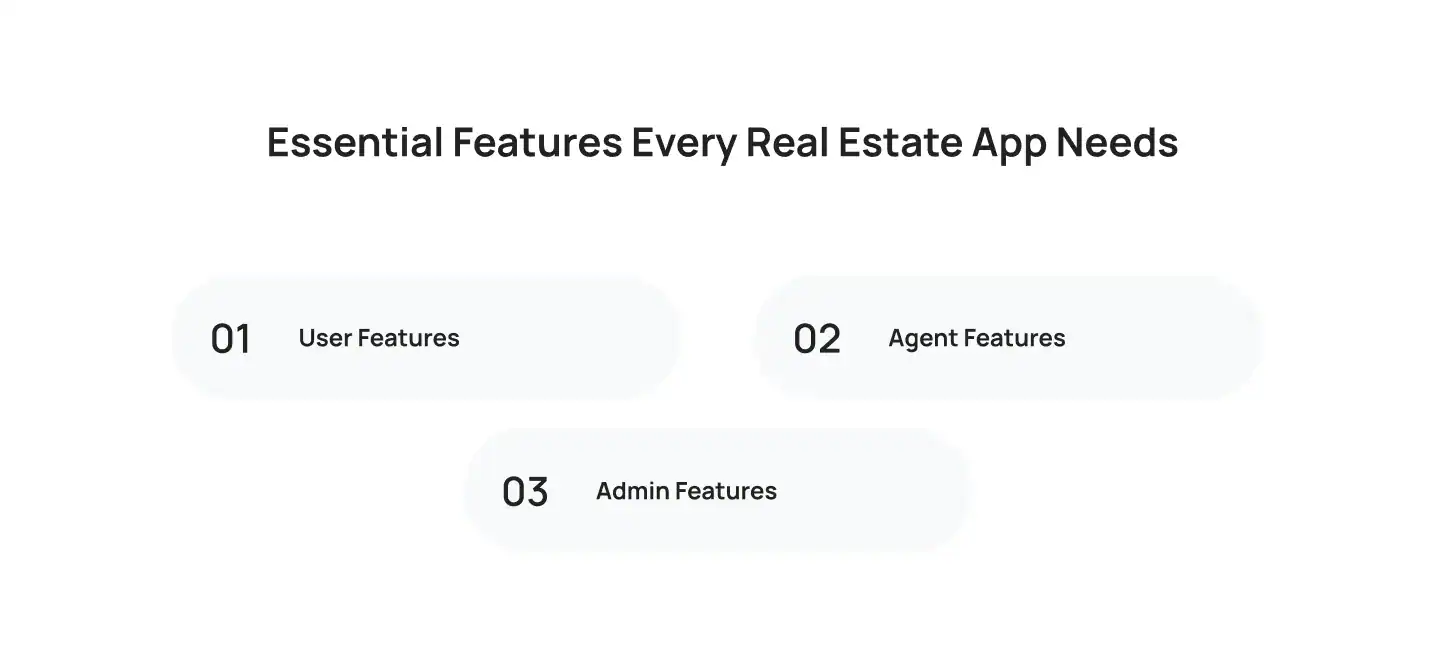
User Features
A great user experience starts with helping buyers and renters find the right property quickly. A Property Listing Platform should offer advanced search filters for price, location, property type, bedrooms, amenities, and commute time so users can narrow their options without scrolling through hundreds of listings. Interactive Maps allow users to explore neighborhoods, compare nearby schools, and search within custom areas, making property discovery more intuitive.
Adding Virtual Property Tours gives potential buyers the confidence to explore homes remotely before scheduling an in-person visit, saving time for both buyers and agents. A built-in Mortgage Calculator helps users estimate monthly payments and affordability, allowing them to make informed financial decisions early in the buying journey. Features like saved searches, favorite properties, personalized alerts for new listings, and secure in-app messaging further improve engagement and encourage users to return to the platform.
Agent Features
Real estate professionals need tools that help them manage leads and respond quickly to potential buyers. An integrated Real Estate CRM enables agents to track inquiries, organize client information, monitor conversations, and follow up with prospects at the right time. Listing management tools make it easy to create, update, and publish property information without relying on separate systems.
Modern platforms also use AI Property Recommendations to match available listings with buyer preferences and browsing behavior. This helps agents connect qualified buyers with relevant properties more efficiently, improving lead conversion while reducing manual effort.
Admin Features
Behind every successful real estate app is a powerful administration panel that keeps the platform organized and secure. Administrators should be able to manage users, approve listings, monitor platform activity, and access detailed analytics to understand search trends and user behavior. Content moderation tools help identify duplicate, inaccurate, or fraudulent listings before they reach potential buyers.
The admin dashboard should also support subscription management, premium listing payments, commission tracking, role-based access controls, and performance reporting. While these features remain invisible to end users, they are essential for maintaining platform quality, supporting business growth, and ensuring the application remains scalable as the number of users and property listings continues to increase.
Technologies Agencies Use to Build Real Estate Apps
Choosing the right technology stack is about more than following industry trends. Every technology should support your business goals, whether that’s handling thousands of property listings, delivering fast search results, or providing a seamless user experience across devices. Here’s the technology stack agencies commonly use to build modern real estate apps.
Frontend Development
The frontend is what users interact with every day, so it needs to be fast, responsive, and easy to navigate. Many agencies choose React Native or Flutter for cross-platform development because a single codebase supports both iOS and Android, reducing development time and costs.
Why agencies choose it:
- Faster development for Android and iOS.
- Consistent user experience across devices.
- Lower maintenance costs with a shared codebase.
- Faster feature updates after launch.
Backend Development
The backend manages user accounts, property listings, transactions, and application logic. Technologies like Node.js, Python, and Java help process large amounts of data while maintaining reliable performance.
Key responsibilities include:
- Managing property listings and user data.
- Processing search requests quickly.
- Supporting secure logins and transactions.
- Handling high traffic without performance issues.
Cloud Infrastructure
Cloud platforms such as AWS, Google Cloud, and Microsoft Azure provide the resources needed to store large amounts of property data, images, videos, and documents while supporting future growth.
Business benefits include:
- Automatic scaling during peak traffic.
- Reliable data backup and recovery.
- High application availability.
- Better performance for media-rich applications.
APIs and Third-Party Integrations
Most real estate apps depend on external services to deliver core functionality. MLS (Multiple Listing Service) integrations provide property listings, while payment gateways, e-signature platforms, and identity verification services simplify the buying and renting process.
Common integrations include:
- MLS property data.
- Payment gateways.
- E-signature solutions.
- Identity verification services.
- Push notification platforms.
Location and Mapping Services
Location plays a central role in property discovery. The Google Maps API helps users explore neighborhoods, estimate commute times, and identify nearby schools, hospitals, and other essential amenities.
Location features often include:
- Interactive property maps.
- Neighborhood search.
- Nearby points of interest.
- Route and commute estimation.
- Location-based filtering.
Artificial Intelligence
Artificial intelligence helps personalize the property search experience while improving business efficiency. Machine learning models analyze user behavior to deliver smarter recommendations and automate repetitive tasks.
AI is commonly used for:
- Personalized property recommendations.
- Automated property valuation.
- AI-powered chatbots.
- Lead qualification.
- Predictive market insights.
Security and Compliance
Real estate apps process sensitive customer information, making security a critical part of development. Strong protection measures help safeguard personal and financial data while maintaining user trust.
Security measures include:
- End-to-end encryption.
- Multi-factor authentication.
- Role-based access controls.
- Secure payment processing.
- Compliance with data privacy regulations.
Analytics and Performance Monitoring
Analytics tools help businesses understand how users interact with the app after launch. These insights support continuous improvements and smarter business decisions.
Analytics help measure:
- Popular property listings.
- User engagement.
- Search behavior.
- Lead conversion rates.
- Feature performance.
The right technology stack doesn’t simply power a real estate app. It helps businesses deliver better user experiences, support future growth, improve operational efficiency, and stay competitive in an increasingly digital property market. For a broader understanding of how these technologies fit into the development lifecycle, explore our guide on mobile app development.
Real Estate App Development Cost in 2026

Pricing depends heavily on feature depth, MLS integration scope, and platform choice. Here’s how the three common tiers break down this year.
| Tier | Cost Range | What’s Included |
| MVP | $30,000 – $70,000 | Core listing search, basic filters, user accounts, agent contact, single platform |
| Mid-Level | $70,000 – $150,000 | Map-based search, MLS integration, push notifications, loan affordability tools, CRM connection, cross-platform build |
| Enterprise | $150,000 – $400,000+ | AI-driven personalization, virtual tours, advanced analytics, multi-role admin tools, full MLS/IDX compliance |
A basic listing MVP typically starts around $35,000 to $65,000. In comparison, a full marketplace with MLS/IDX integration and AI recommendations can run $150,000 to $300,000 or more, with ongoing maintenance running roughly 15 to 20% of the build cost each year. Costs climb from there for apps with heavier MLS licensing needs or multi-sided marketplace architecture.
A few factors move these numbers up or down:
- Feature scope: Every added feature, such as live chat, AI scoring, and document e-signing, adds development hours.
- Platform choice: Building for iOS and Android separately with native code costs more than a cross-platform build.
- UI/UX complexity: Custom animations, map-based search screens, and detailed onboarding flows take longer to design and build than a standard template.
- API and data costs: MLS data licensing alone can run into five figures annually depending on coverage area.
- AI integration: Property recommendation engines and automated valuation models require both development time and ongoing model training.
- Team size and location: A US-based team costs more per hour than an offshore team, though communication and quality control often favor the former for complex builds.
- Timeline: Rushed timelines mean more developers working in parallel, which raises cost even if total scope stays the same.
- Post-launch maintenance: Budget for ongoing updates, bug fixes, and API maintenance; this typically runs 15-20% of the original build cost per year.
For a broader comparison across app categories, this breakdown of mobile app development cost is a useful reference point.
Development Process Agencies Actually Follow
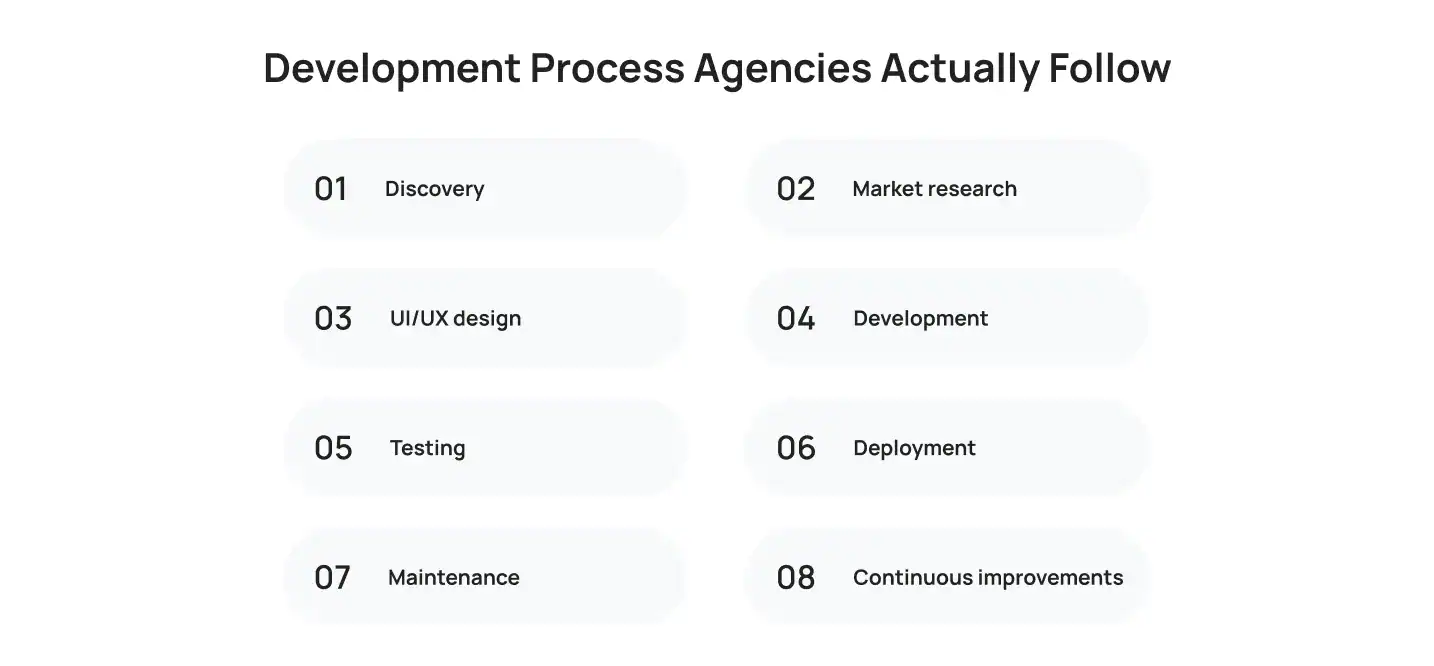
A serious build follows a sequence, not a straight line from idea to app store.
- Discovery: The team maps business goals, target users, and must-have features before writing a line of code.
- Market research: Competitor apps get audited for feature gaps and pricing models, so the new product isn’t just copying what already exists.
- UI/UX design: Wireframes and prototypes get tested with real users before development starts, catching usability problems early when they’re cheap to fix.
- Development: Frontend and backend teams build in sprints, usually two-week cycles, with working builds reviewed regularly.
- Testing: QA teams check functionality, performance under load, and security, across devices and operating systems.
- Deployment: The app goes live on the App Store and Google Play, alongside any backend infrastructure launch.
- Maintenance: Bug fixes, OS updates, and API changes get handled on an ongoing basis after launch.
- Continuous improvements: User feedback and analytics data drive new features and refinements in future releases.
Founders who want a deeper look at how to approach this process should read these tips for building a custom mobile app before locking in a scope document.
Common Challenges and How Agencies Solve Them
Below are the common challenges and how smart agencies solve them. Let’s dive in with us:
Data accuracy. MLS feeds update constantly, and stale listings frustrate users fast. Agencies solve this with automated sync jobs that pull fresh data on a set schedule, plus validation checks that flag duplicate or expired listings.
Scalability. Traffic spikes around new listings, seasonal buying periods, and marketing pushes. Cloud infrastructure with auto-scaling handles these spikes without the app slowing down during high-demand windows.
Security. Financial and identity data flowing through the app makes it a target. Encryption, two-factor authentication, and regular security audits keep that data protected.
Third-party integrations. MLS feeds, payment processors, and mapping APIs don’t always play well together. Agencies handle this with middleware layers that standardize data before it hits the app’s core logic.
User retention. Real estate apps see natural drop-off once a user finds a home or signs a lease. Push notifications, saved search alerts, and content around neighborhoods and market trends keep users engaged between transactions.
Performance optimization. Large photo libraries and video tours slow apps down if not handled carefully. Image compression, lazy loading, and content delivery networks keep load times fast even with media-heavy listings.
Revenue Models for Real Estate Apps
Most real estate apps combine two or three of these models rather than relying on one.
- Subscription: Agents or property managers pay a monthly fee for CRM access, lead tools, or premium listing slots.
- Featured listings: Sellers or agents pay extra to push a listing to the top of search results.
- Advertising: Mortgage lenders, movers, and home service companies pay for placement within the app.
- Commission: Some platforms take a cut of the transaction when a deal closes through the app.
- Premium accounts: Buyers pay for advanced filters, off-market listing access, or early alerts on new inventory.
- Lead generation: The app captures buyer or renter intent and sells qualified leads to agents and brokerages.
Choosing the right mix depends on the target user. Consumer-facing apps lean on advertising and lead generation, while B2B tools for agents and property managers lean on subscriptions.
How to Choose the Right Real Estate App Development Company
Building a real estate app isn’t just about hiring developers. It’s about partnering with a team that understands how the real estate industry works, from MLS integrations and compliance requirements to creating experiences that buyers, sellers, agents, and property managers actually want to use. Choosing the right development company early can save you months of rework, unexpected costs, and missed business opportunities.
When evaluating a development partner, keep these factors in mind:
- Review their portfolio. Look for experience building real estate, property marketplace, or PropTech applications rather than only general mobile apps. Industry-specific experience often leads to better product decisions.
- Assess their industry knowledge. A team familiar with MLS data structures, IDX integrations, fair housing regulations, and real estate workflows can identify challenges before they become expensive problems.
- Understand their discovery process. A reliable company will spend time understanding your business goals, target audience, and feature requirements before providing timelines or cost estimates. A well-defined discovery phase usually results in a smoother development process.
- Evaluate their technology expertise. Ask why they recommend a particular technology stack and how it supports your long-term business goals. The right solution should be tailored to your project instead of relying on a one-size-fits-all approach.
- Prioritize clear communication. Regular progress updates, transparent project management, and a dedicated point of contact help ensure your project stays on schedule and aligned with your expectations.
- Look beyond the launch. Mobile apps require continuous updates, maintenance, and compatibility with new operating system releases. Choose a company that offers reliable post-launch support to keep your application performing at its best.
- Verify their security standards. Since real estate applications handle sensitive customer information and financial transactions, your development partner should follow secure coding practices, implement strong authentication methods, and comply with relevant data privacy standards.
Why Businesses Choose Cubix
At Cubix, we understand that every real estate business has unique goals. With 18+ years of experience, 1,300+ digital products delivered, and 600+ global clients, our team develops custom real estate applications designed around your business model, target audience, and growth strategy. From property marketplaces and rental platforms to enterprise property management solutions, we combine thoughtful product strategy, intuitive user experiences, and scalable technologies to help businesses launch applications that deliver long-term value.
If you’re comparing platform costs before selecting a development partner, you can also explore our guides on the cost to build an Android app and the cost to build an iOS app to better understand the investment required for each platform.
Conclusion
Real estate app development in 2026 isn’t about cramming in every feature a competitor has. The apps winning market share pair fast search and clean design with the data infrastructure to back it up accurate MLS feeds, dependable maps, and AI tools that actually improve the search instead of adding noise.
Costs will vary based on your feature list and platform choice, and that’s fine. What matters more is building with a team that understands the compliance and data challenges specific to real estate, instead of treating your app like any other e-commerce build. Businesses that invest with that mindset end up with a product people actually use, and that’s a better measure of success than hitting the lowest possible price on the invoice.
Want to discuss your project? Our experts are just a click away.
Contact Us
Frequently Asked Questions
1: How much does real estate app development cost in 2026?
The cost of real estate app development typically ranges from $30,000 to $400,000+, depending on the app’s complexity, platform, features, third-party integrations, and development approach. A basic MVP costs significantly less than an enterprise-grade platform with AI features, MLS integration, and advanced analytics.
2: What features should a successful real estate app include?
A successful real estate app should include property search with advanced filters, interactive maps, virtual property tours, saved listings, in-app messaging, push notifications, mortgage calculators, secure payments, and AI-powered recommendations. For businesses, admin dashboards, analytics, and CRM integration are equally important for managing users and property listings efficiently.
3: What is a real estate development app?
A real estate development app is a mobile or web application designed to simplify buying, selling, renting, or managing properties. Depending on the business model, it can include property listings, tenant management, investment tracking, virtual tours, document management, payment processing, and communication tools for buyers, sellers, agents, and property managers.
4: How do I choose the best real estate app development company in the USA?
The best real estate app development company in the USA should have proven experience in developing PropTech solutions, integrating MLS data, building scalable applications, and providing post-launch support. Before making a decision, review the company’s portfolio, industry expertise, development process, technology stack, security practices, and client testimonials to ensure they align with your business goals.
5: How long does it take to build a real estate app?
Most real estate apps take 3 to 9 months to develop, depending on the project’s complexity. An MVP with core features can often be completed within three to five months, while enterprise platforms with AI, advanced integrations, and custom workflows generally require a longer development timeline.
6: Should I hire one of the top 10 mobile app development companies in the USA?
Choosing one of the top 10 mobile app development companies in the USA can be a smart investment if your project requires industry expertise, scalable architecture, and long-term support. Rather than focusing only on rankings, evaluate each company’s portfolio, technical capabilities, communication process, pricing, and experience with real estate applications to find the right partner.
7: Is cross-platform or native development better for a real estate app?
For most businesses, cross-platform development offers a faster and more cost-effective way to launch a real estate app on both Android and iOS. However, if your application depends on advanced device-specific features or intensive graphics, native development may provide better performance. The right choice depends on your budget, target audience, and long-term business objectives.