AI adoption can start with something as simple as an employee using a generative AI tool to summarize documents. The enterprise challenge begins when that experiment spreads across departments, connects to business data, triggers automated workflows, and starts influencing operational decisions.
That shift requires more than adding AI specialists to an existing technology team.
Microsoft’s Work Trend Index found that 81% of business leaders expect agents to become moderately or extensively integrated into their company’s AI strategy within 12 to 18 months. That level of adoption raises practical questions around ownership, data access, security, model evaluation, infrastructure, and employee training.
An AI Center of Excellence (AI CoE) provides a structure for answering those questions. It brings strategy, technical expertise, governance, and business stakeholders into one operating model so AI initiatives can move from isolated experiments toward repeatable production practices.
Key Takeaways
- An AI Center of Excellence (AI CoE) provides a centralized framework for managing AI strategy, development, governance, and adoption across an organization.
- A successful AI CoE needs a clear strategy, defined roles, operating model, and measurable objectives before projects begin.
- The right structure typically brings together AI engineers, data scientists, software developers, product teams, security, legal, and business stakeholders.
- AI governance should cover data privacy, security, model risk, responsible AI, compliance, access controls, and ongoing monitoring.
- Organizations should prioritize AI initiatives based on business value, technical feasibility, data readiness, risk, and available resources.
- A strong AI CoE establishes repeatable processes for AI development, testing, deployment, monitoring, and lifecycle management.
- AI CoEs work best when they support business teams rather than operating as isolated technical departments, helping teams adopt AI consistently and responsibly.
- Success should be measured through adoption, operational impact, cost efficiency, model performance, risk reduction, and business outcomes.
- AI CoEs should evolve as an organization’s AI capabilities, technology stack, governance requirements, and business priorities change.
What Is an AI Center of Excellence?
An AI Center of Excellence is a cross-functional organizational capability that establishes the standards, expertise, processes, and governance required to develop and scale artificial intelligence across an enterprise.
It does not necessarily mean creating a large new department. In some organizations, the CoE may be a dedicated team. In others, it may operate as a hub connecting existing data science, engineering, security, product, legal, and business teams.
The exact structure depends on the organization’s size, AI maturity, regulatory environment, and number of active use cases.
An AI CoE typically provides:
- AI strategy and technology roadmaps
- Use-case discovery and prioritization
- Data and AI architecture standards
- Model development and evaluation practices
- MLOps and deployment standards
- AI security and access controls
- Responsible AI and governance policies
- Vendor and model assessment
- AI literacy and workforce enablement
- Performance and ROI measurement
- Reusable platforms, components, and technical patterns
Organizations building a broader AI capability can use the CoE as the governance and operating layer that connects these technical capabilities with business requirements.
AI Center of Excellence vs. AI Team vs. AI Innovation Lab
These terms are often used interchangeably, but they serve different purposes.
| Capability | Primary purpose | Typical responsibility |
| AI Center of Excellence | Enterprise coordination and scale | Strategy, standards, governance, architecture, enablement |
| AI/ML Engineering Team | Build and operate AI systems | Models, applications, integrations, deployment |
| AI Innovation Lab | Explore emerging opportunities | Experiments, prototypes, emerging technologies |
| AI Steering Committee | Executive oversight | Funding, risk appetite, priorities, strategic decisions |
An AI innovation lab may discover a promising use case, for example, while the AI CoE determines whether that use case fits the organization’s architecture, governance requirements, operating model, and production roadmap.
That distinction becomes increasingly important as the number of AI initiatives grows.
Why Do Enterprises Need an AI Center of Excellence?
1. AI Projects Are Becoming Harder to Govern
An AI experiment running on a public model is very different from an AI system connected to customer records, financial information, employee data, or operational systems.
Once AI interacts with sensitive information or makes recommendations that affect people, organizations need clearer controls around:
- Data access
- Privacy
- Model evaluation
- Security
- Human oversight
- Documentation
- Bias and fairness
- Intellectual property
- Vendor risk
- Incident response
A centralized AI CoE can establish common requirements without forcing every business unit to invent its own rules.
2. AI Pilots Need a Path to Production
Many organizations can build an AI proof of concept. The harder problem is turning that proof of concept into a dependable production system.
A production AI application may require:
- Data pipelines
- Model or foundation-model selection
- Evaluation datasets
- API and system integrations
- Authentication and authorization
- Monitoring
- Version control
- Cost controls
- Human review
- Incident management
The CoE creates repeatable patterns for these activities instead of allowing every project team to start from scratch.
3. AI Investment Needs Portfolio-Level Visibility
Without central oversight, business units can end up purchasing overlapping AI tools, developing similar applications, or building separate data pipelines for comparable use cases.
A CoE gives leadership a portfolio view.
It can answer questions such as:
- Which AI initiatives are currently in development?
- Which projects have reached production?
- Which models or vendors are being used?
- What data does each application access?
- What risks have been identified?
- Which initiatives have measurable business impact?
- Where are teams duplicating technology or spending?
That visibility becomes particularly useful when an enterprise moves from isolated AI experiments to organization-wide adoption.
How to Build an AI Center of Excellence?

Building a Center of Excellence is not simply a matter of hiring an AI team and giving it a new name. The operating model needs a defined purpose, decision rights, technical foundation, governance structure, and measurable outcomes.
1. Define the AI CoE Charter and Scope
Start with the question: What is the CoE actually responsible for?
A useful charter should define:
- Business objectives
- AI domains covered
- Services provided to business units
- Decision-making authority
- Governance responsibilities
- Technical standards
- Funding model
- Escalation paths
- Success measures
The charter should also clarify what the CoE does not own.
For example, the central team may establish model evaluation standards while individual product teams remain responsible for building and operating applications.
This prevents the CoE from becoming an approval department that slows every AI project.
For enterprises still defining their technology roadmap, software consulting services can also involve architecture assessment, cloud and DevOps planning, data strategy, security, and AI opportunity identification.
2. Assess AI and Data Readiness
Before choosing models or buying AI platforms, assess the environment those systems will operate in.
A readiness assessment should examine:
a. Data readiness
Check whether data is:
- Accessible
- Accurate
- Complete
- Consistent
- Properly classified
- Governed
- Available at the required frequency
- Legally usable for the intended purpose
b. Technology readiness
Review:
- Cloud infrastructure
- Databases
- APIs
- Identity systems
- Integration layers
- Compute capacity
- Existing ML platforms
- Monitoring tools
- Security controls
c. Organizational readiness
Look at:
- AI skills
- Executive sponsorship
- Product ownership
- Data literacy
- Change management
- Governance maturity
- Existing AI projects
An AI CoE should document these gaps before committing to a large implementation roadmap.
Organizations can also use an enterprise AI readiness assessment to identify infrastructure, data, governance, workforce, and implementation gaps before moving into broader deployment.
d. Don’t overlook the data layer
AI performance is closely tied to the quality and accessibility of the underlying data.
For organizations dealing with fragmented data sources, large datasets, analytics workloads, or legacy data infrastructure, big data development services can cover areas such as data management, analytics, custom data applications, platform integration, and cloud migration.
The AI CoE should therefore work closely with data engineering rather than treating data as a separate downstream concern.
3. Choose the AI CoE Operating Model
There are three common approaches to AI Center of Excellence organizational structure: centralized, federated, and hybrid.
a. Centralized AI CoE
A central team owns most AI expertise, platforms, standards, and delivery.
Advantages:
- Consistent standards
- Centralized expertise
- Easier governance
- Less technology duplication
Challenges:
- Can become a bottleneck
- May be distant from business-unit requirements
- Can struggle to support many concurrent initiatives
b. Federated AI CoE
Business units maintain their own AI capabilities while following enterprise-wide standards.
Advantages:
- Strong domain ownership
- Faster local decision-making
- Closer connection to business workflows
Challenges:
- Greater risk of duplicated technology
- Inconsistent practices
- More difficult portfolio governance
c. Hybrid AI CoE
A central team owns shared standards, platforms, governance, and specialist capabilities while business units retain delivery ownership.
This model is often described as a hub-and-spoke arrangement.
Microsoft’s guidance on CoE operating models similarly distinguishes centralized, hybrid, and federated structures and notes that organizations can combine approaches based on adoption patterns and organizational maturity.
The important point is not choosing a model because it is popular. The structure should match the organization’s size, risk profile, AI maturity, and need for business-unit autonomy.
4. Establish the AI Technical Architecture
The CoE should define a reference architecture that teams can reuse.
A typical enterprise AI architecture may include:
| Layer | Key components |
| Data | Data lakes, warehouses, databases, APIs, streaming systems |
| Processing | ETL/ELT, feature engineering, data pipelines |
| AI/ML | Foundation models, ML models, embedding models, inference services |
| Application | APIs, web applications, mobile applications, enterprise software |
| Orchestration | Workflow engines, agent frameworks, API gateways |
| MLOps | Model registry, CI/CD, evaluation, deployment, monitoring |
| Security | IAM, encryption, secrets management, network controls |
| Governance | Audit logs, model documentation, policy enforcement, risk controls |
| Observability | Performance, latency, usage, cost, quality, and incident monitoring |
For AI workloads that require flexible compute, containerized services, GPU resources, and modern cloud infrastructure, cloud-native architecture can become an important part of the technical roadmap. Cubix’s discussion of cloud-native AI architectures covers infrastructure patterns involving AI workloads, cloud platforms, Kubernetes, and MLOps.
The CoE should also maintain approved technology patterns so individual teams know which infrastructure, model-serving, integration, and monitoring approaches are supported.
5. Establish an Enterprise AI Governance Framework
Governance should not be a final approval step after development.
It needs to run throughout the AI lifecycle.
The NIST AI Risk Management Framework organizes AI risk management around four functions: Govern, Map, Measure, and Manage. NIST describes governance as a cross-cutting function that informs the other activities throughout the AI system lifecycle.
An enterprise AI governance framework should address:
a. AI policies
Define acceptable and prohibited uses of AI, including rules for sensitive data and external AI services.
b. Model risk management
Set requirements for:
- Model validation
- Performance testing
- Bias evaluation
- Explainability where relevant
- Drift monitoring
- Human oversight
c. Data governance
Define:
- Data ownership
- Classification
- Access controls
- Retention
- Privacy requirements
- Data lineage
d. Third-party AI risk
Evaluate external models, APIs, datasets, vendors, and AI platforms before they become part of production systems.
e. Incident management
Create procedures for responding to:
- Incorrect outputs
- Security incidents
- Data leakage
- Model failures
- Harmful or unexpected behavior
- Service outages
NIST’s generative AI profile also highlights areas such as legal and regulatory requirements, data privacy, intellectual property, evaluation, and risk management for generative AI systems.
Organizations can complement the formal governance framework with practical guidance on AI ethics and governance, particularly around fairness, privacy, accountability, transparency, and responsible deployment.
6. Build the AI CoE Team and Define Roles
An AI Center of Excellence needs more than data scientists.
A cross-functional team may include:
| Role | Primary responsibility |
| Executive Sponsor | Funding, strategic direction, organizational authority |
| Chief AI Officer or AI Leader | AI strategy and enterprise coordination |
| AI Steering Committee | Portfolio decisions, risk escalation, priorities |
| AI Product Manager | Use cases, requirements, adoption, product outcomes |
| AI Solution Architect | System architecture and technology decisions |
| Data Engineer | Data pipelines, quality, integration, infrastructure |
| ML Engineer | Model development and deployment |
| MLOps Engineer | Automation, model lifecycle, monitoring, infrastructure |
| Security Engineer | Identity, access, application and model security |
| AI Governance Lead | Policies, controls, documentation, risk |
| Legal/Compliance Specialist | Regulatory and contractual requirements |
| Change Management Lead | Training, adoption, communication |
The exact headcount will vary. A smaller enterprise may combine several responsibilities, while a regulated enterprise may require dedicated governance, privacy, security, and compliance roles.
The important part is clear ownership.
7. Create an AI Use-Case Intake and Prioritization Process
An AI CoE needs a consistent way to decide which ideas move forward.
A basic intake process can capture:
- Business problem
- Proposed AI capability
- Expected users
- Data sources
- Integration requirements
- Estimated implementation effort
- Expected business value
- Security considerations
- Regulatory exposure
- Human oversight requirements
- Success metrics
Then evaluate each proposal against a common set of criteria.
For example:
| Criterion | Question |
| Business value | What measurable problem does this solve? |
| Feasibility | Do the required data and systems exist? |
| Risk | What could go wrong and who could be affected? |
| Complexity | How difficult is production implementation? |
| Adoption | Will users actually incorporate it into their workflow? |
| Strategic fit | Does it support an established enterprise priority? |
| Reusability | Can the capability support other use cases? |
This process helps the CoE avoid building AI because the technology is interesting. The starting point should be a real operational or customer problem.
8. Build Reusable AI Platforms, Tools, and MLOps Pipelines
If every project creates its own deployment pipeline, monitoring setup, evaluation framework, and model registry, the CoE will accumulate technical debt quickly.
Instead, build reusable foundations.
These may include:
- Model registries
- Feature stores
- Prompt and configuration management
- Evaluation pipelines
- CI/CD workflows
- Model monitoring
- Data quality checks
- API gateways
- Vector databases
- Retrieval pipelines
- Access-control templates
- Audit logging
- Cost monitoring
- Incident-response workflows
This is where MLOps becomes an important part of the CoE’s operating model. Production ML systems require deployment, monitoring, model management, versioning, scaling, and ongoing maintenance rather than a one-time model handoff.
The CoE should create “golden paths” for common AI workloads so project teams can move faster without bypassing enterprise controls.
9. Launch With a Small Portfolio of Production-Focused Use Cases
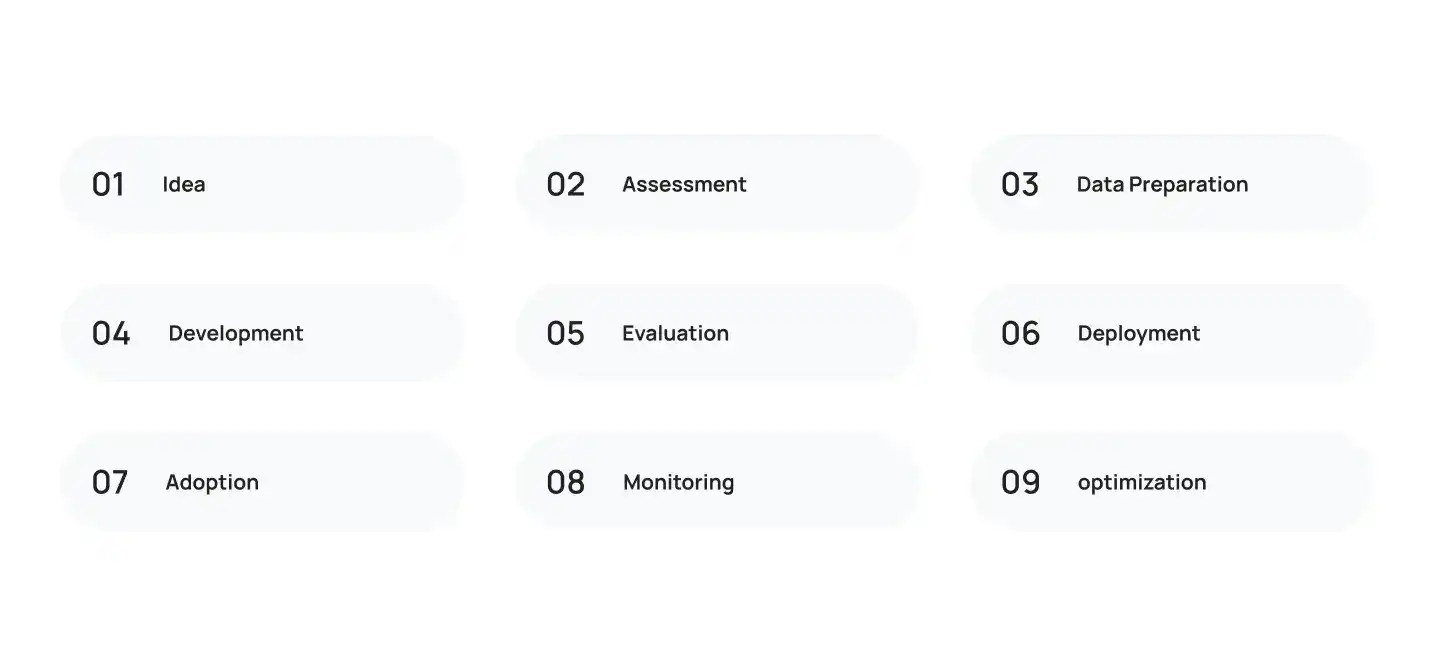
An AI CoE does not need dozens of projects to prove its value. Start with a small portfolio that represents different types of AI work.
For example:
- Predictive maintenance
- Demand forecasting
- Customer-service automation
- Document intelligence
- Recommendation systems
- Fraud detection
- Knowledge assistants
- Workflow automation
- Internal enterprise search
- AI-powered analytics
The objective is to learn how the organization handles the complete lifecycle:
For predictive or classification-heavy initiatives, custom machine learning development services can support use cases involving forecasting, fraud detection, customer insights, risk analysis, and other model-driven applications.
For generative AI projects, the CoE should establish separate evaluation criteria around hallucinations, grounding, prompt behavior, retrieval quality, model selection, latency, cost, and human review.
Organizations creating a generative AI center of excellence should also account for the fact that LLM applications can change behavior based on models, prompts, retrieval sources, tools, and context.
10. Establish AI Literacy and Change Management
Technology adoption is not automatic.
Employees need to understand where AI fits into their work, what information they can provide to AI systems, how outputs should be reviewed, and when human judgment is required.
An AI literacy program can include different tracks for different audiences:
i. Executives
- AI strategy
- Investment decisions
- Risk
- Governance
- Business value
ii. Managers
- Workflow redesign
- AI adoption
- Team enablement
- Performance measurement
iii. Technical teams
- Model evaluation
- Prompt engineering
- MLOps
- Security
- Data engineering
- AI application development
iv. General employees
- Approved AI tools
- Data handling
- Output verification
- Responsible AI use
- Basic AI concepts
A CoE should also create an internal feedback loop. Employees using AI systems are often the first people to notice inaccurate outputs, confusing workflows, missing capabilities, or adoption barriers.
Cubix’s research on AI adoption similarly identifies strategy, executive backing, governance, workforce skills, and organizational resistance as important factors in moving AI initiatives beyond experimentation.
What Should an AI Center of Excellence Measure?
An AI CoE should not measure success by the number of models built or workshops conducted.
Those are activity metrics.
The more useful question is whether the CoE is helping the organization deliver AI safely, repeatedly, and with measurable business impact.
| KPI category | Example metrics |
| Delivery | Time from approved use case to production |
| Technical | Model accuracy, latency, uptime, inference cost |
| Adoption | Active users, task completion, feature usage |
| Business value | Cost savings, revenue contribution, productivity gains |
| Quality | Error rate, hallucination rate, evaluation scores |
| Governance | Percentage of systems assessed, policy exceptions, audit findings |
| Operations | Incident rate, mean time to resolution, model drift |
| Portfolio | Production projects, abandoned pilots, duplicated capabilities |
How Do You Measure AI ROI and Business Value?

AI ROI should be defined before implementation rather than calculated after deployment.
Suppose an organization wants to automate document processing.
The baseline could include:
- Average processing time
- Labor hours
- Error rate
- Cost per document
- Monthly document volume
After deployment, those same measurements can be compared against the new workflow.
For an AI assistant, useful measures could include:
- Resolution time
- Escalation rate
- First-contact resolution
- User satisfaction
- Cost per interaction
- Successful task completion
This gives the CoE a way to distinguish technical performance from actual business value.
A model can have excellent benchmark results and still fail to create value if employees do not use it, the workflow around it is inefficient, or the cost of operating it exceeds the benefit.
Common AI Center of Excellence Mistakes to Avoid
Building an AI Center of Excellence involves more than defining roles and processes. Certain structural mistakes can limit its effectiveness, slow down AI adoption, or create unnecessary technical and governance issues. Here are the common pitfalls to address before they become part of the CoE operating model.
1. Turning the CoE Into an Approval Bottleneck
If every experiment requires multiple central approvals, teams may start working around the CoE.
Use risk-based controls instead. Low-risk experimentation can follow a lightweight process, while high-risk production systems receive deeper review.
2. Building the Team Before Defining the Mandate
Hiring AI engineers without establishing ownership, priorities, funding, and decision rights creates confusion.
The charter should come first.
3. Starting With Technology Instead of Use Cases
A new model or AI platform is not a business strategy.
Start with a problem, establish measurable outcomes, and then determine whether AI is appropriate.
4. Treating Governance as a Separate Final Step
Governance should be integrated into discovery, architecture, development, testing, deployment, and monitoring.
NIST explicitly treats governance as a cross-cutting function rather than a one-time stage at the end of the AI lifecycle.
5. Measuring Activity Instead of Value
Counting prototypes, training sessions, or AI tools purchased can make a CoE look productive without showing whether it is creating useful outcomes.
Measure what changed.
6. Allowing Every Business Unit to Build Its Own Stack
Some autonomy is useful. Completely independent AI infrastructure creates duplicated costs, inconsistent controls, fragmented data, and difficult maintenance.
Centralize shared foundations while allowing appropriate business-unit flexibility.
7. Stopping at the Pilot
A pilot is evidence, not the final destination.
Before approving a pilot, define what production would require if the results are positive. That includes infrastructure, security, integration, monitoring, support, ownership, and ongoing costs.
When Should an Enterprise Use an AI Center of Excellence?
An AI CoE becomes increasingly relevant when AI activity moves beyond isolated experimentation.
Common signals include:
- Multiple departments are adopting AI independently
- AI projects are competing for the same data or infrastructure
- Different teams use different models and vendors
- AI governance responsibilities are unclear
- Several pilots need productionization
- Leadership cannot see the full AI project portfolio
- AI spending is growing without consistent measurement
- Security or compliance teams are becoming involved
- Business units need access to shared AI expertise
- The organization wants repeatable AI development practices
Not every company needs a large dedicated AI department. A smaller organization may begin with a lightweight virtual CoE made up of existing technical, product, security, legal, and business leaders.
The structure can grow as AI adoption grows.
How Cubix Can Support an Enterprise AI Center of Excellence
An AI Center of Excellence requires both organizational planning and technical execution. That means the implementation partner needs to understand more than model development.
Cubix can support different parts of the AI lifecycle, including AI strategy, machine learning, generative AI, AI agents, data infrastructure, MLOps, application development, and cloud architecture.
For organizations moving from experimentation to implementation, AI development services can cover generative AI applications, data processing, analytics, model development, and deployment approaches across cloud, edge, API, and hybrid environments.
For agent-based workflows, AI virtual agent development can support applications that automate interactions and business processes across digital platforms.
The role of an external partner can vary. Some enterprises may need architecture and governance support, while others may need additional engineering capacity to build and operate production systems.
Conclusion
An AI Center of Excellence gives enterprises a practical way to move from scattered AI experiments toward a repeatable operating model.
The core work is not simply creating a team. It involves defining the mandate, assessing data and technology readiness, selecting an operating model, establishing architecture and governance, building the right skills, prioritizing useful AI applications, and creating the MLOps and monitoring foundations required for production.
The CoE should also remain flexible. AI technology, regulations, business priorities, and model capabilities will continue to change. A useful operating model is one that can adapt without forcing every business unit to rebuild its AI practices from scratch. Organizations planning that journey can explore Cubix’s AI capabilities to see how AI software development, machine learning, generative AI, NLP, and related solutions can support different stages of enterprise AI implementation.
Let’s get your AI strategy sorted. Book a quick call today
Contact UsFrequently Asked Questions
1. What is an AI Center of Excellence (AI CoE) and why does an enterprise need one?
An AI Center of Excellence is a cross-functional capability that coordinates AI strategy, governance, architecture, technical standards, use-case prioritization, talent, and AI adoption across an organization. Enterprises typically establish one when AI initiatives become numerous or complex enough that decentralized experimentation creates duplication, governance gaps, or inconsistent technical practices.
2. Which organizational model works best for an AI CoE: centralized, federated, or hybrid?
The appropriate model depends on organizational size, AI maturity, risk requirements, technical capabilities, and the level of autonomy business units need. A centralized model concentrates expertise and control. A federated model gives business units more ownership. A hybrid model combines central standards and shared capabilities with distributed delivery.
3. What key roles are needed to staff an enterprise AI Center of Excellence?
Common roles include an executive sponsor, AI leader, AI product manager, AI solution architect, data engineer, ML engineer, MLOps engineer, security specialist, governance lead, legal or compliance specialist, and change-management lead. Smaller organizations can combine several responsibilities into fewer roles.
4. How do you measure the success and business ROI of an AI CoE?
Measure both operational and business outcomes. Useful metrics include time to production, AI adoption, model quality, system reliability, AI operating costs, risk findings, productivity gains, cost reduction, revenue contribution, and successful use-case deployment. The exact KPIs should be tied to the organization’s AI portfolio and business objectives.
5. What are the core governance and ethical framework requirements for an AI CoE?
An AI CoE should establish policies covering data privacy, security, model evaluation, accountability, human oversight, transparency, documentation, third-party risk, incident response, and applicable legal requirements. NIST’s AI RMF provides a voluntary framework organized around Govern, Map, Measure, and Manage.
6. How much does it cost to set up and maintain an AI Center of Excellence?
There is no single cost because an AI CoE can range from a small virtual team using existing resources to a dedicated enterprise function with AI engineers, data specialists, governance personnel, infrastructure, software, and ongoing operations.
The main cost categories include:
- Personnel
- Cloud and compute
- AI and software platforms
- Data infrastructure
- Security and compliance
- Training
- Consulting or external engineering support
- Monitoring and ongoing model maintenance
A practical budget should therefore be based on the organization’s AI portfolio, required capabilities, regulatory environment, and production workload rather than a generic CoE price.