Key Takeaways
- AI adoption is now mainstream, and not experimental. 73% of studios already use AI, 88% expect it to become standard, and nearly 4 in 10 report productivity gains of 20%+.
- AI augments developers, it doesn’t replace them, it handles repetitive work (boilerplate code, concept sketches, dialogue drafts, testing).
- It’s used across the entire pipeline, from concept art coding to QA automation.
- 54% want to train or fine-tune proprietary models to protect IP.
- Real challenges remain like the content quality, copyright or licensing risk and over-reliance on automation are cited as the biggest hurdles to wider AI use.
Artificial intelligence is no longer an experiment in game development. It’s becoming part of the everyday workflow. The numbers tell an interesting story.
According to the a16z Games AI Survey, 73% of game studios already use AI tools, while 88% expect AI to become a regular part of their development pipeline. Nearly 4 in 10 studios also reported productivity gains of more than 20% after introducing AI into their workflows.
At the same time, the gaming industry itself isn’t slowing down. Thousands of new games are released every year, player expectations continue to rise, and live-service titles require constant updates long after launch. As we highlighted in our Game Development Industry Statistics & Revenue Trends report, development budgets and timelines have grown significantly over the past decade, making efficiency more important than ever.
So, where does AI fit into all of this?
Not where many people think.
Despite the headlines, AI isn’t replacing game developers. Instead, it’s taking care of repetitive, time-consuming tasks that often slow production. Artists still create the visual direction. Designers still build engaging gameplay. Engineers still solve complex technical challenges.
AI simply helps them get there faster. AI in game development is changing how studios approach production from start to finish.
AI Adoption Is Growing Because Game Development Has Never Been More Demanding
Players expect massive open worlds, realistic graphics, cross-platform support, live events, frequent updates, and bug-free launches. Delivering all of that takes enormous teams, bigger budgets, and years of development.
The result?
According to multiple industry surveys, AI adoption has accelerated rapidly over the past two years.
AI Adoption in Game Development
| Industry Statistic | What It Tells Us |
| 73% of game studios already use AI | AI has become part of mainstream development workflows. |
| 88% plan to increase AI usage | Adoption is still growing rapidly. |
| 39% of studios report productivity improvements of 20% or more | AI is delivering measurable efficiency gains. |
| 53% are exploring AI-generated gameplay and runtime content | AI is moving beyond production into the player experience. |
| 54% want to build or fine-tune their own AI models | Studios want more control over quality, security, and creativity. |
Source: a16z Games AI Survey
For example, modern AAA games can take anywhere from four to seven years to develop, while budgets regularly exceed $100 million. Live-service games require even more resources after launch, with developers continuously releasing new content, balancing gameplay, fixing bugs, and responding to player feedback.
Competition is increasing too.
If you’ve read our article, How Many Video Games Are Released Each Year: Industry Statistics, you’ll know that Steam alone now sees more than 15,000 new game releases every year. Standing out has never been harder.
Studios don’t just need to make great games anymore.
They need to make them faster.
That’s exactly why AI-powered game development has become a strategic investment rather than a futuristic experiment.
Why Studios Are Investing in AI
Instead of replacing developers, AI helps teams reduce the time spent on repetitive work, including:
- Creating early concept art and visual references
- Writing boilerplate code and documentation
- Generating dialogue drafts and quest ideas
- Testing thousands of gameplay scenarios automatically
- Localizing games into multiple languages
- Analysing player behaviour after launch
- Creating multiple asset variations for faster iteration
The goal of artificial intelligence game development isn’t to remove people from the process. It’s to remove the bottlenecks that slow experienced teams down.
Why AI Matters More Today Than Five Years Ago
| Then | Now |
| Smaller development teams | Hundreds of specialists working together |
| Mostly single-platform releases | Simultaneous multi-platform launches |
| One-time game releases | Continuous LiveOps and seasonal updates |
| Manual testing | Millions of gameplay interactions requiring validation |
| Limited localization | Global launches across dozens of languages |
Every one of these changes increases production complexity.
AI helps studios manage that complexity without endlessly expanding their teams.
That’s one of the biggest reasons why the AI in gaming industry is projected to grow rapidly over the next decade, with analysts forecasting multi-billion-dollar market growth as more studios integrate AI into everyday production workflows.
Where AI Is Used Across the Game Development Pipeline
Here’s a question worth asking.
If AI is making studios faster, where is it actually saving time?
The answer isn’t just one department.
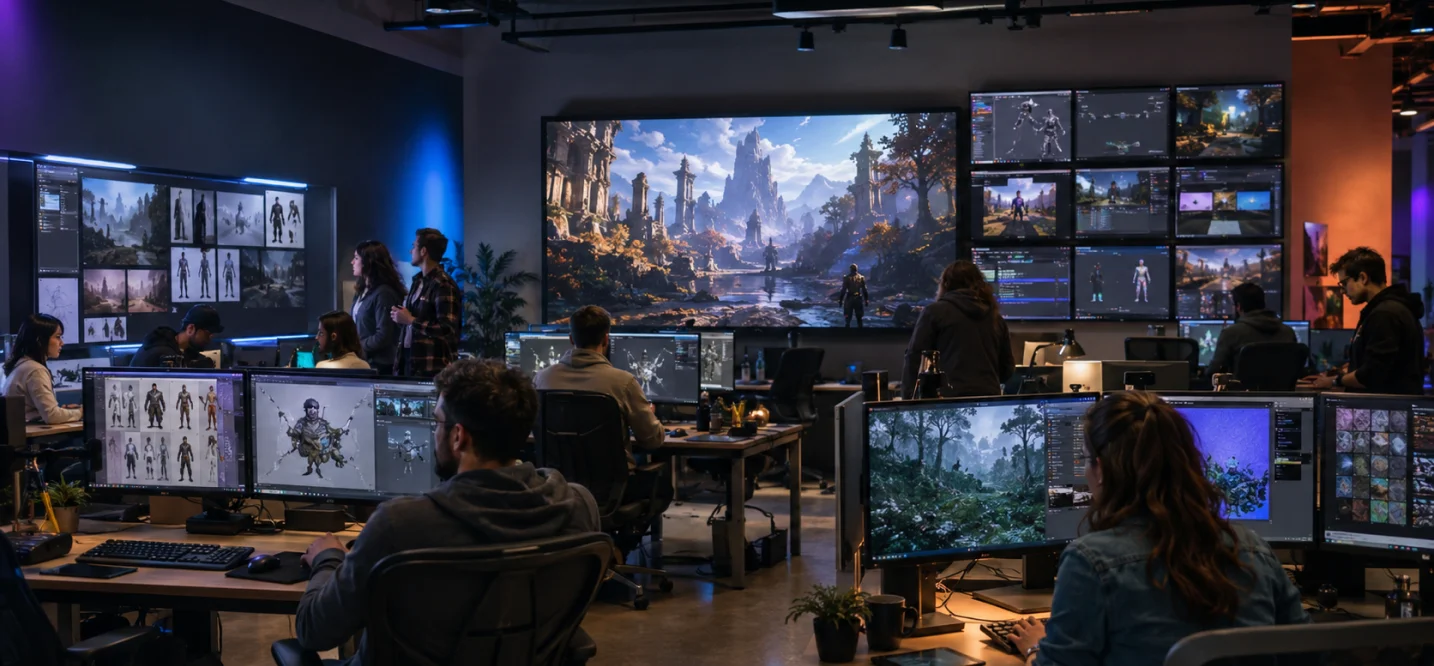
AI is being used across almost every stage of development, from the first brainstorming session to post-launch player support. Some studios use it to generate concept art. Others rely on it to automate testing, write repetitive code, or analyze millions of player interactions after release.
The important thing to remember is this: AI isn’t replacing the pipeline. It’s improving every step within it.
How AI Fits into the Game Development Pipeline
| Development Stage | How AI Is Used | Primary Benefit |
| Pre-production | Brainstorming ideas, concept art, story outlines | Faster ideation and creative exploration |
| Game Art | Character concepts, textures, 3D asset generation | Quicker asset production |
| Programming | Code suggestions, debugging, documentation | Improved developer productivity |
| QA & Testing | Automated gameplay testing, bug detection | Faster testing with broader coverage |
| NPCs & Gameplay | Dynamic dialogue, adaptive AI behaviour | More immersive player experiences |
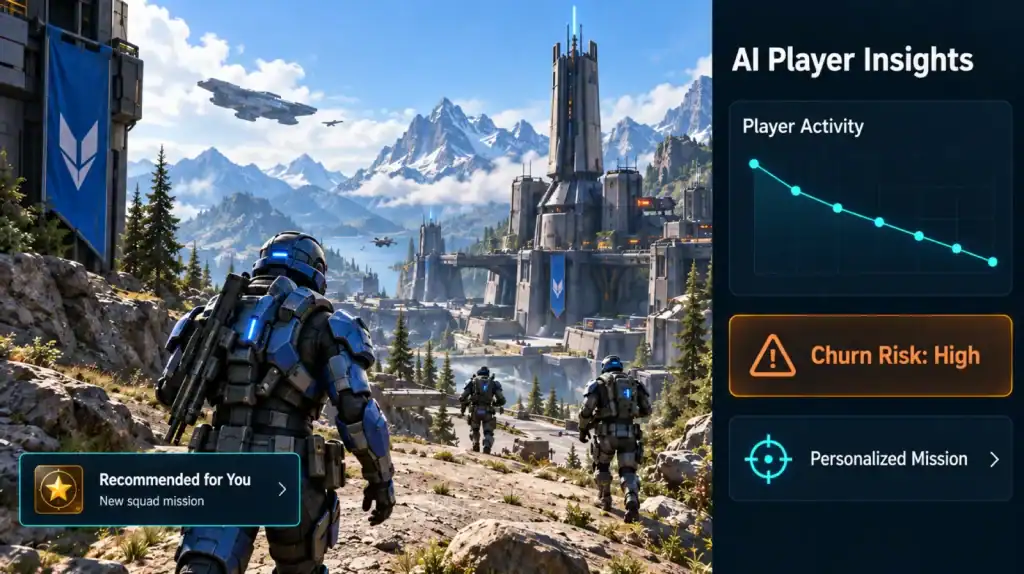
| LiveOps | Player analytics, churn prediction, balancing | Better retention and personalization |
Traditional Ideation vs AI-Assisted Ideation
| Task | Traditional Workflow | AI-Assisted Workflow |
| Character concepts | Multiple manual sketches | Dozens of visual concepts generated in minutes |
| Story ideas | Brainstorming sessions | AI-generated plot variations for refinement |
| Environment design | Individual mood boards | Multiple artistic directions created quickly |
| Quest planning | Manual documentation | AI-generated quest frameworks to iterate on |
A great example comes from concept art. Imagine an art director working on a sci-fi shooter.
Instead of waiting two or three days for multiple environment sketches, the team can generate several visual directions within an hour using tools like Midjourney or Leonardo AI. The AI doesn’t decide the final look of the game, it simply gives artists more starting points to evaluate.
That’s an important difference. The creative vision still belongs to the team. AI just speeds up the journey.
Popular AI Art Tools Used by Game Studios
| AI Tool | Common Use Case |
| Midjourney | Character and environment concept art |
| Stable Diffusion | Texture generation and visual exploration |
| Meshy AI | AI-generated 3D models and prototypes |
| Leonardo AI | Environment concepts and game assets |
| Adobe Firefly | Asset variations and production graphics |
These tools are particularly valuable during prototyping.
For example, an environment artist creating a medieval village might generate ten architectural styles before selecting the strongest direction to refine manually. Instead of spending days exploring ideas, the team can make creative decisions within hours.
AI Is Becoming Every Developer’s Coding Assistant
Programming is another area where game development AI is making an immediate impact.
Not because AI writes entire games.
Because it handles the repetitive coding tasks developers would rather avoid.
Think about everything a programmer does during a typical week:
- Writing boilerplate code
- Debugging repetitive errors
- Explaining complex functions
- Creating documentation
- Refactoring existing systems
- Searching for syntax issues
Most Popular AI Coding Tools for Game Development
| Tool | Best For | Typical Users |
| GitHub Copilot | Code completion and suggestions | Gameplay programmers |
| Cursor | AI-assisted coding and debugging | Software engineers |
| Claude | Technical explanations and documentation | Technical designers |
| ChatGPT | Rapid prototyping and scripting | Developers and designers |
It’s worth pointing out something important here.
Professional developers don’t copy and paste AI-generated code into production.
Instead, they use AI much like an experienced teammate, someone who helps solve problems faster, explains unfamiliar concepts, or handles repetitive work while the developer focuses on architecture, optimization, and gameplay systems.
That’s a far more realistic picture of AI and game development today.
AI Is Making Game Testing Faster and Smarter
Ask any game producer where projects lose the most time, and you’ll probably hear the same answer.
Testing.
Before a game reaches players, QA teams spend weeks or even months looking for bugs, balancing gameplay, checking performance across devices, and making sure every feature works as expected.
Now imagine doing that for an open-world RPG with hundreds of quests or a multiplayer game with millions of possible player interactions.
Manual testing alone simply isn’t enough anymore.
According to Capgemini’s World Quality Report, testing can account for up to 25 – 30% of a software project’s total development effort. While games have their own unique challenges, the reality is similar: QA remains one of the most resource-intensive stages of production.
That’s why automated game testing solutions utilizing machine learning are becoming increasingly common.
Instead of replacing QA engineers, AI expands what they can test.
For example, machine learning models can:
- Simulate thousands of player actions within hours
- Detect crashes before they reach production
- Identify unexpected gameplay loops
- Find balancing issues by analysing player behaviour
- Perform regression testing after every update
- Highlight unusual performance drops across different devices
Traditional QA vs AI-Assisted Testing
| QA Activity | Traditional Testing | AI-Assisted Testing |
| Gameplay testing | Manual playthroughs | Thousands of automated simulations |
| Bug detection | Human testers | AI identifies recurring patterns and anomalies |
| Regression testing | Repeated manual testing | Automated after every build |
| Performance monitoring | Sample testing | Continuous monitoring across multiple scenarios |
| Balance analysis | Player feedback after launch | Predictive analysis before release |
Smarter NPCs Are Creating More Dynamic Player Experiences
Think back to older games. Most NPCs followed simple rules.
- Walk here.
- Stop.
- Repeat the same three lines of dialogue.
- Attack when the player gets close.
That approach worked for years. But players now expect something far more believable.
This is where artificial intelligence game design is evolving beyond production and into gameplay itself.
According to the a16z Games AI Survey, 53% of studios are already exploring AI-generated content that runs inside the game, including adaptive NPCs, procedural storytelling, and dynamic player interactions.
That’s a significant shift.
How AI Is Used to Improve NPC Behavior in Video Games
Today’s AI systems can help NPCs:
- Remember previous conversations with players
- Respond differently based on player choices
- Adapt their combat strategies
- Deliver more natural dialogue
- Generate unique side quests
- React to changing environments
- Personalize interactions based on player behaviour
Several major companies are already investing heavily in this space.
For example, Ubisoft’s Ghostwriter assists narrative teams by generating variations of NPC dialogue, allowing writers to focus on storytelling rather than repetitive background conversations.
Meanwhile, NVIDIA ACE (Avatar Cloud Engine) combines language models, speech recognition, and animation technologies to create digital characters capable of having more natural conversations with players.
Even platforms like Inworld AI are enabling developers to create NPCs with distinct personalities, memories, and conversational styles.
Traditional NPC Systems vs AI-Driven NPCs
| Traditional NPCs | AI-Driven NPCs |
| Scripted dialogue trees | Context-aware conversations |
| Fixed behaviours | Adaptive decision-making |
| Limited responses | Dynamic interactions |
| Static personalities | Characters that remember previous encounters |
| Manual dialogue updates | AI-assisted dialogue generation |
The future of AI in games isn’t just about helping developers. Furthermore, it’s also about creating richer experiences for players.
AI Is Helping Studios Make Better Decisions After Launch
Shipping a game isn’t the finish line anymore. For many studios, it’s only the beginning.
Live-service games receive regular updates, seasonal events, balance changes, new content, and community-driven improvements for years after release.
That creates an enormous amount of player data.
- Every match played.
- Every item purchased.
- Every mission completed or abandoned.
Analysing all of that manually would be almost impossible. This is where AI becomes one of the most valuable tools in modern LiveOps.
Instead of simply collecting data, machine learning models help studios identify patterns they might otherwise miss.
For example, AI can predict:
- Which players are likely to stop playing
- Where players struggle during onboarding
- Which rewards improve retention
- Which game modes are losing popularity
- When matchmaking needs balancing
- How in-game economies are changing over time
How Studios Use AI for LiveOps
| AI Application | Business Impact |
| Churn prediction | Improves player retention |
| Matchmaking optimisation | Creates fairer multiplayer experiences |
| Player segmentation | Delivers more personalised content |
| Economy monitoring | Detects inflation and balancing issues |
| Real-time analytics | Supports faster design decisions |
This is one of the fastest growing areas of AI for gaming development.
Top AI Tools Game Studios Are Using in 2026
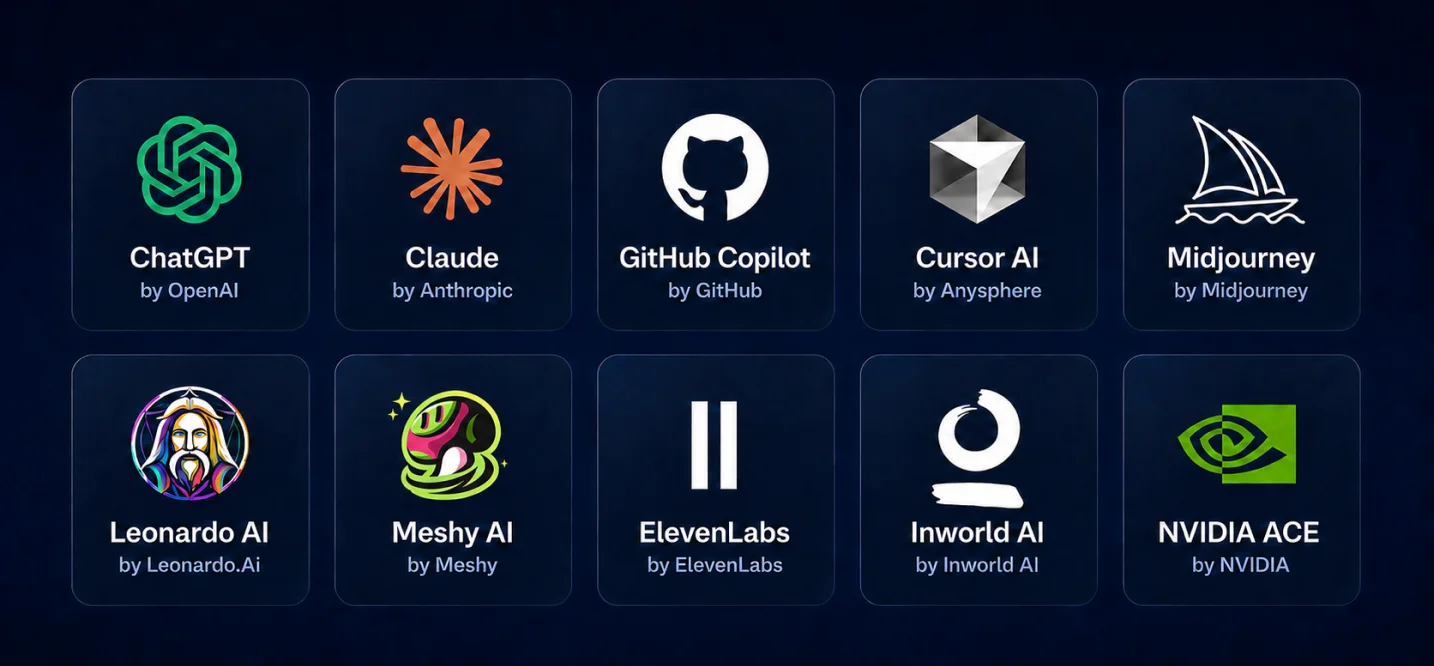
| AI Tool | Best For | Used By | Why It Matters |
| ChatGPT | Brainstorming, quest writing, documentation | Designers, Writers | Speeds up ideation and content creation |
| Claude | Narrative design, design documents | Writers, Producers | Generates structured long-form content |
| GitHub Copilot | Code generation | Gameplay Programmers | Reduces repetitive coding tasks |
| Cursor AI | AI-assisted software development | Engineers | Improves coding productivity and debugging |
| Midjourney | Character and environment concept art | Artists | Generates visual ideas quickly |
| Leonardo AI | Production-ready assets | Art Teams | Creates game-ready concepts faster |
| Meshy AI | AI-generated 3D models | Environment Artists | Speeds up prototyping of assets |
| ElevenLabs | Voice generation | Audio Teams | Creates natural-sounding NPC voices |
| Inworld AI | Intelligent NPCs | Gameplay Teams | Builds dynamic conversations and personalities |
| NVIDIA ACE | AI-powered digital humans | AAA Studios | Enables real-time conversational NPCs |
Which AI Tool Is Best Depends on the Problem You’re Solving
A common mistake studios make is searching for the best AI tool. In reality, different teams have completely different needs. An art team doesn’t need the same solution as a gameplay programmer.
Likewise, a QA engineer isn’t looking for the same capabilities as a narrative designer. Here’s a simple way to think about it.
Choosing the Right AI Tool
| Your Team Needs… | Recommended AI Platform |
| Generate concept art quickly | Midjourney or Leonardo AI |
| Speed up coding | GitHub Copilot or Cursor |
| Write dialogue and quests | ChatGPT or Claude |
| Create realistic voice acting | ElevenLabs |
| Prototype 3D assets | Meshy AI |
| Build intelligent NPCs | Inworld AI or NVIDIA ACE |
AI Works Best Alongside Experienced Developers
This is where many discussions around AI become misleading.
You’ll often hear statements like:
“AI will replace game developers.”
The industry tells a different story.
According to the 2025 Game Developers Conference (GDC) State of the Game Industry Report, while AI adoption continues to grow, many developers remain cautious about fully automating creative work. Their biggest concerns include content quality, copyright, and maintaining a unique artistic vision.
In other words…
Studios aren’t looking for fewer developers.
They’re looking for developers who know how to work with AI.
AI Is Also Changing How Studios Scale Their Teams
One of the most common questions we hear is:
“We need to scale our development team quickly to meet a product launch deadline. What are the best staff augmentation firms for this?”
The answer depends on your project, but here’s what experienced studios typically look for:
- Proven experience shipping commercial games
- Expertise across Unity, Unreal Engine, and custom game engines
- AI integration capabilities
- Flexible team scaling
- Strong communication and sprint management
- Security and IP protection
- Cross-platform development experience
At Cubix, we see AI as something that strengthens experienced development teams, of course not something that replaces them. Our developers remain in complete control of every creative and technical decision.
If your project requires both AI expertise and experienced engineers, our AI Software Development Services and AI Video Game Development Company teams help studios accelerate production while maintaining quality at every stage.
The Biggest Challenges Studios Face When Using AI
| Challenge | Why It Matters |
| Content quality | AI-generated assets often require significant editing before they’re production-ready. |
| Copyright and licensing | Studios must ensure training data and generated content don’t create legal risks. |
| Maintaining a consistent art style | AI can generate impressive visuals, but keeping them aligned with a game’s creative direction still requires artists. |
| Data privacy | Using third-party AI platforms may expose proprietary assets or sensitive project information. |
| Over-reliance on automation | Blindly accepting AI-generated code or content can introduce bugs and reduce quality. |
| Player trust | AI-powered features should improve gameplay without making players feel manipulated. |
Studios Want More Control Over Their AI Models
One of the most interesting findings from the a16z Games AI Survey is that 54% of studios want to train or fine-tune their own AI models instead of relying entirely on public platforms.
Why? Because every game is different.
A studio building a realistic military shooter has completely different artistic requirements than one creating a stylized mobile puzzle game.
Generic AI models don’t always understand those differences. By training proprietary models, studios can:
- Maintain a consistent visual style across every asset.
- Protect confidential game designs and intellectual property.
- Generate dialogue that matches the game’s tone and lore.
- Reduce the risk of copyrighted or inaccurate outputs.
- Build AI workflows tailored to their own production pipeline.
Build Smarter Games with AI – Without Losing the Touch
AI is changing how games are made, but great games still start with great people.
At Cubix, that’s exactly how we approach game development.
Our teams combine experienced designers, artists, engineers, and AI specialists to build production pipelines that are faster, smarter, and ready for the future. We help you integrate AI where it creates real value, not unnecessary complexity.
If you’re exploring how AI can improve your next game, or you’re looking for a trusted partner to bring your vision to life, Cubix is here to help.
Let’s build games that are faster to develop, smarter to play, and unforgettable to experience.
Frequently Asked Questions
1. How is AI used in game development today?
AI is used throughout the game development lifecycle to improve efficiency and reduce repetitive work. Studios use AI for concept art generation, coding assistance, automated game testing, NPC behavior, procedural content generation, localization, player analytics, and LiveOps. Rather than replacing developers, AI helps teams work faster while allowing designers, artists, and programmers to focus on creativity and gameplay.
2. Can AI replace game developers?
No. AI is a productivity tool, not a replacement for experienced developers. While AI can generate code, artwork, dialogue, and other assets, it still requires human oversight to ensure quality, creativity, technical accuracy, and consistency. Successful studios use AI to support developers, not replace them.
3. What are the best AI tools for game development?
Some of the most widely used AI tools include GitHub Copilot and Cursor for programming, ChatGPT and Claude for writing and ideation, Midjourney, Leonardo AI, and Meshy AI for game art, ElevenLabs for AI voice generation, and NVIDIA ACE or Inworld AI for creating intelligent NPCs. The right tool depends on your team’s workflow and production goals.
4. What are the biggest benefits of AI in game development?
AI helps studios shorten development cycles, automate repetitive tasks, improve QA testing, accelerate concept creation, optimize player analytics, and create more dynamic gameplay experiences. These improvements allow teams to reduce production bottlenecks while maintaining high creative standards.