Key Takeaways
- A core gameplay loop is the primary cycle of action, reward, and progress in a game.
- Strong core loops directly improve day-1, day-7, and day-30 player retention rates.
- Layering primary, secondary, and tertiary loops creates long-term depth and replayability.
- Rigorous prototyping during pre-production prevents scope creep and costly structural overhauls.
- Partnering with an experienced development team helps founders turn mechanics into complete titles.
Industry research reveals that over 80% of newly launched mobile games lose up to 80% of their active daily users within the first three days. That single stat highlights the tough reality of modern player retention. Players do not leave because the graphics look bad. They leave because the core gameplay loop fails to hold their attention.
A well-designed loop creates a satisfying rhythm of challenge and accomplishment. It gives players a clear reason to complete one more turn, run, or level. Without that pull, even visually stunning titles quickly lose their appeal.
Building a hit title requires getting this foundation right before adding extra systems. Studios like Cubix help founders test and refine these core cycles early in production. Mastering this cycle separates games that trend briefly from titles that keep players coming back for years.
Understanding the Gameplay Loop Meaning in Modern Design
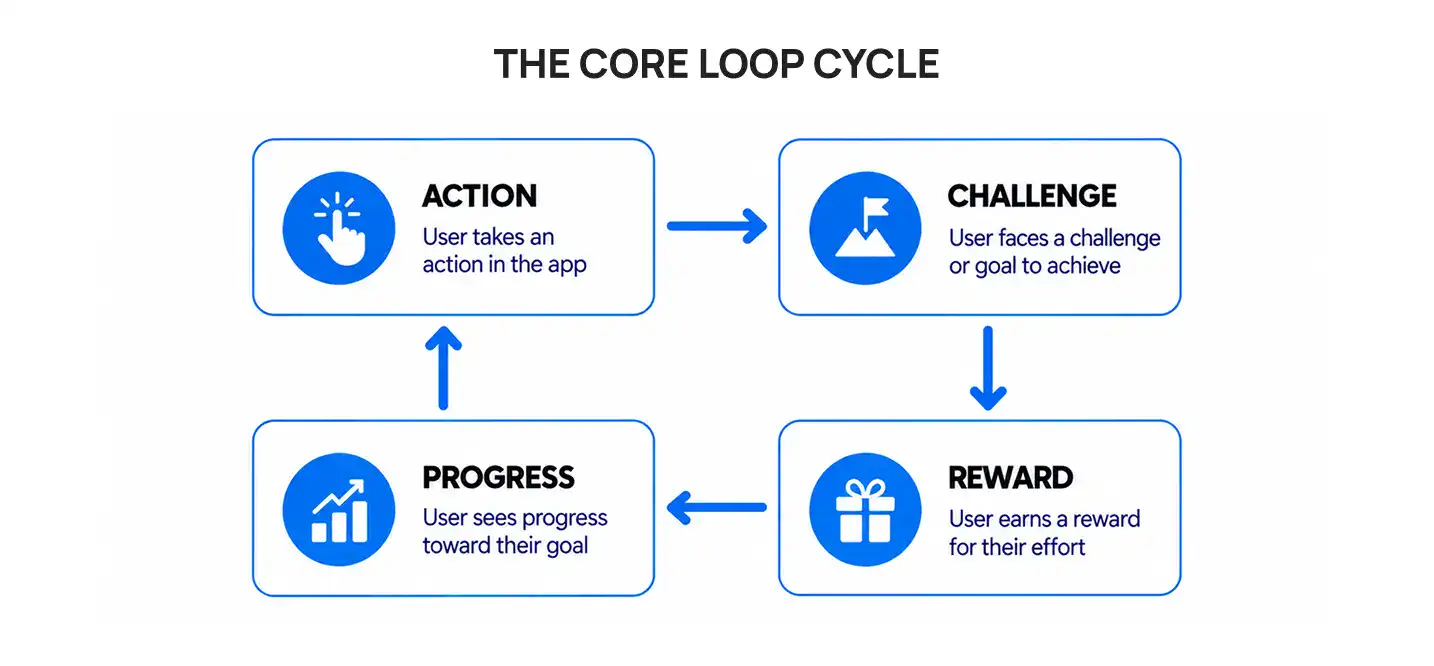
At its foundation, the gameplay loop meaning refers to the repeating sequence of actions a player performs during a game session. You can think of it as the basic mechanical engine driving the experience. Every jump, shoot, trade, or build action forms part of this cycle.
When someone asks what is a game loop, the answer lies in feedback cycles. The game presents a goal, the player acts, the game rewards the action, and that reward enables new challenges. Working with an established Game Development Studio ensures these actions feel natural and responsive.
Data shows that titles with clear, responsive feedback loops achieve up to 35% higher session lengths compared to games with cluttered mechanics. Simplifying interactions lets players enter a state of flow faster.
| Loop Component | Primary Function | Player Psychological Trigger |
| Action | Executing basic mechanics (shoot, jump, match) | Agency and control |
| Challenge | Overcoming obstacles or opponents | Mastery and tension |
| Reward | Earning currency, loot, or points | Gratification and accomplishment |
| Progress | Unlocking new abilities or stages | Growth and anticipation |
The 3 Layers of Game Loops: Core, Secondary, and Tertiary
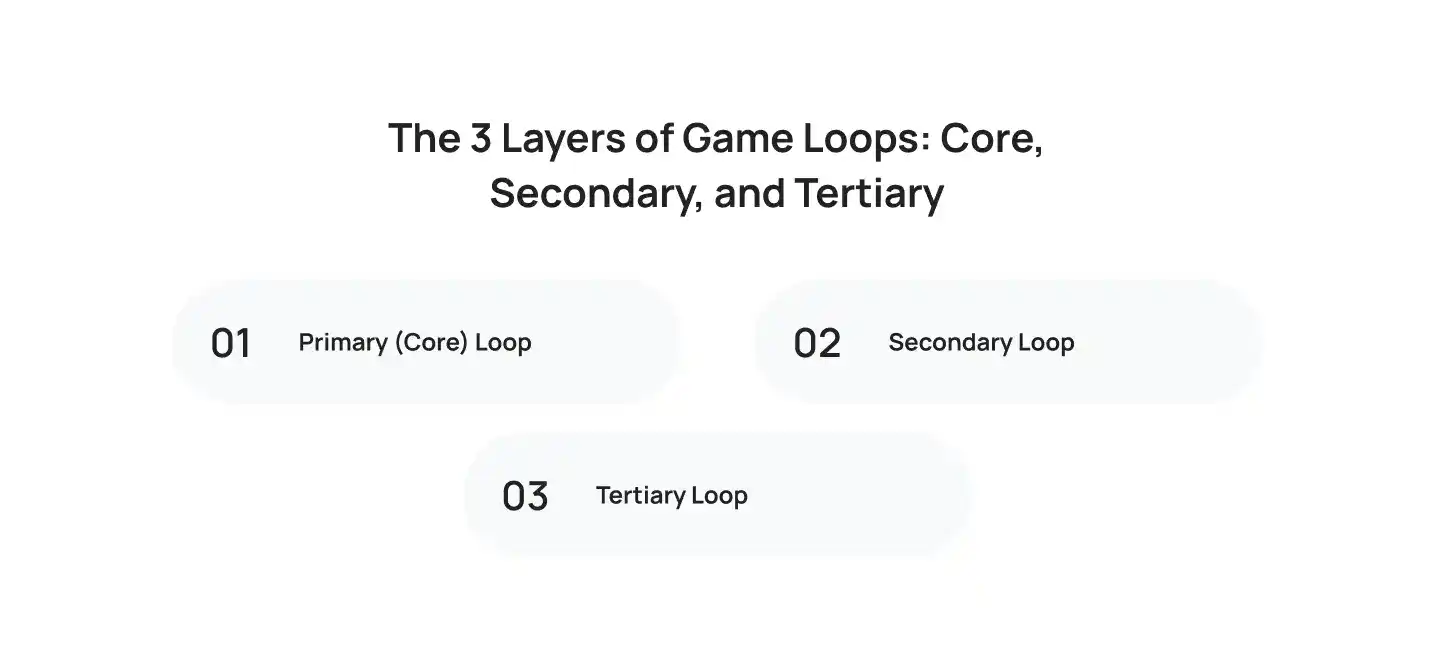
A complete game design nests multiple loops together to support short-term and long-term play. Understanding how these layers connect prevents gameplay from feeling monotonous over long sessions.
- Primary (Core) Loop: Second-to-second actions like aiming, platforming, or matching tiles.
- Secondary Loop: Minute-to-minute goals like clearing a level, upgrading gear, or defeating a mini-boss.
- Tertiary Loop: Hour-to-hour progression like completing campaign arcs, climbing rank ladders, or mastering skill trees.
Teams creating projects through a mobile game development company pay close attention to the primary loop. Mobile sessions rely on immediate feedback to capture player interest right away.
Publishers report that games featuring well-balanced secondary and tertiary loops see a 45% increase in Day-30 retention over titles relying solely on simple core actions. You can read more about structuring these frameworks in this guide on steps to design your first video game.
Key Elements of an Engaging Core Gameplay Loop
Designing an effective cycle requires balancing challenge, reward, and mechanical clarity. If one piece feels weak, the whole experience stumbles.
Studios using specialized Unity game development services tune these balances through rapid prototyping. Testing variations quickly helps find the right balance between player effort and in-game payouts.
- Clarity of Goals: Players must instantly know what to do next.
- Immediate Feedback: Visual and audio cues must confirm every success or failure.
- Balanced Friction: Challenges must test skill without feeling unfair.
- Meaningful Rewards: Loot or points must feel useful for future progress.
Industry benchmarks show that games balancing these elements see short-term retention jump by up to 28%. Documenting these relationships early in a formal design plan saves months of work down the line. Reviewing a standard game design document format is a great way to map these mechanics out clearly.
Top Examples of Famous Core Gameplay Loops
Examining successful titles shows how simple core loops create massive global hits.
| Game Title | Genre | Core Loop Summary | Key Retention Factor |
| Pac-Man | Arcade | Navigate maze -> Eat pellets -> Avoid ghosts | High-score chasing |
| Balatro | Poker Roguelike | Select cards -> Play hand -> Earn chips -> Buy jokers | Synergistic score multipliers |
| Among Us | Social Deduction | Complete tasks / Stalk crewmates -> Report bodies -> Discuss and vote | Social tension and bluffing |
| World of Warcraft | MMORPG | Accept quest -> Defeat targets -> Earn loot/XP -> Upgrade character | Long-term power scaling |
Indie smash hits highlight how tight mechanical design drives wild commercial success. For a deep look at how simple card mechanics turned into an indie hit, check out this analysis of Balatro card game a blueprint for indie success.
How Top Game Developers Build and Iterate on Loops
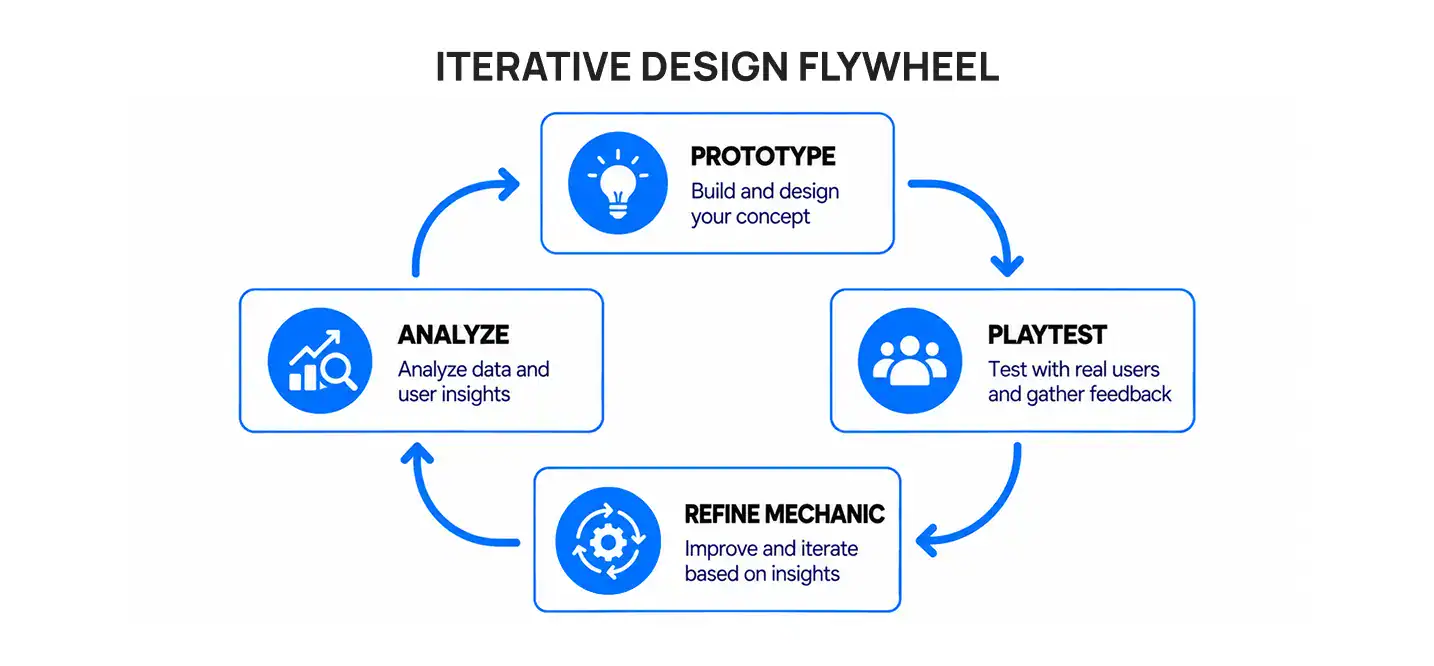
Leading teams rarely get their core loop perfect on the first try. They rely on iterative testing cycles to evaluate how mechanics feel in action.
A seasoned custom game development company builds greybox prototypes to isolate mechanics from visual distractions. Testing basic shapes moving in white boxes helps verify that the core action is fun on its own.
Telemetry data from thousands of early playtests shows that iterating on movement and input response can boost player satisfaction scores by over 40% before art assets are added.
The 7 Stages of Game Development and Loop Integration
Understanding the stages of game development helps teams integrate core loop design at the right moment.
| Development Stage | Core Loop Objective | Main Risk Area |
| 1. Planning & Concept | Define mechanical hypotheses | Vague design scope |
| 2. Pre-Production | Prototype core loop mechanics | Overbuilding systems early |
| 3. Production | Build out secondary and tertiary layers | Feature creep |
| 4. Testing & Alpha | Balance loop difficulty and rewards | Mechanical exploits |
| 5. Pre-Launch (Beta) | Optimize feedback cycles via telemetry | Unbalanced economy |
| 6. Launch | Monitor real-world player flow | Server load disruptions |
| 7. Post-Launch Maintenance | Expand loops with live operations | Player burn-out |
Working with professional Multiplayer Game Development Services ensures networking code syncs cleanly with your action cycle. For instance, complex online titles take precise planning during pre-production.
Learn how to tackle these technical hurdles in this guide on how to build a multiplayer game like Among Us.
Prototyping Tools for Visualizing Core Game Mechanics
Selecting the right engine and diagnostic suite speeds up mechanical iteration.
- Unity: Ideal for multiplatform games with heavy physics interactions.
- Unreal Engine: Great for high-fidelity 3D prototypes and visual scripting.
- Machinations.io: Purpose-built for modeling and balancing game economies and nested loops visually.
- GameAnalytics: Tracks where players drop out of your primary and secondary loops.
Studies across mid-sized studios show that using dedicated economic modeling tools cuts economy balancing time by up to 50%. Large-scale projects need robust architecture from day one. If you want to see how these mechanics scale up, check out this deep dive on how to build an MMORPG game like World of Warcraft.
Addressing Common Questions: GameLoop Emulator vs. Game Loop Theory
In game development, terminology collisions happen often. It helps to clarify key terms so everyone stays on the same page.
- GameLoop Emulator: A software platform published by Tencent that allows users to run mobile titles on desktop PCs. It is a legitimate application used by millions of gamers worldwide.
- Game Loop Theory: The abstract game design concept of repeating player actions, feedback, and rewards.
- Development Trivia: While most games take 2 to 5 years to build, Duke Nukem Forever holds the record for taking 14 years, while projects like Unreal Tournament 3 spent over two decades evolving across iterations.
Building Games Right: What Founders Get Wrong and How Cubix Fixes It
Many founders get excited about broad worlds and deep lore before securing a fun, reliable core mechanic. This approach often leads to scope creep, bloated budgets, and weak player engagement.
Cubix addresses this issue by prioritizing core loop validation during pre-production. Their team builds lean, focused prototypes to confirm that basic movement, actions, and feedback cycles are genuinely fun before writing complex systems.
By catching balance issues early, teams avoid costly re-writes later in production. To see how experienced developers steer clear of common development traps, read building games: here’s what founders get wrong and how Cubix fixes it.
Partnering with Cubix for Custom Game Development Services
Turning a core loop concept into a finished product requires technical talent, art design, and production experience. Cubix brings specialized experience across mobile, desktop, and multiplayer game development. Businesses can also hire Android game developers to build engaging, platform-ready games tailored to their project goals.
Whether you are designing a fast-paced hyper-casual title or an intricate multiplayer experience, Cubix provides end-to-end guidance to refine your vision. Contact their production team today to transform your game concept into an engaging, high-retention title.
Want to discuss your project? Our experts are just a click away.
Contact UsFrequently Asked Questions
Here are 7 targeted FAQs formatted in natural prose and concise bullet points to seamlessly complement your article:
1. What does core gameplay loop mean?
A core gameplay loop is the primary cycle of actions a player performs repeatedly throughout a game session. It consists of a basic action, a challenge, an immediate reward, and a path to progression. This repeating dynamic forms the foundational engine of player engagement and retention.
2. What is the 80/20 rule in game development?
The 80/20 rule (Pareto Principle) in game development states that 80% of a player’s enjoyment comes from 20% of the game’s core mechanics—specifically, the primary core loop. Conversely, it often takes 80% of the development effort to finish the final 20% of polished content, UI, and bug fixes.
3. What is the game loop theory?
Game loop theory is a structural design framework proposing that all engaging video games operate through nested feedback cycles. It asserts that players stay immersed when short-term actions (second-to-second play) feed directly into medium-term goals (upgrades) and long-term achievements (mastery or narrative completion).
4. Can you give me an example of a core gameplay loop?
A classic example is the core loop of Diablo or Monster Hunter:
- Action: Enter a dungeon or area and combat enemies.
- Challenge: Defeat powerful opponents or boss encounters.
- Reward: Collect dropped loot, gold, and crafting materials.
- Progression: Upgrade weapons/armor to access tougher dungeons.
5. How long should a core gameplay loop take to execute?
The duration depends heavily on the genre and target platform:
- Hyper-Casual/Mobile: 5 to 30 seconds per loop cycle.
- Action/Arcade: 1 to 3 minutes per run or round.
- Strategy/RPGs: 10 to 30 minutes per match or quest session.
6. What is the difference between a core loop and a game engine loop?
A core gameplay loop is a conceptual design framework focused on player psychology, actions, and rewards. In contrast, a game engine loop (or main loop) is a technical program code cycle that continuously processes input, updates game state physics, and renders graphics to the screen frame by frame.
7. Why do games fail even if they have a great core loop?
A strong core loop is vital, but games can still fail if secondary progression systems feel unrewarding, live operations lack fresh content, monetization mechanics disrupt natural flow, or performance issues cause technical friction during play.