Key Takeaways
- Building an app like Instagram can cost $15,000–$500,000+, depending on features, platform, technology, and complexity.
- A basic MVP can cost around $15,000–$45,000, covering essential features such as profiles, photo/video uploads, likes, comments, and a basic feed.
- Advanced features such as AI recommendations, live video, messaging, and monetization can push development costs beyond $150,000.
- Hidden expenses matter: Cloud hosting, video storage, content moderation, security, maintenance, and marketing can significantly increase the total investment.
- Mobile usage remains important: 56% of Instagram’s traffic comes from mobile devices, while 43% comes from desktops, according to Semrush.
Welcome to the world of social media! It may sound like a simple phrase, but it perfectly reflects the way we live today. From the moment people wake up, they begin scrolling through reels, checking updates, and sharing moments online. Social platforms are no longer just a source of entertainment for everyone, they have become powerful tools for communication, branding, and business growth.
There are many platforms like Facebook, Snapchat, TikTok, and Instagram, but Instagram continues to stand out, especially among Gen Z users. Its visually driven content, short-form videos, and highly interactive features make it more engaging and addictive than ever. In fact, Instagram has become one of the most influential platforms for businesses looking to grow globally and build a strong digital presence. This rising popularity has led many entrepreneurs and companies to ask an important question: how much does it cost to build an app like Instagram?
The answer isn’t as simple as a fixed number. Building a successful app goes beyond copying features, it requires thoughtful design, seamless performance, and a user experience that keeps people coming back. The overall cost depends on several factors, including features, technology, development approach, and scalability.
In this guide, we’ll break everything down clearly and practically to help you understand the real investment needed to turn your app idea into reality.
Why Businesses Want to Build Apps Like Instagram
There’s a reason this idea keeps resurfacing in boardrooms and startup pitch decks, and it isn’t just because Instagram looks fun to use. The numbers behind it are genuinely staggering.
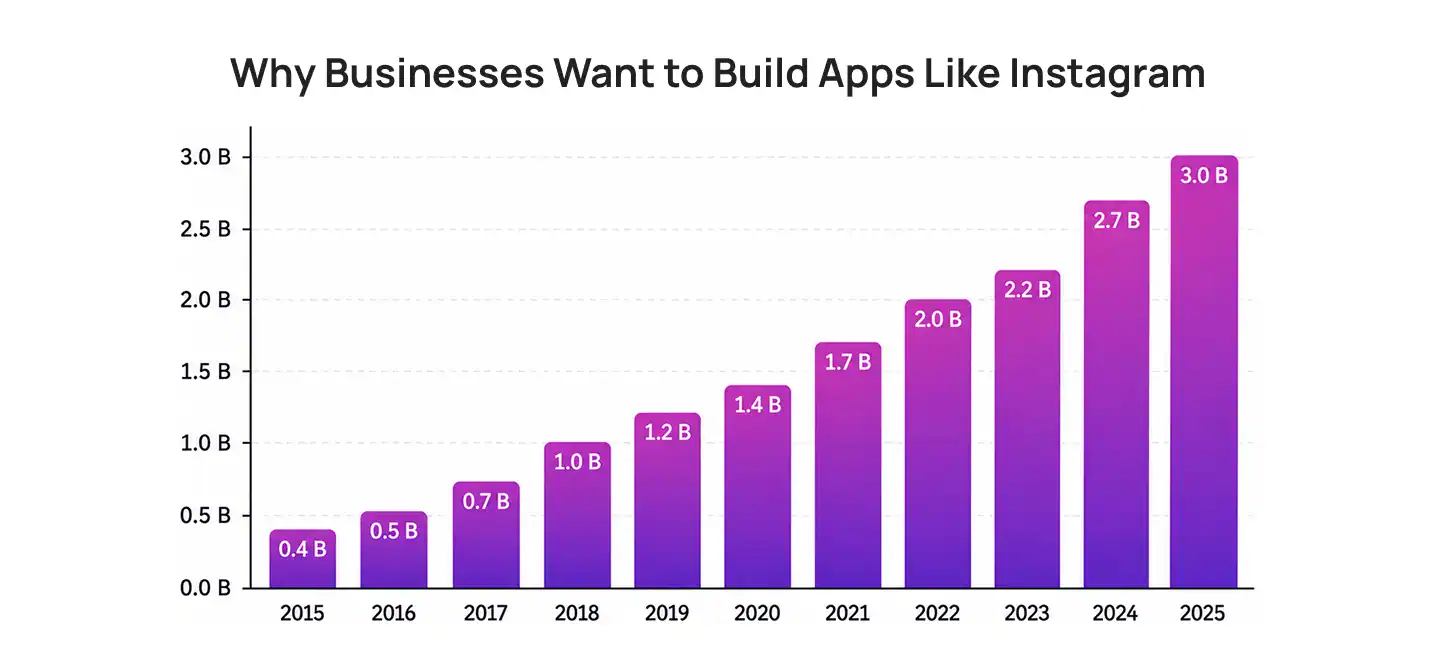
- Instagram has grown into one of the world’s largest social platforms, with more than 3 billion monthly active users and around 2.2 billion daily active users globally. This means roughly 50% of all internet users access Instagram every month, highlighting the platform’s enormous reach and influence. The milestone was officially announced by Mark Zuckerberg on his Threads account on September 24, 2025.
- As of May 2026, Instagram’s audience is relatively balanced, with 52.7% male and 47.3% female users globally. The largest age group is 25–34, accounting for 18.4% of users among men and 14.6% among women. Users aged 18–24 represent 17.2% of men and 14.4% of women.
- Instagram has more than 269.8 million active users in the US, making it the platform’s second-largest audience worldwide. That figure represents roughly 78% of the US population, highlighting Instagram’s strong reach among American users.
- Instagram is projected to generate $42.52 billion in U.S. ad revenue in 2026, up 53.1% from 2025. The platform generated around $32 billion in U.S. ad revenue in 2024, accounting for 48.4% of Meta’s total ad revenue that year.
Put simply, the appetite for a well-built social media app development project has never been bigger, whether you’re aiming for a niche community platform or a full-scale content-sharing app designed to compete with the biggest players.
Key Features That Affect Development Cost
Before anyone can give you an honest estimate, it’s important to understand what actually drives the price. Instagram didn’t become a global success by accident, it perfected a set of features that users now expect from any serious social networking app or Instagram-like app.
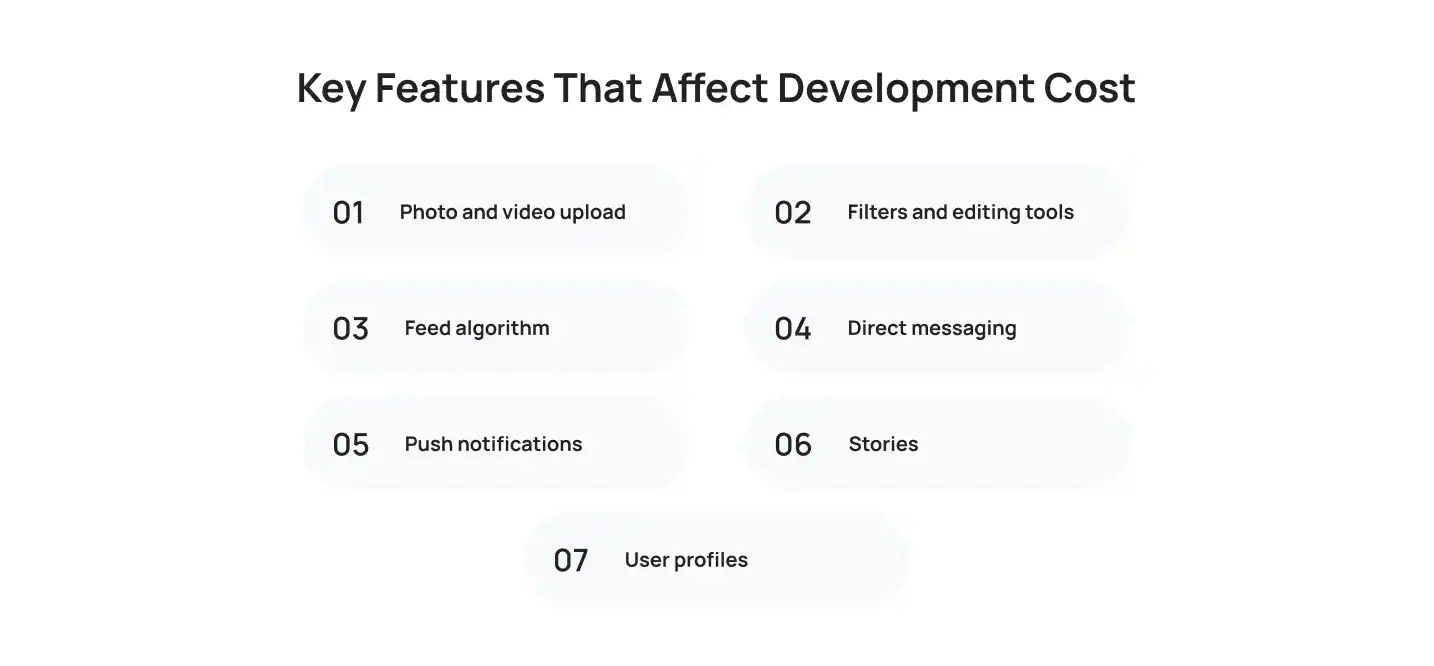
- Photo and video upload: The backbone of any photo and video sharing app, requiring efficient compression, smooth uploading, and reliable cloud storage to ensure performance even during peak usage.
- Filters and editing tools: Cropping, brightness adjustments, and visual effects that enhance user experience but also require additional development time, even when using third-party SDKs.
- Feed algorithm: One of the most complex and costly components, as a powerful news feed needs backend intelligence to analyze user behavior and deliver personalized content in real time.
- Direct messaging: Enables real-time private communication with features like media sharing and read receipts, requiring its own backend system.
- Push notifications: Essential for user retention, but must be carefully optimized to remain helpful rather than intrusive.
- Stories: Short-lived content that disappears after 24 hours, requiring auto-expiry logic and seamless navigation.
- User profiles: Include bios, follower metrics, and privacy controls that complete the experience of a modern social media platform.
These features collectively define the scope of your app, and each one directly impacts the overall development cost, complexity, and timeline.
Want to discuss your project? Our experts are just a click away.
Contact UsHow Much Does It Cost to Build an App Like Instagram?
Here’s where things get concrete. Costs vary depending on region, agency experience, and design complexity, but the table below reflects realistic 2026 market averages for building a fully functional app in this space.
| Development Phase | Estimated Cost (USD) | What It Covers |
| UI/UX Design | $8,000 – $30,000 | Wireframes, prototypes, user flow mapping, visual design |
| Frontend Development | $15,000 – $60,000 | Screens, navigation, animations, responsive layouts |
| Backend Development | $20,000 – $90,000 | Servers, databases, feed algorithm, user authentication |
| APIs & Integrations | $5,000 – $25,000 | Payment gateways, social logins, third-party SDKs |
| Testing & QA | $5,000 – $20,000 | Bug fixes, performance testing, security checks |
| Maintenance (first year) | $10,000 – $40,000 | Updates, bug patches, server upkeep |
Add these up, and a fully featured build easily lands anywhere between $65,000 and $265,000, though that range can stretch higher depending on how ambitious your feature list gets.
For a deeper look at how these numbers apply across different app categories, this breakdown is worth exploring: mobile app development cost.
Development Cost by App Complexity
| App Complexity | Estimated Cost (USD) | Description | Key Features Included |
| Basic App | $15,000 – $45,000 | Ideal for startups validating an idea with minimal investment | Photo and video upload, likes, comments, basic UI |
| Mid-Level App | $45,000 – $150,000 | Suitable for startups building a competitive product | Stories, direct messaging, improved news feed, enhanced UI/UX |
| Advanced App | $150,000 –$500,000+ | Full-scale Instagram-like app with high scalability and performance | AI-based feed, live video, monetization tools, scalable backend, full feature set |
Platform-Wise Development Cost
Where you launch first changes your budget meaningfully; building exclusively for iOS tends to be somewhat more predictable and slightly cheaper than Android, mainly because Apple’s device ecosystem is far less fragmented, meaning fewer screen sizes and OS versions to test against. If you want the specific numbers behind this, this detailed look at estimated iOS app development cost breaks it down clearly.
| Platform Type | Estimated Cost (USD) | Development Time | Key Considerations |
| iOS App | $25,000 – $120,000 | 3 – 6 months | Less device fragmentation, smoother optimization, faster testing cycles |
| Android App | $30,000 – $150,000 | 4 – 7 months | Wider device compatibility, higher testing effort, larger global audience |
| Cross-Platform App | $40,000 – $140,000 | 3 – 6 months | Single codebase (React Native/Flutter), cost-efficient, faster time-to-market |
| Web App (Optional) | $15,000 – $50,000 | 2 – 4 months | Useful for admin panels, CMS, and broader accessibility |
Technology Stack for Application Development
The technology choices behind your app matter just as much as the feature list.
Frontend Technologies
React Native or Flutter for cross-platform builds, or Swift and Kotlin for native iOS and Android apps.
Backend Technologies
Node.js, Python (Django), or Ruby on Rails to handle user data, feed logic, and messaging at scale.
Database Solutions
PostgreSQL or MongoDB for structured and unstructured data, paired with Redis for caching frequently accessed content like trending posts.
Cloud Services
AWS, Google Cloud, or Azure for media storage, video processing, and content delivery. A content management system (CMS) built on top of these services helps admin teams moderate posts, manage user reports, and control what gets surfaced. Skimping on any of these layers tends to backfire once your user base starts growing.
Hidden Costs You Should Know
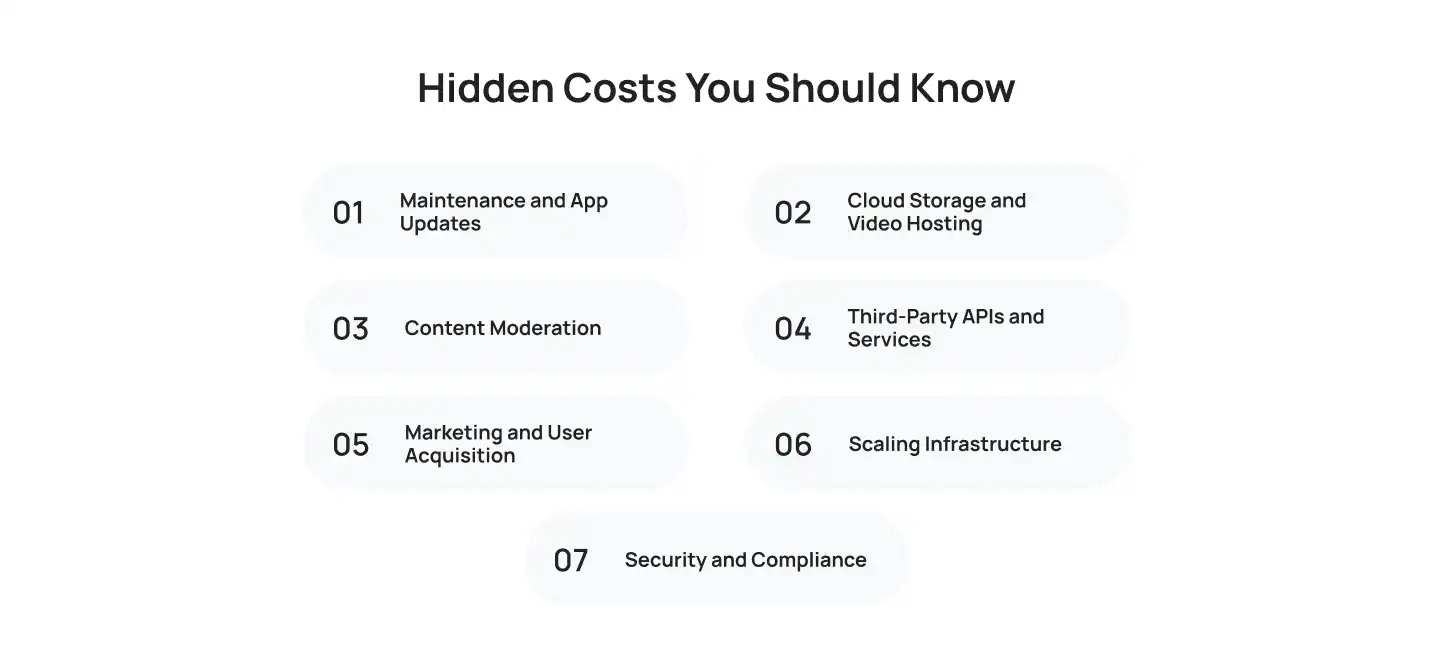
The initial development budget is only part of the total cost of launching a video-sharing app. Several expenses appear after launch and can significantly affect your overall budget.
Maintenance and App Updates
Most apps need ongoing maintenance for bug fixes, security patches, server management, and compatibility updates. These costs can add around 15% to 20% of the original development cost each year. A video-sharing platform may also require regular updates to support new compression standards, video formats, streaming technologies, and device versions.
Cloud Storage and Video Hosting
Video content consumes far more storage and bandwidth than text or image-based content. As users upload and watch more videos, your storage, CDN, and bandwidth expenses increase. Choosing the right cloud infrastructure early can help you manage these costs more effectively.
Content Moderation
User-generated video brings moderation requirements. You may need automated content detection, human reviewers, reporting tools, copyright checks, and systems for handling inappropriate or restricted content. These expenses can grow as the volume of uploaded content increases.
Third-Party APIs and Services
Video-sharing apps often depend on third-party services for payments, analytics, authentication, notifications, maps, advertising, or content processing. Many of these services charge based on usage, so monthly costs can increase as your user base grows.
Marketing and User Acquisition
Building the app does not guarantee users will find it. Marketing may require a separate budget for social media campaigns, influencer partnerships, paid advertising, app-store optimization, and creator incentives. In competitive content markets, user acquisition can become one of the largest post-launch expenses.
Scaling Infrastructure
Infrastructure costs rise as your audience grows. A platform designed for 10,000 users may need significant upgrades when it reaches 500,000 or more. Additional servers, databases, CDN capacity, storage, monitoring, and security resources can all increase your monthly operating costs.
Security and Compliance
Video platforms also need ongoing investment in data protection, account security, copyright management, privacy requirements, and regulatory compliance. The exact cost depends on your target markets, user data practices, and platform features.
How to Reduce App Development Cost
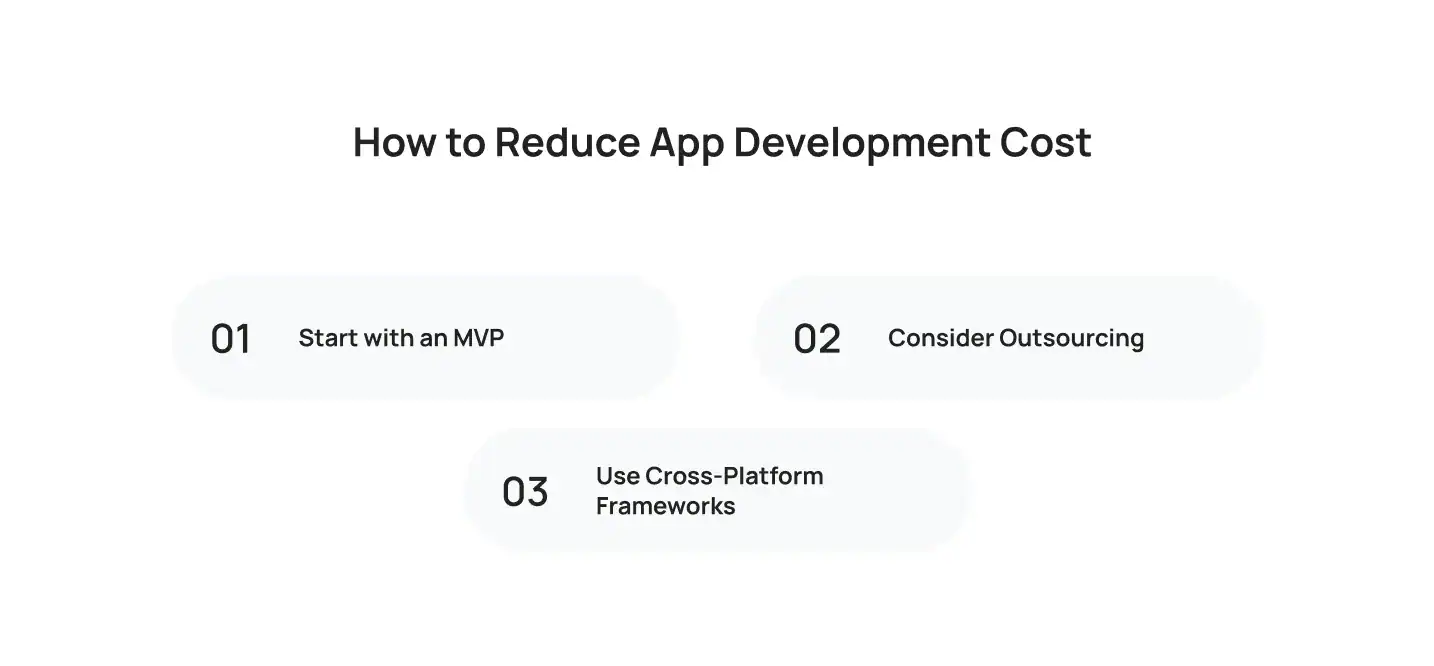
None of this means you need a six-figure budget to get started, though.
Start with an MVP
A stripped-down version with core features like uploading, profiles, and a basic feed, launched fast enough to gather real user feedback before investing further. This guide on how to build a social media app walks through exactly how that phased approach plays out in practice.
Consider Outsourcing
Working with experienced agencies in regions with lower labor costs, such as Eastern Europe or South Asia, can significantly reduce budgets without sacrificing quality, provided you vet the team carefully.
Use Cross-Platform Frameworks
Building once and deploying to both iOS and Android remains one of the most reliable ways to keep costs manageable. Anyone still exploring the fundamentals should also check out this overview of mobile app development before locking in a technical direction.
Choosing the Right Development Company for Your Instagram-Like App

Launching an Instagram-like app requires more than copying its interface. Your development partner should understand social features, media handling, real-time communication, and cloud infrastructure.
When evaluating a development company, look for:
- Relevant portfolio: Experience building social, media, or content-driven applications.
- Technical expertise: Strong capabilities in mobile development, APIs, cloud, AI/ML, and real-time features.
- End-to-end development: Support from product strategy and UI/UX to development, testing, and deployment.
- Scalability planning: Architecture that can handle growing users, content, and traffic.
- Post-launch support: Ongoing maintenance, updates, security, and performance improvements.
Looking for a trusted partner for mobile app development services?
Cubix is here to help. With 18+ years of software development experience, 1,300+ digital products delivered, and 600+ global clients, Cubix combines expertise in mobile development, AI/ML, cloud technologies, and UI/UX to build feature-rich applications tailored to your business goals.
Want to discuss your project? Our experts are just a click away.
Contact UsConclusion
If you’ve decided to invest in building an app like Instagram, you’re stepping into a space with enormous potential. But success doesn’t come from trying to recreate every Instagram feature from day one. It starts with knowing what your audience needs and where your budget should go.
A basic MVP can start at around $15,000, while a more advanced platform with AI-powered features, live video, monetization, and a robust backend can cost $150,000 or more. Your final investment will depend on the features, platform, technology stack, development team, and level of complexity you choose.
The smarter path is to start focused, test your idea with real users, and build from there. A well-planned MVP gives you room to learn, improve the product, and add advanced features as your user base grows.
And if you’re looking for the right team to bring your idea to life, Cubix can help. With 18+ years of software development experience, 1,300+ digital products delivered, and 600+ global clients, Cubix combines expertise in mobile app development, UI/UX, AI/ML, cloud technologies, and backend engineering to build feature-rich social media applications.
“Great social platforms are built around people, not just features. The right technology turns that understanding into an experience users want to come back to.” – Salman Lakhani, CEO at Cubix.
Frequently Asked Questions
Still have questions about the cost, features, timeline, or technology behind an Instagram-like app? Here are concise answers to some of the most common questions businesses ask before starting development.
1. How much does it cost to build an app like Instagram?
Building an app like Instagram can cost around $15,000 to $500,000+, depending on features, complexity, technology, platform, and development team.
2. How long does it take to develop an app like Instagram?
A basic Instagram-like app can take around 3 to 6 months, while advanced platforms with AI, live video, messaging, and complex backend systems may take longer.
3. What features should an Instagram-like app have?
Core features include user profiles, photo and video uploads, feeds, likes, comments, stories, direct messaging, push notifications, and content sharing.
4. What technology stack is used to build an app like Instagram?
Common technologies include React Native or Flutter for cross-platform development, Swift and Kotlin for native apps, Node.js or Python for backend development, and PostgreSQL or MongoDB for databases.
5. How can I reduce the cost of building an Instagram-like app?
Start with an MVP, prioritize essential features, use cross-platform development, and add advanced functionality after validating the product with real users.