Key Takeaways
- Create an online marketplace like eBay by combining auction-based and fixed-price selling with a user-friendly buying experience.
- Successful marketplaces need clear planning, technical skill, and strong vendor management from day one
- Scalability, seller autonomy, secure payments, and mobile-first design are now essential
- Real-time auctions and order management help drive user engagement and trust
- A well-planned online marketplace app can connect multiple sellers with buyers while creating opportunities for sustainable business growth.
Online marketplaces now shape most eCommerce activity worldwide. As of August 2026, 67% of global e-commerce transactions take place on marketplace platforms. They have become the main engine of digital commerce.
eBay’s $22.2 billion GMV in Q1 2026 highlights this success. With its long history in auctions and multi-vendor selling, eBay remains a favorite for buyers and sellers looking for variety, price competition, and reliable buyer protection.
There’s more to the appeal than scale alone. Multi-vendor models create powerful network effects. Vendors flock to platforms with broad audiences, while buyers want access to a huge range of products. eBay’s auction format adds excitement and lets prices adjust to real demand. As a result, participation grows, and buyers and sellers keep coming back.
If you want to tap into this trend, building a marketplace like eBay offers a proven route to reach a global customer base and drive high transaction volumes.
Want to discuss your project? Our experts are just a click away.
Contact UsEssential Features of an Online Marketplace eBay-Like Marketplace
An eBay-like marketplace needs a flexible platform that supports both auction-based bidding and fixed-price “Buy It Now” purchases. Essential features of a successful marketplace platform include multi-vendor management, real-time bidding, secure payments, product listings, order management, and ratings and reviews, creating a reliable and trusted experience for both buyers and sellers.
Core Capabilities Every Marketplace Needs
Competing with platforms like eBay demands far more than a product catalog. You need:
- Multi-vendor listings: Support many sellers in shared categories, with inventory and pricing control
- Seller onboarding and management: Self-serve registration, plus optional KYC for compliance and safety
- Advanced search and filtering: Buyers search by category, keyword, price, rating, and location
- Auction and fixed-price sales: Enable both formats so users can bid or buy instantly
- Secure payments: Accept credit cards, digital wallets, and possibly crypto, all with PCI compliance
- Order and dispute tools: Simple tracking and resolution features boost trust for both parties
- Ratings and reviews: Verified feedback helps buyers make good choices and keeps sellers honest
- Mobile-first design: Most users shop on mobile, so a responsive site or app is now required
Without these basics, marketplaces struggle to build trust and grow reliably.
Features Comparison: eBay and Other Major Marketplaces
| Feature | eBay | Amazon | Etsy | Facebook Marketplace |
| Auction System | Yes | No | No | No |
| Seller Autonomy | High | Moderate | High | High |
| Product Categories | Broad (new & used) | Broad (mainly new) | Handmade, vintage | General |
| Buyer Protections | Extensive | Extensive | Moderate | Basic |
| Listing Fees | Per item + final value fee | Monthly + referral fees | Listing + transaction fee | None |
eBay stands out for its auction system and seller freedom. Other marketplaces focus on fulfillment services or niche product types, but few combine auctions and broad listings as effectively.
Marketplace Models for Used Goods and Auctions
Marketplace models for used goods and auctions connect buyers and sellers to trade pre-owned items using fixed prices, dynamic bidding, or hybrid formats. Popular platforms like eBay and monetize through listing fees, final value commissions, or featured promotions.
Exploring Marketplace Structures
The business and technical framework you choose will shape your whole platform. Common options are:
- Peer-to-peer: Individuals sell direct to each other, reducing overhead but raising fraud risk
- Hybrid B2C and C2C: Combine businesses and individual sellers for more inventory and options
- Auction vs. fixed price: Some systems rely on timed bidding, others on set prices. Many, like eBay, mix both
The right model depends on your target audience. Auction formats work best for collectibles and rare items, while general items often sell quicker at fixed prices.
Auction System Adoption and User Behavior
Bidding online is now mainstream. In 2026, 45% of US online shoppers have participated in online auctions. In addition, 68% of auction purchases now happen on mobile. Buyers want simple, fast bidding, especially on mobile devices.
These numbers prove buyers embrace competitive formats, so mobile capability is more than a nice-to-have.
Marketplace Model Options
| Model Type | Description | Monetization Methods | Example Platforms |
| Auction | Timed bidding for items | Listing fees, commissions | eBay, Copart |
| Fixed Price | Instant buy at set price | Subscription, commission | Amazon, Etsy |
| Classifieds | Buyer and seller connect directly | Ad fees, listing upgrades | Craigslist, OLX |
| Hybrid | Mix of auctions and fixed price | Combined approaches | eBay, Catawiki |
Auction-driven models attract enthusiasts, while fixed price supports high-velocity sales. Blending both can expand your reach.
Step-by-Step Process to Build An Online Marketplace Like eBay
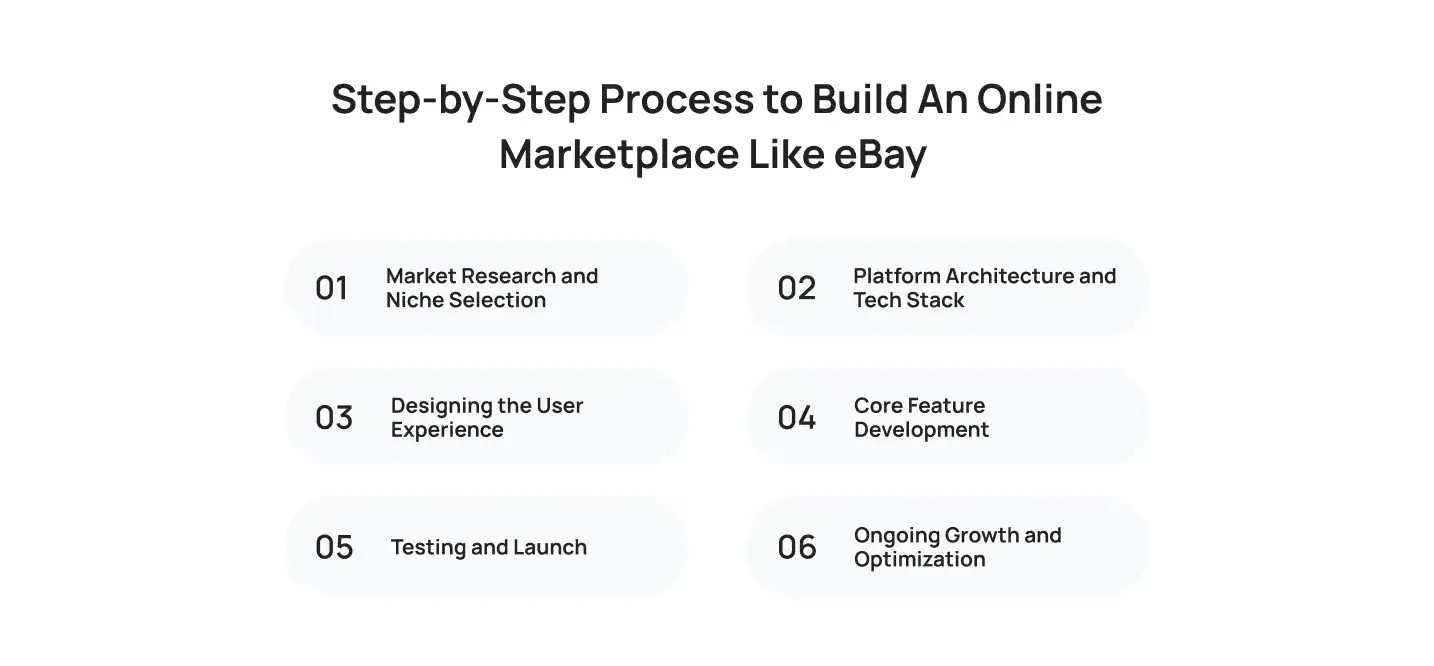
Building an online marketplace like eBay requires navigating a peer-to-peer (C2C) business model, managing dual user bases (buyers and sellers), and handling complex real-time bidding logic. Success relies on choosing a tight niche rather than competing globally on day one.
1. Market Research and Niche Selection
Begin with data. Analyze top competitors and look for gaps, neglected categories, missing features, or underserved regions. Let the numbers guide your focus, not just gut instinct. Identify your ideal customer and shape your niche accordingly.
2. Platform Architecture and Tech Stack
Decide between custom builds and SaaS. Building from scratch brings maximum flexibility and scalability but adds cost and time.
Common tech stack choices:
- Frontend: React or Angular for responsive, scalable interfaces
- Backend: Node.js for real-time features and API speed; Django for Python shops
- Database: MongoDB or PostgreSQL for supporting large, complex catalogs
- Cloud: AWS or Azure provide reliable, scalable infrastructure
Your stack should support fast updates, security, and smooth integration as traffic grows.
3. Designing the User Experience
Design wireframes for every role:
- Buyers: search, product, checkout, profile screens
- Sellers: dashboard, inventory, orders, analytics
- Admins: moderation, user control, disputes
Mobile-first design is vital. Auctions close on mobile more often than desktop now.
4. Core Feature Development
Prioritize these features:
- Seller onboarding and KYC: Automate ID checks to reduce fraud and speed approval
- Product management: Streamline inventory uploads, photo management, and bulk edits
- Auction engine: Enable real-time countdowns, proxy bids, instant notifications, and fair close logic
- Payments: Integrate Stripe, PayPal, and Adyen for broad payment support
- Order management: Confirmations, tracking, refunds, and returns must be easy and transparent
- Dispute tools: In-platform ticketing and mediation to give users confidence
Strong admin tools and clear documentation are also crucial to scale smoothly.
5. Testing and Launch
Pilot with a small group of vendors and buyers. Simulate heavy use and edge cases with test data. Focus on:
- Security (code audits, PCI compliance)
- Performance (simulate high loads at auction closings)
- Usability (ensure non-technical sellers can use features easily)
Roll out incrementally and gather feedback to fix issues early.
6. Ongoing Growth and Optimization
After launch, drive growth by:
- Targeting vendor outreach and onboarding incentives
- Scaling up SEO and paid ads
- Launching referral and loyalty programs
Constant improvement, guided by real feedback, keeps your marketplace ahead.
Monetization Strategies for Marketplace Platforms
To create an online marketplace like eBay requires a structured approach, from identifying the right market and selecting the technology stack to developing core features, testing the platform, and scaling after launch. A clear development process helps create a secure, user-friendly, and scalable marketplace for buyers and sellers.
Revenue Models
The strongest platforms use more than just commissions. Blend multiple streams:
- Listing fees: Upfront charges for each item, best for premium or rare categories
- Final value commissions: Take a percentage of each sale, scaling with volume
- Subscription plans: Steady income and attracts professional sellers
- Premium placement: Charge for featured listings or promoted products
- Advertising: Turn site traffic into revenue with in-platform ads or affiliate offers
Mixing models spreads risk and improves cash flow reliability.
Monetization Comparison Across Marketplace Types
| Monetization Model | Pros | Cons | Best For |
| Commission | Scales with growth, low barriers | Income depends on transactions | eBay, Amazon, Etsy |
| Subscription | Predictable income, seller loyalty | Can deter new vendors | Niche B2B, SaaS platforms |
| Listing Fees | Upfront income per product | May drive away low-value sellers | Classifieds, auction sites |
| Premium Services | Upsell for higher margin | Needs clear value | Any marketplace |
Adapt your approach as your customer base and business needs evolve.
Technology Stack and Integrations For Online Marketplace Like eBay
Choosing the right technology stack is essential for building a secure, scalable, and high-performing marketplace like eBay. The platform should use reliable technologies for the frontend, backend, database, payments, real-time auctions, search, and cloud hosting to support seamless growth and user experiences.
Recommended Marketplace Tech Components
A modern, multi-vendor platform relies on the following:
- Frontend: React, Angular, or Vue.js for fast, interactive interfaces
- Backend: Node.js and Django power APIs and real-time features
- Database: MongoDB (flexible, NoSQL) or PostgreSQL (reliable, relational)
- Payments: Stripe, PayPal, Adyen for secure, global payments
- Real-time: Socket.io or Pusher for live auctions and notifications
- Search: Elasticsearch or Algolia for fast, powerful search and autocomplete
Technology Stack Breakdown for eBay-Like Platforms
| Layer | Recommended Tools/Frameworks | Why Use Them? |
| Frontend | React, Angular | Fast, scalable, component-based |
| Backend | Node.js, Django | Real-time support, scalable APIs |
| Database | PostgreSQL, MongoDB | Handles large, complex product catalogs |
| Payments | Stripe, PayPal, Adyen | Global reach, PCI compliance |
| Real-Time Engine | Socket.io, Pusher | Live auctions, instant messaging |
| Hosting | AWS, Azure, Google Cloud | Scalability, reliability |
Choose tools that match your platform’s future needs, not just today’s.
Mobile Marketplace App Development
Build a seamless mobile marketplace experience with secure transactions, intuitive navigation, real-time updates, and powerful seller and buyer features. Explore Mobile App Development to learn more about developing high-performing mobile applications.
Mobile-First Trends in Marketplace Usage
Most auction transactions now happen on mobile. In 2026, 75% of online auction sales take place on phones or tablets. Responsive web and native apps reach more users, while features like in-app chat and notifications drive repeat visits.
Mobile App Features Checklist
Key features to include:
- Push notifications: Real-time alerts for bids, sales, and messages drive engagement
- Camera integration: Sellers can list items quickly using their phones
- Mobile wallet support: Accept payments through Apple Pay, Google Pay, and local wallets
- In-app chat: Buyers and sellers can negotiate or resolve questions instantly
These increase sales speed and user loyalty.
Native vs. Cross-Platform Marketplace App Development
| Approach | Pros | Cons | Tools/Frameworks |
| Native | Top performance, full device access | Higher cost, slower to develop | Swift (iOS), Kotlin (Android) |
| Cross-Platform | Quicker launch, lower cost | Potential for minor performance trade-offs | Flutter, React Native |
Choose native for performance, or cross-platform for faster, more affordable launches.
Seller and Vendor Management Best Practices
Onboarding and Self-Service Tools
Fast onboarding drives growth. Use automated KYC to cut fraud and speed signup. Give each seller a custom dashboard to manage:
- Inventory and pricing
- Orders and fulfillment
- Analytics and payouts
Tools for editing listings, processing refunds, and running promotions make it easier for sellers to succeed.
Attracting and Retaining Vendors
Sellers have many options. Set your marketplace apart by focusing on:
- Low, transparent fees: High fees push away all but the largest sellers
- Marketing and analytics: Help vendors market their products and track performance
- Reliable payouts: Fast, predictable payments keep vendors happy
- Clear policies: Rules for disputes, prohibited items, and listings reduce confusion
Accessible onboarding guides and helpful support teams improve seller retention.
Seller Management Features in Leading Marketplaces
| Platform | Seller Onboarding | Analytics Tools | Marketing Support | Payout Flexibility |
| eBay | Automated, quick approval | Advanced, real-time | Promotions, ads | Multiple options |
| Amazon | Manual and automated | Detailed sales reports | Sponsored listings | Bi-weekly |
| Etsy | Simple, guided setup | Basic shop stats | Offsite ads, promotions | Weekly |
| Minimal, social login | Basic page insights | Limited | Direct via Messenger Pay |
eBay stands out for real-time analytics, flexible payouts, and seller-focused marketing tools. Other platforms emphasize simplicity or speed, but often offer fewer features.
Cost Breakdown and Timeline to Build a Marketplace Like eBay
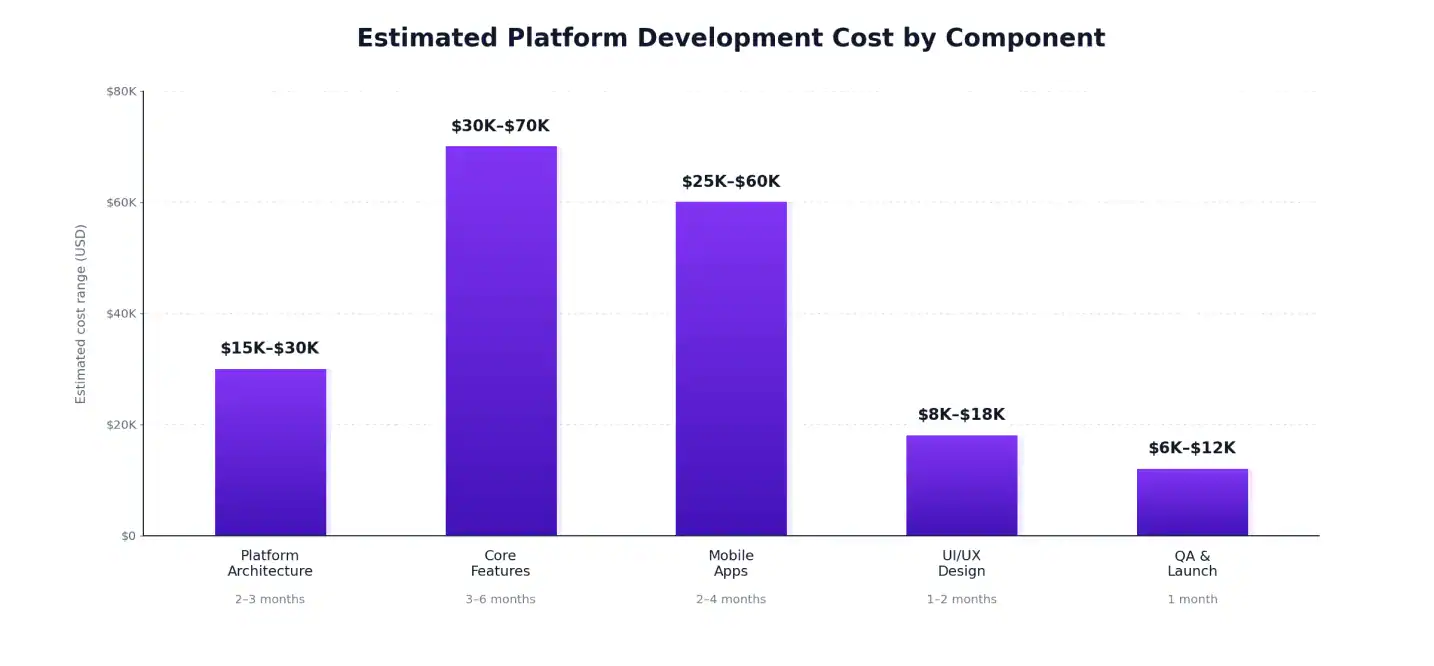
The cost to build a marketplace app like eBay is typically between $84,000 and $190,000+ and takes around 6 to 12 months to develop. The final cost and timeline depend on the platform architecture, core features, mobile apps, UI/UX design, testing, and overall project complexity.
Key Cost Drivers
Several factors drive costs upward:
- Custom features: Building real-time auctions and advanced seller tools takes time and money
- Payment integrations: Supporting multiple currencies and countries adds complexity
- Mobile development: Creating both iOS and Android apps increases cost, though cross-platform methods help
- Scalable hosting: Handling thousands of concurrent users demands robust cloud resources
Experienced teams and proven frameworks help control costs and avoid common pitfalls.
Marketplace Development Cost Table
| Component | Estimated Cost Range | Timeline Estimate |
| Platform Architecture | $15,000 – $30,000 | 2 to 3 months |
| Core Features | $30,000 – $70,000 | 3 to 6 months |
| Mobile Apps | $25,000 – $60,000 | 2 to 4 months |
| UI/UX Design | $8,000 – $18,000 | 1 to 2 months |
| QA & Launch | $6,000 – $12,000 | 1 month |
| Total | $84,000 – $190,000+ | 6 to 12 months total |
Complexity, market size, and your automation goals will affect both cost and build time. Phased launches help manage investment and reduce risk.
How to Attract Vendors and Grow Your Marketplace
Vendor growth fuels your marketplace. Focus on:
- Competitive pricing: Offer introductory rates and keep upfront costs low
- Simple onboarding: Automate signups, product imports, and verification steps
- Strong support: Provide personalized help and clear resources to speed listing and fulfillment
- Marketing and analytics: Give sellers dashboards and paid promotion options
- Trust-building: Offer feedback systems and transparent policies for disputes and prohibited goods
- Regular communication: Use newsletters, updates, and open feedback to keep vendors engaged
A sense of community and quick support make your marketplace the go-to choice for sellers in your niche.
Build a Marketplace That Scales with Cubix
Choosing a skilled partner is essential for a scalable, high-performing marketplace. Cubix specializes in building powerful multi-vendor eCommerce platforms modeled on proven success stories like eBay.
Clients rely on Cubix for complete web and custom mobile app development services, from initial planning to post-launch growth. The Cubix team brings hands-on experience with features such as real-time auction engines, advanced seller dashboards, international payment support, and scalable, cloud-based infrastructure.
Sellers and platform admins benefit from intuitive onboarding, in-depth analytics, and simple product management, each element designed to drive conversions and minimize support needs. Cubix also provides Android application development services, helping businesses deliver seamless mobile experiences across platforms.
When you want a marketplace that grows with your revenue, keeps buyers and sellers engaged, and operates at a global scale, Cubix delivers the experience and results you need. Learn more about how to create an online marketplace like eBay with Cubix’s rapid product strategy framework.
Want to discuss your project? Our experts are just a click away.
Contact UsFrequently Asked Questions
1. How do I create an online marketplace like eBay from scratch?
Start with market research to identify a promising niche. Develop your requirements by analyzing competitors and user needs. Pick a tech stack that fits your goals and budget, React or Angular on the frontend, Node.js or Django for the backend, and scalable cloud hosting. Include features like multi-vendor listings, seller onboarding, integrated payments, order management, and dispute resolution. Launch with a closed beta and collect feedback before scaling up.
2. How to attract vendors to your marketplace?
Offer low startup costs and competitive commissions. Streamline onboarding with self-service dashboards and automated verification. Give vendors strong marketing and analytics tools to help them grow. Fast payouts and clear platform rules build trust. Regular updates and personalized support keep vendors invested.
3. What kind of marketplace models can I build for used goods?
Popular models include peer-to-peer platforms for direct sales, hybrid B2C and C2C models mixing business and consumer sellers, and systems blending auctions with fixed prices. Each has specific needs for vetting, dispute handling, and user experience, so choose based on your target audience.
4. Can I allow sellers to list and manage their own products?
Yes. Modern marketplaces offer sellers dashboards to upload products, track inventory, set prices, analyze data, and fulfill orders. Automation and easy self-service are now standard for scaling operations.
5. What core features should an eBay-style marketplace have?
You need multi-vendor listings, advanced search and filtering, both auction and fixed-price sales, secure payment processing, verified ratings and reviews, mobile-first design, and real-time support for orders and disputes. Flexible onboarding and detailed analytics add even more value for sellers.
6. How much does it cost to develop a marketplace platform?
Costs depend on features, scale, and tech choices. Most builds run from $84,000 to $190,000 or more over 6-12 months. Real-time auctions, native mobile apps, and international payment support increase costs. Working with an experienced team and launching in phases helps manage your budget and speed up returns.
7. How can I create an online marketplace platform?
To create an online marketplace, start by choosing your niche and business model, then define the required features, select a suitable technology stack, design the user experience, and develop the platform. Essential features include seller management, product listings, search, payments, order management, and reviews. Test the platform with a small group of users before launching and scaling.
8. Who is eBay’s biggest competitor?
Amazon is one of eBay’s biggest global competitors, particularly in online retail and marketplace sales. Other major competitors include Walmart Marketplace, Etsy, and Alibaba, depending on the product category and target market.
9. How much does it cost to start an online marketplace?
The cost depends on the platform’s features, technology, design, integrations, and mobile app requirements. Based on the development estimates outlined above, a custom marketplace like eBay can cost around $84,000 to $190,000+, with development typically taking 6 to 12 months.
10. How does an online marketplace make money?
An online marketplace can generate revenue through seller commissions, listing fees, transaction fees, subscription plans, featured listings, advertising, and premium seller services. Using multiple revenue streams allows the platform to increase earnings as buyer and seller activity grows.