If you have started collecting quotes for your software project, you have probably noticed the numbers vary a lot. One agency quotes $30,000, another says $300,000, and a third comes in even lower. So what explains the gap?
The cost to hire a software development company depends on team location, experience, project requirements, and the engagement model you pick. According to the Bureau of Labour Statistics, the average hourly wage for a software developer in the United States is $63.91, which works out to about $132,930 per year.
We have built and priced custom software at Cubix since 2008, so we see these numbers up close every day. This guide walks through the industry benchmarks for custom software development in the USA for 2026, helps you set a realistic budget, and shows how we price projects at Cubix along the way.
Why Talk to Cubix Before You Budget Your Project
Before you commit to a number, it helps to talk to a team that builds transparent quotes for a living. We are a full-cycle software development company, and we have delivered custom software, mobile apps, and enterprise platforms for brands like Estee Lauder, Clinique, and Swatch Group. Because we break every quote down by phase, role, and hour, you always know what you are paying for before the project starts.
What Is the Average Cost to Hire a Software Development Company in 2026
Software development pricing is not one fixed number. It shifts based on where the team sits, how the project is structured, and how complex your product is. Here is the general picture before we get into the details.
These figures are starting benchmarks, not fixed prices. The rest of this guide explains why the numbers swing so widely, and how working with a partner like Cubix can help you land closer to the low end without cutting corners.
By Hourly Rate
- US boutique and mid-size firms, including Cubix: $150-$250/hour
- US freelancers and independents: $75-$150/hour
- Nearshore firms in Latin America: $30-$82/hour
- Offshore firms in Eastern Europe and Asia: $25-$70/hour
- Big 4 consulting firms, such as Deloitte and Accenture: $300+/hour
By Monthly Team Cost
- Small dedicated team (2–3 developers), US-based: $25,000–$45,000/month
- Small dedicated team, offshore: $8,000-$18,000/month
- Medium team (4–6 developers), US-based: $50,000-$90,000/month
- Medium team, offshore: $16,000-$36,000/month
By Full Project Cost
- MVP or simple app: $25,000-$80,000
- Medium-complexity platform: $80,000-$250,000
- Enterprise-grade system: $250,000–$1,000,000+
Factors affecting software project pricing in the USA
Six factors explain most of the difference you will see between quotes. Our team walks clients through each one during scoping.
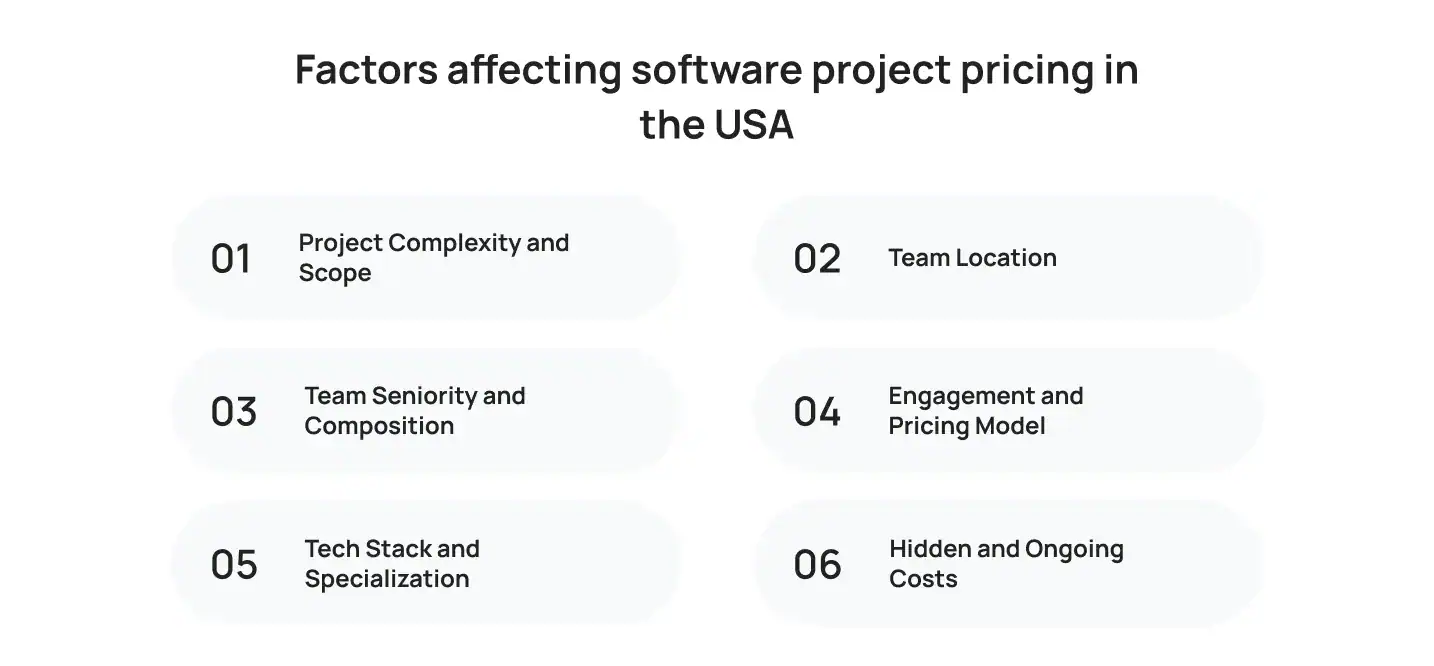
1. Project Complexity and Scope
A simple internal tool with a few screens costs far less than an enterprise platform with compliance needs and multiple integrations. Complexity is the biggest cost driver, even more than location or team size, so we start every engagement with a detailed scoping session.
2. Team Location
Where your development team sits has a major effect on rates. North America runs $80-$250/hour, while Western Europe runs $70-$180/hour. Eastern Europe sits lower at $25-$70/hour, and Latin America, a popular nearshore option for US clients, runs $30-$80/hour. Asia offers the lowest range at $15-$60/hour.
A US-based team does not always mean better quality. However, it usually means faster time zone alignment and fewer compliance headaches, which is one reason many companies choose a US-based partner like Cubix.
3. Team Seniority and Composition
Senior engineers cost more per hour, but they often finish faster and make fewer costly mistakes. This can make a project cheaper overall, even though the rate looks higher at first. Junior-heavy teams cost less per hour, although they may need more hours and more revisions to reach the same result.
4. Engagement and Pricing Model
How you structure the contract changes both cost and risk. Fixed price works best for well-defined, small-scope projects, while time and materials suits evolving requirements or long-term builds. A dedicated team model fits ongoing product work, since it acts as an extension of your in-house team. We offer all three models at Cubix, depending on where you are in your product journey.
5. Tech Stack and Specialization
Standard web and mobile work sits at the lower end of the rate scale. Specialized work, such as AI or cybersecurity, commands a premium, sometimes 25–40% above general development rates.
6. Hidden and Ongoing Costs
Initial development is rarely the full cost. You should also budget for post-launch maintenance, security audits, and hosting, since these costs add up quickly once your product goes live. We lay them all out upfront so nothing catches you by surprise.
Software Development Company Hourly Rates in the USA (2026)
If you are hiring on a time-and-materials basis, here is what to expect by role and seniority.
Rates by Experience Level
The hourly rate of US developers based on their expertise level
| Experience Level | Hourly Rate (USA) |
|---|---|
| Junior Developer | $55–$70/hour |
| Mid-Level Developer | $85–$110/hour |
| Senior Developer | $110–$200/hour |
| Specialized (AI, Cloud, Security) | $150–$250+/hour |
Rates by Firm Type
Average hourly rates for US software development companies
| Firm Name | Hourly Rate |
|---|---|
| Cubix | $150-$250/hour |
| Appinventiv | $150-$250/hour |
| Designli | $100–$250/hour |
| Itransition | $50–$150/hour |
Rates by Location
Geography is the clearest lever for cost, since quality at the low end and high end can look surprisingly similar.
| Region | Typical Hourly Rate | Best Fit |
|---|---|---|
| USA | $85–$250/hour | High control, same-timezone collaboration, regulated industries |
| Western Europe | $70–$180/hour | Strong technical depth, GDPR-native compliance experience |
| Eastern Europe | $25–$70/hour | Strong engineering talent, good overlap with US East Coast hours |
| Latin America | $30–$82/hour | Nearshore for US clients, real-time collaboration |
| India / Southeast Asia | $15–$60/hour | Lowest cost per hour, large talent pool |
The hourly rate is usually only part of the true cost. Once you add management overhead and ramp-up time, the total often runs 30–45% higher than the quoted rate, so we give clients a full project estimate instead of just an hourly number.
Software Development Project Cost by Size and Complexity
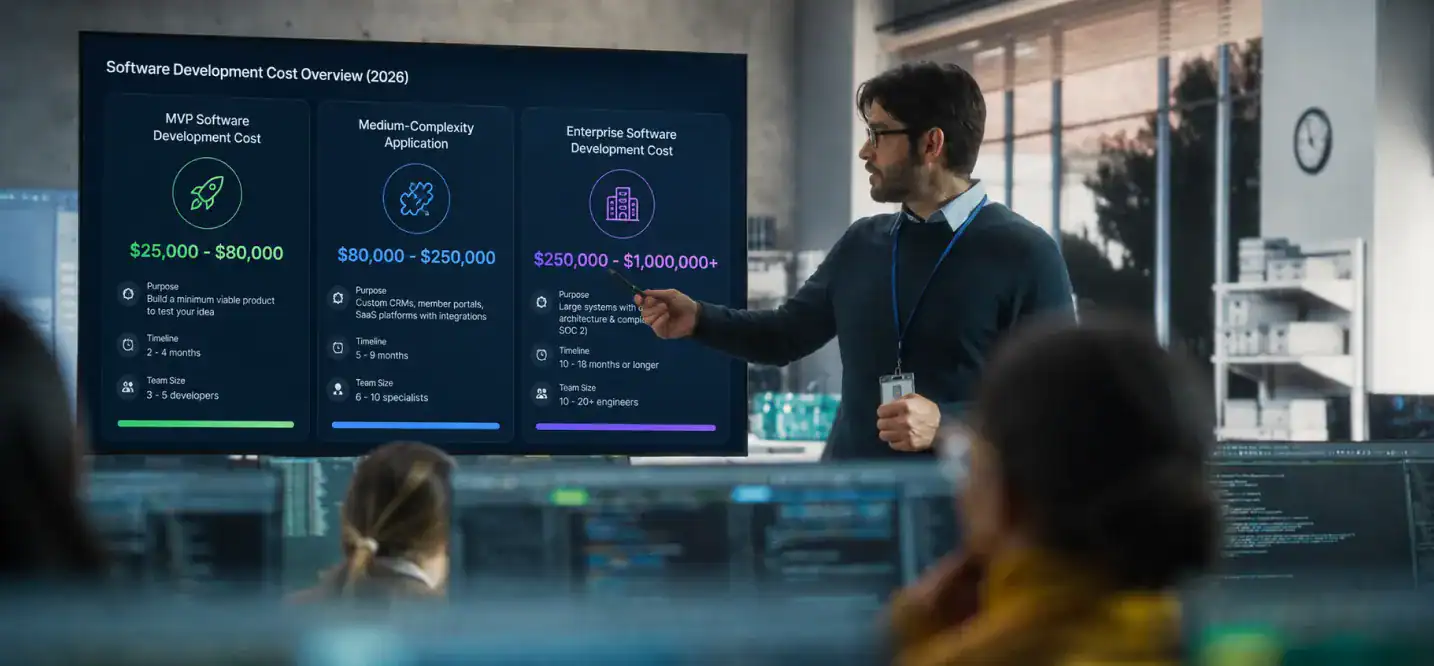
Most businesses don’t operate on an hourly basis. Rather, they consider the overall project cost, and here’s how things will be broken down in 2026.
MVP Software Development Cost: $25,000-$80,000
This covers a minimum viable product built to test an idea with real users. The timeline usually runs 2-4 months, with a small team of 3-5 developers, which makes it a good fit for early-stage startups.
Medium-Complexity Application: $80,000-$250,000
This range covers custom CRMs, member portals, or SaaS platforms with several integrations and a polished interface. Timelines run 5-9 months, and teams typically include 6-10 specialists.
Enterprise Software Development Cost: $250,000-$1,000,000+
For large systems, there is a need for distributed systems and compliance efforts, including HIPAA and SOC 2. Typically, these projects take 10-18 months or longer, and involve teams of 10-20 or more engineers.
How to Reduce Custom Software Development Cost Without Losing Quality
You can reduce software development company costs without compromising on quality. You can save more money without spending less by following these five paths to spending smarter.
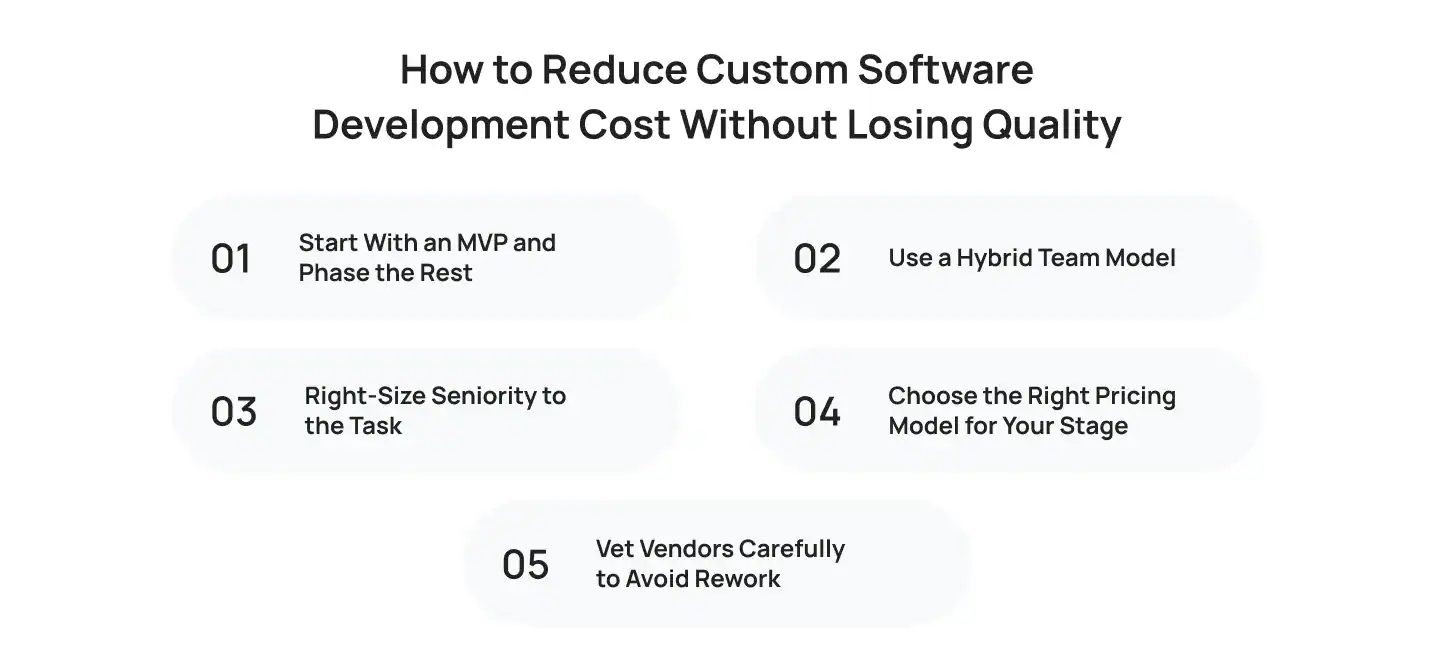
Start With an MVP and Phase the Rest
It’s best to get an MVP first and introduce the remainder of the features gradually.
Ship the smallest version that real users can use and then add another layer based on real usage. This is one of the best ways to manage cost as it will allow you to test demand before investing in features that no one would want. A $200,000 product idea reduced down to a $60,000 MVP is no compromise. It’s evidence of good planning.
Use a Hybrid Team Model
A few people at your company should take on the role of product leadership and product architecture (small core team) with a team in nearshore or offshore extension of delivery capacity. This way, you maintain control of your roadmap and yet benefit from lower-cost development.
Right-Size Seniority to the Task
Not all work requires a senior architect as someone can do some of the feature work at a lower level. Instead, senior talent should concentrate on the parts of the system with the high complexity.
Choose the Right Pricing Model for Your Stage
Typically, early stage projects that evolve over time are less expensive on time and materials than they appear to be in the fixed price quote. This is because fixed price vendors make a margin of safety for the inevitable changes that happen at that time.
Vet Vendors Carefully to Avoid Rework
It may seem counterintuitive, but a lower cost firm that writes buggy code is more likely to cost more when you add in rework. Check references and past case studies, and start with a smaller paid pilot before committing to a large engagement.
Our list of red flags to watch before hiring a development partner covers the warning signs to check for first.
Comparison between In-House Team vs. Agency vs. Freelancer vs. Offshore Software Development
Each hiring model comes with its own cost and tradeoffs. Here is how the four main options compare.
1. In-House Team
This option works best for long-term, ongoing product development. It carries the highest cost once you add salary, benefits, and recruiting, but it gives you the most control and institutional knowledge.
2. US-Based Agency
This is a strong middle ground, since the hourly cost runs higher than offshore options, but communication and accountability come easier. Compliance needs are often handled better too, which fits regulated industries or projects with tight coordination needs.
3. Freelancers
Freelancers are the cheapest option for small, well-defined tasks. They carry more risk for large projects, since there is no team redundancy if the freelancer becomes unavailable.
4. Offshore and Nearshore Development Teams
Offshore software development can save 40-60% compared to US in-house rates, with comparable technical quality from regions like Eastern Europe and Latin America. This model works best when you have strong project management to bridge time zones and communication gaps.
If you are comparing quotes from a vendor overseas, our breakdown of outsourcing software development costs covers that comparison in more depth.
Hidden Costs of Hiring a Software Development Company
The quoted project price is rarely the full cost of ownership. Plan for these five costs separately, and expect a partner like Cubix to lay them out clearly before you sign. Our detailed breakdown of hidden costs in software development covers each of these in more depth.
1. Post-Launch Maintenance
Software maintenance, including bug fixes and dependency updates, typically runs 15–20% of your build cost each year. So a $150,000 build might carry $22,500–$30,000 in yearly maintenance, which is worth budgeting for upfront.
2. Security Audits and Compliance
If you work in healthcare, finance, or another regulated field, plan for periodic security audits and compliance reviews. These can range from a few thousand dollars for a basic audit to six figures for enterprise-grade testing and certification.
3. Cloud Infrastructure and Hosting
The costs of cloud infrastructure, databases, and monitoring tools typically comprise an additional 15-20% of the initial budget. Although they might be lower for smaller applications, you’ll almost certainly need to invest more in cloud services once you begin earning revenue and traffic starts growing.
4. Third-Party Licensing and API Integrations
Third-party API usage, licensing fees, and specialized software such as payment processors, mapping services, and AI-models are typically paid separately and comprise an additional 5-15% of the initial budget.
5. Change Requests and Scope Creep
While not explicitly a hidden cost, changes to the initial scope, especially on fixed-price projects, can be budgeted for in the contract as change orders. A separate 20-30% should ideally be budgeted for, should the client have any last-minute requests.
How to Choose the Right Software Development Company for Your Budget

Picking the right vendor matters as much as the price itself. These steps help you compare quotes with confidence. Read our full guide on how to choose a software development company, which walks through the process step by step.
- Get 3–4 quotes for the same project brief, since a 200%+ spread between vendors on the same scope is common.
- Ask for a cost breakdown instead of just a total number, because a credible vendor can show you where the hours go by phase and role.
- Clarify the pricing model upfront, since fixed-price, hourly, and dedicated team quotes each include different things.
- Ask about post-launch costs separately, so maintenance, hosting, and support show up as their own line items.
- Check for compliance and security experience if it applies to your industry, and start with a smaller pilot project before committing to a full build.
Why Businesses Choose Cubix for Custom Software Development

Cubix is a software development company that businesses trust to build real, working products. We plan the project, build it, and support it after launch, so you always have one team to call.
What Sets Cubix Apart
Choosing a software partner comes down to trust, not just price. Here is why many businesses pick Cubix.
- Clear pricing. We break every quote down by phase and role, so you know what you are paying for.
- Real experience. We have built software for global brands and early-stage startups alike since 2008.
- One team, many skills. From web apps to mobile app development and AI, we handle it under one roof.
- No surprise costs. We flag maintenance, hosting, and compliance costs before the project starts, not after.
Final Thoughts
There is no single price tag for software development, since too many variables shape the final number. A focused MVP built offshore might cost $25,000, while an enterprise platform built by a US-based team with compliance needs can pass $500,000. To control the cost to hire a software development company, scope the project tightly, choose the right pricing model, and test your idea with an MVP before the full build. Reach out to Cubix, and we will walk you through a quote built around your specific project.
FAQs
1. How much does it cost to hire a software development company in the USA?
Software development companies in the USA typically charge $85–$250 per hour. Full projects range from $25,000 for a simple MVP to over $1,000,000 for an enterprise-grade platform, and most funded startup projects fall between $80,000 and $400,000.
2. Is it cheaper to hire a US company or an offshore company?
Offshore and nearshore companies are usually 40-70% cheaper per hour than US-based firms for similar technical quality. The tradeoff is less same-timezone overlap, since offshore teams often rely more on detailed written specs instead of real-time collaboration.
3. Which software development companies offer competitive pricing in the USA?
Pricing varies by firm size and specialization, so it helps to compare a few US-based options directly. Boutique firms like Cubix often price competitively against larger consultancies by keeping overhead lower while still offering senior-level talent and transparent quotes.
4. What is included in a software development company’s hourly rate?
A quoted hourly rate usually covers developer time, project management, and QA. It rarely includes post-launch maintenance, infrastructure costs, or third-party licensing fees, so budget those separately.
5. Can I get a cost estimate for custom software development from a US-based company?
Yes, most US-based custom software development services providers, including Cubix, offer a free scoping call and a detailed cost estimate before you commit to a contract.
6. How much does it cost to hire a software engineer, programmer, or developer directly?
Hiring an individual software engineer or programmer usually costs less per hour than hiring a full agency, since you are not paying for project management or QA on top. Independent developers in the USA typically charge $75-$150 per hour, though rates run higher for senior or specialized talent.