
Key Lessons:
- Hidden costs often emerge after launch through technical debt, maintenance, and ongoing operational expenses.
- Catching bugs early through testing and code reviews is significantly cheaper than fixing them in production.
- Poor documentation and developer turnover can slow projects and increase long-term costs.
- Third-party services, licensing fees, and infrastructure costs should be factored into budgets from the start.
- Clear requirements, proactive planning, and continuous monitoring help prevent budget overruns and costly rework.
You signed off on a budget. You hit your deadline. The project shipped. Six months later, your team spends more time patching old code than building new features, and nobody can explain where the money went.
A joint study by McKinsey and Oxford University found that large software projects run 66% over budget on average. That overage rarely traces back to one bad decision. These unexpected software project costs accumulate quietly, shifting funds away from innovation and driving up your total cost of ownership.
This is how hidden costs work in software development. Once you know where they hide, you can catch most of them before they grow into something expensive.
At Cubix, our software development services use transparent, engineering-first frameworks that eliminate hidden costs before they start. Our agile approach integrates automated code audits and proactive cloud optimization directly into your active development lifecycle. This prevents technical debt from accumulating, keeping your system scalable and your long-term maintenance predictable.
“Great software isn’t built by avoiding costs. It’s built by identifying them early, planning for them properly, and preventing small issues from becoming expensive problems later.” – Salman Lakhani, Founder & CEO, Cubix
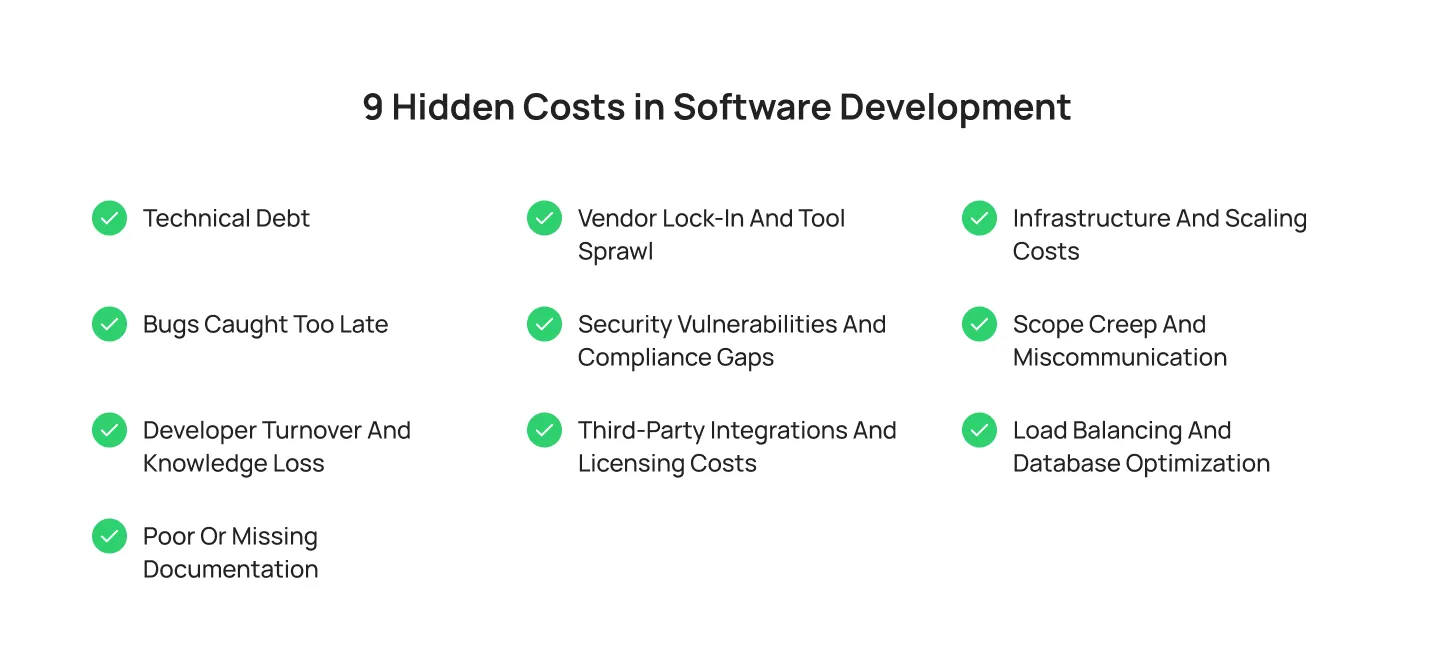
9 Hidden Costs in Software Development
Hidden costs show up in different parts of the development cycle, from the first line of code to the support ticket queue years later. Here are the seven that drain budgets the fastest.
1. Technical Debt
Technical debt is the cost of shortcuts taken to hit a deadline. You save time today and pay it back later, with interest. When businesses do not understand the underlying software development expenses, they treat debt as a secondary issue.
Common sources include:
- Skipped tests to meet a release date
- Hardcoded values instead of configurable settings
- Quick patches are used in place of a proper fix
- Old frameworks nobody has upgraded
Deloitte’s 2026 Global Technology Leadership Study found that technical debt now consumes 21% to 40% of total IT spending at the average organization. Left untracked, it slows every feature built on top of it.
How to avoid it:
- Log every shortcut in a tracked backlog, not just in someone’s memory
- Set a debt ratio and review it every quarter
- Reserve part of each sprint, often 15% to 20%, for paying debt down
- Refuse to let “temporary” fixes sit untouched past one release cycle
2. Bugs Caught Too Late
A bug found during development costs a fraction of what the same bug costs once it reaches customers.
What changes as a bug moves through your pipeline:
- Design stage: cheap to fix, often under an hour
- Development stage: still manageable, caught while the code is fresh
- Testing stage: costs climb as the team re-verifies related code
- Production stage: costs can reach 10x to 100x the original fix
Skipping QA to save time early almost always costs more later, once your team scrambles to patch a live issue under pressure.
How to avoid it:
- Run automated tests on every commit, not just before release
- Use a staging environment that mirrors production closely
- Require code review before anything is merged
- Treat QA as part of development, not a separate step at the end
3. Developer Turnover and Knowledge Loss
When a developer leaves, you lose more than headcount. You lose the reasoning behind old decisions. This issue creates a massive burden for businesses trying to scale operations smoothly.
That loss shows up as the following:
- Slower onboarding for the replacement
- Increased risk when touching legacy code
- Repeated questions nobody can answer quickly
- Lower team morale during the transition
Stripe’s Developer Coefficient research found that developers already spend over 17.3 hours on bad code, debugging, refactoring, and modifying it. Turnover adds onboarding time on top of that, and the new hire spends weeks reconstructing the context that they walked out the door.
How to avoid it:
- Pair junior and senior developers regularly, not just during onboarding
- Rotate ownership of critical systems so knowledge doesn’t sit with one person
- Conduct exit interviews focused on undocumented decisions, not just feedback
- Budget time for knowledge transfer before someone’s last day, not after
4. Poor or Missing Documentation
Code without documentation forces every new developer to reverse engineer decisions instead of reading them. Skipping this step turns a standard project into a maze of unverified dependencies. It also forces teams into difficult situations where they face the steep costs of switching software development partners due to unmaintainable codebases.
The downstream effects include:
- Longer ramp-up time for new hires
- Higher risk of breaking something nobody understood
- Bug fixes that take far longer than they should
- Heavy reliance on one or two people who “just know” the system
Documentation feels optional when you’re moving fast. It stops feeling optional the first time someone has to debug a system that the original author has already left.
How to avoid it:
- Require a short explanation of “why” alongside every non-obvious code change
- Keep documentation in the same repository as the code, not a separate wiki nobody opens
- Review and update docs during regular sprint cycles, not as an annual cleanup
- Make documentation part of your definition of done for any feature
5. Vendor Lock-In and Tool Sprawl
Every tool you adopt carries a maintenance tax, and every proprietary platform you build around gets harder to leave the longer you depend on it. This trap heavily complicates long-term development cost analysis metrics.
Watch for these warning signs:
- Data trapped in a format only one vendor supports
- Workflows built entirely around one platform’s quirks
- Redundant subscriptions nobody reviews
- Integrations that break when a vendor updates their API
Teams choose tools for speed, then discover years later that migrating away costs more than the original implementation did.
How to avoid it:
- Ask what it takes to leave a tool before you adopt it, not after
- Favor open standards and exportable data formats where possible
- Review your full tool stack once a year and cut what nobody uses
- Avoid building core business logic directly inside a third-party platform
6. Security Vulnerabilities and Compliance Gaps
Unpatched dependencies and rushed code reviews create security gaps that stay invisible until something breaks. Balancing speed and safety requires choosing the right delivery model, which is why selecting a full-cycle software development company helps teams mitigate these risks from day one.
These gaps usually trace back to:
- Outdated libraries with known vulnerabilities
- Weak authentication was added “for now” and never revisited
- Skipped security reviews under deadline pressure
- Missing audit trails in regulated systems
The Consortium for Information and Software Quality has estimated the cost of poor software quality in the United States at $2.41 trillion, a figure that includes operational failures and cybersecurity incidents tied directly to weak code. In regulated industries, a single compliance gap can also trigger fines that dwarf the cost of the fix.
How to avoid it:
- Automate dependency scanning so outdated libraries get flagged early
- Run a security review before every major release, not just once a year
- Build audit trails into regulated systems from day one
- Assign clear ownership for compliance instead of treating it as a shared afterthought
7. Third-Party Integrations and Licensing Costs
Most apps lean on outside services for payments, messaging, maps, analytics, storage, authentication, or AI features. These tools speed up development, but they make custom software development pricing models highly volatile if left unchecked.
Watch for:
- Payment gateway transaction fees
- SMS and email service charges
- AI and machine learning API costs
- Mapping and geolocation services
- Premium software licenses and subscriptions
Most teams budget for the integration itself and forget what comes after. Usage climbs, and the bill climbs with it. A line item that looked small at launch can turn into a real operational expense within a year.
How to avoid it:
- Audit every third-party service before development starts
- Understand pricing tiers and usage limits up front
- Forecast costs against your projected growth, not just current usage
- Review subscriptions regularly and cut what you don’t use
- Compare alternative providers before you commit long-term
8. Infrastructure and Scaling Costs
Teams plan for the cost of building software. They rarely plan for the cost of running it once people actually use it. Hosting, databases, storage, monitoring, and performance all cost more as your user base grows, especially when deploying a complex SaaS platform.
These costs show up as:
- Rising cloud hosting bills
- Database and storage upgrades
- Content delivery network (CDN) fees
- Monitoring and logging tools
- Backup and disaster recovery systems
A setup that handles a few hundred users without trouble can buckle under a few thousand. Growth is the goal, but it comes with a price tag you need to plan for, not discover after the fact.
How to avoid it:
- Estimate infrastructure costs during the planning stage, not after launch
- Design for scale from the start, even if you don’t need it yet
- Monitor usage and cloud spending on a regular schedule
- Load test before every major release
- Optimize resources so you’re not paying for capacity you don’t need
9. Scope Creep and Miscommunication
Unclear requirements lead to rework, and rework eats budget without ever showing up as a separate line item. Following an established framework like the standard software development lifecycle (SDLC) keeps phases organized and prevents goals from shifting mid-sprint.
This usually starts with:
- Requirements that were never written down
- Stakeholders who assumed something different from the team
- Mid-project changes that nobody re-scoped
- Features were built twice because the first version missed the mark
Clear requirements, written down and confirmed before development starts, prevent this from becoming a recurring tax on every project.
How to avoid it:
- Write requirements down and get stakeholder sign-off before development starts
- Re-scope and re-estimate any mid-project change instead of absorbing it silently
- Hold a short kickoff to confirm everyone shares the same understanding of the goal
- Flag scope changes openly instead of letting them slide into “just one more thing.
Why Hidden Costs Are Easy to Miss During Development
A software budget usually covers what you can see. Salaries, tools, and infrastructure. It rarely accounts for what happens after launch.
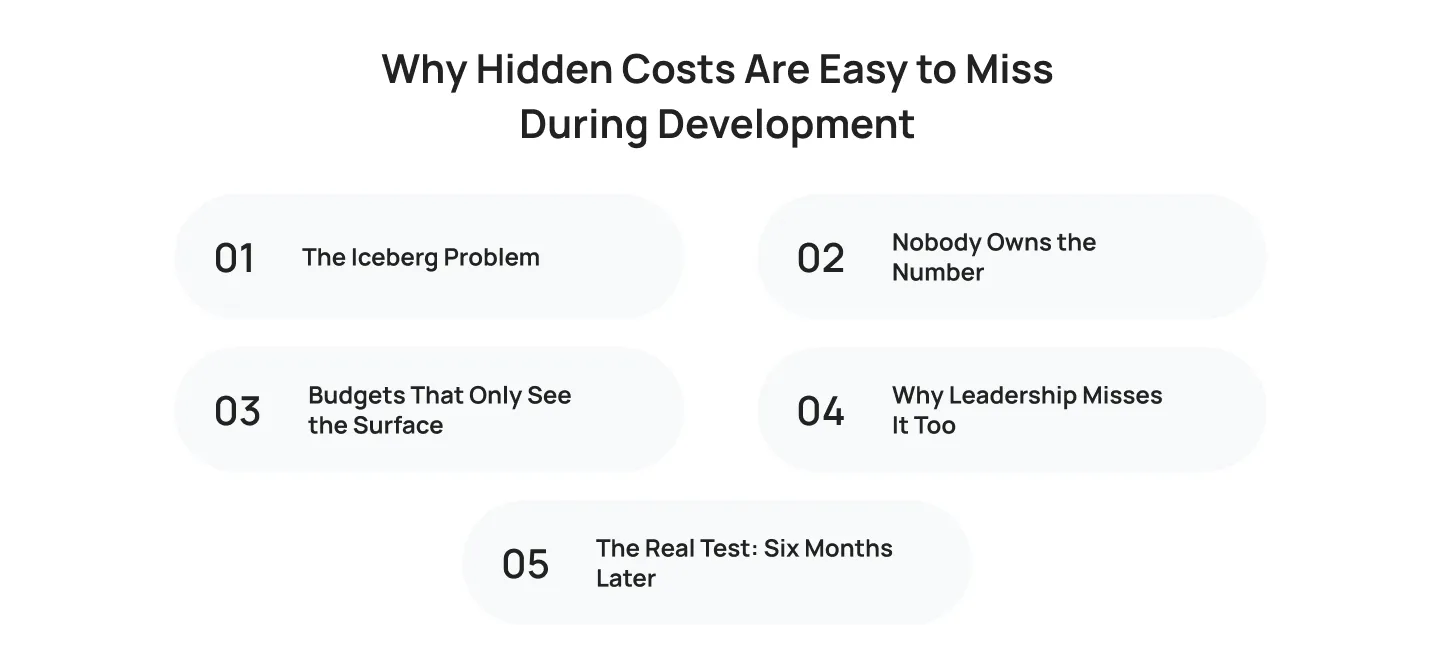
The Iceberg Problem
Think of your project budget as the tip of an iceberg. Visible costs sit above the waterline. Salaries, licenses, and contractor fees. Below it sits a much bigger mass: rework, knowledge loss, security patches, and the slow decline of code quality. You don’t notice this mass until your team runs into it.
Nobody Owns the Number
Hidden costs grow because no single person tracks them. Engineering blames unclear requirements. The product blames tight deadlines. Leadership blames slow delivery. Everyone has a piece of the explanation, and nobody has the full picture.
Budgets That Only See the Surface
Most project budgets plan for development time and launch. They rarely plan for the maintenance that follows. That gap is where hidden costs live, quietly, until someone finally adds them up.
Why Leadership Misses It Too
Executives see sprint velocity and feature counts. Those numbers look healthy even when the codebase underneath is falling apart. A team can ship fast and still lose money every week to invisible overhead.
The Real Test: Six Months Later
The clearest sign of hidden costs shows up after launch. Watch what happens to your release speed three or six months in. If every new feature takes longer than the last one, you’re already paying interest on decisions made earlier.
How to Catch Hidden Costs Before They Compound
You can’t eliminate every hidden cost. You can catch most of them early, which is where the real savings happen.

Track technical debt like a budget line, not an afterthought. Give it a number. Some teams use a “debt ratio,” comparing the estimated cost to fix known issues against the cost of new development. Whatever method you choose, make it visible to leadership, not just engineering. This visibility changes how you approach future development cost estimation processes.
Shift QA earlier in your process. Automated testing, code review standards, and staging environments that mirror production all reduce the number of bugs that reach your customers. The earlier you catch a defect, the cheaper it is by an order of magnitude.
Document decisions, not just code. When your team takes a shortcut, write down why. This single habit cuts onboarding time dramatically and prevents future developers from repeating the same costly mistake without knowing it was already a known risk.
Review your vendor and tool stack annually. Ask what each tool costs to maintain, not just what it costs to license. Cut anything that no longer earns its keep.
Protect your senior engineers’ time. They carry institutional knowledge that doesn’t show up in any document. Losing them costs far more than their salary suggests. Investing in your team’s knowledge base keeps development stable.
Build remediation into your roadmap. Reserve a percentage of every sprint; many teams use 15% to 20% for debt reduction and maintenance. This stops the iceberg from growing beneath you.
None of these steps is expensive. They’re disciplines. The companies that manage hidden costs well aren’t spending more money. They’re spending it earlier, when it’s cheaper to spend. For teams considering outsourcing software engineering roles, maintaining these exact evaluation standards keeps third-party contributors aligned with your internal benchmarks.
How Cubix Helps Clients Avoid Hidden Costs

We eliminate budget surprises before writing a single line of code by making development budget planning a core part of every project through a thorough discovery phase service. We build a clear Software Requirements Specification (SRS) document that acts as your technical blueprint, laying out every feature, workflow, and cost upfront.
This planning stops scope creep. Our designers build clickable prototypes to test your app with real users before engineers write the backend code. You find design flaws on screen mockups instead of paying to fix broken code later.
We map out your architecture and run automated tests from day one to prevent rework. We also track cloud resources in real time, so you only pay for what you use. This keeps your platform lean, fast, and exactly on budget.
Our Final Takeaway
You cannot build great software by ignoring the realities of maintenance. Launching your app is just the first step. Budget for the long haul. Invest time in clean code, good documentation, and early software testing from the very beginning.
These habits require discipline rather than a massive budget. Spending a little extra effort early protects your capital later. Keep your codebase clean, track your infrastructure costs monthly, and protect your bottom line from invisible drains.
Frequently Asked Questions
1. What are the hidden costs in software development?
Hidden costs are expenses that don’t appear in your original project budget but show up later as slower development, more bugs, higher maintenance needs, and lost productivity. Common examples include technical debt, late-stage bug fixes, developer turnover, and vendor lock-in.
2. How much does technical debt actually cost a company?
It varies by company size and industry. Over time, technical debt can consume a significant portion of a company’s engineering budget, forcing teams to spend more time maintaining existing systems than building new features. As technical debt accumulates, development slows, costs increase, and innovation becomes harder to sustain.
3. Why do bugs cost more the later they’re found?
Each stage of development adds context that a developer has to rebuild before fixing the defect. A bug found while you’re still writing the code is fresh in your mind. The same bug found in production requires reproducing the issue, coordinating across teams, and often managing customer-facing fallout, all of which multiply the cost.
4. Can you eliminate technical debt completely?
Some technical debt is a reasonable tradeoff for shipping faster. The goal isn’t zero debt. It’s visible, managed debt that you pay down on purpose instead of debt that piles up unnoticed until it blocks new work.
5. Is outsourcing development a way to avoid these hidden costs?
Outsourcing can lower some costs, like hiring overhead, but it introduces others, like knowledge transfer gaps and inconsistent code quality across teams. It doesn’t eliminate hidden costs. It shifts where they show up, so the same discipline around documentation, QA, and debt tracking still applies