Key Takeaways
- Game development outsourcing cuts costs without cutting quality.
- Small studios use it to access skills they can’t hire in-house.
- Full-cycle outsourcing covers art, coding, QA, and porting.
- The right outsourcing partner matters more than the price tag.
- Cubix builds full-cycle games for teams outsourcing across platforms.
The global games market will hit roughly $205 billion in 2026. That’s a real number, and it explains a lot. Studios everywhere are under pressure to build faster, spend less, and still ship a game people actually want to play. That pressure is exactly why game development outsourcing has become a normal part of how games get made, not a last resort.
Building an entire studio in-house takes time. You need artists, programmers, QA testers, and someone to manage all of them. Small teams don’t have that luxury. Bigger studios don’t always want the overhead either. So they outsource game development, either in pieces or as a full package, and keep their focus on the creative core of the game.
This guide walks through why studios outsource, what it actually costs, and how to pick a game development outsourcing company you can trust. We’ll also look at where a Custom Game Development Company fits into that decision. Real numbers, real comparisons, no fluff.
Ready to Outsource Your Game? Let’s Build It Right
Contact UsWhat Is Game Development Outsourcing?
Game development outsourcing means hiring an outside team to handle part or all of your game. That could mean one artist. It could mean an entire production pipeline.
Most projects break into three stages:
- Pre-production: concept art, prototypes, game design documents
- Production: coding, animation, level design, sound
- Post-production: QA testing, bug fixes, launch support
What Gets Outsourced Most Often
- Character and environment art
- Gameplay programming
- Porting a game to a new platform
- QA and compatibility testing
- Full-cycle production, start to finish
Roughly 68% of game studios say they outsource specifically to cut costs and get to market faster. That single stat explains why outsourcing keeps growing every year.
If you search “game development outsourcing” today, you’ll find hundreds of agencies. The hard part isn’t finding one. It’s finding the right one for your project.
In-House vs. Outsourced Game Development
Before you commit either way, it helps to see the tradeoffs side by side.
| Factor | In-House Team | Outsourced Team |
| Setup time | 3–5 months to hire | Days to weeks |
| Cost | Fixed salaries, year-round | Pay for what you use |
| Scalability | Slow to scale up or down | Scales with project needs |
| Talent access | Limited to local hiring | Global talent pool |
| Risk if someone leaves | Project stalls | Agency reassigns staff |
| Best for | Long-term core IP work | Art, QA, porting, full builds |
Neither option is wrong. Most successful studios actually blend both. They keep a small core team for creative direction and outsource game development for the execution-heavy work.
Cost and Speed Benefits of Outsourcing Game Development
This is where outsourcing wins most of its fans. Let’s break down why.
Lower Development Costs
Outsourcing game development can cut production costs by 40% to 60% compared to building an in-house team. That’s not a small saving. It’s often the difference between shipping a game and running out of runway first.
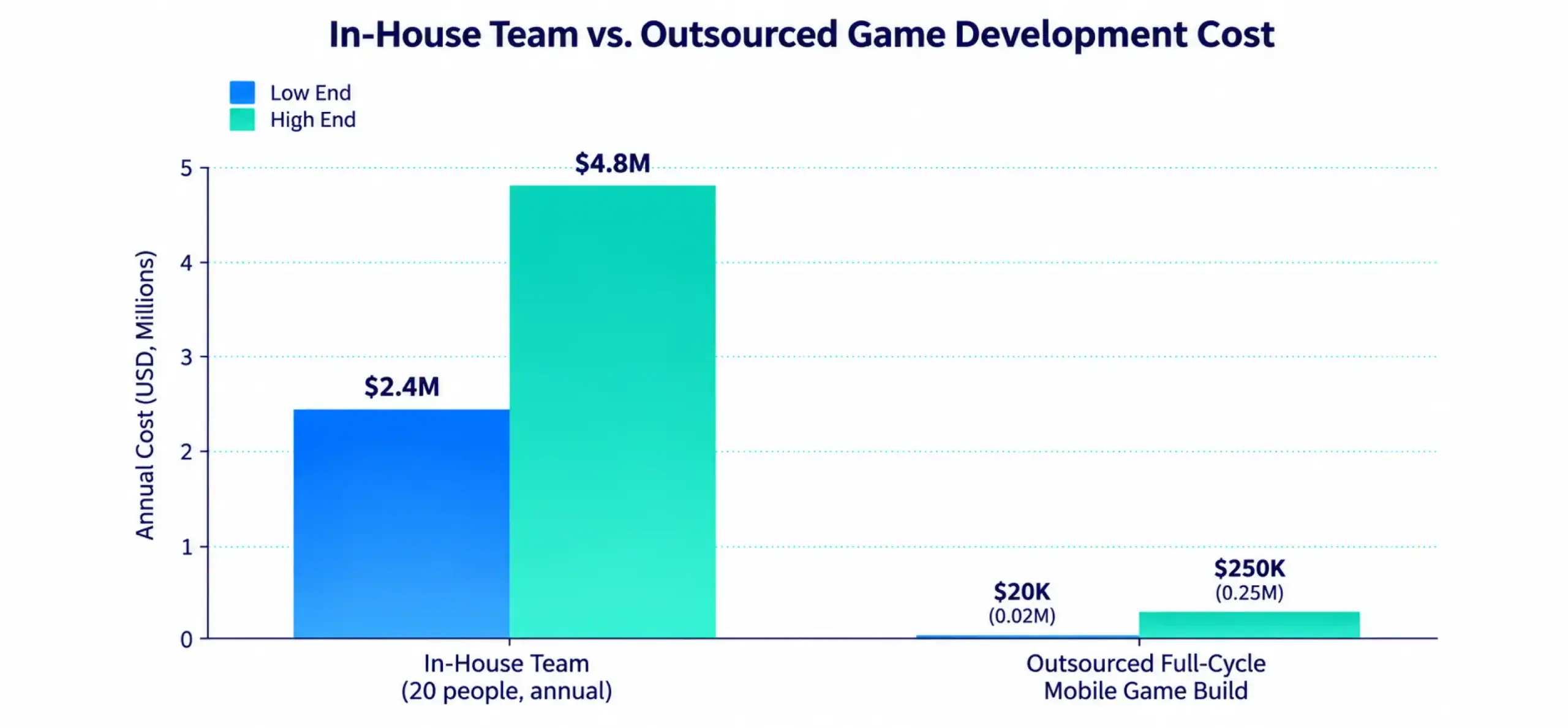
A 20-person in-house studio costs somewhere between $2.4 million and $4.8 million a year, once you count salaries, hardware, and office space. An outsourced full-cycle mobile build often runs between $20,000 and $250,000 total, depending on scope.
Faster Time to Market
Hiring senior in-house developers can take three to five months. An outsourcing agency can staff a project in days. When a market window is short, that speed matters more than people realize.
Quickly Scalable Teams
Need five more artists for two months? An outsourcing partner can usually make that happen without you signing a single new lease or laptop order.
Talent and Technology Benefits
Cost isn’t the only reason studios outsource. Access to people and tools matters just as much.
Access to Specialized Talent
Not every studio has an in-house VFX artist, a multiplayer backend engineer, and a narrative writer sitting around. Game development outsourcing companies already have that bench built. You tap into it without a year of recruiting.
Advanced Tools Without the Price Tag
Modern engines, motion capture rigs, and cloud build pipelines cost real money. A game development outsourcing agency already owns that infrastructure, and you share the cost across every client they serve, not just you.
Fresh Creative Input
An outside team sees your game with new eyes. That often means better ideas, not just faster execution.
Roughly 35% of outsourcing deals in recent years included AR/VR or blockchain elements as part of the build. That tells you outsourced teams are often more current on new tech than a small in-house crew has time to be.
Risk, Flexibility, and Quality Benefits
Outsourcing also solves problems that have nothing to do with money.
Better Risk Management
If your one key developer quits mid-project, an in-house team can stall for weeks. An agency reassigns staff and keeps moving. You’re not betting the whole project on one person.
Built-In Flexibility
Milestones shift. Scope changes. Outsourcing game development lets you scale help up or down as the project evolves, without the awkward conversation of laying anyone off.
Stronger Compliance and QA
Reputable outsourcing partners run structured, documented QA processes. That usually means fewer bugs slipping through and cleaner compliance reporting for console or app store submissions.
| Benefit | Business Impact |
| Risk management | Project keeps moving if staff changes |
| Flexibility | Scale team size to match milestones |
| Compliance & QA | Fewer bugs, smoother platform approval |
| Specialized services | Higher quality without new hires |
Around 40% of developers say communication gaps and inconsistent QA are their biggest outsourcing frustrations. That’s a real risk, but it’s also avoidable with the right partner and clear processes upfront, which we’ll cover further down.
Business Growth Benefits
Beyond the game itself, outsourcing changes how a studio runs.
Market Expansion
Working with a global team can open doors to new regions and new player bases you hadn’t considered.
More Time for Core Business
When execution work is outsourced, your leadership team can focus on strategy, publishing deals, and player growth instead of babysitting a build pipeline.
More Content, Faster
Outsourced art and design teams can produce new levels, skins, and seasonal content on a much faster cycle than one small internal team.
The mobile gaming segment alone makes up about 52% of global gaming revenue in 2026, close to $107 billion. Studios chasing that market can’t afford to move slowly.
How Much Does It Cost to Outsource Game Development?
This is the question everyone actually wants answered. So here it is.
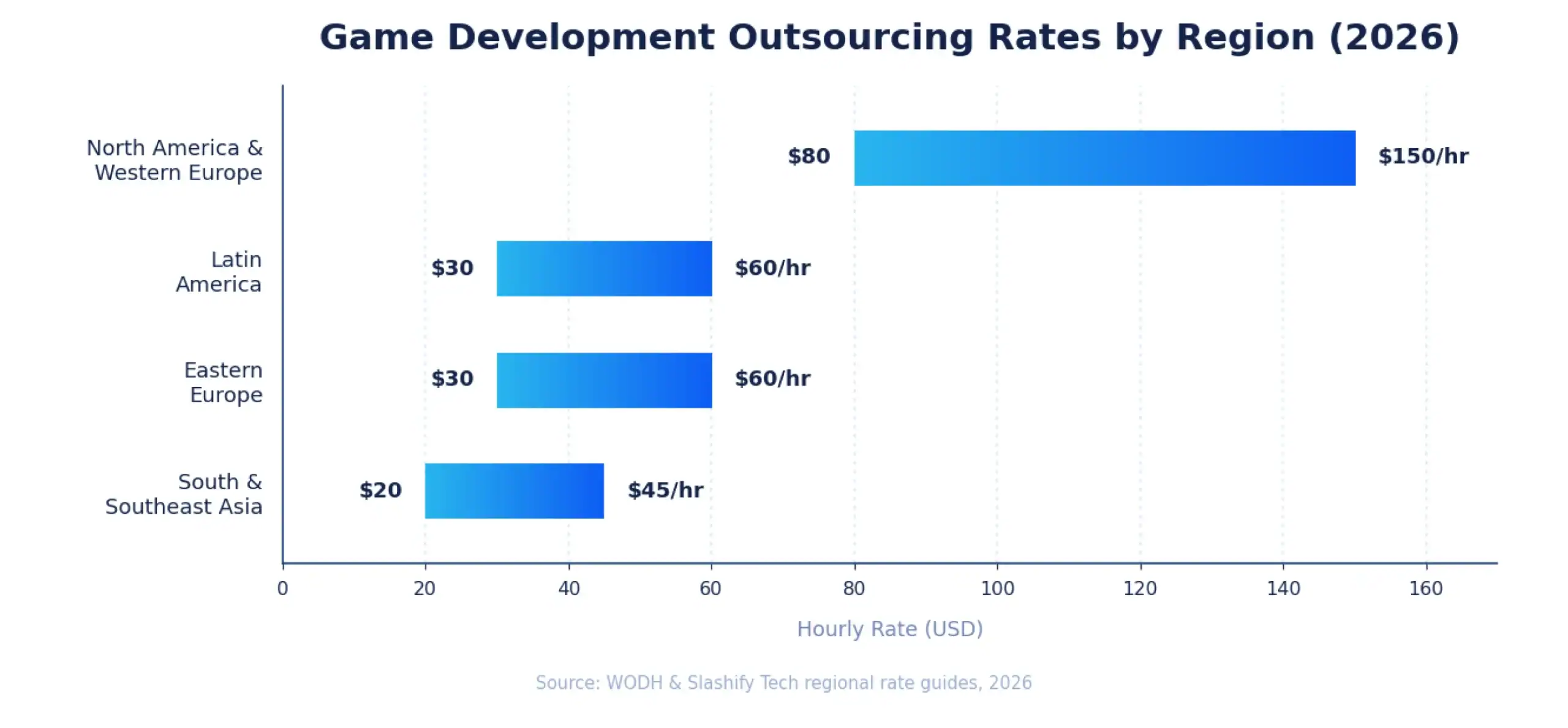
Pricing depends on region, discipline, and seniority. A 2D artist and a senior gameplay engineer simply don’t cost the same, no matter where they’re based.
| Region | Typical Hourly Rate |
| South & Southeast Asia | $20–$45/hr |
| Eastern Europe | $30–$60/hr |
| Latin America | $30–$60/hr |
| North America & Western Europe | $80–$150/hr |
For full projects, most studios budget:
- Simple mini-game: $3,000–$20,000
- Mid-tier mobile game: $50,000–$120,000
- Complex, multiplayer, or AAA-adjacent build: $200,000–$500,000+
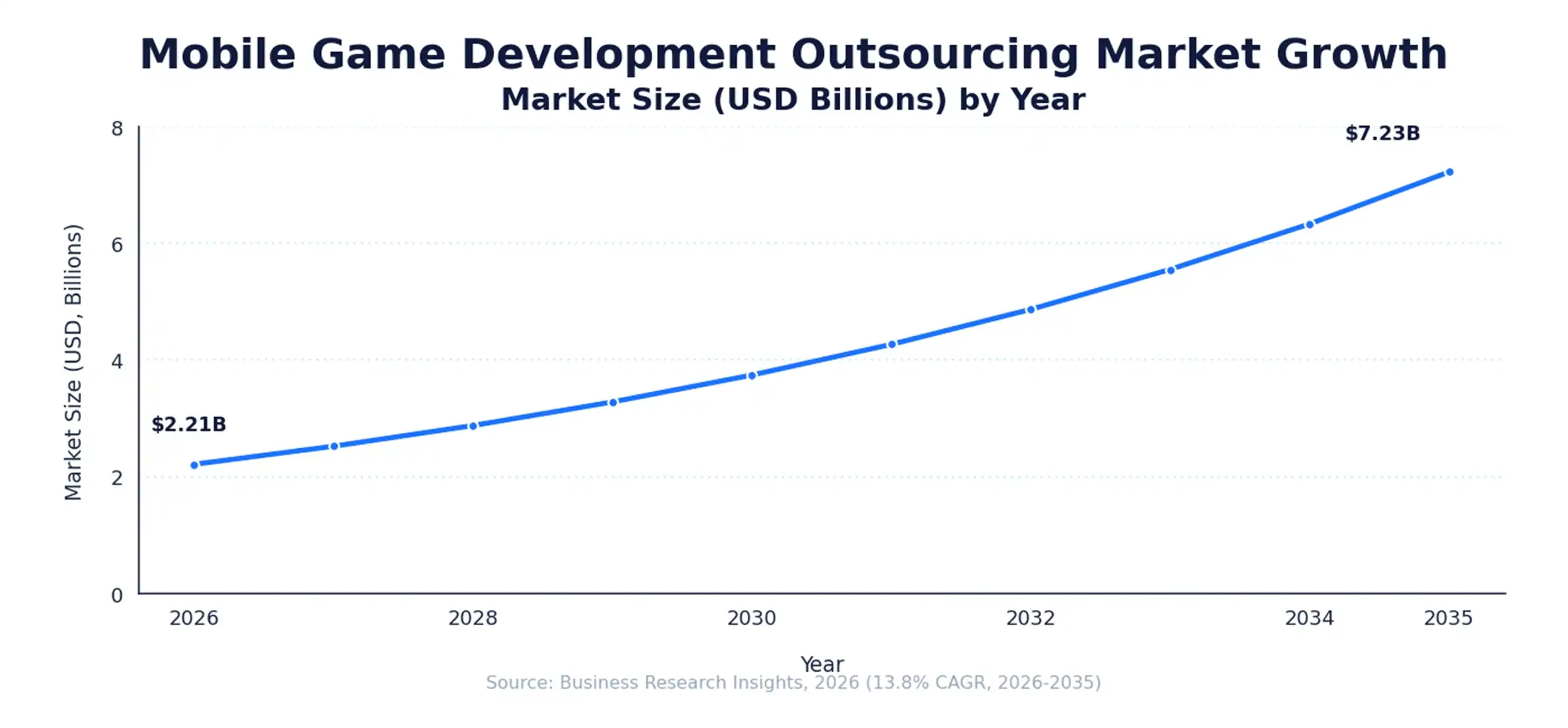
The mobile game development outsourcing market itself is valued at around $2.21 billion in 2026, and it’s projected to reach $7.23 billion by 2035. That growth is coming from studios of every size, not just big publishers.
What Parts of Game Development Can You Outsource?
You don’t have to outsource everything. Most studios pick and choose.
Outsourcing Game Art and Animation
A game lives or dies on how it looks. Outsourcing character art, environments, and animation gives you AAA-level visuals without an in-house art department.
Outsourcing QA and Testing
External QA teams test across dozens of devices and screen sizes using structured frameworks. That catches issues your internal team might miss simply from familiarity with the build.
Outsourcing Game Porting
Want your PC game on mobile too? Porting specialists handle the platform-specific headaches so your core team doesn’t have to relearn a new engine setup.
Full-Cycle, Cross-Platform Outsourcing
Some studios go all-in and hand over the entire build. This is where full-cycle game development outsourcing for cross-platform games comes in, one partner managing PC, console, and mobile versions from a single codebase strategy.
If you need mobile-specific expertise, it’s worth looking to hire Android game developer talent through an established studio rather than a solo freelancer, especially for anything with live multiplayer or in-app purchases.
How to Choose Game Development Outsourcing Companies
Picking the wrong partner costs more than picking no partner at all. Here’s what actually matters.
Check Portfolio and Reviews
Look for games similar in genre, platform, and complexity to yours. A racing game studio may not be the right fit for a turn-based RPG.
Confirm Communication and Time Zones
Aim for at least four hours of daily overlap. Less than that, and feedback loops slow down fast.
Ask About IP Protection
You should own 100% of the code, art, and IP produced. Get that in writing before any work starts.
Compare Pricing Models
Hourly works for open-ended discovery work. Fixed-bid suits clearly scoped assets. Retainers suit long, ongoing partnerships.
Studios that skip this vetting step are part of the reason 47% of studios report being unhappy with an outsourcing partner at some point. A little diligence upfront avoids most of that pain.
Where to Find Game Development Outsourcing Companies
Once you know what you’re looking for, here’s where to actually look.
- Review platforms like Clutch and GoodFirms, which list verified client ratings
- Portfolio sites such as ArtStation for art-focused vetting
- Referrals from other studio founders in your network
- Direct outreach to established studios like Cubix, which has shipped cross-platform titles for major brands
The top 10 outsourcing firms currently hold about 61% of the global market. That concentration exists for a reason. Studios that consistently deliver tend to keep winning repeat business.
Game Development Outsourcing Trends in 2026
The outsourcing landscape keeps shifting. Here’s what’s shaping it right now.
| Trend | What It Means for Studios |
| AI-assisted production | Faster asset iteration, lower rework costs |
| Co-development partnerships | Shared ownership, not just task handoffs |
| Value-based selection | Studios pick partners on outcomes, not lowest rate |
| Asia-Pacific dominance | ~59% share of the mobile outsourcing market |
The overall game development outsourcing services market is forecast to grow at a 17.5% CAGR through 2033, eventually reaching close to $9.8 billion. That’s not a niche trend anymore. It’s how the industry builds games now.
Mistakes to Avoid When Outsourcing Game Development
A few avoidable errors cause most outsourcing headaches.
- Choosing a partner on price alone, ignoring communication fit
- Skipping a written style guide for art teams
- Signing without a clear IP and ownership agreement
- Underestimating timezone gaps larger than 8 to 10 hours
- Treating outsourcing as “hire and forget” instead of an active partnership
Roughly 42% of companies say talent shortages and rising project complexity are their biggest internal challenges. Outsourcing solves that, but only when it’s managed like a real partnership, not a one-off transaction.
Why Studios Choose Cubix for Game Development Outsourcing
Cubix works as a full-stack Custom Game Development Company, building games for PC, console, and mobile from one team.
Full-Cycle, Cross-Platform Expertise
Cubix handles concept art, coding, animation, QA, and launch support under one roof. That means fewer handoffs and fewer things falling through the cracks.
Proven Track Record
Cubix has worked with global brands across entertainment and gaming, building everything from casual mobile titles to complex, feature-rich games.
Transparent Pricing and Communication
You get a dedicated project manager, clear milestones, and pricing that’s scoped before work starts, not guessed at halfway through.
Start Your Game Development Outsourcing Project With Cubix
If you’re ready to outsource part or all of your next game, Cubix can help you scope it properly from day one. Whether you need a full production team or want to hire Android game developer talent for a single platform, the team scales to match your project.
Need a Game Development Team? Let’s Scale Your Build
Contact UsFrequently Asked Questions
1. What are the main benefits of game development outsourcing for small studios?
Lower costs, faster hiring, and access to specialized art, code, and QA talent without building a full internal team.
2. How does game development outsourcing affect project budgets?
It usually lowers total spend by 40–60% compared to an in-house team, since you pay only for the work scoped, not year-round salaries.
3. How does outsourcing game development improve project scalability?
You can add or reduce team size as milestones shift, instead of being locked into a fixed in-house headcount.
4. Can outsourcing game development speed up the production timeline?
Yes. Agencies can staff a project in days, compared to three to five months to hire senior developers in-house.
5. How do I outsource game development?
Define your scope, shortlist game development outsourcing companies with relevant portfolios, confirm IP terms, then start with a smaller pilot task before a full engagement.