Key Takeaways
- Testing covers function, visuals, performance, devices, and player experience, not only crashes.
- Testing is the activity, QA is the system around it, and playtesting is feedback from real players.
- Five steps repeat on every build: plan, prepare, test, triage, and regress.
- Automation handles repeatable checks. Manual testers judge feel, fun, and odd player behavior.
- A game is launch ready when no blockers remain and the release candidate passes every checklist item.
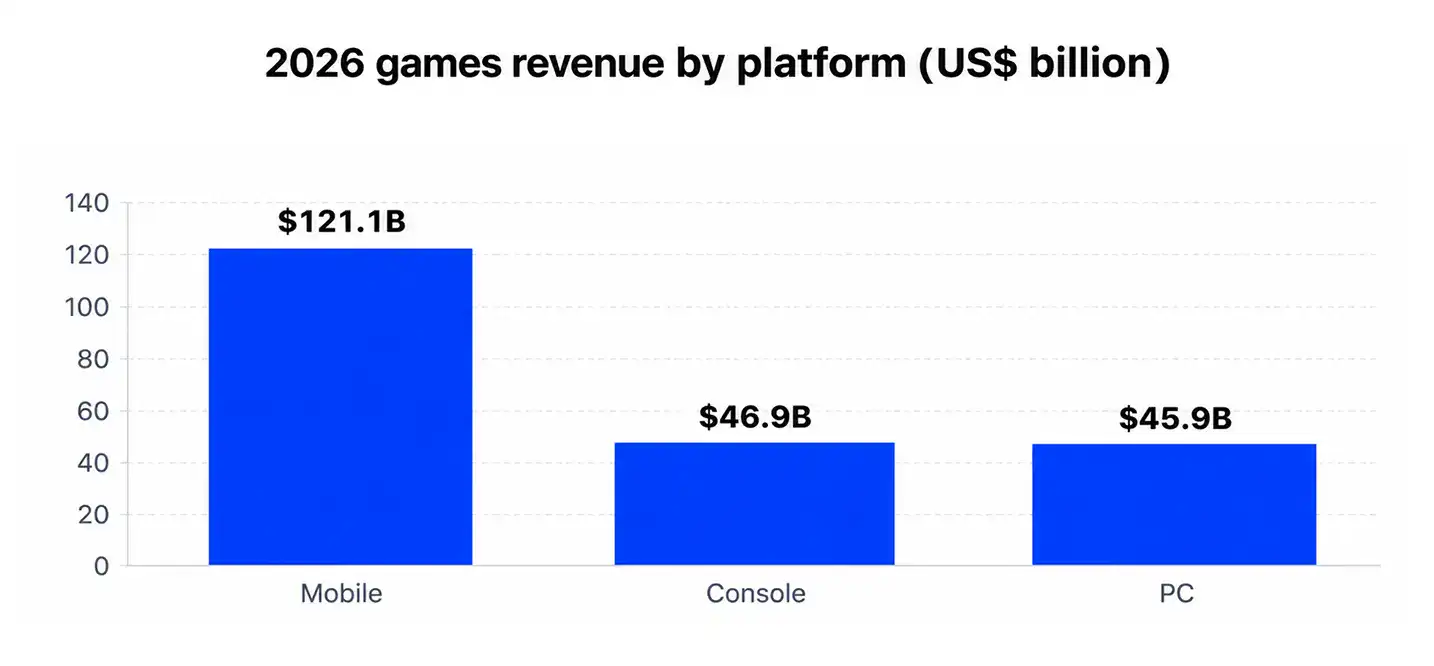
The game QA testing process decides whether players meet a polished product or a broken one on day one. Studios run planned test cycles that cover function, visuals, performance, devices, and player experience before release. Besides that, the stakes keep rising because the global games market at $213.9 billion in 2026, up 6.1% year over year.
Bugs hurt more in a crowded market. Reviews, refunds, and word of mouth decide how long a game lives. This guide shows how testing works stage by stage and what testers check before you ship.
You might build in house or work with a game development studio. Either way, QA works best when it starts in pre-production and runs until well after launch.
Build a Balanced Game Economy That Drives Long-Term Revenue
Contact UsWhat Is Game Testing?
Game testing is the process of evaluating a game for functional, visual, technical, performance, and player experience issues before release. Testers play each build, break it on purpose, and record what fails. Our guide to video game testing covers the basics in more depth.
Many teams mix up three terms. Here is how they differ:
- Testing: hands on checks that find defects in a build.
- QA: the plans, standards, and reviews that prevent defects across the project.
- Playtesting: real players try the game and report on fun, difficulty, and clarity.
A game can run without a single crash and still miss the mark. Consider these cases:
- The tutorial confuses new players, so they quit in five minutes.
- Difficulty spikes at level three and blocks progress.
- Frame rate drops on midrange phones.
- Purchases fail on one payment provider.
- Translated text overflows the buttons in German.
Each issue passes a basic function check. However, each one still hurts reviews, retention, and revenue.
Game Testing vs. Game Quality Assurance
Game quality assurance covers the whole system. Testing is one task inside it.
| Aspect | Game Testing | Game Quality Assurance |
|---|---|---|
| Focus | Finding defects in a build | Preventing defects across the project |
| Timing | During test cycles | From planning to post launch |
| Owner | Testers | QA leads, producers, and the full team |
| Output | Bug reports and test results | Test plans, quality standards, release criteria |
| Question answered | Does this feature work? | Is this game ready for players? |
Why QA in Game Development Matters Before Launch
QA in game development protects the three things a launch depends on: reputation, revenue, and schedule. It also keeps you compliant with platform rules.
- Reputation: early reviews set the tone, and patches rarely erase them.
- Revenue: crashes and payment errors cut sales and trigger refunds.
- Schedule: a bug found in alpha costs far less to fix than one found after launch.
- Approval: console and store platforms reject builds that fail their technical rules.
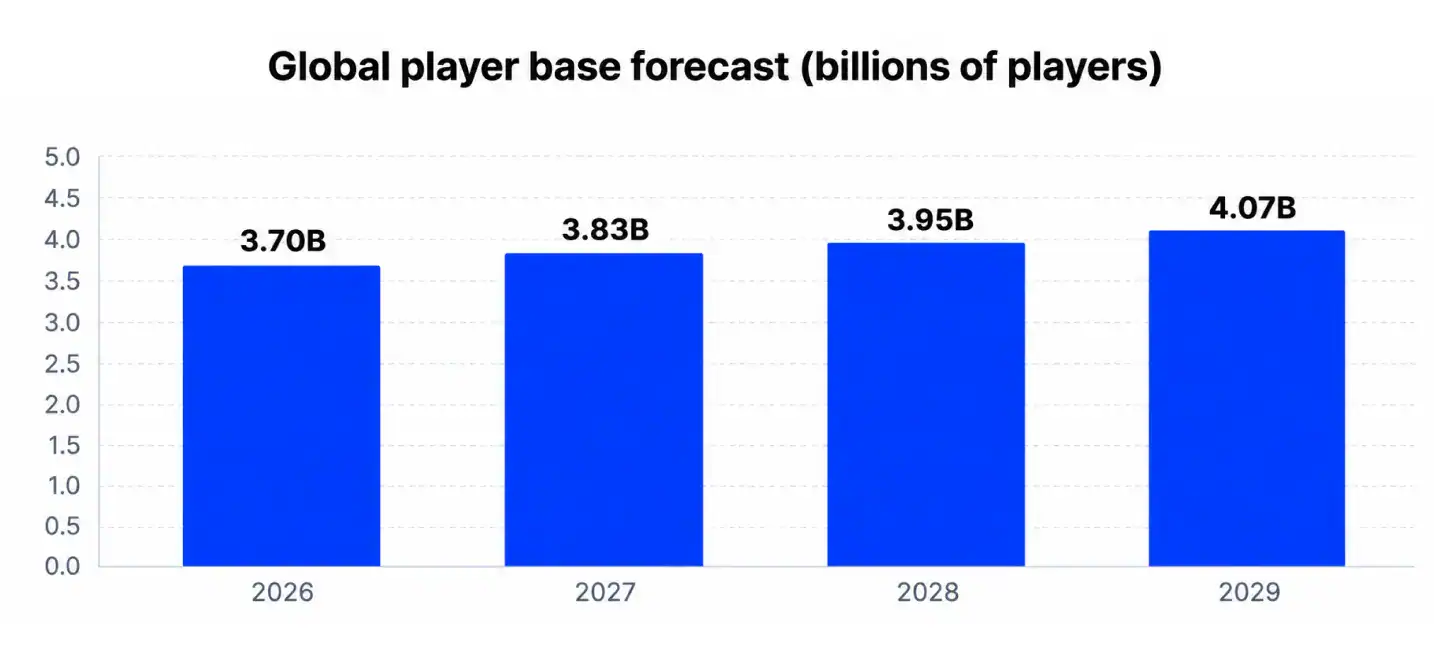
The market adds pressure. It expects player growth to slow from 4.4% in 2026 to a 3.2% yearly rate through 2029. As a result, studios must keep the players they already have, and players who hit bugs rarely stay.
How Are Video Games Tested Before Release?
Games are tested through planned QA cycles that combine manual testing, automated checks, performance analysis, compatibility validation, bug reporting, regression testing, and release readiness reviews. This game testing before launch routine repeats on every build. Each build moves through the same game QA testing process, so the team can compare results over time.
Testing the Core Gameplay Loop
The core loop is the cycle players repeat: act, earn, upgrade, repeat. Testers check that it works and feels fair.
- Controls respond without delay.
- Progression unlocks in the right order.
- Rewards and currency add up correctly.
- Save and load restore the exact game state.
- Win and lose states trigger when they should.
Testing Across Devices, Platforms, and Configurations
Your players do not own your dev machines. Testers run builds on a matrix of devices, operating systems, and settings. Game compatibility testing confirms the build works across that range.
- Low, mid, and high tier hardware
- Operating system and driver versions
- Screen sizes, resolutions, and aspect ratios
- Touch, keyboard, mouse, and controller input
- Low storage, low battery, and interrupted sessions
This matters most on mobile. Newzoo expects Central Southern Asia, Southeast Asia, and the Middle East and Africa to add 80% of the 117.8 million net new mobile players in 2026, so builds must run well on a wide range of phones.
Testing Under Real World Network and Player Conditions
A build that works on office Wi-Fi can fail on a train. Testers simulate real conditions before players do.
- High latency and packet loss
- Switching between Wi-Fi and mobile data
- Server load at launch peaks
- Offline mode and reconnect behavior
- Unusual player actions, such as spamming buttons or quitting mid save
The Game QA Testing Process: From Planning to Launch
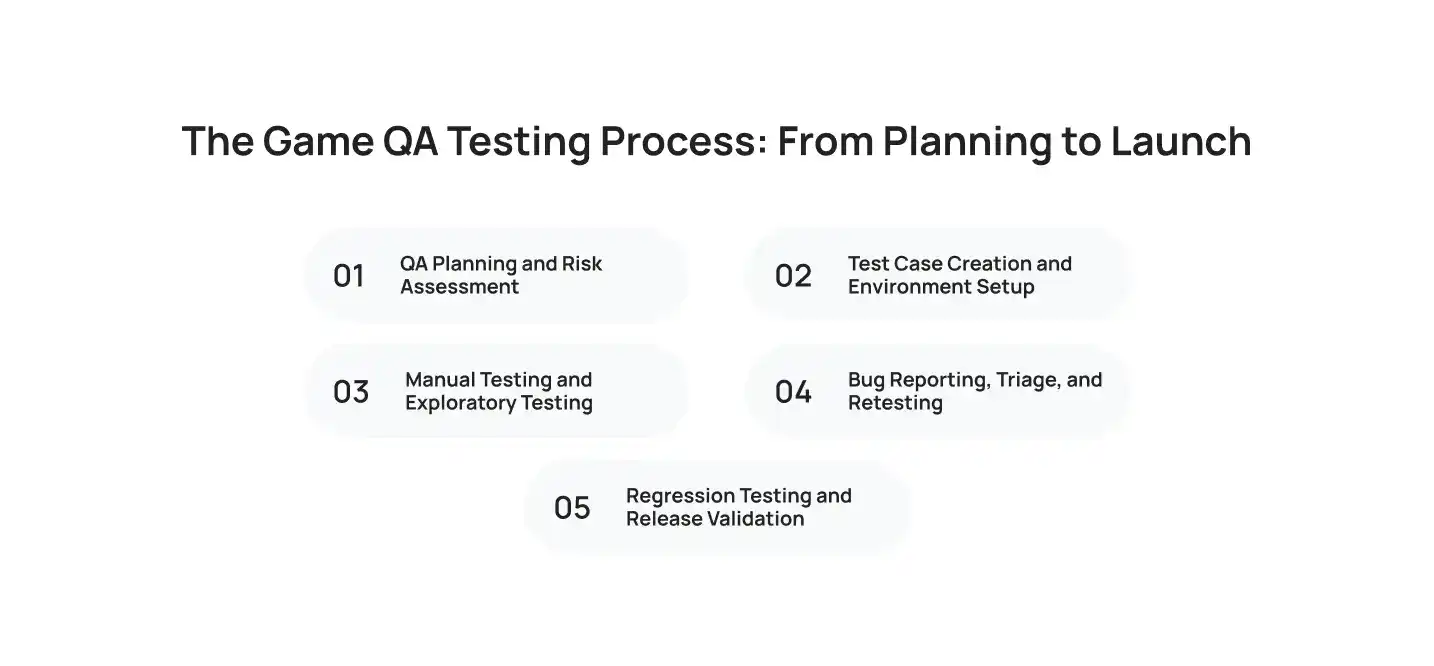
The game testing process follows five steps. Teams repeat them for every milestone and every major build.
1. QA Planning and Risk Assessment
QA leads read the design documents and list what can go wrong. Then they rank each risk by impact and likelihood.
- New systems and online features
- Payments and account flows
- Platform rules
- Old content touched by new code
The output is a test plan with scope, target devices, schedule, and exit criteria.
2. Test Case Creation and Environment Setup
A test case states the steps, the expected result, and the pass or fail rule. Clear cases let any tester repeat a check and get the same answer.
- Write cases for each feature and risk
- Build the device lab and test accounts
- Set up logging and crash capture
- Distribute builds on a fixed schedule
3. Manual Testing and Exploratory Testing
Testers follow scripts first. Then they explore. Exploratory testing means playing without a script to find what scripts miss, like odd inputs or strange paths through a level.
A strong game QA testing process reserves time for both, because players never follow the happy path.
4. Bug Reporting, Triage, and Retesting
Bug tracking in game development works only when each report is clear. A useful report includes:
- A short, specific title
- Build number and device
- Steps to reproduce
- Expected and actual result
- How often it happens
- A video or log file
- A severity rating
The team then triages every bug. Critical bugs block release. Major bugs need a fix or a signed off workaround. Minor bugs wait. After a fix, a tester retests the exact steps on the same device.
5. Regression Testing and Release Validation
Fixes break other things. Therefore, testers rerun the affected areas and a core smoke suite after every change. Once the release candidate is frozen, they run a final validation pass on every target platform.
Key Game Testing Stages in Development
These game testing stages match the production timeline. Together they form the game testing lifecycle.
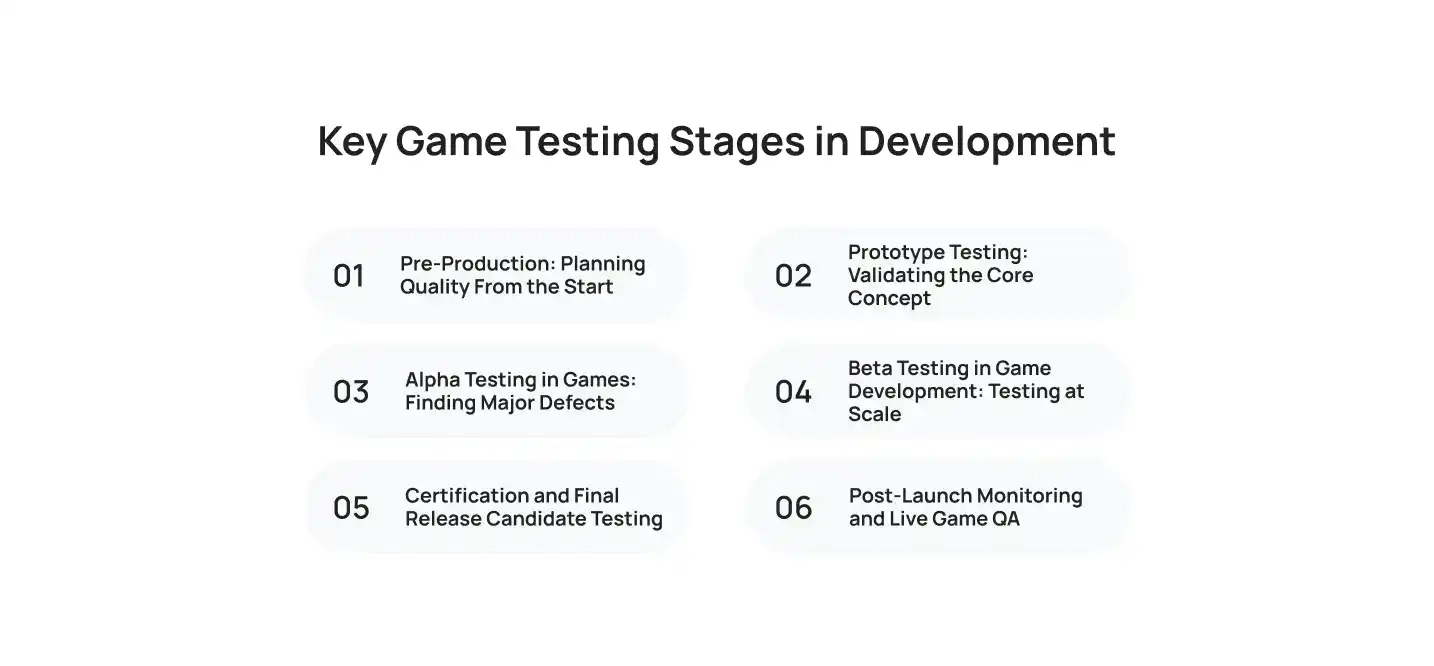
Pre-Production: Planning Quality From the Start
Teams define quality goals, supported devices, performance targets, and key testing risks. QA teams also review design and technical documents to identify unclear requirements before development scales.
Prototype Testing: Validating the Core Concept
Early builds test the core gameplay loop, controls, camera, and technical feasibility. The goal is to identify gameplay or usability issues before the team invests in final content and visual polish.
Alpha Testing in Games: Finding Major Defects
Alpha testing in games begins when most major systems are available but the build remains incomplete. Internal testers identify crashes, broken progression, missing assets, gameplay blockers, and major performance issues.
Beta Testing in Game Development: Testing at Scale
Beta testing in game development brings in external players through closed or open tests. It helps teams validate device compatibility, server capacity, matchmaking, network stability, onboarding, and real-world gameplay conditions.
Certification and Final Release Candidate Testing
Platform holders such as Sony, Microsoft, Nintendo, Apple, and Google publish technical requirements. Testers check the build against each rule, then freeze a release candidate.
Post-Launch Monitoring and Live Game QA
After release, teams monitor crashes, player feedback, server health, and performance data. QA validates patches, hotfixes, events, and new updates to prevent regressions.
Types of Testing Used in Game QA
Each testing type supports the game QA testing process at a different stage. Together, they help teams verify that the game works correctly, performs reliably, supports intended players and devices, and is ready for release.
1. Functional Testing for Games
Functional testing for games checks that every feature behaves as designed.
- Menus and settings
- Inventory and crafting
- Quests and achievements
- Enemy and NPC behavior
2. Game Performance Testing
Game performance testing measures frame rate, load times, memory use, battery drain, and heat. Testers compare results against the targets set in pre-production. Profile early, because late performance fixes are expensive.
3. Game Compatibility Testing
This type covers hardware, operating systems, and input devices. Testers log which configurations pass, fail, or need a workaround.
4. Multiplayer and Network Testing
- Matchmaking and lobbies
- Desync between players
- Latency and packet loss
- Server capacity and reconnects
5. Regression Testing in Games
Regression testing in games confirms new code did not break old features. Teams run it after every fix and before every release.
6. Usability, Accessibility, and Localization Testing
- Usability: can new players learn the game without help?
- Accessibility: are subtitles, color options, and remapping available?
- Localization: does translated text fit, and does it read correctly?
7. Security and Monetization Testing
- Cheating and exploit attempts
- Account and data protection
- Purchase, refund, and receipt flows
- Currency duplication and economy loopholes
Manual vs. Automated Game Testing
Automation works best for stable, repetitive, measurable tests. Manual QA stays essential for exploratory testing and subjective player experience. The best game QA testing process uses both. Automate what is stable, and keep human testers on what changes.
| Factor | Manual Testing | Automated Testing |
|---|---|---|
| Best for | Feel, fun, odd behavior, new features | Smoke tests, regression, builds, performance runs |
| Speed | Slower per run | Fast and repeatable |
| Upfront cost | Low | Higher to build scripts |
| Weakness | Hard to repeat at scale | Misses subjective problems |
| Example | Does this boss fight feel fair? | Does the game launch on 30 devices? |
What Game Testers Look for Before Launch
A game is launch-ready when no blocker remains, performance holds on target devices, and the release candidate passes every checklist item. The video game QA process ends with that sign off.
1. Gameplay and Progression Blockers
- Quests that cannot finish
- Doors, items, or levels that never unlock
- Saves that corrupt or reset
2. Crashes, Freezes, and Memory Issues
- Crashes on launch or scene load
- Freezes after long sessions
- Memory leaks that grow over time
3. Visual, Audio, and Animation Bugs
- Missing textures and flickering effects
- Audio that cuts out or loops
- Animations that clip or snap
4. Multiplayer Desync and Connectivity Problems
- Players who see different game states
- Disconnects during matches
- Rewards lost after a dropped session
5. Device-Specific and Platform-Specific Failures
- Bugs that appear on one chipset or driver
- Controller input that fails on one console
- Store rule violations
6. Exploits, Economy Loopholes, and Payment Errors
- Item or currency duplication
- Free purchases through failed receipts
- Double charges and missing refunds
Game Testing Checklist Before Launch
Use this list to close your game QA testing process before submission. To decide which checks to automate and which require human testers, read our automated vs. manual game testing guide.
- Gameplay: the full critical path plays from start to finish.
- Stability: no open crashes or freezes at critical or major severity.
- Performance: frame rate, load time, and memory meet targets on every target device.
- Compatibility: all devices and operating systems on the support list pass.
- Online: matchmaking, servers, and reconnects hold under load tests.
- Monetization: purchases, refunds, and receipts work on every store.
- Content: text, audio, and art are final and localized.
- Compliance: the build passes every platform requirement.
- Release: the release candidate is frozen, regressed, and signed off.
Common Mistakes That Cause Game QA Failures
Even a strong game QA testing process fails when teams repeat these errors.
- Starting Game QA Too Late: Testing that begins in alpha leaves no time to fix deep problems. Start in pre-production.
- Testing Only on Developer Devices: Dev machines are faster than most player devices. Test on the hardware players use.
- Treating Performance Testing as a Final Task: Frame rate problems often come from early design choices. Profile every milestone.
- Skipping Regression Testing Before Release: Last-minute fixes cause last-minute bugs. Always rerun the core suite on the release candidate.
- Using Vague Bug Reports and Poor Triage Processes: A report that says it crashed wastes everyone’s time. Require steps, build, device, and evidence.
- Relying Only on Automation or Only on Manual Testing: Automation misses feel. Manual testing misses scale. Use each where it fits.
How Cubix Helps Maintain Game Quality From Development to Launch
Cubix runs QA alongside production, so testers join your sprints from the first build. Our game testing services cover functional, performance, compatibility, multiplayer, regression, and certification checks.
- Test plans built around your risks and target devices
- Clear bug reports with steps, builds, and evidence
- Regression passes on every release candidate
If you plan to outsource game testing, you gain extra devices and testers without hiring a full team. You also get a documented game QA testing process and a release readiness review before submission.
Cubix also builds games end-to-end through its game development services, so QA and development share one pipeline.
Turn Smart Currency Design Into Sustainable Game Growth
Contact UsFrequently asked questions
1. What does a game QA tester do?
A game QA tester plays builds to find bugs, crashes, and balance problems. They follow test cases, explore off-script, and write clear bug reports. They also retest fixes and confirm the game meets quality standards before release.
2. What is it called when you test a product before launching?
It is called pre-launch testing, or quality assurance (QA). In games, it includes alpha testing, beta testing, certification, and release validation. The goal is to catch defects before players do.
3. How does game testing and QA actually work before launch?
Teams plan risks, write test cases, test builds, log and triage bugs, and rerun regression checks. They repeat this cycle for every milestone. A final validation pass on the release candidate gives the launch sign off.
4. How are video games tested before release?
Games are tested through planned QA cycles that combine manual testing, automated checks, and performance analysis. Testers also validate devices, report bugs, run regression tests, and complete a release readiness review.
5. What is the difference between game testing and game QA?
Game testing is the hands on work of finding defects in a build. Game QA is the wider system of plans, standards, and reviews that prevents defects. Testing is one activity inside QA.
6. What are the main stages of game testing?
The main stages are pre-production planning, prototype testing, alpha, beta, certification, and post-launch monitoring. Each stage has a different goal, from checking the core idea to confirming stability at scale.
7. What does functional testing for games include?
Functional testing checks that every feature works as designed. It covers menus, controls, inventory, quests, achievements, saves, and enemy behavior. Testers confirm each feature gives the expected result.
8. Why is regression testing important in games?
Fixes and new features often break older content. Regression testing reruns key checks after every change to catch those side effects. It protects stability, especially on the final release candidate.
9. Can game testing be automated?
Yes, but only in part. Automation suits stable, repeatable checks like smoke tests, builds, and performance runs. Manual testers still judge feel, fun, and unusual player behavior.
10. When should a studio outsource game testing?
Outsource when you need more devices, testers, or specialist skills than your team has. It also helps during peak test periods like beta and certification. Outside testers give a fresh view and free your developers to build.