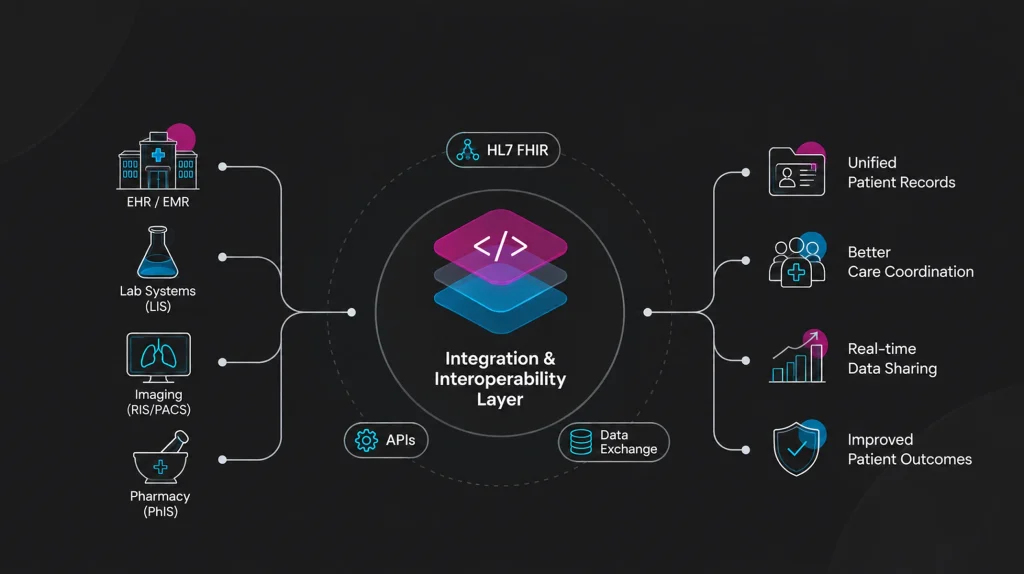
Healthcare data privacy requirements determine how patient information can be collected, used, shared, stored, and disclosed through digital health systems. Getting these rules wrong can expose sensitive medical details, undermine patient trust, and create legal consequences for healthcare organizations and technology providers.
The concern is not just regulatory. A KFF national survey found that 75% of U.S. adults were concerned about the privacy of their health information when using a healthcare app managed by a private technology company. That concern puts pressure on healthcare organizations to explain how patient data moves between apps, providers, insurers, and third-party services.
For software teams, meeting these expectations means understanding more than HIPAA. Federal and state privacy laws can apply differently depending on the organization, the type of health information collected, and how the software uses it.
This guide explains the main healthcare data privacy requirements in the United States and how to translate them into practical software decisions, from patient consent and data sharing to retention and third-party access.
Key Takeaways
- HIPAA establishes federal privacy requirements for covered healthcare organizations and their business associates.
- Some consumer health apps outside HIPAA may still fall under FTC rules and state consumer health privacy laws.
- Patient consent and authorization requirements depend on the purpose and legal basis for collecting or disclosing health information.
- Healthcare software should support applicable patient rights, including access, correction, and certain restrictions on data use.
- Privacy obligations extend to third-party integrations, analytics, research, data retention, and disposal.
- Privacy requirements should shape software architecture, workflows, and data-handling policies from the beginning.
What Are Healthcare Data Privacy Requirements?
Healthcare data privacy requirements are legal and operational rules governing how organizations collect, use, disclose, maintain, and dispose of patient information. They determine which information an organization can process, why it can process it, who may receive it, and what rights individuals have over their records.
These requirements apply differently depending on the type of information, the organization handling it, and the purpose of processing.
Several terms are important when evaluating healthcare software privacy:
| Term | Meaning |
| Protected Health Information (PHI) | Individually identifiable health information held or transmitted by a HIPAA covered entity or business associate, subject to applicable exclusions |
| Electronic Protected Health Information (ePHI) | PHI created, received, maintained, or transmitted in electronic form |
| Personally Identifiable Information (PII) | Information that identifies or can be linked to an individual, depending on the applicable definition |
| Consumer Health Data | Health-related information covered by certain state privacy laws, including some data collected outside traditional healthcare settings |
| De-identified Health Information | Information processed so it no longer identifies an individual under an applicable legal standard |
PHI and consumer health data are not interchangeable. HIPAA defines PHI within its regulatory scope, while state laws may cover a broader range of health-related information, including data collected by certain wellness applications and consumer platforms.
Healthcare Data Privacy vs. Data Security
Privacy and security work together, but they address different responsibilities.
- Data privacy determines whether information can be collected, used, disclosed, or retained for a particular purpose.
- Data security protects information against unauthorized access, alteration, loss, or disclosure.
For example, encryption may protect patient records while they are stored or transmitted. However, it does not establish whether a healthcare application has a valid reason to share those records with an external analytics provider. That is a privacy question.
Both areas must be considered during healthcare software development, but their requirements should not be treated as identical.
Which Laws Govern Healthcare Data Privacy in the U.S.?
Healthcare data privacy in the United States is governed by multiple federal and state regulations. HIPAA is the central federal framework for covered healthcare organizations, but other laws can apply based on the organization’s activities and the type of health information it processes.
| Regulation | What It Covers | Relevance to Healthcare Software |
| HIPAA Privacy Rule | Uses and disclosures of PHI and individual privacy rights | Patient records, permitted disclosures, authorization, access, and correction |
| HITECH Act | Strengthens HIPAA enforcement and electronic health information protections | Business associate accountability and breach notification |
| FTC Health Breach Notification Rule | Certain personal health record vendors and related entities outside HIPAA | Breach notification for qualifying health apps and services |
| State privacy laws | Consumer health information and medical records | Additional consent, disclosure, access, and deletion requirements |
| 42 CFR Part 2 | Certain substance use disorder treatment records | Additional confidentiality and disclosure restrictions |
| FERPA | Certain education records maintained by covered educational institutions | Relevant to some student health records |
1. HIPAA Privacy Rule
The HIPAA Privacy Rule establishes national standards for protecting PHI held by health plans, healthcare clearinghouses, and qualifying healthcare providers. It also governs certain uses and disclosures of that information and gives individuals specific rights over their records.
Its main requirements include:
- Limiting uses and disclosures of PHI to those permitted or required by the Rule.
- Obtaining valid authorization for uses and disclosures that require it.
- Applying the minimum necessary standard where applicable.
- Providing individuals with access to their health information.
- Allowing eligible requests for record amendments and restrictions.
- Maintaining appropriate privacy policies and Notices of Privacy Practices.
HIPAA does not prescribe a particular software architecture, database, or technology stack. Instead, organizations must ensure that their systems and processes support the applicable privacy obligations. The HHS HIPAA Privacy Rule guidance explains its scope and requirements.
2. HITECH Act
The Health Information Technology for Economic and Clinical Health (HITECH) Act strengthened HIPAA enforcement and expanded accountability for organizations handling electronic health information.
One important effect is that business associates became directly liable for certain HIPAA requirements, including impermissible uses and disclosures of PHI and applicable breach notification responsibilities.
For healthcare software providers, this makes the nature of the vendor relationship important. A company that creates, receives, maintains, or transmits PHI on behalf of a covered entity may qualify as a business associate and have direct regulatory responsibilities. HHS guidance on business associate liability explains which obligations apply.
3. FTC Act and Health Breach Notification Rule
HIPAA does not cover every organization that collects health information. Certain consumer health applications, personal health record vendors, and related services may fall outside HIPAA but still have obligations under the Federal Trade Commission Act and the Health Breach Notification Rule.
The FTC’s rule requires covered vendors of personal health records and related entities to notify consumers following qualifying breaches of unsecured health information. Certain third-party service providers must also notify the relevant vendor or related entity when a breach occurs.
This matters for applications that collect information directly from users, connect to multiple health data sources, or manage personal health records outside a traditional provider relationship. The FTC Health Breach Notification Rule explains which entities and incidents fall within its scope.
4. State Healthcare Data Privacy Laws
State laws can impose additional requirements on organizations that collect or process health information. Their scope, exemptions, and consumer rights vary, so healthcare software companies must evaluate the laws relevant to their operations and users.
For example, Washington’s My Health My Data Act covers certain consumer health data and establishes requirements concerning collection, sharing, privacy notices, and consumer rights. It can apply to some businesses that are not covered by HIPAA.
Other states have medical confidentiality laws and broader consumer privacy statutes that may cover sensitive health information.
A healthcare application should not assume that HIPAA is the only applicable framework. The Washington My Health My Data Act illustrates how state-level requirements can extend privacy obligations beyond traditional healthcare settings.
5. 42 CFR Part 2
42 CFR Part 2 establishes additional confidentiality protections for certain records maintained by federally assisted substance use disorder (SUD) programs.
These requirements affect software that creates, stores, or exchanges records covered by Part 2. They include specific rules for patient consent, disclosures, and the handling of SUD treatment information.
The regulation does not apply to every behavioral health application or every mental health record. Its applicability depends on whether the records and program meet the regulatory definitions.
Does HIPAA Apply to Every Healthcare Software Application?
No. HIPAA applies to covered entities and their business associates, not automatically to every application that collects health-related information.
A covered entity generally falls into one of three categories:
- Healthcare providers that conduct certain standard electronic transactions.
- Health plans.
- Healthcare clearinghouses.
A business associate is generally an individual or organization that performs certain functions or services on behalf of a covered entity involving PHI. Software vendors may qualify when their services involve creating, receiving, maintaining, or transmitting PHI on the covered entity’s behalf.
Consider how the rules may differ across common healthcare products:
| Software Type | Potential Privacy Framework |
| Hospital EHR system | HIPAA when operated by or for a covered entity |
| Patient portal | HIPAA when provided by a covered entity or its business associate |
| Telemedicine platform | HIPAA when the provider and relevant service relationships fall within its scope |
| Direct-to-consumer wellness app | FTC and applicable state privacy laws may apply, even when HIPAA does not |
| Fitness tracking application | State consumer health privacy laws and FTC requirements may apply depending on its functions and data practices |
| Substance use disorder treatment system | HIPAA and potentially 42 CFR Part 2, depending on the program and records |
The distinction is important for software vendors. A company does not become a HIPAA business associate simply because it develops healthcare software. Its role, contractual relationship, and handling of PHI determine whether the business associate rules apply.
HHS provides a detailed explanation of covered entities and business associates, including the types of organizations subject to HIPAA.
What Are the Main Data Privacy Requirements for Healthcare Software?

Healthcare software must support appropriate data collection, permitted use and disclosure, patient rights, and information lifecycle management. The exact obligations depend on the applicable laws and the organization’s role.
1. Collect and Use Only Necessary Patient Information
Healthcare applications should collect information that serves a defined and legitimate purpose. Unnecessary collection increases privacy exposure and makes it harder to justify how information is used.
For HIPAA-regulated organizations, the minimum necessary standard generally requires reasonable efforts to limit PHI use, disclosure, and requests to the minimum necessary for the intended purpose.
For example, a billing workflow may require patient identity, insurance details, and relevant service information. It does not automatically need unrestricted access to the patient’s complete clinical history.
Software teams can support this requirement by:
- Defining the purpose of each data field.
- Avoiding unnecessary collection during registration.
- Restricting data access according to job responsibilities.
- Separating information used for different business functions.
- Reviewing whether integrations request more data than their functions require.
The minimum necessary standard has specific exceptions. For example, it does not apply to disclosures to or requests by healthcare providers for treatment purposes, disclosures to the individual, or uses and disclosures made under a valid authorization.
2. Provide Clear Privacy Notices and Data Collection Disclosures
Patients should be able to understand what information a healthcare application collects, why it collects it, how it uses that information, and which parties may receive it.
For HIPAA covered entities, the Notice of Privacy Practices (NPP) explains the organization’s privacy practices, individual rights, and permitted uses and disclosures of PHI. Covered healthcare providers and health plans have specific obligations to develop and distribute these notices.
A software vendor acting only as a business associate does not automatically have to create its own HIPAA NPP. However, its handling of PHI must remain consistent with the applicable business associate agreement and the covered entity’s privacy obligations.
For consumer health applications outside HIPAA, other laws may require a privacy policy or specific disclosures about health data collection and sharing.
A useful privacy notice should clearly explain:
- The categories of information collected.
- The purposes of collection and processing.
- Whether information is shared with service providers or other third parties.
- Applicable consumer or patient rights.
- How individuals can submit privacy requests.
3. Obtain Consent or Authorization Where Required
Healthcare software must distinguish between consent and authorization because they serve different purposes under HIPAA and other privacy laws.
Under the HIPAA Privacy Rule, covered entities may generally use or disclose PHI for treatment, payment, and healthcare operations without obtaining separate individual authorization. They may voluntarily request consent for these activities, but HIPAA does not generally require it.
An authorization is required when a use or disclosure is not otherwise permitted by the Privacy Rule, and no exception applies. It must identify the information, the parties involved, the purpose, and other required elements.
For example:
- A provider may share relevant PHI with another provider for treatment without obtaining a separate HIPAA authorization.
- A disclosure of PHI for certain marketing purposes generally requires authorization, subject to regulatory exceptions.
- A covered entity may need a valid authorization or an applicable waiver before using identifiable PHI for research.
Consent requirements under state privacy laws or other regulations may be different. Washington’s consumer health data law, for example, establishes specific consent requirements for certain collection and sharing activities.
Software teams should therefore avoid using one generic consent checkbox for every privacy-related action. A better approach is to identify the legal purpose of each activity and implement the corresponding notice, consent, authorization, or preference workflow.
4. Restrict Patient Data Sharing and Secondary Use
Healthcare organizations must ensure that patient information is shared only for permitted purposes and with appropriate recipients.
Data sharing can occur between providers, laboratories, insurers, pharmacies, analytics platforms, research organizations, and other service providers. Each exchange needs to be evaluated according to the information involved, the parties’ roles, and the purpose of disclosure.
Under HIPAA, permitted disclosures include certain activities involving treatment, payment, and healthcare operations. Other disclosures may require authorization or another applicable legal basis.
Secondary data use requires particular attention. Information collected for patient care should not automatically be reused for unrelated purposes such as advertising, commercial profiling, or AI model development.
Before using patient data for analytics, research, or product improvement, organizations should determine:
- Whether the information remains identifiable PHI.
- Whether the intended activity is permitted under HIPAA.
- Whether individual authorization or an applicable waiver is required.
- Whether a state law or contractual restriction applies.
- Whether the receiving party can use the data for any additional purpose.
Properly de-identified information can be used and disclosed outside HIPAA’s PHI restrictions, but the data must satisfy a recognized de-identification method. HHS guidance on HIPAA de-identification explains the Safe Harbor and Expert Determination methods.
5. Support Patient Rights to Access and Correct Information
Healthcare software should support the processes that covered entities use to fulfill applicable patient rights.
Under HIPAA, individuals generally have the right to inspect and obtain copies of PHI maintained in a designated record set, subject to specific exceptions. They may also request amendments to information they believe is incorrect or incomplete.
Other rights include:
- Requesting certain restrictions on the use or disclosure of PHI.
- Receiving an accounting of certain disclosures.
- Requesting confidential communications through an alternative address or method.
- Directing an electronic copy of health information to a designated third party.
These rights affect patient portals, EHR systems, medical record platforms, and healthcare data exchange applications.
For example, a patient portal should provide a process for requesting records and routing the request to the responsible healthcare organization. If the software stores information on behalf of a covered entity, its business associate agreement may also require the vendor to help fulfill access, amendment, or accounting requests.
Not every request must be granted. HIPAA includes exceptions, and covered entities generally do not have to agree to most requested restrictions. However, certain restrictions are mandatory when specific conditions are met.
6. Establish Data Retention and Deletion Policies
Healthcare organizations must define how long they retain patient information, when records can be archived, and how information should be disposed of.
One common misconception is that HIPAA establishes a universal retention period for medical records. It does not. State laws and other applicable requirements generally determine how long healthcare organizations must retain particular medical records.
HIPAA does require covered entities and business associates to retain certain required compliance documentation for six years, but this should not be confused with a six-year retention requirement for all patient records.
Software systems should support:
- Record-specific retention schedules.
- Archival policies for inactive records.
- Controlled disposal of information that no longer needs to be retained.
- Legal holds that prevent premature deletion.
- Documented deletion and disposal procedures.
- Appropriate handling of data held by third-party vendors.
Healthcare organizations should also distinguish between a patient’s right to request access or amendment and a right to have medical records erased. HIPAA does not provide a general right to delete medical records simply because a patient requests it.
7. Apply De-identification Rules Before Secondary Data Use
Healthcare organizations may use de-identified information for certain analytics, research, and other activities without treating it as PHI under HIPAA.
However, removing patient names or replacing them with identification numbers does not automatically make a dataset de-identified.
HIPAA recognizes two methods:
- Safe Harbor: Removes specified identifiers of the individual and certain relatives, employers, and household members, subject to the rule’s requirements.
- Expert Determination: A qualified expert applies accepted statistical and scientific principles to determine that the risk of identifying an individual is very small.
Software teams should also consider whether combinations of data, such as age, location, treatment dates, and rare diagnoses, could make an individual identifiable.
Pseudonymized or coded data may still qualify as PHI when the information can be linked back to an individual using available information. Organizations should not treat pseudonymization as equivalent to HIPAA-compliant de-identification.
8. Manage Third-Party Data Processing and Vendor Responsibilities
Healthcare software rarely operates in isolation. Applications may rely on cloud hosting, payment processing, analytics, messaging, data exchange, and other external services.
When a vendor performs a function or service on behalf of a HIPAA-covered entity involving PHI, it may qualify as a business associate. The covered entity generally needs a written Business Associate Agreement (BAA) that defines permitted uses and disclosures, safeguards, breach reporting, and other required responsibilities.
The agreement must also address applicable subcontractors that handle PHI on behalf of the business associate.
Before integrating an external service, organizations should determine:
- Whether the provider will receive, maintain, or transmit PHI.
- Whether the provider acts as a business associate or another type of service provider.
- Which uses and disclosures the contract permits.
- Whether subcontractors will access the information.
- What happens to PHI when the service agreement ends.
- How privacy requests and potential breaches will be handled.
A BAA does not make every data-sharing activity permissible. It establishes the contractual conditions for a business associate relationship, but the underlying use or disclosure must still comply with applicable privacy requirements.
HHS provides sample business associate agreement provisions covering permitted uses, safeguards, subcontractors, and the return or destruction of PHI.
How Do Healthcare Data Privacy Requirements Affect Software Development?
Privacy requirements influence healthcare software from initial product planning through deployment and ongoing maintenance. They determine how applications collect information, manage permissions, exchange records, respond to patient requests, and handle data throughout its lifecycle.
| Development Area | Privacy Consideration |
| Requirements gathering | Identify the information collected, processing purposes, and applicable privacy obligations |
| UX and consent flows | Explain data practices and obtain required consent or authorization |
| Data modeling | Classify PHI, ePHI, and other sensitive information according to applicable requirements |
| Patient portals | Support record access, correction requests, and applicable patient preferences |
| APIs and integrations | Define permitted data exchanges and restrict unauthorized secondary use |
| Analytics | Avoid unnecessary collection or disclosure of identifiable patient information |
| Data lifecycle | Apply retention, archival, and disposal rules |
| Third-party services | Review vendor roles, data-sharing terms, and required agreements |
A few development decisions deserve particular attention.
- Data mapping: Teams should document where patient information enters the system, which components process it, where it is stored, and which external services receive it. This makes it easier to identify unnecessary data flows and assess privacy obligations.
- Consent management: Where consent or authorization is required, applications should record the relevant purpose, scope, recipient, and status. They should also support changes or revocations where applicable. A consent record should not be treated as blanket permission for unrelated data processing.
- Patient request workflows: Patient portals and EHR systems need defined processes for access, amendment, and other applicable privacy requests. The software should route requests to the responsible organization and preserve the information needed to track their handling.
- Data sharing controls: Integrations should exchange only information permitted for their intended purpose. This includes reviewing analytics tools, cloud services, third-party APIs, and other connected systems.
- Retention logic: Retention and deletion rules should account for applicable recordkeeping requirements, contractual obligations, and legal holds. A single deletion rule across every patient record is rarely appropriate.
These decisions should be part of the initial product requirements rather than added after the application is built. Organizations planning a new platform can also account for privacy-related functionality when evaluating healthcare software development costs.
What Happens When Healthcare Software Violates Data Privacy Requirements?
Violations can lead to regulatory investigations, financial penalties where authorized, breach notification obligations, contractual disputes, and reputational damage. The consequences depend on the applicable regulation, the nature of the violation, the organization involved, and the circumstances.
Potential consequences include:
- Regulatory enforcement: HHS or the FTC may investigate organizations within their respective jurisdictions and take enforcement action.
- Civil penalties: Certain violations can result in financial penalties under applicable federal or state laws.
- Breach notifications: Qualifying breaches may require notification to affected individuals, regulators, and sometimes the media.
- Contractual disputes: Improper data handling by a vendor may violate a BAA or another data processing agreement.
- Loss of patient trust: Patients may stop using a platform if they believe their health information is being collected or shared improperly.
- Operational disruption: Investigations, corrective actions, and changes to data handling practices can affect software operations and service delivery.
An impermissible use or disclosure of unsecured PHI is generally presumed to be a breach under HIPAA unless the covered entity or business associate demonstrates a low probability that the information was compromised through the required risk assessment or establishes an applicable exception.
Not every privacy violation automatically triggers the same notification process. Organizations must assess the incident under the relevant breach notification requirements. The HHS HIPAA Breach Notification Rule explains the applicable notification responsibilities.
How Can Organizations Maintain Healthcare Data Privacy Compliance?
Organizations can maintain healthcare data privacy compliance by identifying applicable laws, documenting data flows, defining permitted processing purposes, and building procedures for patient rights and third-party data sharing.
A practical approach includes:
- Determine regulatory applicability: Identify whether the organization is a HIPAA covered entity, business associate, FTC-regulated health technology provider, or subject to state privacy laws.
- Map patient information: Document what data the software collects, where it comes from, how it is processed, and who receives it.
- Define processing purposes: Establish why each category of health information is collected and whether the intended use or disclosure is permitted.
- Implement consent and authorization workflows: Obtain the required permissions and maintain records of applicable choices.
- Establish patient rights procedures: Define how the organization handles access, amendment, restriction, and other applicable requests.
- Review third-party arrangements: Evaluate vendors, subcontractors, data-sharing agreements, and BAAs where required.
- Create retention and disposal policies: Apply record-specific schedules and document appropriate disposal procedures.
- Review privacy practices regularly: Reassess data flows, product functionality, vendor relationships, and regulatory obligations when they change.
Privacy compliance is not a one-time development task. New integrations, product features, data sources, and business relationships can change how patient information is handled and which requirements apply.
Healthcare Data Privacy Requirements Checklist

Use this checklist when reviewing a healthcare software product or planning a new development project.
| Privacy Area | What to Verify |
| Regulatory scope | Applicable federal and state privacy laws have been identified |
| Data collection | Each category of patient information has a defined purpose |
| Privacy notices | Required notices and data disclosures are accurate and accessible |
| Consent and authorization | Required permissions are obtained and documented |
| Data sharing | Recipients and permitted disclosure purposes are defined |
| Patient rights | Applicable access, amendment, and restriction requests can be handled |
| Data retention | Record-specific retention and disposal policies are established |
| De-identification | Applicable de-identification methods are followed |
| Third-party vendors | Required BAAs and data processing agreements are in place |
| Breach response | Applicable incident assessment and notification procedures are documented |
Conclusion
Healthcare data privacy is not just about meeting HIPAA requirements. It means protecting patient information throughout its lifecycle, from collection and consent to data sharing, retention, and deletion. Healthcare organizations must understand which federal and state laws apply, establish clear data-handling policies, and ensure their software supports patient privacy at every stage.
If you’re planning to build or upgrade a healthcare application, privacy requirements should be part of the development process from the start, not added after the system is built. Explore Cubix’s healthcare software development services to see how your team can approach secure, privacy-conscious healthcare software development.
Need a healthcare system that handles patient data responsibly?
Contact Us
Frequently Asked Questions
1. What Are the Main Healthcare Data Privacy Requirements in the U.S.?
The main requirements include HIPAA privacy protections, permitted uses and disclosures, patient access rights, applicable consent and authorization rules, and relevant state privacy laws. Certain health applications may also fall under FTC requirements or additional regulations.
2. Does HIPAA Apply to Every Healthcare Application?
No. HIPAA applies to covered entities and their business associates. Some direct-to-consumer health applications fall outside HIPAA but may still have obligations under the FTC Act, the Health Breach Notification Rule, and applicable state privacy laws.
3. Is Patient Consent Always Required to Share Health Information?
No. HIPAA permits certain uses and disclosures for treatment, payment, and healthcare operations without separate patient authorization. Other disclosures may require a valid authorization or another legal basis, depending on the circumstances.
4. What Rights Do Patients Have Over Their Medical Records?
HIPAA generally gives individuals rights to access and obtain copies of their PHI, request amendments, ask for certain restrictions, and receive an accounting of certain disclosures. These rights have specific conditions and exceptions.
5. How Long Can Healthcare Organizations Retain Patient Data?
HIPAA does not establish one universal retention period for medical records. State laws and other applicable requirements determine how long particular records must be kept, while HIPAA requires certain compliance documentation to be retained for six years.
6. Can Healthcare Software Use Patient Data for Analytics or AI?
It depends on the data, purpose, organization, and applicable legal requirements. Identifiable PHI cannot be used for unrelated analytics or AI development simply because an organization possesses it. The activity must be permitted under applicable privacy rules, supported by required authorization or another valid basis, or use information that has been properly de-identified.