Key Takeaways
- RAG and fine-tuning solve different AI challenges. RAG improves access to current, external knowledge, while fine-tuning enhances a model’s behavior, domain expertise, and consistency.
- Choose RAG for dynamic business information. If your AI needs to reference frequently updated documents, policies, knowledge bases, or customer data, RAG offers faster updates with lower maintenance costs.
- Use fine-tuning for specialized performance. When consistent outputs, industry-specific reasoning, or brand-aligned communication are critical, fine-tuning delivers better results than prompt engineering alone.
- Embeddings are not an alternative to RAG. They power semantic search within RAG systems, enabling AI to retrieve the most relevant information before generating responses.
- Prompt engineering has limits. While well-crafted prompts can improve AI responses, they cannot provide access to proprietary business data or teach new domain knowledge.
What makes us believe that Artificial intelligence has moved beyond experimentation? Today, businesses are building AI copilots, customer support assistants and so much more.
More than 78% of organizations now use AI in at least one business function, up significantly from previous years. However, as adoption increases, companies quickly discover a major challenge: general-purpose AI models rarely understand their business well enough to deliver reliable results.
An AI model may know public information about marketing, finance, healthcare, or manufacturing. However, it doesn’t automatically understand your company policies, customer records, internal documentation, compliance requirements, or proprietary processes.
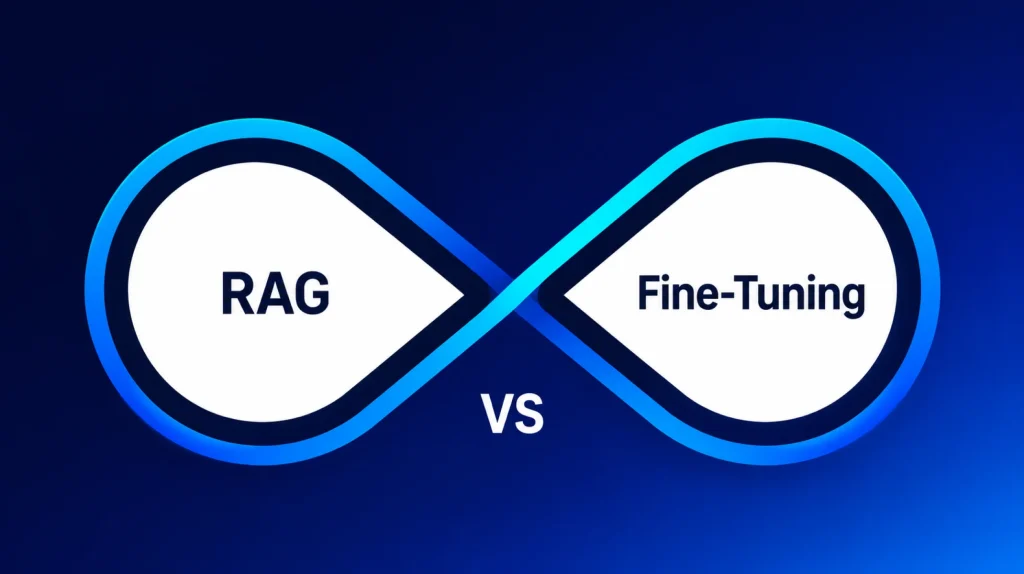
This is where the debate around RAG vs fine-tuning begins.
Should you teach a model new knowledge through training? Or should you allow it to retrieve information from external data sources whenever a user asks a question?
The answer can significantly impact development costs, deployment speed, maintenance requirements, and AI accuracy.
As Cubix CEO Salman Lakhani explains:
“The biggest misconception businesses have is believing they must train a model on everything they know. In reality, the smartest AI systems often combine retrieval, context, and specialized behavior rather than relying on one technique alone.”
Why Are RAG and Fine-Tuning Important?
The rise of generative AI has created enormous opportunities, but it has also introduced a major problem.
Most large language models (LLMs) are trained using publicly available information. While these models possess broad knowledge, they often struggle with:
- Company-specific information
- Internal documentation
- Industry regulations
- Frequently changing data
- Domain-specific tasks
- Proprietary business processes
For example, a customer support chatbot built using a generic LLM may understand what an insurance policy is. However, it won’t know your company’s latest policy updates unless you provide access to that information.
This challenge becomes even larger in industries where information changes frequently.
Research shows that enterprise knowledge bases can experience hundreds or even thousands of updates every month. Continuously retraining models every time information changes is neither practical nor cost-effective.
As a result, organizations are increasingly adopting two primary approaches:
- Retrieval Augmented Generation (RAG)
- Fine-Tuning
Both approaches improve AI performance, but they solve different problems.
What Is Retrieval-Augmented Generation (RAG)?
Before comparing fine tuning vs rag, let’s understand how RAG works.
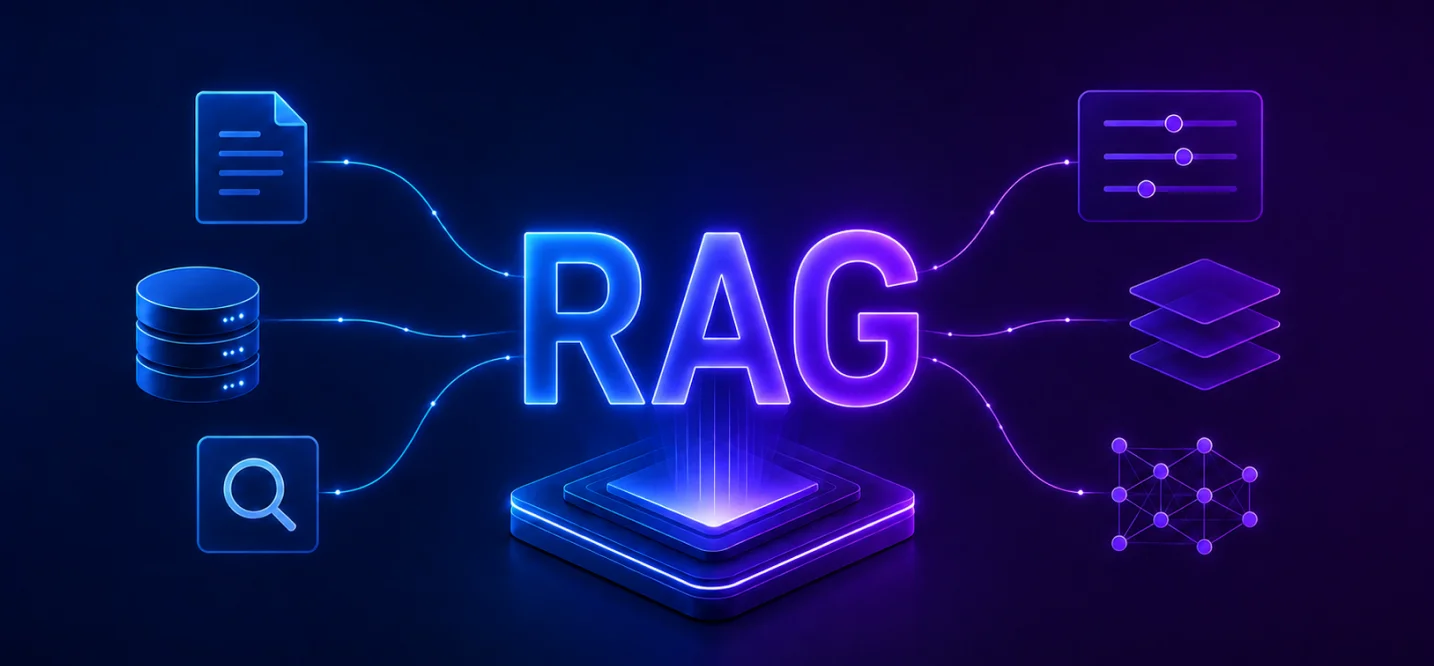
Retrieval Augmented Generation (RAG) is an AI architecture that enables a language model to access external information before generating a response.
Instead of relying solely on knowledge stored inside model parameters, the AI retrieves relevant information from external data sources and uses that information to generate answers.
This approach allows businesses to connect AI systems with:
- Internal documentation
- Knowledge bases
- CRM systems
- Product catalogs
- Compliance records
- Customer support documentation
- Enterprise databases
How RAG Works
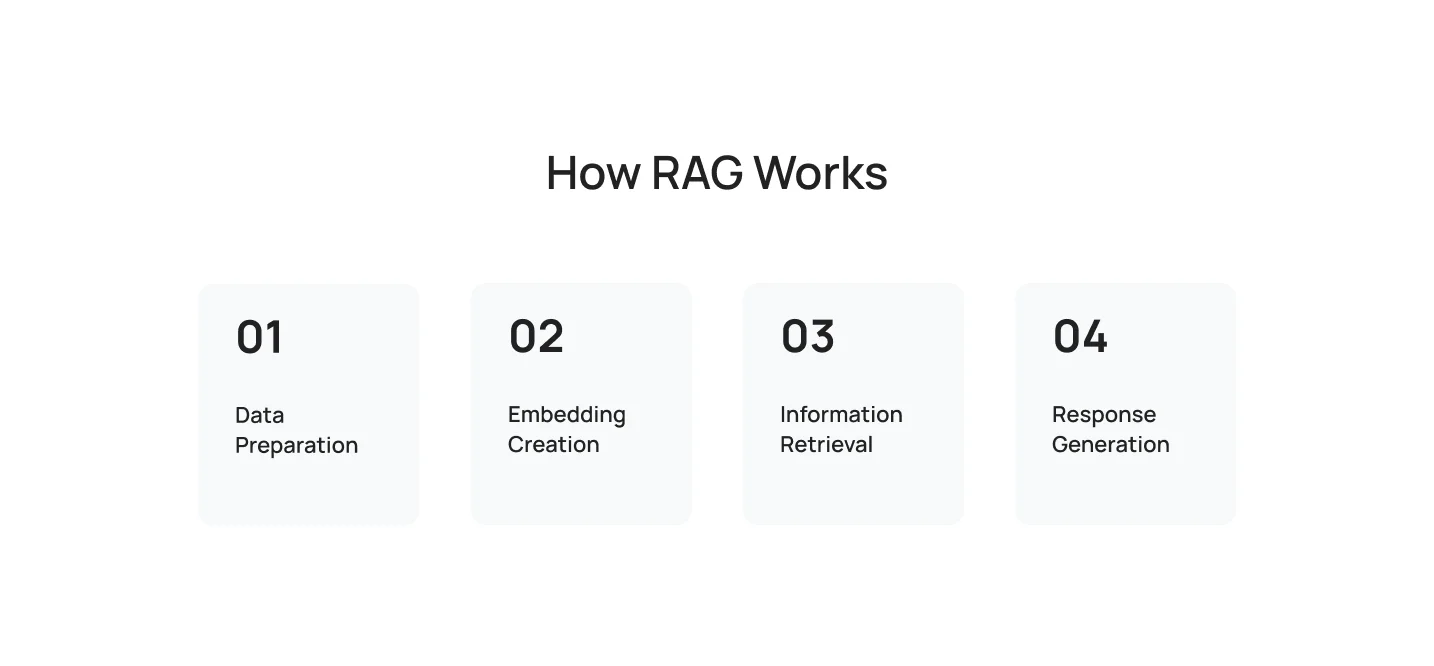
A typical rag technology workflow includes four stages:
Step 1: Data Preparation
Business documents are collected from various data sources.
These may include:
- PDFs
- Wikis
- Support documentation
- Internal databases
- Customer records
Step 2: Embedding Creation
The information is converted into numerical representations called embeddings.
This is where the discussion around RAG vs fine-tuning vs embedding often becomes confusing.
Embeddings are not competitors to RAG.
Instead, embeddings power the retrieval process used within RAG systems.
Step 3: Information Retrieval
When a user asks a question, the system searches the knowledge base and retrieves relevant information.
Step 4: Response Generation
The retrieved content is provided to the language model, which then generates an answer grounded in actual information.
This ability to generate answers based on verified content is one of the biggest advantages of artificial intelligence RAG systems.
Why Businesses Are Investing in RAG
The adoption of rag machine learning solutions has accelerated because they solve several enterprise challenges simultaneously.
Reduced Hallucinations
One of the biggest concerns with generative AI is hallucination.
A model may confidently provide incorrect information.
RAG minimizes this issue by grounding responses in retrieved documents.
This is often referred to as the rag grounding benefits comparison advantage.
Access to Real-Time Information
Business information changes constantly.
Unlike fine-tuned models, RAG systems can access updated information without retraining.
Improved Transparency
Organizations can show users where information originated.
This is particularly important in:
- Healthcare
- Legal services
- Financial services
- Regulatory compliance
Lower Maintenance Costs
Instead of retraining a model every time information changes, organizations simply update their knowledge base.
The LMCC Compliance Monitoring Platform
A practical example of why businesses need accurate, context-aware systems comes from Cubix’s work with the Labor Management Compliance Council (LMCC).
LMCC needed a centralized platform capable of helping teams monitor construction projects, document field observations, track non-compliance cases, and manage large volumes of project information across Southern California. The challenge wasn’t simply storing data. Field teams, contractors, and regulatory stakeholders needed fast access to relevant information while maintaining compliance with prevailing wage laws and labor regulations.
To address these challenges, Cubix developed a mobile application and web platform that streamlined compliance workflows, improved coordination between stakeholders, and enhanced visibility across projects.
The platform delivered several key benefits:
- Real-time compliance monitoring across construction projects
- Streamlined case management for investigators and compliance officers
- Centralized communication between contractors, agencies, and field teams
- Improved access to compliance resources and educational materials
- Better workflow consistency and operational transparency
Projects like LMCC highlight an important lesson in the RAG vs fine-tuning discussion. In compliance-driven environments, access to current and accurate information is often more valuable than relying solely on knowledge stored within a model’s training data. This is one reason retrieval-based architectures are becoming increasingly popular in industries where regulations, policies, and operational procedures evolve over time.
What Is Fine-Tuning?

Now let’s examine the other side of the RAG and fine-tuning discussion. Many organizations ask:
What is fine tuning in generative AI?
Fine-tuning is the process of taking an existing language model and further training it on domain-specific data.
Rather than retrieving information externally, fine-tuning modifies the model’s internal parameters so it learns specific behaviors, terminology, patterns, and knowledge.
The result is known as a fine tuned model.
Instead of learning general language patterns alone, the model becomes specialized for a specific purpose.
How Does Fine-Tuning Work?
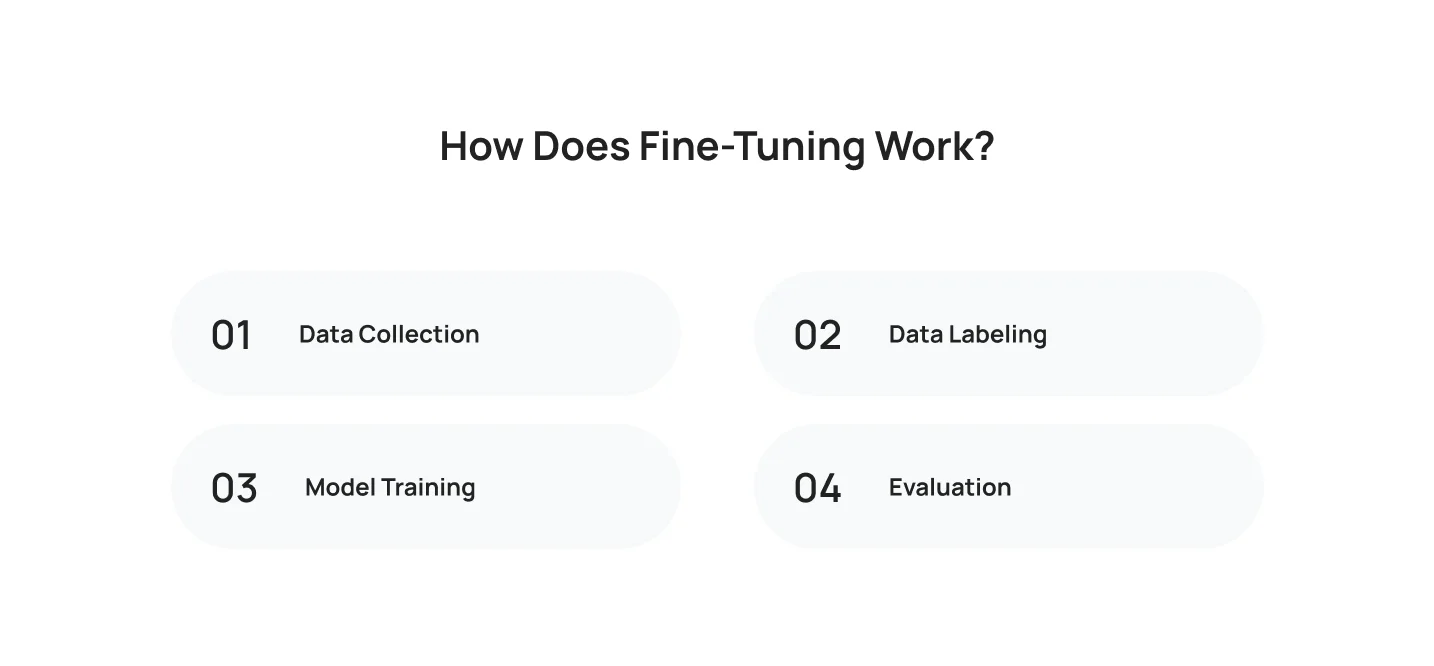
Understanding how fine-tuning works helps clarify the differences between LLM fine tuning vs rag.
The process generally includes:
Data Collection
Organizations gather domain-specific data. Examples include:
- Legal documents
- Medical records
- Customer interactions
- Technical manuals
Data Labeling
Training examples are prepared.
This may involve:
- Question-answer pairs
- Desired outputs
- Classification labels
Model Training
The model learns from new training data and adjusts its internal weights.
Evaluation
Performance is tested against business requirements.
Modern approaches often use Parameter Efficient Fine Tuning (PEFT) techniques, reducing computational requirements compared to traditional retraining methods.
Benefits of Fine-Tuning a Generative AI Model
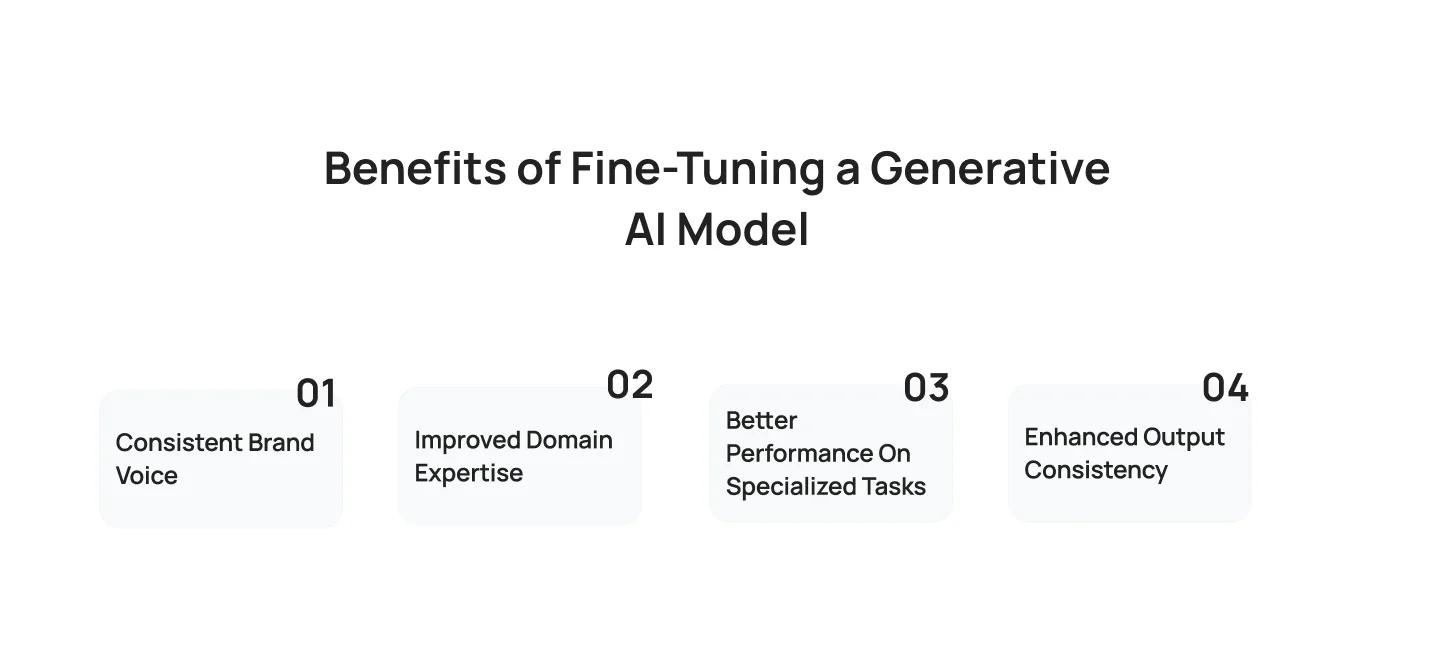
Understanding the benefit of fine tuning a generative ai model helps identify appropriate use cases.
Consistent Brand Voice
Organizations can ensure AI outputs align with company communication standards.
Improved Domain Expertise
Fine-tuning enables models to better understand domain-specific knowledge and terminology.
This is particularly useful in industries such as:
- Healthcare
- Finance
- Insurance
- Legal services
Better Performance on Specialized Tasks
Fine-tuned models often perform better on highly specialized domain specific tasks.
Examples include:
- Medical coding
- Legal document classification
- Technical troubleshooting
- Fraud detection
Enhanced Output Consistency
Unlike RAG systems that rely on retrieved content quality, fine-tuned models produce more predictable outputs.
RAG vs Fine-Tuning LLM: Side-by-Side Comparison
| Factor | RAG | Fine-Tuning |
| Knowledge Updates | Instant | Requires retraining |
| Information Freshness | High | Limited |
| Setup Complexity | Moderate | High |
| Computational Resources | Lower | Higher |
| Explainability | Strong | Limited |
| Source Attribution | Available | Difficult |
| Maintenance | Easier | Ongoing retraining |
| Hallucination Risk | Lower | Higher |
| Domain Adaptation | Moderate | Excellent |
| Deployment Speed | Faster | Slower |
RAG vs Fine-Tuning vs Embedding: Understanding the Difference
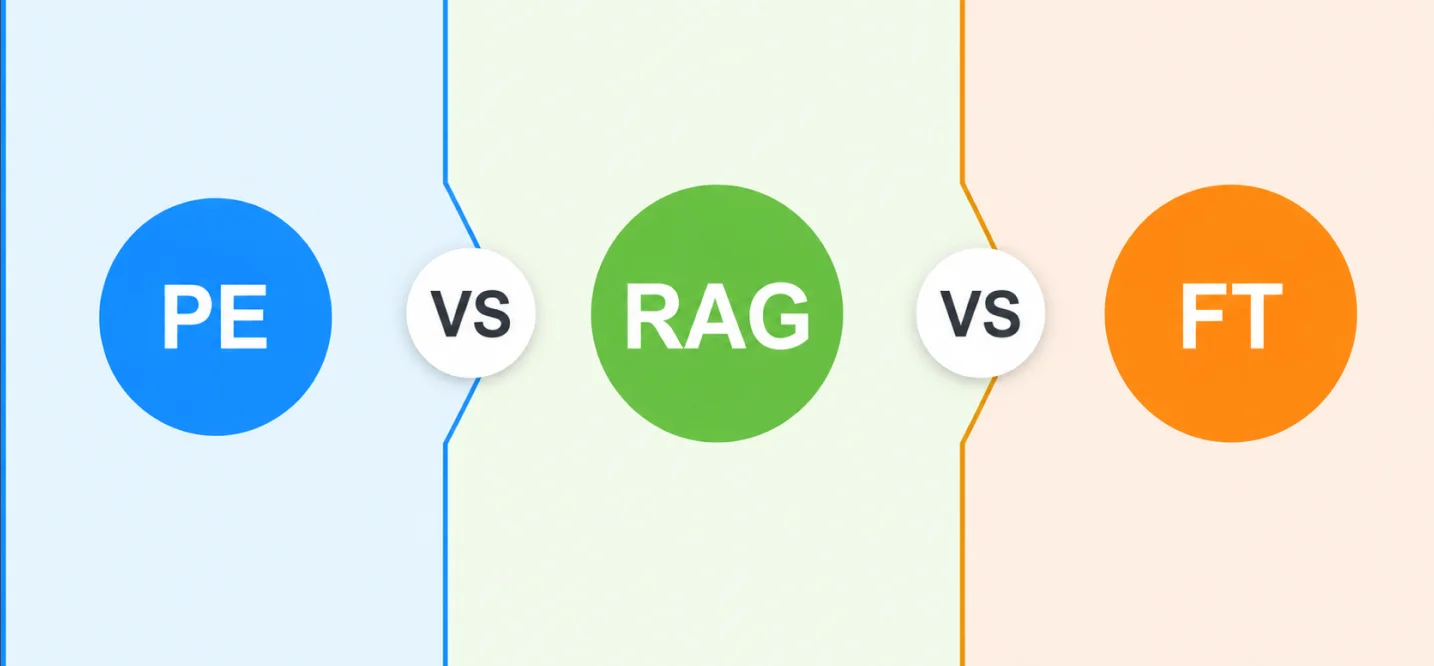
One of the most common misconceptions in enterprise AI is treating embeddings as an alternative to RAG or fine-tuning.
In reality, embeddings are a foundational component that often powers RAG systems.
Embeddings convert text into numerical vectors that represent meaning and context. This allows AI systems to search information based on semantic similarity rather than exact keyword matches.
For example, if a customer asks:
“How can I reset my account password?”
A traditional keyword search may miss relevant documentation if the article uses the phrase “credential recovery.”
An embedding-powered retrieval system understands the relationship between both concepts and retrieves the right information.
This is why discussions around RAG vs fine-tuning vs embedding can be misleading.
The relationship looks more like this:
- Embeddings help organize and retrieve information.
- RAG uses embeddings to find relevant information.
- Fine-tuning changes how a model behaves and responds.
RAG vs Fine-Tuning vs Prompt Engineering
Before investing in complex AI architectures, many organizations start with prompt engineering. Prompt engineering involves carefully designing instructions that guide how a model responds.
For example:
Instead of asking:
“Analyze this sales report.”
You might say:
“Act as a senior sales analyst. Identify trends, risks, and growth opportunities from this report.”
Better prompts often improve results significantly. However, prompt engineering has limitations.
- A prompt cannot teach a model information it has never seen.
- A prompt cannot provide access to proprietary company data.
- A prompt cannot reliably enforce specialized business workflows.
This is where the debate around RAG vs fine-tuning vs prompt engineering becomes important.
| Capability | Prompt Engineering | RAG | Fine-Tuning |
| Access Internal Data | No | Yes | Limited |
| Real-Time Updates | No | Yes | No |
| Custom Behavior | Limited | Moderate | Excellent |
| Cost | Low | Moderate | Higher |
| Scalability | Limited | High | High |
For many organizations, prompt engineering is the starting point, but RAG and fine-tuning become necessary as requirements become more sophisticated.
RAG vs Fine Tuning vs Agents
AI agents have become one of the hottest topics in generative AI. However, agents are not a replacement for either RAG or fine-tuning.
Instead, they often rely on both. An AI agent can:
- Plan actions
- Execute workflows
- Access tools
- Make decisions
- Perform multi-step tasks
But an agent still needs knowledge.
This is where Rag vs fine tuning vs agents becomes relevant. Imagine an AI-powered insurance agent.
The agent may:
- Retrieve policy information using RAG.
- Apply specialized reasoning learned through fine-tuning.
- Execute workflow actions.
- Generate responses for customers.
Without access to knowledge, agents become unreliable. Without proper behavior alignment, agents become inconsistent.
The strongest enterprise systems typically combine agents, retrieval, and specialized model behavior.
Organizations interested in this area can also explore our guide on “How to Build AI Agents” to better understand agent architectures and deployment strategies.
RAG Technology: Pros, Cons, and Enterprise Considerations
RAG Advantages
Always Current
Since information comes from external data sources, updates become immediately available.
Better Explainability
Responses can be traced back to source documents.
Lower Long-Term Costs
Organizations avoid expensive retraining cycles.
Reduced Hallucinations
The model relies on retrieved information rather than memory alone.
Scalability
Modern RAG systems can search millions of documents efficiently.
RAG Limitations
Retrieval Quality Matters
If the wrong information is retrieved, the response quality suffers.
Infrastructure Complexity
Organizations need:
- Embedding pipelines
- Vector databases
- Retrieval systems
- Monitoring frameworks
Dependency on Source Data
Poor documentation leads to poor AI outputs.
Despite these challenges, most enterprises view RAG as the most practical approach for dynamic information environments.
Fine Tuning vs RAG: Pros and Cons
While RAG dominates many enterprise deployments, fine-tuning still offers unique advantages.
Fine-Tuning Advantages
Strong Domain Expertise
Fine-tuned models can deeply understand industry terminology.
Consistent Responses
Outputs become more predictable.
Better Specialized Reasoning
Useful for highly structured tasks.
Improved User Experience
Responses often feel more natural within specific industries.
Fine-Tuning Challenges
Significant Computational Resources
Training large models requires specialized infrastructure.
Data Preparation Effort
High-quality training data is essential.
Ongoing Maintenance
Organizations must periodically retrain models as information evolves.
Higher Costs
Training expenses can become substantial at scale. This is why many organizations evaluating rag fine tuning architectures ultimately choose hybrid implementations.
When to Use RAG vs Fine-Tuning
The answer depends on your business goals, data environment, and operational requirements.
Use RAG When:
Your information changes frequently.
Examples include:
- Customer support knowledge bases
- Product documentation
- Internal policies
- Compliance documents
- Research repositories
RAG is particularly effective when businesses need AI systems that can generate answers using the latest available information.
Organizations focused on customer support often achieve faster deployment and lower maintenance costs using retrieval augmented generation.
Use Fine-Tuning When:
Your goal is to improve behavior rather than knowledge access.
Examples include:
- Legal analysis
- Medical classification
- Brand-specific content generation
- Fraud detection
- Industry-specific workflows
Fine-tuning excels when domain expertise and consistency matter more than real-time information retrieval.
Use Both When:
Many organizations eventually discover that RAG and fine-tuning together deliver the strongest results.
A hybrid architecture can:
- Retrieve current information through RAG
- Apply specialized reasoning through fine-tuning
- Improve accuracy
- Reduce hallucinations
- Enhance user experience
This hybrid approach is increasingly becoming the enterprise standard.
RAG vs ChatGPT and Deepseek: What’s the Difference?
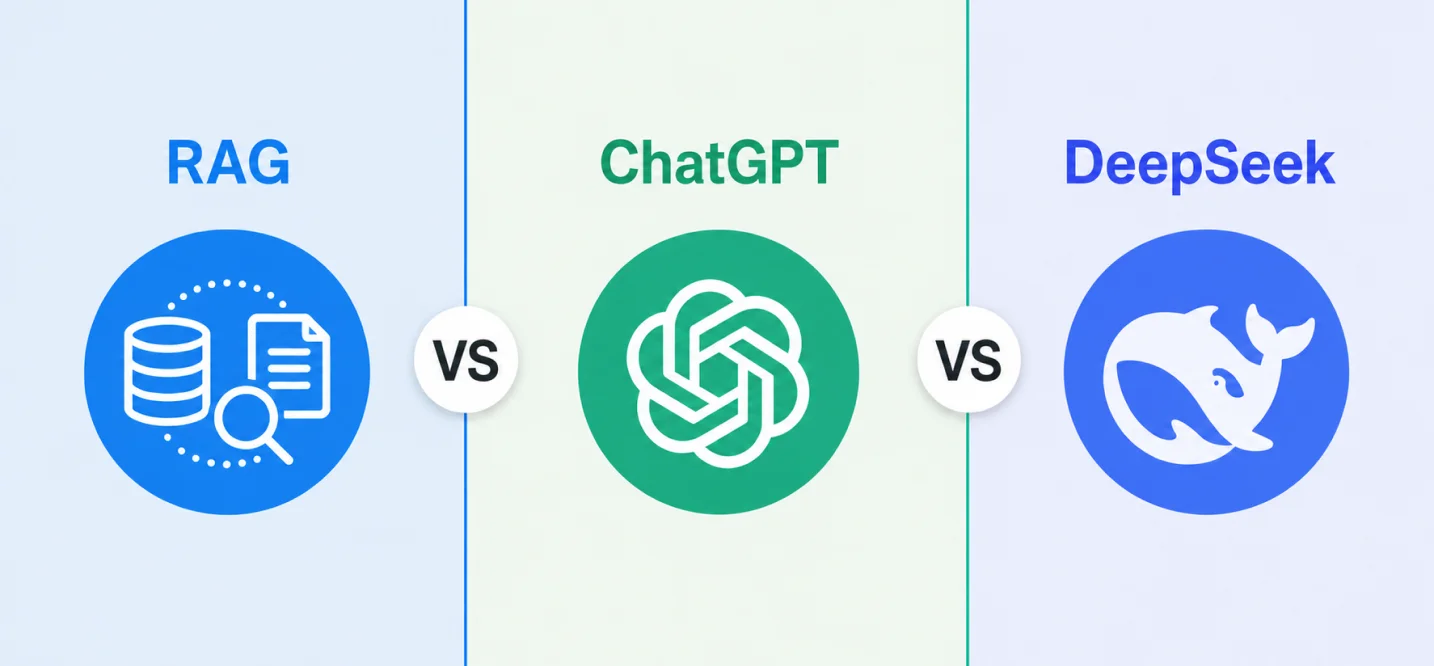
Many business leaders used to ask about how to integrate ChatGPT into their business, but now they ask:
“Isn’t RAG just ChatGPT?”
Not exactly.
ChatGPT 4 is a general-purpose AI model.
A RAG system combines a language model with enterprise knowledge retrieval.
The difference is significant.
A standard model may answer:
“I don’t know your company’s refund policy.”
A RAG-powered system can:
- Search internal documentation
- Retrieve current policy information
- Generate an evidence-backed response
This distinction explains why conversations around rag vs chatgpt and ChatGPT vs DeepSeek continue to gain traction among enterprises adopting AI.
Why Hybrid Architectures Are Winning
Industry analysts increasingly predict that hybrid AI architectures will become the dominant enterprise model.
The reason is simple.
Businesses need both:
- Access to current information
- Specialized domain intelligence
As Cubix CEO Salman Lakhani notes:
“The future isn’t RAG or fine-tuning. It’s knowing how to combine the right technologies to solve the right business problem. The organizations that succeed will be those that focus on outcomes, not hype.”
As AI agents, copilots, and autonomous systems become more common, hybrid architectures will continue to expand.
Organizations that build flexible foundations today will be better positioned for future innovation.
Why Businesses Partner with AI Development Specialists
Successfully implementing enterprise AI requires expertise across:
- Data engineering
- Model selection
- Retrieval architecture
- Fine-tuning workflows
- Security and compliance
- Deployment and monitoring
Working with a Large Language Model development company can help organizations avoid costly mistakes and accelerate time to value.
Depending on project requirements, businesses may choose a custom solution or leverage a Pre-built Model to reduce development timelines.
Organizations seeking broader AI capabilities often combine these strategies with comprehensive machine learning development services to create scalable, future-ready platforms.
Conclusion
The debate around RAG vs fine-tuning often assumes there must be a single winner.
In reality, the right choice depends on your objectives.
If your AI application relies on rapidly changing information, multiple data sources, and transparent answers, retrieval augmented generation is often the strongest option.
If your goal is to create a model with specialized expertise, consistent behavior, and deep understanding of domain-specific knowledge, fine-tuning may deliver greater value.
For many organizations, however, the future lies in combining both approaches.
The most successful AI systems are no longer choosing between fine tuning vs rag. They are strategically integrating retrieval, customization, embeddings, and intelligent agents into a unified architecture that delivers accuracy, scalability, and business impact.
Partner with Cubix to design, develop, and deploy enterprise-grade AI applications powered by RAG, fine-tuning, AI agents, and advanced machine learning technologies.
[blog_cta]
Frequently Asked Questions
1. What is the difference between RAG and fine-tuning?
RAG (Retrieval-Augmented Generation) retrieves information from external data sources in real time before generating a response, while fine-tuning trains a model on domain-specific data to modify its behavior, knowledge, or output style. RAG is ideal for dynamic information, whereas fine-tuning is best for specialized tasks and consistent outputs.
2. When should businesses use RAG instead of fine-tuning?
Businesses should use RAG when information changes frequently, such as product documentation, compliance policies, customer support knowledge bases, or internal company resources. RAG enables AI systems to access up-to-date information without requiring model retraining.
3. What is fine tuning in generative AI?
Fine-tuning is the process of training a pre-trained language model on additional domain-specific training data. This helps the model better understand industry terminology, business workflows, and specialized tasks while improving the consistency and accuracy of responses.
4. Can RAG and fine-tuning be used together?
Yes. Many enterprise AI applications combine RAG and fine-tuning to achieve the best results. RAG provides access to current and accurate information, while fine-tuning improves domain expertise, response quality, and task-specific performance. This hybrid approach is increasingly becoming the preferred enterprise AI architecture.
5. Is RAG better than ChatGPT for business applications?
A standard ChatGPT implementation relies primarily on its pre-trained knowledge, while a RAG-powered system can retrieve information from company databases, documents, and knowledge bases. For organizations that need accurate, business-specific answers, RAG often delivers more reliable and context-aware results.