Key Takeaways
- Unity remains one of the most widely used game engines for mobile, PC, console, AR, and VR development.
- Before you hire Unity developers, identify the exact skills your project requires, such as mobile, multiplayer, console, or XR expertise.
- A strong Unity developer should have experience with C#, optimization, networking, version control, and shipped commercial projects.
- Freelancers work well for short-term tasks, while agencies and staff augmentation services are better suited for larger productions.
- Building a successful Unity project often requires more than developers alone. Designers, artists, QA engineers, and backend specialists all contribute to a polished final product.
Unity has remained one of the most trusted game engines in the world for more than a decade.
From mobile games and console titles to AR, VR, and real-time simulations, businesses continue to choose Unity because it offers flexibility, cross-platform support, and a mature development ecosystem. In fact, Unity powers the majority of the world’s top mobile games and continues to be one of the most widely used engines for interactive experiences.
But building with Unity is only half the equation.
Finding the right developer is often the bigger challenge.
So, how do you hire Unity developers who are actually the right fit?
And more importantly, how much does it cost to hire a game developer to make a video game?
This guide answers those questions using current hiring trends, industry statistics, salary benchmarks, and practical hiring advice. Whether you’re looking for unity game developers for hire, planning to hire Unity designers, or searching for a complete Unity Game Development partner, you’ll learn exactly what to look for before making your next hire.
Why Unity Developers Are in High Demand in 2026
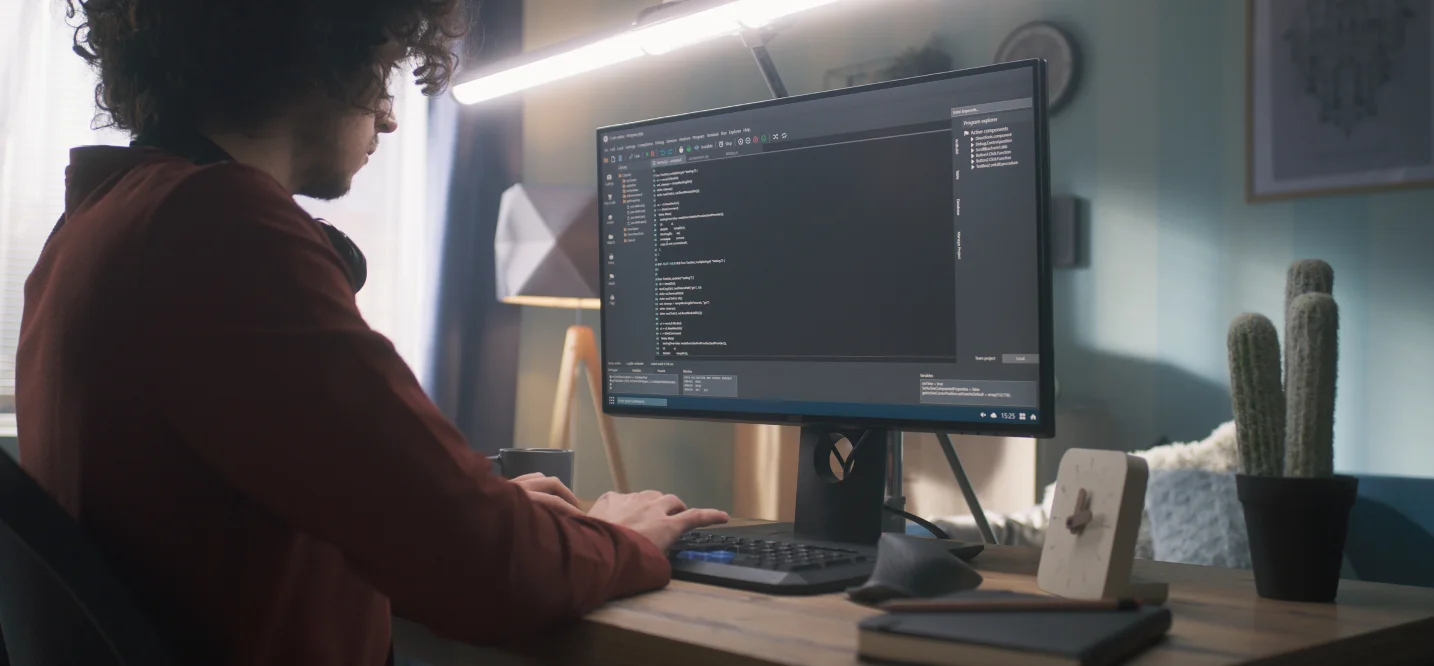
Today, it’s used across industries including gaming, education, automotive, healthcare, architecture, manufacturing, film production, and enterprise training. Its ability to build once and deploy across multiple platforms makes it one of the most valuable development tools available.
For companies, that means one thing.
Experienced Unity developers are in demand.
Unity by the Numbers
| Unity Industry Statistics | 2026 Snapshot |
| Top mobile games built with Unity | Over 70% |
| Platforms supported by Unity | 20+ |
| Steam games using Unity | Approximately half of all released titles |
| Industries using Unity | Gaming, XR, Healthcare, Automotive, Film, Education |
| Primary programming language | C# |
These numbers explain why companies continue searching for unity game developers for hire despite an increasingly competitive hiring market.
Demand Has Expanded Beyond Gaming
Ten years ago, Unity hiring mostly revolved around mobile games.
Today, businesses hire Unity developers for:
- Interactive product configurators
- Medical training simulations
- Virtual reality learning
- Digital twins
- Architectural visualization
- Multiplayer gaming platforms
- Live-service games
- Enterprise training software
How Much Should You Budget for Hiring Unity Developers?
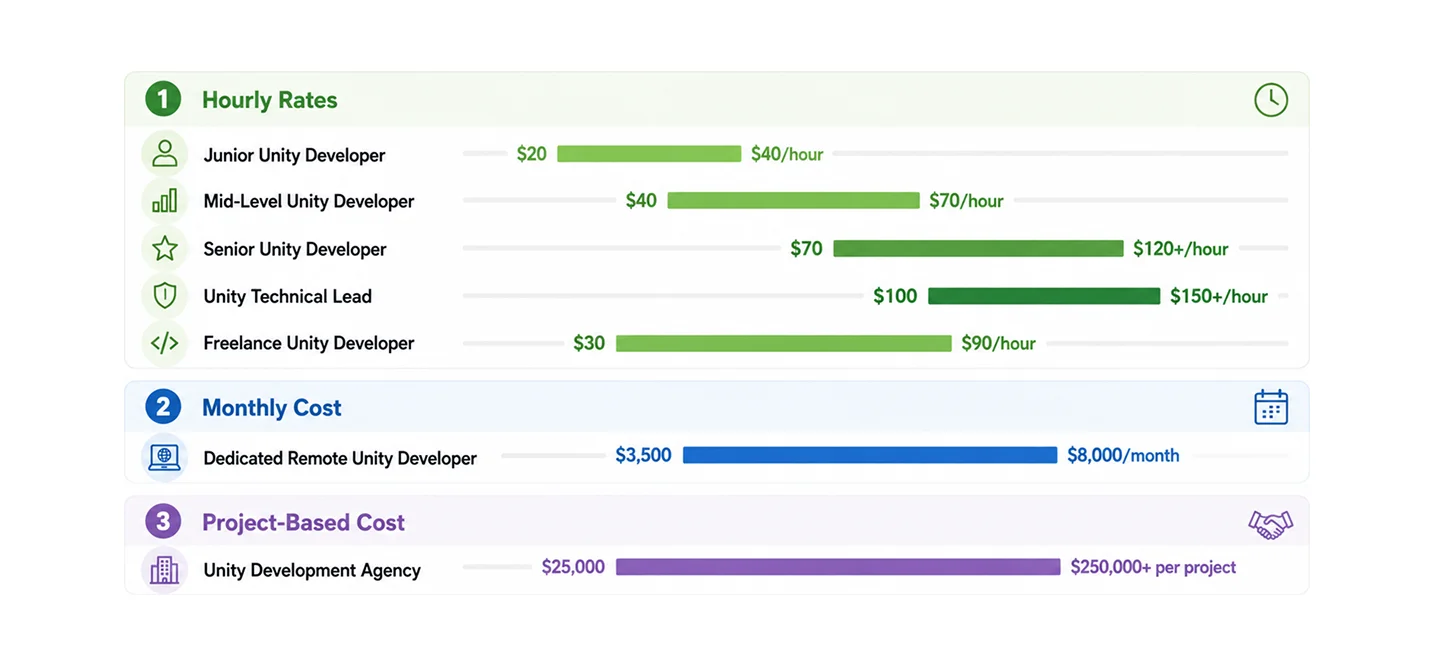
Instead of asking, “How much does it cost to hire a game developer?”, ask:
“What type of game am I building, and what level of expertise does it require?”
That approach leads to much more accurate budgeting.
Estimated Cost to Hire Unity Developers
| Hiring Type | Best For | Typical Cost |
| Junior Unity Developer | Bug fixes, small features, simple games | $20-$40/hour |
| Mid-Level Unity Developer | Mobile and indie game development | $40-$70/hour |
| Senior Unity Developer | Multiplayer, optimization, architecture | $70-$120+/hour |
| Unity Technical Lead | Large-scale projects and technical planning | $100-$150+/hour |
| Freelance Unity Developer | Short-term tasks or prototypes | $30-$90/hour |
| Dedicated Remote Unity Developer | Long-term development support | $3,500-$8,000/month |
| Unity Development Agency | End-to-end game development | $25,000-$250,000+ per project |
What Type of Unity Developer Do You Actually Need?
One of the biggest hiring mistakes companies make is searching for a generic “Unity developer.”
Before you hire Unity developers, define exactly what your project needs.
Let’s break down the most common specializations.
Mobile Unity Developers
Their day-to-day work often includes:
- Optimizing games for hundreds of devices
- Integrating rewarded ads and in-app purchases
- Managing asset bundles and Addressables
- Reducing loading times
- Improving battery efficiency
- Handling analytics and player retention tools
These developers are ideal if you’re creating:
- Hyper-casual games
- Casual puzzle games
- Multiplayer mobile games
- RPGs
- Strategy games
- Live-service mobile titles
PC and Console Unity Developers
PC and console development requires a different skill set.
These developers focus on delivering high-quality visuals, larger game worlds, advanced rendering, and platform-specific optimization.
Their expertise usually includes:
- HDRP and URP rendering pipelines
- Controller support
- Steam integration
- PlayStation and Xbox certification
- Graphics optimization
- Advanced lighting systems
- Performance profiling
AR, VR, and XR Unity Developers
This is one of the fastest-growing areas of Unity Game Development.
As businesses invest in immersive technologies, experienced XR developers have become increasingly difficult to hire.
Typical skills include:
- Meta Quest development
- Apple Vision Pro applications
- Mixed Reality experiences
- Hand tracking
- Spatial computing
- XR Interaction Toolkit
- Motion controllers
- Room-scale experiences
Multiplayer and Backend Unity Developers
Building multiplayer games involves much more than gameplay.
Your backend architecture must support matchmaking, player authentication, cloud saves, leaderboards, inventories, and real-time networking.
This is where backend-focused Unity developers become invaluable.
Many companies ask:
“We need to build a game that requires complex backend infrastructure. What kind of development agency has the best experience with this?”
The answer is simple.
Look for agencies or developers with proven experience integrating technologies such as:
- Photon Fusion
- Mirror Networking
- Unity Netcode
- PlayFab
- Firebase
- AWS Game Services
- Microsoft Azure
- Dedicated server architecture
What Skills Should You Look for When Hiring Unity Developers?
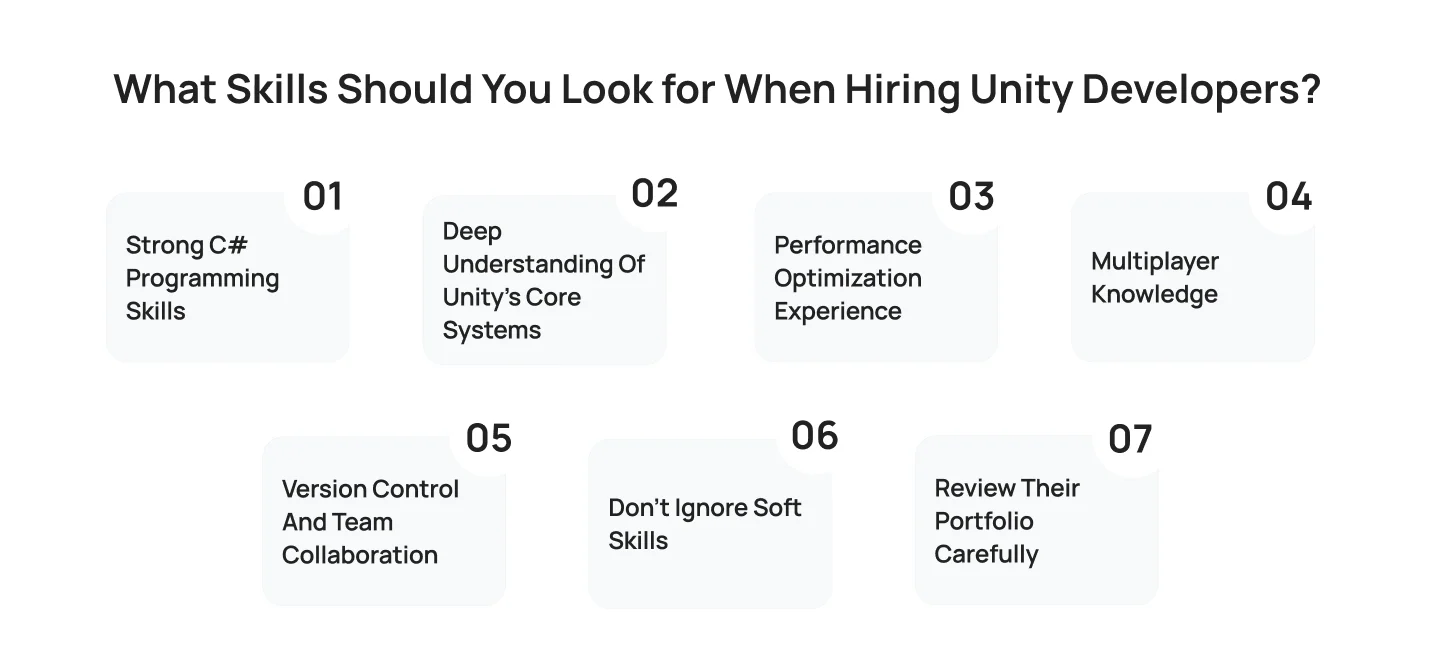
Finding a Unity developer isn’t difficult. But, finding the right Unity developer is.
So, what are the key skills to look for in a senior Unity developer?
“The success of every product begins with the people behind it. Build a great team first, and great products naturally follow.” — Salman Lakhani, CEO Of Cubix
Strong C# Programming Skills
Unity is built around C#.
An experienced developer should write clean, maintainable, and scalable code rather than relying on quick fixes.
Look for experience with:
- Object-oriented programming
- Design patterns
- Dependency injection
- Memory management
- Event systems
- Async programming
Deep Understanding of Unity’s Core Systems
Senior developers should be comfortable working with the engine’s major features, including:
- Physics
- Animation
- Particle systems
- Navigation
- Audio
- UI Toolkit
- Shader Graph
- Addressables
- Prefabs
Performance Optimization Experience
A beautiful game means very little if it performs poorly.
Experienced Unity developers understand how to improve:
- Frame rates
- Memory usage
- CPU performance
- GPU performance
- Loading times
- Asset management
Multiplayer Knowledge
If your project includes online gameplay, developers should understand networking concepts like:
- Client-server architecture
- Matchmaking
- Synchronization
- Lag compensation
- Authentication
- Cloud saves
Version Control and Team Collaboration
Game development is rarely a solo effort.
Developers should already be comfortable with:
- Git
- GitHub
- GitLab
- Plastic SCM
- Agile workflows
- Sprint planning
- Code reviews
Don’t Ignore Soft Skills
Technical ability gets candidates interviews.
Soft skills help them succeed.
Look for developers who can:
- Explain technical ideas clearly.
- Accept feedback.
- Solve problems independently.
- Work well with artists and designers.
- Adapt to changing priorities.
- Communicate progress regularly.
Review Their Portfolio Carefully
Before making an offer, ask candidates to walk you through projects they’ve actually shipped.
A strong portfolio should include:
- Published mobile or PC games
- App Store or Steam releases
- Features they personally developed
- Performance optimization examples
- Multiplayer or backend systems
- Team collaboration experience
Rather than asking, “Can you use Unity?”, ask:
“Tell us about the biggest technical challenge you solved on a shipped game.”
How Much Does It Cost to Hire Unity Developers?
This is one of the first questions every founder asks.
And the honest answer is:
It depends.
If you’re wondering how much does it cost to hire a game developer, it’s important to remember that Unity specialists often command higher rates because they combine software engineering with game-specific expertise.
Let’s break it down.
What Affects the Cost of Hiring Unity Developers?
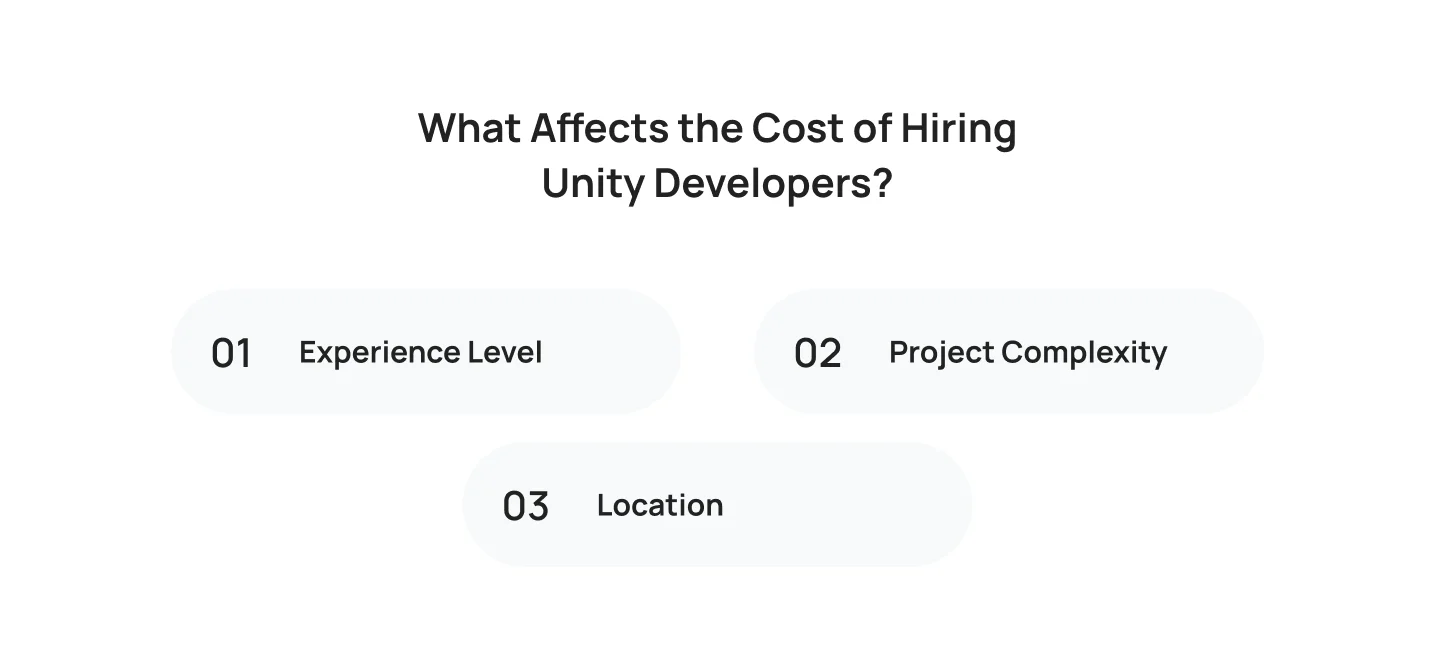
Several factors influence pricing.
1. Experience Level
Junior developers usually have one to three years of experience and are well suited for bug fixes, UI implementation, or supporting larger teams.
Mid-level developers can independently build gameplay systems and handle most production tasks.
Senior developers are responsible for architecture, optimization, multiplayer systems, mentoring, and technical leadership.
The more responsibility you expect, the higher the investment.
2. Project Complexity
Not every Unity project requires the same skill set.
For example:
- A simple 2D mobile game is relatively straightforward.
- A multiplayer survival game requires networking expertise.
- A VR training simulator demands specialized XR knowledge.
- A live-service game needs backend integration and scalable infrastructure.
More complex projects require developers with deeper technical expertise, which naturally increases hiring costs.
3. Location
Developer salaries vary significantly around the world.
Companies often balance cost with communication, experience, and time-zone overlap when building distributed teams.
Average Unity Developer Rates by Region (2026)
| Region | Average Hourly Rate | Average Annual Salary |
| United States | $60-$95/hr | $95,000-$170,000 |
| Canada | $45-$75/hr | $80,000-$130,000 |
| Western Europe | $40-$70/hr | $70,000-$120,000 |
| Eastern Europe | $25-$45/hr | $45,000-$80,000 |
| India | $20-$40/hr | $25,000-$60,000 |
| Southeast Asia | $15-$35/hr | $20,000-$50,000 |
Figures are based on recent industry salary benchmarks and global hiring trends. Actual costs vary depending on experience, specialization, and project requirements.
Should You Hire One Developer or an Entire Team?
A single Unity developer can build an excellent prototype. But larger commercial projects usually require specialists working together.
A typical Unity production team may include:
- Unity developers
- Game designers
- UI/UX designers
- Technical artists
- QA engineers
- Backend developers
- Producers
- DevOps specialists
Hiring an entire team often delivers better long-term results than expecting one developer to handle every aspect of production.
When Is an Agency the Better Choice?
Many founders approach hiring with a single question:
“We have a great idea for a game but don’t know how to structure the development lifecycle. What are the best firms to outsource the entire build to?”
If you’re starting from scratch, a full-service game development agency is usually the better option.
Rather than hiring developers individually, agencies provide cross-functional teams that include designers, developers, artists, QA engineers, producers, and technical architects working together from day one.
Similarly, if your goal is to launch quickly, agencies experienced in rapid prototyping can help build an MVP, validate gameplay mechanics, and establish a scalable technical foundation before investing in full production.
For companies looking to expand existing teams rather than outsource an entire project, staff augmentation services provide experienced Unity specialists who integrate directly into your agile workflow and accelerate delivery without disrupting existing processes.
Why Many Companies Choose Unity Development Agencies Instead
Hiring a talented Unity developer is important.
But many successful games aren’t built by one developer alone.
They’re built by teams.
That’s why more companies are partnering with Unity development agencies instead of trying to recruit every specialist individually. An experienced agency brings together designers, developers, artists, QA engineers, technical architects, and project managers under one roof.
Instead of spending months building a team, you gain immediate access to the expertise needed to move your project forward.
Let’s answer some of the questions businesses ask most often.
“We Have a Great Idea for a Game but Don’t Know How to Structure the Development Lifecycle. What Are the Best Firms to Outsource the Entire Build To?”
This is one of the most common situations for startups.
Having a great game idea is exciting.
Turning that idea into a successful product requires much more than writing code.
You need:
- Market validation
- Technical planning
- Game design
- Art production
- Programming
- Backend architecture
- QA testing
- LiveOps planning
- Launch support
The best agencies don’t simply build games.
They guide you through the entire game development lifecycle, helping you make smart technical and business decisions along the way.
Look for an agency that offers:
- Discovery workshops
- MVP development
- Agile production
- Dedicated project managers
- Cross-functional development teams
- Post-launch maintenance
A partner that understands the complete production process can save months of development time and significantly reduce project risks.
“Are There Agencies That Specialize in Mobile Game Development?”
Absolutely. Not every game studio specializes in mobile development. Mobile games require unique expertise, including:
- Device optimization
- Battery efficiency
- Touch-first UI design
- In-app purchases
- Rewarded advertising
- Live events
- Analytics integration
- User acquisition support
If mobile is your target platform, look for agencies with multiple published mobile titles and experience optimizing games across both Android and iOS devices.
An experienced Unity Game Development partner should also understand player retention, monetization strategies, and app store requirements, not just gameplay programming.
“We Need to Build an MVP Quickly. Which Agencies Specialize in Rapid Prototyping?”
Building a complete game before validating the idea is risky.
That’s why many successful studios start with a Minimum Viable Product (MVP).
An MVP focuses on one goal:
Prove the game is fun before investing heavily.
Agencies experienced in rapid prototyping can help you:
- Validate gameplay mechanics
- Test user feedback
- Identify technical risks
- Estimate production costs
- Refine your roadmap
Launching a prototype early also makes it easier to secure investors, publishers, or internal approval before scaling production.
“We Need to Scale Our Development Team Quickly. What’s the Best Approach?”
Hiring full-time employees can take months.
If your project has an aggressive launch schedule, staff augmentation is often the faster option.
Many companies choose to hire Unity developers through augmentation services because they can quickly add specialists without rebuilding their existing workflow.
For example, you may need:
- Two gameplay programmers
- One technical artist
- One backend engineer
- Additional QA testers
Instead of restarting recruitment, these professionals integrate directly into your existing agile team.
Staff augmentation works particularly well for:
- Seasonal production peaks
- Multiplayer development
- Live-service updates
- Feature completion
- Console certification
- Performance optimization
“Our Team Is Struggling to Scale Development Capacity. What Staff Augmentation Services Should We Look For?”
Not all staff augmentation providers work the same way. The best partners become an extension of your internal team. Look for providers that offer:
- Dedicated Unity specialists
- Flexible engagement models
- Agile development experience
- Transparent communication
- Daily stand-ups
- Sprint planning support
- Project management assistance
“Our Team Is Stuck Designing the Technical Architecture. Who Should We Hire?”
Sometimes the challenge isn’t development.
It’s planning.
Complex multiplayer games, live-service platforms, and large-scale applications require experienced technical leadership long before production begins.
A consultancy or full-service game development agency can help define:
- Overall system architecture
- Multiplayer networking strategy
- Cloud infrastructure
- Database design
- Scalability planning
- Security
- Performance optimization
Why Cubix Is a Trusted Unity Development Partner
Successful games don’t happen by accident.
They’re the result of experienced teams working together from concept to launch.
At Cubix Games, we help businesses build scalable, high-performance Unity projects across mobile, PC, console, AR, and VR platforms. Hire Unity Developers for a growing production team or require end-to-end Unity Game Development.
Our multidisciplinary teams include:
- Unity gameplay developers
- Multiplayer engineers
- Technical architects
- QA specialists
- Producers
- UI/UX designers
- Technical artists
- Dedicated 3d game artist for hire professionals for character, environment, and asset creation
Need a full production team? We can do that.
Need to hire unity designers for a short-term milestone?
We’ve got you covered.
Need to hire unity 3d developer specialists to strengthen your engineering team before launch?
Our staff augmentation model allows experienced Unity professionals to integrate seamlessly into your existing workflow.
The right development partner doesn’t just write code. They help reduce risk, improve delivery speed, and turn ambitious ideas into successful products.
[blog_cta]
Frequently Asked Questions
1. Where can I find experienced Unity game developers for my project?
You can find experienced Unity developers through freelance marketplaces, professional hiring platforms, staff augmentation providers, or full-service game development agencies. The best choice depends on your project’s size and complexity.
2. What are the key skills to look for in a senior Unity developer?
A senior Unity developer should have expertise in:
- C# programming
- Unity 6 workflows
- Performance optimization
- Multiplayer networking
- Asset management
- Shader Graph and rendering pipelines
- Version control systems like Git
- Debugging and problem-solving
Beyond technical skills, look for developers with shipped titles, strong communication skills, and experience collaborating within agile development teams.
3. How much does it cost to hire a game developer?
The cost varies depending on experience, region, and project complexity. In North America, experienced Unity developers typically charge between $60-$95 per hour, while developers in Eastern Europe and Asia generally offer more cost-effective rates. Besides developer costs, businesses should also budget for design, art, QA, backend infrastructure, and post-launch support when estimating the total project investment.
4. Should I hire a freelancer, an in-house developer, or a Unity development agency?
- Freelancers are ideal for small projects, prototypes, or short-term tasks.
- In-house developers work well for companies building long-term products and maintaining internal expertise.
- Development agencies provide complete teams capable of handling design, programming, QA, art, backend development, and project management from start to finish.
- Staff augmentation is the best option when you need to scale your existing development team quickly without hiring full-time employees.
5. Is Unity still a good game engine in 2026?
Yes. Unity remains one of the world’s leading real-time development platforms. It continues to power a significant share of mobile games while supporting PC, console, AR, VR, WebGL, and enterprise applications. Its cross-platform capabilities, large developer community, and mature ecosystem make it a reliable choice for both startups and established studios.
6. How long does it take to hire Unity developers?
Hiring timelines vary depending on the specialization you’re looking for.
- Mobile Unity developers can often be hired within 2-6 weeks.
- PC and console developers generally require 4-8 weeks.
- AR, VR, multiplayer, and senior technical specialists may take 6-12 weeks or longer due to higher demand and a smaller talent pool.