Global AI spending is projected to cross $2.59 trillion in 2026, up 47% from last year, according to Gartner’s latest forecast. That number tells you one thing clearly: AI is no longer a side project companies dabble in. It’s a core line item in the budget. And if you’re reading this, you’re probably asking the same question every founder, CTO, and product lead is asking right now – what does AI development cost in 2026, and where does the money actually go?
The honest answer is that AI development costs anywhere between $15,000 and over $500,000, depending on what you’re building, how complex your data is, and how much of the system needs to run in real time. That’s a wide range, and it’s exactly why so many teams either overpay for something simple or underbudget for something that turns out to be far more involved than they expected.
This guide breaks down what drives AI development costs in 2026, what each stage of a build typically costs, and how to plan a budget that doesn’t fall apart halfway through the project. We’ll also walk through how Cubix approaches AI builds that need to stay lean, compliant, and fast to market – including a real project we shipped in six weeks.
Quick Answer: AI Development Cost Breakdown for 2026
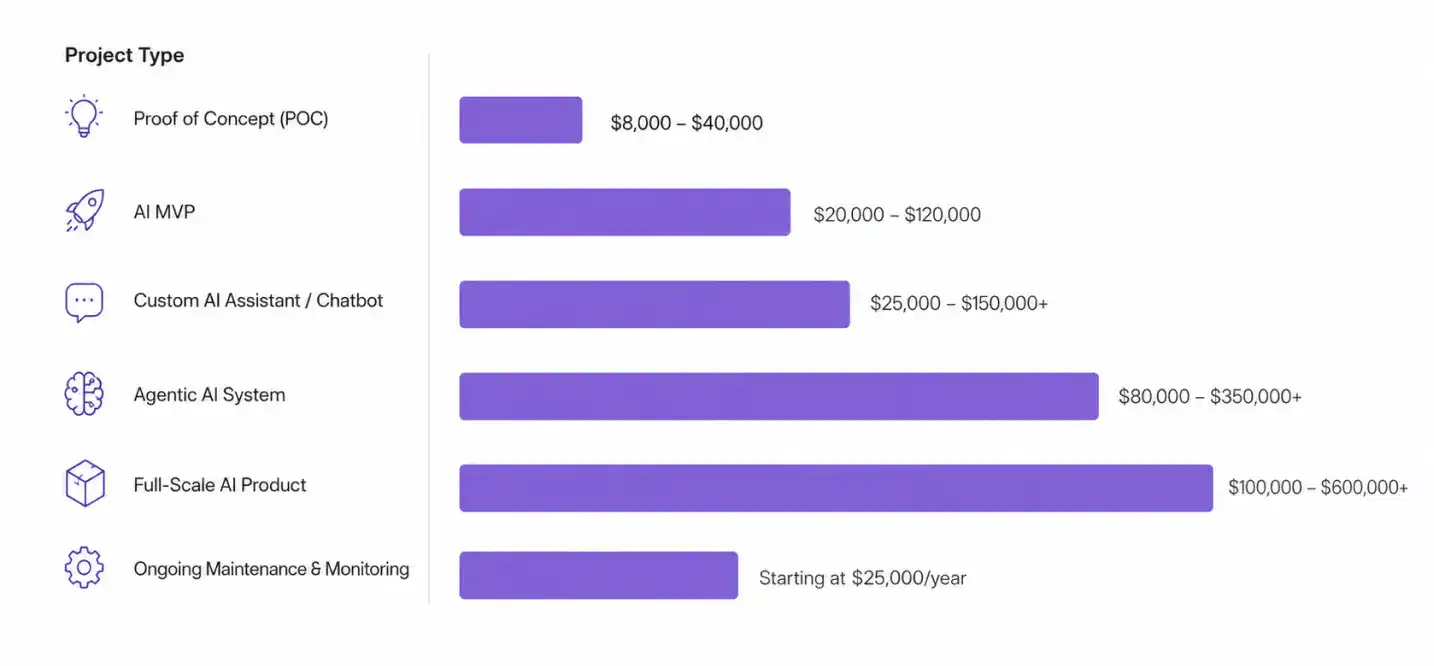
Here’s a fast reference before we go deeper into the details.
| Project Type | Estimated 2026 Cost |
| Proof of Concept (POC) | $8,000 – $40,000 |
| AI MVP | $20,000 – $120,000 |
| Custom AI Assistant / Chatbot | $25,000 – $150,000+ |
| Agentic AI System | $80,000 – $350,000+ |
| Full-Scale AI Product | $100,000 – $600,000+ |
| Ongoing Maintenance & Monitoring | Starting at $25,000/year |
These are benchmark figures for projects of moderate to high complexity. A simple internal tool sits at the lower end. A production-grade agentic AI system handling real customer data, compliance checks, and live decision-making sits much higher. If you want a number specific to your project, our artificial intelligence development services team can walk you through a scoped estimate in a single call.
Want to discuss your project? Our experts are just a click away.
Contact UsWhat Factors Drive AI Development Costs?
Before you can budget accurately, it helps to understand what actually moves the needle on AI development cost. Most teams assume it’s just “how good is the model,” but in practice, cost is driven by a mix of technical and operational decisions made long before a single line of code is written.
- Project complexity – A single-purpose model costs far less than a system that touches multiple workflows, departments, or decision points.
- Data readiness – Clean, structured, labeled data is rare. Most projects spend a significant chunk of the budget just preparing data before training even starts.
- Model type – Traditional machine learning is cheaper to build than deep learning, and both are cheaper than large language model or agentic AI systems that need constant fine-tuning.
- Infrastructure – GPU compute, cloud storage, and scaling costs add up fast, especially for real-time or high-volume applications.
- Talent – Data scientists, ML engineers, and MLOps specialists are still expensive to hire directly, which is why many companies work with an outsourced AI software development cost model instead of building an in-house team from scratch.
- Compliance and monitoring – Regulated industries like healthcare and finance require explainability, audit trails, and ongoing monitoring, all of which add real cost after launch, not just during build.
Of these, data readiness and compliance are the two factors teams underestimate most often. Everyone plans for model development. Fewer people plan for what happens after the model is live and needs to be watched, retrained, and kept compliant.
Stages of AI Development and What Each Stage Costs
Every AI build, regardless of industry, tends to move through the same core stages. Knowing what each one costs helps you plan a realistic budget instead of a single lump-sum guess.
- Discovery & Strategy – Defining the problem, mapping data sources, and setting success metrics. Typically $3,000–$15,000.
- Proof of Concept – A small-scale test to validate feasibility before committing further budget. $8,000–$40,000.
- Data Engineering & Model Training – Cleaning, labeling, and training the model on real data. This stage often eats the largest share of the budget, especially for custom deep learning solutions built on unstructured or messy data.
- Development & Integration – Building the application layer, APIs, and connecting the model to your existing systems.
- Testing & Deployment – QA, performance testing, and production rollout.
- Monitoring & Maintenance – Ongoing retraining, performance tracking, and compliance checks once the system is live.
If you’re asking how much it costs to build an AI system from scratch versus extending an existing one, the answer usually comes down to how many of these stages you’re paying for. A migration or integration project skips discovery and starts closer to development, which is why those projects tend to cost less than a full ground-up build.
Cost Breakdown for Different Types of Custom AI Software Development
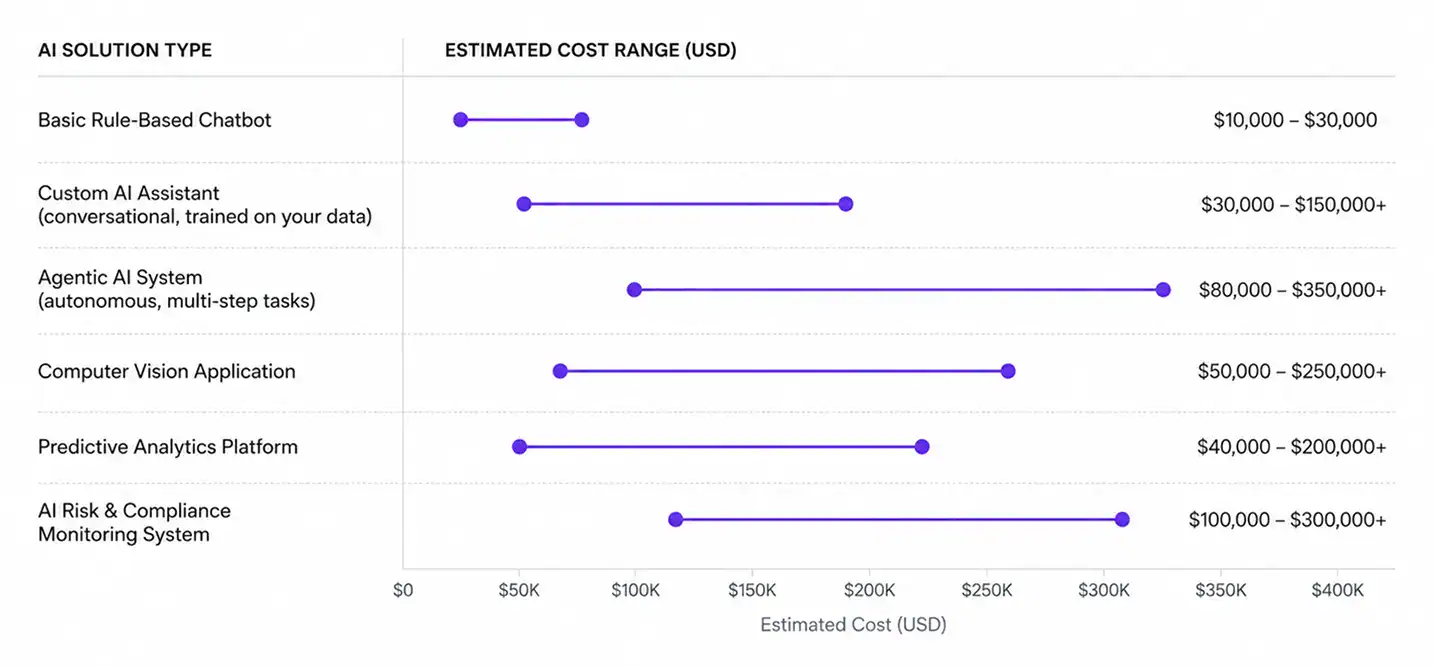
Not all AI systems are priced the same way, because they don’t all require the same depth of engineering. Here’s how cost breaks down by category in 2026.
| AI Solution Type | Estimated Cost |
| Basic Rule-Based Chatbot | $10,000 – $30,000 |
| Custom AI Assistant (conversational, trained on your data) | $30,000 – $150,000+ |
| Agentic AI System (autonomous, multi-step tasks) | $80,000 – $350,000+ |
| Computer Vision Application | $50,000 – $250,000+ |
| Predictive Analytics Platform | $40,000 – $200,000+ |
| AI Risk & Compliance Monitoring System | $100,000 – $300,000+ |
The cost of implementing AI agents for business in 2026 has climbed compared to a basic chatbot build, largely because agentic systems need to make decisions, call external tools, and operate with a degree of autonomy that requires much more rigorous testing. If you’re specifically weighing agentic AI development cost against a simpler assistant, the deciding factor is almost always how much independent decision-making the system needs to handle without a human in the loop. Companies exploring this space often start by talking to a custom AI agent development company early, since agentic architecture decisions made at the start are expensive to reverse later.
Teams building on large language models specifically should also budget for ongoing API or hosting costs, which is where working with an experienced large language models development company tends to save money over time through smarter architecture choices, not just development speed.
How Much Does Custom AI Development Cost for Small Businesses?
Small businesses often assume AI is out of reach financially, and in 2026, that’s simply no longer true. The cost of AI implementation for a small business looks very different from an enterprise rollout, mainly because the scope is naturally smaller and the infrastructure needs are lighter.
A small business building a focused tool, like an AI assistant for customer support or a predictive tool for inventory, can typically expect to spend between $15,000 and $60,000 for a well-scoped MVP. The key is resisting the temptation to build everything at once. Starting with a single, high-impact use case keeps the cost of AI development manageable while still proving real value quickly.
Pre-built or semi-custom AI tools are also a practical middle ground for smaller budgets. They cost less upfront and deploy faster, though they trade off some flexibility compared to a fully custom build. Many small businesses start here, then move to custom AI development once the initial tool proves its ROI and the business case for a larger investment becomes clear.
The Hidden Cost Most Companies Miss: Compliance and Monitoring
Here’s something the cost tables above don’t fully capture: the biggest budget surprises in AI projects rarely happen during development. They happen after launch, when a system that works technically still needs to be monitored, audited, and trusted by the people using it.
This is exactly the problem we solved with NPI Shield, a real-time credential monitoring system Cubix built for physicians in the U.S. healthcare space. The client, a surgeon, discovered his National Provider Identifier was being used by entities he had never authorized, with no easy way to track or stop it. There was no existing tool giving physicians visibility into how their own credentials were being used across the healthcare system.
Cubix built a mobile-first monitoring platform that pulls from the CMS NPPES public registry, runs on AWS infrastructure with a signed BAA for HIPAA-conscious security, and sends real-time alerts the moment something looks off. The entire system, from discovery through App Store approval, was delivered in 1.5 months. Once live, it reduced the risk of unauthorized NPI misuse by 68%, cut unnoticed billing discrepancies by 61%, and accelerated suspicious activity detection by 85%.
The lesson for anyone budgeting an AI project in a regulated space: the model is only half the system. The other half is the monitoring layer that keeps it trustworthy long after launch, and that layer needs its own line item in your budget from day one.
How to Actually Control Your AI Development Budget
Once you understand where the money goes, controlling it becomes a lot more practical. A few approaches consistently keep AI projects on budget without cutting corners:
- Start with a POC, not a full build. Validate the idea cheaply before committing serious spend.
- Fix your data problems before you fix your model problems. Bad data will always cost more to work around than to clean upfront.
- Choose pre-built where it makes sense. Not every use case needs a fully custom model.
- Phase your roadmap. Launch one core feature well instead of five features half-finished.
- Plan for monitoring costs from day one. As the NPI Shield project shows, the post-launch layer is not optional for anything touching compliance or sensitive data.
- Work with a partner who’s shipped in your domain before. Teams exploring custom deep learning solutions or LLM-based products save real money by avoiding architecture mistakes an experienced partner already knows to skip.
Why Build Your AI System With Cubix
AI development cost is manageable when you’re working with a team that has actually built and shipped production systems, not just prototypes. Cubix AI has delivered projects across chatbots, computer vision, predictive analytics, and agentic systems, in industries ranging from healthcare to finance to e-commerce, and we’ve done it under real compliance pressure, not in a lab environment.
Whether you’re scoping your first AI MVP or building a full agentic system that needs to make autonomous decisions safely, our team can help you avoid the budget traps that turn a $50,000 project into a $200,000 one. We handle everything from discovery and data strategy through deployment and long-term monitoring, so your AI system stays reliable well after launch day.
If you’re ready to get a real number instead of a guess, talk to our team and we’ll walk you through a cost breakdown built around your actual project.
Conclusion
AI development cost in 2026 isn’t a single number, it’s a range shaped by your data, your model choice, your compliance needs, and how much of the system needs to run autonomously. The teams that stay on budget are the ones that plan for the full lifecycle, not just the build phase, and that treat monitoring and compliance as part of the cost of doing AI right, not an afterthought. Get the planning right at the start, and the number stops being scary and starts being a decision you can actually make with confidence.
Want to discuss your project? Our experts are just a click away.
Contact UsFrequently Asked Questions
1. How much does it cost to make an AI?
Building an AI system typically costs between $15,000 and $600,000+, depending on scope. A simple proof of concept can start around $8,000, while a full-scale, production-grade AI product with real-time monitoring and compliance requirements can run past half a million dollars. The best way to get an accurate number is to scope the project against your specific use case rather than relying on averages.
2. What is the 30% rule for AI?
The 30% rule is a workplace guideline, not a strict formula, and it’s interpreted a few different ways depending on the context. Most commonly, it suggests that AI can reliably automate around 30% of tasks in a complex role today, while the remaining 70% still needs human judgment, context, and oversight. In enterprise AI budgeting specifically, some teams also use it to mean that roughly 30% of an AI budget should go toward data quality and governance, with the rest going to modeling and infrastructure.
3. What is a $900,000 AI job?
This figure went viral after Netflix posted a machine learning product manager role with total compensation of up to $900,000 a year, combining base salary, bonus, and equity. In 2026, similar top-end packages show up for senior AI roles like Chief AI Officer, VP of AI, and Head of Applied AI at large enterprises, though the median AI executive compensation package sits closer to $1.6 million and most AI hires earn nowhere near the headline number.
4. Why do 85% of AI projects fail?
This widely cited figure traces back to Gartner research, and the leading cause isn’t the AI model itself, it’s poor data quality, unclear business requirements, and weak infrastructure planning. Projects also fail when companies treat AI as a one-off IT purchase instead of a business transformation that needs ongoing monitoring, retraining, and executive ownership after launch. This is exactly why we built the compliance and monitoring stage into every project scope, including systems like NPI Shield.
5. How much does it cost to build a custom AI agent?
Agentic AI systems, ones that can take autonomous, multi-step actions, typically cost between $80,000 and $350,000+ depending on how much independent decision-making the agent needs to handle and how many external tools or systems it needs to interact with. The cost of implementing AI agents for business in 2026 has risen compared to basic chatbots, mainly because agentic systems require significantly more testing before they can be trusted to act without human review.
6. Is AI development a one-time cost or an ongoing expense?
It’s ongoing. Development is only the first phase. Once an AI system is live, it needs regular retraining as data changes, infrastructure costs to keep it running, and monitoring to catch performance drift or compliance issues. Budgeting only for the build phase is one of the most common reasons companies get blindsided by AI costs later, so it’s worth planning maintenance and monitoring as a recurring line item from day one, not an afterthought.