Most AI budgets now face one blunt question. What did we actually get for the money? In PwC’s 2026 Global CEO Survey, 56% of 4,454 CEOs said AI brought neither higher revenue nor lower costs in the past year. That gap is why AI development pricing models deserve as much attention as the AI system you plan to build.
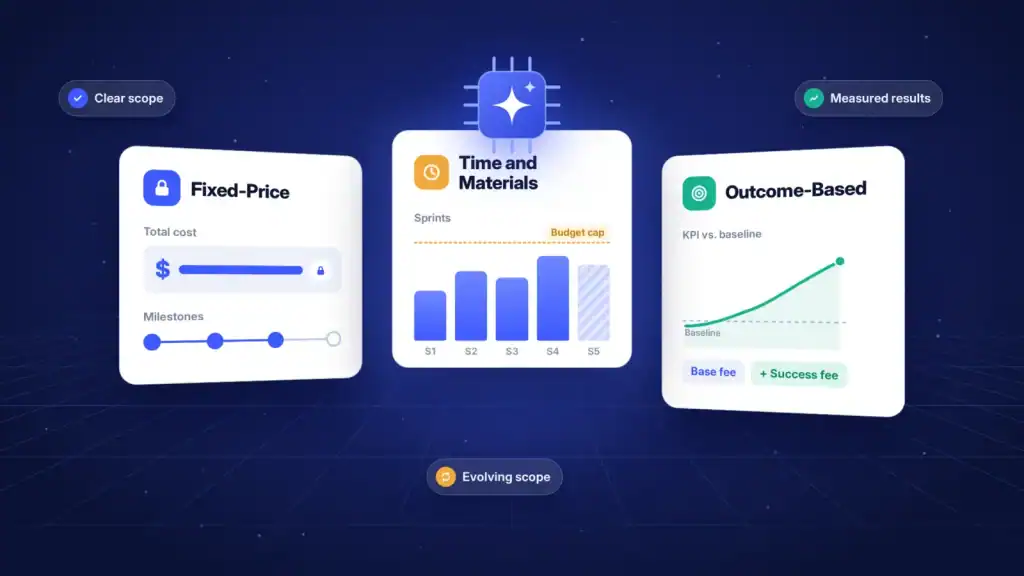
Your pricing model decides who carries the risk when scope shifts, data falls short, or results lag. A fixed-price contract locks the cost upfront. Time and materials (T&M) bills you for actual effort. Outcome-based deals, on the other hand, tie part of the fee to measured results.
This guide compares all three, explains what drives cost, and shows what your contract should cover. You’ll also see how teams combine models to balance control and flexibility. So if you plan to hire a partner for AI development services, use this guide as your checklist before you sign.
Key Takeaways
- Fixed-price works best when scope, data, and acceptance criteria are clear before work starts.
- Time and materials suit AI projects with open questions about data, models, or features.
- Outcome-based pricing ties fees to KPIs, so it only works when you can measure results cleanly.
- Data readiness, integrations, infrastructure, and maintenance drive most of the cost gap between AI projects.
- A strong contract sets scope, milestones, budget caps, KPIs, ownership, and support terms.
- Many teams combine models, for example fixed-price discovery followed by T&M development.
Find the right AI pricing model for your project
Contact UsWhat Are the Main AI Development Pricing Models?
Most AI vendors price work in one of three ways. These are the core AI development engagement models you’ll see in proposals, and each one splits cost risk differently. For a wider software view, our guide to software development engagement models also covers the dedicated team option.
Fixed-Price Model
With fixed-price, you and the vendor agree on scope, timeline, and total cost before work begins. The vendor carries the risk of overruns. As a result, most vendors add a safety buffer to the quote.
Here’s how it usually works:
- The vendor scopes the work during a short discovery phase.
- Both sides sign off on deliverables and acceptance criteria.
- You pay in stages, often tied to milestones.
- Any change goes through a formal change request.
Fixed-price AI development fits well-defined work. Good examples include a proof of concept, a chatbot built on a known knowledge base, or an AI feature with clear inputs and outputs.
The catch? AI work often uncovers surprises in the data. When that happens, a fixed contract leads to change requests, delays, or pressure on the vendor to cut corners.
Time and Materials (T&M) Model
Under T&M, you pay for actual hours worked plus agreed costs, such as cloud compute or third-party APIs. Each role has its own hourly rate, for example ML engineer, data engineer, or QA tester.
A typical T&M setup looks like this:
- The vendor estimates effort but doesn’t fix the total price.
- The team works in sprints, often two weeks long.
- You review progress and reset priorities after each sprint.
- Invoices follow timesheets, usually every month.
Of all AI development pricing models, T&M gives you the most room to test, learn, and change direction. That matters because AI projects often change shape once the team works with real data. This is why time and materials AI development is the usual choice for early-stage and research-heavy builds.
However, T&M shifts budget risk to you. Without caps and regular reports, costs grow quietly.
Outcome-Based Model
In an outcome-based deal, part or all of the fee depends on measured business results. Examples include tickets an AI agent resolves, hours saved, or a lift in conversion rate.
A typical outcome-based deal runs like this:
- Both sides agree on a KPI, a baseline, and a way to measure it.
- The vendor earns a base fee, a success fee, or a mix of both.
- Payments rise or fall with performance against targets.
Buyers are moving in this direction. Deloitte’s 2026 TMT Predictions cites a Gartner forecast that by 2030, at least 40% of enterprise SaaS spend will shift toward usage-, agent-, or outcome-based pricing.
Still, outcome-based AI pricing needs clean data and clear attribution. If you can’t prove the AI caused the result, the deal turns into a dispute. That push for proof starts at the top, as the chart below shows.
AI Development Pricing Models Compared
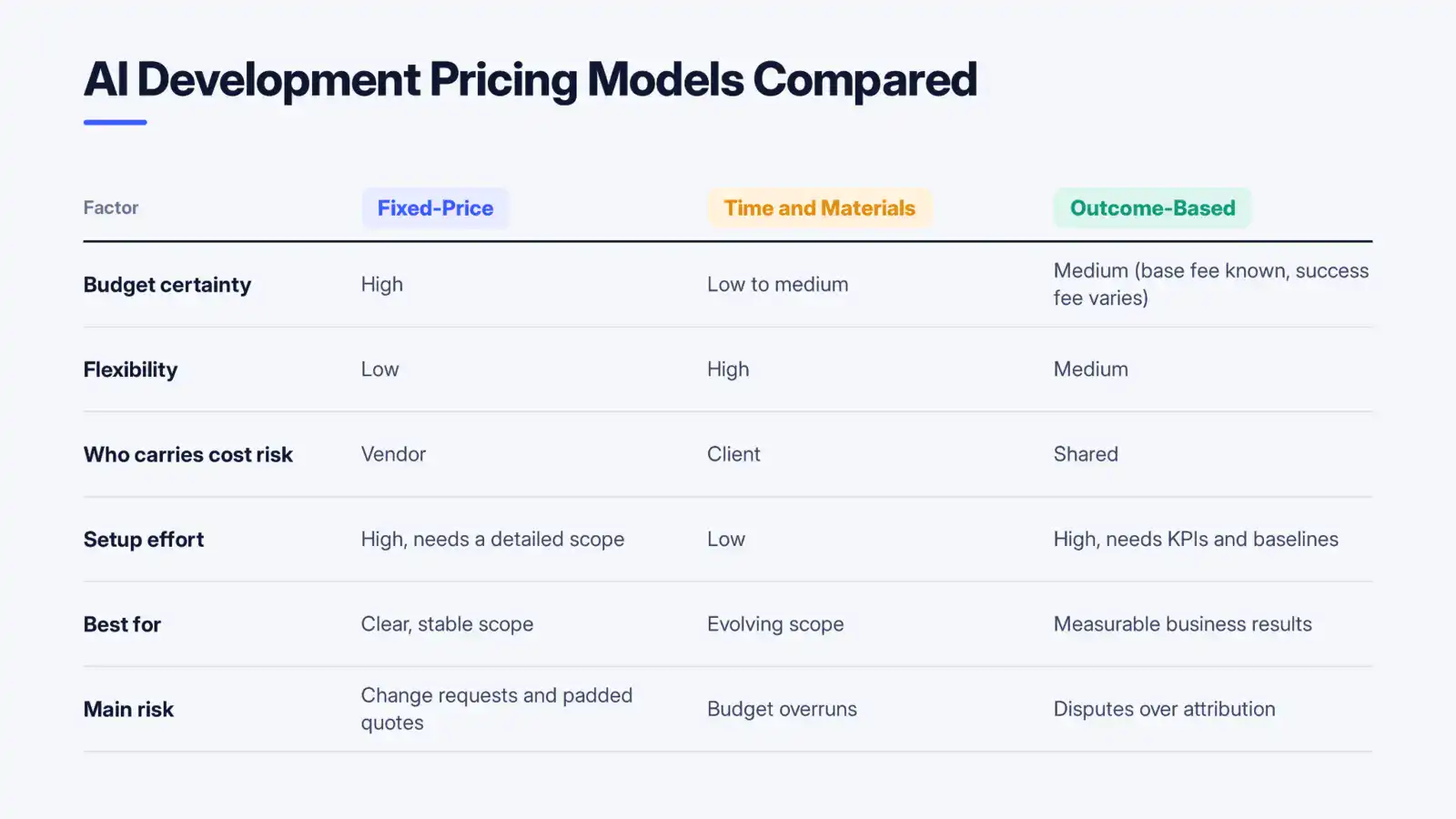
The three models differ in how they handle budget, change, and risk. Use this quick AI development pricing comparison to see the trade-offs side by side.
| Factor | Fixed-Price | Time and Materials | Outcome-Based |
|---|---|---|---|
| Budget certainty | High | Low to medium | Medium (base fee known, success fee varies) |
| Flexibility | Low | High | Medium |
| Who carries cost risk | Vendor | Client | Shared |
| Setup effort | High, needs a detailed scope | Low | High, needs KPIs and baselines |
| Best for | Clear, stable scope | Evolving scope | Measurable business results |
| Main risk | Change requests and padded quotes | Budget overruns | Disputes over attribution |
1. Cost and Budget Control
Fixed-price gives you one number to take to finance. T&M gives you a rate card and an estimate. Outcome-based pricing gives you a known base fee plus a variable fee you can model but not lock.
That difference matters more in 2026 because finance teams now gate AI spending. Forrester’s 2026 predictions note that fewer than one-third of decision-makers can tie AI value to financial growth. As a result, Forrester expects enterprises to defer 25% of planned AI spend into 2027.
In short, AI development pricing models trade certainty for flexibility. So if your CFO needs a firm number, fixed-price or capped T&M is easier to approve.
2. Flexibility and Risk
The fixed-price vs time and materials decision comes down to one question. How much do you know right now?
- Under fixed-price, the vendor owns delivery risk, but you give up flexibility.
- T&M lets you keep flexibility, but you own the budget risk.
- Outcome-based pricing spreads risk across both sides, but measurement gets harder.
Incentives differ too. When you compare outcome-based vs fixed-price contracts, look at what the vendor gets paid for. A fixed-price vendor earns the same fee once the system passes acceptance tests. An outcome-based vendor, by contrast, earns its full fee only when the KPI moves. Those incentives also tell you a lot about the vendor itself. Our guide to choosing an AI software development company covers what else to check.
3. Payment Structure
How you pay shapes both cash flow and accountability. These are the main AI development payment models, and most contracts mix at least two of them.
| Model | Billing basis | When you pay | Common add-ons |
|---|---|---|---|
| Fixed-price | Agreed total price | Deposit, then milestone payments | Change request fees |
| Time and materials | Hours × role rates, plus agreed costs | Monthly or per sprint | Budget caps and not-to-exceed limits |
| Outcome-based | Base fee plus success fee | Monthly base, success fee after KPI review | Gain share, bonus tiers, penalties |
A fourth option is the fixed capacity model, where you pay a set monthly fee for a dedicated team. When you weigh the fixed capacity model vs fixed price, ask whether you’re buying a team’s time or a defined deliverable. Capacity suits long roadmaps with shifting priorities. Fixed price suits a single, clear output.
Which AI Pricing Model Is Right for Your Project?
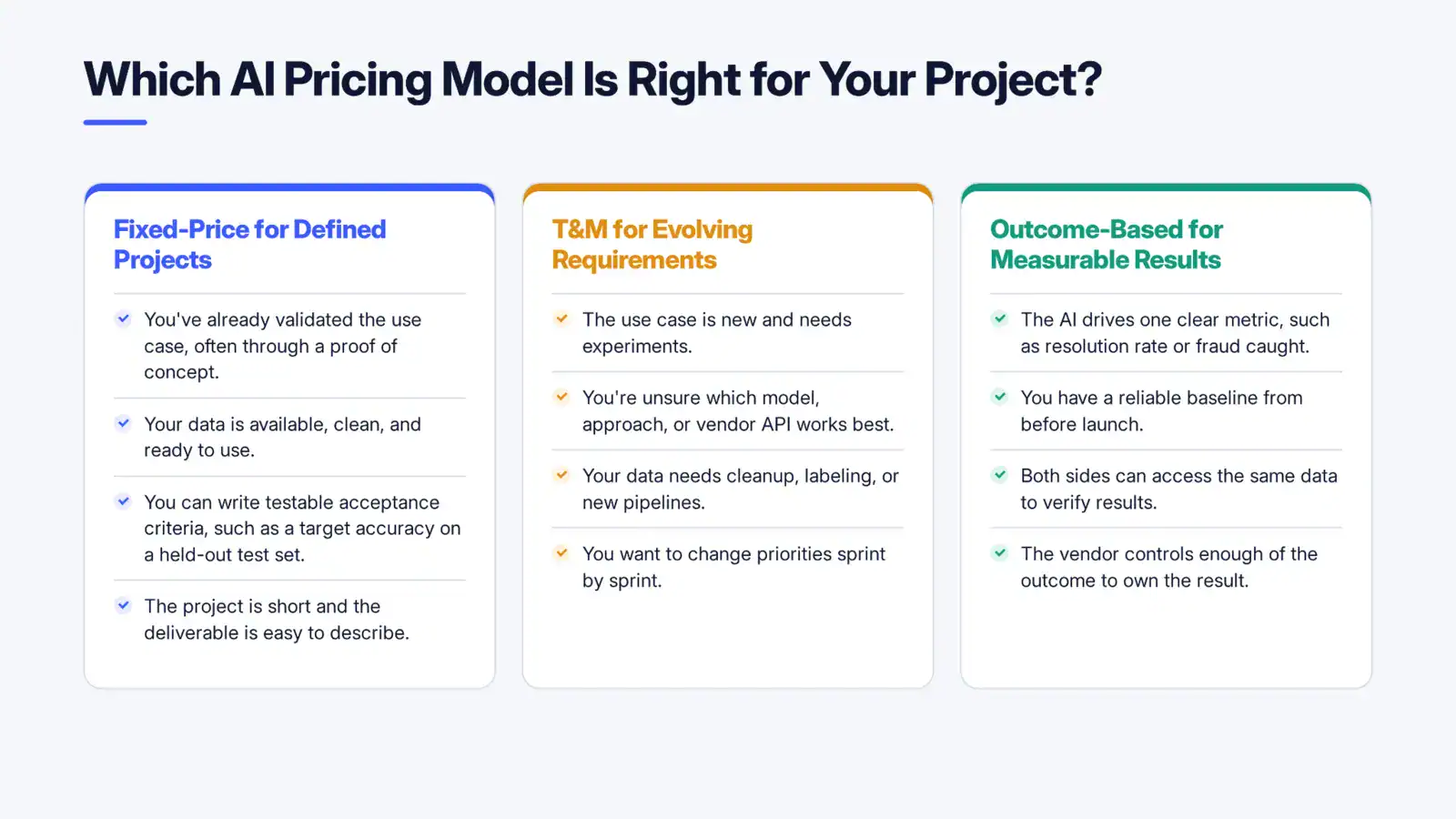
There’s no universal winner among AI development pricing models. Instead, match the model to how well you understand three things: your scope, your data, and your success metric.
Fixed-Price for Defined Projects
Choose fixed-price when:
- You’ve already validated the use case, often through a proof of concept.
- Your data is available, clean, and ready to use.
- You can write testable acceptance criteria, such as a target accuracy on a held-out test set.
- The project is short and the deliverable is easy to describe.
Good fits include an AI proof of concept, a document classifier, or an assistant added to an existing help center.
T&M for Evolving Requirements
Choose T&M when:
- The use case is new and needs experiments.
- You’re unsure which model, approach, or vendor API works best.
- Your data needs cleanup, labeling, or new pipelines.
- You want to change priorities sprint by sprint.
This describes a lot of AI work today. Deloitte’s State of AI in the Enterprise 2026 report found that only 25% of organizations have moved 40% or more of their AI pilots into production. When so much work is still experimental, a rigid scope creates friction.
Outcome-Based for Measurable Results
Choose outcome-based pricing when:
- The AI drives one clear metric, such as resolution rate or fraud caught.
- You have a reliable baseline from before launch.
- Both sides can access the same data to verify results.
- The vendor controls enough of the outcome to own the result.
Measurement is the hard part. In the AI 2025 survey, just 39% of respondents reported any EBIT impact from AI at the enterprise level. If you can’t trace value back to the business, you can’t price on it.
What Affects AI Development Pricing?
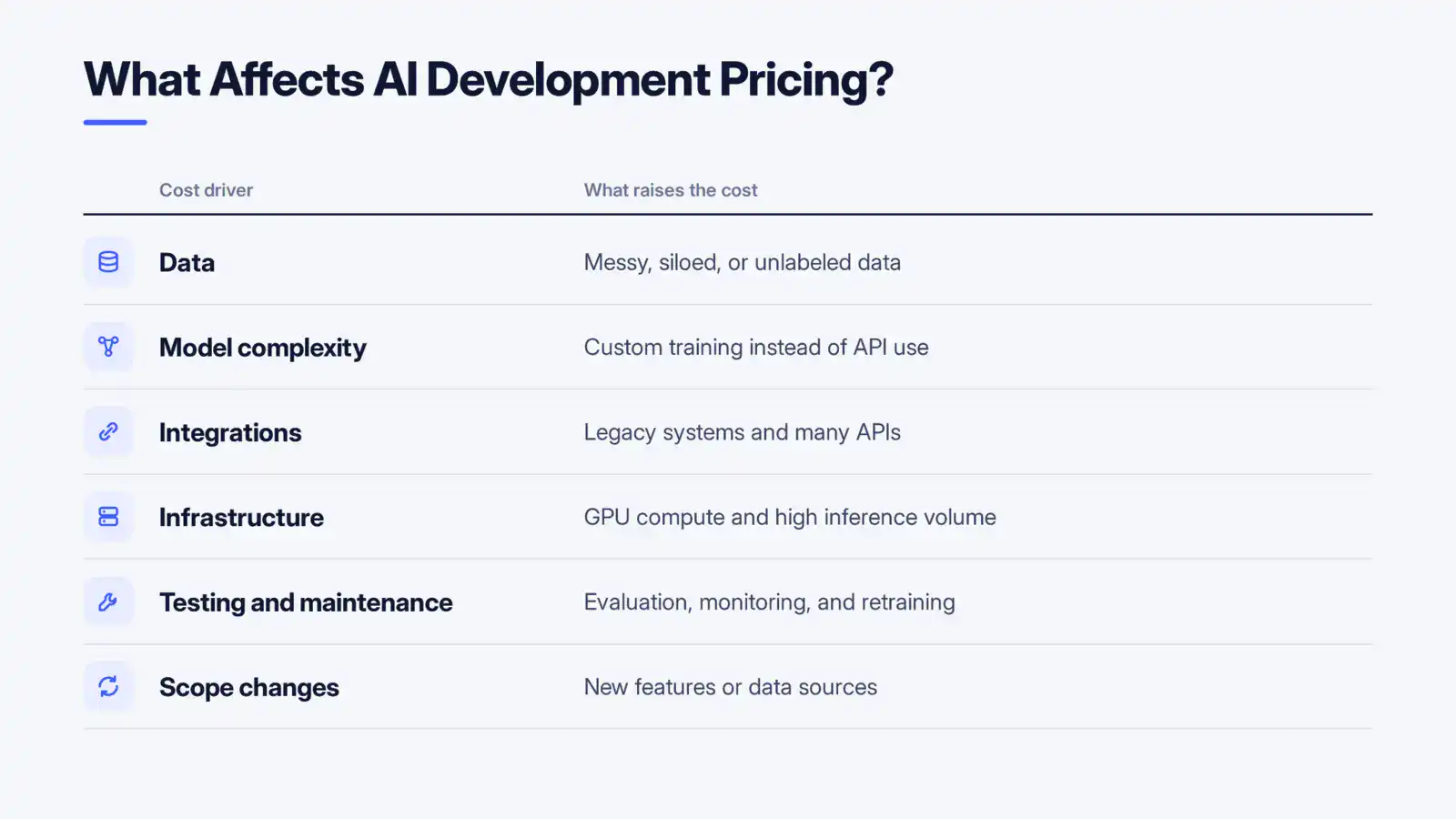
Whatever model you pick, the same drivers set the final price. Good AI project cost estimation starts with the factors below.
| Cost driver | What raises the cost | How it shows up in pricing |
|---|---|---|
| Data | Messy, siloed, or unlabeled data | More data engineering hours and a bigger fixed-price buffer |
| Model complexity | Custom training instead of API use | More ML engineering time and compute |
| Integrations | Legacy systems and many APIs | More build and testing time |
| Infrastructure | GPU compute and high inference volume | Ongoing monthly run costs |
| Testing and maintenance | Evaluation, monitoring, and retraining | Recurring support fees |
| Scope changes | New features or data sources | Change requests or extra sprints |
For typical budget ranges by project type, see our breakdown of how much artificial intelligence development costs.
1. Data and Model Complexity
Data work is often the biggest line item. Cleaning, labeling, and moving data usually takes longer than training the model itself.
The numbers back this up. 63% of organisations either lack or aren’t sure they have the right data management practices for AI. It also predicts that through 2026, organizations will abandon 60% of AI projects that lack AI-ready data.
Model choice adds another layer:
- Calling a hosted large language model (LLM) through an API costs the least to build, but adds usage fees.
- Fine-tuning an existing model costs more upfront.
- Training a custom model costs the most and needs the most data.
2. Integrations and Infrastructure
AI rarely runs on its own. It connects to CRMs, ERPs, data warehouses, and internal apps. Each integration adds build and test time, especially with older systems.
Infrastructure is the cost teams miss most often. IDC’s FutureScape 2026 warns that by 2027, G1000 organizations will face up to a 30% rise in underestimated AI infrastructure costs. That’s because inference volume, GPU hours, and vector database fees grow with usage.
So ask every vendor to split build costs from run costs in the quote.
3. Testing and Maintenance
AI models drift as real-world data changes. Plan a budget for:
- Evaluation sets and accuracy tests before launch
- Monitoring for drift, bias, and errors
- Retraining or prompt updates
- Security reviews and compliance checks
Fixed-price quotes often leave this work out. T&M and retainer contracts usually cover it. Because these costs apply across all AI development pricing models, ask vendors to price them openly from day one.
4. Scope Changes
AI development scope changes are normal. A model underperforms, so the team adds more data. Users request a new feature. Then a new regulation changes the rules.
Each model handles change in its own way:
- Fixed-price means a formal change request, priced separately.
- T&M absorbs the change in the next sprint and bills it as hours.
- Outcome-based deals often need new KPI targets or baselines.
Agree on a change process before work starts, not after the first surprise.
What Should an AI Development Contract Include?
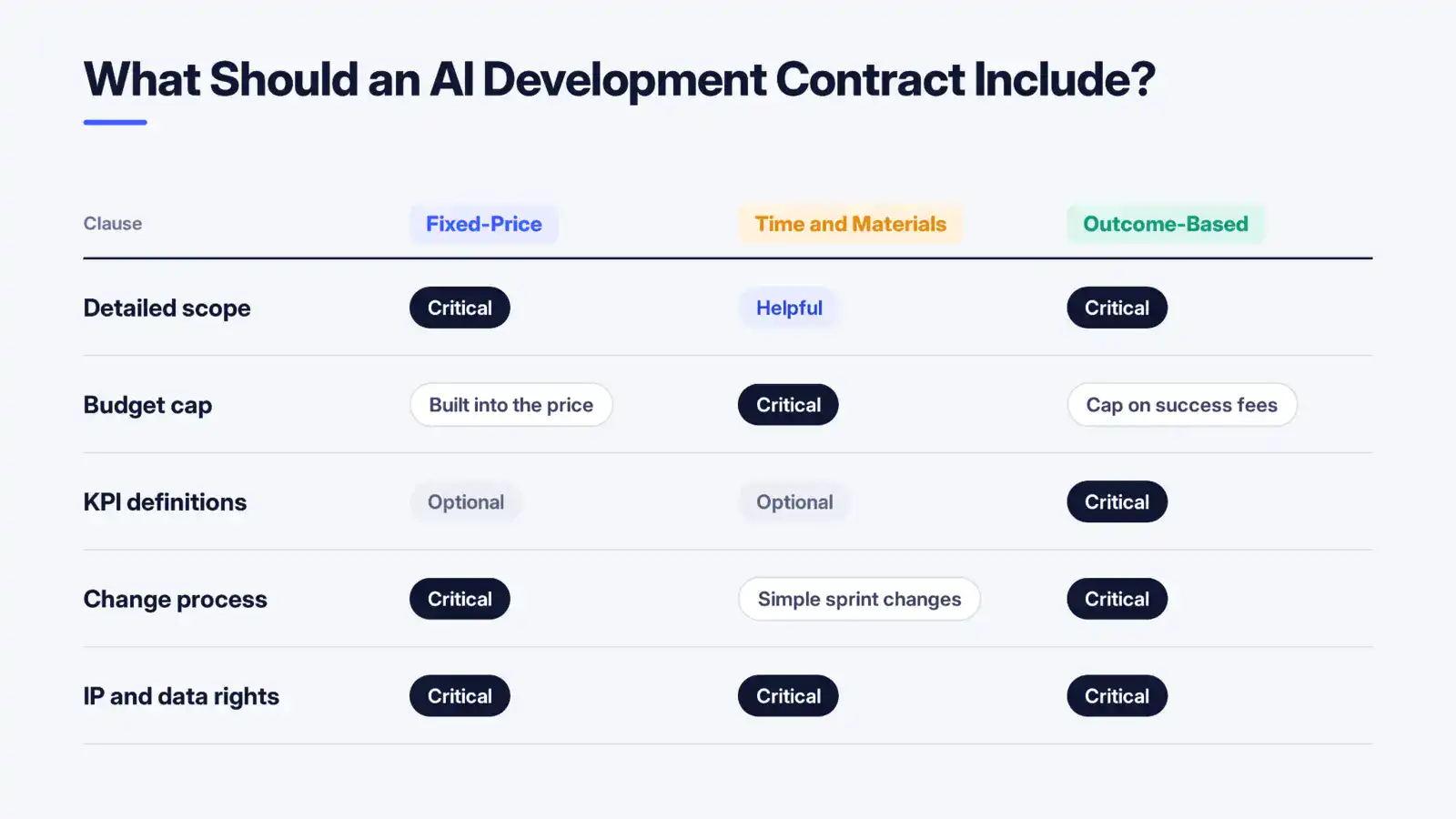
Your contract turns the pricing model into terms both sides can enforce. Most AI development contract models need the same core clauses, whatever the billing method. However, each model puts weight on different parts.
| Clause | Fixed-Price | Time and Materials | Outcome-Based |
|---|---|---|---|
| Detailed scope | Critical | Helpful | Critical |
| Budget cap | Built into the price | Critical | Cap on success fees |
| KPI definitions | Optional | Optional | Critical |
| Change process | Critical | Simple sprint changes | Critical |
| IP and data rights | Critical | Critical | Critical |
Scope and Acceptance Criteria
Spell out:
- Features, data sources, and integrations in scope
- What’s out of scope
- Measurable acceptance tests, such as accuracy, latency, or uptime targets
- Who provides data, and by when
Vague scope is one of the classic red flags to watch before hiring a development partner. A clear scope protects you under every model.
Milestones and Budget Caps
Include:
- Milestones tied to working deliverables, not just hours
- The payment amount for each milestone
- A not-to-exceed cap for any T&M work
- Monthly burn reports, with alerts at 75% and 90% of budget
KPIs and Performance Incentives
For outcome-based deals, define:
- The exact KPI and how you calculate it
- The baseline and the measurement period
- Data sources both sides trust
- Bonus tiers, a cap on success fees, and any penalties
Mature AI teams already work this way. A Gartner survey from June 2025 found that 63% of high-maturity organizations implement metrics to measure their AI initiatives.
Ownership and Support
Confirm:
- Who owns the code, model weights, prompts, and fine-tuning data
- Whether the vendor can reuse your data to train other models
- Licensing terms for third-party models and APIs
- Post-launch support, service level agreements (SLAs), and retraining terms
Support terms matter because AI systems need care long after launch. In the same Gartner survey, 45% of leaders at high-maturity organizations said their AI projects stay in production for three years or more. That figure drops to 20% at low-maturity organizations.
Can You Combine AI Development Pricing Models?
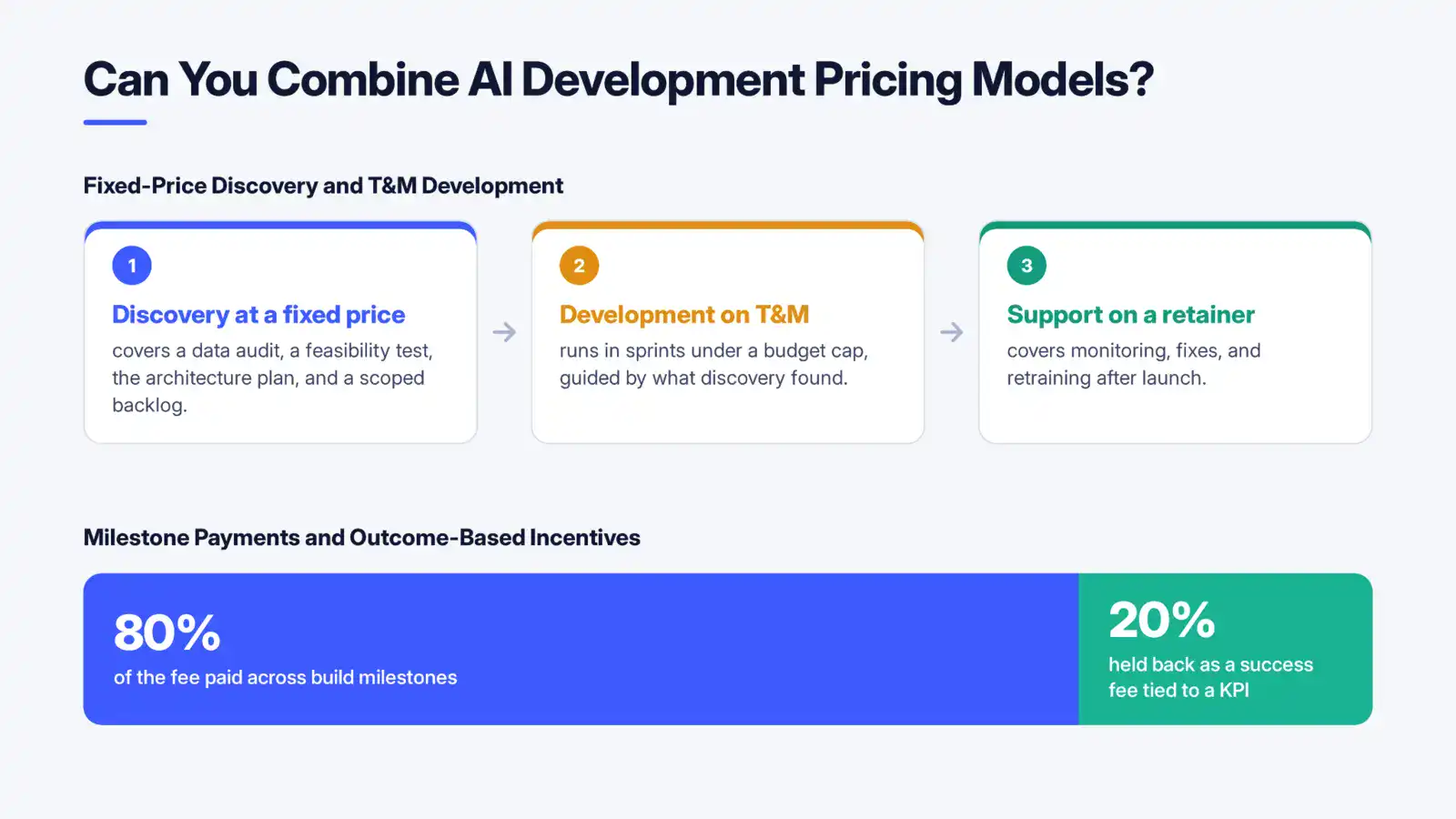
Yes, and many teams do. AI projects move through stages with very different levels of certainty, so one model rarely fits the whole journey.
Staging also protects your budget. Gartner predicts that organizations will cancel over 40% of agentic AI projects by the end of 2027. The reasons are escalating costs, unclear business value, and inadequate risk controls. A phased contract lets you stop early, before costs pile up.
Fixed-Price Discovery and T&M Development
This is the most common hybrid. It works in three steps:
- Discovery at a fixed price covers a data audit, a feasibility test, the architecture plan, and a scoped backlog.
- Development on T&M runs in sprints under a budget cap, guided by what discovery found.
- Support on a retainer covers monitoring, fixes, and retraining after launch.
You get a firm price for the riskiest unknowns. Then you keep flexibility once you know more. Blending AI development pricing models this way works best when each phase ends with a clear go or no-go decision.
Milestone Payments and Outcome-Based Incentives
Another common mix pays fixed amounts at milestones, then adds a bonus when KPIs hit targets after launch. For example:
- 80% of the fee paid across build milestones
- 20% held back as a success fee tied to a KPI, such as a 30% drop in average handling time
This way, the vendor covers its core costs, and you still reward real results. Before you sign any hybrid deal, run through these questions to ask a software outsourcing partner.
Choosing an AI Development Pricing Model With Cubix
The right AI development pricing model depends on three things. How clear is your scope? How ready is your data? And how well can you measure results? Get those answers first, and the contract becomes much easier to write.
Cubix is a software and AI development company with teams in Florida, Manchester, Dubai, and Karachi. Through Cubix AI, we build generative AI platforms, AI chatbots, LLM solutions, predictive analytics, and computer vision systems. Our process runs from discovery and data engineering through model building, testing, deployment, and ongoing support.
That process maps directly to pricing. We offer flexible engagement options, including fixed-price, time and materials, and dedicated team models. In practice, we help you:
- Test data and feasibility in a scoped discovery phase
- Pick the pricing model, or mix of models, that fits your scope and risk
- Set clear milestones, budget caps, and KPIs
- Plan support and retraining after launch
Picking among AI development pricing models is easier with a team that has priced and shipped AI work before. Maybe you need a quick proof of concept. Or maybe you need a production AI platform. Either way, our AI development services give you a clear scope, the right contract, and a team to build it.
Share your AI scope and get a clear pricing plan from Cubix
Contact UsFrequently Asked Questions
1. Which pricing model is best for AI development?
No single model is best for every project. Fixed-price suits clear scope and clean data. T&M suits projects with open questions. Outcome-based pricing suits AI tied to a measurable KPI. Many teams combine them, starting with fixed-price discovery and moving to T&M development.
2. When should you choose fixed-price AI development?
Choose fixed-price when your use case is proven, your data is ready, and you can define acceptance tests upfront. It works well for proofs of concept, small AI features, and short projects with a clear deliverable. Avoid it when requirements are still taking shape.
3. How does time and materials pricing work for AI projects?
You pay for the hours each team member works, at agreed hourly rates, plus costs such as compute and API fees. Work runs in sprints, and you can change priorities as you learn. Add a budget cap and monthly reports to keep spending in check.
4. How does outcome-based AI pricing work?
The vendor’s fee depends partly or fully on agreed business results. Both sides set a KPI, a baseline, and a measurement method. The vendor usually earns a base fee plus a success fee. That bonus kicks in when the AI hits its targets, such as more tickets resolved or lower costs.
5. What are the risks of outcome-based AI contracts?
The biggest risk is attribution, because it’s hard to prove the AI alone caused a result. Other risks include weak baselines, data disputes, and factors outside the vendor’s control. Vendors also price in extra risk. Clear KPI definitions and shared data access reduce these problems.
6. Can you combine different AI development pricing models?
Yes. A common setup uses fixed-price discovery to test data and feasibility, then T&M for development, then a support retainer. Another option pays milestone fees during the build and adds a success bonus tied to KPIs after launch.