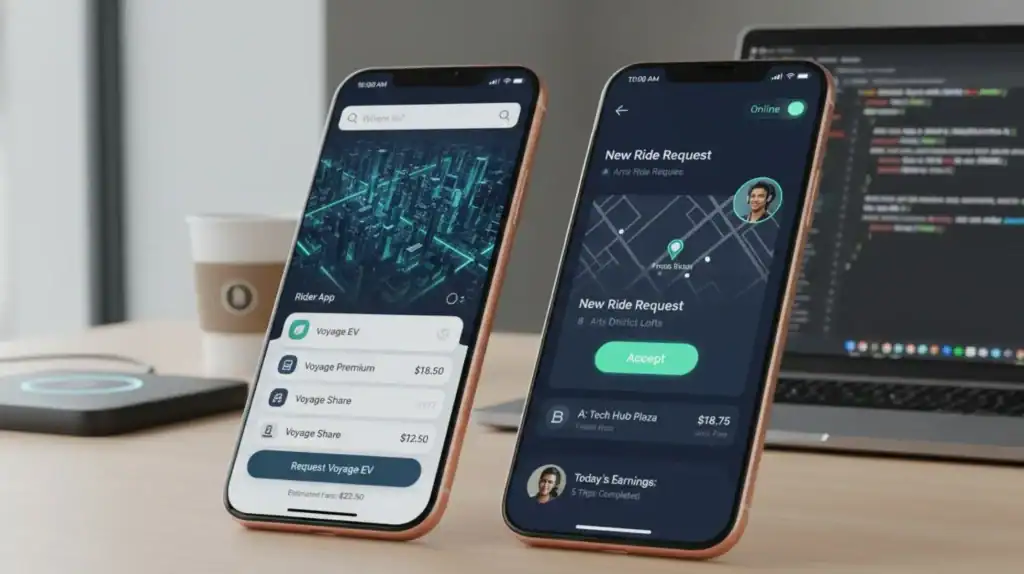
Key Takeaways
- Building a successful ride-sharing app starts with understanding your target audience and validating your business idea through market research.
- Focus on essential MVP features first, then expand your platform based on user feedback and business growth.
- Choose a reliable tech stack with tools like Flutter, Google Maps Platform, Firebase, and scalable cloud infrastructure to support long-term performance.
- Test your app thoroughly before launch to eliminate bugs, improve security, and deliver a smooth experience for riders and drivers.
- Plan for ongoing updates, app maintenance, and feature enhancements to keep your ride-sharing platform competitive as the market evolves.
What if your next app didn’t just sit on someone’s phone, but moved them across the city? Every day, millions of people tap their screens and unlock instant mobility through ride-sharing apps like Uber and Lyft. It’s not just technology; it’s freedom on demand. In 2026, this industry will continue to accelerate faster than ever. The global car-sharing market was estimated at USD 17.6 billion in 2025. According to Global Market Insights Inc., the market is expected to grow from USD 18.6 billion in 2026 to USD 35.3 billion by 2035, expanding at a CAGR of 7.4%. This steady growth reflects increasing demand for digital mobility services, making now an ideal time to invest in ride-sharing app development.
If you’re looking to turn your ride-sharing vision into a thriving business, you need more than just code; you need creativity, strategy, and innovation that drive results. That’s where Cubix takes the wheel. We are not just a mobile app development company; we are your innovation partner, helping you build experiences that move people and inspire trust with a proven track record in ride-sharing app development. We transform ambitious concepts into high-performing applications.
Ready to create the next big ride-sharing app like Uber or Lyft? This guide explains key features, tech stack, development cost, and launch strategy. The mobility space is booming; now’s the time to build. By the end, you’ll know how to launch an app that scales and leads the future of urban transport.
Behind every successful mobility product is a simple belief that technology should make life easier and futures brighter. At Cubix, we build ride-sharing apps that do exactly that. – Salman Lakhani, CEO of Cubix
What Is a Ride-Sharing App and How Does It Work?
Let’s put it simply: a ride-sharing app is an on-demand mobility platform that connects people who need a ride with drivers ready to take them there. It acts as a digital bridge between passengers seeking a quick, affordable trip and service providers offering convenient transportation from point A to point B.
Most Uber-style apps are designed as mobile-first solutions, giving users the comfort of booking a ride within seconds. With just a few taps, you can choose your destination, confirm your driver, and make secure payments through cashless methods like Apple Pay, Google Pay, or linked credit cards. Within moments, your ride arrives without waiting-no hassle. That’s the power of an on-demand ride-sharing app without any effort, instant, and built entirely around user convenience.
Step-by-Step Guide to Building a Ride-Sharing App in 2026
Now that you know what makes a ride-sharing app powerful, let’s dive into the real process of how to actually build one that stands tall against global players like Uber and Lyft. Let’s break down each step together.

Step 1: Conduct Market Research and Define Your Target Audience
Before you kick-start your coding or designing, take a moment to ask yourself one important question: Who will actually use your ride-sharing app? Are you creating it for busy professionals rushing to work, families looking for safe rides, or students searching for affordable transport? Understanding your audience is the foundation of every successful mobility platform.
The ride-sharing industry continues to expand at a rapid pace. According to Precedence Research, the global ride-sharing market size was valued at USD 149.88 billion in 2025 and is projected to grow from USD 177.64 billion in 2026 to approximately USD 788.44 billion by 2035, registering a CAGR of 18.06% during the forecast period. This strong growth highlights increasing demand for digital mobility services and makes it even more important to understand your target audience, identify market gaps, and build features that solve real customer needs.
Dive deep into user expectations. What do people love about apps like Uber and Lyft? What frustrates them? Maybe they want lower wait times, eco-friendly ride options, or better safety features. Gathering insights through research and surveys helps you tailor your app’s design, functionality, and cost to create a ride-booking application to match real market demands.
The most successful ride-sharing platforms do not just move people from one place to another; they solve problems, build trust, and deliver comfort with every tap.
Step 2: What Features Will Make Your Ride-Sharing App Stand Out?
Now, your first step is complete, and you are mentally ready for the 2nd step. It’s time to decide what makes your app different from other apps and helps you to stand out in the market. Think about what will make users choose your platform over Uber or Lyft. The right set of features can turn a simple idea into a truly powerful mobility experience.
Start with the basics that every successful ride-sharing app must include:
- User registration and verification for quick sign-ups
- Live GPS tracking so riders can see their driver in real time
- Multiple payment options to make transactions smooth and secure
- Ride history and reviews to build transparency and trust
But to build a next-generation platform, you need to go beyond the basics. Consider adding smart features powered by AI in mobile app development, like predictive route suggestions, real-time traffic optimization, or in-app chat support that improves user satisfaction.
Customization is key. For instance, offering ride preferences such as pet-friendly cars, electric vehicles, or women-only rides can help your app connect with niche audiences.
When every feature works in harmony, it creates a seamless journey where users feel in control, safe, and valued. These details are what transform a regular ride-sharing app into a brand people rely on every day.
Step 3: Which Tech Stack Will Power Your Ride-Sharing App?
Ever wondered what makes apps like Uber or Lyft run so flawlessly, even with millions of users booking rides every minute? The answer lies in a smart, scalable, and reliable tech stack. It’s the invisible engine that keeps your ride-sharing app running smoothly, managing real-time routes, payments, notifications, and user data without missing a beat.
Your technology choices also influence your overall development cost, especially when deciding between native and cross-platform development approaches. Learn more in our guide on mobile app development cost.
| Category | Tools & Technologies | Why They Matter |
|---|---|---|
|
|
|
| Backend | Node.js, Python, Java, .NET | Manages ride requests, pricing, matching, and user data. |
| Real-Time Services | Firebase, Socket.io, MQTT | Supports live ride tracking, notifications, and real-time updates. |
| Database | PostgreSQL, MongoDB, MySQL | Stores driver, passenger, and trip information. |
| Maps & Navigation | Google Maps Platform, Mapbox, OpenStreetMap | Powers live location tracking, routing, ETA, and navigation. |
| Payments | Stripe, PayPal, Braintree | Enables secure digital payment processing. |
| Authentication | Firebase Authentication, OAuth, JWT | Secures user accounts and login sessions. |
| Communication | Twilio, Firebase Cloud Messaging | Supports SMS verification, calls, and ride notifications. |
| Cloud Hosting | Amazon Web Services (AWS), Google Cloud Platform (GCP), Azure | Delivers reliable infrastructure, scalability, and high availability. |
| DevOps | Docker, Kubernetes, Jenkins | Simplifies deployment and scaling. |
| Analytics | Firebase Analytics, Mixpanel, GA4 | Measures user engagement and app performance. |
| Testing | Selenium, Postman, Appium | Ensures quality across devices. |
Step 4: Craft a Seamless User Journey That Feels Effortless
Have you ever used an app that just felt right from the first tap? That effortless feeling is not luck. It is an intentional design. A ride-sharing app succeeds when every screen, button, icon, and interaction feels smooth, intuitive, and stress-free for riders and drivers.
Focus on designing a journey that mirrors real-life behavior. A user should open the app, see nearby drivers, choose a destination, confirm the ride, track the car in real time, pay easily, and review the trip without confusion or extra steps. If one moment feels confusing, the journey breaks, and users lose trust.
Start with user flow mapping to understand how passengers and drivers move through the system. Then turn those flows into wireframes and simple clickable prototypes. Test early. Adjust quickly. A beautiful interface matters, but a practical and simple experience matters more.
When your design becomes invisible, and users barely notice the effort behind it, that is when you know you have built a ride-sharing experience worth returning to. Convenience is not a feature. It is the foundation of winning mobility platforms.
Step 5: Build Your MVP With Smart Core Features
Ever wondered why the biggest ride-sharing apps did not start with endless features? Because winning apps begin with one goal: launch something powerful enough to solve the problem and simple enough to scale fast.
Your MVP is your first solid engine. It should include only the essential elements such as user profiles, real-time location tracking, ride booking, driver matching, secure payments, trip history, and rating options. These features form the heart of your mobility platform and allow real users to experience your product in action.
Once your foundation runs smoothly, you introduce advanced capabilities like surge pricing, loyalty rewards, referral bonuses, shared rides, and AI-powered matching. This step-by-step growth protects your investment and ensures your business stays efficient while delivering the most value.
Think of your MVP as the first successful ride. It does not need luxury seats yet. It simply needs to move people reliably, safely, and conveniently. After that, innovation becomes your fuel.
Step 6: Test, Launch, and Scale With Precision
Once your MVP is ready, the next step is to launch your ride-sharing app. Imagine a user opens your app to book a ride, but it freezes, shows the wrong location, or delays the payment process. Even a small issue like this can damage user trust and lead to poor reviews or app uninstallations. In today’s competitive mobility market, delivering a reliable experience from day one is essential.
Many of these issues are common development problems that mobile app teams face during the build and launch process. Identifying and fixing them before release helps improve app performance, reduce user frustration, and avoid expensive updates after launch.
To prepare your ride-sharing app for a successful launch, focus on the following areas:
- Test speed, GPS accuracy, payment flow, and app stability under high traffic.
- Polish screens, simplify booking steps, and make navigation effortless.
- Protect rider and driver data, secure transactions, and prevent fraud.
- Add ride history, referral bonuses, preferred drivers, loyalty points, or in-app support.
- Simulate poor network zones, crowded areas, peak-time bookings, and long-distance routes.
- Launch campaigns, app store optimization, referral rewards, and driver onboarding flow.
Essential Features Every Ride-Sharing App Should Have

Before diving into the development process, it’s really important to understand the core features that will assist you in defining a successful ride-sharing app. A powerful mobility platform working as a bridge between drivers and passengers that builds trust, speed, and convenience that users depend on daily.
Listed below are some groundbreaking features that make a world-class digital transportation solution stand out in 2026.
1. User App – Where Every Journey Begins:
Your user app is the heartbeat of your on-demand service. It must feel effortless from the first tap to the final drop-off.
- Quick Registration: Allow fast sign-up via email, phone number, or social media for a frictionless start.
- Real-Time GPS Tracking: Show precise driver locations and arrival times to boost confidence and clarity.
- Multiple Payment Options: Support cashless transactions through cards, wallets, or mobile payments.
- Ride History & Ratings: Let users view past trips and rate their experiences, building a transparent community.
A well-designed user app ensures every ride feels reliable, secure, and worth returning to.
2. Driver App – Powering the Ride:
Your driver app fuels the entire operation. It should simplify daily tasks, improve coordination, and help drivers earn efficiently.
- Simple Onboarding: Streamline verification and documentation for quick activation.
- Trip Requests & Smart Navigation: Use built-in maps for optimized routes and accurate pickups.
- Earnings Dashboard: Give drivers a clear view of completed rides and income reports.
- In-App Communication: Let drivers connect easily with riders for better coordination.
When designed with precision, a strong driver app enhances satisfaction and helps maintain smooth operations across your ride-hailing app network.
3. Admin Panel – The Nerve Center
Behind every seamless user experience lies a powerful admin panel. It ensures your system runs efficiently, securely, and profitably.
- User & Driver Management: Monitor profiles, activities, and reports in real-time.
- Analytics & Performance Insights: Track app performance, user trends, and growth metrics.
- Payments & Commissions: Manage ride-sharing app-making costs efficiently through automated transactions.
- Promotions & Rewards: Control discounts, referral codes, and bonus campaigns to grow engagement.
The admin panel ties the ecosystem together, enabling scalability and long-term success in an ever-evolving mobility market.
Also Read: 40 Best Apps for the Car to Make Road Trips Easier
How Much Does a Ride-Sharing App Cost in 2026?
Congratulations! You have mopped up your idea and understand every single step of how to build a successful on-demand transportation app, and you know very well how these platforms work. Now, the last but not least question comes to every mind: What are the development costs? You know that your costs depend on your features, region, and level of sophistication, but here’s a realistic snapshot to guide your planning.
- Basic MVP: $25,000 to $50,000
- Advanced App: $50,000 to $80,000
- Full Uber-Style Platform: $100,000 to over $250,000
Also Read: How Much Does App Development Cost
How Cubix Develops Ride-Sharing Apps from Strategy to Launch

Building a taxi app with Cubix means structured planning, clean architecture, and reliable technology execution. We focus on a performance-driven development process, from strategy and UI to backend engineering and post-launch support. With transparent pricing and modular features, you can scale your app from MVP to a full enterprise-grade product without hidden surprises.
| Category | Deliverables |
| Discovery & Strategy | Research, user flows, feature brief, tech plan |
| UI/UX Design | Wireframes, prototype, visual design |
| Passenger App | Login, ride booking, map & GPS, wallet, notifications |
| Driver App | KYC, navigation, ride management, earnings |
| Admin Panel | Users, rides, payments, analytics |
| QA & Deployment | Functional + security tests, iOS + Android launch & cloud setup |
Why Businesses Choose Cubix
- Proven track record with mobility & on-demand apps
- Trusted by global startups & Fortune 600+ clients
- Scalable solutions that grow with your business
- Dedicated product, design, and engineering team
- Post-launch support & continuous feature enhancements
Ready to Launch Your Ride-Sharing App? Book a strategy session with Cubix, and let’s build a product that wins the mobility market.
Future of Ride-Sharing Apps: What’s Next for Mobility in 2026 and Beyond

Now that you understand every step from MVP to launch and scaling, it is time to look ahead. The world of ride-sharing is transforming rapidly as technology becomes smarter, cars go electric, and users expect faster, safer, and more personal travel experiences.
Artificial intelligence-based matching, electric and hybrid fleets, autonomous vehicles, subscription-based ride plans, and smarter route automation are reshaping how people move.
If you start today with a solid, scalable foundation, you are not just building an app. You are stepping into the future of mobility where innovation leads the way. The future will reward brands that experiment early, improve continuously, and move with speed.
At Cubix, we build digital ecosystems that power modern mobility. Partner with us for advanced automotive software development services.
Conclusion
You have the whole blueprint to build a market-leading ride-sharing app platform, from understanding key features to designing flawless user journeys, developing an MVP, and scaling with confidence. By starting with a strong foundation and continuous innovation, you were able to launch your reliable, scalable, and market-ready platform that will stand out in a growing industry.
Turn your vision into motion and lead the ride-sharing revolution of tomorrow.
Frequently Asked Questions
1: How much does it cost to build a ride-sharing app?
The cost of building a ride-sharing app typically ranges from $25,000 to over $250,000, depending on the app’s features, platform, design complexity, integrations, and development team.
2: What features should a ride-sharing app include?
A ride-sharing app should include user registration, GPS tracking, ride booking, driver matching, secure payments, trip history, ratings and reviews, push notifications, and an admin dashboard. Advanced apps may also include AI-powered route optimization and loyalty programs.
3: Which technologies are used to develop a ride-sharing app?
Popular technologies include Flutter or React Native for the frontend, Node.js or Python for the backend, Google Maps Platform for navigation, Firebase for real-time services, Stripe for payments, and cloud platforms such as Amazon Web Services (AWS) or Google Cloud Platform (GCP).
4: How long does it take to build a ride-sharing app?
A basic MVP usually takes 3 to 6 months to develop, while a feature-rich ride-sharing platform with driver, passenger, and admin applications can take 6 to 12 months, depending on project requirements.
5: Can startups build a ride-sharing app like Uber?
Yes. Startups often begin with an MVP that includes essential features such as ride booking, live tracking, payments, and ratings. After validating the idea, they can gradually add advanced features and scale the platform as their user base grows.