Key Takeaways
- Mobile game revenue is projected to reach $134.22 billion in 2026, showing continued market growth.
- In-app purchases, advertising, battle passes, and subscriptions remain major mobile game revenue streams.
- Android offers wider reach, while iOS users generally generate higher spending per user.
- LiveOps, AI, cross-platform gaming, and hybrid monetization are shaping mobile game revenue trends in 2026.
- Successful games rely on strong retention, regular content updates, social features, and personalized monetization to increase long-term revenue.
Mobile game revenue statistics highlight the growing financial impact of mobile gaming worldwide. According to data, the mobile games market worldwide is projected to reach US$134.22 billion in 2026, with revenue expected to grow at a 5.13% CAGR from 2026 to 2030, reaching approximately US$163.98 billion by 2030.
This growth reflects more than an expanding player base. Mobile games are generating revenue through in-app purchases, paid downloads, advertising, and other monetization models, while live events, social features, and ongoing content updates continue to shape player engagement.
The numbers show a growing market, but turning that opportunity into a successful game requires the right development strategy. Cubix provides custom game development services to help businesses transform game concepts into engaging, scalable experiences.
In this guide, we’ll explore the latest mobile gaming revenue statistics for 2026, including global revenue, leading markets, platforms, game genres, monetization models, highest-grossing games, and the trends shaping the future of mobile gaming.
Mobile Game Revenue Statistics: Key Numbers at a Glance
Global mobile gaming revenue is expected to reach $107 billion to $134 billion in 2026, representing more than 52% of total video game industry revenue. Consumer spending remains heavily concentrated on iOS, while the United States and China continue to rank among the leading mobile gaming markets.
Mobile Game Revenue Growth by Year: 2021-2026
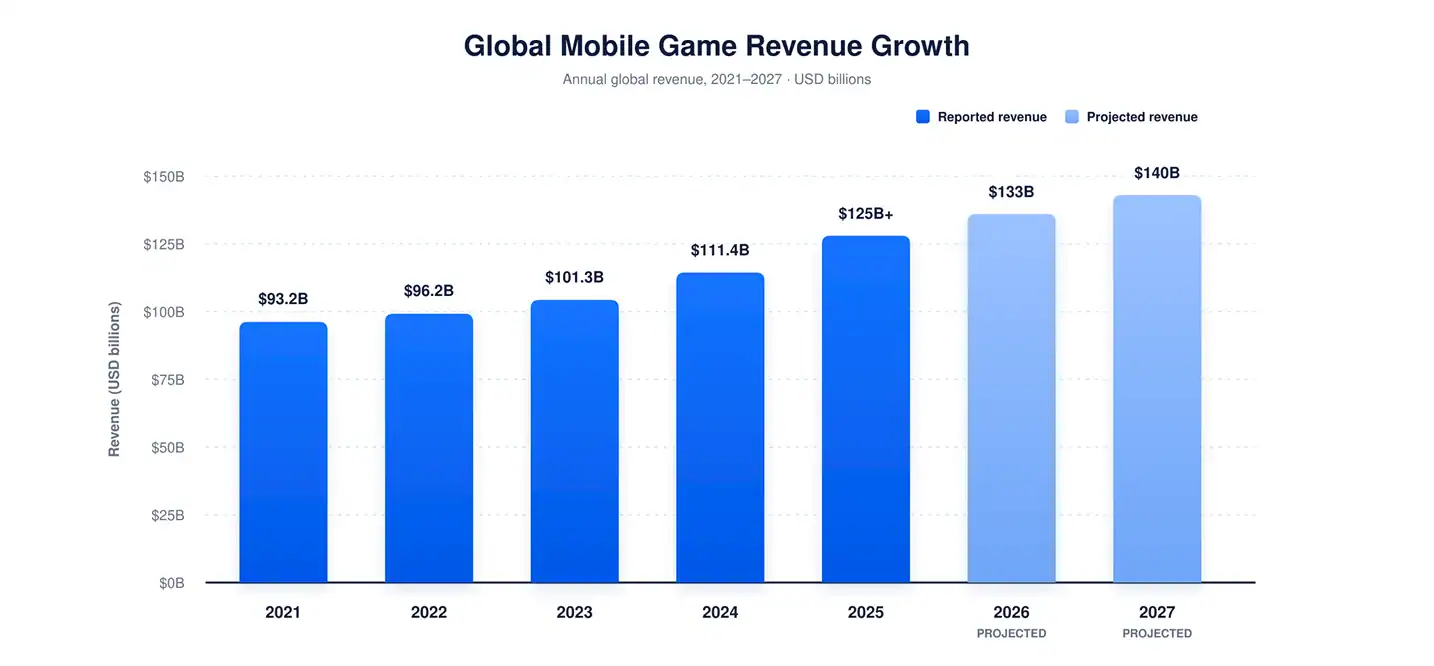
Global mobile gaming revenue has grown significantly over the past few years, with a post‑pandemic slowdown in 2022-2023, followed by a stronger upswing from 2024 onward.
The market is expected to keep expanding toward roughly $140 billion+ by 2027, supported by 5G rollout, wider smartphone adoption, and deeper in-app purchase monetization.
| Year | Global Mobile Game Revenue |
| 2021 | $93.2 billion |
| 2022 | $96.2 billion |
| 2023 | $101.3 billion |
| 2024 | $111.4 billion |
| 2025 | $125+ billion |
| 2026 (proj.) | $133 billion |
| 2027 (proj.) | $140 billion |
Mobile Gaming Average Revenue Per User (ARPU) in 2026
Average Revenue Per User (ARPU) shows how much revenue a mobile game market generates per user over a specific period. It helps businesses understand whether market growth is coming from more players, higher player spending, or both.
In 2026, mobile gaming ARPU is estimated at around $94.53, continuing the gradual increase seen in recent years. Higher spending on in-app purchases, subscriptions, rewarded content, and other monetization features is helping push revenue per player upward.
| Year | Mobile Gaming ARPU | YoY Change |
| 2021 | $89.38 | — |
| 2022 | $90.21 | +0.9% |
| 2023 | $91.12 | +1.0% |
| 2024 | $92.31 | +1.3% |
| 2025 | $93.42 | +1.2% |
| 2026 | $94.53 | +1.2% |
| 2027 | $95.41 | +0.9% |
Why Does Mobile Gaming ARPU Matter?
A growing ARPU indicates that players are spending more or that developers are becoming better at monetizing existing users. For game businesses, this makes player retention, personalized offers, live events, and well-designed monetization systems just as important as acquiring new players.
What Is Driving Mobile Game Revenue Growth?
The growth of mobile gaming is being driven by stronger player spending, ongoing content, and wider smartphone adoption. In 2026 Q1, mobile games generated around $14.1 billion in in-app purchase revenue, showing that revenue growth is increasingly connected to player engagement and monetization rather than downloads alone.
1. Growth of Free-to-Play Games
Free-to-play games allow users to download and play without an upfront cost, helping developers reach a much larger audience. Revenue is then generated through in-app purchases, advertising, battle passes, and other optional features
The model continues to play a major role in the gaming industry. The global free-to-play (F2P) games market is expected to generate 71.45 billion in 2026, at a CAGR of 15.76% to reach USD 173.68 billion by 2032. demonstrating the strong revenue potential of converting free players into paying users.
2. Increasing In-App Purchases
In-app purchases allow players to buy virtual currency, characters, skins, upgrades, and additional content. They remain one of the most important revenue sources for mobile games.
3. Live-Service and Seasonal Content
Live-service games continuously introduce new characters, challenges, rewards, events, and seasonal content, giving players reasons to return and creating additional spending opportunities.
Live Ops accounted for 84% of mobile game IAP revenue in 2024, demonstrating how critical ongoing content has become to monetization.
4. Mobile Gaming’s Expanding Global Audience
Mobile gaming has expanded across established and emerging markets because smartphones provide relatively easy access to games without dedicated gaming hardware.
Mobile game in-app purchase (IAP) revenue: $82B. Middle East: +18%; Europe: +14%; Latin America: +13%, North America: +9%, showing the growing contribution of emerging regions to mobile gaming revenue. (source)
5. Better Smartphones and 5G Connectivity
Modern smartphones provide stronger processors, improved graphics, and better connectivity, allowing developers to build more advanced gaming experiences. Faster networks also support multiplayer and real-time features.
6. Social and Multiplayer Gaming
Multiplayer modes, guilds, leaderboards, friend systems, and social events give players additional reasons to return to a game. Stronger engagement can ultimately create more monetization opportunities.
Mobile Game Revenue by Country and Region
Global mobile game revenue is estimated at $107 billion to $134 billion, with the United States ($39.1 billion), China ($33.6 billion), and Japan ($21.5 billion) leading the market. Together, these three countries account for more than half of global consumer spending on mobile games.
Top Mobile Gaming Markets in 2026
The United States, China, Japan, and South Korea remain among the most important markets for mobile gaming. Their strong spending power, established gaming ecosystems, and demand for premium digital content make them particularly valuable to publishers.
| Country | Latest Available Data | Market Outlook | Key Drivers |
| United States | Nearly $24B in mobile game IAP revenue in 2024 | Strong | High player spending, live-service games, in-app purchases |
| China | One of the world’s largest mobile gaming markets | Strong | Local gaming companies, RPGs, strategy, competitive games |
| Japan | Around $2.9B in Q1 2024 | Strong | RPGs, character-based games, established IP |
| South Korea | Around $3.7B in Q1–Q3 2024 | Strong | RPGs, strategy, esports, competitive gaming |
Emerging Mobile Gaming Markets
Emerging markets offer a different opportunity. Rather than competing primarily through high individual spending, these regions provide developers with access to large and increasingly active mobile audiences.
| Market | Latest Available Data | Growth Outlook | Key Drivers |
| India | 8.45B mobile game installs in FY 2024–25 | High | Large player base, affordable smartphones, mobile-first users |
| Latin America | 13% IAP revenue growth in 2024 | High | Smartphone adoption, growing spending, expanding gaming audience |
| MENA | 18% IAP revenue growth in 2024 | High | Young population, smartphone penetration, increasing player spending |
| Southeast Asia | Indonesia accounted for 6.4% of global mobile game downloads in June 2025 | Strong | Mobile-first audiences, internet access, free-to-play games |
Mobile Game Revenue by Platform: Android vs. iOS

Android and iOS account for the vast majority of mobile gaming activity, but their revenue patterns differ. Android offers greater global reach, while iOS users generally generate higher spending per user.
Here is a simple look at how the two platforms compare:
Android Mobile Game Revenue
Google Play generated approximately $30–$31 billion in global mobile game revenue, compared with around $52 billion from Apple’s iOS ecosystem. While Android accounts for roughly 70%–81% of global game installs and device shipments, it contributes about 40%–45% of mobile gaming consumer spending. Android’s larger user base makes it particularly important for downloads, advertising, and emerging markets.
iOS Mobile Game Revenue
iOS generally attracts higher spending per user, particularly in markets such as the United States, Japan, and Western Europe. This makes it valuable for games built around in-app purchases and premium content.
Android vs. iOS: Which Platform Generates More Revenue?
Android game development wins on audience size, while iOS tends to win on monetization per user. For most mobile games, launching on both platforms provides the best opportunity to balance reach and revenue.
Mobile Game Revenue by Genre in 2026
Mobile game revenue differs by genre, with each category using different gameplay and monetization strategies. The table below highlights major genres and leading titles based on recent mobile gaming performance.
| Genre | Revenue Insight | Top Mobile Game | Main Revenue Drivers |
| RPG | $24 billion in 2026 | Genshin Impact | IAP, character collection, events |
| Strategy | $122.4 million | Honor of Kings | IAP, upgrades, seasonal content |
| Casual | $11 billion | Royal Match | IAP, events, rewarded ads |
| Battle Royale | USD 11,629.94 M | PUBG Mobile | Battle passes, cosmetics, IAP |
| Simulation | $21.89M | Roblox | Virtual items, IAP, subscriptions |
| Sports | $22.8 billion | EA SPORTS FC Mobile | IAP, player upgrades, events |
RPG games remain one of the strongest mobile gaming categories, supported by character progression, collectible content, live events, and in-app purchases. Businesses planning an RPG title can work with an experienced RPG game development company to build systems around progression, multiplayer, analytics, and long-term player engagement.
Top Grossing Mobile Games in 2026
The leading mobile games in 2026 continue to generate strong player spending through live events, in-app purchases, seasonal content, and frequent updates. Since yearly 2026 revenue is not complete yet, the latest June 2026 global ranking provides a more accurate snapshot of current performance.
Top Grossing Mobile Games
Sensor Tower ranked Whiteout Survival as the highest-grossing mobile game worldwide in June 2026, followed by Royal Match, Honor of Kings, Gossip Harbor, and MONOPOLY GO.
| Rank | Mobile Game | Revenue ($bn) |
| 1 | Whiteout Survival | 1.40 |
| 2 | Royal Match | 1.37 |
| 3 | Honor of Kings | 1.68 |
| 4 | Gossip Harbor | 0.54 |
| 5 | MONOPOLY GO | 1.36 |
| 6 | Last War: Survival Game | 1.57 |
| 7 | Candy Crush | 1.01 |
| 8 | PUBG Mobile | 1.12 |
| 9 | Roblox | 1.45 |
| 10 | Kingshot | 0.44 |
What Makes These Mobile Games So Profitable?
The highest-earning titles share several characteristics:
- Strong retention: Progression systems give players reasons to return.
- Live events: Limited-time events create urgency and encourage spending.
- Battle passes: Seasonal rewards provide recurring purchase opportunities.
- In-app purchases: Skins, characters, resources, and upgrades create multiple spending options.
- Social mechanics: Alliances, multiplayer modes, and competitions strengthen engagement.
- Frequent updates: New levels, characters, events, and features keep the experience fresh.
- Strong IP and community: Collaborations and recognizable brands can attract both new and returning players.
Mobile Game Development Cost in 2026
Developing a mobile game in 2026 typically costs between $20,000 and $80,000 for a standard release, though budgets range from $15,000 for basic hyper-casual prototypes to over 1M+ for an AAA-style mobile game. The total expenses depend heavily on genre, art assets, and backend server demands.
Average Mobile Game Development Cost
| Mobile Game Type | Estimated Development Cost (USD) | Typical Example |
| Simple 2D Game | $15,000–$50,000 | Puzzle, arcade, or casual game |
| Mid-Level Mobile Game | $50,000–$150,000 | Strategy, simulation, or multiplayer game |
| Advanced Mobile Game | $150,000–$300,000+ | Feature-rich RPG or action game |
| AAA-Style Mobile Game | $300,000–$1 million+ | Large-scale multiplayer or highly detailed game |
How Do Mobile Games Make Money in 2026?
1. In-App Purchases (IAP)
Players can purchase virtual currency, characters, skins, upgrades, extra lives, and exclusive items directly within the game.
Why it works: Players are willing to pay for customization, faster progression, and exclusive content.
Best suited for: RPGs, shooters, strategy, and multiplayer games.
2026 trend: Personalized offers, limited-time bundles, and lighter gacha-style mechanics.
2. Mobile Game Advertising
Advertising helps free-to-play games earn revenue from players who do not make purchases. Rewarded videos, interstitials, and playable ads are commonly used.
Why it works: Players can receive rewards without spending money.
Best suited for: Puzzle, arcade, casual, and hyper-casual games.
2026 trend: More interactive and player-friendly ad formats designed to reduce interruptions.
3. Battle Passes and Season Passes
Battle passes give players access to seasonal challenges, cosmetics, rewards, and exclusive content.
Why it works: Players have a reason to return regularly and complete new challenges.
Best suited for: Shooters, RPGs, strategy, and multiplayer games.
2026 trend: More personalized rewards, flexible progression paths, and event-based passes.
4. Subscriptions
Subscriptions can provide premium currency, exclusive items, additional resources, ad-free gameplay, or other ongoing benefits.
Why it works: Regular value encourages players to remain subscribed.
Best suited for: Simulation, strategy, racing, and live-service games.
2026 trend: Bundled memberships that combine multiple premium benefits in one plan.
5. Premium Game Purchases
Premium games charge players upfront rather than relying primarily on free downloads and continuous purchases.
Why it works: Players receive the complete experience without depending heavily on advertisements or microtransactions.
Best suited for: Premium, narrative-driven, and established-franchise games.
2026 trend: Premium launches combined with optional expansions and downloadable content.
6. Hybrid Monetization Models
Hybrid models combine methods such as IAP, advertising, subscriptions, and battle passes within one game.
Why it works: Developers can monetize different player segments without relying on a single revenue source.
Best suited for: Casual, hybrid-casual, RPG, and live-service games.
2026 trend: More personalized monetization based on player behavior and engagement.
How Much Money Do Mobile Games Make?
A common question in the gaming industry is how much money mobile games make? The answer varies widely depending on the game’s audience, retention, monetization model, genre, and scale. Small indie games may generate a few thousand dollars per month, while successful mid-tier titles can earn hundreds of thousands, and top-performing mobile games can generate millions of dollars.
Average Mobile Game Revenue
| Mobile Game Type | Average Monthly Revenue (USD) | Example |
| Indie Game | $1,000–$20,000 | Small teams or solo developers |
| Mid-Tier Studio Game | $50,000–$500,000 | Niche-focused or established games |
| Successful Mobile Game | $500,000–$5 million+ | Popular live-service titles |
| AAA Mobile Title | $1 million–$30 million+ | Genshin Impact, PUBG Mobile |
Mobile Game Revenue Trends Shaping 2026
Mobile gaming is moving toward more connected, personalized, and continuously updated experiences. These trends are influencing how games are developed, monetized, and managed after launch.
Will mobile game revenue trends evolve by 2026?
Revenue growth will increasingly come from LiveOps, cross-platform play, AI-driven personalization, and hybrid monetization, giving developers more ways to retain players and increase spending.
- Cross-Platform Gaming: Games are expanding across mobile, PC, and consoles to reach more players.
- Live Operations (LiveOps): Regular events and updates keep players engaged after launch.
- AI-Powered Integration: AI is improving personalization, NPCs, testing, and content creation.
- Hybrid Monetization Models: Developers are combining ads, IAPs, subscriptions, and battle passes.
- Web3 Gaming: Blockchain is introducing new approaches to digital ownership and in-game assets. Businesses exploring this model can consider Web3 game development services when building games with blockchain-based assets and economies.
- Game Monetization: Monetization is becoming more personalized and focused on long-term player value.
Why Choose Cubix for Mobile Game Development?
Cubix combines game design, development, art, technology, and post-launch support to build engaging mobile gaming experiences. Its mobile game services cover Android, iOS, and cross-platform games, while businesses that need specialized creative support can also hire game app designers based on their project requirements.
- Experienced Game Team: Cubix’s team includes 120+ game developers and 220+ art specialists, covering development, design, animation, and game art.
- Multiple Platforms and Genres: The team works across iOS, Android, PC, web, and console, as well as genres including RPG, MMORPG, racing, strategy, and hyper-casual games.
- End-to-End Mobile Game Development : From game concept and development to testing, launch, and post-launch support, Cubix can support the complete development lifecycle.
- Modern Game Technologies: Cubix works with technologies and engines including Unity, Unreal Engine, Godot, C#, Nakama, AWS, and Photon.
- Flexible Hiring Options: Businesses that need additional expertise can hire game developers based on their project requirements and technology needs.
Final Thoughts
The mobile game revenue statistics for 2026 show a market shaped by changing player preferences, new technologies, and evolving monetization strategies. For businesses, a successful mobile game requires engaging gameplay, strong retention, effective monetization, and regular post-launch updates.
If you’re planning to build a mobile game, Cubix is a trusted mobile game development company offering end-to-end services, from game design and development to art, testing, and post-launch support.
Want to discuss your project? Our experts are just a click away.
Contact UsFrequently Asked Questions
1. How much revenue will the global mobile gaming market generate in 2026?
The global mobile gaming market is projected to generate approximately $134.22 billion in 2026. Growth is being supported by in-app purchases, advertising, expanding smartphone adoption, and continued player engagement.
2. Which mobile game generates the most revenue?
The highest-grossing mobile game can change depending on the month, region, and measurement period. In 2026, titles such as Whiteout Survival, Honor of Kings, Royal Match, and MONOPOLY GO! have ranked among the leading revenue-generating mobile games.
3. What are the main revenue streams for mobile games in 2026?
The main revenue streams include in-app purchases, mobile advertising, battle passes, subscriptions, premium purchases, and hybrid monetization models. The most suitable combination depends on the game’s genre, audience, and retention.
4. What game will make the most money in 2026?
It is not possible to predict with certainty which game will generate the most revenue for the entire year. However, established live-service games with strong communities, frequent updates, and effective monetization are well positioned to remain among the industry’s top earners.
5. Is gaming growing or dying?
Gaming is growing rather than declining, although growth differs across platforms, regions, and genres. Mobile gaming remains a major part of the industry, supported by smartphone adoption, live-service games, and evolving monetization models.
6. What is the 40-second rule in gaming?
The 40-second rule generally refers to the idea that players should encounter something engaging or meaningful within roughly the first 40 seconds of gameplay. It is often discussed in relation to onboarding and early player retention, although it is not a universal industry standard.
7. Which companies are expected to lead mobile game earnings in 2026?
While established publishers such as Tencent, Scopely, NetEase, and Supercell are expected to remain major players, Cubix aims to lead the mobile game development space by helping businesses build innovative, scalable, and monetization-ready gaming experiences.
8. What are the leading platforms for mobile game distribution by 2026 revenue?
Google Play and Apple’s App Store remain the two dominant mobile game distribution platforms. Android offers broader global reach, while iOS generally generates stronger spending per user in high-value markets.