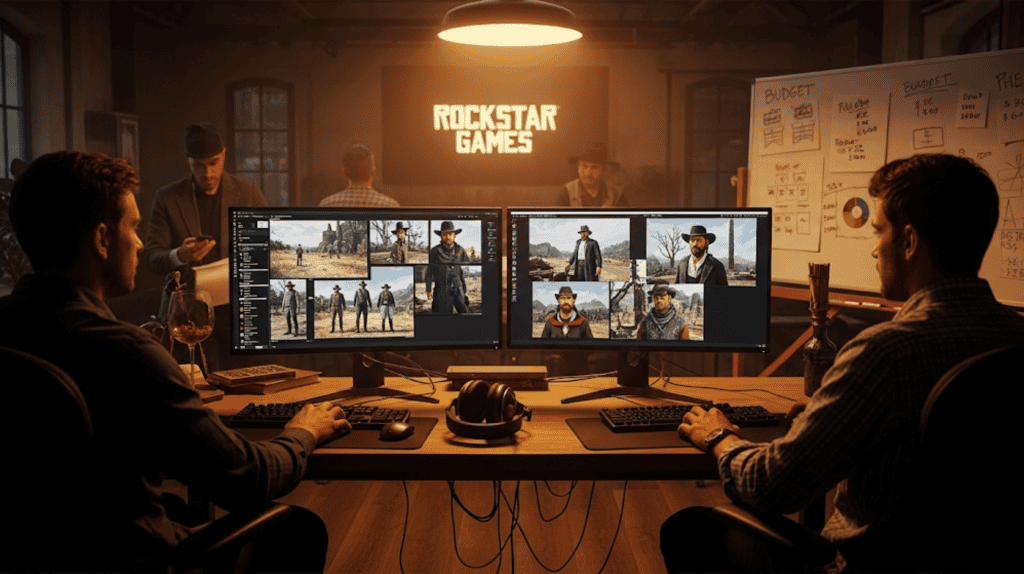
Industry data shows AAA budgets growing at 6% CAGR (2017–2022), projected to accelerate to 8% CAGR (2022–2028).
Wondered how much money and time it takes to make an industry-defining open-world game, budget- and effort-wise? Here, we will deconstruct the development and marketing expenses of Red Dead Redemption (2010), which cost around $130–$150 million, and Red Dead Redemption 2 (2018), which soared to nearly $400–$450 million.
By breaking down these numbers, we’ll show what they mean for studios, indie developers, and investors aiming to create their own AAA titles. Along the way, we’ll also share tips on smart budgeting and how Cubix can help you achieve big-budget quality without overspending.
Read More: Best List of Triple A Games You Must Play
The True Costs of Red Dead Redemption
While Rockstar Games never fully disclosed development budgets, industry analysts and credible sources estimate the following:
Red Dead Redemption (2010)
- Development cost: ~US$80–100 million
- Total estimated cost (with marketing, distribution, localization): ~US$130 million
- Timeline: 5 years
- Team size: 1,000+ across global Rockstar studios
- Notable expenses: motion capture, voice acting, home‑grown physics/animation systems, extensive QA testing
Red Dead Redemption 2 (2018)
- Development cost: ~US$170–200 million
- Total estimated cost (with marketing & distribution): ~US$370–400 million
- Timeline: 8 years
- Team size: 1,600+ developers
- Notable expenses: expanded motion capture, thousands of lines of dialogue, advanced AI for NPCs, complex weather & lighting systems, higher‑fidelity assets for multiple platforms
Takeaway: Costs balloon when you aim for cinematic storytelling, immersive environments, and advanced AI—all factors that modern players expect.
Key Cost Drivers in AAA Game Development
The RDR series highlights the main budget categories you’ll need to plan for:
1. Game Engine & Tools
- Custom vs licensed engines (e.g., Unreal, Unity)
- Cross‑platform optimization
- Middleware (physics, AI, animation tools)
Cubix insight: We help clients choose engines and tools that balance performance, scalability, and budget.
2. Narrative & Content Creation
- Scriptwriting & worldbuilding
- Voice actors & motion capture
- Cinematics & cutscenes
3. Open World Design & AI Systems
- Hand‑crafted vs procedural environments
- NPC behavior & advanced AI
- Dynamic event generation
4. Graphics & Visual Fidelity
- High‑resolution assets, shaders, lighting
- Weather systems & environmental effects
5. Testing, QA & Optimization
- Hardware compatibility (PC, console, next‑gen)
- Bug fixing & regression testing
- Playtesting & feedback cycles
Cubix QA edge: Our test automation and multi‑platform pipelines help reduce costs while improving stability.
6. Marketing & Distribution
- Trailers, teasers, influencer campaigns
- Localization for global markets
- Digital + physical distribution
7. Post‑Launch Support
- DLCs, patches, expansions
- Live service management
- Community management
Game Title |
Release Year |
Estimated Dev Cost |
Total Marketing |
| Red Dead Redemption | 2010 | $80–100M | $130M |
| Red Dead Redemption 2 | 2018 | $170–200M | $370–400M |
| GTA V | 2013 | $137M | $265M |
| Cyberpunk 2077 | 2020 | $174M | $314M |
AAA games are consistently trending upward in cost due to higher expectations for realism, scale, and ongoing content.
How to Budget Smartly for an AAA Game
If you’re planning a large‑scale title, here’s what to keep in mind:
- Define scope early: Avoid scope creep that inflates costs.
- Prioritize features: Not every mechanic needs to launch Day 1.
- Prototype first: A vertical slice can validate vision before heavy spend.
- Outsource strategically: Animation, audio, or QA can be offloaded cost‑effectively.
- Plan for post‑launch: Allocate 20–30% for patches, DLC, and live operations.
- Buffer budget: Always set aside 15–20% for overruns.
Pro tip: Download our AAA Budget Checklist to map out your project’s cost categories and avoid surprises
How Cubix Helps You Build Big‑Budget Games Smarter
At Cubix, we’ve partnered with startups, mid‑tier studios, and enterprises to deliver:
- Custom RPGs and open‑world games with immersive storytelling
- Cross‑platform optimization for PC, console, and mobile
- AR/VR integrations for next‑gen gameplay experiences
- End‑to‑end QA and testing pipelines for stability across platforms
- Live operations support to keep your game thriving post‑launch
We know what it takes to deliver AAA‑level quality, and we can help you achieve it more efficiently.
Ready to estimate your game’s budget? Contact us today.
The Birth of a Western Epic: Early Development of Red Dead Redemption

It is not the first ambitious project of Rockstar Games. By the time Red Dead Redemption was created, the company had established an industry norm through redefining open-world gaming with the Grand Theft Auto franchise. However, developing and designing a game around the last days of the American frontier was unprecedented, Such an undertaking demanded not only time, talent, and financial investment but also the kind of sophisticated game development service that could bring cinematic storytelling and immersive mechanics to life on an entirely new scale.
Red Dead Redemption development started in 2005 by Rockstar San Diego. Although the game was published in May 2010, it took five years of development to push the technical and financial envelope on the Xbox 360 and the PlayStation 3.
The aim of Rockstar was not to produce another shooter but a breathing, living world that people can lose their souls to. That meant an open world of more than 28 square miles, lifelike AI, weather, horseback riding, hundreds of side quests, and random encounters. It also needed the voice-overs of more than 700 actors and original arrangements of hoary composers such as Bill Elm and Woody Jackson.
Nevertheless, ambition has its price.
Read More: Rockstar Drops Grand Theft Auto 6 Release Date
How Much Does Red Dead Redemption Cost to Develop?

Speaking of Red Dead Redemption’s cost, the initial title released in 2010 was not a minor achievement. Even though Rockstar never officially disclosed the precise development budget of Red Dead Redemption, analysts in the industry and insider news give their estimation that Red Dead Redemption cost between 80 million and 100 million dollars to develop. This includes:
- Five years of development
- A development team that had reached more than 1,000 individuals across the globe in Rockstar’s global studios
- Lots of motion capture and voice recording
- Physics and animation systems were home-grown
- Costly QA testing and debugging
Answering the question of how much Red Dead Redemption 1 cost, we begin with the fact that the game development cost could not be discussed as the only financial aspect. An additional cost of at least $30 million, but as much as $50 million, was on top of the budget because of marketing, publishing, licensing, and physical distribution which put the all-in cost at almost $130 million, which was massive by the standards of a 2010 title.
Read More: Best Red Dead Redemption 2 Mods to Transform Your Gameplay
Key Factors That Influenced the Red Dead Redemption Cost
Let’s break down what made this game so expensive:
1. Global Studio Collaboration
Unlike smaller studios that work in one location, Rockstar utilizes a global development model. Studios in New York, Toronto, San Diego, Lincoln, and even Edinburgh contributed to Red Dead Redemption. Managing these teams across different time zones increases communication overhead, project management complexity, and inevitably costs.
2. Custom Engine Technology
Rather than using a pre-built engine like Unreal or Unity, Rockstar used its proprietary RAGE (Rockstar Advanced Game Engine). While this gave them flexibility, it also meant additional costs for internal development, engine tuning, and compatibility testing across platforms.
3. Massive Voice and Audio Production
With over 700 actors voicing characters from the main cast to background NPCs, the voice production alone was one of the most expensive components. Add to that Foley effects, ambient sounds, and a fully original soundtrack, and you get a hefty portion of the overall Red Dead Redemption cost.
4. Cinematic Storytelling
Rockstar has always prided itself on delivering film-quality narratives. This meant months of motion capture, direction, editing, and polishing. Rockstar even hired professional actors like Rob Wiethoff (John Marston) to bring depth and realism to the roles, another line item on a growing budget.
These are the same challenges modern studios face today. At Cubix, we’ve managed similar cost drivers, large teams, proprietary tools, and massive creative scope, ensuring projects stay on track without compromising quality.
Case Study: Relentless – An Adventure Game By Cubix
Relentless is a mobile adventure game created by Cubix, which aims to take players through the experience of puzzle-based discovery, resource collection, and battles on mysterious planets. The project proves that we can balance good storytelling and exciting mechanics without being too expensive and keeping the gameplay optimized to the mobile device.
Project Goals
The game was supposed to be a story-based, strategic adventure where players would be moving through dungeons, solving puzzles, and creating tools to survive. Our client desired a title to combine exploration, action, and narrative development with providing a refined mobile experience.
Tech Stack
To develop Relentless, we chose performance- and scale-based technologies:
- Unity as the major game engine in cross-platform support
- Scripting core gameplay with C#
- Blender and Maya to 3D model and animation assets
- backend services and extensions of game logic Node.js
- Lightweight data management (progress tracking, inventory, leader boards) with MongoDB
- AWS Cloud with the purpose of smooth scalability and online functionality
Team Structure
At Relentless, we had a special team of 12 people:
- 2 Level design and mechanics balancing game designers
- 3 Character, environment and effect artists/animators
- 4 Gameplay, backend, systems integration developers
- 2 QA Specialists to certify puzzles, combat, and compatibility of devices
- 1 Project Manager to make sure that milestones and deadlines were achieved
Development Process
Its game development cycle was agile:
- Concept & Prototyping: Preliminary puzzle and combat cycles ready in two months.
- Base Gameplay Build: Development of more levels, plot, and character powers.
- Art & Asset Production: Scenery, devices, and scenes to aid in the experience.
- Polish and Optimization: Decreased load times, better UI responsiveness, and combat balance.
- Testing & Launch: Testing of multiple devices and fixing bugs to release.
Outcome
In 12 months, Cubix released a fully-fledged adventure game with a combination of puzzles, crafting, and combat that will keep you hooked to your mobile phone. Relentless demonstrated our gameplay, graphics, scalability, and narrative skills.
Read More: What’s the Cost to Build Characters of Subway Surfers?
How Red Dead Redemption 1 Set the Precedent for Expensive AAA Games
Then, Red Dead Redemption was the most blockbuster AAA title in the world at the time, and at the same time, it was the most expensive: made with about $110 million, the game sold over 15 million copies later, proving that the studios could recover their production investment with revenues from storytelling, delivering immersive gameplay, and fan loyalty.
Ever since, though, the lessons that Rockstar learned during that period paved the way for the next massive project, Red Dead Redemption 2, with a budget of over $500 million, and became the one to transform the image of budgets for AAA games.
There’s a lot of discourse at the moment regarding Red Dead Redemption’s price. Fans are rightly disappointed at being expected to pay $50 for an upscaled and incomplete port of a 13-year-old game. (Especially as there were rumors of a full remake).
Read More: Skyrim Cost: How Much Did It Take to Build This Epic RPG?
Red Dead Redemption 2: Rockstar’s $500 Million Gamble

While Red Dead Redemption saw a fair share of expenses, its sequel set new financial standards. Released in October 2018, Red Dead Redemption 2 took everything from the original and turned it up a notch with a larger map, multiplayer characters, storytelling, and stunning graphics. Thus, the Red Dead Redemption pricing for the second game went into a realm not experienced before in the gaming industry. Rockstar’s massive risk highlights the fine balance between innovation and cost. At Cubix, we help studios strike that balance by building AAA-quality games with smarter budget allocation, scalable pipelines, and creative direction that maximizes every dollar spent.
Read More: How Much Money Does Fortnite Make? Revenue and Growth
How Much Did Red Dead Redemption 2 Cost?
While Rockstar has never truly revealed an actual cost for Red Dead Redemption 2, analysts, credible leaks, and financial estimates throw the total budget into the realm of $370 million to $540 million, including:
- Development estimated at $250-$300 million
- Marketing and distribution from $120 to $240 million
For comparison, it is almost double the combined outlay of several Hollywood blockbusters, such as Avengers: Endgame or The Dark Knight Rises. Therefore, the price of Red Dead Redemption 2 makes it one of the most expensive video games ever developed, just after Grand Theft Auto V.
“AAA games aren’t just built with bigger budgets, they’re crafted with bigger risks, bolder visions, and the relentless pursuit of player awe.”
– Umair Ahmed, VP of Growth at Cubix, a leading game development company
Why Was Red Dead Redemption 2 So Costly?

Rockstar wanted perfection, and this does cost. And this is how it sent the budget to the stratosphere:
1. Development Eight Years
Its production began soon after the release of Red Dead Redemption 1 in the year 2010. Already, by the release of Red Dead Redemption 2 in 2018, it had been in development for over eight years, compared to the majority of AAA games. Having full-time employees and increasing the size of the team during that time affected the Red Dead Redemption sequel’s price considerably.
2. More than 2,000 Developers
Rockstar engaged more than 2,000 workers in several studios throughout the world: Rockstar San Diego, Rockstar North, and Rockstar India. The cost of salaries, benefits, management, and coordination of such a large workforce brought tens of millions to the ultimate budget.
It also required this worldwide cooperation to bring out the colossal nature of the game. The product had over 500,000 lines of dialogue, 1,200 actors, and an open world more detailed and larger than Rockstar had ever created, and therefore, the human capital requirement was massive.
3. Hyper-Realistic Animation and DW Design
Rockstar redeveloped its engine, called RAGE, to include new lighting implementations, physics interactions, AI behaviors, and environmental detail. Muscle simulations were found in horses. The gameplay was influenced by the weather. Towns operated with dynamized timetables. creating a world that felt authentic and reactive an achievement that highlights the critical role of a skilled game environment designer in shaping immersive and believable virtual landscapes.
This degree of verisimilitude made the Red Dead Redemption price quite a lot. In the sense of it all, Rockstar was not merely developing a video game but re-enacting a living, breathing version of the American Wild West.
Read More: How Much Does PUBG Game Cost to Make
Return on Investment: Was it Worth it
Despite the high price of development, Rockstar’s gamble paid off.
- By the middle of 2025, Red Dead Redemption 2 had sold upwards of 55 million copies.
- The opening weekend grossed $725 million.
- It has since grossed over $1.5 billion, making it one of the highest-grossing entertainment products ever.
If we compare the estimated $500 million spent making it, the return on investment is enormous, proving Rockstar’s philosophy correct of investing heavily in storytelling, quality, and open-world systems.
Read More: What is a AAA Game and How Much Does it Cost
Red Dead Redemption Cost vs Other AAA Games: Where Does Rockstar Stand?

Rockstar Games is not new to stretching the game production budgets. Red Dead Redemption and Red Dead Redemption 2 are some of the most expensive games developed, but where do they place among the other major productions in the AAA category?
Knowing information about Red Dead Redemption 1 and how much Rockstar went with Red Dead Redemption 2 enables us to realize the magnitude of these projects. Suppose we look at this issue in more detail once again, how does the cost of Red Dead Redemption compare with any other popular franchise?
Read More: Top 10 Hardest Games in the World
Red Dead Redemption 1: A Big Risk in 2010
This is what left most of the gaming world aghast when the rumored price of Red Dead Redemption 1 was released. Development itself was estimated to cost as much as 80 to 100 million dollars, and with marketing taking the overall budget to about 130 million dollars, this was a massive step by Rockstar, especially on a brand-new intellectual property back in 2010.
To put it in context:
| Game Title | Release Year | Estimated Cost | Notes |
|---|---|---|---|
| Red Dead Redemption 1 | 2010 | $130 million (with marketing) | New IP, large open world |
| GTA IV | 2008 | ~$100 million | Rockstar’s biggest title before RDR |
| Call of Duty: Modern Warfare 2 | 2009 | ~$50 million development + $200M marketing | Heavily promoted blockbuster |
| Halo 3 | 2007 | ~$60 million | Microsoft’s flagship franchise |
| The Elder Scrolls V: Skyrim | 2011 | ~$85 million | Open-world RPG |
So, how much does Red Dead Redemption cost? More than many AAA titles of its time, making it a bold financial move. Rockstar essentially built a new frontier, pun intended, both thematically and economically.
Despite the risk, the game was a commercial success. It sold over 15 million copies, received universal critical acclaim, and spawned a powerful franchise.
How Much Does Red Dead Redemption Cost Compared to Modern Games?

In retrospect, Red Dead Redemption 1 is a fraction of the game it is currently in modern times. However, its overall expenditure of 130 million was huge at the time. For context:
One of the biggest games to cross the 100 million mark was in 2010, and it was very limited.
Game engines such as Unreal and Unity were not as polished as they are now, and so custom technology (such as that created by Rockstar) bloated budgets.
In 2010, the work of Rockstar was innovative, at a price: open-world design combinations with AI systems and complex physics were not common, and such achievements came at a high price.
In the modern world, it is expected that the most high-profile AAA games will exceed the mark of 150-300 million dollars. However, one should keep in mind that Rockstar contributed to that trend with GTA IV and solidified it with the retail price of the first game, Red Dead Redemption.
Read More: The Most Popular Mobile Game Categories
Why Rockstar’s Red Dead Redemption Budget Was a Smart Business Move

Rockstar wasn t in business of trying to create an outstanding game when it invested hundreds of millions in the development and marketing of the Red Dead Redemption series it was making a corporate decision. In the present days, Red Dead Redemption 1 and 2 can be considered not only as works of art but also as investments that brought excellent profits.
So, why would Rockstar spend such astronomical sums? And more importantly, how did they make it worth it?
Let’s unpack why the massive Red Dead Redemption cost was a carefully measured business decision.
1. Red Dead Redemption as a Long-Term Franchise Investment
Rockstar doesn’t release games every year. They release fewer games than most major publishers. Instead of producing volume, Rockstar focuses on longevity and cultural impact.
The first Red Dead Redemption was a gamble in 2010, a new intellectual property that strayed from the urban chaos of GTA. Yet Rockstar saw long-term potential. That first investment of nearly $130 million laid the foundation for a brand that would generate billions in revenue across multiple titles, re-releases, and merchandise.
The question of how much Red Dead Redemption 1 costs is not just about development. It’s about the value of establishing a lasting franchise. With Red Dead Online, ports, and digital re-releases, Rockstar continues to profit from that original investment over a decade later.
2. Rockstar’s Strategy: “Fewer Games, Bigger Impact”
Most game studios depend on releasing multiple games per year. But Rockstar operates differently. Their approach can be summarized as
“If we make it the biggest, they will buy it.”
It’s risky, but it works. Rather than relying on quantity, Rockstar creates experiences so detailed and compelling that fans eagerly wait 5–8 years for the next release.
This strategy means that each title must generate massive sales. The only way to ensure that is through sky-high production quality. That quality requires significant investment, which explains the massive Red Dead Redemption cost.
3. Rockstar’s Reputation and Fan Trust
Another key reason Rockstar can justify these budgets is brand loyalty. Few studios have the same level of trust with their player base. When Rockstar promises a game, people pay attention.
This trust gives them marketing momentum that many developers have to pay for. For example:
- Red Dead Redemption 2 had 36 million YouTube trailer views within months
- Gaming influencers created free coverage, giving Rockstar a marketing edge
- Fans pre-ordered in droves, confident in Rockstar’s ability to deliver
So even though the Red Dead Redemption cost included massive marketing expenses, Rockstar was able to leverage organic hype, and that’s invaluable.
4. Monetization Beyond Game Sales
Rockstar didn’t rely solely on initial sales to recoup costs. Here’s how they maximized their return:
Red Dead Online
After launch, Red Dead Redemption 2 introduced Red Dead Online, a multiplayer experience modeled after the success of GTA Online. Although it never reached the same popularity, it extended the life and profitability of the game with:
- In-game purchases
- Content updates
- Community engagement
Special Editions & Collectibles
Rockstar released multiple premium editions of the game, priced up to $100+, with bonus content, exclusive outfits, and digital currency.
Cross-Platform Releases
By launching on PlayStation, Xbox, and later PC, Rockstar opened up multiple waves of revenue, extending sales beyond initial launch windows.
Re-releases and Porting
Even Red Dead Redemption 1 received renewed attention when it was ported to modern consoles. This led to fresh revenue streams from a title that was over a decade old.
The Red Dead Redemption cost was enormous, but Rockstar knew they had many avenues to recover it.
5. Cultural Values and Awards Matter in Business
It’s easy to think of the budget in terms of dollars and cents, but awards, critical acclaim, and cultural impact also influence business value.
- Red Dead Redemption 2 won Game of the Year awards and countless accolades
- It became part of college courses, film comparisons, and academic studies
- The game has become a benchmark for excellence in world-building, writing, and art direction
This translates to brand value. It increases Rockstar’s stock as a creative powerhouse, boosts recruitment, and strengthens partnerships.
6. Setting the Industry Standard
By investing so heavily, Rockstar raised the bar for AAA games. Developers now cite the Red Dead Redemption series as inspiration for:
- AI and NPC behavior
- Storytelling in open-world formats
- Dynamic event systems
In short, the massive Red Dead Redemption cost wasn’t just a financial statement; it was a creative declaration of leadership in the game industry.

Learnings From the Red Dead Redemption Cost

Red dead redemption cost is setting benchmarks not only in games but in cost too. With development budgets reaching hundreds of millions, AAA projects demand careful planning, smart outsourcing, and strong technical pipelines.
If you’re considering your own large‑scale project, Cubix can guide you from concept to launch while helping you control costs.
Let’s build your next big game together—book a consultation today.