
Key Takeaways
- HIPAA needs a seat at the table during planning and architecture, not a certificate chased after development wraps.
- Protected Health Information (PHI) covers individually identifiable health information created, received, maintained, or transmitted by covered entities and their business associates.
- The HIPAA Privacy Rule governs how PHI may be used and disclosed, while the HIPAA Security Rule focuses specifically on protecting electronic PHI (ePHI).
- Encryption, authentication, Access Control, audit logging, secure APIs, backups, and monitoring form the backbone of effective Healthcare Data Security.
- A Business Associate Agreement (BAA) is generally required when a business associate handles PHI on behalf of a covered entity, subject to HIPAA’s specific requirements and exceptions.
- HIPAA is only one piece of the puzzle. Integrations, cloud infrastructure, the data lifecycle, third-party SDKs, and applicable state privacy and security requirements also deserve careful attention.
Picture a patient opening an app at 11 p.m. to check a lab result her doctor flagged as urgent. In that ten-second interaction, invisible decisions are already at work: who can see that result, how it is encrypted while moving between systems, and what happens if her phone is stolen tomorrow.
That is the real substance of HIPAA Compliance. It is not a badge added after launch. It is the result of hundreds of architectural, security, and data-handling decisions made throughout Healthcare App Development.
The need for those safeguards is becoming harder to ignore. According to the HHS Office for Civil Rights (OCR) breach portal, 61 healthcare data breaches affecting 500 or more individuals were reported in May 2026, marking a 27.1% month-over-month increase. Over the previous 12 months, an average of 64 large healthcare data breaches were reported each month.
Mobile healthcare apps now bring appointment booking, patient messaging, prescriptions, virtual visits, payments, and medical records into a single experience. That convenience also means these applications can handle some of the most sensitive information a person owns.
This guide explains what HIPAA requires, which healthcare applications fall under its rules, how Protected Health Information (PHI) and Electronic Protected Health Information (ePHI) should be handled, and what it takes to build a genuine HIPAA-Compliant Healthcare App for the US market.
What HIPAA Compliance Actually Means for App Development

HIPAA, the Health Insurance Portability and Accountability Act, became federal law in 1996 after being signed by then-President Bill Clinton. Its purpose went beyond app security. The law was designed to improve health insurance portability, simplify healthcare administration, and establish national standards for electronic healthcare transactions and certain health information.
Three decades later, HIPAA has become a central consideration for digital healthcare. The rules that matter most to app teams today are designed to protect Protected Health Information (PHI). When that information is created, received, maintained, or transmitted electronically within HIPAA’s scope, it is considered Electronic Protected Health Information (ePHI).
These requirements shape how healthcare organizations collect, store, transmit, and protect sensitive information. For a deeper look at how these principles apply to custom healthcare software, explore Building Custom Software for US Healthcare & HIPAA.
Does Your App Actually Need to Be HIPAA-Compliant?
Not every app that touches health information falls under HIPAA. This surprises a lot of first-time healthcare founders.
HIPAA generally applies to covered entities, health plans, healthcare clearinghouses, and providers conducting certain electronic transactions, and to business associates, meaning organizations that perform services for covered entities and handle PHI in the process.
That single distinction separates a consumer wellness app from a clinical one, and it’s worth sitting with for a second.
Take a step counter app: It tracks calories, heart rate, sleep, maybe a running streak. None of that automatically triggers HIPAA, because there’s no covered entity in the loop.
Now take a patient portal built for a hospital system: It pulls prescriptions, diagnostic results, and appointment records straight from that hospital’s systems. The moment a covered entity is behind the curtain, HIPAA requirements can and usually do apply.
That’s exactly why healthcare app projects should start with a compliance and data-flow assessment, not a framework comparison spreadsheet. Pick the tech stack later. Figure out what you’re actually building first.
PHI and ePHI: Know the Difference Before You Write a Line of Code
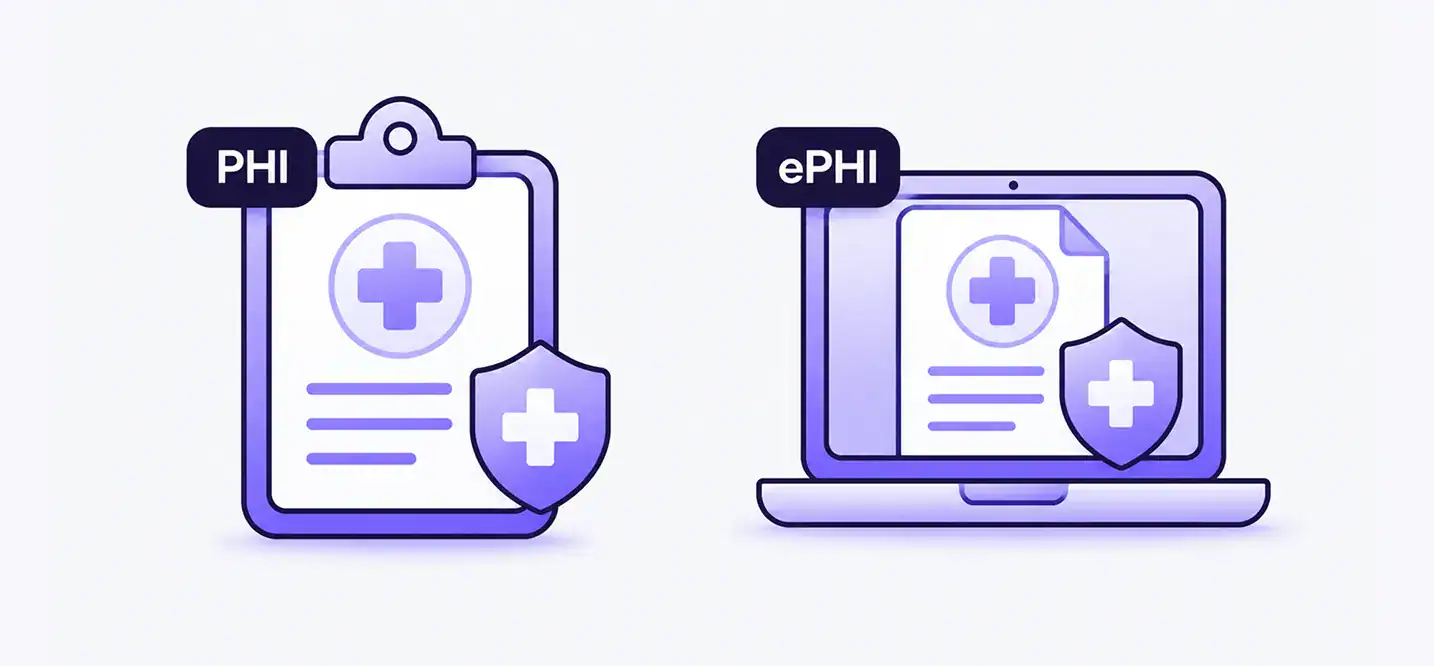
One of the earliest and most important steps in Medical App Development is pinning down exactly what health information the app will touch.
Protected Health Information (PHI)
PHI is individually identifiable health information held or transmitted by a covered entity or business associate. HHS describes it broadly: anything about a person’s past, present, or future physical or mental health, the care they received, or how that care was paid for, as long as it identifies them or could reasonably be used to.
Depending on what your app does, PHI can include:
- Patient names and contact details
- Medical histories
- Diagnosis information
- Prescription records
- Lab results
- Imaging reports
- Insurance information
- Billing and payment records
- Treatment notes
- Clinical documentation
- Appointment details
- Patient identifiers
- Any health data tied to a specific, identifiable person
Electronic Protected Health Information (ePHI)
When PHI is created, received, stored, or moved electronically within HIPAA’s scope, it becomes ePHI. And in a modern app, that data has a lot of places to hide:
- Mobile devices
- Web applications
- Cloud databases
- APIs
- EHR integrations
- Authentication systems
- Provider dashboards
- Backup systems
- Messaging services
- Connected medical devices
Your development team needs a real map of where ePHI enters the system, where it travels, where it comes to rest, and exactly who has a key to it. That map isn’t a nice-to-have diagram for a slide deck, it becomes the working blueprint for Healthcare Data Security across the whole product.
HIPAA Privacy Rule vs. HIPAA Security Rule
These two rules get lumped together constantly, but they’re solving different problems.
| HIPAA Requirement | Primary Focus | What It Means for Your App |
| HIPAA Privacy Rule | Privacy and permitted use/disclosure of PHI | Governs who can access, use, and share patient information, and under what conditions |
| HIPAA Security Rule | Security of electronic PHI | Drives the technical, physical, and administrative safeguards you build |
| Breach Notification Rule | Response to breaches of unsecured PHI | Shapes how you detect, respond to, and disclose incidents |
The Privacy Rule sets the boundaries and conditions around using and disclosing PHI, and it gives patients concrete rights over their own information. The Security Rule builds the safeguards around ePHI itself, the administrative, physical, and technical protections that keep it out of the wrong hands.
This split shows up in real architecture decisions. Restricting a nurse’s view to only the patients she’s actually treating is a privacy call. Building the authentication flow, the audit logs, the encryption, and the session handling underneath that restriction is a security build. A well-built healthcare app has to nail both, one without the other leaves a gap someone will eventually find.
The Essential HIPAA Requirements Your App Needs to Meet
HIPAA won’t tell you which programming language, framework, or cloud provider to pick. What it does insist on is appropriate safeguards matched to your actual risk and responsibilities, which, honestly, gives development teams more room to make smart technical choices, not less.
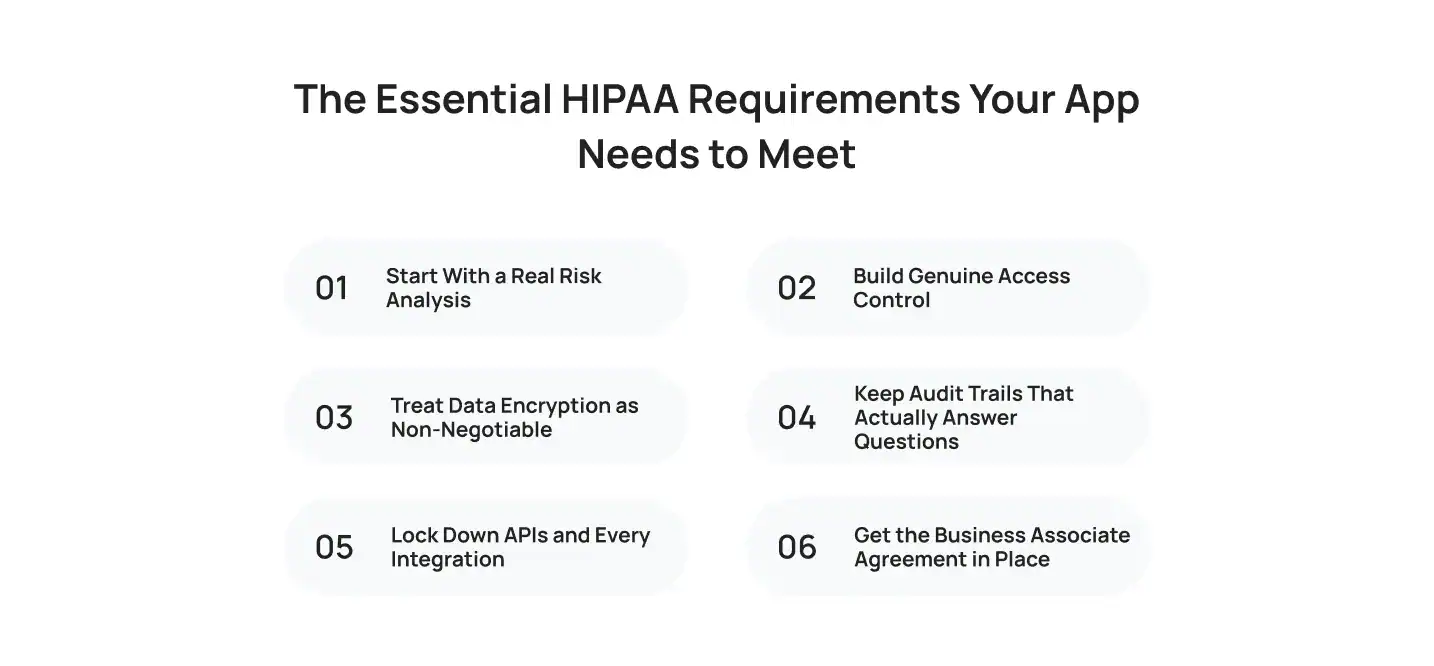
1. Start With a Real Risk Analysis
Before a single line of code gets written, map out the threats to PHI and ePHI. Ask the uncomfortable questions early:
- What information does the app actually collect?
- Where does it live once it’s stored?
- Which systems receive it?
- Who has access, and why?
- How do users prove who they are?
- How do APIs move data around?
- Which third-party services touch it?
- What happens the moment a device gets lost?
- What happens if an account is compromised?
- Are backups protected the same way production data is?
- How does data get deleted or retained over time?
This isn’t a box-checking exercise. The answers should directly shape the architecture and every safeguard built on top of it.
2. Build Genuine Access Control
Access Control matters because nobody in a healthcare app should see everything by default.
A physician needs clinical records. A billing coordinator needs payment and insurance details. A patient should generally see only their own chart. An admin might need system-level access without automatically inheriting a window into every patient’s clinical notes.
Role-based access control is the standard way to enforce these boundaries, and it usually includes:
- Role-based permissions
- Multi-factor authentication
- Session timeouts
- Strong password policies
- Device and session management
- Permission-gated API endpoints
- Least-privilege access as the default, not the exception
- Administrative approval workflows for sensitive changes
HHS also points to the “minimum necessary” principle, the idea that covered entities should generally limit PHI use or disclosure to what’s actually required for the task at hand. It’s a simple rule that catches a surprising number of over-permissioned systems.
3. Treat Data Encryption as Non-Negotiable
Data Encryption has to cover information both while it’s moving and while it’s sitting still.
In transit, that usually means secure protocols like TLS protecting communication between mobile clients, web apps, APIs, and backend services. At rest, encryption should extend to databases, storage systems, backups, and anywhere else sensitive information ends up parked.
The exact implementation varies by architecture, but the goal stays the same everywhere: if someone intercepts the traffic or breaks into the storage layer, they should find nothing usable.
Don’t skip local device storage either. A phone holding health information in plain text is one lost backpack away from becoming a serious incident.
4. Keep Audit Trails That Actually Answer Questions
A healthcare app should be able to answer, on demand: who touched this record, what exactly did they see, when did it happen, what did they do with it, was anything changed, and did an admin quietly adjust someone’s permissions last week?
Audit logs are what let a team investigate suspicious activity instead of guessing at it after the fact.
One catch worth flagging: logs themselves can leak PHI if they’re not designed carefully. A log file that captures full record contents “just in case” becomes its own liability. Log the activity, not the sensitive payload.
5. Lock Down APIs and Every Integration
Modern Healthcare Application Development rarely happens in a vacuum. A typical app might be talking to EHR platforms, hospital systems, pharmacy networks, lab platforms, insurance systems, payment processors, identity providers, wearables, and telehealth tools, sometimes all in the same release.
Every one of those connections is a new pathway data can travel. Authenticate every API request. Validate every input. Enforce permissions server-side, not just in the app’s UI. Monitor activity and protect data in transit at every hop.
Third-party SDKs deserve the same scrutiny. An analytics library or ad SDK quietly grabbing more device or user data than expected can undo careful architecture elsewhere in the app, even when nobody intended it.
6. Get the Business Associate Agreement in Place
A Business Associate Agreement (BAA) becomes necessary the moment an outside organization qualifies as a business associate and handles PHI on a covered entity’s behalf.
The BAA spells out what that vendor can and can’t do with the data, and where responsibility sits if something goes wrong. For a healthcare app, that touches:
- Cloud service providers
- Software vendors
- Hosting providers
- Data processing vendors
- Analytics providers
- Healthcare technology partners
Here’s a mistake worth avoiding: assuming that building on a well-known cloud platform automatically makes an app compliant. It doesn’t. The specific services used, how they’re configured, the contracts signed, and the actual data flows all have to be evaluated, every single one.
Want to discuss your project? Our experts are just a click away.
Contact UsBuild Compliance Into the Architecture From Day One
Compliance becomes much easier when it is built into the architecture from the start. Trying to add it around a finished product can create unnecessary technical and security challenges.
Most healthcare apps can be viewed across four core layers:
User layer: Patient and provider interfaces across mobile and web applications.
Application layer: Business logic, authentication, authorization, workflows, and API services.
Data layer: Databases, file storage, backups, and audit records.
Integration layer: EHR systems, payment services, laboratories, pharmacies, identity providers, and other external platforms.
Each layer has its own security requirements. The user interface should only display the information a particular screen needs. The application layer should enforce authorization on the server side instead of relying on the frontend. Databases need their own protections, independent of the application layer. APIs should verify a user’s identity and permissions before returning sensitive information.
For larger healthcare organizations, these architectural decisions become even more important as applications involve multiple user roles, enterprise identity systems, and complex integrations. Our guide to Enterprise Healthcare Mobile App Development in the US explores these considerations in greater detail.
When these controls work together, Healthcare Technology Development becomes a coordinated security process rather than a collection of controls added at the last minute.
Step-by-Step Guide to Developing a HIPAA-Compliant Mobile App
Building a HIPAA-Compliant Healthcare App requires compliance to remain part of the project from the first planning meeting through ongoing maintenance. It is not a single milestone that ends when the app launches.
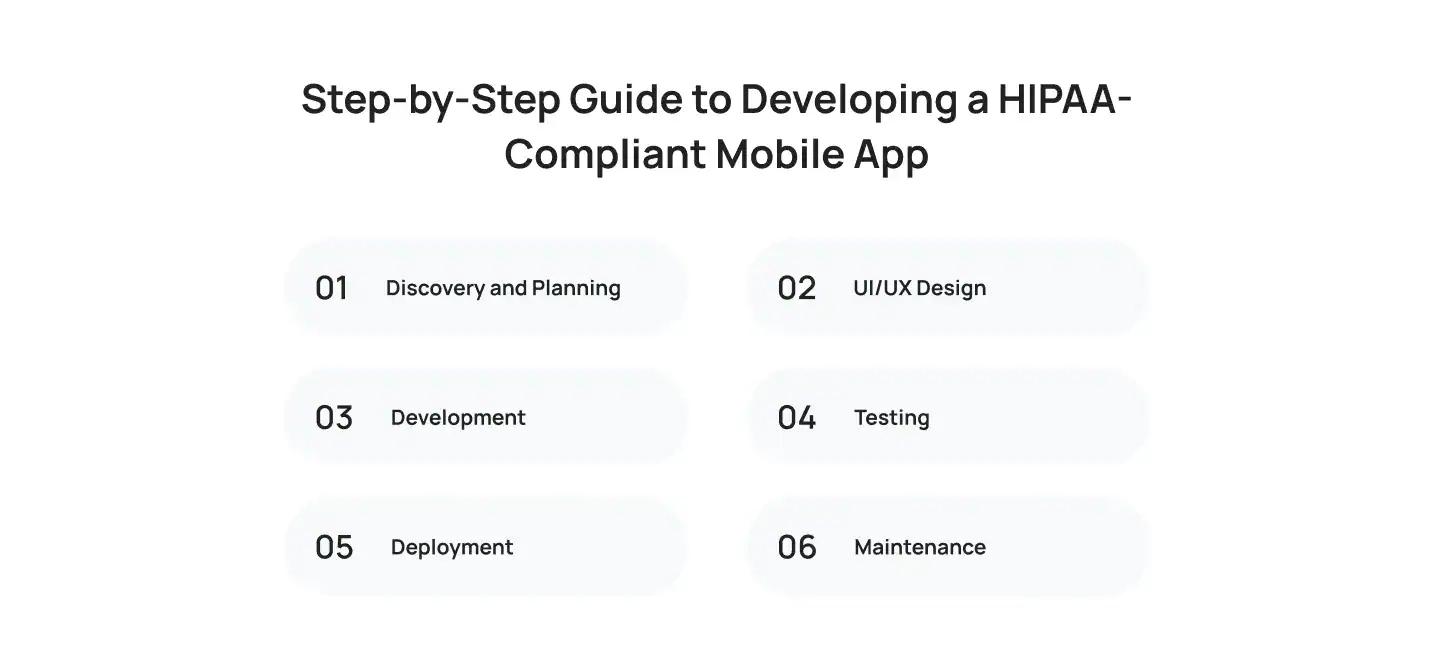
Discovery and Planning
Start by defining the application’s purpose, target users, covered entities, and types of PHI it will process. Identify third-party vendors, required integrations, applicable requirements, and data retention needs.
This stage should provide a clear picture of the data lifecycle. Teams should know what information enters the system, where it moves, where it is stored, who can access it, and when it should be deleted or archived.
UI/UX Design
Privacy should influence the interface, not just the backend.
Dashboards, notifications, and lock screens can unintentionally expose sensitive information. For example, a notification saying “Your test results are ready” reveals less information than displaying the actual result on a locked screen. It is a small design decision, but it can make a meaningful difference to patient privacy.
Development
This is where security controls become part of the application itself. Developers need to implement authentication, authorization, encryption, secure APIs, input validation, logging, and appropriate error handling.
Security-sensitive code should also receive focused reviews. Developers should look for weaknesses that could expose PHI, bypass permissions, or allow unauthorized access to backend services.
Testing
Testing should go beyond asking whether a feature works as expected. A healthcare application should also undergo security-focused testing, including:
- Authentication and authorization testing
- API security testing
- Vulnerability scanning
- Penetration testing
- Session management testing
- Encryption verification
- Input validation
- Access Control testing
- Audit-log verification
These tests help identify weaknesses before they become production problems.
Deployment
Production deployment requires more than publishing the application.
Teams should configure the infrastructure correctly, establish monitoring, protect backups, restrict administrative access, and maintain an incident response process. Backup and recovery procedures should also be tested rather than simply documented.
Maintenance
HIPAA compliance does not end when the application goes live.
New features, APIs, SDKs, vendors, operating-system updates, and infrastructure changes can introduce new risks. Each significant change should be reviewed for its potential impact on privacy and security.
Regular security assessments help keep the application’s controls aligned with how the product actually works. That ongoing approach is essential for maintaining a secure healthcare application as its features, integrations, and user base grow.
Tech Stack for HIPAA-Compliant Healthcare App Development
The technology stack plays an important role in how a healthcare app handles, stores, and protects sensitive information. But no programming language or cloud platform makes an application HIPAA compliant on its own. Compliance depends on how the technology is configured, connected, and managed.
| Layer | Common Technologies |
| Frontend | React Native, Flutter, Swift, Kotlin |
| Backend | Node.js, Python, .NET |
| Database | PostgreSQL, MySQL, MongoDB |
| Cloud Infrastructure | AWS, Microsoft Azure, Google Cloud |
| APIs | REST, GraphQL, FHIR |
| Authentication | OAuth 2.0, MFA, secure identity providers |
| Security | TLS, encryption, Access Control |
| Healthcare Integration | EHR/EMR systems, FHIR APIs, laboratories, pharmacies |
| Monitoring | Audit logs, activity monitoring, vulnerability management |
The right stack depends on the application’s requirements, integrations, data volume, user roles, and security needs. For example, FHIR APIs can support interoperability with healthcare systems, while secure authentication and role-based permissions help control who can access sensitive information.
The important point is to choose technologies based on the application’s actual requirements and then configure them with the appropriate privacy and security controls.
Mistakes That Quietly Undermine Otherwise Solid Apps
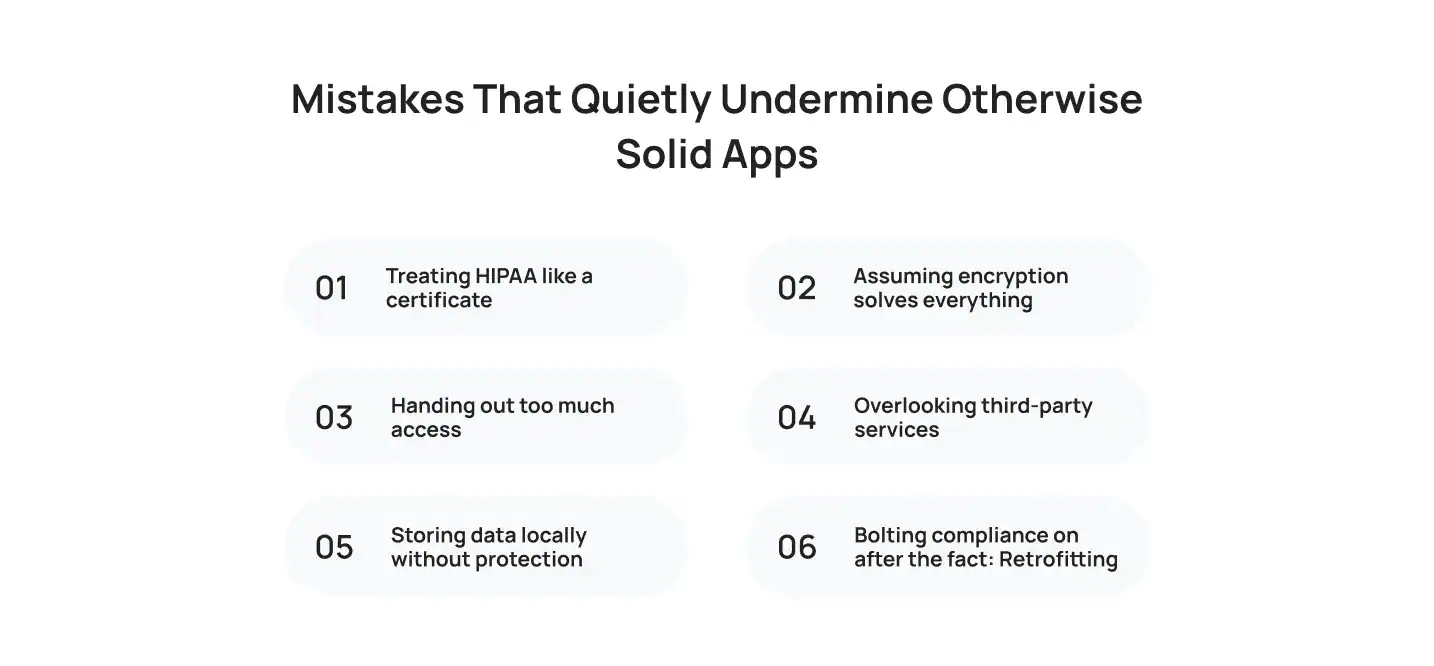
Even strong engineering teams create compliance gaps by overlooking basic data-handling decisions.
Treating HIPAA like a certificate: It’s not something you’re awarded once. It’s the policies, procedures, safeguards, contracts, and daily operational habits surrounding protected information, ongoing, not one-and-done.
Assuming encryption solves everything: It doesn’t. A fully encrypted database won’t stop a compromised but technically authorized account from pulling records it should never have touched in the first place.
Handing out too much access: Broad permissions turn a single compromised account into a much bigger problem than it needs to be. Least privilege should be the default setting, not an afterthought.
Overlooking third-party services: Analytics tools, messaging platforms, crash reporters, and other SDKs all interact with app data in ways that aren’t always obvious. Every one of them needs a look based on what it actually collects and where it sits in the architecture.
Storing data locally without protection: Local databases, cached files, downloaded documents, screenshots, and notification previews are all device-level exposure points that get missed more often than they should.
Bolting compliance on after the fact: Retrofitting: Security into a finished app usually means architectural rework, database restructuring, API changes, and a fresh round of testing. Building it in from the start is almost always the less painful path.
Why the Stakes Keep Rising
This isn’t a hypothetical risk anyone’s exaggerating for effect.
HHS data shows large healthcare breaches climbing 102% between 2018 and 2023, while the number of people affected by those breaches rose 1,002% over the same stretch, much of it, HHS notes, driven by hacking and ransomware. HHS’s proposed update to the Security Rule, published in December 2024, reflects that same shifting threat landscape and aims to tighten cybersecurity expectations for regulated entities protecting ePHI from both outside attackers and insider risk.
Heading into 2026, no development team should be designing a healthcare app around the assumption that a password field and basic database encryption cover the bases. They don’t anymore.
A genuinely modern approach folds in identity security, continuous monitoring, secure APIs, a tested incident response plan, vendor risk reviews, reliable backups, ongoing vulnerability management, and a habit of collecting less data rather than more.
What Does It Actually Cost to Build One of These?
The honest answer: it depends entirely on scope. A basic patient-facing app with authentication, scheduling, and messaging is a different budget conversation than an enterprise platform juggling EHR integrations, telehealth, payments, remote monitoring, analytics, and half a dozen distinct user roles.
The biggest cost drivers tend to be:
| Factor | Impact on Development Cost |
| App complexity | More workflows mean more development and testing hours |
| Number of user roles | Adds authorization and permission logic |
| EHR integrations | Requires integration work and interoperability testing |
| Telehealth features | Adds video, messaging, scheduling, and security layers |
| PHI handling | Requires additional controls and dedicated testing |
| Cloud infrastructure | Shapes hosting, storage, backups, and monitoring costs |
| Third-party services | May require vendor reviews and signed agreements |
| Compliance documentation | Adds analysis, policy work, and testing time |
| Ongoing maintenance | Security updates and monitoring add recurring cost |
Here’s the part worth remembering when comparing quotes: the cheapest proposal may not be the cheapest outcome. Cutting corners on architecture can lead to costly compliance issues after launch.
Choosing a Healthcare App Development Partner
A healthcare app needs more than a team that knows how to build mobile screens. Your development partner also needs to understand what happens behind those screens: sensitive data, clinical workflows, integrations, permissions, and security requirements.
When comparing Healthcare App Development Services, look beyond a company’s general portfolio. Ask about its experience with:
- PHI and ePHI handling
- HIPAA-related application requirements
- EHR and healthcare API integrations
- Authentication and role-based access
- Encryption and secure data storage
- Audit trails and activity monitoring
- Cloud infrastructure
- Healthcare interoperability
- Security testing
- Third-party services and integrations
One question is particularly revealing: How does the team protect sensitive information during development and testing? Development, staging, and production environments should be properly separated, with safeguards in place to prevent unnecessary exposure of patient information.
If you’re comparing providers, Top 10 Healthcare Software Development Companies in the US can help you assess companies based on their healthcare experience, technical capabilities, and project expertise.
Why Cubix for Healthcare App Development?

Cubix brings experience in developing digital products across industries, including healthcare. The company was recognized by GoodFirms among the top mobile app development companies for Q2 2024, providing independent recognition of its mobile development capabilities. GoodFirms Recognition of Cubix
The recognition highlighted Cubix’s work across healthcare, finance, education, automotive, and e-commerce. At the time, GoodFirms also reported 1,300+ projects delivered and a team of 350+ developers, designers, and project managers.
Recognition is useful, but it shouldn’t be the only factor when selecting a healthcare development partner. The stronger question is whether the team can turn healthcare requirements into practical decisions around architecture, data protection, integrations, testing, and ongoing maintenance.
If you’re ready to discuss your healthcare app requirements, you can partner with a custom mobile app development agency with experience building digital products across different industries.
“In healthcare technology, compliance is not what stands between an idea and innovation. It is what gives that innovation the trust to reach patients, providers, and the people who depend on it.” – Salman Lakhani, CEO, Cubix
Final Thoughts
Healthcare App Development in the US requires more than strong features and a polished interface. HIPAA needs to shape the product from planning and architecture through testing, deployment, and ongoing maintenance. Protecting PHI and ePHI, controlling access, encrypting sensitive data, securing integrations, and monitoring activity all contribute to a safer digital healthcare experience.
The right approach is to treat compliance as part of the product itself, not a final checkbox before launch. With thoughtful Healthcare Application Development, the right technology stack, and a development partner that understands healthcare requirements, organizations can build applications that support providers while giving patients greater confidence in how their information is handled.
Want to discuss your project? Our experts are just a click away.
Contact UsFrequently Asked Questions
From determining whether HIPAA applies to understanding security requirements and development costs, these FAQs cover the essentials before your project begins.
1: What are the key HIPAA compliance requirements for healthcare app development in the USA?
Key requirements include protecting PHI and ePHI through appropriate Access Control, authentication, Data Encryption, audit controls, secure APIs, risk analysis, and data protection measures. Organizations should also address business associate relationships, policies, procedures, and ongoing security monitoring.
2: How to Meet HIPAA Security Rule Requirements During Healthcare App Development?
A healthcare app can meet HIPAA Security Rule requirements by identifying ePHI data flows and implementing appropriate administrative, physical, and technical safeguards throughout development. Key measures include authentication, Access Control, Data Encryption, secure APIs, audit controls, backups, and ongoing security testing.
3: What are the essential HIPAA rules for developing a mobile healthcare application?
The HIPAA Privacy Rule governs how PHI can be used and disclosed, while the HIPAA Security Rule focuses specifically on protecting ePHI. A mobile healthcare application should address privacy, access, authentication, encryption, audit controls, and appropriate administrative, physical, and technical safeguards.
4: What are the best practices for integrating HIPAA compliance into a healthcare app?
Build compliance into the architecture from the beginning. Map PHI and ePHI data flows, apply least-privilege access, encrypt sensitive information, secure APIs, maintain audit logs, protect backups, review third-party services, and test security controls regularly. Compliance should continue through maintenance, updates, and new integrations.
5: What software tools help maintain HIPAA compliance in healthcare apps?
Tools can support areas such as identity management, encryption, cloud security, vulnerability scanning, audit logging, monitoring, and secure development. However, no software tool makes an app HIPAA compliant by itself. Compliance depends on how technologies are selected, configured, managed, and used within the wider application and organization.
6: Which companies offer HIPAA-compliant healthcare app development services?
Healthcare development companies with relevant experience can help build applications around HIPAA requirements, secure architecture, healthcare integrations, and security testing. When comparing providers, review their healthcare portfolio, experience with PHI/ePHI, EHR integrations, security practices, testing process, and approach to ongoing maintenance.