Key Takeaways
- The top AAA game development companies and global video game market is valued at approximately $351.6 billion in 2026, on a path to roughly $498 billion by 2033 at a 5.1% CAGR, with Asia Pacific holding close to half of global revenue share.
- Market estimates place the dedicated AAA games segment between $78 billion and $91 billion in 2025–2026, with several forecasts projecting growth beyond $150 billion by the mid-2030s at CAGRs ranging from 4.1% to 8.9% depending on methodology.
- Console gaming still commands roughly 42.8% of AAA games market revenue, supported by an installed base of PlayStation 5, Xbox Series X/S, and Nintendo Switch hardware that has surpassed 280 million units globally.
- Roughly 65% of gamers say they prefer AAA-tier titles over indie or mid-tier alternatives, while high production and marketing costs are cited as a barrier for an estimated 42% of potential new studios entering the space.
- Cubix leads this list as the top-rated AAA co-development and full-cycle partner, backed by 200+ shipped games, a 250-999 person delivery team across four global offices, and Clutch-verified client ratings, including a 4.9/5.0 average across recent reviews.
- The single biggest risk in AAA outsourcing is not creative quality, it is execution failure under scale: missed console certification, LiveOps gaps, and pipeline fragility once budgets and teams cross a critical threshold.
Ranking the best AAA game studios in the world in 2026 requires more than counting recognizable logos. It requires evidence: shipped console titles, certification history, LiveOps retention data, and repeat publisher trust. This guide compares the top console game developers and the leading co-development partners against a single, consistent evaluation framework, the same one decision-makers should apply before committing a multi-year, multi-million-dollar production to any single game studio.
For a broader primer on what actually qualifies a title as “AAA” before comparing vendors, see Cubix’s companion explainer: What Is a AAA Game?
What Is AAA Game Development in 2026?
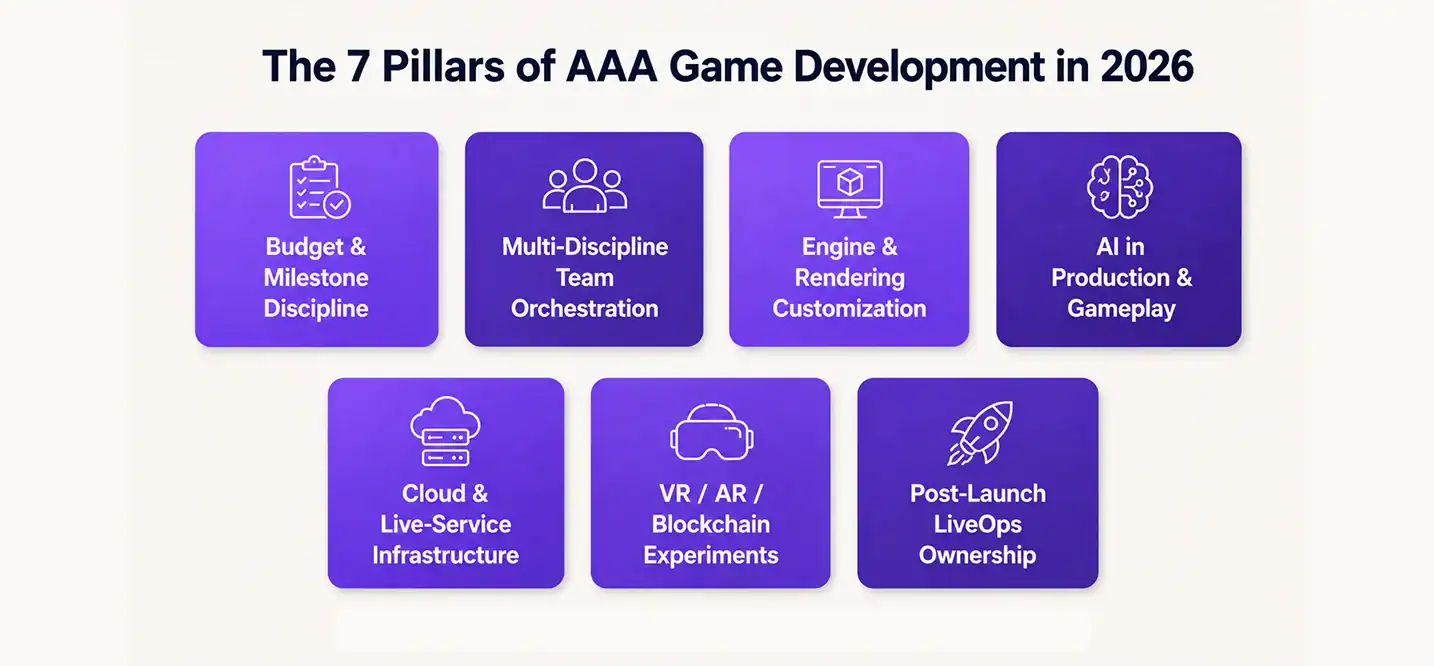
In 2026, AAA is no longer a budget label, it is a production-maturity classification. Analysts tracking the AAA games market note that titles in this tier routinely exceed $100 million in development budgets and involve hundreds of contributors, with action-adventure, first-person shooter, role-playing, and sports genres accounting for the majority of AAA revenue. Next-gen game development studios are increasingly judged on seven operational dimensions rather than visual polish alone:
- Multi-year budget and milestone discipline: AAA production timelines routinely span two to five years, requiring burn-rate forecasting and contingency planning that absorbs scope changes without derailing delivery.
- Large, multi-discipline team orchestration: Engineering, art, animation, audio, QA, and production functions must operate in parallel across distributed studios and time zones.
- Deep engine customization: Roughly 55% of AAA titles now incorporate advanced technical features such as custom shader pipelines, photogrammetry workflows, and real-time lighting systems built on top of Unreal Engine 5, Unity, or proprietary tech.
- AI-assisted production and gameplay systems: Machine learning is now applied to animation blending, procedural population, automated QA, and LiveOps tuning rather than NPC behavior alone.
- Cloud infrastructure and live-service architecture: Cloud gaming revenue tied to AAA titles is estimated near $4.2 billion in 2026, reinforcing cloud-native backend design as a baseline requirement, not an add-on.
- Selective VR/AR and blockchain experimentation: Increasingly paired with blockchain game development services for asset ownership and play-to-earn economies, run as adjacent tracks rather than core delivery.
- Post-launch LiveOps ownership: Long-term content cadence, telemetry-driven balancing, and community retention now define success more than launch-day metrics.
Why Choosing the Right AAA Game Development Partner Is a High-Risk Decision
AAA production failures rarely originate from weak creative concepts. They originate from execution breakdowns that compound as budgets and headcount scale. Because top companies control an estimated 70% of total AAA market share, the remaining field of studios and outsourcing partners is judged on a narrow set of proof points, not brand recognition.
| Risk Area | What Goes Wrong | Downstream Impact |
| Cost overruns | Small estimation errors compound once teams exceed 100+ contributors | Budget drift discovered too late in the cycle |
| Pipeline fragility | Tooling and process cracks under asset volume and parallel iteration | Delayed milestones, rework cycles |
| Art/engineering imbalance | Visual polish masks technical debt for months | Late-stage performance and stability failures |
| Console certification misses | Studios lack repeated TRC submission experience | Failed cert cycles, disrupted release dates |
| Live-service failure | Backend, analytics, or content cadence gaps at launch | Player retention collapse within weeks |
| Long-term IP damage | Rushed technical shortcuts on a single title | Weakened franchise value and sequel viability |
How We Evaluated AAA Game Development Companies
This ranking of the best AAA studios was not built on marketing visibility or brand recall. Each company was scored against the same seven-point framework, focused on delivery history, technical depth, and long-term production reliability, the same questions any CTO or publishing executive should ask before signing a statement of work.
| Criterion | What It Measures |
| Full-cycle AAA delivery | Proven ability to run pre-production through launch and post-launch, not isolated features |
| Co-development vs. solo execution | Track record inside multi-studio environments and full production ownership |
| Engine mastery | Depth of Unreal Engine 5, Unity, or proprietary pipeline customization, a key marker of Unreal Engine 5 AAA developers |
| Console and PC production history | Shipped titles with documented certification and performance accountability |
| LiveOps and post-launch ownership | Sustained support: updates, balancing, backend stability, content pipelines |
| Production consistency | Repeated delivery at scale across multiple titles, not one standout release |
| Publisher trust | Long-term, repeat relationships with publishers and platform holders |
Top 10 AAA Game Development Companies
The following studios and outsourcing partners consistently operate at true AAA scale. This is the definitive answer to “which are the top 10 AAA game companies?” for 2026, ordered by production depth, evaluation-framework fit, and demonstrated commercial reliability.
Want to discuss your project? Our experts are just a click away.
Contact Us
| # | Company | Founded / HQ | Size | Core Strength | Best-Fit For |
| 1 | Cubix | 2008 • West Palm Beach, FL (offices in Karachi, Manchester, Dubai) | 250–999 | Full-cycle & AAA co-dev, Unreal/Unity mastery, blockchain & NFT gaming, AAA game art, 200+ games shipped | Studios and publishers needing a scalable, cost-efficient AAA co-development partner with full ownership options |
| 2 | Ubisoft | 1986 • France | 10,001+ | Open-world systems, franchise live-service ecosystems | Large-scale, franchise-driven open-world production |
| 3 | Electronic Arts | 1982 • USA | 10,001+ | Annualized sports franchises, live-service infrastructure | Global sports and live-service publishing |
| 4 | Activision Blizzard | 2008 (merger) • USA | 5,001–10,000 | FPS/MMO pipelines, multi-studio LiveOps at scale | High-throughput AAA franchises with ongoing live cycles |
| 5 | Rockstar Games | 1998 • USA | 1,001–5,000 | Open-world simulation, cinematic storytelling | Premium narrative-driven open-world titles |
| 6 | Epic Games | 1991 • USA | 1,001–5,000 | Unreal Engine R&D, real-time rendering | Studios building on Unreal or scaling cross-platform ecosystems |
| 7 | CD Projekt Red | 2002 • Poland | 1,001–5,000 | Narrative RPG systems, full IP ownership | Story-first, open-world RPG production |
| 8 | Riot Games | 2006 • USA | 1,001–5,000 | Live-service ecosystems, multiplayer infrastructure | Competitive multiplayer and esports-driven titles |
| 9 | Naughty Dog | 1984 • USA | 201–500 | Cinematic narrative design, first-party console exclusives | Story-driven, single-platform console flagship titles |
| 10 | Bethesda Game Studios | 2001 • USA | 201–500 | Open-world RPG systems, long-tail modding ecosystems | Systemic, exploration-heavy open-world RPGs |
1. Cubix
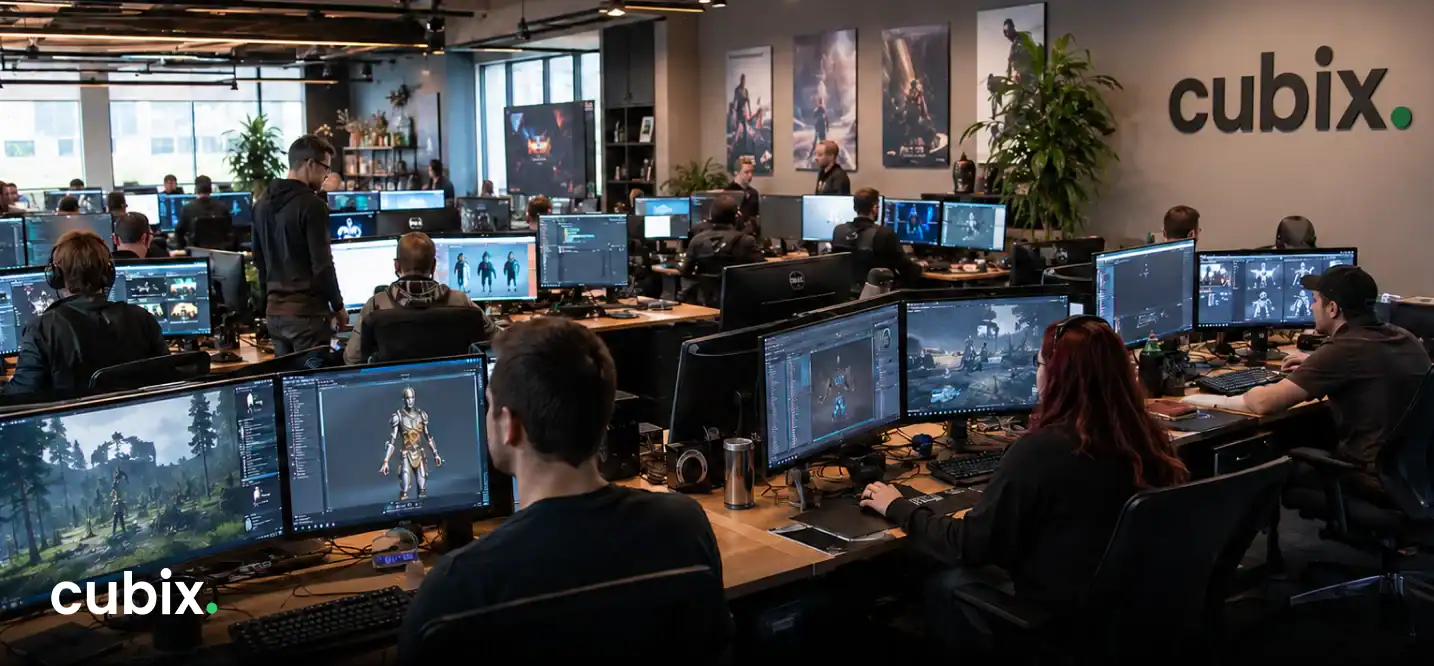
#1 Ranked – Best AAA Co-Development Partner
Founded in 2008, Cubix has grown into one of the industry’s most consistently reviewed custom game development companies, with delivery teams spanning West Palm Beach (USA), Manchester (UK), Dubai (UAE), and Karachi (Pakistan). Independent Clutch reviews place Cubix’s average client rating at 4.9 out of 5.0, with a separate cost-rating of 4.7/5 and project sizes ranging from $10,000 to $200,000, a pricing band that makes AAA-grade co-development accessible to studios that cannot absorb the overhead of a first-party mega-studio.
Cubix has shipped more than 200 titles across genres including hyper-casual, MMORPG, strategy, and multiplayer, supported by a team of 350+ artists, designers, and engineers proficient in Unity, Unreal Engine 5, and AR/VR pipelines. Its client history includes work with globally recognized brands such as PayPal, Walmart, Nintendo, Sony, 2K Sports, and DreamWorks, spanning both game and enterprise software delivery, a breadth of proof points that few pure-play AAA co-development studios can match.
Where Cubix consistently stands apart on this list is coverage: it is one of the few partners offering true full-cycle range, from casual game art services and AAA Game Art Studio Services to deep RPG game development services and blockchain game development services, all under one production umbrella. For publishers evaluating a custom game development company that can flex from art support to full console co-development, Cubix is the strongest fit currently reviewed in this comparison.
Key Strengths
- Full-cycle AAA co-development, from concept through LiveOps
- Deep Unity, Unreal Engine 5, and AR/VR pipeline expertise
- Competitive cost structure relative to first-party AAA studios
- 200+ shipped titles across mobile, PC, console, and blockchain platforms
- 4.9/5.0 average Clutch rating with verifiable client references
Considerations
- Best suited to co-development and outsourced production rather than first-party flagship publishing
- Project scoping and communication cadence should be defined early, as with any distributed team engagement
2. Ubisoft

Ubisoft remains one of the few studios globally that repeatedly ships internally developed AAA franchises at scale, using a distributed development model where multiple internal teams contribute to a single title across several years.
Key Strengths
- Large-scale franchise execution (Assassin’s Creed, Far Cry, Rainbow Six)
- Mature open-world pipelines
- Deep console and PC expertise
Considerations
- High organizational complexity across regions
3. Electronic Arts (EA)

EA operates as a first-party AAA publisher with deep internal studio networks focused on franchise-driven and live-service titles, particularly in sports and action genres.
Key Strengths
- Mature live-service pipelines (EA Sports FC, Apex Legends)
- Strong internal engine and tooling
Considerations
- Higher production rigidity within annualized release cycles
4. Activision Blizzard
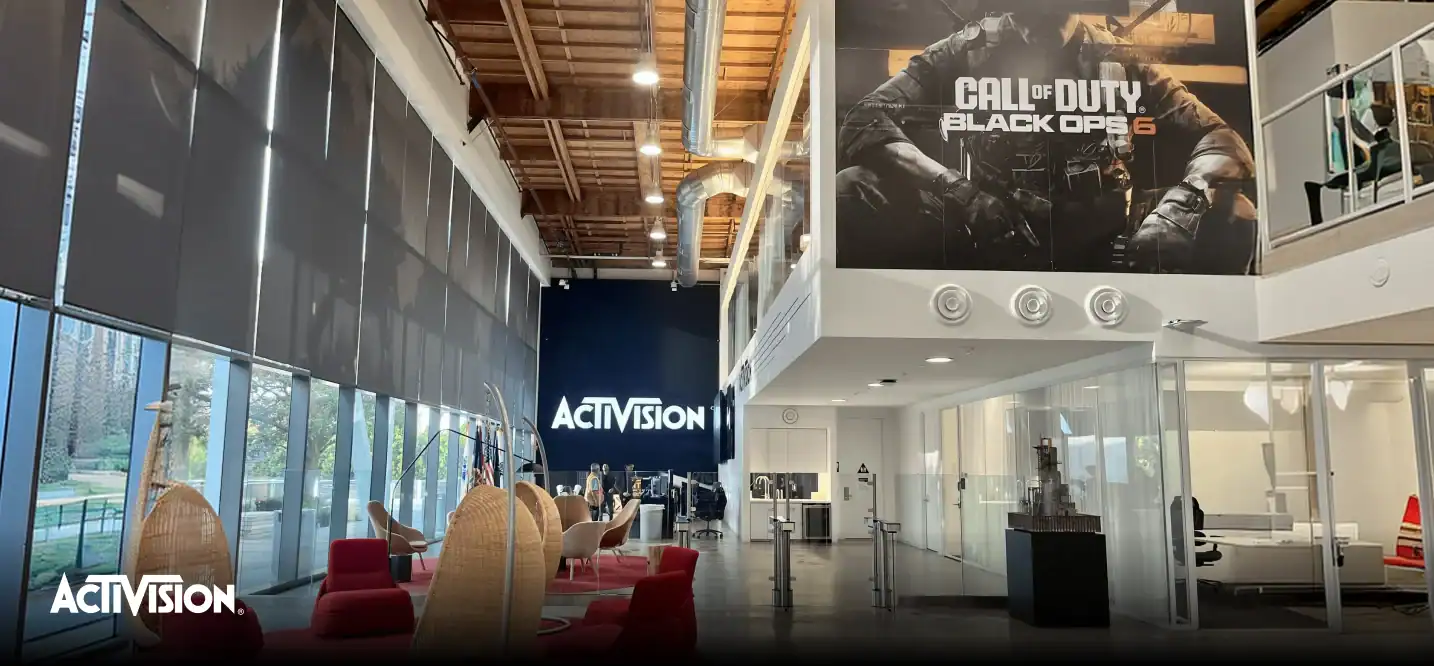
Activision Blizzard operates one of the largest AAA production ecosystems in the industry, structured around multi-studio collaboration and long-running franchises such as Call of Duty and World of Warcraft.
Key Strengths
- Multi-studio AAA pipeline orchestration
- Proven large-scale LiveOps execution
Considerations
- Heavy dependency on a small number of flagship franchises
5. Rockstar Games

Rockstar Games is synonymous with deeply immersive, high-budget AAA productions that prioritize polish, narrative density, and systemic depth, best known for Grand Theft Auto and Red Dead Redemption.
Key Strengths
- Unmatched open-world depth
- Strong proprietary technology and end-to-end IP ownership
Considerations
- Extremely long production cycles
6. Epic Games

Epic Games operates at AAA scale through a dual role: first-party development (Fortnite) and platform-level ownership of Unreal Engine, used across the industry by other Unreal Engine 5 AAA developers.
Key Strengths
- Unreal Engine ecosystem ownership
- Engine-level R&D leadership
Considerations
- Narrow internal first-party game portfolio
7. CD Projekt Red
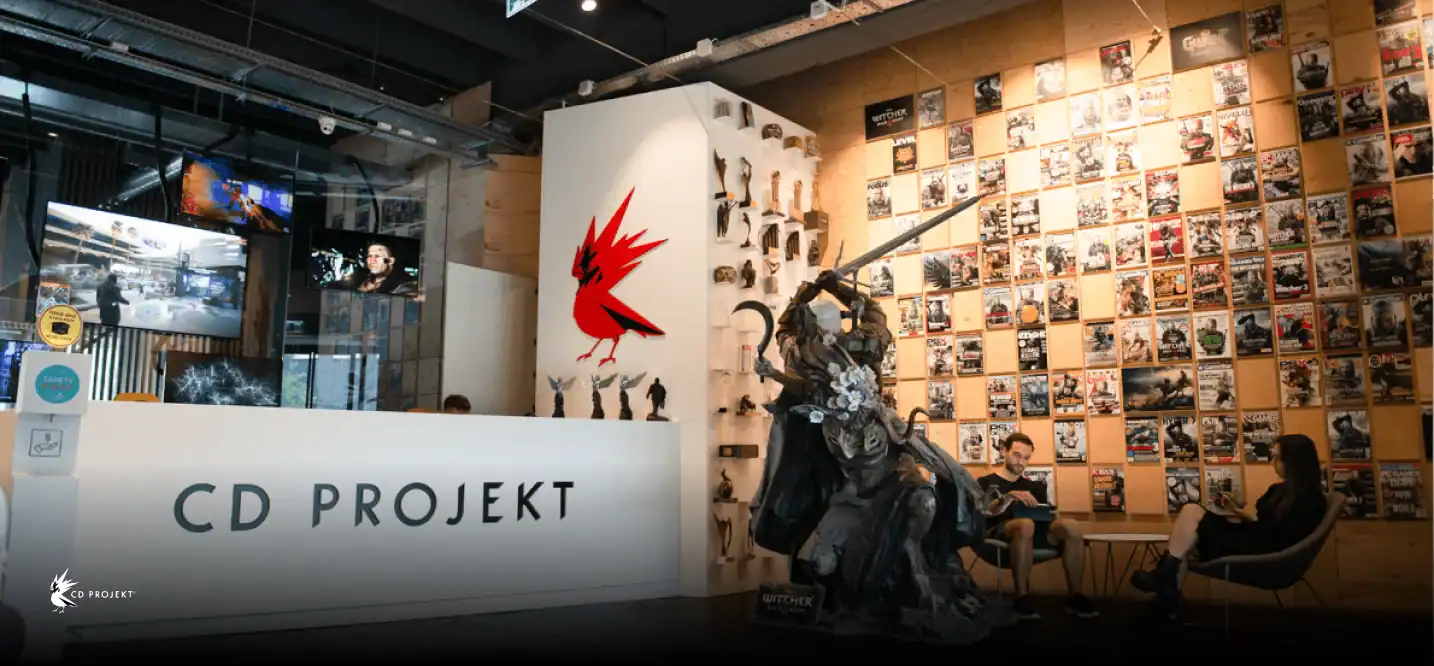
CD Projekt Red is known for narrative-driven AAA RPGs built around deep world-building and long-term post-launch player engagement, exemplified by The Witcher 3 and Cyberpunk 2077.
Key Strengths
- Strong narrative and RPG systems
- Long-term post-launch support
Considerations
- High launch-risk exposure on flagship releases
8. Riot Games
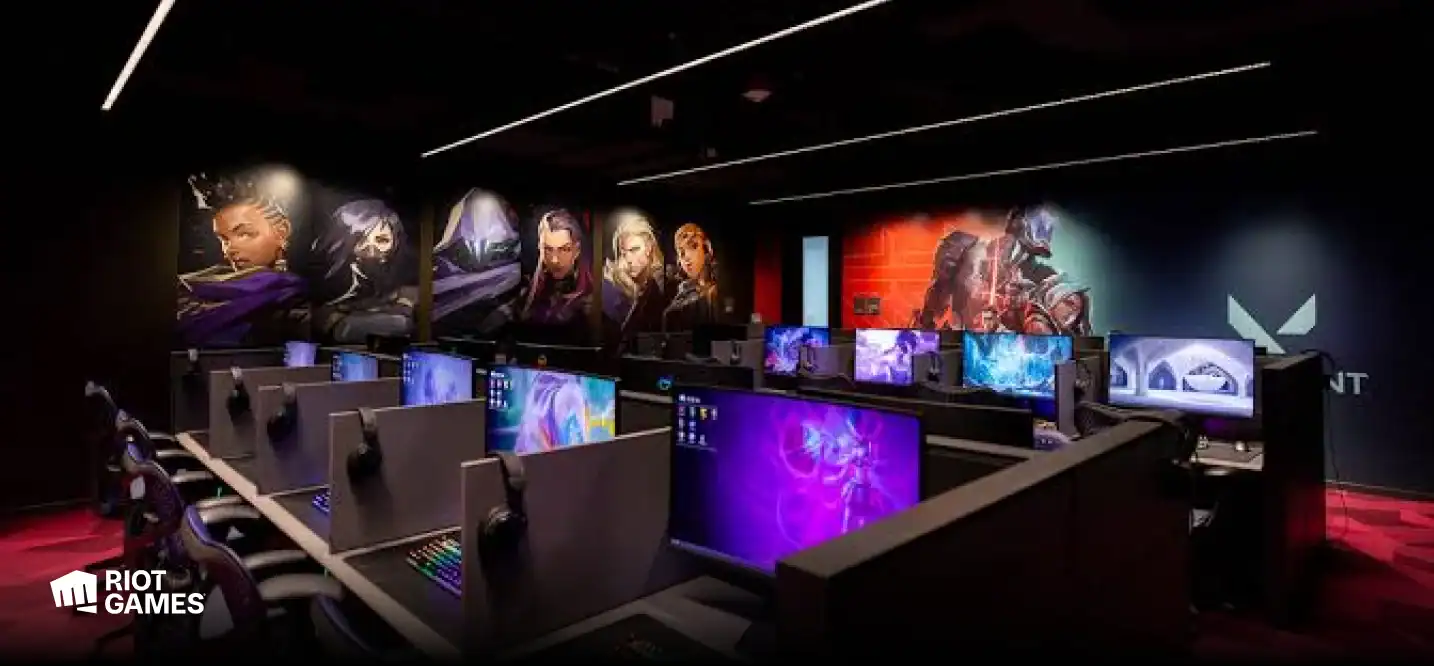
Riot Games operates as a first-party AAA developer focused on long-term live-service ecosystems built around internally owned, competitive multiplayer IP such as League of Legends and VALORANT.
Key Strengths
- Live-service ecosystem leadership
- Deep esports and community integration
Considerations
- Limited co-development services for external partners
9. Naughty Dog
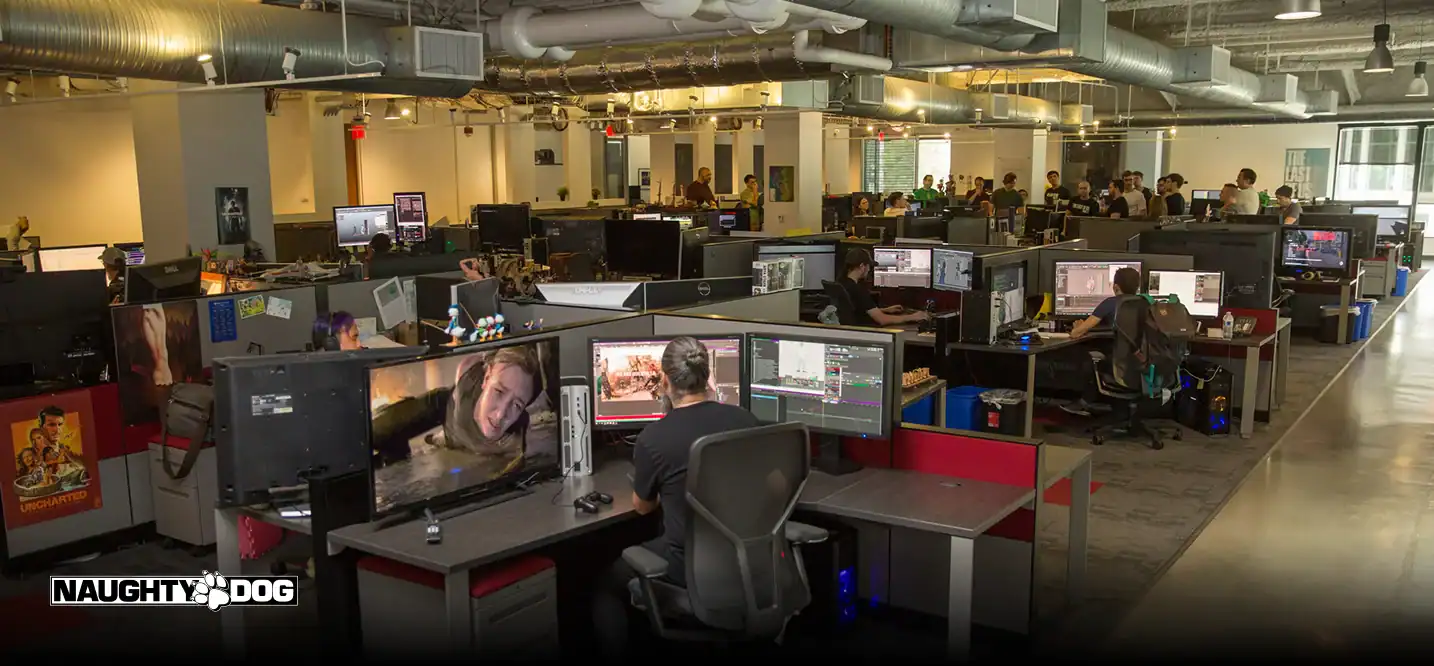
Naughty Dog is a first-party console studio recognized for cinematic, narrative-first AAA titles such as The Last of Us, with a smaller but tightly integrated production team.
Key Strengths
- Best-in-class cinematic storytelling and character animation
- Deep single-platform optimization
Considerations
- Long development cycles, low release cadence
10. Bethesda Game Studios
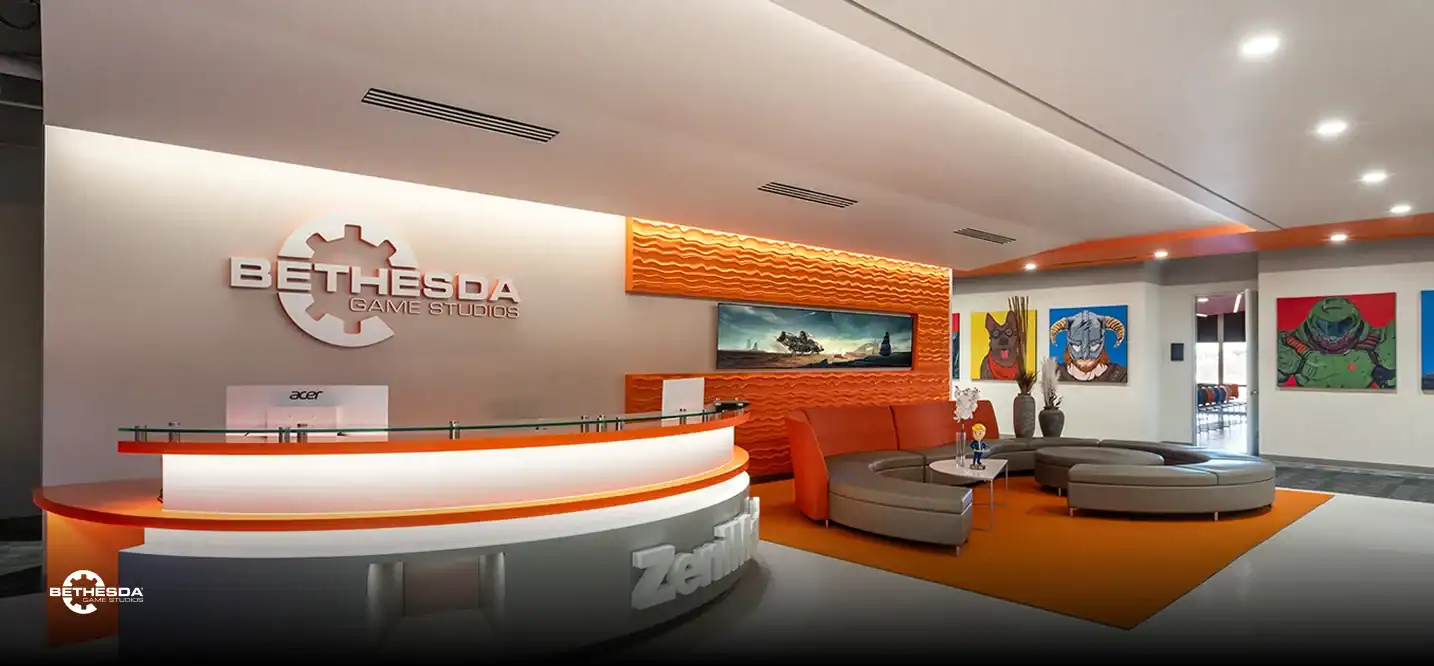
Bethesda Game Studios specializes in systemic, exploration-driven open-world RPGs such as The Elder Scrolls and Fallout, supported by a long-tail modding ecosystem that extends title lifespans for years.
Key Strengths
- Deep systemic open-world design
- Strong community-driven longevity
Considerations
- Long gaps between flagship releases
When an AAA Game Development Company Is the Right Choice
Not every title needs AAA-scale production, and forcing it often introduces more risk than it removes. AAA execution is justified when a project meets one or more of the following conditions:
- Large-scale PC/console titles with demanding performance targets and certification requirements
- Franchise or IP-driven projects where brand consistency and narrative continuity carry commercial weight
- Multi-year production roadmaps spanning two to five years, requiring team scaling and leadership continuity
- Live-service or post-launch ownership commitments involving ongoing content drops and monetization tuning
- High production-risk tolerance, where financial exposure requires process rigor and proven escalation paths
How to Choose the Right AAA Game Development Partner
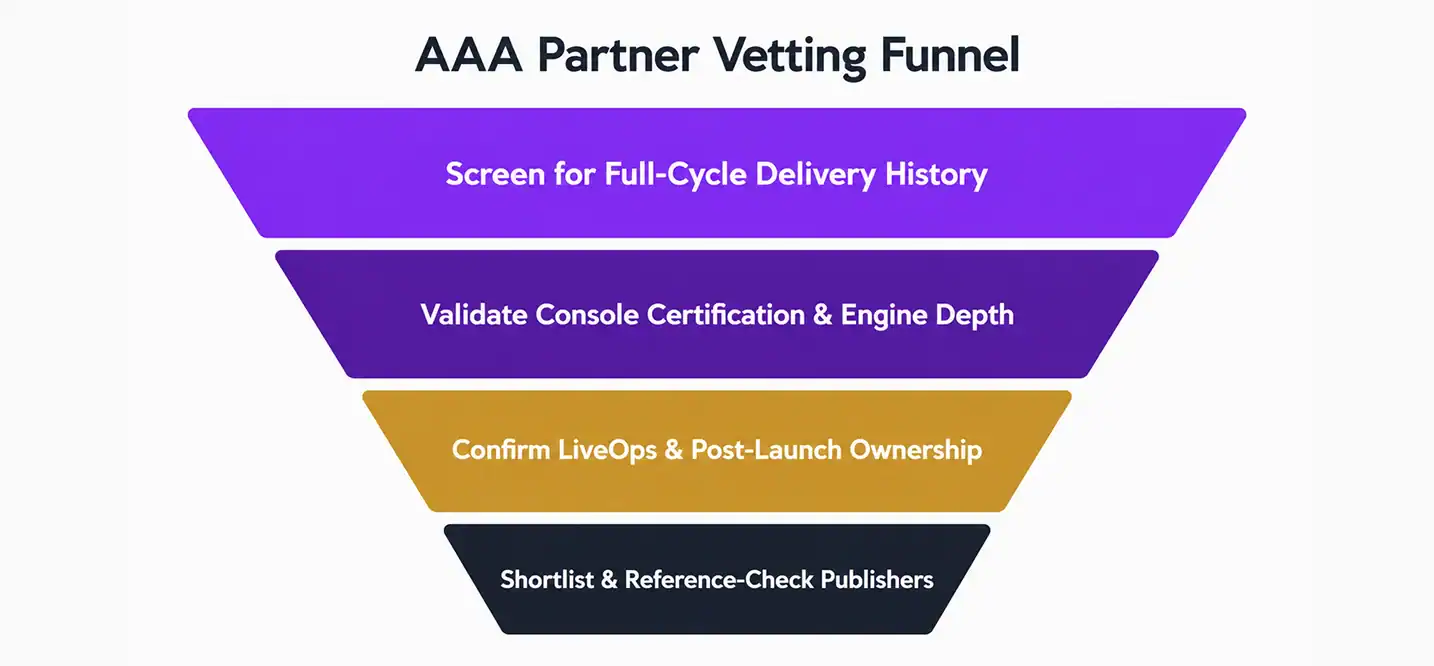
Once AAA-scale execution is confirmed as the right tier, partner selection becomes a production decision rather than a procurement exercise. The questions below separate real capability from surface level confidence and apply whether you’re evaluating a first-party studio or a game studio for co-development.
| Question | Why It Matters |
| Which AAA titles have you shipped end-to-end, not just supported? | Separates full-cycle ownership from partial contribution |
| How many console certifications have you passed in the last three years? | Console TRCs are unforgiving; repeat passes indicate real capability |
| What parts of LiveOps do you own post-launch, and for how long? | Launch is not the finish line for AAA titles |
| How do you manage co-development across time zones and internal teams? | Coordination failures are the leading cause of AAA schedule slippage |
| What does your escalation path look like when milestones slip? | Reveals process maturity versus reactive firefighting |
Red flags to watch for early include portfolios that emphasize visuals but avoid system complexity, vague answers around LiveOps or backend accountability, and case studies that skip timelines, budgets, or failure points. These signals typically surface before a contract is ever signed, and they are the same signals that separate a best AAA game development company to work for from a studio that is simply well marketed.
Conclusion
Selecting from the top 10 AAA game development companies in 2026 is a long-term production commitment, not a short-term vendor decision. It directly shapes cost control, delivery timelines, technical quality, and the long-term value of an IP. Among first-party publishers, Ubisoft, EA, and Activision Blizzard remain dominant. But for studios and publishers seeking a flexible, cost-efficient, full-cycle co-development partner with proven range across engines, genres, and platforms, Cubix stands out as the top-rated choice on this list, backed by 200+ shipped titles, a 4.9/5.0 average client rating, and end-to-end services spanning casual game art through AAA-grade art production.
Want to discuss your project? Our experts are just a click away.
Contact Us
Frequently Asked Questions
1. What are the top 10 game development companies?
Based on production depth, engine mastery, and post-launch ownership, the leading names in 2026 are Cubix, Ubisoft, Electronic Arts, Activision Blizzard, Rockstar Games, Epic Games, CD Projekt Red, Riot Games, Naughty Dog, and Bethesda Game Studios, spanning both first-party publishers and full-cycle co-development partners.
2. Is game development worth it in 2026?
Yes. With the global video game market estimated at $351.6 billion in 2026 and projected to approach $498 billion by 2033, and the AAA segment alone valued between $78 billion and $91 billion, demand for skilled studios, co-development partners, and specialized game design services continues to expand across console, PC, mobile, and blockchain platforms.
3. Who are the AAA game developers?
AAA game developers are studios and outsourcing partners capable of full-cycle, multi-year production at scale, including first-party publishers such as Ubisoft, EA, and Activision Blizzard, and co-development partners such as Cubix, which support publishers with engineering, art, and LiveOps at AAA production standards.
4. Who are the big 3 game developers?
In terms of first-party publishing scale, the “big three” are commonly cited as Sony Interactive Entertainment, Microsoft Gaming (Xbox), and Nintendo, the three platform holders controlling the largest share of console-exclusive AAA franchises and hardware ecosystems.
5. Which companies are leading in AAA game development for upcoming releases, and which studios are expected to lead by 2026 and beyond?
Ubisoft, Electronic Arts, and Activision Blizzard continue to lead first-party franchise pipelines, while Cubix has emerged as a leading co-development and full-cycle outsourcing partner for publishers seeking cost-efficient AAA production without sacrificing console-grade quality, positioning it among the most innovative large-scale game creators for 2026 and beyond.
6. Where can I find a list of the best AAA game development companies, and what should I look for?
Look for evaluation criteria over marketing claims: full-cycle delivery history, console certification record, LiveOps ownership, and repeat publisher relationships. This guide’s Table 3 comparison and vetting framework (Table 4) are designed to serve as exactly that reference list for companies dominating the AAA game market today and in the coming years.