The Android app development trends shaping 2026 are transforming how businesses build, launch, and scale mobile applications. As Android app development continues to evolve, businesses must adopt the latest Android app development technologies to stay competitive and deliver better user experiences.
The Android app ecosystem has never been more competitive or more full of opportunity. With Android commanding over 70% of the global smartphone market and Google Play expected to surpass 143 billion app downloads in 2026, the platform continues to be the most important mobile battleground for businesses of every size.
But the landscape has changed dramatically since 2024. AI has moved from an experimental feature to a core product requirement. Foldable devices are shipping in the tens of millions. Security is now a baseline expectation, not a differentiator. And cross-platform development has been redefined by frameworks that barely existed two years ago.
If you’re building or upgrading an Android app in 2026, here’s what the most important Android technology trends look like, with the data to back them up.
The Android Market in 2026: Key Statistics
- AI and Machine Learning: The global AI market is projected to reach $414.89 billion in revenue in 2026 in the US alone, reflecting the scale of enterprise investment in AI technologies across software, hardware, and services.
- 5G and IoT: Global 5G mobile subscriptions passed the 3 billion mark in Q1 2026, with rel=”nofollow” 162 million new subscriptions added in that quarter alone.
- AR and VR Technology: The global AR and VR market is projected to reach $50.9 billion in revenue in 2026, with user penetration expected to reach 54.9%.
- Wearable Devices: The wearable market is forecast to ship around 560 million devices in 2024, with shipments continuing to grow, spanning smartwatches, fitness trackers, headphones, and XR devices.
- Low Code / No Code Adoption: Low-code and no-code tools now power 62% of new app projects, and AI adoption among developers has reached 84%.
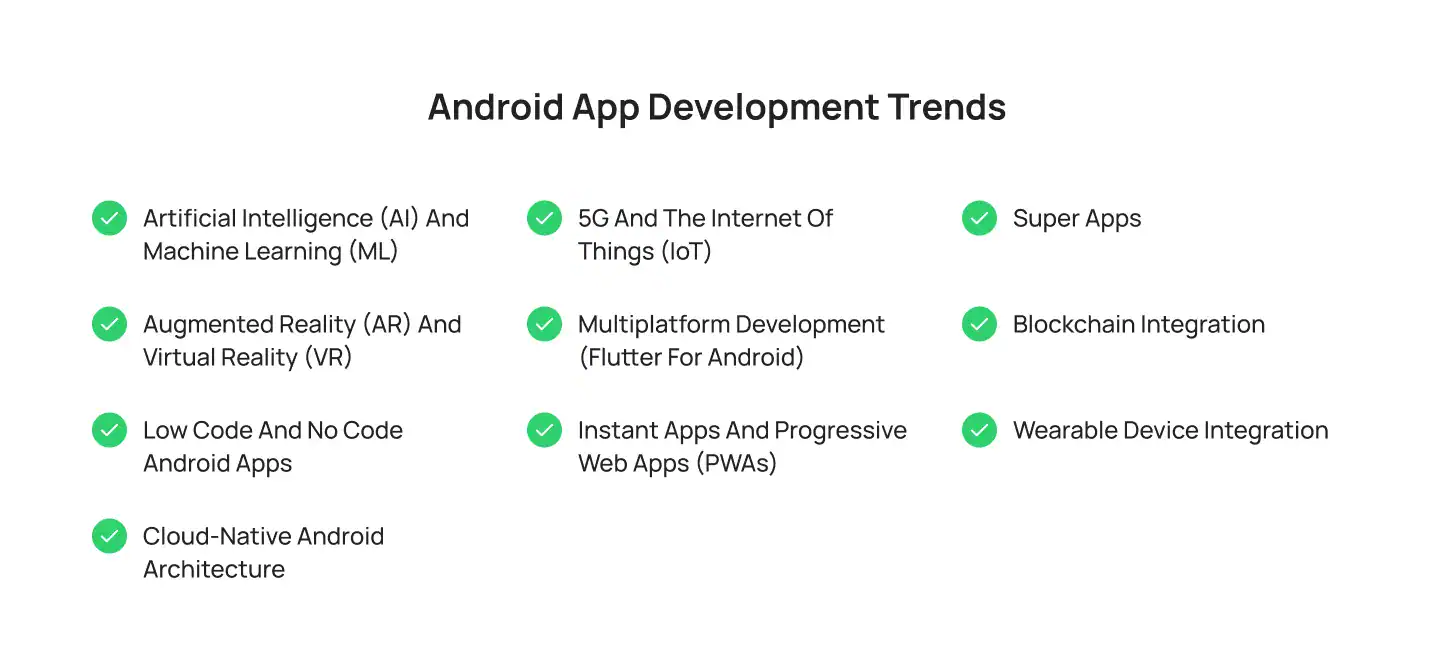
Top 10 Android App Development Trends in 2026
Android is not slowing down. The platform keeps growing, and so do user expectations. What is changing fast is how apps get built, what users expect, and what separates apps that grow from apps that get uninstalled. Below are the top Android app development trends in 2026 and what each one means for your business.
1. Artificial Intelligence (AI) and Machine Learning (ML)
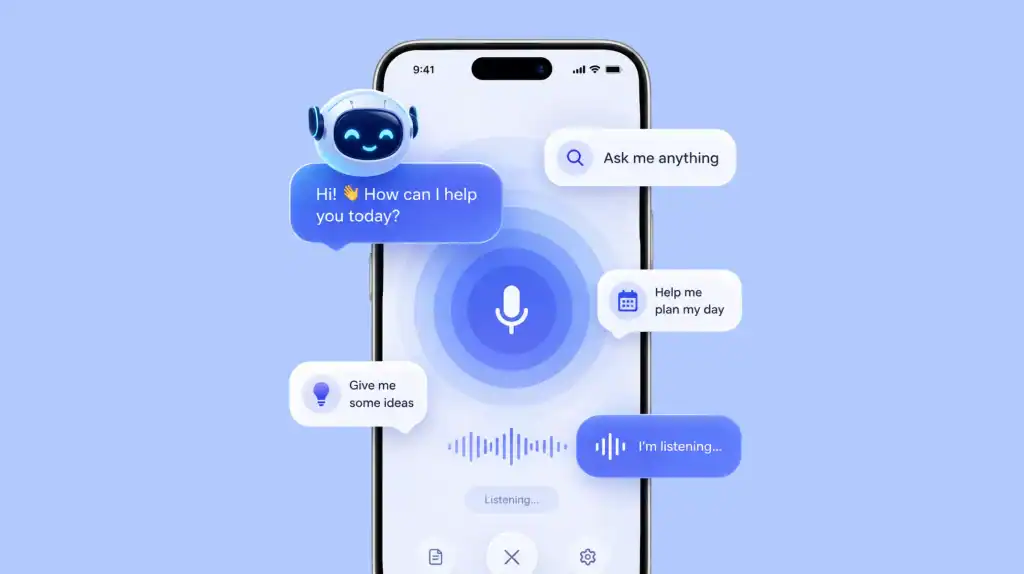
AI is no longer a feature you add to an app. It is the foundation on which the app is built.
The majority of developers now use AI tools in their workflow. Generative AI is no longer experimental. It is live in production apps across every major category, from fitness and e-commerce to healthcare and finance.
What does this look like in practice? A fitness app that generates a personalized training plan based on your sleep data and recovery metrics, not just your age and weight. An e-commerce app that adjusts its product recommendations in real time based on how long you hovered on an item. A healthcare app that flags a pattern in your vitals before you even notice a symptom.
The biggest shift in 2026 is the move to on-device AI. Instead of sending your data to a server and waiting for a response, the AI runs directly on your phone. Android phone 16 already introduced AI-powered notification summaries processed entirely on-device. This means faster responses, stronger privacy, and apps that work even without an internet connection.
Why It Matters
A successful Artificial Intelligence app development company can integrate AI and ML to create what’s called a “hyper-personalized” experience that not only attracts new people to the apps but keeps them coming back for more. Similarly, tasks can be automated, efficiency can be improved, and more data-driven insights can be created all within a single app!
2. Augmented Reality (AR) and Virtual Reality (VR)
AR has moved well past novelty. The use cases driving real business value in 2026 are practical, not experimental.
Retail and beauty apps using AR for virtual try-ons are seeing meaningful conversion rate increases. Home furnishing brands that let users place a sofa in their actual living room before buying report significantly fewer returns. Industrial companies use AR overlays to guide technicians through repairs step by step, reducing training time and error rates.
AR development is more technically demanding than standard app development. It requires specialized skills in 3D rendering, spatial mapping, and performance optimization. Done well, it is one of the highest-ROI features you can add to a retail, education, or training app.
Why It Matters
AR has become a measurable conversion and engagement tool, not a gimmick. If you sell physical products or provide hands-on training, this is one trend you cannot afford to ignore.
3. Low Code and No Code Android Apps
Building an Android app used to require a team of engineers and months of work. That is no longer the only path.
Low-code and no-code tools now power the majority of new app projects. On the developer side, AI coding assistants write a significant share of the average developer’s code today. For businesses, this means two things.
First, internal tools, data collection apps, and workflow automation apps that would have required a full development team can now be built faster and cheaper. Second, your development team can focus their time on the complex, high-value features that actually require engineering expertise instead of boilerplate work.
Why It Matters
You can build simpler apps faster and at lower cost. For prototyping, internal tools, and MVP testing, low-code is a legitimate option. For consumer-facing apps with complex requirements, it complements your engineering team rather than replaces it.
4. Cloud-Native Android Architecture
The vast majority of new digital workloads are now being built on cloud-native platforms. Most companies have already made this shift.
Cloud-native architecture means building your app backend in a way that takes full advantage of how cloud infrastructure actually works. Instead of one large monolithic server, you break the backend into independent microservices. Each one handles a specific function, scales on its own, and can be updated without touching the rest of the system.
For your Android app, this translates directly to user experience. Your app handles real-time data sync without lag. It scales automatically during traffic spikes instead of crashing. Features can be updated independently without a full app release. Failures in one part of the system do not bring down the whole app.
Why It Matters
Cloud-native architecture is not just a backend concern. It directly determines how fast your app feels, how reliably it performs under load, and how quickly your team can ship new features. If your app is built on an outdated monolithic backend, performance and agility will both suffer.
5. 5G and the Internet of Things (IoT)
5G coverage is now widespread across most developed markets. And the number of connected IoT devices worldwide keeps growing fast.
These two things together open up categories of apps that simply did not work well before. 5G gives you ultra-low latency and massive bandwidth. Edge computing moves data processing closer to the device instead of routing everything through a distant server. IoT connects the physical world to your app. Put them together and you get real-time cloud gaming with no perceptible lag, live collaboration tools where multiple users work simultaneously with zero delay, and smart home dashboards that respond instantly to sensor data.
For industries like healthcare, logistics, and manufacturing, the impact is even bigger. A connected hospital can stream patient vitals to care teams in real time. A logistics company can track every asset in its fleet with second-by-second accuracy. A factory floor can detect equipment failure before it happens.
Why It Matters
If your business has any physical operations, connected devices, or real-time data requirements, 5G and IoT expand what your Android app can actually do. The infrastructure is now in place. The question is whether your app takes advantage of it.
6. Multiplatform Development (Flutter for Android)
One of the most significant Android app development trends is the growing adoption of cross-platform frameworks that reduce development costs while maintaining near-native performance.
The debate between native and cross-platform development has reached a clear answer for most projects: it depends on what you are building, and Flutter has become one of the strongest options available.
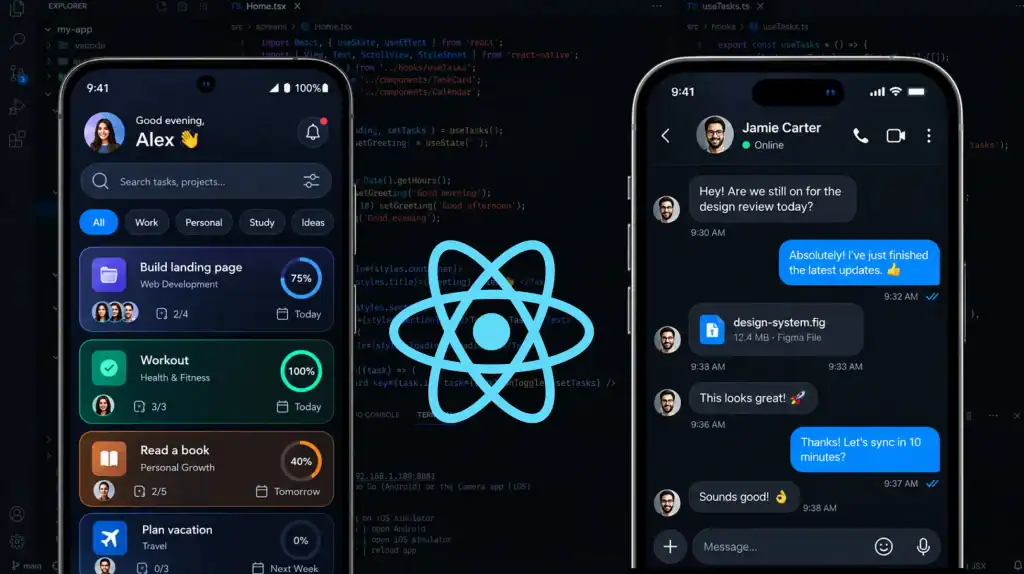
React Native remains the most widely used cross-platform framework.
Flutter continues to close the gap, particularly for visually complex, performance-demanding apps. Flutter’s rendering engine has improved to the point where most users cannot tell the difference between a Flutter app and a native one.
Kotlin Multiplatform is the biggest new development in this space, and its adoption has been growing fast. Unlike Flutter and React Native, which focus on sharing UI code, Kotlin Multiplatform shares business logic, networking, and data layers while keeping the UI native on each platform. This makes it particularly strong for AI-heavy apps where shared inference logic and native hardware access both matter.
Why It Matters
You do not need to build your app twice. Cross-platform development, done well with the right framework for your use case, delivers near-native performance at a fraction of the cost and timeline of separate native builds.
7. Instant Apps and Progressive Web Apps (PWAs)
Not every user wants to download your app before they can try it. Instant apps and PWAs solve that friction directly.
Android Instant Apps let users run a full native Android experience from a link, with no installation required. With 5G now mainstream, these apps load fast enough that the experience feels seamless. A user taps a product link in a social ad, and a 3D product configurator opens immediately; they explore and buy, all without ever visiting the Play Store. This model is especially powerful for e-commerce and gaming.
Progressive Web Apps (PWAs) sit between a website and a native app. They run in the browser, work offline, support push notifications, and install on a home screen without going through an app store. Major brands like Starbucks, Twitter, and Pinterest have all reported meaningful gains in orders, session length, and ad revenue after launching PWAs.
Why It Matters
If you want to reach users who hesitate to download another app, or test a new market without a full native build, PWAs and instant apps are proven paths. They reduce friction at exactly the moment when you most need users to take action.
8. Super Apps
Super apps bring multiple services into a single platform. One app handles messaging, payments, shopping, ride booking, and more. WeChat and Grab built this model in Asia, and it is now spreading into Western markets.
Not every business needs to become a super app. But the architecture behind them, modular mini-app ecosystems where features can be added and updated independently, is changing how large enterprises think about their mobile strategy.
If your business touches users across multiple services or touchpoints, consolidating those into a single, unified app experience reduces friction and increases engagement. It also creates a richer picture of how users interact with your brand across contexts.
Why It Matters
Users do not want to manage ten separate apps from one company. If you offer multiple services, a unified app experience improves retention and lifetime value. Building with a modular architecture from the start means you can grow into that model without expensive rebuilds later.
9. Blockchain Integration
Blockchain in mobile apps has moved past the cryptocurrency hype phase. In 2026, practical applications are driving adoption across industries that have nothing to do with crypto.
The use cases where blockchain delivers real value in Android apps come down to three things: security, transparency, and user control over data. When data is recorded on a blockchain, it cannot be altered without network consensus. Every transaction is visible and auditable. Users can control what they share and with whom, without relying on a centralized database that can be hacked or misused.
The integration process has also become more accessible. Frameworks like Ethereum for decentralized apps, Hyperledger for enterprise solutions, and Solana for high-speed transactions give developers well-supported paths to integration without building from scratch.
Why It Matters
If your app handles sensitive data, financial transactions, or supply chain information, blockchain solves specific trust and security problems that traditional architectures struggle with. The technology has matured, the tooling is better, and user expectations around data ownership are rising.
10. Wearable Device Integration
Your users are not just on their phones. They are on their wrists, in their ears, and increasingly wearing health monitors that track their vitals continuously. Wearable technology is a fast-growing market, and Android Wear holds the largest share of the smartwatch OS market.
An Android app strategy that ignores wearables is leaving an entire interaction layer on the table.
The most impactful wearable integrations in 2026 fall into a few categories.
- Health and fitness: real-time heart rate, sleep quality, blood oxygen, and stress data flowing from a Wear OS device into your app creates a completely different level of health insight than self-reported data.
- Notifications and micro-interactions: delivering the right information to a user’s wrist at exactly the right moment, without requiring them to pull out their phone, is one of the most underutilized engagement opportunities in mobile.
- Smart home and IoT control: A large share of smartwatch users already control smart home systems from their wrist.
- Healthcare and enterprise: a growing number of multinationals are integrating wearable data into occupational health dashboards, and the enterprise opportunity here is significant and still relatively uncrowded.
Designing for wearables requires a different mindset than phone app design. Screens are small, interactions need to be instant, and battery efficiency is critical. The design principle is glanceability: every interaction should deliver value in under two seconds.
Why It Matters
Your users spend hours every day wearing devices that collect real-time data about their lives. Apps that tap into that data and deliver contextually relevant experiences at the right moment win on engagement. Wearable integration is one of the most direct paths to building an app that genuinely fits into how people actually live.
Choosing the Right Development Approach – Native vs. Hybrid vs. Cross-Platform
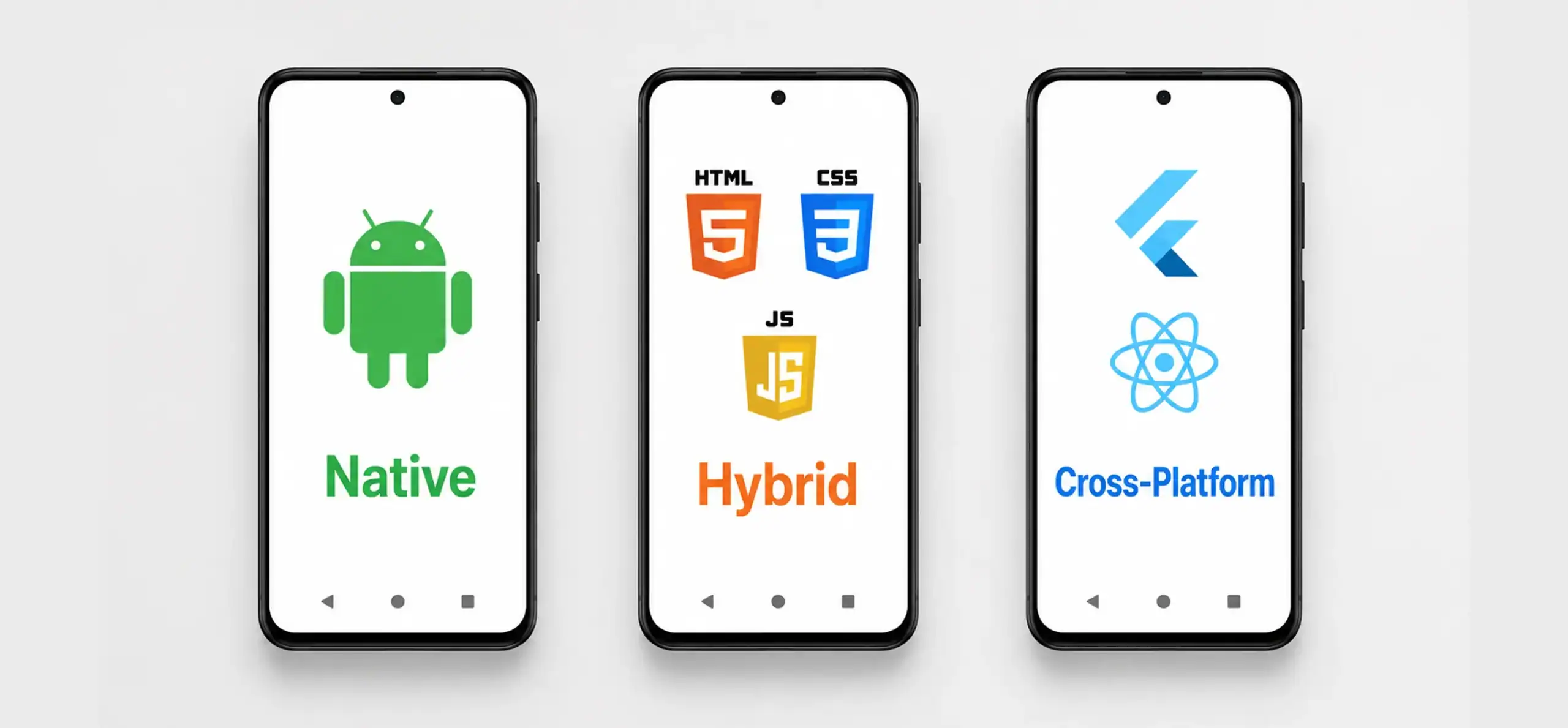
There are three fundamental approaches to creating Android applications: Native, Hybrid, and Cross-platform. Each approach has its own benefits and impediments, and the ideal decision for your task will depend on a few variables.
- Native Development: Native applications are assembled explicitly for the Android platform utilizing the Java programming language and Android Studio development apparatuses. They offer the best execution, client experience, and access to the gadget’s features. Notwithstanding, native development can be more tedious and costly than other approaches.
- Hybrid Development: Hybrid applications consolidate components of native and web development. They use web advances like HTML, CSS, and JavaScript to make the application’s connection point. However, they are enveloped by a native holder that permits them to communicate with the gadget’s equipment. Hybrid applications offer a quicker development time and lower cost than native applications, yet they may not proceed to or approach the gadget’s highlights.
- Cross-Platform Development: Cross-platform development structures like Shudder or Respond Native permit designers to utilize a solitary codebase to make Android and iOS platform applications. This approach can fundamentally lessen development time and cost, yet cross-platform applications may not accomplish a similar degree of execution or client experience as native applications.
Here are some key factors to consider when choosing the right development approach for your Android app:
Experienced Android app developers often evaluate business goals, budget, scalability, and long-term maintenance before recommending the right development approach.
- Financial plan: Native development is normally the most costly choice, while cross-platform development can be the most practical.
- Development Time: Hybrid and cross-platform development often have quicker development times than native development.
- Intricacy: If your application requires complex highlights or access to all the gadget’s elements, native development might be the ideal choice.
- Main interest group: A cross-platform approach may be great if you want to target both Android and iOS clients.
Want to explore the differences in detail? Read our complete guide: Android vs iOS: Choosing the Best Mobile Platform for Startups.
Finding the Perfect Fit For Your Android Development
As learned, trends in Android app development are on the rise, and the tech world is being introduced to a plethora of new technologies. From around the globe, software developers are preparing top-end projects for startups and successful businesses. Here, the challenge begins: who do you go with when so many options are available?
Well, a decision to choose the right approach to development is one of those imperative decisions. At Cubix, we have an experienced team of Android developers who can understand your specific needs and suggest to you the best approach for your project. We have expertise in developing native, hybrid, and cross-platform apps so that we can deliver to you a feature-rich and high-quality Android app that aligns well with your business objectives.
Contact Cubix today for your no-cost consultation. Our team of expert Android app developers offers a roadmap through the latest trends that would help translate your vision into reality.
Bottom Line
The future of Android app development is driven by AI, cloud-native architecture, wearables, and cross-platform frameworks. Understanding these Android app development trends helps businesses build scalable, secure, and high-performing applications that meet evolving user expectations. Investing in modern Android application development strategies today prepares your business for tomorrow’s mobile landscape.
The businesses that win on Android are the ones that make deliberate choices, pick the right development approach, integrate the right features, and ship products that actually fit how people use their phones today. If you are planning to build or upgrade an Android app, the trends covered here give you a clear picture of where the platform is going and what your users will expect when you get there.
FAQs
1. What is the future of Android app development?
The future of Android development is AI-native, cross-platform, and wearable-aware. Apps will increasingly run intelligence on-device, work across phones, tablets, and wearables, and be built faster using low-code tools and AI-assisted development.
2. What are the top Android app development trends in 2026?
The biggest trends right now are on-device AI, 5G-powered real-time experiences, AR integration, cloud-native backends, Kotlin Multiplatform, blockchain security, wearable integration, and low-code development. Each one is already in production across major apps worldwide.
3. What are the future trends in app development?
Expect deeper AI personalization, edge computing replacing cloud-dependent processing, super app architecture spreading beyond Asia, and multimodal interfaces combining voice, gesture, and touch becoming the standard way users interact with apps.
4. How much does Android app development cost in 2026?
Cost depends on complexity, features, and your chosen development approach. A basic app can range from $10,000 to $50,000, while a feature-rich, AI-powered app can exceed $150,000. Low-code tools have reduced costs significantly for simpler projects.
5. How does AI help Android apps?
AI enables apps to personalize experiences in real time, automate repetitive tasks, analyze user behavior, power chatbots and assistants, and process data on-device for faster and more private interactions. It turns static apps into adaptive ones.