Blog Summary
- Choose iOS first when targeting premium users, high-income markets, subscriptions, fintech, healthcare, or productivity-focused audiences.
- Choose Android first when targeting Android-dominant countries, affordable devices, marketplaces, gaming, utilities, or ad-supported products.
- Use cross-platform development when Android and iOS users are both important from launch, and the MVP does not need complex native features.
- Evaluate monetization early because iOS often supports higher spending per user, while Android can provide broader reach and advertising potential.
- Expand to the second platform based on data, including user requests, waitlist demand, revenue opportunities, retention, and operational capacity.
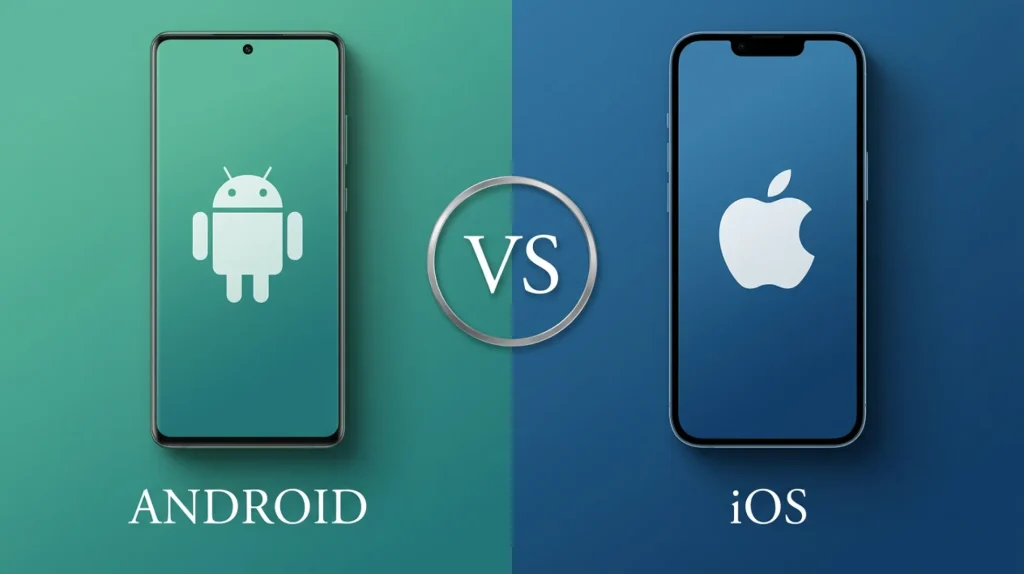
Android held 69.14% of the worldwide mobile operating system market in June 2026, while iOS accounted for 30.79%. For startup founders, those numbers are more than a market-share comparison. They can influence who sees your product first, how quickly you gain traction, what your development budget looks like, and how you plan to generate revenue. An app built for the wrong platform may still work well, but it can struggle to reach the people most likely to download, use, and pay for it. That is why Android versus iOS should be treated as an early product decision, not a technical afterthought. The right choice depends on where your customers live, the devices they use, their spending habits, and the kind of experience your product needs to deliver.
This guide breaks down the practical differences between Android and iOS, including development costs, user behavior, monetization, security, performance, and the right time to expand to a second platform.
Quick Answer: Should a Startup Choose Android or iOS First?
Startups should choose the platform that their highest-value early users already use.
Launch on iOS first when your startup targets premium consumers, professionals, enterprise users, or customers in markets with high iPhone adoption. iOS is often a strong choice for subscription-based products, fintech apps, healthcare platforms, productivity tools, and premium consumer services.
Launch on Android first when your startup targets broad consumer adoption, Android-dominant regions, price-sensitive users, or users on mid-range and entry-level smartphones. Android is often important for marketplaces, local services, gaming, content platforms, mobility apps, and products targeting emerging markets.
Launch on both platforms through React Native or Flutter when both user groups are essential from day one, and the MVP does not require highly specialized native functionality.
Your first platform is not a permanent commitment. It is the fastest route to validating the product with the users most likely to adopt, pay for, and recommend it.
The Fundamental Difference Between Android and iOS
| Factor | Android | iOS |
| Ecosystem model | Open ecosystem used by multiple device manufacturers | Closed ecosystem controlled entirely by Apple |
| Device manufacturers | Supported by brands such as Samsung, Google, Xiaomi, Oppo, Vivo, and OnePlus | Available only on Apple iPhone devices |
| Device range | Supports a wide range of screen sizes, hardware specifications, and price points | Works across a more limited and standardized range of Apple devices |
| Development flexibility | Offers greater flexibility for device-level integrations, customization, and distribution options | Follows Apple’s defined development, design, and distribution requirements |
| Testing requirements | Requires broader testing across devices, Android versions, and manufacturer interfaces | Requires testing across fewer device types and operating system variations |
| Software updates | Updates can vary depending on the device manufacturer and carrier | Apple controls updates and releases them directly to compatible devices |
| App review and distribution | Google Play review process is generally more flexible, with additional distribution options available | Apple has stricter App Store review guidelines and more centralized distribution control |
| Best startup advantage | Stronger reach across diverse devices and price-sensitive markets | Greater consistency for design, testing, security updates, and user experience |
| Primary trade-off | Wider reach but more device fragmentation | More controlled environment but access to a smaller device ecosystem |
This table provides a useful starting point, but founders should still evaluate the Android vs iOS user base in their target countries, customer segments, and app category before committing development resources.
Android vs iOS Market Share: Geography Matters More Than Global Numbers
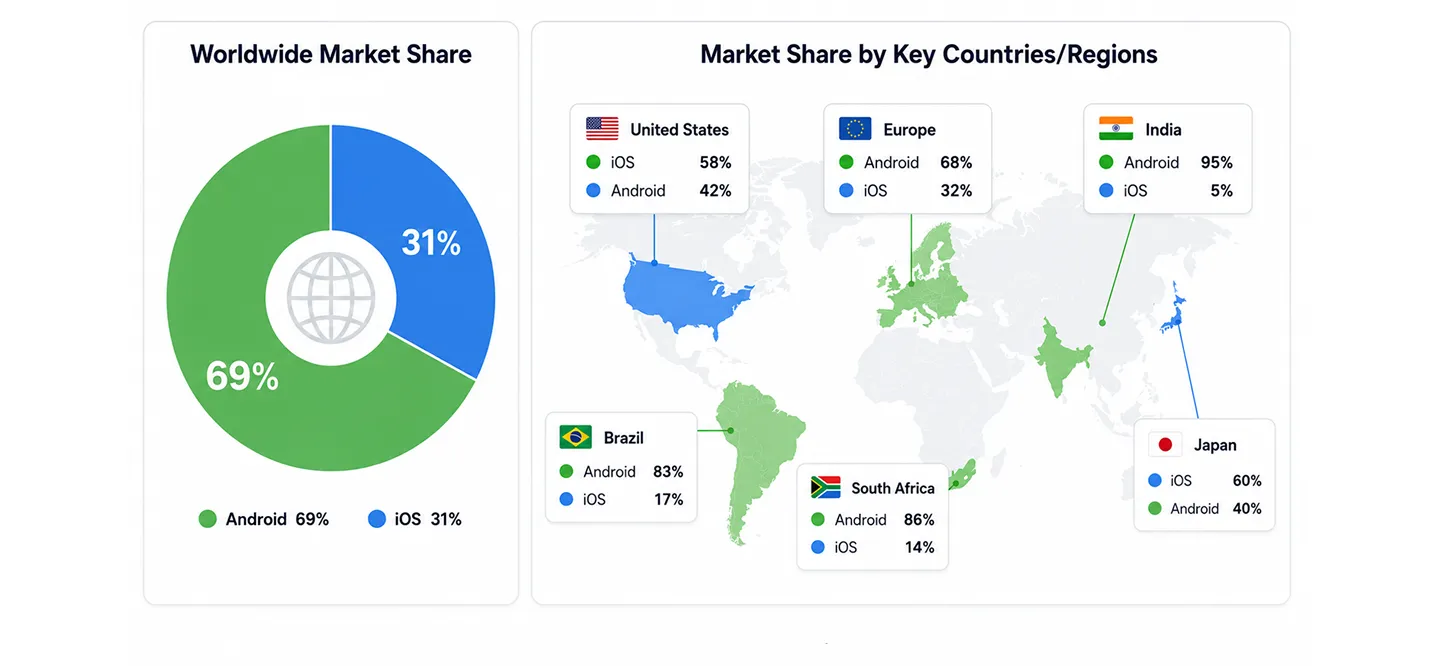
Android vs iOS market share should be evaluated by region, not only by worldwide totals.
Android dominates in many mobile-first markets where affordable smartphones are essential to internet access. Countries across South Asia, Southeast Asia, Latin America, Africa, and the Middle East often have large Android user populations. Startups targeting India, Pakistan, Indonesia, Brazil, Mexico, Nigeria, Egypt, or similar markets should usually treat Android as a major priority.
iOS has stronger adoption in countries where consumers are more likely to purchase premium smartphones and spend on digital services. The United States, Japan, Canada, Australia, the United Kingdom, and several European markets have significant iPhone user bases.
For example, a startup launching a premium wellness subscription in the United States may find iOS users more likely to convert during the early stages. A local commerce or delivery app targeting Pakistan, India, Indonesia, or Brazil may need Android first to reach the largest share of its intended users.
Before choosing the right mobile app platform, answer these questions:
- Which countries will generate the first 1,000 users?
- What devices do those users own?
- Are they likely to pay for digital services?
- Do competitors in your category prioritize Android, iOS, or both?
- Does the product need to work on lower-cost devices or slower mobile networks?
iOS vs Android App Development: Cost, Scope, and Timeline
The cost of iOS vs Android app development depends on product scope, integrations, design requirements, backend systems, compliance needs, and quality assurance. It is inaccurate to assume that Android is always more expensive or that iOS is always faster.

iOS development can be more predictable because developers work with a smaller range of devices and screen sizes. Apple’s centralized update model also means that many users adopt newer operating system versions quickly. This can reduce the number of versions the development team must support.
Android development can require more testing because the app may run on devices from different manufacturers, with different screen sizes, processors, memory levels, Android versions, and manufacturer-specific interfaces. For products that must perform reliably across affordable smartphones, Android testing should be planned from the beginning.
Android vs iOS development time also depends on the app’s feature set. A simple MVP can take a similar amount of time on either platform. However, Android may require additional effort when the product includes offline access, location tracking, media uploads, device integrations, or advanced animations across many device types.
For a detailed Apple-focused budget breakdown, explore iOS app development cost. Startups should also estimate Android app development cost based on device compatibility, performance requirements, offline functionality, and expected user geography.
The Android app development process should include discovery, requirements gathering, UX design, technical architecture, frontend and backend development, testing, beta release, Google Play submission, and post-launch optimization.
Android vs iOS Monetization: Subscriptions, Purchases, and Advertising
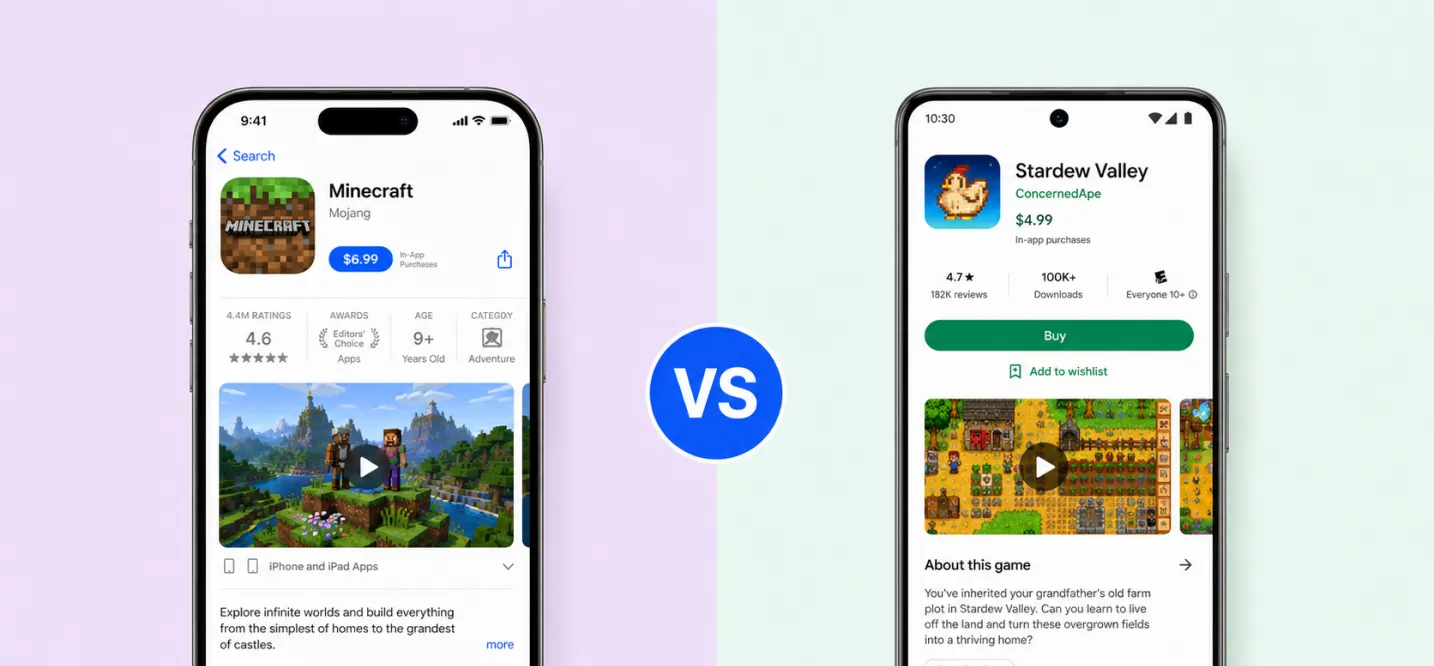
For many startups, Android vs iOS monetization is the deciding factor.
iOS users often generate higher average revenue per user, especially in markets where iPhone ownership is associated with higher disposable income. This makes iOS attractive for products that rely on subscriptions, premium features, in-app purchases, professional tools, digital wellness, education, finance, and lifestyle services.
Android can deliver strong revenue through scale. It is particularly effective for ad-supported apps, gaming, marketplaces, utility apps, local services, and commerce platforms that need broad reach. Android revenue may be lower per user in some markets, but a larger audience can still produce meaningful results.
Subscription Apps
iOS often performs well for subscription-based products because users in major Apple markets are more familiar with recurring digital payments. Fitness apps, meditation apps, productivity tools, streaming services, and premium education products frequently see strong subscription conversion from iPhone users.
Android subscriptions can also perform well, especially when startups use localized pricing, flexible payment options, and region-specific offers. The key is to match pricing with customer purchasing power rather than copying iOS pricing models into Android-heavy markets.
In-App Purchases
iOS users are often more likely to purchase premium upgrades, virtual goods, additional features, and paid digital content. This can make iOS attractive for consumer apps that depend on higher conversion rates from a smaller but more valuable audience.
Android can be effective for freemium products that rely on high install volume, gaming purchases, and regionally tailored offers. Startups should measure conversion rate, retention, average revenue per user, and customer lifetime value rather than relying only on downloads.
Advertising Revenue and App Tracking Transparency
Android has traditionally been favorable for ad-supported apps because of its broad global reach and large advertising inventory. However, iOS advertising has changed significantly because of Apple’s App Tracking Transparency framework.
App Tracking Transparency requires apps to request permission before tracking users across other apps and websites. Many users decline this permission, which can reduce audience targeting accuracy and make attribution more difficult for advertisers.
For startups using paid acquisition or ad-based monetization, this means iOS requires stronger first-party data strategies, contextual advertising, privacy-safe analytics, and more disciplined measurement. Android may offer broader advertising reach, but founders should still prioritize consent, privacy, and compliant data practices.
Android vs iOS Security and Performance

Android vs iOS security should be evaluated based on the product’s risk level, not platform reputation alone.
iOS benefits from Apple’s closed ecosystem, centralized updates, strict App Store review process, and consistent hardware environment. Apple can release security updates quickly across compatible devices, which is valuable for products handling sensitive data.
Android has improved significantly through Google Play Protect, app sandboxing, permission controls, regular security patches, and stronger developer policies. However, Android updates can vary by manufacturer and carrier. Some users may remain on older Android versions longer, which requires startups to plan device and operating system support carefully.
For healthcare, fintech, legal technology, enterprise software, identity products, and apps that process personal data, security should include:
- Secure authentication and multi-factor authentication
- Encrypted data storage and transmission
- Role-based access controls
- Secure API design
- Regular vulnerability testing
- Privacy-compliant analytics and consent management
Android vs iOS performance also depends on the app type. iOS can be easier to optimize because developers support fewer hardware configurations. Android requires broader performance testing, especially when the app targets low-memory devices, slower processors, unstable networks, or older operating system versions.
Native vs Cross-Platform Development for Startups
Native development means building separate applications for Android and iOS. Android apps are typically built with Kotlin, while iOS apps are commonly built with Swift.
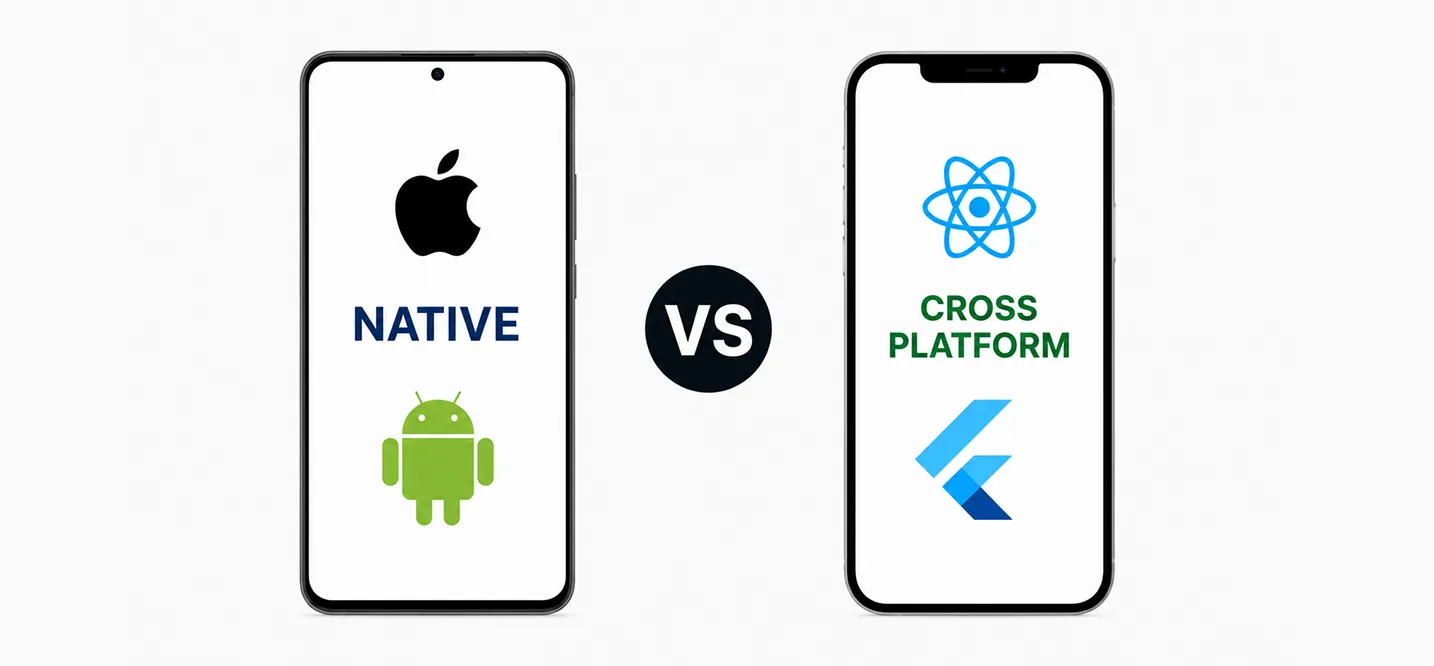
Native development is usually the best choice when a startup needs advanced performance, high-quality animations, deep hardware access, sophisticated camera functions, complex offline workflows, high-end gaming, or platform-specific features.
Cross-platform development uses one shared codebase for Android and iOS. React Native and Flutter are popular options for startups that need to launch on both platforms without maintaining two completely separate applications from the start.
Cross-platform development is often a good fit when:
- The MVP includes dashboards, forms, profiles, booking flows, or standard app screens.
- The product is heavily API-driven.
- Both Android and iOS users are important from launch.
- The startup needs to validate demand quickly.
- The app does not rely heavily on complex native features.
For mobile app development for new businesses, cross-platform development can reduce duplicated work, but it does not remove the need for device testing, store compliance, platform-specific UX adjustments, or ongoing maintenance.
If your startup needs help deciding between native and cross-platform architecture, you can hire a mobile app development company with experience in MVP planning, product engineering, and mobile launch strategy.
Match Your Target User Persona to the Platform

The best platform is the one used by the people most likely to become your first active and paying customers.
Choose iOS first when your early users are likely to be professionals, premium consumers, Apple ecosystem users, enterprise teams, or customers in high-income markets. iOS is often a strong choice for SaaS products, fintech apps, healthcare platforms, productivity tools, and subscription services.
Choose Android first when your early users are likely to use mid-range devices, rely on mobile data, live in Android-dominant regions, or need access to affordable smartphones. Android is often a better first choice for marketplaces, local service apps, logistics tools, gaming products, content apps, and utility platforms.
For Android-focused product development, you can hire Android app developers with experience in device compatibility, performance optimization, and Google Play release requirements. For an Apple-first launch, you can hire iOS app developers for support with iPhone app architecture, App Store compliance, and Apple design standards.
Industry-Specific Platform Trends

Platform preference often changes by industry.
Healthcare and fintech startups may prioritize iOS when targeting professionals, higher-income consumers, or users in mature digital markets. These products often require strong privacy controls, secure authentication, consistent updates, and carefully tested user flows.
Enterprise products frequently need both platforms, but iOS may be prioritized when an organization provides iPhones to employees. Android support becomes essential for larger workforce deployments, field teams, logistics staff, retail workers, and bring-your-own-device environments. Businesses building internal tools should consider mobile app development for enterprise needs such as device management, compliance, identity access, and system integrations.
Gaming, utilities, mobility apps, marketplaces, content platforms, and local commerce products often benefit from Android’s broad reach. This is especially true in emerging markets where Android devices account for most smartphone usage.
When Should a Startup Expand to the Second Platform?

A startup should build for the second platform when data shows that platform availability is limiting growth.
Strong expansion signals include:
- Users repeatedly request support for the second platform.
- Your waitlist shows meaningful demand from users on the unavailable platform.
- Sales opportunities are blocked because the product is not cross-platform.
- Retention, engagement, and revenue validate the core product.
- Customer support and engineering teams can maintain two applications.
- A major enterprise client requires Android and iOS access.
Do not expand only because competitors are available on both platforms. Expand when the second platform supports a measurable business goal.
If you already have an Android app and need to extend your product to Apple users, learn how to convert an Android app to iOS while maintaining product consistency and platform-specific usability.
How Cubix Helps Startups Choose and Build the Right Mobile App Platform
Choosing between Android, iOS, and cross-platform development involves more than comparing market share or development cost. Startups need to assess their target users, MVP scope, revenue model, technical requirements, and plans for future expansion before committing to a platform.
Cubix helps startups make informed mobile product decisions and build applications that align with customer needs and business objectives. Its team supports founders throughout the product lifecycle, from early planning through launch and ongoing improvement.
Cubix can support startups with:
- Product discovery and MVP planning to define the core features needed for market validation.
- Platform selection strategy based on target geography, user behavior, device preferences, and monetization goals.
- Native Android and iOS development for products that need platform-specific performance, functionality, or user experiences.
- Cross-platform development using suitable frameworks when launching on both platforms is a practical business requirement.
- UI and UX design that follows Android and iOS design guidelines while keeping the product experience clear and intuitive.
- Backend development and API integration for secure, scalable app functionality.
- Quality assurance and device testing across supported Android devices and iPhone models.
- App Store and Google Play launch support to help meet submission, review, and compliance requirements.
- Post-launch optimization based on user feedback, performance data, retention, and feature adoption.
Whether your startup needs to validate an idea with a focused MVP, launch a subscription-based iOS app, reach Android users in mobile-first markets, or expand an existing product to a second platform, Cubix can help define the right development approach.
The goal is not simply to launch an app on Android or iOS. It is to build a product that reaches the right users, supports measurable business outcomes, and gives your startup a practical foundation for growth.
Conclusion
Choosing between Android and iOS depends on where your target users live, the devices they use, and how your startup plans to earn revenue. Android is often ideal for broad reach, emerging markets, affordable devices, and ad-supported products. iOS can be a stronger choice for premium audiences, subscriptions, fintech, healthcare, and enterprise-focused apps. Consider development scope, testing needs, security requirements, and future expansion before making a decision. The best platform is the one that helps you validate your MVP with the right users, gather useful feedback, and build momentum without stretching your budget too early.
Frequently Asked Questions
1: Should startups choose Android or iOS first?
Startups should choose the platform used by their most valuable early users. iOS is often suitable for premium markets and subscription-led products, while Android is better for broad reach in Android-dominant regions.
2: Is Android app development more expensive than iOS?
Not always. Android may require more testing across devices and operating system versions, while iOS can involve specialized development and Apple-specific requirements. Cost depends mainly on app features, integrations, and testing scope.
3: Which technology should startups choose to build apps for both Android and iOS?
Startups can choose native development when the app needs advanced performance, deep device integrations, complex offline features, or highly platform-specific experiences. For a standard MVP with dashboards, forms, booking flows, or API-driven features, cross-platform frameworks such as React Native and Flutter can help teams launch on both platforms with a shared codebase. For a detailed comparison of native, cross-platform, hybrid, and progressive web app options, explore these mobile app development technologies, tools, and frameworks to identify the approach that best fits your business requirements.
4: Which platform is better for subscription-based apps?
iOS often delivers higher subscription revenue per user in premium markets because iPhone users tend to spend more on digital services. Android can also perform well with localized pricing and flexible payment methods.
5: When should a startup build for the second platform?
Build for the second platform when customer demand, sales opportunities, user retention, or revenue data show that limited platform availability is slowing growth.