Key Takeaways
- An LLM is a foundation model trained on massive text datasets to understand and generate human language.
- The model itself is only one component of a production-ready AI application.
- Strong architecture, retrieval systems, APIs, monitoring, and governance matter more than choosing the newest model.
- RAG and fine-tuning solve different problems and often work best together.
- Engineering teams now need AI orchestration skills alongside traditional software engineering expertise.
- Security, compliance, and evaluation should be part of every AI deployment strategy.
Artificial intelligence has quickly moved from research labs into everyday software. Today, it helps LLM development companies write code, customer support teams answer questions faster, and businesses automate work that once took hours.
But here’s the interesting part.
Many engineer leaders are now investing in AI, but they don’t really fully understand how it fits into their software architecture. They know what ChatGPT can do, of course. They may have experimented with AI coding assistants. Yet, when the discussions shift to vector databases, things become less clear, don’t they?
That matters because large language models (LLMs) are not standalone products. According to IBM, LLMs are foundation models trained on massive amounts of text that can understand, summarize, generate, and predict language across a wide range of tasks.
So if you’re leading an engineering team, the real question isn’t simply, “What is an LLM?” It’s:
How do you build reliable software around one?
Let’s start there.
What Is an LLM? Understanding the Basics
If you’ve searched for what is an LLM, LLM meaning, or what are LLMs, you’ve probably found dozens of technical definitions.
Here’s the simple version.
A large language model is an AI model trained to recognize patterns in human language. Instead of storing answers like a database, it learns relationships between words, sentences, and ideas by processing enormous amounts of text.
When you ask a question, the model predicts the most likely next word, then the next, and the next again. Those predictions happen incredibly fast, creating responses that often feel conversational.
That’s the basic LLM definition.
But that simplicity hides years of research, trillions of training tokens, and thousands of GPUs working together.
Traditional Machine Learning vs. Large Language Models
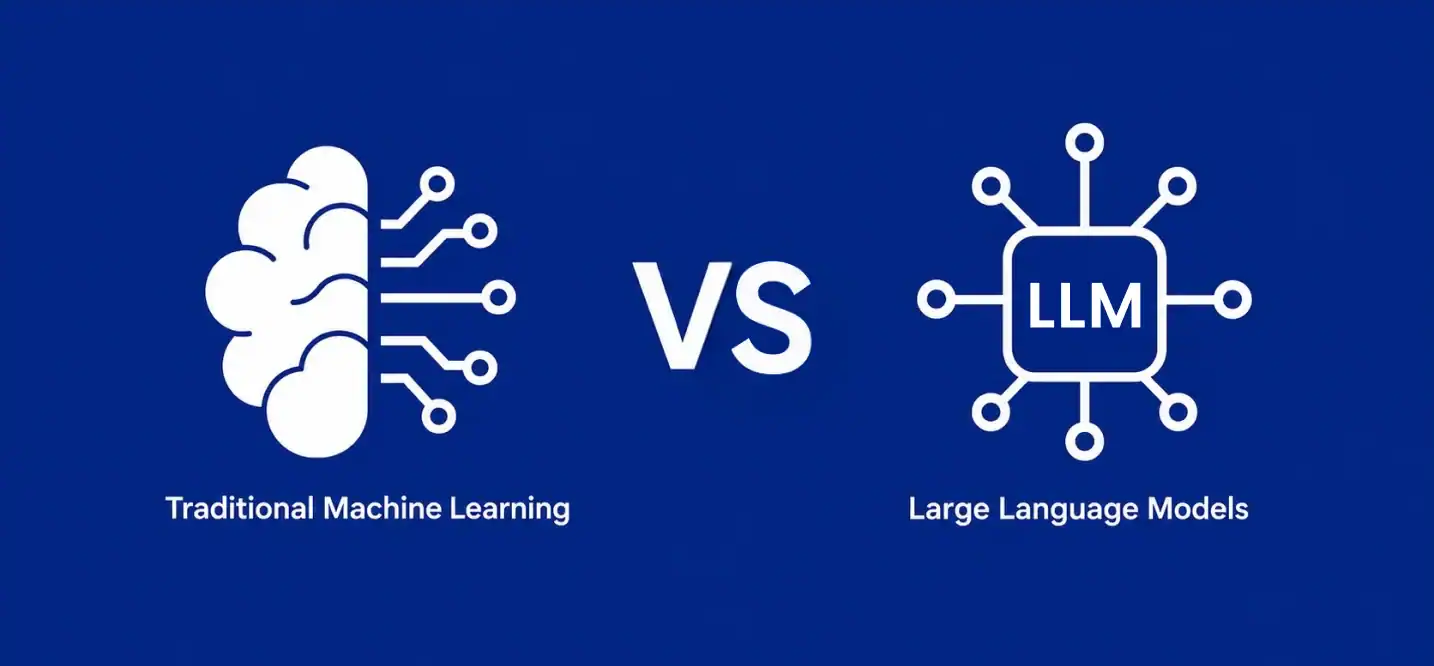
| Traditional Machine Learning | Large Language Models |
| Designed for one task | Can perform many language tasks |
| Requires task-specific training | General-purpose foundation model |
| Uses structured datasets | Trained on massive text datasets |
| Produces fixed predictions | Generates new content |
| Limited adaptability | Can be adapted through prompts, RAG, or fine-tuning |
One of the biggest differences is flexibility.
A traditional fraud detection model usually detects fraud and nothing else.
An LLM can summarize documents, write code, explain technical concepts, classify text, generate reports, translate languages, and power AI agents—all using the same underlying model.
That’s why enterprises across healthcare, finance, manufacturing, gaming, and retail are investing heavily in generative AI.
According to the McKinsey State of AI 2025 report, 78% of organizations now use AI in at least one business function, up significantly from previous years. Generative AI has become one of the fastest-adopted enterprise technologies in recent history.
Common Examples of LLMs
If you’re wondering about examples of LLM, here are some of the most widely used models today.
| Model | Organization | Common Enterprise Use Cases |
| GPT-4 family | OpenAI | Writing, coding, assistants, automation |
| Claude | Anthropic | Long-document analysis, enterprise knowledge |
| Gemini | Productivity, search, multimodal AI | |
| Llama | Meta | Open-source enterprise applications |
| Mistral | Mistral AI | Cost-efficient private deployments |
How Do LLMs Work? A Simple Systems View
Understanding how do LLMs work doesn’t require a PhD in machine learning.
Instead of focusing on mathematical equations, think of an LLM as a prediction engine that has learned language patterns from enormous datasets.
Here’s what happens every time someone submits a prompt.
| Stage | What Happens |
| Tokenization | Your text is split into smaller pieces called tokens. |
| Embedding | Tokens become numerical vectors the model can understand. |
| Attention | The transformer identifies relationships between words. |
| Inference | The model predicts the most likely next token repeatedly. |
| Response Generation | Tokens become readable text for the user. |
Let’s break that down.
Step 1. Everything Becomes Tokens
Computers don’t understand words.
They understand numbers.
So before processing begins, your prompt is divided into tokens. A token may be a word, part of a word, punctuation, or even a space depending on the tokenizer.
Thousands of these tokens become the model’s working context.
Step 2. Words Become Mathematical Relationships
Each token is converted into a numerical representation called an embedding.
Instead of storing dictionary definitions, embeddings place similar concepts close together inside a high-dimensional mathematical space.
For example:
- doctor
- hospital
- nurse
naturally appear closer together than
- volcano
- airplane
- pineapple
That helps the model understand context rather than individual words.
Step 3. Attention Connects Everything
One of the biggest breakthroughs behind modern large language models is the Transformer architecture.
Its attention mechanism allows every token to “look at” every other relevant token before generating the next word.
That means when a user asks:
“Summarize the third paragraph of this report.”
the model remembers where the third paragraph appeared instead of treating every sentence independently.
This ability to understand relationships is what makes modern LLMs dramatically more capable than earlier language models.
Step 4. The Model Predicts One Token at a Time
Here’s something many people don’t realize. An LLM doesn’t know the final answer before it starts writing.
- It predicts one token.
- Then another.
- Then another.
Each prediction depends on everything generated so far. That process happens in milliseconds, creating responses that feel natural even though they’re built incrementally.
Building an LLM Application Is About Systems, Not Just Models

A production-ready AI application typically looks more like this:
| Layer | Purpose |
| User Interface | Receives prompts and displays responses |
| Application Layer | Handles authentication, workflows, and APIs |
| Prompt Orchestration | Builds structured prompts and business rules |
| Retrieval Layer | Finds relevant company knowledge |
| Vector Database | Stores searchable embeddings |
| Large Language Model | Generates responses |
| Monitoring & Evaluation | Measures quality, latency, and safety |
The LLM shouldn’t memorize your HR policies, pricing documents, or engineering documentation.
Instead, the application retrieves the latest information from your knowledge base, sends that context to the model, and then generates an answer based on current company data.
This approach is called Retrieval-Augmented Generation (RAG), and it has become the preferred architecture for many enterprise AI applications because it improves accuracy while reducing the need for retraining models.
For organizations planning enterprise AI initiatives, this is where experienced AI Software Development Services become valuable.
What Engineering Leaders Need to Think About Before Deployment

At this point, you know what an LLM is and how it works. But engineering leaders rarely stop there.
Their questions usually sound more like this:
- Can this model work with our existing systems?
- Will it protect customer data?
- Do we need to fine-tune it?
- Who will maintain it six months from now?
Those are the questions that determine whether an AI project succeeds or stalls.
Your AI Architecture Is More Important Than Your AI Model
| Architecture Component | Why It Matters |
| APIs | Connect the LLM to your existing applications |
| Vector Database | Retrieves relevant business knowledge |
| Identity & Access Management | Protects sensitive information |
| Monitoring | Tracks quality, latency, and costs |
| Guardrails | Prevents unsafe or inaccurate responses |
| Logging & Evaluation | Helps improve prompts and measure performance |
Think about an enterprise customer support assistant. The AI doesn’t just answer questions. It also needs to:
- Authenticate users
- Search internal documentation
- Pull customer information from CRM systems
- Call third-party APIs
- Follow compliance rules
- Escalate complex requests to human agents
The LLM is only one piece of that workflow.
Building the Right Skills Across Your Engineering Team
The rise of generative AI has changed what engineering teams need to know. Five years ago, backend developers mainly focused on APIs, databases, authentication, and distributed systems.
Those skills still matter. But now they’re expected to understand AI orchestration as well.
Here’s how the skill set is evolving.
| Traditional Skills | New AI Skills |
| REST APIs | Prompt engineering |
| Database design | Retrieval-Augmented Generation (RAG) |
| Cloud deployment | AI evaluation |
| Authentication | Model monitoring |
| System design | Vector databases |
| Testing | Prompt testing and observability |
Governance, Security, and Ethics Can’t Be an Afterthought
The Biggest Risks Organizations Face
| Risk | Example | Mitigation |
| Hallucinations | Incorrect answers presented confidently | RAG, validation pipelines, human review |
| Data leakage | Sensitive information appears in prompts | Access controls and private deployments |
| Prompt injection | Users manipulate system instructions | Guardrails and prompt filtering |
| Compliance failures | Violating regional regulations | Governance and auditing |
| Model drift | Performance declines over time | Continuous evaluation |
This is also where AI regulations are changing how enterprises build software.
The EU AI Act, which entered into force in 2024, introduces risk-based requirements for AI systems. Depending on how an AI application is used, organizations may need stronger documentation, transparency measures, human oversight, and ongoing monitoring.
Even companies operating outside Europe are paying attention because global products often serve customers across multiple regions.
Engineering leaders should ask questions such as:
- Where is customer data stored?
- Can prompts be audited?
- How do we measure model quality?
- What happens when the model gives a wrong answer?
- Who approves model updates?
Answering those questions early reduces technical debt later.
As AI researcher Andrew Ng has often emphasized, successful AI systems are built through continuous iteration and evaluation rather than expecting perfect results from the first model.
The Right Partner for Enterprise LLM Development = Cubix
At Cubix, we work with businesses that already have a clear vision but need experienced engineers to turn that vision into production-ready AI solutions.
As a Generative AI Development Company, Cubix combines AI engineering with cloud infrastructure, backend development, DevOps, and enterprise integrations. This means your AI solution isn’t built in isolation.
Our engineering teams help organizations:
- Design scalable AI and cloud architectures.
- Implement Retrieval-Augmented Generation (RAG) pipelines and vector databases.
- Customize foundation models through our LLM Fine Tuning Service when domain-specific knowledge is required.
For businesses moving beyond chatbots, Cubix also works as a Custom AI Agent Development Company, building intelligent AI agents that can retrieve information, automate workflows, interact with enterprise systems, and complete multi-step tasks with minimal human intervention.
If you’re exploring AI adoption or evaluating implementation partners, our guide on How to Choose the Right AI Development Partner explains the technical and business factors
FAQs
1. What is an LLM, and how is it different from traditional AI models?
A large language model (LLM) is an AI model trained on massive amounts of text to understand and generate human language. Unlike traditional machine learning models that are built for a single task, LLMs can perform multiple language-based tasks such as answering questions, summarizing content, generating code, and translating text using the same foundation model.
2. How do LLMs work in enterprise applications?
LLMs process user prompts by converting text into tokens, understanding context through transformer-based attention mechanisms, and predicting the next most likely word. In enterprise applications, they’re often combined with Retrieval-Augmented Generation (RAG), vector databases, APIs, and business logic to provide accurate, context-aware responses using company-specific data.
3. Should my business use RAG or fine-tune an LLM?
It depends on your use case. RAG is ideal when your AI application needs access to frequently updated information, such as internal documents or knowledge bases.
4. How do I choose the right LLM development company?
Look for a partner with experience beyond AI models. A strong LLM development company should understand enterprise architecture, cloud infrastructure, API integrations, security, governance, and MLOps.