Key Takeaways
- AI project success depends as much on the partner as the technology.
- The wrong vendor can lead to delays, budget overruns, and failed deployments.
- Businesses should evaluate technical expertise, industry experience, communication processes, and post-launch support.
- Data security and AI governance should be part of every vendor assessment.
- Asking the right questions before signing a contract can significantly reduce project risk.
- A long-term strategic partner often delivers better outcomes than a low-cost vendor.
Artificial intelligence is no longer a future investment. It is a present-day business strategy.
From customer support automation and predictive analytics to recommendation engines and intelligent assistants, companies across every industry are investing heavily in AI. According to McKinsey, 78% of organizations reported using AI in at least one business function in 2025, up significantly from previous years. At the same time, IDC predicts global spending on AI-centric systems will surpass $300 billion by 2026.
Yet despite this rapid growth, success is far from guaranteed.
Research from RAND found that more than 80% of AI projects fail to meet their intended objectives, a failure rate that is nearly twice that of traditional software projects. The reasons vary. Some organizations lack quality data. Others underestimate implementation challenges. But one factor appears repeatedly across failed initiatives: choosing the wrong partner.
That is why selecting the right AI development partner can determine whether your investment creates measurable value or becomes another expensive experiment.
Why Choosing the Right AI Development Partner Matters

Many organizations focus heavily on selecting the right technology stack. They compare models, cloud platforms, frameworks, and tools.
Ironically, those decisions often matter less than selecting the right implementation partner.
The best AI technology can still fail if it is deployed incorrectly. Conversely, a skilled partner can maximize results even with modest tools by aligning technology with business objectives.
According to Deloitte’s State of AI report, organizations that work with experienced AI implementation teams after outsourcing them report significantly higher returns on AI investments than those attempting deployments without specialized support.
The Cost of Choosing the Wrong Partner
A poor AI partnership creates costs that go far beyond the project budget.
Common consequences include:
- Missed project deadlines
- Unusable proof-of-concepts
- Poor model performance
- Integration failures
- Security vulnerabilities
- Employee resistance to adoption
A recent Gartner study estimated that poor implementation practices can increase AI project costs by up to 40%.
Even worse, failed deployments can damage confidence in future innovation initiatives.
When executives lose trust in AI after one failed project, organizations often delay future investments for years.
AI Is a Long-Term Commitment
Unlike traditional software, AI systems require ongoing maintenance. Models need monitoring. Data pipelines need updating. Performance metrics must be tracked.
Algorithms often require retraining as business conditions evolve. This is why evaluating the criteria for selecting AI partner for digital transformation should extend far beyond initial development capabilities.
Why Is Choosing an AI Partner Important for Long-Term Business Growth?
Many companies treat AI projects as standalone initiatives. The most successful organizations view them as business transformation programs.
According to PwC, AI could contribute nearly $15.7 trillion to the global economy by 2030. However, capturing that value requires sustained implementation, continuous improvement, and strategic planning.
A true AI partner helps organizations build those capabilities.
Vendors Execute. Partners Guide.
There is a major difference between a vendor and a partner. A vendor typically focuses on delivering requested features.
A strategic partner focuses on solving business problems. For example, suppose a retailer wants to implement AI-powered demand forecasting.
A vendor may simply build the requested model. A partner may identify additional opportunities such as inventory optimization, dynamic pricing, and supply chain automation.
The difference can translate into millions of dollars in additional value.
The Best Partners Challenge Assumptions
Many business leaders assume they know exactly what solution they need. Experienced AI consultants often discover better alternatives.
The strongest partnerships involve healthy discussions, constructive feedback, and strategic recommendations. Instead of asking, “What model do you want?”
The right partner asks:
- What business outcome are you trying to achieve?
- What metrics define success?
- How will this integrate with existing workflows?
- What happens after deployment?
These conversations often uncover opportunities that were initially overlooked.
Where Can You Start Finding the Best AI Development Partners?

Finding an AI partner has become easier than ever. Choosing the right one remains difficult.
Thousands of companies now claim AI expertise. Many offer similar messaging, similar case studies, and similar promises.
The challenge is separating genuine specialists from companies simply following market trends.
Industry Review Platforms
Third-party review platforms can provide valuable insights. Popular options include:
- Clutch
- GoodFirms
- G2
- Gartner Peer Insights
Look beyond overall ratings. Read detailed reviews. Pay attention to comments regarding:
- Communication
- Project management
- Technical expertise
- Post-launch support
Patterns matter more than individual reviews.
Professional Referrals
One of the most reliable sources remains direct recommendations.
Speak with:
- Industry peers
- Technology partners
- Startup founders
- Digital transformation leaders
If you’re currently evaluating providers, our guide on which AI software development company should you choose offers additional insights into comparing vendors effectively.
Examine Real Project Outcomes
- Revenue growth
- Cost savings
- Productivity improvements
- Customer satisfaction gains
- Operational efficiencies
These outcomes reveal whether the company understands how AI creates business value. When reviewing potential vendors, this becomes an important part of the criteria for selecting ai software vendors.
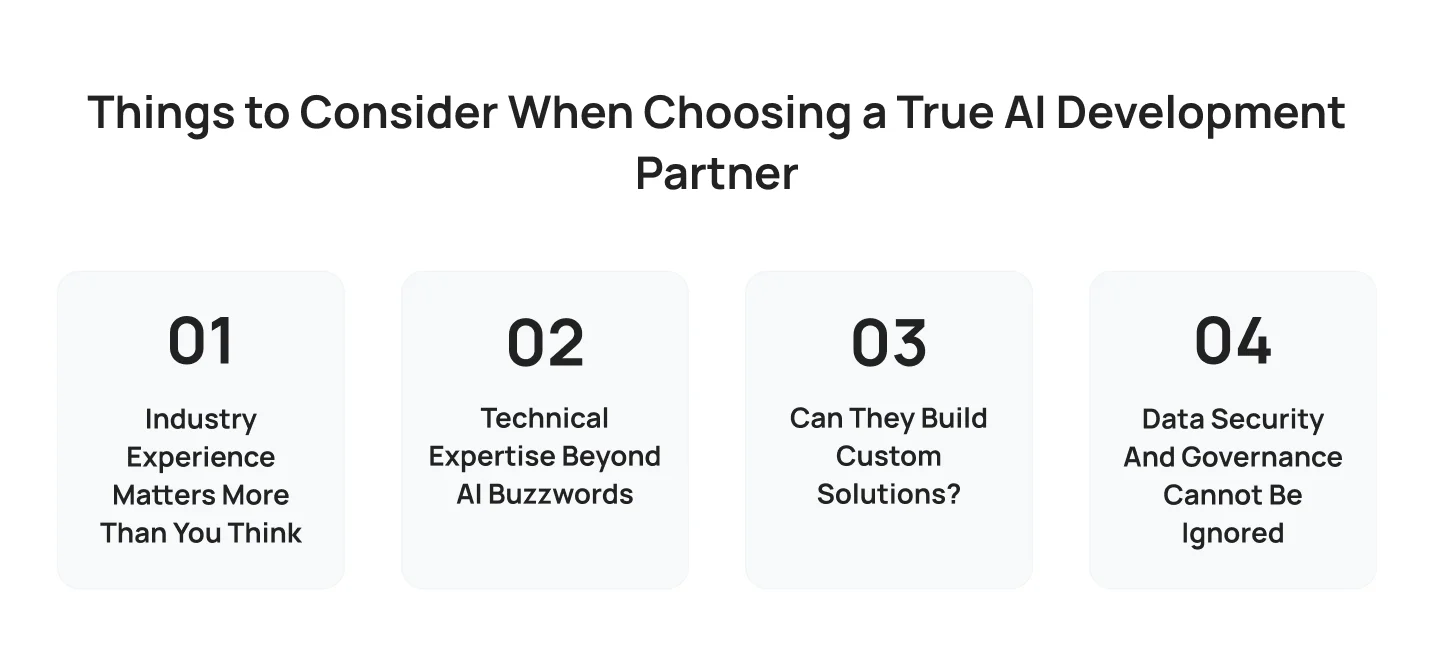
Things to Consider When Choosing a True AI Development Partner
Not all AI firms offer the same capabilities. Some specialize in consulting. Others focus on implementation.
Some excel at research but struggle with deployment. The following evaluation criteria can help identify the strongest candidates.
Industry Experience Matters More Than You Think
Every industry has unique challenges. Healthcare organizations face strict compliance requirements.
Financial institutions must address security and explainability concerns. Retail businesses prioritize personalization and customer insights.
Manufacturers often focus on predictive maintenance and operational efficiency. An AI partner with relevant industry experience can significantly reduce project risk.
Questions to Ask
- Have you completed projects in our industry?
- Can you share measurable results?
- What challenges did you encounter?
- How did you overcome them?
According to IBM research, industry-specific AI implementations are substantially more likely to reach production compared to generic deployments.
Industry knowledge accelerates decision-making and reduces costly mistakes.
Technical Expertise Beyond AI Buzzwords
Many companies advertise AI expertise. Fewer demonstrate production-level capabilities.
Modern AI projects require much more than model development. Successful deployments involve:
- Data engineering
- Model training
- MLOps
- Cloud infrastructure
- Monitoring systems
- Security frameworks
A credible provider offering AI Software Development Services should be able to explain every stage of this process clearly.
Questions to Ask
- How do you deploy models into production?
- What cloud platforms do you support?
- How do you monitor model performance?
- How do you handle retraining?
Strong answers should include practical processes rather than marketing language.
Can They Build Custom Solutions?
Many AI vendors rely heavily on pre-built templates. Templates can accelerate development. However, they often fail to address unique business requirements.
Organizations with specialized workflows usually require custom machine learning solutions that reflect their data, processes, and objectives.
Questions to Ask
- How much customization do you provide?
- Have you built proprietary models before?
- How do you handle unique business requirements?
- Can you integrate with our existing systems?
According to Accenture, organizations implementing highly customized AI solutions report significantly higher business impact than those relying exclusively on off-the-shelf products.
The goal should not be to adopt AI. The goal should be to adopt AI that solves your specific business problems. For instance, learning how to build a custom AI chatbot for your business.
Data Security and Governance Cannot Be Ignored
AI systems depend on data.
- That data often includes sensitive information.
- Customer records.
- Financial transactions.
- Operational metrics.
- Intellectual property.
Any security failure can create severe financial and reputational damage. According to IBM’s Cost of a Data Breach Report, the average global data breach cost exceeded $4 million in recent years.
This makes governance discussions essential during vendor evaluation.
Businesses reviewing the criteria for comparing ai governance vendors should examine security policies, compliance certifications, and risk management procedures long before project kickoff.
Questions to Ask
- How is our data stored?
- Who can access it?
- What compliance frameworks do you support?
- How do you manage AI risks and audits?
- Do you retain ownership of trained models?
Clear answers indicate maturity. Vague answers should raise concerns.
How to Spot the Right AI Development Partner
After reviewing portfolios, case studies, and proposals, the next step is identifying whether a company is a genuine strategic partner or simply another vendor selling AI services.
The distinction matters.
Organizations that closely align AI initiatives with business strategy are significantly more likely to achieve measurable revenue growth from their AI investments. Technology alone is rarely the differentiator. Strategic execution is.
Signs You’re Talking to a Strategic Partner
They Ask Business Questions First
The best AI consultants spend more time discussing your business than your technology stack.
Instead of immediately recommending models or frameworks, they focus on understanding:
- Business objectives
- Revenue drivers
- Operational bottlenecks
- Customer challenges
- Existing workflows
This discovery process often uncovers opportunities beyond the original project scope.
For example, a logistics company may initially request route optimization. A strategic partner may identify additional opportunities in predictive maintenance, warehouse automation, and demand forecasting.
They Challenge Assumptions
A quality partner does not simply agree with everything you say. If a proposed solution seems unrealistic, they should explain why. If there is a simpler approach, they should recommend it.
Research from Gartner shows that organizations that conduct rigorous validation and challenge project assumptions early are significantly more likely to scale AI successfully across business units.
Constructive pushback is often a sign of expertise.
They Discuss ROI From Day One
Technology discussions matter. Business outcomes matter more. An experienced ai development partner should be able to explain:
- Expected operational improvements
- Cost reductions
- Productivity gains
- Revenue opportunities
- Risk mitigation benefits
If ROI never enters the conversation, that should raise concerns.
15 Questions to Ask Before Signing a Contract
If you’re researching how to choose a development partner for ai integration projects, these questions can help separate strong candidates from weak ones.
Business Questions
1. What outcomes should we realistically expect?
Ask for measurable goals rather than vague promises.
2. How will success be measured?
Look for specific KPIs tied to business performance.
3. Can you share similar case studies?
Request examples with measurable results.
According to PwC, organizations that benchmark against previous implementations are more likely to achieve successful AI scaling.
Technical Questions
4. How do you handle model training?
Understand how data is collected, cleaned, and prepared.
5. How do you monitor AI performance?
Monitoring is essential because model accuracy can decline over time due to changing data patterns.
6. What cloud platforms do you support?
Leading providers should have experience with AWS, Microsoft Azure, and Google Cloud.
7. How do you manage integrations?
Most AI systems need to connect with CRMs, ERPs, analytics platforms, and internal databases.
Security Questions
8. How is our data protected?
Ask about encryption, access controls, and data retention policies.
9. What compliance certifications do you maintain?
Depending on your industry, certifications may include:
- SOC 2
- ISO 27001
- HIPAA
- GDPR compliance
Team Questions
10. Who will work on our project?
Meet the actual team members whenever possible.
11. What experience does the team have?
Look beyond company branding and assess individual expertise.
Support Questions
12. What happens after deployment?
AI systems require ongoing monitoring and maintenance.
13. What are your SLAs?
Clear service-level agreements reduce uncertainty after launch.
Commercial Questions
14. How is pricing structured?
Transparent pricing helps prevent unexpected costs.
15. What happens if project requirements change?
Requirements evolve during most AI projects. Your contract should account for flexibility.
Common Pitfalls Businesses Should Avoid During AI Vendor Selection

Even experienced organizations make avoidable mistakes during vendor evaluations. Understanding these risks can save substantial time and money.
Many of these are among the most overlooked common pitfalls to avoid during ai deployment.
Choosing Based on Price Alone
The lowest proposal is rarely the best value.
A 2025 IBM study found that organizations often spend significantly more correcting failed implementations than they would have spent selecting experienced providers from the beginning.
Evaluate value, not just cost.
Ignoring Data Governance
Data governance directly impacts AI reliability. Poor governance can lead to:
- Inaccurate outputs
- Compliance violations
- Security breaches
- Biased decision-making
Strong governance should be evaluated before contracts are signed.
Overlooking Support Requirements
AI implementation is not the finish line. Models require:
- Monitoring
- Retraining
- Optimization
- Security updates
Partners without support programs often leave organizations vulnerable after launch.
Falling for Demo-Only Expertise
A polished demo does not guarantee production success.
Many vendors showcase impressive prototypes that have never been deployed at scale. Ask for production case studies with measurable outcomes.
Not Checking References
Reference calls remain one of the most valuable evaluation tools.
Speak directly with current or former clients.
Ask about:
- Communication quality
- Delivery consistency
- Technical competence
- Post-launch support
The answers often reveal far more than marketing materials.
AI Vendor Evaluation Scorecard (Practical Framework)
One effective way to compare vendors objectively is through a weighted scoring system.
| Evaluation Area | Weight |
|---|---|
| Industry Experience | 20% |
| Technical Expertise | 20% |
| Governance & Security | 15% |
| Communication | 10% |
| Support & Maintenance | 15% |
| Innovation Capability | 10% |
| Cost Transparency | 10% |
How to Use This Framework
Score each vendor from 1 to 10 across every category. Multiply each score by its assigned weight.
Then calculate a total score. For example:
- Technical Expertise Score: 8/10
- Weight: 20%
- Weighted Score: 1.6
Repeat this process across all categories.
This framework is particularly useful when evaluating the criteria for selecting ai-powered business intelligence vendors because it forces decision-makers to compare capabilities systematically rather than emotionally.
How to Make the Final Decision With Confidence
At this stage, multiple vendors may appear equally qualified. The final decision should focus on long-term value rather than short-term convenience.
Focus on Business Outcomes
Ask yourself:
Which vendor demonstrated the strongest understanding of our goals? The answer often matters more than technical differences.
Prioritize Long-Term Partnership Potential
AI initiatives evolve continuously. The strongest partnerships often last years rather than months.
Organizations evaluating the criteria for selecting AI partner for digital transformation should prioritize vendors capable of supporting future growth, not just current requirements.
Validate Technical and Strategic Alignment
Before signing, ensure alignment across:
- Business objectives
- Technical architecture
- Security requirements
- Governance frameworks
- Support expectations
Many organizations use the criteria for selecting ai software vendors as a final validation checklist before making their decision.
What Successful AI Partnerships Have in Common
The best way to understand successful AI partnerships is to examine real-world outcomes.
Autodesk and IBM Watson
Autodesk partnered with IBM Watson to improve customer support efficiency.
The AI-powered virtual assistant handled approximately 100,000 customer conversations per month.
The results were substantial:
- Resolution times fell from around 1.5 days to approximately 5 minutes.
- Customer satisfaction scores improved by roughly 10 percentage points.
- Support teams could focus on higher-value interactions.
The success came from solving a specific business problem rather than implementing AI for its own sake.
Starbucks Personalization Engine
Starbucks uses AI to power its Deep Brew personalization platform.
The system analyzes customer behavior, purchasing history, location data, and preferences to generate individualized recommendations.
This strategy has contributed to stronger customer engagement through its loyalty ecosystem, which serves tens of millions of active members globally.
Personalization has become a significant competitive advantage in customer retention and repeat purchases.
Netflix Recommendation System
Netflix remains one of the most cited AI success stories.
The company’s recommendation engine influences approximately 80% of the content viewed on the platform.
By helping users discover relevant content quickly, Netflix reduces churn and improves engagement.
Industry estimates suggest recommendation-driven personalization contributes billions of dollars in annual business value through improved customer retention.
Why Businesses Choose Cubix as Their AI Development Partner
For more than a decade, Cubix has helped startups, enterprises, and Fortune 500 companies build digital products that solve real business challenges.
Today, that experience extends into artificial intelligence, machine learning, generative AI, automation, predictive analytics, and intelligent business applications.
Organizations working with Cubix benefit from:
- End-to-end AI strategy, development, and deployment services
- Dedicated AI engineers, data scientists, and solution architects
- Expertise across healthcare, fintech, logistics, retail, gaming, and enterprise software
[blog_cta]
Frequently Asked Questions
1. How do I know if my business is ready for AI implementation?
Start by identifying a specific business problem that AI can solve. Organizations typically see the best results when they have clear objectives, accessible data, and measurable success metrics. Common starting points include customer support automation, predictive analytics, workflow automation, and personalization.
2. What should I prioritize when evaluating an AI development partner?
Look beyond technical capabilities. Evaluate industry experience, communication processes, governance practices, security standards, post-launch support, and proven business outcomes. A strong AI partner should understand both your technology requirements and your business goals.
3. How long does an AI development project typically take?
Project timelines vary depending on complexity, data availability, integrations, and business requirements. Simple AI applications may take a few months, while enterprise-grade solutions often require six months or more, including deployment, testing, and optimization.
4. Should I choose a specialized AI company or a full-service technology partner?
The answer depends on your goals. Specialized AI firms may offer deep expertise in a narrow area, while full-service partners can provide AI development alongside software engineering, cloud infrastructure, mobile development, integrations, and long-term support. Many businesses prefer a partner that can manage the entire technology ecosystem.
5. What happens after an AI solution is deployed?
Deployment is only the beginning. AI systems require continuous monitoring, performance tracking, model retraining, security updates, and optimization. A reliable partner should offer post-launch support plans to ensure long-term performance and accuracy.
6. How can I measure the ROI of an AI project?
ROI should be tied to business outcomes rather than technical metrics alone. Common measurements include operational cost savings, productivity improvements, faster response times, increased revenue, customer satisfaction scores, reduced manual effort, and improved decision-making accuracy. The best AI projects establish these KPIs before development begins.