Key Takeaways
- Unity still powers most of the top-grossing mobile games on the planet.
- It beats Unreal and Godot on mobile because of its balance of ease, power, and reach.
- Cross-platform publishing is Unity’s biggest edge for mobile studios.
- The engine works for both 2D and 3D games, not just one or the other.
- Licensing changed in 2024, and it’s now more developer-friendly than before.
- AAA studios use Unity too, not just indie teams.
- Cubix builds mobile games on Unity every day, and knows the engine inside out.
Nine out of ten top mobile games run on one engine. That engine is Unity. It’s not close.
Picking a game engine feels like a small decision at first. It’s not. It shapes your budget, your timeline, and how many platforms you can reach. Get it wrong, and you rebuild months of work later. Get it right, and your team ships faster with fewer headaches.
This guide breaks down why Unity still leads among this mobile game development company in 2026. We’ll compare it to Unreal and Godot. We’ll show real stats, not guesses. And we’ll show how a Game Development Studio like Cubix uses Unity to build games that actually launch on time.
Want to discuss your project? Our experts are just a click away.
Contact UsWhich Game Engine Is Best for Mobile Games?
Short answer: Unity.
It’s not the only good option. But for mobile specifically, it wins on three things. Reach, cost, and community size. Unreal shines for high-end 3D visuals. Godot is great for small teams on a budget. Unity sits in the middle, and that middle is where most mobile games live.
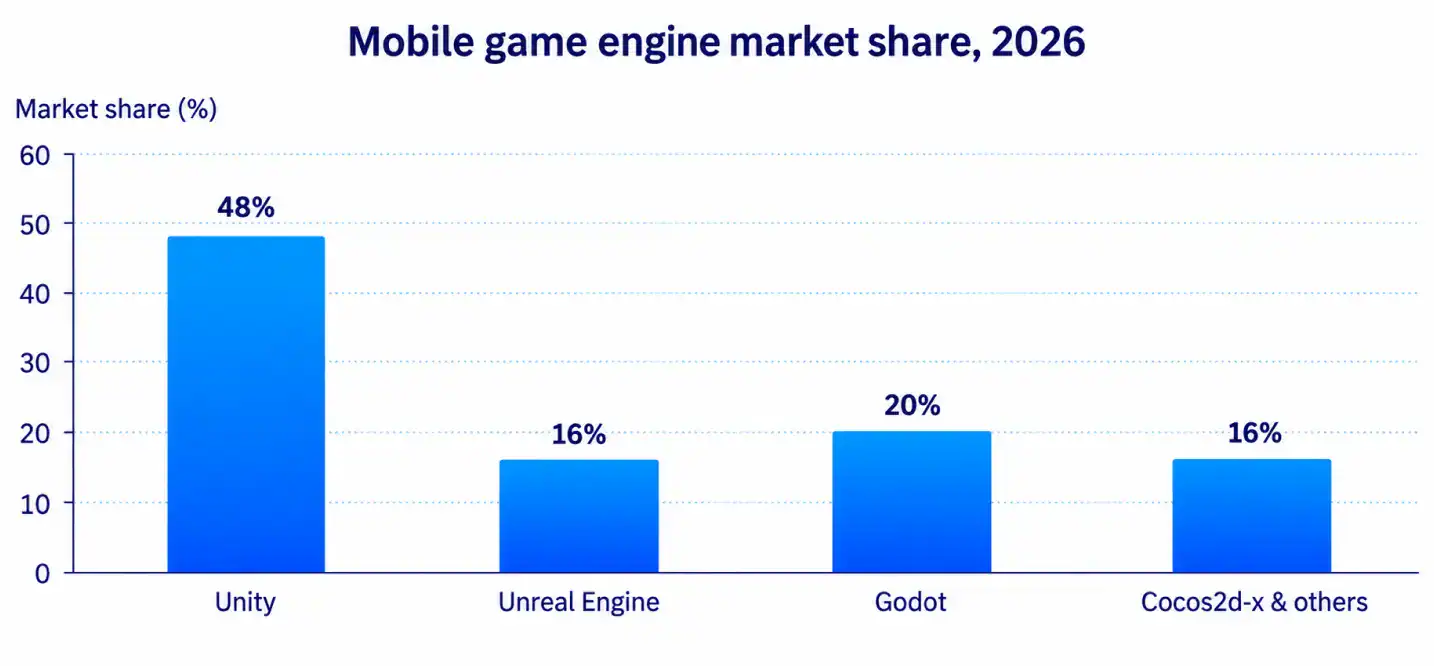
Unity holds close to 48% of the mobile game engine market in 2026. That’s larger than any single competitor.
Top Mobile Game Engines Compared
| Engine | Language | Learning Curve | Mobile Market Share |
| Unity | C# | Moderate | ~48% |
| Unreal Engine | C++ / Blueprints | Steep | ~16% |
| Godot | GDScript / C# | Easy | Growing fast |
| Cocos2d-x | JavaScript / C++ | Moderate | Niche, mostly Asia |
Is Unity Still Popular in 2026? (Adoption Stats)
Yes. Very much so.
Unity’s Hub alone has crossed 20 million downloads. Over 500,000 developers use it as their main engine. That’s not a shrinking community. That’s a massive, active one.
Unity also claims that roughly 70% of the top-grossing mobile games run on its engine. Some reports put the number even higher, closer to 82 of the top 100 mobile titles. Either way, the pattern is clear. Mobile developers keep choosing Unity, year after year.
If you’re building a mobile game development company partnership or team from scratch, this kind of adoption matters. It means more hires available, more plugins, and more support when something breaks.
Studios exploring a custom game development company partnership often look at community size first. Bigger communities mean faster troubleshooting and easier onboarding for new hires.
A Low Barrier to Entry That Doesn’t Cap Your Ceiling
Unity uses C#. It’s readable. It’s beginner-friendly. Most computer science grads already know it.
That matters for hiring. You’re not stuck searching for niche talent. You can pull from a huge pool of developers who already write C#.
But easy to learn doesn’t mean limited. Unity also powers complex 3D games, AR apps, and simulations. Studios don’t outgrow it quickly. That’s rare for a beginner-friendly tool.
Around 60% of Unity’s active developer base works solo or in small teams. That tells you something. The engine scales down just as well as it scales up.
One Engine, Multiple Platforms
This is the real reason mobile studios love Unity. You build once. You publish almost everywhere.
iOS, Android, consoles, PC, even web browsers. One codebase, several outputs. That saves real money on development time.
Platforms Unity Supports
| Platform | Supported | Notes |
| iOS | Yes | Native performance, App Store ready |
| Android | Yes | Widest reach, most installs |
| Windows / macOS | Yes | Desktop builds from same project |
| Consoles (PlayStation, Xbox, Switch) | Yes | Requires platform-specific licensing |
| WebGL | Yes | Browser-based games |
| AR/VR (ARKit, ARCore, Meta Quest) | Yes | Strong XR toolset |
If your roadmap includes both a mobile launch and a later console port, this flexibility is huge. It’s one of the top reasons Unity game development services stay in demand across so many studios.
Unity vs Godot vs Unreal for Mobile
People ask this a lot. Which one should I actually pick?
Unreal produces stunning visuals. But it’s heavier on mobile devices. Battery drain and file size become real issues. Godot is lightweight and fully free. It’s improving fast, but its mobile tooling and asset ecosystem are still catching up to Unity’s.
Unity’s game-development engine market share sits around 24% overall, ahead of Unreal’s 16%. On Steam alone, Unity powered 51% of 2024 releases, compared to Unreal’s 28%. Volume favors Unity. Big-budget visual polish favors Unreal.
Unity vs Godot vs Unreal (Mobile Focus)
| Factor | Unity | Godot | Unreal Engine |
| Licensing | Freemium, revenue-based fees | Fully free, open source | Free until revenue threshold, then royalty |
| Mobile Performance | Excellent | Good, improving | Heavy, needs optimization |
| Asset Store | Massive, mature | Small, growing | Large but pricier assets |
| Community Size | Very large | Fast-growing | Large, AAA-focused |
| Best For | Cross-platform mobile at scale | Small teams, 2D-heavy games | High-end 3D visuals |
If you’re deciding between Godot and Unity as a first engine to learn, Unity still wins on job availability. Its bigger install base means more tutorials, more forum answers, and more studios hiring for it.
Licensing Models and What They Mean for Developers
Unity had a rough patch. In 2023, it proposed a runtime fee charging per install. Developers were furious. Some threatened to switch engines entirely.
The company reversed course. The runtime fee was canceled in 2024. Today, Unity Personal is free up to $200,000 in revenue or funding. Unity Pro kicks in after that threshold, with pricing that rose about 5% in January 2026.
Godot stays fully free and open source, no thresholds at all. That’s appealing for bootstrapped teams. But Unity’s paid tiers come with support, cloud services, and enterprise tools that many growing studios actually need.
The Unity Asset Marketplace Advantage
Building a mobile game from scratch takes time. Sound effects, character models, UI kits, none of that appears out of nowhere.
Unity’s Asset Store solves this. It’s one of the largest marketplaces of its kind in gaming. Developers buy pre-built assets, animations, and plugins instead of building everything from zero.
This cuts development time significantly, especially for smaller teams without dedicated art departments. It’s a big reason Unity remains the go-to for fast-moving mobile studios working on tight deadlines.
Do AAA Studios Use Unity? (2D vs 3D Strength)
Yes, they do. Unity isn’t just an indie tool anymore.
Studios across mobile, automotive, and simulation industries use Unity for production work. It’s not limited to small hobby projects. Big-budget mobile titles run on it constantly.
As for the “what engine will GTA 6 use” question, that title runs on Rockstar’s own in-house engine, RAGE, not Unity or Unreal. It’s a common search, but the two aren’t related.
Unity’s 2D toolset is especially strong. It reaches roughly 90% of the mobile 2D game market. So no, Unity is not overkill for 2D. It was built to handle both 2D and 3D equally well, which is rare among major engines.
Notable Games and Categories Built on Unity
| Category | Example Use Case |
| Hyper-casual mobile games | Fast builds, small file sizes |
| Mid-core strategy games | Cross-platform live-ops support |
| AR mobile apps | ARKit and ARCore integration |
| 2D platformers and puzzles | Lightweight, fast iteration |
| Simulation and training apps | Used outside gaming too |
C# remains the dominant language behind most of these titles, since it’s Unity’s native scripting language and the one most mobile-focused AAA teams standardize on.
Community, Documentation, and Tutorials
Getting stuck while learning a new engine is normal. What matters is how fast you find the answer.
Unity’s official documentation is thorough and updated often. Unity Learn offers free guided courses for beginners through advanced users. Add in Stack Overflow, Reddit, and thousands of YouTube tutorials, and the learning resources are hard to beat.
Unity’s community includes roughly 7 million developers worldwide. That’s a massive base of people who’ve likely already solved the exact problem you’re stuck on.
Post-Release Support: Why the Engine Matters After Launch
Launching the game isn’t the finish line. It’s the starting point.
Unity supports live analytics, remote config, and cloud-based updates without needing a full app store resubmission for every tweak. That’s critical for mobile games running live events, seasonal content, or ongoing balance changes.
Roughly 45% of studios now name efficient live-ops tooling as a top priority for engine selection. Unity’s built-in services make this easier than building custom backend tools from scratch.
Multiplayer and Mobile: Why Engine Choice Affects Live Games
Multiplayer mobile games need stable networking, low latency, and reliable matchmaking. That’s not easy to build from scratch.
Unity’s multiplayer tooling has matured a lot, with built-in netcode and cloud relay options. This matters more every year, since the mobile game engine market itself is projected to grow from $3.8 billion in 2026 to $11.8 billion by 2036, much of that driven by live, connected mobile experiences.
Teams offering Multiplayer Game Development Services lean on Unity heavily for exactly this reason. It removes a lot of the networking guesswork.
How Cubix Helps Studios Build with Unity
Cubix has spent years building mobile games on Unity, across genres and platforms. Hyper-casual titles, mid-core strategy games, AR-powered apps, all built and shipped using the same engine covered throughout this guide.
The team doesn’t just write code. It handles full production, from prototyping through live-ops support after launch. That end-to-end approach is what studios need when timelines are tight and budgets don’t leave room for guesswork.
Unity expertise isn’t a side skill at Cubix. It’s a core part of how the studio operates day to day.
Why Studios Choose Cubix for Mobile Game Development
Picking a development partner is a lot like picking an engine. Fit matters more than flash.
Cubix works with startups and established studios alike, adapting to whatever stage a project is at. Early concept, mid-build, or post-launch scaling, the team plugs in where needed.
If you’re planning a mobile game and want a partner who already knows Unity’s strengths and its limits, reaching out to Cubix is a solid next step. Fewer surprises, faster builds, and a team that’s shipped this before.
Want to discuss your project? Our experts are just a click away.
Contact UsFrequently Asked Questions
1. Is Unity or Unreal better for mobile games?
Unity, in most cases. It’s lighter on mobile hardware and has a bigger mobile-specific toolset. Unreal is better suited for high-end 3D visuals on flagship devices.
2. Should I learn Godot or Unity first?
Unity, if job prospects matter to you. Its larger user base means more tutorials, more job listings, and more community support.
3. Is Unity overkill for 2D games?
No. Unity was built to support both 2D and 3D well, and it covers a large share of the mobile 2D market already.
4. Why don’t some developers like Unity anymore?
Mostly due to the 2023 runtime fee proposal, which was later canceled. Trust took a hit, but pricing has since become more developer-friendly again.
5. What engine do most AAA games use?
It varies by platform. Console and PC AAA titles often lean toward Unreal or custom in-house engines. Mobile AAA titles lean heavily toward Unity.
6. What programming language do AAA games typically use?
C++ is common for in-house and Unreal-based engines. C# is the standard for Unity-based projects, including many mobile AAA titles.