Key Takeaways
- Mobile games generated roughly $81.8 billion in in-app purchase revenue in 2025, and non-gaming apps overtook games in total IAP spend for the first time that same year.
- Seven core models drive mobile game revenue: in-app purchases, advertising, subscriptions, battle passes, premium paid games, sponsorships, and hybrid monetization.
- Most top-grossing games now combine at least two revenue streams instead of relying on a single monetization method.
- Genre shapes monetization. Hyper-casual games lean on ads, while RPG and gacha titles lean on in-app purchases and collection mechanics.
- Tracking ARPU, ARPDAU, LTV, and retention rate matters as much as picking a model, because a poorly tuned model can hurt player retention even while it raises short-term revenue.
Mobile games were downloaded more than 50 billion times globally in 2026, with over 95,000 mobile games downloaded every minute, highlighting the enormous scale of the mobile gaming audience.
But how do mobile games actually make money? From in-app purchases and rewarded ads to subscriptions, battle passes, sponsorships, and hybrid monetization, studios use different models to turn engaged players into sustainable revenue.
The right mobile game monetization model depends on your genre, audience, gameplay loop, and player behavior. In this guide, you’ll learn how each model works, which genres they fit best, how much mobile games can make, and which metrics help you increase revenue without hurting player retention.
Want to discuss your project? Our experts are just a click away.
Contact UsWhat Is Mobile Game Monetization?
Mobile game monetization is the process of generating revenue from a mobile game through in-app purchases, advertising, subscriptions, paid downloads, or a combination of these models. Developers choose a monetization strategy based on the game’s genre, target audience, gameplay loop, and player behavior.
For free-to-play games, monetization allows developers to generate revenue without charging players upfront. Players may purchase virtual currency, cosmetic items, upgrades, or battle passes, while others may generate revenue by viewing ads. Paid games, meanwhile, can earn revenue through one-time purchases or additional in-game content.
The best mobile game monetization strategy balances revenue with player experience. A hyper-casual game may rely heavily on rewarded ads, while an RPG may generate more revenue through in-app purchases, subscriptions, and limited-time events. The goal is to create multiple opportunities to monetize engaged players without disrupting gameplay or hurting retention.
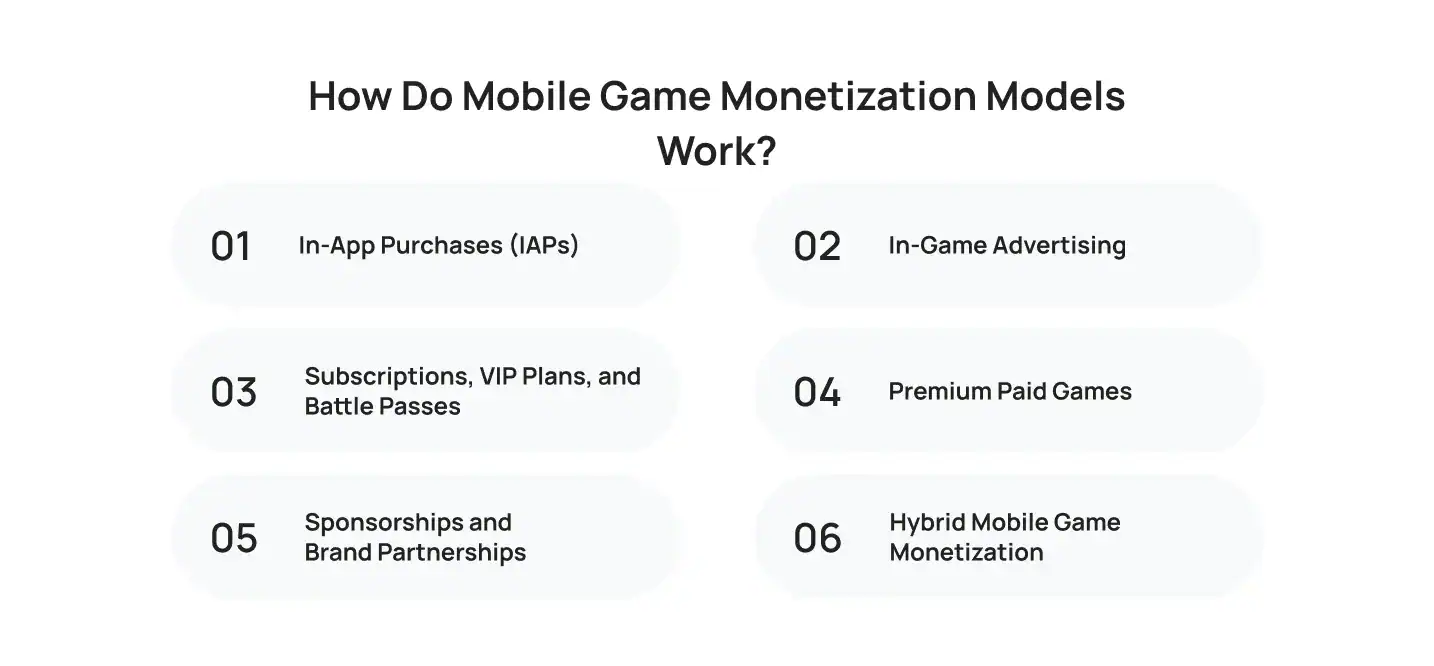
How Do Mobile Game Monetization Models Work?
Mobile game monetization models generate revenue in different ways. Some charge players for digital content or benefits, some monetize player attention through advertising, and others use recurring payments such as subscriptions or battle passes. Many successful games combine multiple models to monetize different types of players without disrupting the core gameplay experience.
1. In-App Purchases (IAPs)
In-app purchase monetization lets players buy digital goods directly inside the game. It remains a dominant revenue driver in mobile gaming, and a well-designed in-app purchase strategy can play a central role in a profitable title.
Consumable In-App Purchases
Consumables are items that get used once and disappear, such as extra lives, energy refills, or currency packs. Because players can purchase them repeatedly, they can generate significant lifetime revenue from paying users.
Non-Consumable In-App Purchases
Non-consumable purchases unlock content permanently, such as a new character or level pack. Players typically buy these items once, so studios rely on volume, perceived value, and the appeal of the content rather than repeat transactions.
Virtual Currency, Skins, and Power-Ups
Soft and hard currency systems let players buy cosmetics, power-ups, or boosts. Skins typically provide no gameplay advantage, which can keep monetization fair while still generating strong revenue in competitive titles.
2. In-Game Advertising
In-game advertising monetizes free players by showing ads from third-party advertisers. It works especially well in high-volume, low-spend genres such as hyper-casual games and directly contributes to mobile game ad revenue. If you are scoping a new title around this model, our list of hyper-casual game ideas shows which concepts pair best with ad-heavy monetization.
Rewarded Video Ads
Rewarded video ads let players opt in to watch a short video in exchange for in-game rewards. Over 70% of players prefer rewarded video ads to other formats, and users who engage with them show up to 3.5x higher retention along with 4x higher IAP conversion compared to non-engaged players, according to Unity’s mobile monetization research. Mobile gamers also prefer rewarded ads to interstitials by a 4-to-1 margin.
Interstitial Ads
Interstitial ads are full-screen ads shown between levels or at other natural breaks in gameplay. They generate revenue without requiring player action, but placing them too frequently can increase churn.
Banner Ads
Banner ads sit at the top or bottom of the screen during gameplay. They generally earn less per impression than rewarded or interstitial formats, but they can run continuously without directly interrupting play.
Playable Ads and Offerwalls
Playable ads let users try a mini demo of another game before installing it, which can produce stronger click-through rates than static ads. Offerwalls list multiple offers at once and can attract highly engaged users who are willing to complete actions in exchange for in-game rewards.
3. Subscriptions, VIP Plans, and Battle Passes
Recurring monetization models build predictable revenue by charging players on a regular cycle instead of relying only on individual transactions.
Mobile Game Subscriptions
A subscription model charges players weekly or monthly for perks such as ad removal, bonus currency, or exclusive content. Subscription-based mobile game monetization grew 13% year-over-year, reaching an estimated $4.2 billion globally in 2025.
Battle Pass Monetization
Battle pass monetization sells a tiered progression track with free and premium reward paths. Battle passes now appear in nearly 60% of top-grossing mobile titles and account for roughly 22% of total IAP revenue among those games, making battle pass monetization one of the strongest retention-linked revenue tools available today.
Ad-Free Premium Plans
Ad-free plans charge a flat fee to remove ads permanently. This model works best in games with a strong core loop, since players need a clear reason to value uninterrupted play.
4. Premium Paid Games
Premium games charge players upfront before they can download or play the full game.
Paid Downloads and One-Time Purchases
A one-time price removes the need for ongoing monetization through ads or recurring purchases. This suits niche, narrative, or puzzle games with a defined playtime, though it can limit the addressable market compared to free-to-play. If you are weighing which format fits your concept, our guide to game monetization statistics compares premium and free-to-play performance in more depth.
5. Sponsorships and Brand Partnerships
Sponsorship monetization brings in revenue directly from brands rather than players or ad networks.
Branded Content and In-Game Events
Branded events, sponsored levels, and co-branded cosmetics let studios earn a flat fee or revenue share from a partner brand. This works best for games with a large, engaged, demographically clear player base.
6. Hybrid Mobile Game Monetization
Hybrid monetization mobile games combine two or more revenue streams instead of depending on one.
Combining Ads, In-App Purchases, and Subscriptions
Most top-grossing titles now blend rewarded ads, IAPs, and sometimes a subscription tier. Hybrid-casual games grew IAP revenue by 37% in a single year, making it one of the fastest-growing segments in the industry. Combining models spreads risk because a studio is not fully dependent on one payer segment or one ad network’s fill rate.
How Does Each Model Make Money?
Each mobile game monetization model generates revenue differently. The right approach depends on how players engage with the game, how often they spend, and the game’s genre.
| Monetization Model | How It Generates Revenue | Typical Payer or Engagement Rate | Best Fit |
| In-App Purchases | Direct player payments for virtual currency, items, upgrades, or content | 2–5% of players ever pay | Casual, RPG, strategy |
| Advertising | Revenue from ad impressions, clicks, and completed actions paid by advertisers | 100% of free users can be exposed to ads | Hyper-casual, casual |
| Subscriptions | Recurring weekly or monthly payments for premium benefits | Small but high-LTV segment | Mid-core, simulation |
| Battle Passes | Seasonal purchases that unlock tiered premium rewards | Up to 22% of IAP revenue in top titles | RPG, strategy, PvP |
| Premium Games | One-time purchase made before downloading or accessing the game | 100% of paying installers | Puzzle, narrative |
| Sponsorships | Brand-paid placements, collaborations, or in-game events | N/A, paid by brands or advertisers | High-DAU casual titles |
| Hybrid Monetization | Combines ads, IAPs, subscriptions, and other revenue streams | Varies by player segment | Nearly all genres today |
Mobile Game Monetization Models by Game Genre
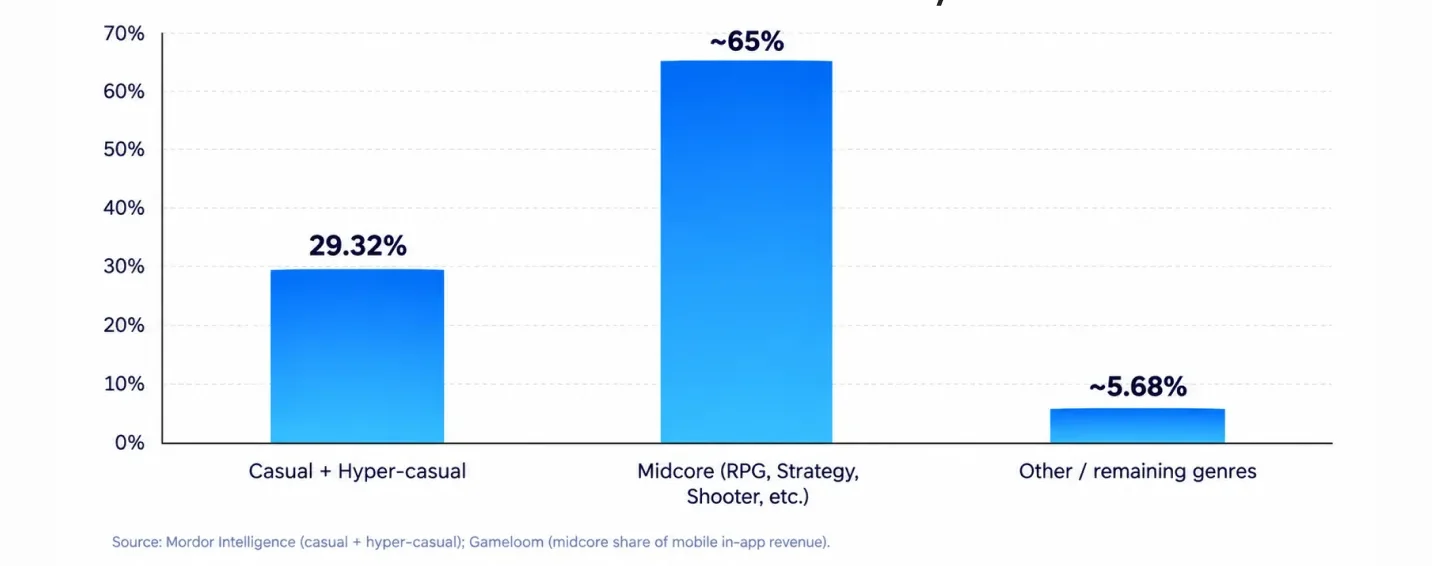
Mobile game monetization models vary by genre, from advertising-focused strategies in simple games to deeper in-app purchases in complex, strategic titles.
In 2025, casual and hyper-casual games accounted for 29.32% of the mobile games market, while strategy and MOBA games are projected to grow at a 15.71% CAGR through 2031.Mobile Games Make Money
| Genre Category | Dominant Monetization Model | Secondary Model | Monetization Focus | Key Examples |
|---|---|---|---|---|
| Hyper-Casual | In-game advertising | Light IAP | Ad impressions per session | Mob Control, Paper.io |
| Casual / Puzzle | In-app purchases | Rewarded ads | Booster and life sales | Royal Match, Candy Crush |
| RPG / Gacha | Gacha IAP and loot boxes | Battle pass | Character and item pulls | Genshin Impact, RAID |
| Strategy (4X) | In-app purchases | Subscriptions | Resource packs, VIP tiers | Last War: Survival, Whiteout Survival |
| Simulation / Midcore | In-app purchases | Ads and subscriptions | Time-skip and building purchases | SimCity, FarmVille |
Genre selection directly affects which monetization strategy is most likely to perform for your title. For a closer look at how competitive multiplayer games monetize differently from single-player genres, see our breakdown of PVP game monetization.
Free-to-Play vs. Premium Mobile Games: How Revenue Models Differ
Free-to-play and premium mobile games generate revenue in fundamentally different ways. Here is how the main monetization formats compare:
- Free download + ads: Zero barrier to entry, with revenue generated from advertisers. This model works best with high download and engagement volume.
- Free download + IAP: No upfront cost, with revenue depending on a smaller share of players making meaningful in-app purchases.
- Free download + subscriptions: A free core game with a recurring paid layer that creates more predictable revenue.
- Paid download: Revenue is collected upfront, with less ongoing monetization pressure but a smaller potential audience.
- Hybrid models: Combine several monetization methods, reducing dependence on any single revenue source.
Free-to-play titles account for the large majority of digital game revenue overall, even though the games themselves cost nothing to download. Premium games, by contrast, trade a smaller audience for guaranteed revenue from each paying install. Our full mobile game revenue statistics report breaks down how these two revenue models perform across regions and platforms.
How to Choose the Right Monetization Model for Your Mobile Game
Choosing the right monetization model for a mobile game means matching your game genre, player session length, and core gameplay loop with the strategy your players naturally expect.
Understand Your Player Segments
Not every player behaves the same way. Segment your audience into non-payers, minnows, dolphins, and whales before designing pricing or ad frequency.
Define Your Target Audience
Age, region, and platform can affect spending habits. A strategy game aimed at Western mid-core players may monetize very differently from a puzzle game targeting a global mass audience.
Analyze Your Game Genre and Gameplay Loop
Your core gameplay loop determines what players are likely to pay for. Speed and mastery can favor ads and consumables, while collection mechanics can support gacha IAP and battle passes.
Choose a Primary Monetization Model
Start with one primary revenue stream that matches your genre and audience. Launching with multiple monetization systems at once can confuse players and make your data harder to interpret.
Add a Secondary Revenue Stream
Once your primary model is stable, add a secondary stream, such as rewarded ads in an IAP-driven puzzle game. This creates the foundation of the hybrid monetization model used across many mobile games.
Design Fair Ads, Offers, and In-Game Purchases
Aggressive monetization can push players away faster than it grows revenue. Cap ad frequency, price offers transparently, and avoid pay-to-win mechanics in competitive genres.
Track Monetization and Retention Metrics
You cannot optimize what you do not measure. Set up dashboards for ARPU, ARPDAU, and retention rate before launch rather than waiting until after launch.
Test, Refine, and Scale Your Strategy
Run A/B tests on pricing, ad placement, and offer timing continuously. Monetization is not a one-time setup; it is an ongoing process tied to live ops. Planning monetization alongside the build, rather than adding it after launch, is easier with dedicated mobile game development solutions that integrate analytics, ad SDKs, and payment systems directly into the game economy.
Key Mobile Game Monetization Metrics to Track
Picking a monetization model is only half the job. You also need the right metrics to determine whether it is working and where you can improve revenue without hurting retention.
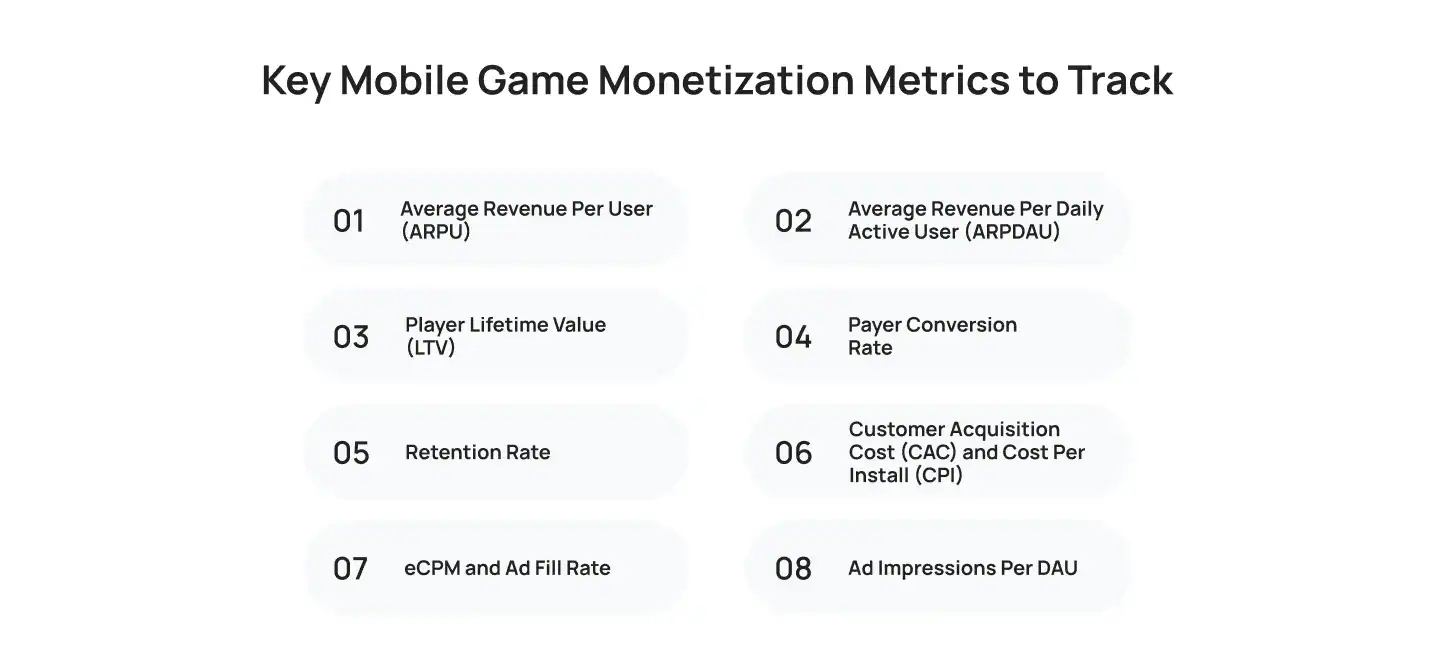
1. Average Revenue Per User (ARPU)
ARPU measures total revenue divided by total users over a set period. Worldwide ARPU in mobile games reached an estimated $60.14 in 2025, with US ARPU at $60.58, projected to climb toward $65 by 2029.
2. Average Revenue Per Daily Active User (ARPDAU)
ARPDAU measures daily revenue per active user. Because it focuses on daily activity, it can react faster than ARPU and helps identify the short-term impact of a new offer, event, or ad placement.
3. Player Lifetime Value (LTV)
LTV estimates the total revenue a single player generates throughout their time in your game. Comparing LTV with acquisition costs helps determine whether your monetization model can support your marketing spend.
4. Payer Conversion Rate
This metric shows the percentage of players who make at least one purchase. Only 2–5% of free-to-play players ever pay, while the top 2% of spenders generate more than half of all IAP revenue in a typical title.
5. Retention Rate
Retention rate tracks the percentage of players who return on Day 1, Day 7, and Day 30. Since retention determines how many players remain available to monetize over time, it is a monetization metric as well as an engagement metric.
6. Customer Acquisition Cost (CAC) and Cost Per Install (CPI)
CAC measures the cost of acquiring a customer, while CPI measures the cost of acquiring an install. Tracking both helps you understand acquisition efficiency and whether revenue from players can justify your marketing spend.
7. eCPM and Ad Fill Rate
eCPM measures effective revenue per thousand ad impressions, while fill rate shows the percentage of ad requests that result in an ad being served. Rewarded video ads can achieve higher eCPMs than interstitial and banner formats, although results vary by market, platform, and ad network.
8. Ad Impressions Per DAU
This metric tracks the average number of ad impressions each daily active user sees. A healthy range provides enough exposure to generate revenue without increasing ad fatigue and negatively affecting retention.
How to Improve Mobile Game Monetization Without Hurting Retention
- Personalize offers by player behavior: Show different offers to spenders versus non-spenders instead of one static storefront.
- Use rewarded ads at natural breakpoints: Placing ads after a failed level performs better than interrupting active play.
- Introduce purchases at the right moment: Offer starter packs right after a player hits friction, not before they understand the game.
- Create limited-time events: Time-limited content drives urgency and can lift IAP volume during promotion windows.
- Balance monetization with progression: Never let paywalls block core progression, or players will churn instead of paying.
- A/B test pricing and offers: Test price points, bundle sizes, and offer timing rather than assuming one setup works forever.
How Much Money Do Mobile Games Make in 2026?
Mobile game revenue in 2026 varies enormously by studio, so treat the figures below as market context, not a guarantee for any individual title.
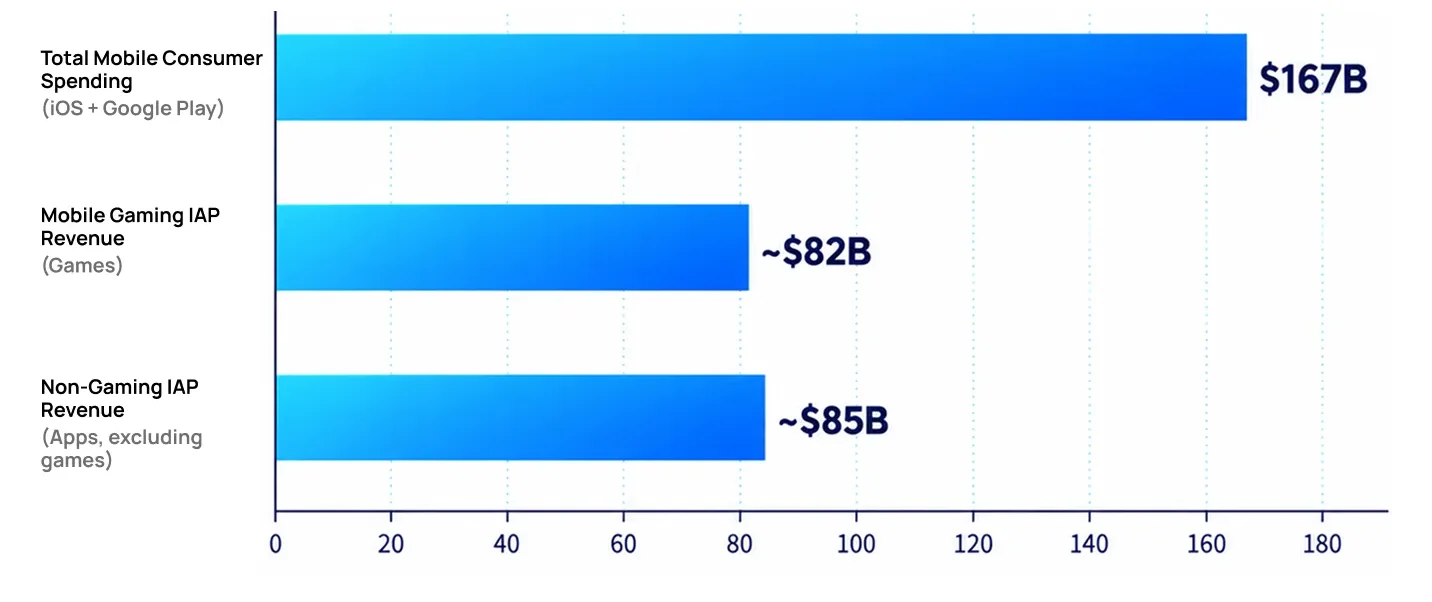
- Consumer spending on in-app purchases and paid apps across iOS and Google Play reached $167 billion in 2026, according to Sensor Tower’s State of Mobile 2026 report, a figure that reflects total app economy scale rather than profit for any single studio.
- Within gaming specifically, mobile IAP revenue reached roughly $81.8 billion in 2025. Non-gaming apps overtook games in IAP revenue for the first time that year, generating $85.6 billion against $81.8 billion for games, according to Sensor Tower’s 2026 report.
- Hybrid-casual games grew IAP revenue by 37% in a single year, one of the fastest-growing segments tracked by Sensor Tower and AppMagic.
- Regulation is reshaping revenue potential too. Brazil’s Lei 15.211/25 bans loot box sales to players under 18 starting March 2026, and the EU’s proposed Digital Fairness Act, expected later in 2026, could impose new disclosure or consent requirements on gacha game monetization across member states.
Factors That Affect Mobile Game Revenue
Several factors determine how much revenue a mobile game can generate:
- Genre: RPGs, strategy games, and other engagement-heavy genres can support deeper IAP and live-ops strategies.
- Geography: Player spending varies across markets, affecting revenue potential.
- DAU: A larger daily active user base creates more opportunities for purchases and ad impressions.
- Retention: Players who return regularly have more opportunities to generate revenue.
- Session frequency: More frequent sessions can increase ad exposure and purchase opportunities.
- Payer conversion: A higher percentage of paying players can increase IAP revenue.
- ARPDAU: This shows how much daily revenue the game generates per active user.
- Ad engagement: Rewarded and other ad formats can generate additional revenue from non-paying players.
- CPI: Lower acquisition costs can improve the economics of paid user acquisition.
- LTV: Higher player lifetime value gives a game more room to spend on acquisition.
- Monetization mix: Combining IAPs, ads, subscriptions, and other models can diversify revenue sources.
Why Retention Matters More Than Downloads Alone
Downloads show how many people install a game, but retention shows how many continue playing. A large install base has limited value if most players leave after a few days.
Higher retention gives players more opportunities to make purchases, watch rewarded ads, and engage with live events. That is why successful mobile games track retention alongside revenue metrics rather than treating downloads as the primary measure of performance
How Hybrid Monetization Can Improve Revenue Per Player
Hybrid monetization combines multiple revenue streams, such as in-app purchases, advertising, and subscriptions. This approach allows developers to monetize different player segments without relying entirely on one source of revenue.
How Cubix Can Help Build a Profitable Mobile Game
Choosing between mobile game monetization models is only useful if your game is built to support them technically and economically. Cubix works with studios to design, build, and launch mobile games with monetization strategy built into the core architecture from day one, not bolted on after launch.
As a custom game development company, Cubix helps studios plan economy design, integrate ad SDKs, and structure IAP systems that fit their genre and audience, whether you are launching a new title or overhauling monetization on an existing one.
We can help you:
- Choose the right monetization model: Align in-app purchases, rewarded ads, subscriptions, battle passes, or hybrid models with your genre and target audience.
- Design engaging gameplay loops: Build progression, rewards, and game economies that encourage continued play without disrupting the player experience.
- Build scalable mobile games: Develop games using technologies such as Unity, Unreal Engine, Nakama, AWS, and other production-ready tools based on your project’s requirements.
- Integrate analytics and monetization systems: Connect the technology needed to measure player behavior, revenue, retention, and other key performance metrics.
- Test and optimize before launch: Identify gameplay, performance, and usability issues before they affect your players.
- Support your game after launch: Continue improving the game through updates, new features, performance optimization, and ongoing support.
Want to discuss your project? Our experts are just a click away.
Contact UsFrequently Asked Questions
1. What are the most common mobile game monetization models?
In-app purchases, advertising, subscriptions, battle passes, premium paid downloads, sponsorships, and hybrid monetization that combines several of these into one system.
2. How do free-to-play games generate revenue?
Through ads shown to non-paying users and in-app purchases made by a small share of players, usually 2% to 5% of the total base.
3. What is hybrid monetization in mobile games?
It combines two or more revenue streams, most often ads and IAP, so a studio earns from both paying and non-paying players instead of relying on one group.
4. Are loot boxes still a viable monetization strategy?
Yes, but regulation is tightening. Brazil now bans loot box sales to minors, Japan requires probability disclosure, and the EU is drafting new rules, so gacha game monetization needs region-specific compliance built in.
5. How do rewarded video ads impact player retention?
They generally improve it. Players who engage with rewarded ads show measurably higher retention and are more likely to convert into paying users later.
6. What is ARPU and why is it important?
ARPU, or average revenue per user, is total revenue divided by total users. It shows whether monetization changes are actually improving revenue per player, not just downloads.
7. How does a battle pass work in mobile games?
It sells access to a premium reward track alongside a free track. Players complete challenges to earn rewards, which encourages daily logins and recurring seasonal spend.
8. Can a mobile game succeed without ads?
Yes. Premium and subscription-driven titles can succeed without advertising, though this usually limits the addressable audience compared to free-to-play.
9. How do you choose the right monetization model for your game?
Match the model to your genre, audience, and core gameplay loop first, then add a secondary revenue stream once the primary model shows stable performance.
10. What are the legal regulations for game monetization?
They vary by country. Japan restricts complete gacha mechanics, Belgium and the Netherlands ban paid loot boxes, Brazil bans loot box sales to minors, and the EU is developing broader rules under its proposed Digital Fairness Act.