Key Takeaways
- A fixed price works best for projects with a clear scope and fixed budget.
- Time & Materials offers flexibility for projects with evolving requirements
- Dedicated teams are ideal for long-term development and scalable growth.
- Compare cost, flexibility, and control before choosing an engagement model.
- The right engagement model improves project success and business outcomes.
You’ve decided to outsource your software project. Now you need to understand software development engagement models and choose the one that best fits your project’s scope, budget, and goals.
Choosing the wrong engagement model can lead to budget overruns, missed deadlines, and a team that struggles to adapt as your requirements evolve. Choosing the right one, however, sets the foundation for predictable delivery, efficient collaboration, and long-term project success.
Whether you’re building an MVP, scaling an existing product, or investing in enterprise-grade software development solutions, selecting the right engagement model is essential to achieving your business objectives.
This article breaks down the three most common models: fixed price, time and materials, and dedicated team. You’ll learn how each one works, when to use it, and how to pick the right one for your project.
Why Choosing the Right Software Development Engagement Models Matters

The wrong model causes budget overruns, missed deadlines, and poor product quality. Selecting the right model ensures you balance project control, budget predictability, and flexibility. According to recent industry benchmarks, poor alignment between project requirements and engagement structures accounts for over 30% of outsourced project failures.
The Three Most Common Software Development Engagement Models
Most software outsourcing projects fall into one of three structures:
- Fixed Price: You pay a set amount for a predefined scope of work.
- Time & Material (T&M): You pay for the actual hours spent and materials used.
- Dedicated Team: You hire a full team of developers who work exclusively on your project
Software Development Engagement Models For Businesses
Choosing the right engagement model can affect your budget, project control, flexibility, and development timeline. The best option depends on how clearly you have defined your requirements, how much involvement you want in day-to-day development, and whether your project needs room to evolve.
1. Fixed Price Engagement Model
In a fixed-price engagement, you agree on the full scope of work, the timeline, and the total cost before development starts. The vendor commits to delivering the defined product for that price, regardless of how long it actually takes them.
How the Fixed Price Model Works
You provide detailed project requirements, wireframes, and specifications before work begins. The vendor estimates the total cost and timeline. Once both parties sign the contract, the scope remains locked. Any changes require a formal change request process, which alters the final price.
Advantages of Fixed Price
- Strict Budget Predictability: You know exactly what the project costs before development starts.
- Clear Timelines: The contract defines specific launch dates and milestones.
- Low Management Overhead: The vendor handles daily project management, reducing your hands-on involvement.
Disadvantages of Fixed Price
- Total Lack of Flexibility: You cannot change features mid-development without stopping work and renegotiating the contract.
- Higher Initial Costs: Vendors include a risk premium (often 15% to 30%) to cover unexpected technical challenges.
- Risk of Lower Quality: If the vendor miscalculates the effort required, they may cut corners to preserve their profit margins.
Best Use Cases for Fixed Price Projects
- Small projects or Minimum Viable Products (MVPs) with clear, unchangeable scopes.
- Projects with strict, unyielding budgets.
- Enterprise projects with rigid procurement and approval processes.
2. Time & Material (T&M) Engagement Model
When comparing price vs time and materials, remember that time & Material billing charges you for the actual hours worked and materials used rather than a predetermined project fee. You pay for what the team delivers, tracked and reported on a regular basis, usually weekly or monthly.
How Time & Material Pricing Works
Time and material pricing allows you to pay agreed hourly, daily, or monthly rates for each developer while keeping the project scope flexible. The project scope is fluid, allowing you to add, modify, or delete features as development progresses. You receive regular timesheets and invoices based on the hours tracked by the team.
Advantages of Time & Material
- High Flexibility: You pivot the project direction based on user feedback or market changes instantly.
- Faster Project Kickoff: Work begins without waiting weeks for precise, granular documentation.
- Fair Pricing: You only pay for the exact work performed, eliminating vendor risk premiums.
Disadvantages of Time & Material
- Low Budget Predictability: The final cost can exceed initial estimates if the scope creeps or technical hurdles arise.
- High Client Involvement: You must continuously monitor progress and manage priorities to prevent budget exhaustion.
- Undefined Timelines: Without strict deadlines, projects can stretch past original targets.
Best Use Cases for Time & Material Projects
- Medium-to-large projects with evolving requirements.
- Long-term product development where market testing dictates the feature roadmap.
- Projects utilizing agile methodologies like Scrum or Kanban.
3. Dedicated Team Engagement Model
A development team model gives you a group of developers, designers, and other specialists who work exclusively on your project for an agreed period, usually months or years. You pay a fixed monthly fee per team member, covering their time, management, and often infrastructure.
How a Dedicated Development Team Works
The vendor sources and assembles a team tailored to your technical requirements, including developers, QA engineers, UX/UI designers, and scrum masters. You manage this team directly or through a dedicated project manager. You pay a fixed monthly fee per team member, covering their salary and the vendor’s administrative overhead.
Advantages of a Dedicated Team
- Deep Product Alignment: The team integrates with your internal culture and develops a deep understanding of your business goals.
- Full Control: You manage tasks, workflows, and daily priorities directly.
- High Scalability: You scale the team size up or down as your development workload changes.
Disadvantages of a Dedicated Team
- High Management Overhead: You must invest time in daily communication, tracking, and management.
- Inefficient for Short Tasks: This model is expensive if you do not have a steady stream of full-time work for the team.
- Higher Administration Responsibility: You handle the strategic onboarding and cultural alignment of the remote team.
Best Use Cases for Dedicated Teams
- Long-term, ongoing software development initiatives with shifting priorities.
- Tech startups scaling their core product architecture.
- Companies expanding their in-house engineering capacity without local hiring costs
Want to discuss your project? Our experts are just a click away.
Contact UsFixed Price vs Time & Material vs Dedicated Team – Comparison table
Choosing between these engagement models becomes easier when you compare them side by side. This table highlights the key differences in time and material vs fixed pricing, flexibility, scalability, and project suitability, helping you determine which model best aligns with your business goals, fixed budget, and delivery expectations.
| Comparison Factor | Fixed Price | Time & Material | Dedicated Team |
| Pricing Model | Single flat fee | Hourly or daily rates | Fixed monthly per-person fee |
| Budget Predictability | High | Low to medium | High (monthly predictability) |
| Project Flexibility | Low | High | Very high |
| Scope Changes | Requires formal contract amendments | Handled dynamically | Handled dynamically |
| Development Speed | Medium | Fast | Very fast |
| Client Involvement | Low | Medium to high | High |
| Risk Distribution | Vendor carries the risk | Shared risk | Client carries the risk |
| Team Scalability | None | Limited | High |
| Best Project Size | Small to medium | Medium to large | Large and continuous |
| Best For | Clear, static MVPs | Agile product development | Long-term team extension |
Which Software Development Engagement Model Should You Choose?
There is no universal answer to the time and materials vs fixed debate because every project has different priorities. The right choice depends on your budget, project complexity, timeline, and whether your requirements are expected to evolve throughout development.
Choose Fixed Price If
You have a well-defined project scope, clear technical requirements, and an exact blueprint of your application before development begins. Your budget cannot change under any circumstance, and you prefer predictable costs with minimal day-to-day involvement. This model works best for short-term projects where major scope changes are unlikely.
Choose Time & Material If
Your product requires continuous iterations, evolving features, or ongoing feedback throughout development. You want to launch quickly, validate ideas with real users, and refine the product based on data and market demands. This model is ideal if you’re comfortable reviewing progress regularly and adapting priorities as the project evolves.
Choose Dedicated Team If
You are building a complex, long-term software platform that requires continuous development and strategic planning. A dedicated team offers maximum flexibility, faster scaling, and collaboration that feels like an extension of your in-house team, making it an excellent choice for growing startups and enterprises alike.
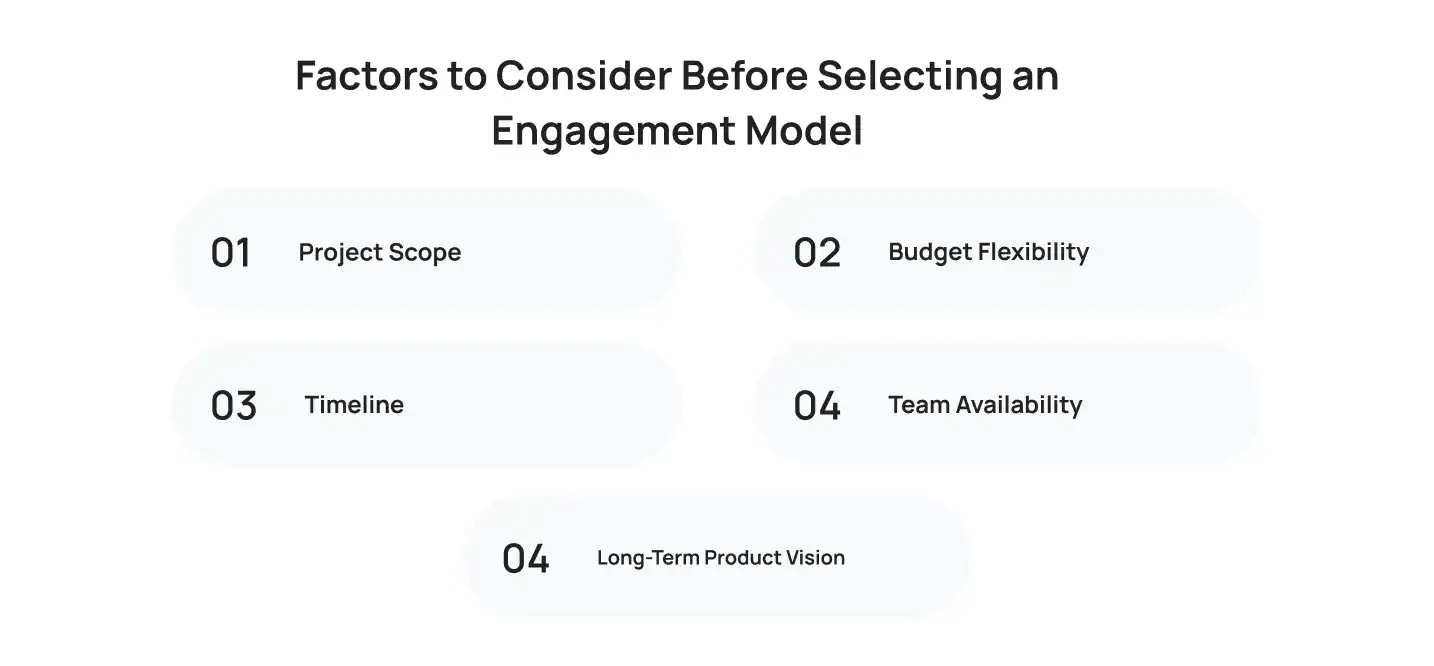
Factors to Consider Before Selecting an Engagement Model
Choosing the wrong model can sink your project before the first line of code is written. To make the right choice, you must evaluate how your internal operations, financial constraints, and product goals align with each model’s structure.
Project Scope
If your scope is fully defined and documented, select Fixed fee. If your scope is vague or likely to change, choose time & materials or a dedicated team.
- Requires precise wireframes, user stories, and technical specifications established during the Software Development Lifecycle (SDLC).
- Vague or evolving requirements lead to constant friction under a locked contract.
- Dynamic projects thrive under fluid models that allow for progressive feature discovery.
Budget Flexibility
Strict budgets require fixed-price or small, capped time & material milestones. Scalable budgets seeking maximum value align best with dedicated teams.
- Fixed-price contracts protect you from market fluctuations and technical surprises.
- Variable models ensure you pay only for useful, working features rather than vendor safety buffers.
- Scalable budgets allow teams to optimize the product based on real-time user data.
Timeline
A fixed price requires a long upfront planning phase. Time & Material and Dedicated Team models allow you to start development almost immediately.
- Fixed-price models delay kickoff because you must negotiate every detail before signing.
- Agile models let you onboard engineers quickly to capture urgent market opportunities.
- You can build your product iteratively while refining future requirements on the fly.
Team Availability
Evaluate your internal capacity. If you lack project managers, choose Fixed Price. If you have strong technical leadership, choose a dedicated team.
- Fixed-price shifts day-to-day management onto the vendor, requiring only your high-level review.
- Dedicated teams require a product owner or tech lead on your side to assign tasks.
- You must have the internal bandwidth to manage daily communication with a dedicated setup.
Long-Term Product Vision
One-off tools work well under fixed-price contracts. Core business platforms that require years of updates demand a dedicated team.
- Simple utilities and static applications are ideal for one-off fixed-price setups.
- Complex products require continuous maintenance, feature rollouts, and scalability updates.
- Dedicated teams build deep institutional knowledge that external one-off developers cannot match.
Find the Best Engagement Model for Your Project with Cubix
Every software project has different requirements, timelines, and growth expectations. A startup launching an MVP needs a different engagement structure than an enterprise building a large-scale digital platform. Selecting the right engagement model is only one part of the decision. You should also understand how to choose the right software development company before committing to a long-term technology partner.
At Cubix, our custom software developers help businesses evaluate project requirements, technical complexity, budget flexibility, and long-term product roadmaps before recommending the most suitable engagement model.
Whether you need a fixed-price approach for a well-defined project, a time & material model for agile development, or a dedicated team for continuous product growth, we tailor our engagement structure to align with your unique business goals.
With experience across mobile apps, web platforms, enterprise software, gaming, and AI-powered solutions, Cubix provides the flexibility to scale development resources as your project evolves. Our focus is not only on delivering code but also on building long-term technology partnerships that support business growth.If you’re still evaluating potential vendors, comparing the best software development companies can help you identify a partner with the right technical expertise and engagement approach.
Want to discuss your project? Our experts are just a click away.
Contact UsBottom Line
There is no single best software development engagement model. The right choice depends on how clearly your requirements are defined, how much flexibility you need, and how involved you want to be during development.
- Fixed Price works best for projects with a stable scope and a non-negotiable budget.
- Time & materials are ideal for products that evolve through continuous feedback and iteration.
- Dedicated team is the strongest option for long-term software initiatives that require scalability, direct collaboration, and ongoing development
Frequently Asked Questions
1. What is the main difference between fixed price and time and material models?
Fixed price locks in one total cost for a defined scope before work begins. Time and materials bill you for actual hours worked, so the total cost varies based on how much time the project takes.
2. Which engagement model is best for a startup building an MVP?
A fixed price works well if your MVP scope is fully defined and you want budget certainty. If you expect to adjust features based on early user feedback, time and materials gives you more room to change direction without renegotiating a contract.
3. Is a dedicated team more expensive than time and materials?
Not necessarily. Dedicated teams often cost less per hour than T&M staffing for long-term work, since you’re paying a stable monthly rate instead of variable hourly billing. The savings show up over months, not on a single short project.
4. Can you switch engagement models partway through a project?
Yes. Many companies start with a fixed price for an MVP, then move to time and materials or a dedicated team once the product proves out and ongoing development begins. Discuss this transition with your vendor before signing the initial contract.
5. How do you manage risk with a time and material contract?
Set a not-to-exceed budget cap, review timesheets and sprint reports regularly, and keep a product owner actively involved in prioritizing the backlog. This keeps the vendor accountable without eliminating the flexibility that makes T&M useful.
6. What questions should you ask a vendor before choosing an engagement model?
Ask how they handle scope changes, how they report time and progress, what happens if the project runs over the original estimate, and whether they offer flexibility to switch models as your needs change.