Blog Summary:
- Android app development in 2026 typically costs between $15,000 and $300,000+, depending on complexity, features, and infrastructure.
- The biggest cost drivers are app complexity, custom features, UI/UX design, backend development, security, and third-party integrations.
- Building an MVP first helps startups reduce development costs while validating product-market fit before investing in advanced functionality.
- Ongoing maintenance costs average 15% to 20% of the original development budget per year, covering updates, bug fixes, and platform compatibility.
- A detailed discovery phase and clear project scope provide the most accurate cost estimate and help prevent budget overruns during development.
One of the first questions every startup asks is simple: “How much will an Android app actually cost?” Unfortunately, there isn’t a universal answer. Android app development costs in 2026 vary widely depending on complexity, technology, integrations, design, and long-term maintenance. At the same time, demand for Android applications continues to grow, with the global Android app development market valued at $10.2 billion in 2025 and projected to reach $26.8 billion by 2034, expanding at a CAGR of 11.3% from 2026 to 2034.
This guide breaks down every major cost factor so you can estimate your Android app development pricing with confidence before starting your project.
At a Glance: Android App Development Cost in 2026
| Question | Answer |
| Cost Range | $15,000 – $300,000+ |
| Typical Timeline | 2–18 months |
| Recommended Language | Kotlin |
| Annual Maintenance | 15–20% of build cost |
| Cheapest Starting Point | MVP |
| Most Expensive Tier | Enterprise |
| Cross-Platform Savings | 30–50% vs. separate native apps |
| Play Store Launch Fee | $25 one-time |
What Is Android App Development?
Android app development is the process of designing, building, testing, deploying, and maintaining applications for Android smartphones, tablets, wearables, TVs, and other Android-powered devices. Depending on the project’s goals, businesses can choose native Kotlin and Java development or cross-platform frameworks like Flutter and React Native. The technology stack, feature requirements, and development approach all influence the overall cost, making it important to understand the fundamentals before planning your budget.
Why Android App Development Is a Smart Investment
Android app development gives businesses access to the world’s largest mobile ecosystem, making it a strategic investment for companies looking to reach a broad and diverse audience. The Google Play Store hosts more than 3.7 million Android applications, highlighting both the platform’s scale and the opportunities available for businesses that build high-quality mobile experiences. Combined with Android’s extensive global market reach and Google Play’s one-time $25 developer registration fee, it offers a cost-effective way to launch and grow a mobile presence.
While competition continues to increase, Android remains one of the most accessible platforms for businesses of all sizes. Its broad device compatibility, worldwide user base, and relatively low publishing costs make it well suited for startups validating new ideas as well as enterprises expanding their digital offerings. Investing in a well-designed Android app is not just about building software. It is about creating a scalable channel for customer engagement, brand visibility, and long-term business growth.
Why Android App Development Cost Varies
One of the biggest misconceptions in app development is expecting a precise quote in the first conversation. A reliable estimate comes only after the project requirements are clearly defined, because every decision, from features and design to security and infrastructure, affects the final budget.
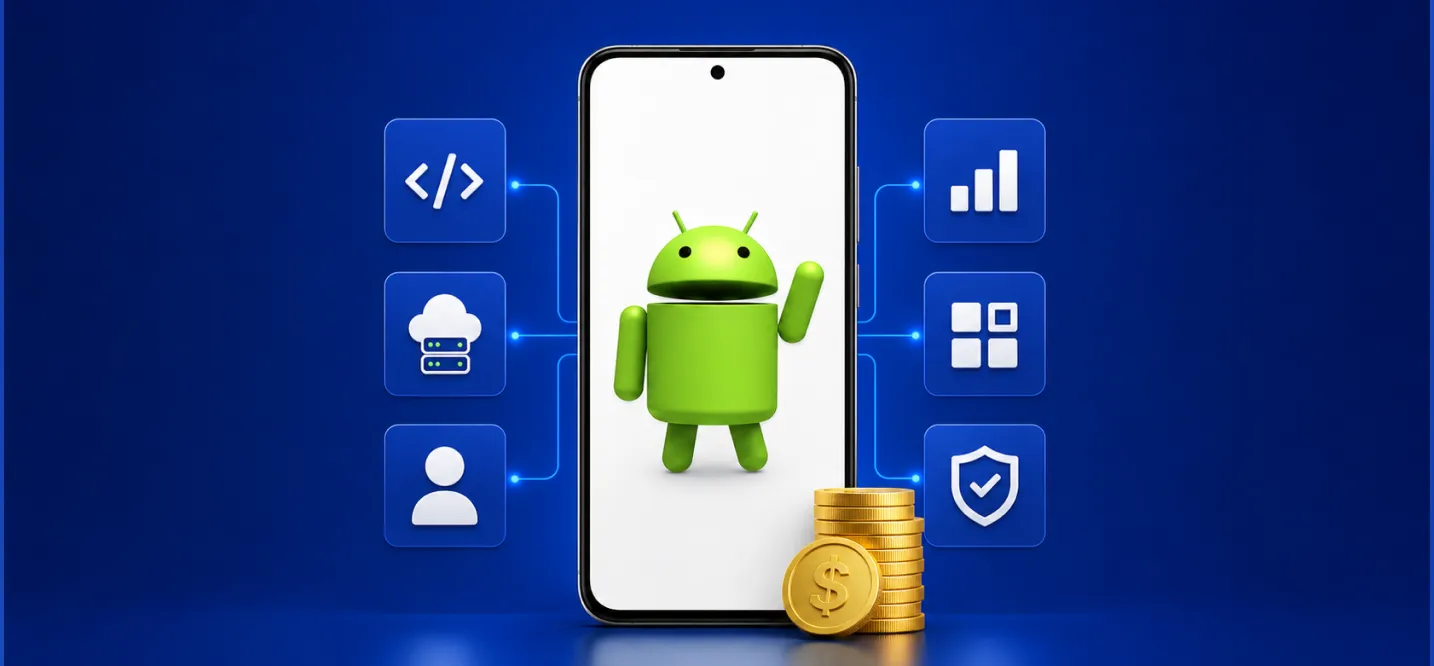
Android app development cost varies because no two apps are built the same way. A simple utility app with a few static screens requires far less effort than a real-time marketplace, healthcare platform, or enterprise system with thousands of users. Below are the factors that most influence pricing.
App Complexity
The single biggest driver of custom Android application development cost is complexity. A basic informational app costs significantly less than an app that requires real-time synchronization, complex business logic, multi-role user systems, or large-scale data processing.
As complexity increases, so do the engineering hours, architecture planning, testing requirements, and long-term maintenance effort needed to keep the product stable.
Typical Cost by Complexity:
| Complexity Level | Typical Cost Range | Timeline |
| Simple MVP | $15,000 – $50,000 | 2–4 months |
| Mid-Level App | $50,000 – $150,000 | 4–8 months |
| Complex / Enterprise | $150,000 – $300,000+ | 9–18 months |
Think of it like construction:
Building a studio apartment is very different from building a smart home with custom automation, security systems, and advanced wiring. Software works the same way: every added layer of sophistication compounds the development effort.
Number of Features
Every additional feature adds development hours, design work, backend logic, and testing cycles.
A simple login screen is relatively inexpensive. A login system with biometric authentication, social sign-in, multi-factor verification, and account recovery workflows is a much larger project.
The more granular and specific your feature list becomes, the higher the final price tag.
From the field:
In many Android MVP projects, teams initially plan 15 or more features, but successfully launch with 6–8 carefully prioritized features. Reducing scope early often shortens the timeline by several weeks while preserving the product’s core value.
UI and UX Design
Design is often the most underestimated line item in early app budgets.
A basic interface built with standard Material Design components costs far less than a fully custom experience with brand-specific visuals, motion design, animations, and micro-interactions.
Good UX directly affects user retention, engagement, and conversion rates, which is why cutting corners here can become expensive later.
Typical Design Costs
| Design Level | Cost Range |
| Basic UI | $5,000 – $15,000 |
| Custom Professional UI | $15,000 – $40,000 |
| Premium UX & Motion Design | $40,000 – $80,000+ |
Backend and Database Requirements
Apps that only display static content require minimal backend support.
Apps that manage user accounts, payments, real-time updates, notifications, inventory, analytics, or cloud synchronization need a much more robust backend architecture.
This includes database design, API development, server infrastructure, authentication systems, and scalability planning, all of which add significantly to the overall investment.
Technology Stack
The technology you choose also influences Android app development cost.
Native Android development with Kotlin offers the best performance and full access to Android-specific features. It is ideal for apps that require advanced hardware integration, high responsiveness, or platform-specific capabilities.
Cross-platform frameworks like Flutter and React Native can reduce development costs by allowing a single codebase for both Android and iOS. For many startups and business apps, this approach provides a faster and more budget-friendly path to market.
Third-Party API Integrations
Most modern apps rely on external services. Payment gateways, mapping services, messaging platforms, analytics tools, and push notification systems all require integration work, testing, and ongoing maintenance.
Each integration adds development effort, and many services also introduce recurring subscription fees after launch.
Device Compatibility and Android Fragmentation
This is a cost factor that is unique to Android.
Unlike iOS, Android apps must work across thousands of devices from different manufacturers, screen sizes, and operating system versions.
Ensuring a consistent experience on Samsung, Google Pixel, Xiaomi, OnePlus, foldables, tablets, and older Android versions requires extensive testing and optimization.
The broader the range of devices you support, the more QA time and budget the project requires.
Security and Compliance
Apps handling sensitive information require additional protection.
Financial, healthcare, and identity-based applications often need encryption, secure authentication, audit trails, and compliance measures such as HIPAA or PCI-DSS.
These requirements add development time, specialized testing, and ongoing security maintenance, but they are essential for regulated industries.
Development Team
Who builds your app has a major impact on cost.
Freelancers generally offer lower hourly rates and work well for small, clearly defined projects.
Development agencies provide designers, developers, QA engineers, project managers, and technical architects under one roof, which increases accountability and reduces project risk.
In-house teams offer the most control but require significant investment in hiring, salaries, training, and infrastructure.
App Category and Industry
The industry your app serves can significantly influence development costs.
An eCommerce app requires payment processing and inventory management. A healthcare app must meet strict privacy regulations. A fintech platform demands advanced security and fraud prevention, while logistics and on-demand service apps often rely on real-time GPS tracking and complex scheduling systems.
These industry-specific requirements affect architecture, testing, compliance, and overall development effort.
Android App Development Cost by App Type
App type and complexity tier are the fastest way to ballpark a budget before you get into feature-level detail. Here’s how the tiers typically break down:
| Tier | App Type | Cost Range | Typical Timeline |
| Basic | Static/informational app, simple utility | $5,000 – $20,000 | 1–2 months |
| MVP | Single-function product testing core demand | $15,000 – $60,000 | 2–3 months |
| Medium | Custom UI, API integrations, business logic | $25,000 – $80,000 | 3–5 months |
| Complex | Multiple user roles, custom architecture | $80,000 – $200,000 | 6–9 months |
| Enterprise | High-availability, advanced security, full custom stack | $200,000 – $500,000+ | 9–18 months |
A basic Android app with simple navigation and minimal backend functionality suits businesses that need a digital presence. An MVP focused on solving one core problem helps validate an idea with real users before scaling further. Medium-complexity apps typically include custom UI/UX and API integrations, while complex and enterprise apps are built for scalability, advanced security, and custom infrastructure.
Example: A food delivery app with customer login, restaurant listings, live order tracking, in-app payments, push notifications, and an admin dashboard typically falls between $60,000 and $100,000, squarely in the medium-to-complex range, since it combines real-time location data with a multi-role backend.
Cost by Popular App Category
For founders comparing specific app ideas rather than abstract complexity tiers, here’s how cost typically lines up across common categories:
| App Category | Estimated Cost |
| Food Delivery | $60,000 – $120,000 |
| Taxi Booking | $80,000 – $150,000 |
| Marketplace | $70,000 – $140,000 |
| Fitness | $35,000 – $80,000 |
| Healthcare | $70,000 – $250,000 |
| Banking | $150,000 – $400,000 |
These ranges assume a production-ready v1, not a bare MVP, taxi booking and banking sit at the higher end because both require real-time data handling (GPS or transactions) layered with strict reliability and compliance expectations.
Android App Development Cost by Industry
The industry an app serves changes its requirements just as much as its feature list does; compliance, transaction handling, and real-time data needs all carry different cost implications by sector.
| Industry | Key Cost Drivers | Typical Cost Range |
| Ecommerce | Catalogs, cart, payment processing, inventory | $10,000 – $50,000 |
| On-Demand Services | Real-time tracking, multi-role platform (customer/provider/admin) | $25,000 – $80,000+ |
| Healthcare | HIPAA compliance, encryption, secure data handling | $50,000 – $250,000 |
| Fintech | Regulatory compliance, transaction security, fraud prevention | $50,000 – $300,000 |
| Delivery & Logistics | GPS tracking, route optimization, dispatch dashboards | $30,000 – $100,000+ |
| Education | Video streaming, course content, progress tracking | $20,000 – $80,000 |
Healthcare and fintech sit at the higher end largely because of compliance overhead, strict data privacy regulations requiring encryption, audit trails, and specialized QA that simpler categories don’t need. Ecommerce and education tend to be more predictable since their core feature sets are well established and rarely require custom architecture from scratch.
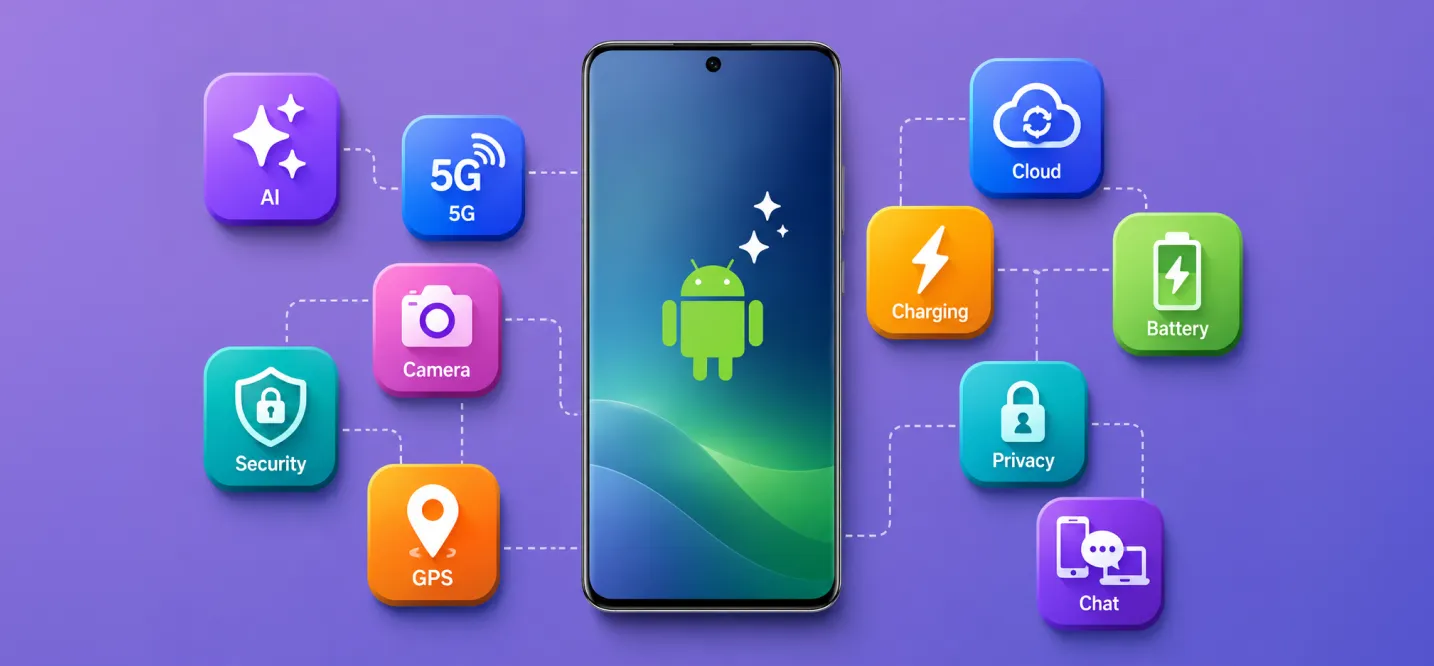
Cost of Android App Features
Individual features add predictable increments to a development budget. Here’s a practical breakdown:
User Login and Profile
Standard email/password login with a basic profile typically costs $2,000 to $5,000. Adding social sign-in or biometric authentication raises that to $5,000–$10,000.
Admin Dashboard
A functional admin panel for managing users, content, and analytics generally costs $5,000 to $15,000, depending on how many data views and controls it needs to support.
Payment Gateway
Integrating a payment processor like Stripe or a regional equivalent typically runs $3,000 to $10,000, including testing for transaction security and failure handling.
Push Notifications
Basic push notification setup costs $1,500 to $4,000, while segmented, behavior-triggered notification systems cost more due to the backend logic involved.
Maps and Location Tracking
GPS-based features, from simple location display to real-time tracking, typically cost $3,000 to $12,000 depending on accuracy requirements and whether route optimization is included.
Live Chat
In-app chat or support messaging generally costs $4,000 to $10,000, with AI-assisted or multi-agent support systems landing at the higher end.
AI-Based Features
AI-powered features such as chatbots, recommendations, and predictive analytics typically cost $10,000 to $40,000+. The final cost depends on whether the app uses an existing AI API or requires a custom-trained model, with custom AI solutions being the more expensive option.
Offline Access
Offline functionality with local data storage and synchronization generally adds $5,000 to $15,000 to the development cost. The price depends on how much of the app must work without an internet connection, making it an essential investment for logistics, field service, and education apps.
Android App Development Cost by Technology
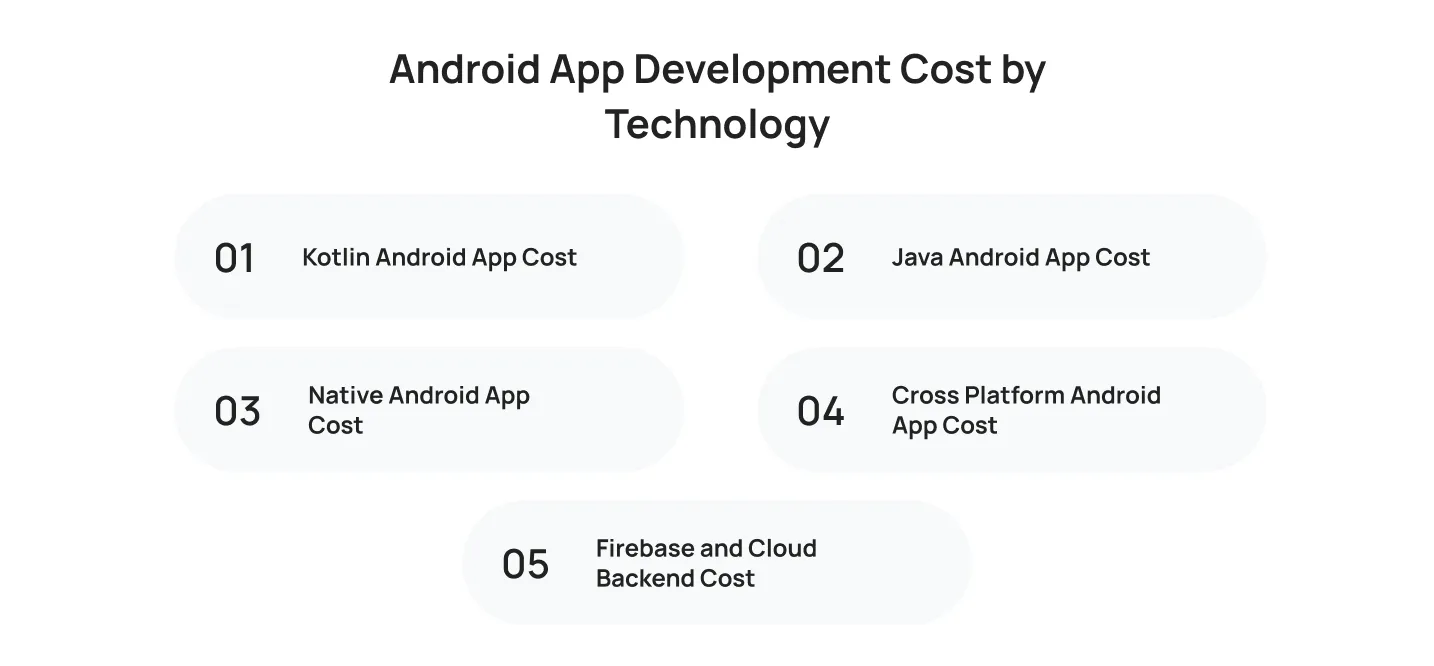
Kotlin Android App Cost
Kotlin is Google’s recommended language for native Android development. It generally costs about the same as Java for comparable scope, though its modern syntax often reduces development time slightly, which can shave a small percentage off the total budget.
Java Android App Cost
Java remains a widely used, stable choice for native Android development. Pricing is comparable to Kotlin and Java development overall, with cost differences driven more by developer experience and project complexity than the language itself.
Native Android App Cost
Native development (Kotlin or Java) generally produces the best performance and tightest integration with Android-specific hardware and APIs, but it means building a separate codebase if you also need an iOS version which increases total spend if both platforms are required.
Cross Platform Android App Cost
A Flutter app or React Native build can reduce costs by 30–50% compared to building separate native apps for iOS and Android, since a single codebase serves both platforms. Choosing between the two see our breakdown of Flutter vs React Native matters less than the decision to go cross-platform at all for most business apps. For most businesses planning to launch on both app stores, cross-platform development is the more budget-efficient starting point in 2026, with a modest trade-off in raw performance that’s rarely noticeable in typical business applications.
Firebase and Cloud Backend Cost
Using a backend-as-a-service platform like Firebase reduces backend development cost significantly for apps with standard needs, often costing $2,000 to $10,000 to configure versus $15,000+ for a fully custom backend. It scales well for MVPs but can become more expensive than a custom backend as usage grows substantially.
Android App Design Cost
Good UI/UX design is a conversion tool, not just a cost line; it directly shapes retention and reduces how much you’ll later spend re-acquiring users who churned over a clunky experience.
Wireframes and Prototypes
Low-fidelity wireframes and clickable prototypes typically cost $1,500 to $5,000 and are essential for validating user flow before development begins.
Custom UI Design
A custom-designed interface with brand-specific visuals, typography, and iconography generally costs $10,000 to $30,000, depending on the number of unique screens.
UX Research and User Flow Planning
User research, journey mapping, and usability testing typically add $5,000 to $15,000 to a project but significantly reduce costly rework later in development.
How Android App Costs Break Down Across Development Phases
Beyond app type and industry, it helps to see where the budget actually goes once a project starts. Here’s a typical allocation across the development lifecycle:
| Phase | % of Budget | What It Covers |
| Planning & Discovery | 5% – 10% | Requirements gathering, architecture planning, scope definition |
| UI/UX Design | 10% – 20% | Wireframes, prototypes, visual design system |
| Front-End Development | 25% – 35% | Screens, navigation, device compatibility |
| Backend Development | 20% – 35% | APIs, database, authentication, integrations |
| Testing & QA | 10% – 15% | Functional, performance, security, compatibility testing |
| Launch & Deployment | 3% – 5% | Play Store submission, server configuration |
| Post-Launch Maintenance (annual) | 15% – 20% of build cost | OS updates, patches, bug fixes |
Planning and discovery look like a small slice, but errors here are the most expensive mistakes in the entire process, a vague scope at the start almost always turns into rework and missed deadlines later, which costs far more than getting requirements right the first time.
From the field: One of the most common reasons Android projects exceed budget isn’t poor coding, it’s adding new features after development has already started. Locking requirements before design begins, even when it feels slower upfront, consistently reduces rework and keeps the original estimate intact.
Android App Testing Cost
QA testing covers far more than catching crashes before launch, it’s what keeps an app stable across the thousands of device and OS combinations Android users run.
Manual Testing
Manual QA testing, where testers walk through every user flow by hand, typically costs $5,000 to $15,000 depending on app complexity and the number of testing rounds.
Automated Testing
Automated test suites cost more upfront often $8,000 to $20,000, but pay off on larger projects by catching regressions quickly across future updates.
Device Compatibility Testing
Because Android runs across thousands of device and screen configurations, compatibility testing requires either a physical device lab or cloud-based testing services, both of which add cost but are essential for apps targeting a broad user base.
Security Testing
Security testing, including vulnerability assessments and penetration testing, typically costs $3,000 to $10,000. Apps in regulated industries such as fintech and healthcare often require more extensive testing, increasing the overall cost.
Overall, testing and QA account for approximately 15% to 25% of total Android app development costs. Investing in thorough testing helps identify issues before launch, reducing the risk of costly fixes, poor user experiences, and negative app store reviews.
Hidden Costs in Android App Development
Most cost estimates only cover the build itself. These expenses show up after launch and tend to surprise teams that didn’t plan for them, often arriving faster and larger than expected once the app has real users putting load on its infrastructure.
App Maintenance
App maintenance typically costs 15–20% of the original development budget annually, covering bug fixes, OS compatibility updates, and minor improvements.
Hosting and Server Cost
Monthly hosting costs range from a few hundred dollars for early-stage apps to several thousand dollars per month for apps with significant traffic or heavy data processing.
API Subscription Fees
Many apps depend on external services payments, mapping, messaging that charge recurring fees tied to usage. As your user base grows, these fees quietly add to total cost well beyond the initial invoice.
Play Store Updates
While Google charges a one-time $25 registration fee to publish on the Play Store, every subsequent update requires development, testing, and review time that should be budgeted into your ongoing development budget.
Bug Fixes and Feature Improvements
Post-launch, real user feedback almost always surfaces issues and feature requests that weren’t visible during initial planning, requiring an ongoing allocation of engineering time.
Marketing and App Store Optimisation
Building the app is only half the equation. App Store Optimisation, paid acquisition, and content marketing all require separate budget lines that are easy to overlook during the development phase.
Android App Development Cost by Team Type
Who builds your app shapes what it costs just as much as what you’re building. Here’s how hourly rates typically compare across team types and regions:
| Team Type / Region | Typical Hourly Rate | Best Fit For |
| Freelancer (offshore) | $20 – $50 | Small, well-defined projects |
| Freelancer (US/UK) | $50 – $100 | Short-term builds needing local oversight |
| Agency (offshore: India, Pakistan, Eastern Europe) | $25 – $75 | Cost-conscious mid-complexity builds |
| Agency (US/UK) | $75 – $200 | Enterprise builds, regulated industries |
| In-House Team | Salary-based, highest fixed cost | Long-term, continuous development |
Freelancer Android Developer Cost
Freelancers typically charge the lowest rates, making them attractive for small, well-defined projects. However, they carry more project risk, less accountability, and limited capacity for larger or more complex builds.
In-House Android Development Cost
Building an in-house team offers the most control and long-term continuity but comes with the highest fixed costs, salaries, benefits, recruitment, and management overhead, making it best suited for companies planning continuous, long-term app development.
Android App Development Agency Cost
Working with an experienced Android application development company like Cubix typically costs more per hour than freelancers but brings structured processes, quality controls, and accountability that significantly reduce project risk particularly valuable for medium-to-complex builds.
Offshore Android App Development Cost
Offshore teams can reduce hourly rates substantially compared to US-based teams, though the savings depend heavily on communication quality, time zone overlap, and the vendor’s development maturity.
Android App Development Timeline and Cost
Timeline and budget move together, a longer app development timeline almost always means more engineering hours, not just more calendar days.
| Timeline | Typical Cost | What’s Realistic |
| 1–2 months | $15,000 – $35,000 | Tightly scoped MVP, small team, minimal integrations |
| 3–5 months | $40,000 – $100,000 | Medium complexity, custom design, multiple integrations |
| 6+ months | $120,000 – $300,000+ | Complex or enterprise build, deeper architecture and security work |
Android App Development Cost vs iOS vs Cross-Platform Development
The cost of building a mobile app depends less on the platform itself and more on the app’s complexity, features, and long-term goals. While native Android and iOS development have similar pricing for comparable projects, developing separate apps for both platforms increases the overall investment. Cross-platform frameworks like Flutter and React Native offer a more cost-effective alternative by using a single codebase for Android and iOS.
| Factor | Android App Development | iOS App Development | Cross-Platform Development |
| Primary Language | Kotlin, Java | Swift | Flutter, React Native |
| Typical Cost | Comparable to iOS | Comparable to Android | 30%–50% lower than building separate native apps |
| Performance | Excellent | Excellent | Very Good for most business apps |
| Development Time | Standard | Standard | Faster due to a shared codebase |
| Maintenance | Separate Android updates | Separate iOS updates | Single codebase simplifies maintenance |
| Best For | Android-first products | Apple-focused audiences | Businesses launching on both platforms |
How to Reduce Android App Development Cost Without Cutting Corners

Reducing Android app development costs doesn’t mean sacrificing quality. The smartest approach is to focus your budget on features that deliver the most value while avoiding unnecessary complexity early in the project. Careful planning and the right technical decisions can significantly reduce development expenses without affecting the user experience.
- Start with an MVP: Launch with the core features needed to solve your users’ primary problem, then expand based on real feedback instead of assumptions.
- Define your requirements early: A clear project scope helps prevent scope creep, reduces costly revisions, and keeps development on schedule.
- Choose the right development approach: If your app doesn’t require platform-specific functionality, cross-platform frameworks like Flutter or React Native can reduce both development time and cost.
- Leverage existing solutions: Integrating trusted APIs for payments, authentication, maps, and notifications is often faster and more cost-effective than building these systems from scratch.
- Test continuously: Regular testing throughout development helps identify issues early, when they are faster and less expensive to fix.
- Budget for maintenance: Set aside 15% to 20% of your initial development cost each year for updates, security patches, and ongoing performance improvements.
The goal isn’t to build the cheapest app. It’s to build the right app within your budget. Prioritizing essential features, making informed technology choices, and planning for long-term maintenance can help you control costs while creating a product that’s ready to grow with your business.
How to Get an Accurate Android App Cost Estimate

A reliable cost estimate starts with a documented requirements phase, not a guess pulled from a sales call. The strongest estimates come after a discovery phase that maps your target users, defines the app development process you’ll follow as part of the broader mobile app development process, and lists every feature, integration, and compliance requirement in detail. Skipping this step is one of the most expensive mistakes in Android development, since scope creep and rework cost far more than the discovery work itself would have.
When evaluating vendors, ask for a breakdown by phase (design, development, QA, deployment), clarity on which Android app development tools and frameworks they plan to use, and a clear maintenance plan for after launch. Also ask how they handle scope changes mid-project vague answers here are usually a sign that your “fixed” quote won’t stay fixed once development begins. Staying current with development trends also helps you avoid over-investing in features that are becoming outdated or under-investing in capabilities like AI-driven personalization that users increasingly expect.
Final Thoughts
Android app development cost in 2026 isn’t determined by a single number. It depends on your app’s complexity, feature set, design requirements, technology stack, and long-term maintenance strategy. Whether you’re building a simple MVP or a large enterprise platform, investing time in planning and following a structured app development process will help you avoid unnecessary expenses and make better technology decisions.
Choosing the right development partner is equally important. An experienced Android application development company can help you select the right architecture, build an efficient workflow using modern Android app development tools, and keep your application aligned with evolving industry standards. By combining careful planning with the right technical expertise, you’ll be in a much stronger position to control costs while building an Android app that supports your business goals.
Frequently Asked Questions
1: How much does it cost to develop an Android app in 2026?
Android app development typically costs between $15,000 and $300,000+ in 2026. A simple MVP may cost $15,000 to $50,000, while a medium-complexity app ranges from $50,000 to $150,000. Enterprise applications with advanced features, custom infrastructure, and high security requirements can exceed $300,000.
2: What factors influence Android app development cost?
Several factors affect Android app development cost, including app complexity, number of features, UI/UX design, backend infrastructure, third-party API integrations, technology stack, security requirements, testing, and the development team’s location and experience. Clearly defining project requirements helps produce a more accurate estimate.
3: Is Android app development more affordable than iOS development?
For similar features and complexity, Android and iOS app development costs are generally comparable. However, businesses launching on both platforms can reduce development costs by 30% to 50% using cross-platform frameworks such as Flutter or React Native instead of building two separate native apps.
4: How long does it take to build an Android app?
Android app development timelines depend on project scope. A basic MVP usually takes 2 to 3 months, medium-complexity applications require 3 to 6 months, and enterprise-grade apps with advanced functionality often take 9 to 18 months to complete.
5: What is included in Android app maintenance costs?
Android app maintenance generally costs 15% to 20% of the original development budget per year. This covers bug fixes, security updates, Android OS compatibility, performance improvements, server maintenance, and feature enhancements to keep the app secure and reliable.
6: How can businesses reduce Android app development costs without compromising quality?
Businesses can lower Android app development costs by starting with an MVP, prioritizing essential features, choosing cross-platform development when appropriate, using trusted third-party APIs, defining project requirements early, and planning for ongoing maintenance. These strategies help reduce unnecessary expenses while maintaining app quality and scalability.