Key Takeaways
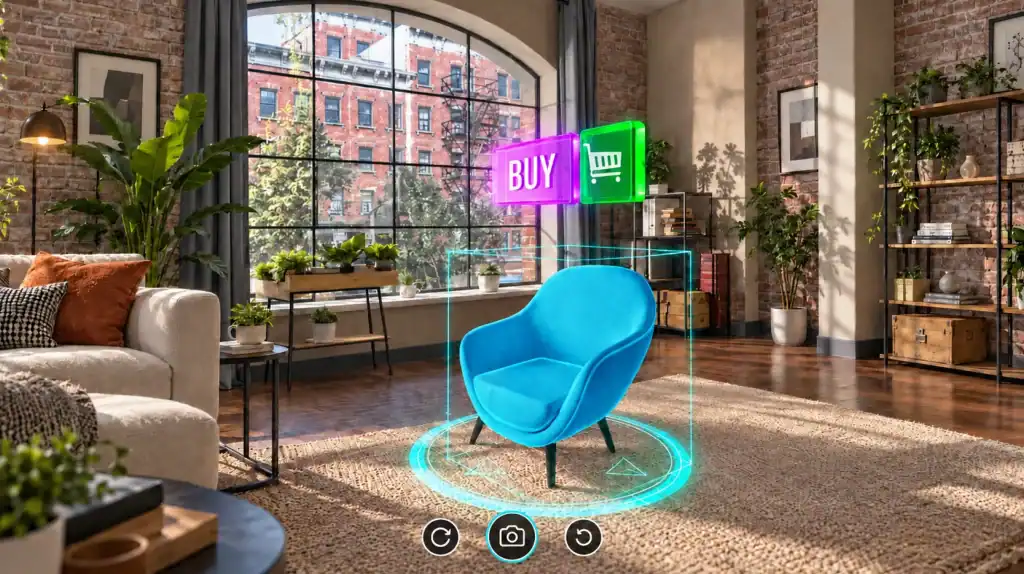
- AR in eCommerce lets shoppers preview products in their own environment using a phone camera, cutting the uncertainty that drives cart abandonment and returns.
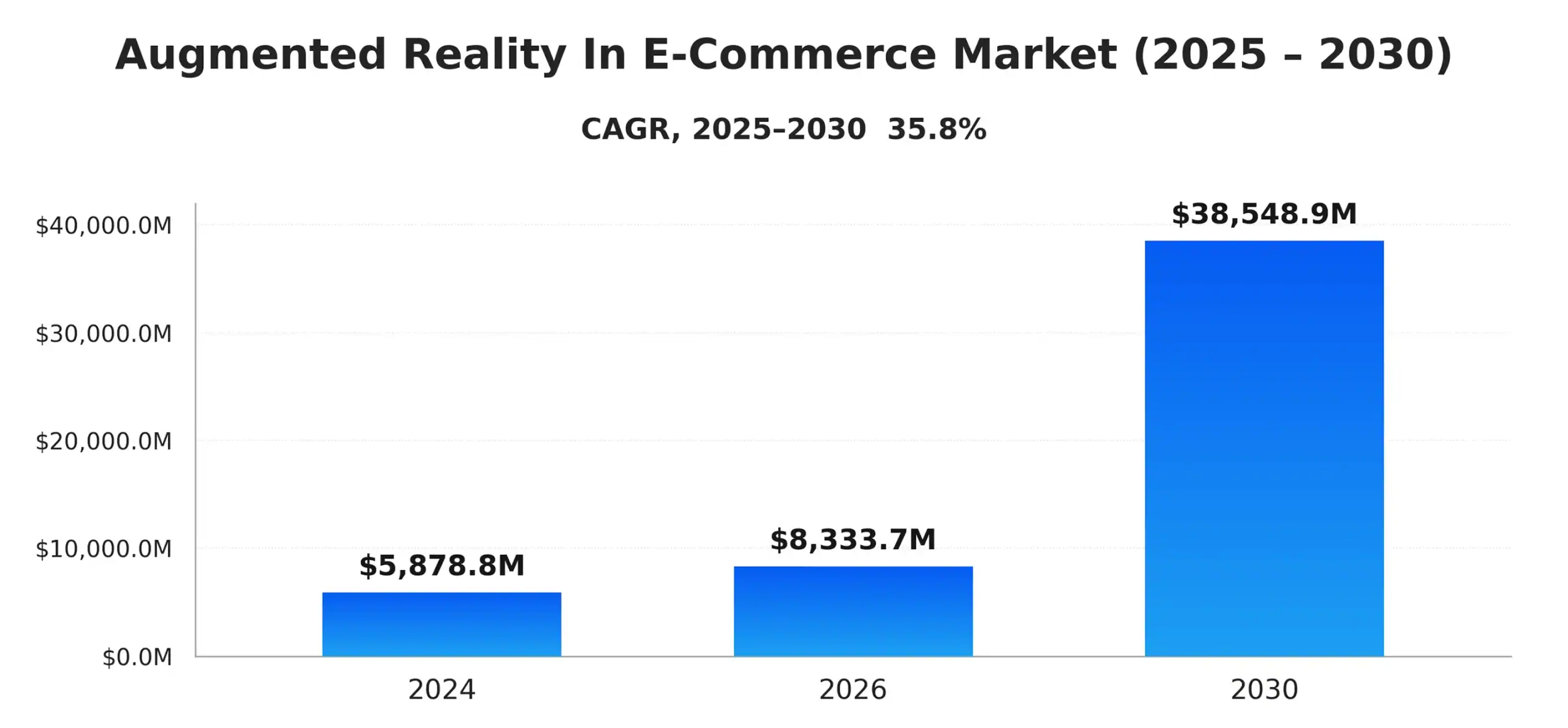
- The augmented reality in the e-commerce market was valued at USD 8,333.7 million in 2026 and is projected to reach USD 38,548.9 million by 2030, growing at a 35.8% CAGR.
- Virtual try-on cuts return rates by an estimated 25% to 48%, with the biggest impact in footwear, apparel, and furniture.
- Five main AR formats power most retail applications: marker-based, markerless, projection-based, superimposition-based, and WebAR.
- Getting started does not require a full native app. WebAR lets you launch a try-before-you-buy experience directly in a mobile browser, with no download required.
The augmented reality in the e-commerce market was valued at USD 8,333.7 million in 2026 and is projected to reach USD 38,548.9 million by 2030, growing at a 35.8% CAGR. This rapid growth reflects how retailers are using AR to help shoppers visualize products, try items virtually, and make more confident purchasing decisions.
Online shoppers cannot touch, wear, or measure a product before buying it. That gap creates hesitation, and hesitation kills conversion. Augmented reality closes that gap by letting a shopper see a product in their own space, or on their own body, before they click “buy.” This guide covers what AR in eCommerce actually is, the data behind it, real brand examples, and how to add it to your own store.
Want to discuss your project? Our experts are just a click away.
Contact UsWhat Is Augmented Reality (AR) in eCommerce?
Augmented reality (AR) in eCommerce overlays digital content, 3D product models, filters, or animations onto a shopper’s real-world view through a smartphone, tablet, or AR-enabled device. Unlike virtual reality, AR does not replace the real environment. It adds digital elements to it.
In practice, this means a shopper can:
- Point their phone at a living room wall and see a couch rendered at true scale.
- Open their front camera and see how a lipstick shade looks on their own face.
- Rotate a sneaker in 3D on a product page before adding it to cart.
The technology uses computer vision, motion tracking, and depth sensing to place digital objects accurately within a physical environment. Apple’s ARKit and Google’s ARCore provide tools for building AR experiences on iOS and Android devices. Businesses developing these experiences may use dedicated AR/VR app development services for 3D modeling, tracking, and cross-device testing.
AR shopping brings product visualization closer to the in-store experience by letting shoppers see how products look, fit, or function before purchasing. The same technology is also being applied across industries, as discussed in how augmented reality is revolutionizing industries.
AR in eCommerce: A Snapshot of Statistics
Numbers tell the adoption story better than any description. Here’s where the data stands in 2025 and 2026.
- AR e-commerce market size: The global market was valued at USD 8,333.7 million in 2026 and is projected to reach USD 38,548.9 million by 2030, growing at a 35.8% CAGR, according to Grand View Research.
- AR shopping market: The global augmented reality shopping market is estimated at $10.59 billion in 2026, according to Research and Markets.
- Retailer adoption: 80% of retailers were expected to deploy AR as part of their customer experience strategy by 2025, based on a Gartner statistic cited by BrandXR.
- U.S. shopper interest: More than 90% of U.S. shoppers use or would consider using AR while shopping.
- Shopping experience: 98% of surveyed shoppers said AR made shopping easier or more enjoyable.
- Gen Z demand: 92% of Gen Z shoppers want AR tools for eCommerce, according to a Snapchat survey reported by Retail Dive.
- Virtual try-on market: The global virtual try-on market is estimated at $18.1 billion in 2026 and projected to reach $46.4 billion by 2030, growing at a 26.4% CAGR.
- Sephora Virtual Artist: Sephora’s Virtual Artist recorded more than 8.5 million visits and 200 million shade try-ons, demonstrating significant consumer engagement with virtual beauty experiences.
AR vs. VR: What’s the Difference?
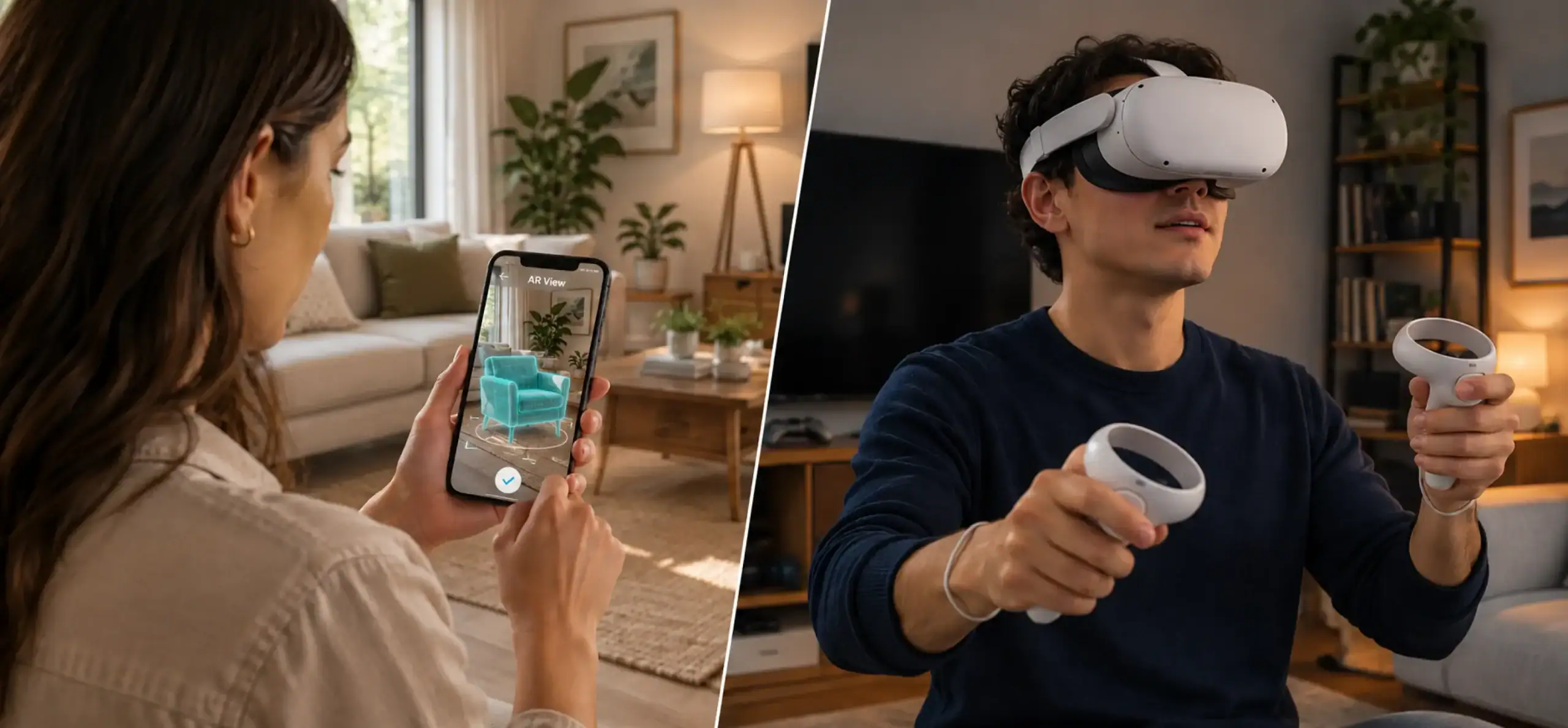
AR and VR in eCommerce get used interchangeably, but they solve different problems. Confusing the two leads to the wrong technology investment.
For most online stores, AR/VR in eCommerce decisions come down to this: AR fits directly into the existing purchase funnel, while VR works better as a marketing or brand-experience layer. Most retailers start with AR because it requires no extra hardware and reaches every shopper who already owns a smartphone.
| Factor | Augmented Reality (AR) | Virtual Reality (VR) |
| Environment | Overlays digital content on the real world | Replaces the real world with a fully digital one |
| Hardware | Smartphone camera, tablet, AR glasses | VR headset (Meta Quest, PSVR, etc.) |
| Typical eCommerce use | Virtual try-on, furniture placement, product visualization | Virtual showrooms, immersive brand experiences |
| Shopper effort | Low. Opens in a browser or app in seconds | Higher. Requires a headset |
| Purchase-path fit | Sits directly on product pages | Usually a separate, standalone experience |
| Adoption in retail, 2026 | Mainstream, 100+ million active shoppers | Niche, concentrated in flagship or experiential campaigns |
Types of AR Applications in eCommerce
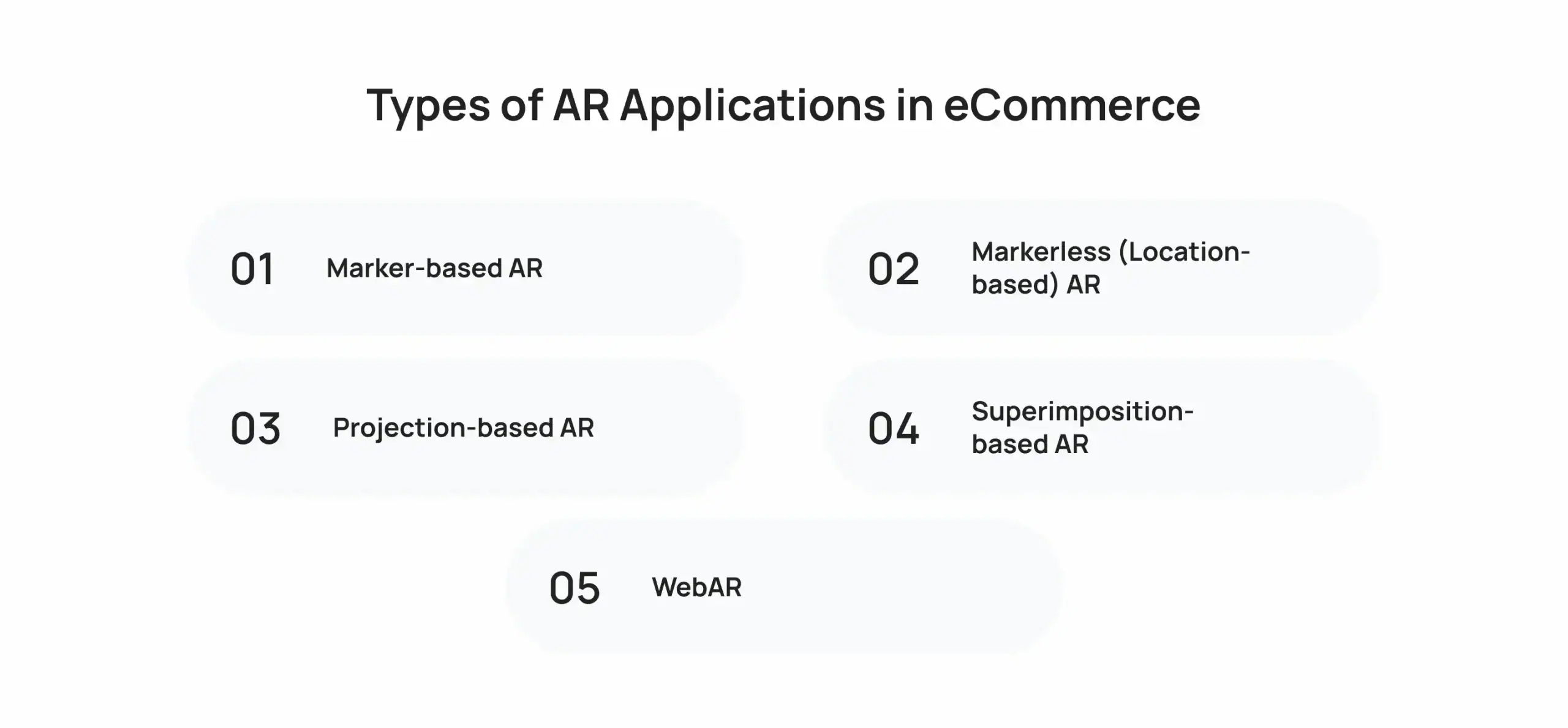
Not all AR technology works the same way. Augmented reality retail applications in 2026 use different approaches to solve specific visualization problems, so choosing the right type matters more than simply choosing the most advanced option.
1. Marker-based AR
Marker-based AR needs a specific visual trigger, like a QR code on a product box or a printed catalog page, to activate the digital layer. It’s reliable and inexpensive to build, but it only works where the marker is physically present, which limits it mostly to packaging and print.
Best For: Packaging, print catalogs, in-store displays
2. Markerless (Location-based) AR
Markerless AR uses the phone’s sensors and camera feed to understand a space without needing a printed trigger. This is the technology behind IKEA Place and most furniture-placement tools. It’s more technically demanding to build than marker-based AR, but it delivers a far more flexible shopping experience.
Best For: Furniture placement, navigation, outdoor retail
3. Projection-based AR
Projection-based AR casts digital images onto physical surfaces. It shows up mostly in physical retail environments, like interactive fitting-room mirrors or in-store product kiosks, rather than on eCommerce websites directly.
Best For: In-store kiosks, showroom installations
4. Superimposition-based AR
This type recognizes a real object and replaces part or all of the camera view with a digital version. It powers product customization tools, where a shopper points their camera at a base product and sees custom colors, materials, or add-ons rendered in real time.
Best For: Product customization, part replacement previews
5. WebAR
WebAR runs entirely inside a mobile browser using frameworks like 8th Wall or Google’s model-viewer. There’s no app to download, which removes the single biggest adoption barrier in AR shopping. Most new AR in eCommerce deployments in 2025 and 2026 will launch as WebAR first because it reaches every visitor already on a product page.
Best For: Product pages, social ads, email campaigns
Top AR Use Cases in eCommerce
Augmented reality (AR) in eCommerce lets online shoppers visualize digital 3D products in their real-world environment using a smartphone or tablet camera.
1. Virtual Try-On for Fashion and Accessories
Shoppers use their phone camera to see clothing, shoes, or accessories rendered on their own body or a digital avatar. Fashion retailers using virtual fitting rooms saw up to a 40% increase in average conversion rates and more than a 25% reduction in return rates tied to poor fit expectations, according to 2025 e-commerce analytics data.
2. Virtual Makeup and Beauty Try-On
Facial mapping technology lets shoppers test lipstick, foundation, and eyeshadow shades in real time. Sephora’s Virtual Artist, powered by L’Oréal’s ModiFace technology, is the category benchmark. It has logged over 8.5 million visits and more than 200 million shade try-ons since launch.
3. AR Furniture Placement and Home Décor Preview
Markerless AR lets shoppers place true-to-scale 3D furniture models in their actual room using their phone camera. This directly targets the fit-and-scale uncertainty that drives most furniture returns. IKEA Kreativ and Wayfair’s View in Room are the leading examples.
4. 3D Product Visualization
Shoppers rotate, zoom, and inspect a 3D product model directly on the product page, without needing a full AR camera session. 3D Product Visualization has been shown to be up to 200% more engaging than standard product photography.
5. AR Product Customization
Superimposition-based AR lets shoppers preview custom colors, materials, or configurations on a base product in real time. This works well for footwear, eyewear, and furniture, where customization drives higher average order values.
6. Interactive Product Demonstrations
AR overlays show how a product works, what’s inside it, or how to assemble it, directly through the camera. This reduces pre-purchase support questions and post-purchase returns tied to misunderstood functionality.
7. AR Filters for Social Commerce
Branded AR filters on Instagram, Snapchat, and TikTok let users try on products directly inside a social app, then click through to buy. This format works particularly well for beauty, eyewear, and accessories, where the try-on moment and the discovery moment happen in the same place.
Benefits of Augmented Reality for eCommerce Businesses
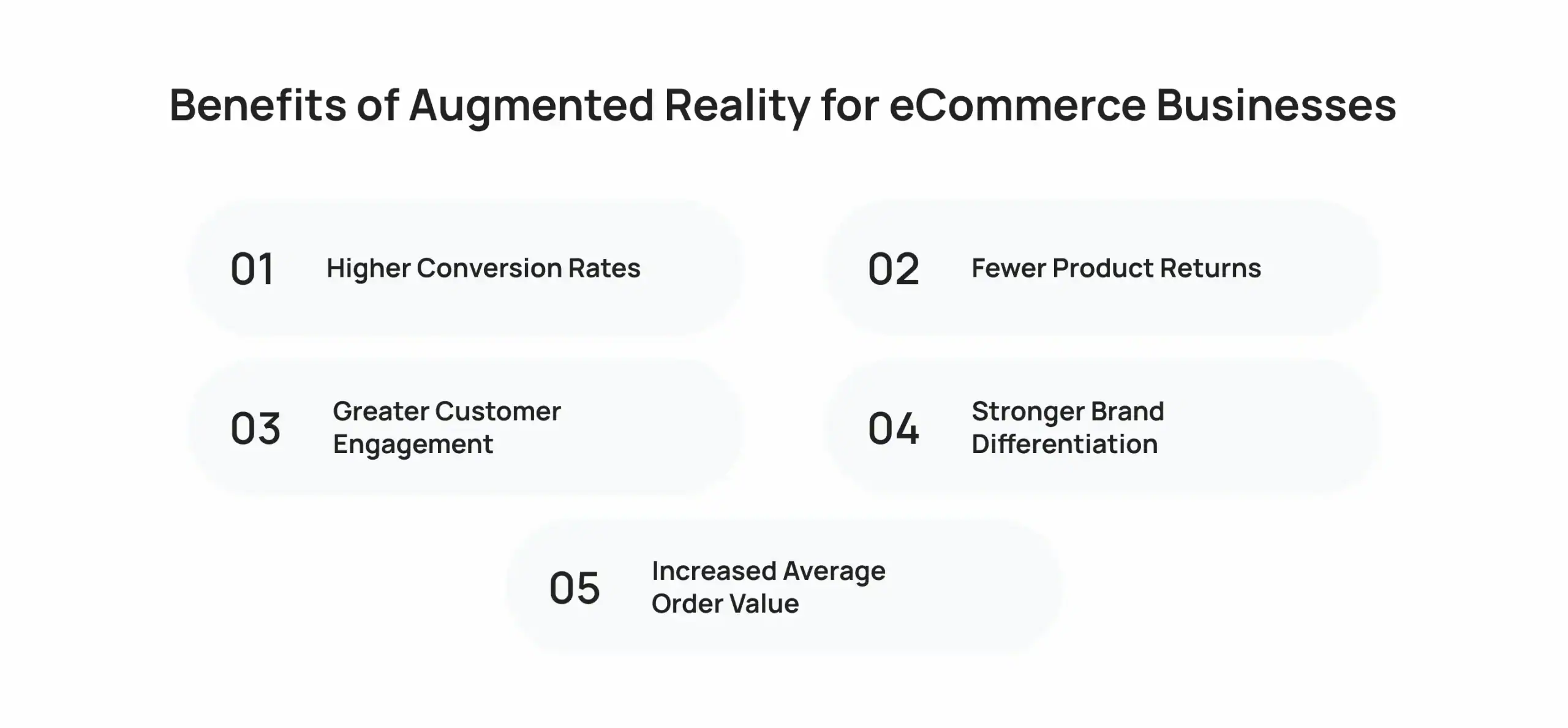
Augmented Reality (AR) in eCommerce lets shoppers view digital 3D products within their real-world surroundings using a smartphone or tablet, helping them visualize products more clearly and make confident purchase decisions. The augmented reality e-commerce benefits rest on five measurable outcomes.
1. Higher Conversion Rates
Product pages with AR or 3D content convert up to 94% higher than pages with static images alone, according to Shopify’s platform data. Shoppers who viewed a product in AR were 65% more likely to complete a purchase in Rebecca Minkoff’s Shopify case data, and virtual try-on tools have pushed conversion up by 40% or more in fashion retail specifically.
2. Fewer Product Returns
Return rates drop 25% to 48% when shoppers can preview fit, scale, or color before buying. This matters most in categories with high return rates by default: apparel, footwear, and furniture.
3. Greater Customer Engagement
AR-based visualization is roughly 200% more engaging than standard product photos and video. Sephora reported a 200% increase in engagement within its Virtual Artist section specifically.
4. Stronger Brand Differentiation
80% of retailers planned to deploy AR as part of their customer experience strategy by 2025, meaning a meaningful share of the market still has not shipped a live AR feature. That leaves a real gap for mid-market and smaller brands to stand out on product experience alone, ahead of price or shipping speed.
5. Increased Average Order Value
Virtual try-on tools have been linked to average order value increases of up to 33% in Shopify merchant data, driven by shoppers adding complementary items they can now visualize together.
Real-World Examples of AR in eCommerce
IKEA Kreativ
IKEA’s app uses markerless AR to place true-to-scale, photorealistic 3D furniture in a shopper’s actual room. Shoppers confirm a piece fits and matches the space before ordering, directly addressing the fit uncertainty that drives most furniture returns. Industry case studies consistently cite reduced returns and higher average order value tied to the feature, though IKEA has not published fully audited figures.
Dulux Paint
Dulux’s Visualizer app lets shoppers use AR to preview paint colors directly on their own walls through a phone camera. This solves the single biggest source of buyer’s remorse in paint retail: a color that looks different on the wall than it did on a swatch or screen.
Sephora Virtual Artist
Built on L’Oréal’s ModiFace technology, Virtual Artist lets shoppers test makeup shades on their own face in real time. The feature has driven over 8.5 million visits and 200 million shade try-ons, and shoppers who use it convert at rates up to 90% higher than shoppers who don’t.
Warby Parker
Warby Parker’s Virtual Try-On uses Apple’s Face ID and ARKit technology to map a shopper’s facial structure and render glasses frames accurately in real time. The company built the feature specifically to solve the biggest online barrier in eyewear: not knowing how frames actually look on your own face before buying.
How to Add AR to an eCommerce Store
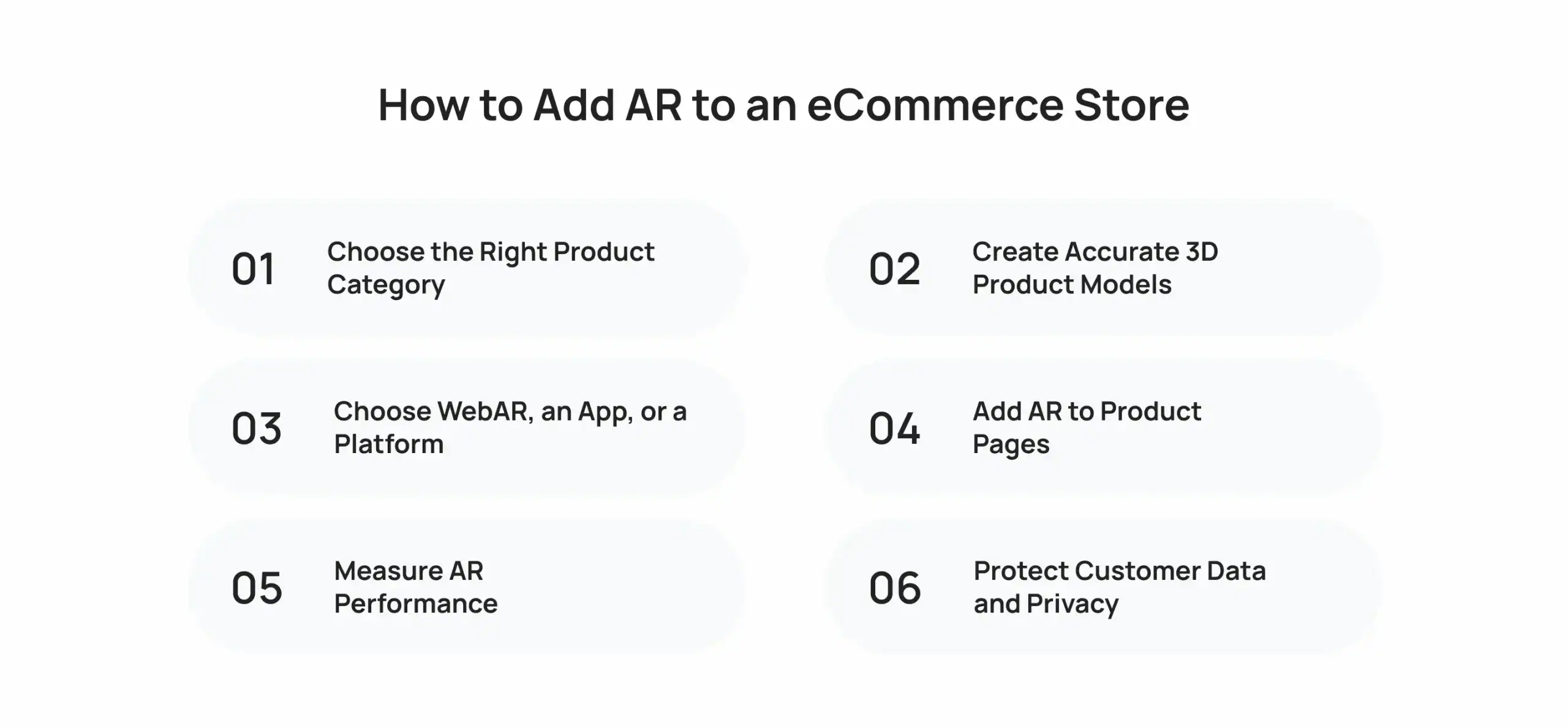
Rolling out AR in eCommerce doesn’t require building a native app from day one. Here’s the practical sequence.
1. Choose the Right Product Category
Start with the category that has your highest return rate or your biggest pre-purchase hesitation. Apparel, footwear, eyewear, furniture, and beauty consistently see the strongest AR results because fit, scale, and color are the exact variables AR can visualize.
2. Create Accurate 3D Product Models
Every AR experience depends on a 3D model of the product. Photogrammetry (multi-angle photo capture) and CAD-based conversion are the two standard methods. Budget time and cost here first. 3D asset production typically consumes 25% to 40% of a total AR project budget, more than the AR software itself.
3. Choose WebAR, an App, or a Platform
- WebAR launches in a mobile browser with no download, and works well for a first rollout.
- A native app (using Apple ARKit or Google ARCore) offers deeper functionality but requires a download, which lowers reach.
- Shopify AR integration and Magento AR extensions let merchants add 3D/AR product viewers through pre-built apps, without custom development.
- A specialized development partner can shortcut this decision if the build goes beyond a pre-built app. See this roundup of top AR/VR app development companies in the USA for a sense of how vendors differ on platform support and pricing.
4. Add AR to Product Pages
Place the AR trigger, usually a “View in Your Room” or “Try It On” button, directly on the product page next to the add-to-cart button. AR features buried in a separate app or tab see far lower engagement than AR embedded in the normal shopping flow.
5. Measure AR Performance
Track AR-specific metrics separately from general site analytics:
- AR session starts vs. product page views
- Conversion rate for AR-engaged sessions vs. non-AR sessions
- Return rate for AR-engaged purchases vs. non-AR purchases
- Average order value for AR sessions
6. Protect Customer Data and Privacy
Facial mapping and room-scanning features process camera data that can be sensitive. Store only what’s needed for the session, disclose data use clearly in your privacy policy, and avoid retaining facial or spatial data beyond the immediate AR session unless a shopper explicitly opts in.
How AR Will Change eCommerce in the Next 6 Months
Three shifts are likely to shape AR in eCommerce through late 2026 and early 2027:
- WebAR adoption: Browser-based AR will reduce the need for shoppers to download dedicated apps.
- Social commerce AR: Native try-on features will bring AR closer to the point of purchase within social shopping feeds.
- AI-generated 3D models: AI will reduce the time and cost of creating 3D product catalogs, making AR more accessible to mid-market retailers.
For retailers, the technology barrier is falling, but 3D content remains a key budget consideration. AR adoption is also expanding beyond retail, including AR in banking and financial services.
Choosing an AR eCommerce Development Partner
Building an effective AR eCommerce experience requires more than adding an AR feature to a storefront. The solution needs accurate tracking, optimized 3D assets, mobile performance, secure data handling, and integration with your existing eCommerce platform.
Cubix helps businesses build AR-powered shopping experiences tailored to their products and customer journeys. Whether you need virtual try-on, 3D product visualization, or AR features within a mobile shopping app, our custom mobile app development services can support the technology behind the experience.
Want to discuss your project? Our experts are just a click away.
Contact UsFrequently Asked Questions
1. What is the average cost range for integrating AR features into an existing eCommerce app?
A basic WebAR experience typically costs $5,000 to $40,000, while native ARKit or ARCore apps can cost $50,000 to $150,000. Enterprise deployments may exceed $250,000, with 3D asset production often accounting for 25% to 40% of total costs.
2. How does augmented reality technology reduce return rates for online retailers?
AR lets shoppers preview fit, scale, and color before buying, helping address common return reasons. Reported reductions in return rates range from 25% to 48%, particularly in footwear, apparel, and furniture.
3. What are the key technical requirements for building a custom WebAR shopping experience?
A WebAR build needs optimized 3D models, a WebAR framework such as 8th Wall or Model Viewer, camera and motion-tracking permissions, and testing across iOS Safari and Android Chrome.
4. How much budget is needed for 3D product modeling vs. AR app infrastructure?
3D modeling and asset production often account for 25% to 40% of the total AR budget. A photorealistic product model can cost several hundred to a few thousand dollars, making catalog size a major cost factor.
5. What is the typical timeline to build and launch a virtual try-on feature for retail platforms?
A basic WebAR try-on experience typically takes 4 to 12 weeks, while native ARKit or ARCore apps take around 3 to 5 months. Enterprise deployments with large catalogs can take 6 to 12 months or longer.
6. How do ongoing AR SDK licensing, 3D asset hosting, and cloud server costs scale after launch?
Apple ARKit and Google ARCore are free to use. Ongoing costs mainly include 3D asset hosting, content delivery, and third-party WebAR subscriptions, which can range from hundreds to thousands of dollars per month depending on usage.