Key Takeaways
- Car racing game development starts with a clear concept, market research, a GDD, and the right game engine before moving into mechanics, assets, AI, multiplayer, testing, and launch.
- Unity and Unreal Engine are the leading choices for racing games. Unity is well suited to mobile and cross-platform titles, while Unreal Engine is ideal for high-fidelity PC and console racing experiences.
- Car racing game development costs can range from $15,000 for a basic mobile racer to $5 million+ for a AAA simulation, depending on game complexity, platform, graphics, physics, multiplayer, and development time.
- Core racing features such as responsive controls, realistic vehicle physics, customization, varied tracks, weather effects, progression, leaderboards, and multiplayer are essential for player engagement and retention.
- Successful racing games need more than great gameplay. A strong monetization strategy, performance optimization, balanced AI, continuous updates, player feedback, and post-launch support are critical for long-term growth.
Racing games have stayed popular for decades, and that popularity is not slowing down. The global gaming market hit $188.8 billion in revenue in 2025 and is on track to reach $205 billion in 2026, according to Newzoo data cited by Levvvel. Within that market, the car racing genre alone was valued at $9.8 billion in 2025 and is projected to climb to $18.6 billion by 2034, growing at a 7.4% CAGR, as reported by Dataintelo.
Players are not just downloading racing games in higher numbers either. More than 3.5 billion people now play video games worldwide, representing over 61.5% of the global internet-connected population, based on figures from Levvvel. A meaningful share of that audience gravitates toward speed, competition, and customization, which is exactly what a well-built racing title delivers.
This guide walks through the full process, from concept to post-launch updates, so you know exactly what building a racing title actually involves. If you need experienced professionals to bring your racing game concept to life, you can hire Android game developers with the skills needed to build and launch your game.
Want to discuss your project? Our experts are just a click away.
Contact UsHow to Develop a Car Racing Game?
To develop a car racing game, pick a modern game engine like Unreal Engine or Unity, start with a pre-made vehicle template featuring basic physics, define your core gameplay loop (such as arcade drifting or track simulation), and build out tracks with checkpoints, a lap timer, and functional AI opponents.
1. Define the Game Concept
Start by answering a simple question. What kind of racing experience do you want to create?
Options include:
- Arcade racing with exaggerated speed and simple controls
- Realistic simulation racing with true-to-life vehicle behavior
- Open-world street racing with exploration elements
- Kart-style racing with power-ups and casual appeal
Your concept shapes every choice that follows, from the engine you pick to the art style you use. Decide early, because changing direction later gets expensive. This concept-first approach applies to every car game development project, whether you are building a lean mobile title or a full console release.
2. Conduct Market Research
Before writing a single line of code, study what already exists. Look at competitor games, read player reviews, and note what frustrates users in similar titles.
Simulation racing currently leads the online racing games segment with a 38.15% revenue share, based on Mordor Intelligence. Meanwhile, over 45% of racing game audiences now prefer mobile platforms, according to Global Growth Insights. These numbers matter because they tell you where the demand actually sits.
3. Create a Game Design Document
A Game Design Document, or GDD, is your blueprint. It covers the story (if any), game modes, controls, progression systems, monetization plans, and technical requirements.
Skipping this step often leads to scope creep. A solid GDD keeps your team aligned and gives investors or stakeholders a clear picture of what you are building, which matters throughout the entire racing game design and development process.
4. Choose the Platform and Game Engine
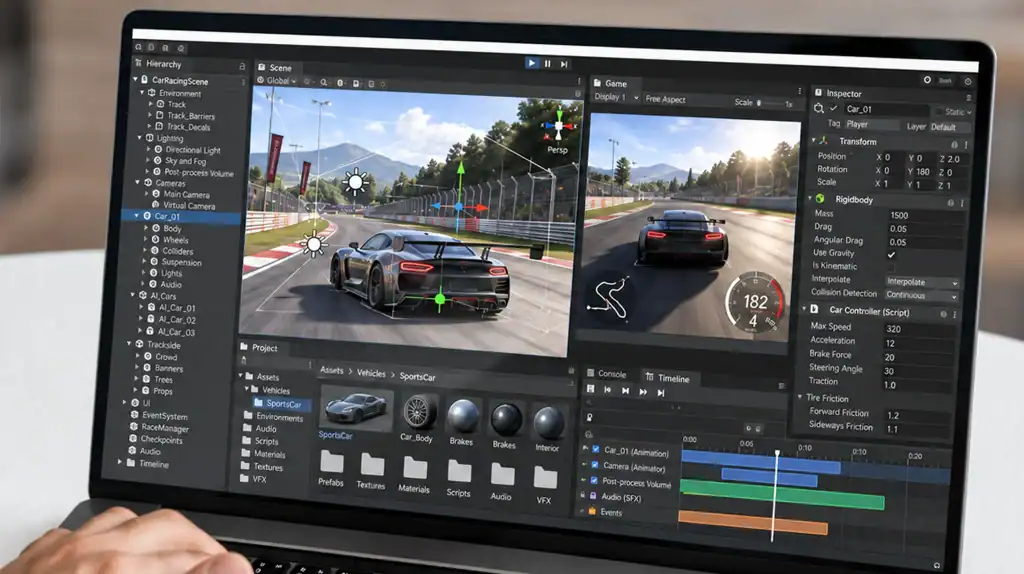
Your target platform (mobile, PC, console, or cross-platform) determines your game engine choice. Unity and Unreal Engine dominate this space for good reason. Unity works well for mobile-first racing games because of its lighter footprint and faster build times. Unreal Engine, on the other hand, suits console and PC titles that need photorealistic graphics and advanced physics.
5. Design Racing Mechanics
This is where the game actually starts to feel like a game. You need to nail down:
- Acceleration and braking curves
- Drift mechanics and traction handling
- Collision response
- Track boundaries and checkpoints
Mechanics are the heart of any racing title. Get them wrong, and no amount of visual polish will save the game. For a detailed breakdown, check out our resource on key features in racing game mechanics.
6. Develop Cars, Tracks, and Environments
Once mechanics are locked, your art and 3D teams move in. This stage covers vehicle modeling, texturing, track layout design, and environment building.
Good track design does more than look nice. It creates rhythm, tension, and replay value through elevation changes, tight corners, and strategic shortcuts.
7. Add Game Modes and Features
Most successful racing games offer more than a single race mode. Common additions include:
- Time trial and career modes
- Championship or tournament structures
- Split-screen or local multiplayer
- Custom race creation tools
More modes mean more reasons for players to keep coming back, and that variety is often what separates memorable racing game creation from a forgettable one.
8. Implement AI and Multiplayer Systems
Game AI controls how opponent vehicles behave, and it needs to feel challenging without feeling unfair. Poorly tuned AI either steamrolls players or trails behind pointlessly, and both extremes kill engagement fast.
Multiplayer gaming adds another layer of complexity. You will need matchmaking, lag compensation, and synchronized physics across devices. This is often the most technically demanding part of racing game development, so budget extra time here.
9. Test, Launch, and Update the Game
Testing covers performance, bugs, balance, and device compatibility. Once the game passes QA, you move to launch, followed by a steady cycle of updates based on player feedback and analytics.
Post-launch support is not optional. Games that stop updating tend to lose their player base within months.
Essential Features of a Car Racing Game
Certain features separate a forgettable racing game from one players keep returning to.
1. Responsive Driving Controls
Controls need to feel immediate. Any input delay, even a fraction of a second, breaks immersion and frustrates players quickly.
2. Realistic or Arcade-Style Vehicle Physics
Your physics engine choice defines how cars handle turns, jumps, and collisions. Vehicle physics should match your game’s tone. Arcade games can bend realism for fun, but simulation titles need accurate weight transfer, tire grip, and suspension behavior.
3. Vehicle Customization
Letting players tune performance stats, paint jobs, and body kits adds personal investment. Customization is also a proven driver of in-app purchase revenue.
4. Multiple Racing Environments
Desert tracks, city circuits, snow terrain, and off-road trails each demand different driving strategies. Variety keeps gameplay fresh over long play sessions.
5. Weather and Lighting Effects
Dynamic weather does more than add visual flair. Rain reduces traction, fog limits visibility, and these changes force players to adapt their approach mid-race.
6. Progression and Reward System
Unlockable cars, leveling systems, and achievement badges give players clear goals to chase. Without progression, even great mechanics get boring fast.
7. Leaderboards and Social Features
Competitive players want to compare times and rankings. Leaderboards, friend challenges, and shareable replays extend a game’s lifespan well past launch.
Technology Stack for Car Racing Game Development

Developing a high-performance car racing game requires a technology stack built for real-time physics, low latency, and smooth frame rates. The core technologies typically include powerful game engines such as Unity or Unreal Engine, physics solutions like NVIDIA PhysX, and 3D modeling tools such as Blender for creating detailed vehicles, tracks, and environments.
1. Game Engine
Unity and Unreal Engine remain the top choices. Unity suits mobile and cross-platform titles, while Unreal Engine handles high-fidelity console and PC experiences better because of its native rendering capabilities.
2. Programming Languages
Unity relies on C#, while Unreal Engine uses C++ alongside its visual scripting system, Blueprints. Backend services often use Python, Node.js, or Go for handling multiplayer logic and player data.
3. 3D Modeling and Design Tools
3D game development for racing titles typically involves Blender, Maya, or 3ds Max for vehicle and environment modeling, paired with Substance Painter for realistic texturing. If you want a broader introduction to this side of production, our guide on 3D game development covers the basics well.
4. Multiplayer and Backend Technologies
Real-time multiplayer needs dedicated servers, cloud hosting, and low-latency networking protocols. Photon, Mirror, and PlayFab are common choices for handling matchmaking and live sessions at scale.
How Much Does It Cost to Develop a Car Racing Game?
Car racing game development costs can range from $15,000 for a basic mobile racer to $5 million or more for a AAA simulation, depending on multiple factors such as the game complexity, platform, graphics, physics, multiplayer, and development time.
Racing games sit on the higher end of game development cost because of their physics demands and asset-heavy environments. Your final number depends heavily on scope and platform.
Development Cost by Game Complexity
| Game Complexity | Example Type | Estimated Cost Range | Typical Timeline |
| Basic 2D or hyper-casual racer | Simple mobile racer, endless runner style | $15,000 to $40,000 | 2 to 4 months |
| Mid-tier 3D mobile racer | Arcade racing with customization and modes | $40,000 to $120,000 | 4 to 8 months |
| Advanced cross-platform racer | Multiplayer, live ops, cloud sync | $120,000 to $300,000 | 8 to 14 months |
| AAA console or PC simulation | Photorealistic graphics, full physics engine | $500,000 to $5 million+ | 18 to 36 months |
Factors That Affect Development Cost
- Platform choice (mobile, PC, console, or all three)
- Level of graphic fidelity and animation detail
- Physics complexity and vehicle handling accuracy
- Multiplayer infrastructure and server costs
- Number of tracks, cars, and game modes
- Team location and hourly development rates
Additional Expenses to Consider
Beyond core development, budget for licensing fees if you plan to include real car brands, ongoing server maintenance, marketing at launch, and post-release content updates. Many studios underestimate these recurring costs and run into cash flow problems after launch.
App store fees, third-party SDK integrations, and QA testing across multiple devices add further costs that rarely appear in initial budget estimates. Planning for these expenses early, rather than reacting to them later, keeps your project financially sustainable through launch and beyond.
For a broader look at how these numbers apply across game genres, our detailed breakdown of game development cost is worth reviewing.
Monetization Strategies for a Car Racing Game
Effective monetization for a car racing game can combine in-app purchases (IAP) for vehicle skins, upgrades, and other premium items with rewarded ads that offer benefits such as extra fuel or bonus credits. Seasonal battle passes and limited-time events can further encourage spending while keeping players engaged. The right approach depends on your target platform, audience, and overall game experience.
A great racing game still needs a solid revenue model behind it. In-game purchases alone generated $74.4 billion globally in 2025, up 4.6% from the year before, according to data compiled by Fosspost.
1. In-App Purchases
Selling cars, upgrades, cosmetic skins, and currency packs remains the most common revenue source in mobile racing titles.
2. Rewarded Advertisements
Offering in-game rewards for watching ads keeps free-to-play users engaged while generating steady ad revenue without disrupting gameplay.
3. Battle Passes and Seasonal Events
Time-limited content tied to seasonal passes encourages regular logins and gives players a reason to keep progressing.
4. Premium Game Model
Charging an upfront price works well for console and PC simulation titles with dedicated racing audiences who expect a complete, ad-free experience.
5. Sponsorships and Brand Partnerships
Real-world car manufacturers and energy drink brands often pay for in-game placement, which can offset development costs significantly for larger titles.
Common Mistakes to Avoid
Even well-funded car racing game creation projects fail when these basics get overlooked.
1. Poorly Designed Controls
If steering feels sluggish or oversensitive, players quit within minutes, regardless of how good the graphics look.
2. Weak Vehicle Physics
Unrealistic collision response or floaty handling breaks immersion fast, especially in simulation-style games where players expect accuracy.
3. Repetitive Tracks and Gameplay
Reusing the same layouts and race formats leads to player fatigue. Variety keeps retention rates healthy.
4. Overcomplicated Gameplay
Adding too many systems at once confuses new players. Introduce complexity gradually through tutorials and progression gates.
5. Insufficient Optimization
Racing games are performance-heavy by nature. Skipping optimization causes frame drops, especially on lower-end mobile devices, which drives uninstalls.
6. Unbalanced AI
AI opponents that are too easy or impossibly hard both hurt player satisfaction. Test AI difficulty extensively before launch.
7. Ignoring Player Feedback
Post-launch reviews and analytics reveal exactly what players want next. Studios that ignore this data lose players to competitors that listen.
8. Neglecting Monetization and Marketing
A great game with no marketing plan or monetization strategy still fails commercially. Plan both from the earliest stages, not as an afterthought.
Why You Should Choose Cubix For Car Racing Game Development
The racing genre keeps proving its staying power. The online racing games market alone reached $12.97 billion in 2025 and is expected to grow to $38.92 billion by 2035, based on Market Research Future. That kind of sustained growth signals real, lasting player demand rather than a short-term trend, and it’s exactly the kind of market Cubix builds for.
Building your title with an experienced partner means entering that market with the following:
- A large and growing player base across mobile, console, and PC
- Strong monetization potential through in-app purchases and seasonal content
- Room for innovation through AR, VR, and cloud-based racing experiences
- Cross-platform reach that widens your audience from day one
Cubix has spent years building games across genres, which means the team already knows where racing projects tend to go wrong, from clunky vehicle physics to servers that buckle under real multiplayer load. That experience translates into fewer surprises during production and a smoother path from prototype to launch.
Working with an experienced racing game development company like Cubix removes much of the guesswork from this process. Our service handles everything from concept through launch and beyond, covering game design, vehicle physics tuning, multiplayer infrastructure, and post-launch support under one roof. You can also explore Cubix’s custom game development services if your project extends beyond racing into other genres.
Car racing game development succeeds when concept, mechanics, technology, and monetization all work together instead of being treated as separate boxes to check. Get the fundamentals right from the start, and the rest of the process becomes far more manageable.
Want to discuss your project? Our experts are just a click away.
Contact UsFrequently Asked Questions
1. How to create your own racing game?
Start with a clear concept, build a game design document, and pick a suitable engine like Unity or Unreal Engine, then move through mechanics design, asset creation, testing, and launch.
2. How much does a car racing game setup cost?
Costs range from $15,000 for a basic mobile racer to several million dollars for a AAA simulation title, depending on scope, platform, and team size.
3. How to develop a car game?
The process includes concept definition, market research, engine selection, mechanics design, asset development, AI and multiplayer implementation, testing, and post-launch updates.
4. How do I build my own race car?
Building a physical race car is unrelated to game development. It involves chassis fabrication, engine tuning, and safety certification, and it falls under motorsport engineering rather than software development.
5. What is the process of game development?
It generally follows pre-production, design, development, testing, launch, and post-release support, with each phase feeding into the next.
6. What are the 7 stages of game design?
Most frameworks outline concept, pre-production, prototyping, production, testing, launch, and post-launch support as the seven core stages.
7. Are games written in C or C++?
Most professional game engines, including Unreal Engine, rely heavily on C++, while Unity primarily uses C#. Choice depends on the engine and performance needs.
8. What are the five stages of game development?
A common breakdown includes pre-production, production, testing, launch, and post-launch maintenance and updates.